Stay Ahead in Fast-Growing Economies.
Browse Reports Now
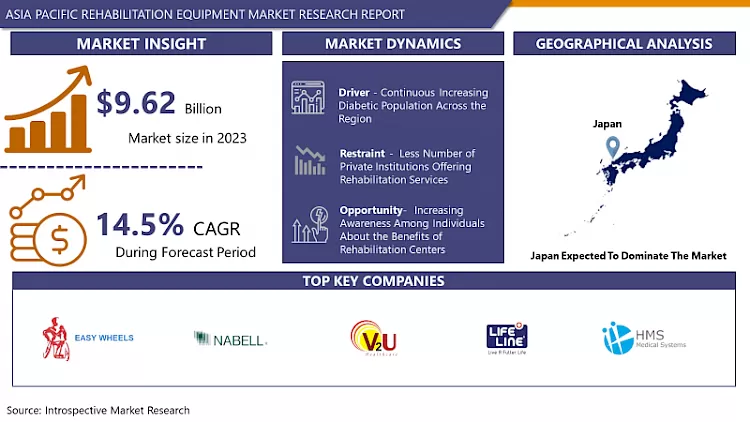
Asia Pacific Rehabilitation Equipment Market- Comprehensive Study Report & Recent Trends
Rehabilitation can significantly reduce the impact of a wide range of health conditions, including acute and chronic diseases, illnesses, and injuries. It works in tandem with medical and surgical interventions, aiding in recovery and achieving optimal outcomes. Additionally, rehabilitation helps prevent, reduce, or manage complications in conditions such as spinal cord injury, stroke, and fractures.

IMR Group
Description
Asia Pacific Rehabilitation Equipment Market Overview
The Asia Pacific Rehabilitation Equipment market is estimated at USD 8.84 Million in 2023 and is projected to reach a revised size of USD 18.96 Million by 2032, growing at a CAGR of 8.85% over the period 2024-2032.
Rehabilitation encompasses a variety of interventions aimed at enhancing functioning and minimizing disability in individuals who have health conditions. These interventions are tailored to address the unique needs of each person, considering the interaction between their health condition and their environment. The goal is to help individuals achieve the highest possible level of independence and quality of life.
Rehabilitation can significantly reduce the impact of a wide range of health conditions, including acute and chronic diseases, illnesses, and injuries. It works in tandem with medical and surgical interventions, aiding in recovery and achieving optimal outcomes. Additionally, rehabilitation helps prevent, reduce, or manage complications in conditions such as spinal cord injury, stroke, and fractures.
For chronic health conditions like cardiovascular disease, cancer, and diabetes, rehabilitation plays a crucial role in minimizing or slowing down disabling effects. It equips individuals with self-management strategies, provides necessary assistive products, and addresses pain and other complications, thus promoting healthy aging.
Investing in rehabilitation yields cost benefits for individuals and society. It can reduce hospitalization costs, shorten hospital stays, and prevent re-admissions. Furthermore, rehabilitation enables people to return to work, remain independent at home, and reduce the need for financial or caregiver support.
Market Dynamics And Factors For Asia Pacific Rehabilitation Equipment Market
Drivers:
Continuous Increasing Diabetic Population Across The Region
Diabetes is one of the most common health issues in the world. To achieve set goals, diabetes management necessitates a lifelong multifaceted treatment approach. The primary goals of diabetic rehabilitation are to achieve glycemic control, improve quality of life, prevent or delay complications, and educate patients about their condition. Diabetic foot wounds (DFWs) are threatening diabetic complications. At later stages of diabetic complications, particularly after amputation surgery, patients are frequently referred to rehabilitation facilities. Rehabilitation practices have the potential to help prevent and manage DFW’s. As a result, rehabilitation should be involved in the management of DFWs at all stages of diabetic care. For instance, 25% of India’s estimated 77 million diabetics are expected to develop diabetic foot ulcers during their lifetime. Nearly half of them would have an infected diabetic foot ulcer that would necessitate hospitalization, and a staggering 20% would require amputation.
According to IDF, the number of diabetic individuals in China reached 140.9 million in 2021. This number is anticipated to reach 174.4 million by the end of 2045. In addition, Pakistan and Indonesia reported 33 and 19.5 million diabetic individuals in 2021 with projections to reach 62.2 and 28.6 million by 2045 in their respective countries. This staggering number of individuals inflicts that there would be a tremendous demand for rehabilitation equipment in the coming years. The increasing number of diabetic populations coupled with supportive government policies is anticipated to strengthen the development of rehabilitation equipment market growth over the forecasted period.
Restraints:
Less Number of Private Institutions Offering Rehabilitation Services
One of the most significant barriers to understanding disability in this region is accepting community-based rehabilitation as an effective intervention. Rehabilitation services are solely provided by hospitals, and if this trend continues, only a small number of disabled people will be able to benefit from this service due to social isolation and knowledge mystification. Other major issues include the lack of a comprehensible and well-established strategy, poor planning, limited efficiency, and a lack of prioritizing of essential resources such as materials, manpower, and finance thus, hampering the development of the rehabilitation equipment market over the analysis period.
Opportunities:
Increasing Awareness Among Individuals About the Benefits of Rehabilitation Centers
Despite advances in the availability of effective and safe prevention strategies around the world, cardiovascular disease (CVD) continues to be the leading cause of death and premature death. In 2019, Asia accounted for 58% of the 18.6 million CVD deaths worldwide. In 2019, CVD was the leading cause of death in Asia, accounting for 10.8 million deaths, or approximately 35% of all deaths in the region. Almost 39% of these CVD deaths were premature (defined as death before the age of 70). Initiatives are being taken by the government and other NGO bodies to circulate the importance of rehabilitation services among individuals to increase their chances of reaching out to a rehab center. For instance, The Indian government launched the National Programme for Prevention and Control of Cancer, Diabetes, Cardiovascular Diseases, and Stroke (NPCDCS) in 2010 to strengthen infrastructure, develop human resources, and promote good health hygiene. Similar initiatives by other economies in this region are anticipated to create lucrative opportunities for market players over the forecasted timeframe.
Regional Analysis of Asia Pacific Rehabilitation Equipment Market
Japan is anticipated to lead the development of the rehabilitation equipment market over the analysis period. In 2021, Japan had 192,327 physical therapists, 94,255 occupational therapists, and 36,255 speech-language-hearing therapists. Due to its aging population, Japan has the world’s largest rehabilitation workforce, and therapist-led rehabilitation is primarily provided through the health system. The importance of long-term care quality in dealing with population aging issues has recently been recognized. As a result, there is a growing interest in developing evidence-based care on the same principles as evidence-based medicine in Japan. As a result, Japan introduced two new information systems: (i) the Monitoring and Evaluation for Rehabilitation Services for Long-Term Care (VISIT) system in 2018; and (ii) the Care, Health Status and Events (CHASE) system in 2020. The Information System for Evidence (LIFE) database was established by the central government in April 2021 to support independent living and prevent increases in the level of care required. The LIFE database combines data from VISIT and CHASE to provide real-world data on interventions and outcomes (particularly functional outcomes) in long-term care service users.
Back pain is one of the most common occurrences among Singaporeans, with an estimated 80% of adults in Singapore experiencing lower back pain at some point in their lives. Physical therapy is essential for treating and preventing back pain in Singapore. Physical therapists are trained to use a variety of techniques to treat both acute and chronic back pain, such as spinal manipulation to relieve joint pressure, reduce inflammation, and improve nerve function. Soft tissue mobilization is also used to improve flexibility and range of motion, as well as deep tissue massages to relieve pain, relax muscles, and improve circulation. In addition, with the rising number of spine-related disorders in this country, the demand for rehabilitation equipment is anticipated to increase over the analysis period.
Segmentation Analysis of Asia Pacific Rehabilitation Equipment Market
By Product, the exercise equipment segment is anticipated to lead the development of the market in the forecasted period. Physical rehabilitation equipment can range from simple and low-tech, such as an exercise ball, to heavy-duty and motorized, such as steppers. Treadmills are great for cardiovascular exercise, but physical therapists also use them to better understand a patient’s range of motion, posture, and gait. Stationary bicycles are also excellent low-impact fitness tools that can help with flexibility, cardiovascular health, and pain symptoms. Many people can continue to exercise while recovering from injuries that would otherwise limit their mobility by using stationary bikes.
By Application, the physiotherapy segment is projected to have the highest share of the market. With the large population, the number of individuals opting for a career in sports is also increasing. Cricket, Football, Tennis, and Tournaments like Asian Games and Olympics are some of the trending sports topics in the Asia-Pacific. The International Federation of Sports Physical Therapy (IFSPT) states that “sports physiotherapy is a growing specialization in cultures that strive to promote an active lifestyle and athletic excellence”. There is an inherent level of injury risk in the vast majority of athletic pursuits, so everyone can benefit from a session with a sports physiotherapist. Weekend warriors and professional athletes alike can find themselves put out of commission for a few weeks or months and in need of physio rehabilitation.
By End User, the hospitals & clinics segment is forecasted to have a lion’s share of the market across the projected period. Hospitals & clinics are the primary healthcare settings in low-middle-income countries. These care settings offer several services under one roof and at affordable prices. In addition, they also offer support for various insurance policies thus, making the reimbursement process a lot easier and simpler. Hospitals & clinics have sufficient funds as well as space for setting up large premises dedicated to rehabilitation. They too have advanced equipment and skilled healthcare professionals that help individuals throughout the sessions thus, strengthening the expansion of the segment during the forecasted period.
Top Key Players Covered In Asia Pacific Rehabilitation Equipment Market
NIHON MEDIX
Ito Co., Ltd
NABELL Corporation
Easy Wheels Pte Ltd
V2U Healthcare Pte Ltd
Lifeline Corporation Pte Ltd
HMS Medical Systems
Vissco Next
Johari Digital
HEMC
GPC Medical Ltd.
Siyi Intelligent Technology Co. Ltd.
Ningbo Greetmed Medical Instruments Co. Ltd.
Jiangsu Rixin Medical Equipment Co. Ltd.
TecnoBody S.r.l. and Other Major Players.
Key Industry Developments In Asia Pacific Rehabilitation Equipment Market
In September 2024, At the Quad leaders’ Cancer Moonshot event in Wilmington, Delaware, Japanese Prime Minister Fumio Kishida stated that Japan had supported the deployment of medical equipment and facilities, as well as offered technical cooperation. He emphasized that these efforts were part of Japan’s commitment to enhancing global health initiatives. Kishida highlighted that such endeavors had been crucial in advancing cancer care and treatment capabilities in various regions. He expressed Japan’s dedication to continuing these collaborative efforts to improve healthcare outcomes and strengthen partnerships in the fight against cancer moving forward.
In September 2024, Select Medical Corporation announced that it had signed a definitive agreement to acquire Valir Rehabilitation Hospital, a 50-bed inpatient rehabilitation facility located in Oklahoma City, from Valir Health. The financial details of the transaction were not disclosed. Tom Mullin, president of Select Medical, expressed excitement about expanding their services to meet the demands of Oklahoma City’s growing population. He noted that Select Medical was already well-established in the post-ICU and outpatient care markets and was pleased to now provide patients with a full continuum of care throughout their healing and recovery journey.
Chapter 1: Introduction
1.1 Scope and Coverage
Chapter 2:Executive Summary
Chapter 3: Market Landscape
3.1 Market Dynamics
3.1.1 Drivers
3.1.2 Restraints
3.1.3 Opportunities
3.1.4 Challenges
3.2 Market Trend Analysis
3.3 PESTLE Analysis
3.4 Porter’s Five Forces Analysis
3.5 Industry Value Chain Analysis
3.6 Ecosystem
3.7 Regulatory Landscape
3.8 Price Trend Analysis
3.9 Patent Analysis
3.10 Technology Evolution
3.11 Investment Pockets
3.12 Import-Export Analysis
Chapter 4: Asia Pacific Rehabilitation Equipment Market by Product (2018-2032)
4.1 Asia Pacific Rehabilitation Equipment Market Snapshot and Growth Engine
4.2 Market Overview
4.3 Daily Living Aids
4.3.1 Introduction and Market Overview
4.3.2 Historic and Forecasted Market Size in Value USD and Volume Units
4.3.3 Key Market Trends, Growth Factors, and Opportunities
4.3.4 Geographic Segmentation Analysis
4.4 Exercise Equipment
4.5 Body Support Devices
4.6 Mobility Equipment
Chapter 5: Asia Pacific Rehabilitation Equipment Market by Application (2018-2032)
5.1 Asia Pacific Rehabilitation Equipment Market Snapshot and Growth Engine
5.2 Market Overview
5.3 Daily Living Aids
5.3.1 Introduction and Market Overview
5.3.2 Historic and Forecasted Market Size in Value USD and Volume Units
5.3.3 Key Market Trends, Growth Factors, and Opportunities
5.3.4 Geographic Segmentation Analysis
5.4 Exercise Equipment
5.5 Body Support Devices
5.6 Mobility Equipment
Chapter 6: Asia Pacific Rehabilitation Equipment Market by End User (2018-2032)
6.1 Asia Pacific Rehabilitation Equipment Market Snapshot and Growth Engine
6.2 Market Overview
6.3 Hospitals & Clinics
6.3.1 Introduction and Market Overview
6.3.2 Historic and Forecasted Market Size in Value USD and Volume Units
6.3.3 Key Market Trends, Growth Factors, and Opportunities
6.3.4 Geographic Segmentation Analysis
6.4 Rehab Centers
6.5 Homecare Settings
6.6 Physiotherapy Centers
6.7 Others
Chapter 7: Company Profiles and Competitive Analysis
7.1 Competitive Landscape
7.1.1 Competitive Benchmarking
7.1.2 Asia Pacific Rehabilitation Equipment Market Share by Manufacturer (2024)
7.1.3 Industry BCG Matrix
7.1.4 Heat Map Analysis
7.1.5 Mergers and Acquisitions
7.2 ALTERG INCAMY ROBOTICS COLTDAOBO INFORMATION TECHNOLOGY COLTDBIONIK LABORATORIES CORPBLUE FROG ROBOTICS SAS
7.2.1 Company Overview
7.2.2 Key Executives
7.2.3 Company Snapshot
7.2.4 Operating Business Segments
7.2.5 Product Portfolio
7.2.6 Business Performance
7.2.7 Recent News & Development
7.2.8 SWOT Analysis
7.3 BLUE OCEAN ROBOTICS APS
7.4 BOTSANDUS LTDCAMANIO AB
7.5 DOUBLE ROBOTICS INCEMBODIED INCFURHAT ROBOTICS AB
7.6 HAPPY SAS
7.7 HANSON ROBOTICS LTDAEROBICS SOCIAL ROBOTICS SLL
7.8 INTUITION ROBOTICS LTDKINOVA INC.
Chapter 8:Asia Pacific Rehabilitation Equipment Market Analysis, Insights and Forecast, 2016-2028
8.1 Market Overview
8.2 Key Market Trends, Growth Factors and Opportunities
8.3 Key Players
8.4 Historic and Forecasted Market Size by Product
8.4.1 Daily Living Aids
8.4.2 Exercise Equipment
8.4.3 Body Support Devices
8.4.4 Mobility Equipment
8.5 Historic and Forecasted Market Size by Application
8.5.1 Daily Living Aids
8.5.2 Exercise Equipment
8.5.3 Body Support Devices
8.5.4 Mobility Equipment
8.6 Historic and Forecasted Market Size by End User
8.6.1 Hospitals & Clinics
8.6.2 Rehab Centers
8.6.3 Homecare Settings
8.6.4 Physiotherapy Centers
8.6.5 Others
8.7 Historic and Forecast Market Size by Country
8.7.1 China
8.7.2 India
8.7.3 Japan
8.7.4 South Korea
8.7.5 Malaysia
8.7.6 Thailand
8.7.7 Vietnam
8.7.8 The Philippines
8.7.9 Australia
8.7.10 New-Zealand
8.7.11 Rest of APAC
Chapter 9 Analyst Viewpoint and Conclusion
9.1 Recommendations and Conclusion
Chapter 10 Our Thematic Research Methodology
10.1 Research Process
10.2 Primary Research
10.3 Secondary Research
Q1: What would be forecast period in the Asia Pacific Rehabilitation Equipment Market research report?
A1: The forecast period in the Asia Pacific Rehabilitation Equipment Market research report is 2024-2032.
Q2: Who are the key players in Asia Pacific Rehabilitation Equipment Market?
A2: NIHON MEDIX, Ito Co. Ltd, NABELL Corporation, Easy Wheels Pte Ltd, V2U Healthcare Pte Ltd, Lifeline Corporation Pte Ltd, HMS Medical Systems, Vissco Next, Johari Digital, HEMC, GPC Medical Ltd., Siyi Intelligent Technology Co. Ltd., Ningbo Greetmed Medical Instruments Co. Ltd., Jiangsu Rixin Medical Equipment Co. Ltd., TecnoBody S.r.l., and Other Major Players.
Q3: What are the segments of Asia Pacific Rehabilitation Equipment Market?
A3: The Rehabilitation Equipment Market is segmented into Product, Application, End User and Region. By Product the market is categorized into Daily Living Aids, Exercise Equipment, Body Support Devices, and Mobility Equipment. By Application, the market is categorized into Physiotherapy, Occupational Therapy, and Others. By End User, the market is categorized into Hospitals & Clinics, Rehab Centers, Homecare Settings, Physiotherapy Centers, and Others. By region, it is analyzed across Asia-Pacific (China, India, Japan, Singapore, Australia, New Zealand, Rest of APAC).
Q4: What is the Asia Pacific Rehabilitation Equipment Market?
A4: The Asia-Pacific region is experiencing an unprecedented rise in the aging group and is at the forefront of the global phenomenon of population aging. According to UNFPA, one in every four people in Asia and the Pacific will be over 60 by 2050. Between 2010 and 2050, the region's population of older people (aged over 60) will triple, reaching nearly 1.3 billion people.
Q5: How big is the Asia Pacific Rehabilitation Equipment Market?
A5: The Asia Pacific Rehabilitation Equipment market is estimated at USD 8.84 Million in 2023 and is projected to reach a revised size of USD 18.96 Million by 2032, growing at a CAGR of 8.85% over the period 2024-2032.
How to Buy a Report from eminsights.jp
On the product page, choose the license you want: Single-User License, Multi-User License or Enterprise License.
If you required report in your native language, then you can click on Translated Report button and fill out the form with report name and language you want, then our team will contact you as soon as possible.
Click the Buy Now button.
You will be redirected to the checkout page. Enter your company details and payment information.
Click Place Order to complete the purchase.
Confirmation: You’ll receive an order confirmation and our team will contact you shortly with your ordered report.
If you have any questions, fill out the contact form below or email us at bizdev@eminsights.net.
Thank you for choosing eminsights.jp!