Stay Ahead in Fast-Growing Economies.
Browse Reports Now
Artificial Intelligence as a Service (AIaaS) Market Analysis & Share
AI as a service refers to a business model and market where AI abilities and features are delivered via the web, similar toSaS andPaS. In this model, machine learning, text and speech recognition, image analysis, and predictive statistical models and other AI technologies are provided as on-demand or pre-paid and post-paid service, thus not requiring organizations to build AI capabilities that they cannot deploy at low utilization

IMR Group
Description
Artificial Intelligence as a Service (AIaaS) Market Synopsis
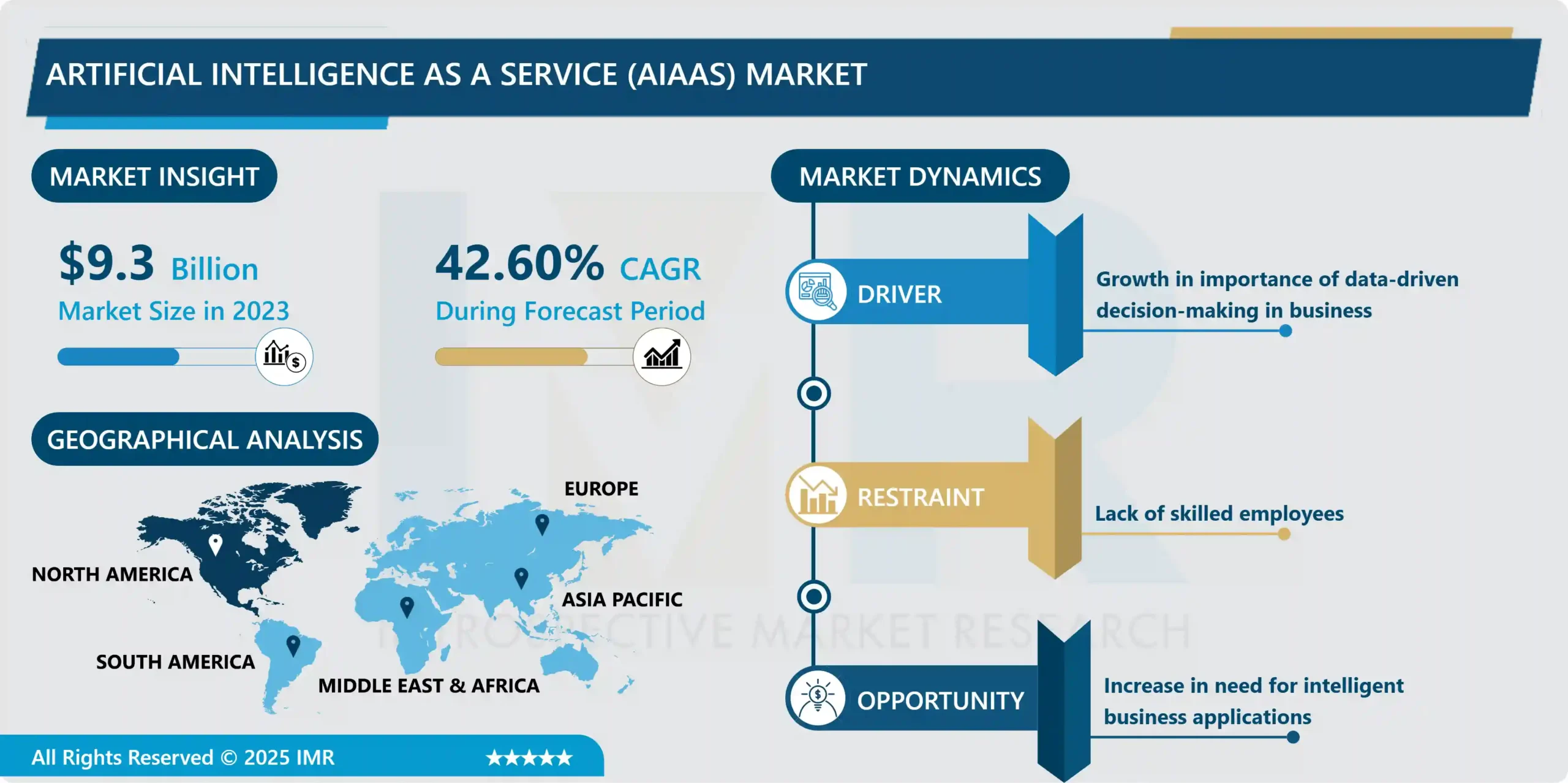
Artificial Intelligence as a Service (AIaaS) Market Size Was Valued at USD 9.30 Billion in 2023, and is Projected to Reach USD 226.76 Billion by 2032, Growing at a CAGR of 42.60% From 2024-2032.
AI as a service refers to a business model and market where AI abilities and features are delivered via the web, similar toSaS andPaS. In this model, machine learning, text and speech recognition, image analysis, and predictive statistical models and other AI technologies are provided as on-demand or pre-paid and post-paid service, thus not requiring organizations to build AI capabilities that they cannot deploy at low utilization. As discussed, AIaaS providers commonly implement cloud as the primary deployment model since it directly enables businesses to leverage and incorporate AI into their other applications, platforms, and processes with flexibility, efficiency, and cost superiority. This model promotes more widespread use of Artificial Intelligence where organizations from various fields can reap the benefits of this tool without having to sink a lot of investments into artificial intelligence tools, systems, and personnel.
The AI as a Service (AIaaS) market is at the begining of going through the shift from the early adopters to the fully-fledged demand from the market as more and more businesses see the potential AI can bring into different industries. It means that AIaaS is, in fact, a strategic direction for those companies that want to leverage AI capabilities in order to boost productivity while avoiding obstacles of developing an in-house AI system and recruiting specialists at the same time. This particular solution brings numerous advantages such as versatility, the possibility to adjust, and being budget-friendly; thus, enabling as many companies as possible to integrate AI solutions into their work. Now, businesses are capable of gaining access to major cloud-based AI services that enable organizations to easily employ the most innovative machine learning, NLP solutions, computer vision, and predictive analysis tools and algorithms on various business problems and opportunities.
Another aspect that has been driving the steepest fortunes in demand of AIaaS is the rising amount and variety of data which is being produced in enterprises as well as consumers. In light of the current and emerging organization networks and connections facilitated by social media and digital business transactions, information overload threatens to overwhelm organizations with an avalanche of data that can be effectively used to power advanced information and business decision-making processes. AIaaS deployment opens the door for businesses to stand and gain insights from information overload, which allows them to discover patterns, trends, and relationships that were not easy to uncover earlier.
Third, it can be said that AIaaS providers are not only developing new services or enhancing existing offerings but also diversifying them so that they match the requirements of their consumers. This refers to the enhancement of machine learning algorithms and frameworks used in developing AI models as well as integration tools that will ensure that the final models are deployed effortlessly and integrated into the current systems and operations. Finally, the field is expanding in terms of the vertical sectors in which it is selling its platforms and services, through offering industry-specific solutions, thus opening newer and more relevant avenues for value creation.
However, the democratization of AI through services such as AIaaS is now valued upward, and used frequently in various segments and markets. An example of AI-supported applications that might find a ready market are: Small and medium-sized enterprises (SMEs) could particularly be interested in AIaaS solutions in view of the fact that they could hardly dedicate the efforts, time and resources necessary to create an AI model and possibly have limited capability of implementing it successfully on their own. The technologies of AIaaS allow SMEs to be at the same playing field as large enterprises and have the chance to access high levels of AI that they could not afford in the past.
Moving to the future, the AIaaS market’s growth should have a good perspective because organizations today are actively focused on such digitalization processes and require the use of various tricks to remain relevant in the context of growing data-driven economies. Potential and growth of cloud computing infrastructure, the availability of data, and continuous funding and focus on AI research, AIaaS is poised to revolutionalise business and industries together, through boosting the value of operational processes, redefining customer engagement, and/or creating opportunities for new revenue streams and innovation.
Artificial Intelligence as a Service (AIaaS) Market Trend Analysis
Emerging Trends in the Artificial Intelligence as a Service (AIaaS) Market
The burgeoning adoption of AIaaS among enterprises is fundamentally reshaping how businesses approach innovation and operational efficiency. By embracing AIaaS solutions, organizations can access cutting-edge artificial intelligence technologies without the need for significant upfront investments in infrastructure or specialized expertise. This accessibility democratizes AI, leveling the playing field for businesses of all sizes and industries to harness the transformative power of artificial intelligence. Consequently, AIaaS becomes not just a tool but a strategic imperative for staying competitive in today’s rapidly evolving digital landscape.
Moreover, the accelerating adoption of AIaaS reflects a broader paradigm shift towards data-driven decision-making and automation across industries. Enterprises recognize that AI has the potential to revolutionize processes, optimize resource allocation, and unlock insights from vast datasets that were previously untapped. From predictive analytics in finance to personalized recommendations in retail, the applications of AIaaS are virtually limitless, driving operational efficiencies and enabling organizations to deliver superior products and services to their customers. As AI continues to mature and evolve, businesses that embrace AIaaS stand to gain a significant competitive advantage, positioning themselves at the forefront of innovation in their respective markets.
Transforming Businesses with User-Friendly AIaaS Platforms
The concept of caveman technology is slowly halted as AI becomes more accessible due to the availability of user-friendly AIaaS platforms. Earlier, the incorporation of AI was often limited to a few specific organizations or departments with adequate technological background. Nevertheless, with present-day providers of AIaaS, who present facile user interfaces and out-of-the-box models, the obstacles to taking advantage of the changes brought about by AI have been lowered. This means that non-tech individuals, such as business analysts, marketers, or operations managers, can utilize and implement the service of AI models even without knowing coding or have substantial backgrounds in machine learning. This democratization democratizes AI to such a degree, enabling more members in an organization using its capabilities.
This has put pressure on the democratization of artificial intelligence, which in turn is leading to more innovative performance across a variety of industries since most can now implement advanced AI solutions to tackle problems that require a AI expertise. As an example, those traditional low-tech industries such as small and medium manufacturing companies that did not have sufficient capital to adopt AI technology or to recruit AI professionals can now leverage the AIaaS provider solution to improve service quality, promote supply chain, or lead targeted marketing. Furthermore, by democratising AI, it drives the organisation to adopt safe, scalable, impactful and autonomous AI solutions across the company and promote data-mindedness and AI innovation among all business divisions within these large organisations. In sum, the democratization of AI through AIaaS has considerably brought AI within easy reach and giving the companies across the world an equal ability to harness AI in delivering value and unearthing fresh opportunities for competing in the emerging digital economy.
Artificial Intelligence as a Service (AIaaS) Market Segment Analysis:
Artificial Intelligence as a Service (AIaaS) Market Segmented based on Technology, Cloud Type, Organization Size, Offering and Vertical.
By Technology, Machine learning segment is expected to dominate the market during the forecast period
Machine learning is currently icy the most powerful and promising branch of artificial intelligence technology because of its peculiarities related to data analysis of tremendous volumes and accuracy. They are great in terms of pattern recognition, trends, and potential associations between different pieces of data, something that could help organizations make decisions more effectively. From consumer trends forecasting, to formulating for supply chain management, to fraud detection in financial exchanges, machine learning models are the pivotal techniques which companies cannot wait to adopt this year for competitive advantage. Moreover, unprecedented growth and sophistication of machine learning and its constituent subfields, along with upgradation of additional physical hardware elements, and better algorithms, propositions al and mathematical models make it clearer that it is here to stay, and will normalize its place at the summit of the circle of technology, enabling further advancements in other fields.
However, it is important to note that machine learning does not just cut across business functions alone but is evident in almost all sections of the society and our everyday living. Starting from recommendations on the choice of movies and serials in streaming services to the more serious application in the sphere of fraud detection in transactions, machine learning is inappreciably incorporated into a number of goods and services, making users’ experiences and effectiveness even better. Also, in segments such as healthcare, machine learning is significant in exploration of medical images, diagnostic, and treatments, as well as in the discovery of new drugs, which has changed the ways in which health facilities look at patient care and treatment methods. Due to the escalation of widespread awareness concerning the potentiality of machine learning within various organizations, research and development, expertise, and fundamentals are up for expansion, making it the basis of contemporary technological development and intervention defining the technological advancement in the future.
By Cloud Type, Public Cloud segment held the largest share in 2023
It is a proven wellspring that the public cloud’s role in technology is undeniable due to the responsiveness, scalability, and cost-efficiency. Businesses, ranging from small companies, virtual ones to large multinational corporations, are gradually shifting to find public cloud services to satisfy their computing requirements due to the benefits they offer. Businesses can quickly scale up their operations as it allows them to provision new resources in an instant and they only pay for what they or their teams actually utilize, whereas having to host everything on-site often proves expensive to maintain and can lack the scalability needed in today’s fast-paced business environment. This scalability is essential in today’s world for two major reasons; The first is the current unpredictable business environments and constantly changing customer trends that call for organizations to avoid falling behind. Moreover, the characteristic of the public cloud organisation means that businesses can select from numerous services and setting up plans which meet various needs of their users, such as computing resources, data storage or special applications.
Includes other giants like AWS, Azure, and Google Cloud, the consolidated market dominants that have consequently been providing diverse and more sophisticated innovative services to art consumers. These providers have offices throughout the world and a solid foundation; because of these, they boast of reliability, security, and utmost performance compared to other service providers which are why they are favored greatly by organizations from all fields and sectors. In addition, many business applications have a vast network of affiliates, which allows organizations not only to expand their functionality with additional services and products but also to solidify their positions in the market. The inevitability of cloud services remains high due to transformation, data-driven applications, and technologies, with the public cloud set to stay the course with other clouds in the technology ecosystem by continuing to lead innovation and transform technologies of the future.
Artificial Intelligence as a Service (AIaaS) Market Regional Insights:
North America is Expected to Dominate the Market Over the Forecast period
With regards to worldwide geography, AiaaS providers have drastically grown in the North American realm, more so in the United States due to highly advanced technological infrastructure in this region. That is why the United States, with silicon valley in its weak, has become a market friendly to the development of new generations of AI technologies. The expansion of flagship companies in this industry such as Google, Microsoft, and Amazon and the mushrooming of many new firms has culminated into the advancement of the industry pertaining to AIaaS. These companies have not only dedicated significant resources to research and development in machine learning and AI technologies but have deployed AIaaS solutions at scale internally and created a use case example for several industries.
The high penetration of AI as a service is particularly well documented in North America, especially in various industry including healthcare, finance, and e commerce. In the healthcare domain, AI-driven solutions have emerged as game changers in ways of approaching and managing patient cases, diagnosing illnesses, and conducting drug development research, ultimately, enhancing the results and performance advantages. Similarly, in the field of finance, AI applications are being used for fraud detection systems, risk management, and for algorithmic trading, giving a competitive edge to finance companies in faster decision making capabilities. Furthermore, in the field of digital purchases, personalized services facilitated by artificial intelligence and recommendation systems are already conventionally important for getting more customers.
Technological base combined with the large investments, coupled with the culture of innovation, has essentially positioned North America, and particularly USA, as a leading region in the development of AIaaS market. As industries in many sectors assess the value of AI and make efforts to harness it in their processes, the prominence of AIaaS providers in North America should remain unswerving, which will contribute to the creation of new and enabling the future advances in industries all across the world.
Active Key Players in the Artificial Intelligence as a Service (AIaaS) Market
IBM (US)
Microsoft (US)
Google (US)
AWS (US)
FICO (US)
SAS Institute (US)
Baidu (China)
SAP (Germany)
Salesforce (US)
Oracle (US)
Iris.AI (US)
Craft.AI (France)
BigML (US)
H2O.ai (US)
Vital.ai (US)
Fuzzy.ai (Canada)
RainBird Technologies (UK)
SiftScience (US)
DataBricks (US)
CenturySoft (India)
DataRobot (US)
Alibaba (China)
Tencent (China)
Dataiku (US)
Yottamine Analytics (US)
Tecnotree (Finland)
Cloudera (US)
Other Major Players
Key Industry Developments in the Artificial Intelligence as a Service (AIaaS) Market:
In March 2023, Google Cloud introduced Generative AI support in Vertex AI that allows data science teams access to foundation models from Google and others, enables them build and customize atop these models on the same platform they use for homegrown ML models and MLops.
In March 2023, Salesforce launched Einstein GPT, a generative AI CRM technology, which delivered AI-created content across every sale, service, marketing, commerce, and IT interaction at a hyper-scale.
In January 2023, Microsoft extended its partnership with OpenAI to accelerate AI breakthroughs to ensure these benefits were broadly shared with the world
Chapter 1: Introduction
1.1 Scope and Coverage
Chapter 2:Executive Summary
Chapter 3: Market Landscape
3.1 Market Dynamics
3.1.1 Drivers
3.1.2 Restraints
3.1.3 Opportunities
3.1.4 Challenges
3.2 Market Trend Analysis
3.3 PESTLE Analysis
3.4 Porter’s Five Forces Analysis
3.5 Industry Value Chain Analysis
3.6 Ecosystem
3.7 Regulatory Landscape
3.8 Price Trend Analysis
3.9 Patent Analysis
3.10 Technology Evolution
3.11 Investment Pockets
3.12 Import-Export Analysis
Chapter 4: Artificial Intelligence as a Service (AIaaS) Market by Technology (2018-2032)
4.1 Artificial Intelligence as a Service (AIaaS) Market Snapshot and Growth Engine
4.2 Market Overview
4.3 Machine Learning
4.3.1 Introduction and Market Overview
4.3.2 Historic and Forecasted Market Size in Value USD and Volume Units
4.3.3 Key Market Trends, Growth Factors, and Opportunities
4.3.4 Geographic Segmentation Analysis
4.4 Natural Language Processing
4.5 Context Awareness
4.6 Computer Visison
Chapter 5: Artificial Intelligence as a Service (AIaaS) Market by Cloud Type (2018-2032)
5.1 Artificial Intelligence as a Service (AIaaS) Market Snapshot and Growth Engine
5.2 Market Overview
5.3 Public Cloud
5.3.1 Introduction and Market Overview
5.3.2 Historic and Forecasted Market Size in Value USD and Volume Units
5.3.3 Key Market Trends, Growth Factors, and Opportunities
5.3.4 Geographic Segmentation Analysis
5.4 Hybrid Cloud
5.5 Private Cloud
Chapter 6: Artificial Intelligence as a Service (AIaaS) Market by Organization Size (2018-2032)
6.1 Artificial Intelligence as a Service (AIaaS) Market Snapshot and Growth Engine
6.2 Market Overview
6.3 Small & Medium-Sized Enterprises
6.3.1 Introduction and Market Overview
6.3.2 Historic and Forecasted Market Size in Value USD and Volume Units
6.3.3 Key Market Trends, Growth Factors, and Opportunities
6.3.4 Geographic Segmentation Analysis
6.4 Large Enterprises
Chapter 7: Artificial Intelligence as a Service (AIaaS) Market by Offering (2018-2032)
7.1 Artificial Intelligence as a Service (AIaaS) Market Snapshot and Growth Engine
7.2 Market Overview
7.3 Infrastructure as a Service
7.3.1 Introduction and Market Overview
7.3.2 Historic and Forecasted Market Size in Value USD and Volume Units
7.3.3 Key Market Trends, Growth Factors, and Opportunities
7.3.4 Geographic Segmentation Analysis
7.4 Platform as a Service
7.5 Software as a Service
Chapter 8: Artificial Intelligence as a Service (AIaaS) Market by Vertical (2018-2032)
8.1 Artificial Intelligence as a Service (AIaaS) Market Snapshot and Growth Engine
8.2 Market Overview
8.3 Banking
8.3.1 Introduction and Market Overview
8.3.2 Historic and Forecasted Market Size in Value USD and Volume Units
8.3.3 Key Market Trends, Growth Factors, and Opportunities
8.3.4 Geographic Segmentation Analysis
8.4 financial services
8.5 and insurance
8.6 Retail & eCommerce
8.7 Healthcare & life sciences
8.8 IT & ITeS
8.9 Telecommunications
8.10 Government & defense
8.11 Manufacturing
8.12 Energy & utilities
8.13 Other Verticals
Chapter 9: Company Profiles and Competitive Analysis
9.1 Competitive Landscape
9.1.1 Competitive Benchmarking
9.1.2 Artificial Intelligence as a Service (AIaaS) Market Share by Manufacturer (2024)
9.1.3 Industry BCG Matrix
9.1.4 Heat Map Analysis
9.1.5 Mergers and Acquisitions
9.2 AERCAP (GECAS) (IRELAND)
9.2.1 Company Overview
9.2.2 Key Executives
9.2.3 Company Snapshot
9.2.4 Role of the Company in the Market
9.2.5 Sustainability and Social Responsibility
9.2.6 Operating Business Segments
9.2.7 Product Portfolio
9.2.8 Business Performance
9.2.9 Key Strategic Moves and Recent Developments
9.2.10 SWOT Analysis
9.3 AVOLON (IRELAND)
9.4 BBAM (U.S.)
9.5 NORDIC AVIATION CAPITAL (IRELAND)
9.6 SMBC AVIATION CAPITAL (IRELAND)
9.7 ICBC LEASING (CHINA)
9.8 BOC AVIATION (SINGAPORE)
9.9 AIR LEASE CORPORATION (U.S.)
9.10 DAE CAPITAL (UAE)
9.11 BOEING CAPITAL CORPORATION (U.S.)
9.12 OTHER KEY PLAYERS
Chapter 10: Global Artificial Intelligence as a Service (AIaaS) Market By Region
10.1 Overview
10.2. North America Artificial Intelligence as a Service (AIaaS) Market
10.2.1 Key Market Trends, Growth Factors and Opportunities
10.2.2 Top Key Companies
10.2.3 Historic and Forecasted Market Size by Segments
10.2.4 Historic and Forecasted Market Size by Technology
10.2.4.1 Machine Learning
10.2.4.2 Natural Language Processing
10.2.4.3 Context Awareness
10.2.4.4 Computer Visison
10.2.5 Historic and Forecasted Market Size by Cloud Type
10.2.5.1 Public Cloud
10.2.5.2 Hybrid Cloud
10.2.5.3 Private Cloud
10.2.6 Historic and Forecasted Market Size by Organization Size
10.2.6.1 Small & Medium-Sized Enterprises
10.2.6.2 Large Enterprises
10.2.7 Historic and Forecasted Market Size by Offering
10.2.7.1 Infrastructure as a Service
10.2.7.2 Platform as a Service
10.2.7.3 Software as a Service
10.2.8 Historic and Forecasted Market Size by Vertical
10.2.8.1 Banking
10.2.8.2 financial services
10.2.8.3 and insurance
10.2.8.4 Retail & eCommerce
10.2.8.5 Healthcare & life sciences
10.2.8.6 IT & ITeS
10.2.8.7 Telecommunications
10.2.8.8 Government & defense
10.2.8.9 Manufacturing
10.2.8.10 Energy & utilities
10.2.8.11 Other Verticals
10.2.9 Historic and Forecast Market Size by Country
10.2.9.1 US
10.2.9.2 Canada
10.2.9.3 Mexico
10.3. Eastern Europe Artificial Intelligence as a Service (AIaaS) Market
10.3.1 Key Market Trends, Growth Factors and Opportunities
10.3.2 Top Key Companies
10.3.3 Historic and Forecasted Market Size by Segments
10.3.4 Historic and Forecasted Market Size by Technology
10.3.4.1 Machine Learning
10.3.4.2 Natural Language Processing
10.3.4.3 Context Awareness
10.3.4.4 Computer Visison
10.3.5 Historic and Forecasted Market Size by Cloud Type
10.3.5.1 Public Cloud
10.3.5.2 Hybrid Cloud
10.3.5.3 Private Cloud
10.3.6 Historic and Forecasted Market Size by Organization Size
10.3.6.1 Small & Medium-Sized Enterprises
10.3.6.2 Large Enterprises
10.3.7 Historic and Forecasted Market Size by Offering
10.3.7.1 Infrastructure as a Service
10.3.7.2 Platform as a Service
10.3.7.3 Software as a Service
10.3.8 Historic and Forecasted Market Size by Vertical
10.3.8.1 Banking
10.3.8.2 financial services
10.3.8.3 and insurance
10.3.8.4 Retail & eCommerce
10.3.8.5 Healthcare & life sciences
10.3.8.6 IT & ITeS
10.3.8.7 Telecommunications
10.3.8.8 Government & defense
10.3.8.9 Manufacturing
10.3.8.10 Energy & utilities
10.3.8.11 Other Verticals
10.3.9 Historic and Forecast Market Size by Country
10.3.9.1 Russia
10.3.9.2 Bulgaria
10.3.9.3 The Czech Republic
10.3.9.4 Hungary
10.3.9.5 Poland
10.3.9.6 Romania
10.3.9.7 Rest of Eastern Europe
10.4. Western Europe Artificial Intelligence as a Service (AIaaS) Market
10.4.1 Key Market Trends, Growth Factors and Opportunities
10.4.2 Top Key Companies
10.4.3 Historic and Forecasted Market Size by Segments
10.4.4 Historic and Forecasted Market Size by Technology
10.4.4.1 Machine Learning
10.4.4.2 Natural Language Processing
10.4.4.3 Context Awareness
10.4.4.4 Computer Visison
10.4.5 Historic and Forecasted Market Size by Cloud Type
10.4.5.1 Public Cloud
10.4.5.2 Hybrid Cloud
10.4.5.3 Private Cloud
10.4.6 Historic and Forecasted Market Size by Organization Size
10.4.6.1 Small & Medium-Sized Enterprises
10.4.6.2 Large Enterprises
10.4.7 Historic and Forecasted Market Size by Offering
10.4.7.1 Infrastructure as a Service
10.4.7.2 Platform as a Service
10.4.7.3 Software as a Service
10.4.8 Historic and Forecasted Market Size by Vertical
10.4.8.1 Banking
10.4.8.2 financial services
10.4.8.3 and insurance
10.4.8.4 Retail & eCommerce
10.4.8.5 Healthcare & life sciences
10.4.8.6 IT & ITeS
10.4.8.7 Telecommunications
10.4.8.8 Government & defense
10.4.8.9 Manufacturing
10.4.8.10 Energy & utilities
10.4.8.11 Other Verticals
10.4.9 Historic and Forecast Market Size by Country
10.4.9.1 Germany
10.4.9.2 UK
10.4.9.3 France
10.4.9.4 The Netherlands
10.4.9.5 Italy
10.4.9.6 Spain
10.4.9.7 Rest of Western Europe
10.5. Asia Pacific Artificial Intelligence as a Service (AIaaS) Market
10.5.1 Key Market Trends, Growth Factors and Opportunities
10.5.2 Top Key Companies
10.5.3 Historic and Forecasted Market Size by Segments
10.5.4 Historic and Forecasted Market Size by Technology
10.5.4.1 Machine Learning
10.5.4.2 Natural Language Processing
10.5.4.3 Context Awareness
10.5.4.4 Computer Visison
10.5.5 Historic and Forecasted Market Size by Cloud Type
10.5.5.1 Public Cloud
10.5.5.2 Hybrid Cloud
10.5.5.3 Private Cloud
10.5.6 Historic and Forecasted Market Size by Organization Size
10.5.6.1 Small & Medium-Sized Enterprises
10.5.6.2 Large Enterprises
10.5.7 Historic and Forecasted Market Size by Offering
10.5.7.1 Infrastructure as a Service
10.5.7.2 Platform as a Service
10.5.7.3 Software as a Service
10.5.8 Historic and Forecasted Market Size by Vertical
10.5.8.1 Banking
10.5.8.2 financial services
10.5.8.3 and insurance
10.5.8.4 Retail & eCommerce
10.5.8.5 Healthcare & life sciences
10.5.8.6 IT & ITeS
10.5.8.7 Telecommunications
10.5.8.8 Government & defense
10.5.8.9 Manufacturing
10.5.8.10 Energy & utilities
10.5.8.11 Other Verticals
10.5.9 Historic and Forecast Market Size by Country
10.5.9.1 China
10.5.9.2 India
10.5.9.3 Japan
10.5.9.4 South Korea
10.5.9.5 Malaysia
10.5.9.6 Thailand
10.5.9.7 Vietnam
10.5.9.8 The Philippines
10.5.9.9 Australia
10.5.9.10 New Zealand
10.5.9.11 Rest of APAC
10.6. Middle East & Africa Artificial Intelligence as a Service (AIaaS) Market
10.6.1 Key Market Trends, Growth Factors and Opportunities
10.6.2 Top Key Companies
10.6.3 Historic and Forecasted Market Size by Segments
10.6.4 Historic and Forecasted Market Size by Technology
10.6.4.1 Machine Learning
10.6.4.2 Natural Language Processing
10.6.4.3 Context Awareness
10.6.4.4 Computer Visison
10.6.5 Historic and Forecasted Market Size by Cloud Type
10.6.5.1 Public Cloud
10.6.5.2 Hybrid Cloud
10.6.5.3 Private Cloud
10.6.6 Historic and Forecasted Market Size by Organization Size
10.6.6.1 Small & Medium-Sized Enterprises
10.6.6.2 Large Enterprises
10.6.7 Historic and Forecasted Market Size by Offering
10.6.7.1 Infrastructure as a Service
10.6.7.2 Platform as a Service
10.6.7.3 Software as a Service
10.6.8 Historic and Forecasted Market Size by Vertical
10.6.8.1 Banking
10.6.8.2 financial services
10.6.8.3 and insurance
10.6.8.4 Retail & eCommerce
10.6.8.5 Healthcare & life sciences
10.6.8.6 IT & ITeS
10.6.8.7 Telecommunications
10.6.8.8 Government & defense
10.6.8.9 Manufacturing
10.6.8.10 Energy & utilities
10.6.8.11 Other Verticals
10.6.9 Historic and Forecast Market Size by Country
10.6.9.1 Turkiye
10.6.9.2 Bahrain
10.6.9.3 Kuwait
10.6.9.4 Saudi Arabia
10.6.9.5 Qatar
10.6.9.6 UAE
10.6.9.7 Israel
10.6.9.8 South Africa
10.7. South America Artificial Intelligence as a Service (AIaaS) Market
10.7.1 Key Market Trends, Growth Factors and Opportunities
10.7.2 Top Key Companies
10.7.3 Historic and Forecasted Market Size by Segments
10.7.4 Historic and Forecasted Market Size by Technology
10.7.4.1 Machine Learning
10.7.4.2 Natural Language Processing
10.7.4.3 Context Awareness
10.7.4.4 Computer Visison
10.7.5 Historic and Forecasted Market Size by Cloud Type
10.7.5.1 Public Cloud
10.7.5.2 Hybrid Cloud
10.7.5.3 Private Cloud
10.7.6 Historic and Forecasted Market Size by Organization Size
10.7.6.1 Small & Medium-Sized Enterprises
10.7.6.2 Large Enterprises
10.7.7 Historic and Forecasted Market Size by Offering
10.7.7.1 Infrastructure as a Service
10.7.7.2 Platform as a Service
10.7.7.3 Software as a Service
10.7.8 Historic and Forecasted Market Size by Vertical
10.7.8.1 Banking
10.7.8.2 financial services
10.7.8.3 and insurance
10.7.8.4 Retail & eCommerce
10.7.8.5 Healthcare & life sciences
10.7.8.6 IT & ITeS
10.7.8.7 Telecommunications
10.7.8.8 Government & defense
10.7.8.9 Manufacturing
10.7.8.10 Energy & utilities
10.7.8.11 Other Verticals
10.7.9 Historic and Forecast Market Size by Country
10.7.9.1 Brazil
10.7.9.2 Argentina
10.7.9.3 Rest of SA
Chapter 11 Analyst Viewpoint and Conclusion
11.1 Recommendations and Concluding Analysis
11.2 Potential Market Strategies
Chapter 12 Research Methodology
12.1 Research Process
12.2 Primary Research
12.3 Secondary Research
Q1: What would be the forecast period in the Artificial Intelligence as a Service (AIaaS) Market research report?
A1: The forecast period in the Artificial Intelligence as a Service (AIaaS) Market research report is 2024-2032.
Q2: Who are the key players in the Artificial Intelligence as a Service (AIaaS) Market?
A2: IBM (US), Microsoft (US), Google (US), AWS (US), FICO (US), SAS Institute (US), Baidu (China), SAP (Germany), Salesforce (US), Oracle (US), Iris.AI (US), Craft.AI (France), BigML (US), H2O.ai (US), Vital.ai (US), Fuzzy.ai (Canada), RainBird Technologies (UK), SiftScience (US) DataBricks (US), CenturySoft (India), DataRobot (US), Alibaba (China), Tencent (China), Dataiku (US), Yottamine Analytics (US), Tecnotree (Finland), Cloudera (US) and Other Major Players.
Q3: What are the segments of the Artificial Intelligence as a Service (AIaaS) Market?
A3: The Artificial Intelligence as a Service (AIaaS) Market is segmented into Technology, Cloud Type, Organization Size, Offering, Vertical and Region. By Technology, the market is categorized into Machine Learning, Natural Language Processing, Context Awareness and Computer Visison. By Cloud Type, the market is categorized into Public Cloud, Hybrid Cloud and Private Cloud. By Organization Size, the market is categorized into Small & Medium-Sized Enterprises and Large Enterprises. By Offering, the market is categorized into Infrastructure as a Service, Platform as a Service and Software as a Service. By Vertical, the market is categorized into Banking, financial services, and insurance, Retail & eCommerce, Healthcare & life sciences, IT & ITeS, Telecommunications, Government & defense, Manufacturing, Energy & utilities and Other Verticals. By region, it is analyzed across North America (U.S.; Canada; Mexico), Europe (Germany; U.K.; France; Italy; Russia; Spain, etc.), Asia-Pacific (China; India; Japan; Southeast Asia, etc.), South America (Brazil; Argentina, etc.), Middle East & Africa (Saudi Arabia; South Africa, etc.).
Q4: What is the Artificial Intelligence as a Service (AIaaS) Market?
A4: AI as a service refers to a business model and market where AI abilities and features are delivered via the web, similar toSaS andPaS. In this model, machine learning, text and speech recognition, image analysis, and predictive statistical models and other AI technologies are provided as on-demand or pre-paid and post-paid service, thus not requiring organizations to build AI capabilities that they cannot deploy at low utilization. As discussed, AIaaS providers commonly implement cloud as the primary deployment model since it directly enables businesses to leverage and incorporate AI into their other applications, platforms, and processes with flexibility, efficiency, and cost superiority. This model promotes more widespread use of Artificial Intelligence where organizations from various fields can reap the benefits of this tool without having to sink a lot of investments into artificial intelligence tools, systems, and personnel.
Q5: How big is the Artificial Intelligence as a Service (AIaaS) Market?
A5: Artificial Intelligence as a Service (AIaaS) Market Size Was Valued at USD 9.30 Billion in 2023, and is Projected to Reach USD 226.76 Billion by 2032, Growing at a CAGR of 42.60% From 2024-2032.
How to Buy a Report from eminsights.jp
On the product page, choose the license you want: Single-User License, Multi-User License or Enterprise License.
If you required report in your native language, then you can click on Translated Report button and fill out the form with report name and language you want, then our team will contact you as soon as possible.
Click the Buy Now button.
You will be redirected to the checkout page. Enter your company details and payment information.
Click Place Order to complete the purchase.
Confirmation: You’ll receive an order confirmation and our team will contact you shortly with your ordered report.
If you have any questions, fill out the contact form below or email us at bizdev@eminsights.net.
Thank you for choosing eminsights.jp!