Stay Ahead in Fast-Growing Economies.
Browse Reports Now




Application Delivery Networks (ADN) Market Insights Analysis
Advanced capabilities of Application Delivery Networks (ADNs) ensure reliable delivery of web-based applications, optimizing security, performance, and user experience, thereby enhancing the overall user experience and minimizing latency. Load Balancing is a technique that distributes network traffic across multiple servers to ensure optimal utilization and prevent overloading. It accelerates content delivery by caching frequently accessed data closer to end-users, reducing latency and improving performance. Web Application Firewall (WAF) protects against web-based threats like SQL injection and cross-site scripting.

IMR Group
Description
Application Delivery Networks (ADN) Market Synopsis
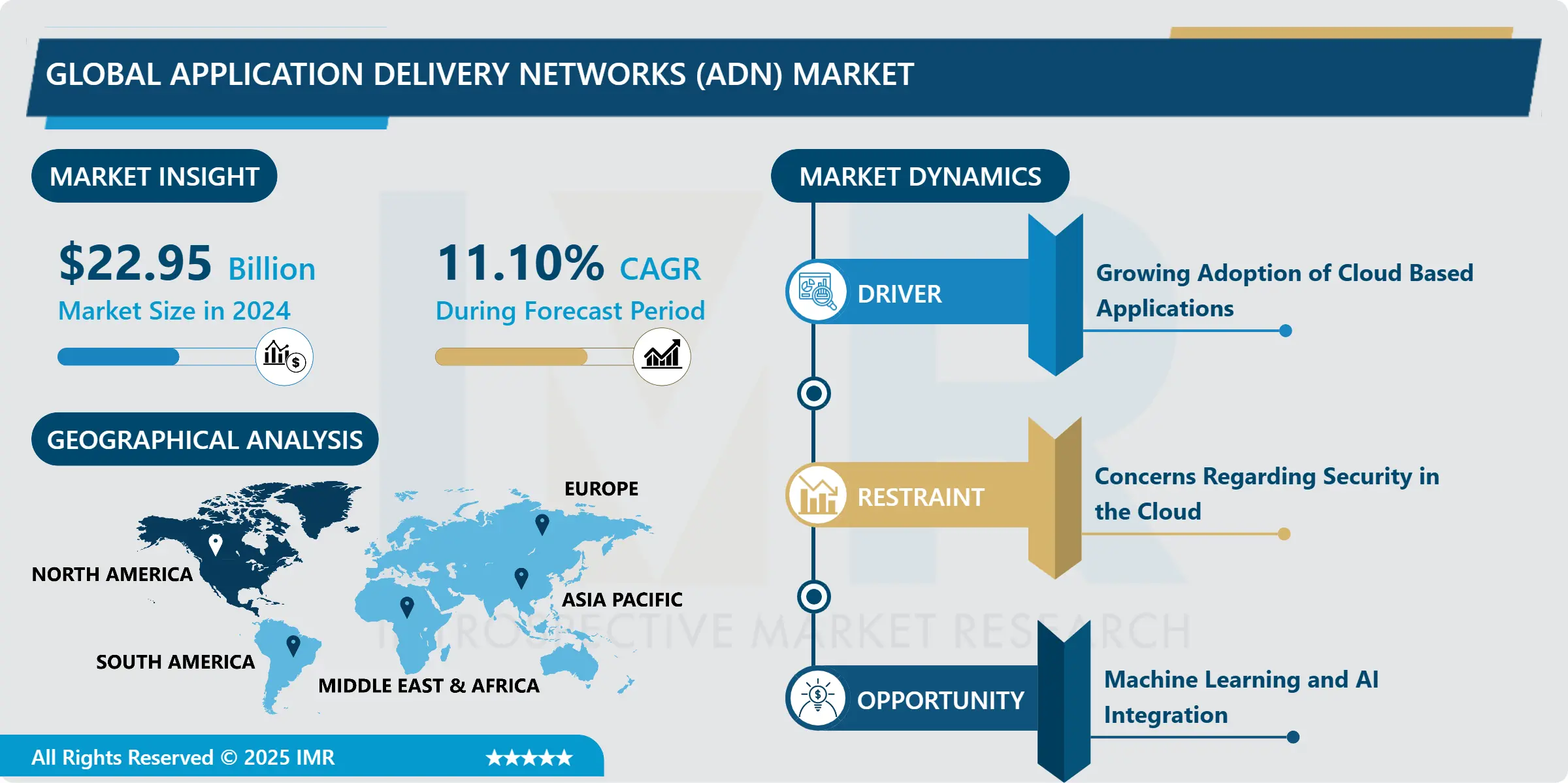
Global Application Delivery Networks (ADN) Market Size Was Valued at USD 22.95 Billion in 2024 and is Projected to Reach USD 53.27 Billion by 2032, Growing at a CAGR of 11.10% From 2025-2032.
Advanced capabilities of Application Delivery Networks (ADNs) ensure reliable delivery of web-based applications, optimizing security, performance, and user experience, thereby enhancing the overall user experience and minimizing latency.
Load Balancing is a technique that distributes network traffic across multiple servers to ensure optimal utilization and prevent overloading. It accelerates content delivery by caching frequently accessed data closer to end-users, reducing latency and improving performance. Web Application Firewall (WAF) protects against web-based threats like SQL injection and cross-site scripting. SSL/TLS Offloading handles encryption and decryption of secure connections, improving performance. Acceleration and optimization techniques like compression and protocol optimization enhance data transfer speed and efficiency. Application Performance Monitoring helps identify bottlenecks and optimize resource allocation. Global Server Load Balancing (GSLB) distributes traffic across multiple servers for high availability and disaster recovery. Traffic management controls and directs network traffic based on load, user location, and content type. Scalability supports application growth by easily scaling resources.
Application Delivery Networks (ADNs) offer several benefits, including improved performance, high availability, enhanced security, scalability, cost efficiency, global reach, and traffic prioritization. Load balancing, CDN, and caching technologies enhance application performance by reducing latency and ensuring faster response times. ADNs distribute traffic across multiple servers and data centers, minimizing downtime and ensuring the integrity and confidentiality of sensitive data. WAF protects applications from cyber threats and SSL/TLS acceleration ensures secure communication. ADNs can be scaled horizontally or vertically, providing flexibility to accommodate growing traffic and application demands. They also optimize resource utilization, reduce downtime, and improve performance, contributing to cost savings.
Application Delivery Networks (ADN) Market Trend Analysis:
Growing Adoption of Cloud Based Applications
The increasing acceptance of cloud-based applications is a key factor driving the expansion of the Application Delivery Networks (ADN) market. As organizations progressively shift their essential applications and services to cloud infrastructures, the need for effective and optimized delivery mechanisms has become crucial. Cloud-based applications, housed on distant servers, necessitate robust and responsive networks to ensure smooth accessibility and improved performance for end-users across various geographical locations. ADN solutions perform an essential function in facilitating this transition by providing the necessary tools and technologies to enhance application delivery over the cloud.
Adaptive application delivery solutions become necessary due to the cloud’s scale and adaptability, which goes beyond simply increasing accessibility. Businesses may adapt their application delivery infrastructure to meet demand thanks to ADN technologies, which enable them to take advantage of dynamic network circumstances and shifting workloads. Moreover, the security issues surrounding cloud-based apps emphasize the need for ADN, since these solutions help to secure data integrity, strengthen the delivery process, and guard against cyberattacks.
Machine Learning and AI Integration
The integration of Machine Learning (ML) and Artificial Intelligence (AI) presents significant opportunities for the substantial expansion of the Application Delivery Networks (ADN) market. A key avenue for growth involves predictive analytics, where ML algorithms analyze historical data to predict traffic patterns, identify potential bottlenecks, and optimize application delivery accordingly. This proactive approach ensures efficient resource allocation, preventing potential performance issues before they arise.
Additionally, AI can provide a vital function in enhancing security within ADN by employing advanced threat detection and mitigation techniques to guard against evolving cyber threats. This not only strengthens the overall resilience of the application delivery infrastructure but also aligns with the growing emphasis on cybersecurity in today’s digital landscape.
Furthermore, the integration of ML and AI introduces adaptive and self-learning capabilities within ADN solutions. These systems can dynamically adapt to changing network conditions, user behaviors, and application requirements, resulting in a more responsive and agile application delivery network. As organizations strive to streamline their operations, minimize downtime, and improve user experiences, integrating machine learning and artificial intelligence becomes a strategic necessity, positioning ADN providers at the forefront of technological innovation and market competitiveness.
Application Delivery Networks (ADN) Market Segment Analysis:
Application Delivery Networks (ADN) Market Segmented on the basis of Product Type, Deployment, End-User, and Vertical
By Deployment, Cloud segment is expected to dominate the market during the forecast period
The dominance of the cloud segment is expected to play a crucial role in propelling the growth of the Application Delivery Networks (ADN) market. As there is a growing trend towards cloud computing, organizations are embracing cloud-based ADN solutions to optimize application delivery, ensure scalability, and improve overall performance. Cloud-based ADN offerings offer flexibility and cost-effectiveness, aligning well with the dynamic requirements of modern enterprises.
Moreover, the scalability of these solutions enables businesses to seamlessly adapt to changing workloads. As industries undergo digital transformation, the cloud segment is poised to lead the ADN market by addressing the diverse needs of businesses seeking efficient and scalable application delivery solutions. The widespread impact of cloud technology on IT infrastructures positions cloud-based ADN as a major player in shaping the future of application delivery.
By Product Type, Application Delivery Controllers segment held the largest share
The Application Delivery Controllers (ADC) segment has emerged as the frontrunner in the Application Delivery Networks (ADN) market, securing the largest market share. ADCs play a pivotal role in optimizing the performance and availability of applications by efficiently distributing network traffic and balancing workloads. Organizations across various industries leverage ADC solutions to enhance user experiences, ensure application reliability, and streamline overall network efficiency.
As businesses increasingly prioritize seamless and secure application delivery, the demand for advanced ADC functionalities continues to grow. The robust capabilities of ADCs in load balancing, traffic management, and application acceleration contribute to their market dominance. The ADC segment’s dominance underscores the critical role these controllers play in addressing the complex challenges of modern application delivery, positioning them as a cornerstone technology within the broader ADN landscape.
Application Delivery Networks (ADN) Market Regional Insights:
North America is Expected to Dominate the Market Over the Forecast period
The forefront position in market growth is expected to be taken by North America, driven by various factors contributing to its robust standing. The region’s mature IT infrastructure, technological advancements, and widespread digitalization across industries contribute significantly to its dominance.
Additionally, North America benefits from a strong presence of key market players and a proactive approach to adopting advanced technologies. The demand for Application Delivery Controllers (ADC) in North America is propelled by the growing emphasis on secure and seamless application delivery across diverse sectors. Businesses in the region prioritize optimizing application performance, ensuring reliability, and improving overall network efficiency. The increasing need for advanced ADC functionalities solidifies North America’s pivotal role as the primary driver of growth in the ADC market within the broader context of Application Delivery Networks (ADN).
Key Players Covered in Application Delivery Networks (ADN) Market:
Array Networks (U.S.)
A10 Networks, Inc. (U.S.)
Aryaka Networks, Inc. (U.S.)
Broadcom Inc. (Symantec Corporation) (U.S.)
Cisco Systems Inc. (U.S.)
Hewlett-Packard (HP) (U.S.)
Citrix Systems Inc. (U.S.)
Verizon (U.S.)
Dell Inc. (U.S.)
F5 Networks Inc. (U.S.)
Avi Networks (Vmware) (U.S.)
Akamai Technologies (U.S.)
Riverbed Technology (U.S.)
Oracle Corporation (U.S.)
Barracuda Networks Inc. (U.S.)
Fortinet (U.S.)
Kemp Technologies (Ireland)
Radware Corporation (Israel), and Other Active Players
Key Industry Developments in the Application Delivery Networks (ADN) Market:
In March 2024, Arista Networks, Inc., a leader in data-driven client-to-cloud networking, introduced a new network observability software, merging network infrastructure performance with compute and server systems data. Arista’s CloudVision® Universal Network Observability™ (CV UNO™), available as a premium feature license on Arista CloudVision, automates network, systems, and application visibility. AI-driven analysis provides proactive insights, reducing errors, accelerating issue resolution, and offering precise root cause analysis of network events and their impact on application delivery.
In February 2023, Juniper Networks Inc. announced that Green Energy Data Centers, a Baltics-based energy data efficient company, has partnered with Juniper’s cloud-ready data center and AI-driven enterprise solutions. The 14,500-square-meter facility, with multiple physical security levels and redundant power and digital infrastructure systems, ensures reliable operations.
In December 2022, A10 Networks, Inc launched A10 Defend, A10 offers a SaaS trial service that integrates threat insights, network data knowledge, and attack indicators. It leverages internal networking expertise and cybersecurity research to provide valuable insights into customer use case requirements, enhancing their global customer base.
Chapter 1: Introduction
1.1 Scope and Coverage
Chapter 2:Executive Summary
Chapter 3: Market Landscape
3.1 Market Dynamics
3.1.1 Drivers
3.1.2 Restraints
3.1.3 Opportunities
3.1.4 Challenges
3.2 Market Trend Analysis
3.3 PESTLE Analysis
3.4 Porter’s Five Forces Analysis
3.5 Industry Value Chain Analysis
3.6 Ecosystem
3.7 Regulatory Landscape
3.8 Price Trend Analysis
3.9 Patent Analysis
3.10 Technology Evolution
3.11 Investment Pockets
3.12 Import-Export Analysis
Chapter 4: Application Delivery Networks (ADN) Market by Product Type (2018-2032)
4.1 Application Delivery Networks (ADN) Market Snapshot and Growth Engine
4.2 Market Overview
4.3 WAN Optimization Controllers
4.3.1 Introduction and Market Overview
4.3.2 Historic and Forecasted Market Size in Value USD and Volume Units
4.3.3 Key Market Trends, Growth Factors, and Opportunities
4.3.4 Geographic Segmentation Analysis
4.4 Application Security Equipment
4.5 Application Delivery Controllers
4.6 Application Gateways
Chapter 5: Application Delivery Networks (ADN) Market by Deployment (2018-2032)
5.1 Application Delivery Networks (ADN) Market Snapshot and Growth Engine
5.2 Market Overview
5.3 On-premise
5.3.1 Introduction and Market Overview
5.3.2 Historic and Forecasted Market Size in Value USD and Volume Units
5.3.3 Key Market Trends, Growth Factors, and Opportunities
5.3.4 Geographic Segmentation Analysis
5.4 Cloud
Chapter 6: Application Delivery Networks (ADN) Market by End-User (2018-2032)
6.1 Application Delivery Networks (ADN) Market Snapshot and Growth Engine
6.2 Market Overview
6.3 Cloud Service Providers
6.3.1 Introduction and Market Overview
6.3.2 Historic and Forecasted Market Size in Value USD and Volume Units
6.3.3 Key Market Trends, Growth Factors, and Opportunities
6.3.4 Geographic Segmentation Analysis
6.4 SMEs Enterprises
6.5 Telecommunication Service Providers
6.6 Large Enterprises
Chapter 7: Application Delivery Networks (ADN) Market by Vertical (2018-2032)
7.1 Application Delivery Networks (ADN) Market Snapshot and Growth Engine
7.2 Market Overview
7.3 BFSI
7.3.1 Introduction and Market Overview
7.3.2 Historic and Forecasted Market Size in Value USD and Volume Units
7.3.3 Key Market Trends, Growth Factors, and Opportunities
7.3.4 Geographic Segmentation Analysis
7.4 Retail
7.5 Media & Entertainment
7.6 Healthcare
7.7 IT services
7.8 Others
Chapter 8: Company Profiles and Competitive Analysis
8.1 Competitive Landscape
8.1.1 Competitive Benchmarking
8.1.2 Application Delivery Networks (ADN) Market Share by Manufacturer (2024)
8.1.3 Industry BCG Matrix
8.1.4 Heat Map Analysis
8.1.5 Mergers and Acquisitions
8.2 CISCO(U.S.)
8.2.1 Company Overview
8.2.2 Key Executives
8.2.3 Company Snapshot
8.2.4 Role of the Company in the Market
8.2.5 Sustainability and Social Responsibility
8.2.6 Operating Business Segments
8.2.7 Product Portfolio
8.2.8 Business Performance
8.2.9 Key Strategic Moves and Recent Developments
8.2.10 SWOT Analysis
8.3 COMODO(U.S.)
8.4 DNSFILTER (U.S.)
8.5 WEBROOT (U.S.)
8.6 INFOBLOX (U.S.)
8.7 AKAMAI (U.S.)
8.8 MXTOOLBOX (U.S.)
8.9 F5 NETWORKS (U.S.)
8.10 NEUSTAR (U.S.)
8.11 BLUECAT (CANADA)
8.12 CSIS SECURITY GROUP (DENMARK)
8.13 EFFICIENTIP (FRANCE)
8.14 TITANHQ (IRELAND)
8.15 AND OTHERS MAJOR PLAYERS.
Chapter 9: Global Application Delivery Networks (ADN) Market By Region
9.1 Overview
9.2. North America Application Delivery Networks (ADN) Market
9.2.1 Key Market Trends, Growth Factors and Opportunities
9.2.2 Top Key Companies
9.2.3 Historic and Forecasted Market Size by Segments
9.2.4 Historic and Forecasted Market Size by Product Type
9.2.4.1 WAN Optimization Controllers
9.2.4.2 Application Security Equipment
9.2.4.3 Application Delivery Controllers
9.2.4.4 Application Gateways
9.2.5 Historic and Forecasted Market Size by Deployment
9.2.5.1 On-premise
9.2.5.2 Cloud
9.2.6 Historic and Forecasted Market Size by End-User
9.2.6.1 Cloud Service Providers
9.2.6.2 SMEs Enterprises
9.2.6.3 Telecommunication Service Providers
9.2.6.4 Large Enterprises
9.2.7 Historic and Forecasted Market Size by Vertical
9.2.7.1 BFSI
9.2.7.2 Retail
9.2.7.3 Media & Entertainment
9.2.7.4 Healthcare
9.2.7.5 IT services
9.2.7.6 Others
9.2.8 Historic and Forecast Market Size by Country
9.2.8.1 US
9.2.8.2 Canada
9.2.8.3 Mexico
9.3. Eastern Europe Application Delivery Networks (ADN) Market
9.3.1 Key Market Trends, Growth Factors and Opportunities
9.3.2 Top Key Companies
9.3.3 Historic and Forecasted Market Size by Segments
9.3.4 Historic and Forecasted Market Size by Product Type
9.3.4.1 WAN Optimization Controllers
9.3.4.2 Application Security Equipment
9.3.4.3 Application Delivery Controllers
9.3.4.4 Application Gateways
9.3.5 Historic and Forecasted Market Size by Deployment
9.3.5.1 On-premise
9.3.5.2 Cloud
9.3.6 Historic and Forecasted Market Size by End-User
9.3.6.1 Cloud Service Providers
9.3.6.2 SMEs Enterprises
9.3.6.3 Telecommunication Service Providers
9.3.6.4 Large Enterprises
9.3.7 Historic and Forecasted Market Size by Vertical
9.3.7.1 BFSI
9.3.7.2 Retail
9.3.7.3 Media & Entertainment
9.3.7.4 Healthcare
9.3.7.5 IT services
9.3.7.6 Others
9.3.8 Historic and Forecast Market Size by Country
9.3.8.1 Russia
9.3.8.2 Bulgaria
9.3.8.3 The Czech Republic
9.3.8.4 Hungary
9.3.8.5 Poland
9.3.8.6 Romania
9.3.8.7 Rest of Eastern Europe
9.4. Western Europe Application Delivery Networks (ADN) Market
9.4.1 Key Market Trends, Growth Factors and Opportunities
9.4.2 Top Key Companies
9.4.3 Historic and Forecasted Market Size by Segments
9.4.4 Historic and Forecasted Market Size by Product Type
9.4.4.1 WAN Optimization Controllers
9.4.4.2 Application Security Equipment
9.4.4.3 Application Delivery Controllers
9.4.4.4 Application Gateways
9.4.5 Historic and Forecasted Market Size by Deployment
9.4.5.1 On-premise
9.4.5.2 Cloud
9.4.6 Historic and Forecasted Market Size by End-User
9.4.6.1 Cloud Service Providers
9.4.6.2 SMEs Enterprises
9.4.6.3 Telecommunication Service Providers
9.4.6.4 Large Enterprises
9.4.7 Historic and Forecasted Market Size by Vertical
9.4.7.1 BFSI
9.4.7.2 Retail
9.4.7.3 Media & Entertainment
9.4.7.4 Healthcare
9.4.7.5 IT services
9.4.7.6 Others
9.4.8 Historic and Forecast Market Size by Country
9.4.8.1 Germany
9.4.8.2 UK
9.4.8.3 France
9.4.8.4 The Netherlands
9.4.8.5 Italy
9.4.8.6 Spain
9.4.8.7 Rest of Western Europe
9.5. Asia Pacific Application Delivery Networks (ADN) Market
9.5.1 Key Market Trends, Growth Factors and Opportunities
9.5.2 Top Key Companies
9.5.3 Historic and Forecasted Market Size by Segments
9.5.4 Historic and Forecasted Market Size by Product Type
9.5.4.1 WAN Optimization Controllers
9.5.4.2 Application Security Equipment
9.5.4.3 Application Delivery Controllers
9.5.4.4 Application Gateways
9.5.5 Historic and Forecasted Market Size by Deployment
9.5.5.1 On-premise
9.5.5.2 Cloud
9.5.6 Historic and Forecasted Market Size by End-User
9.5.6.1 Cloud Service Providers
9.5.6.2 SMEs Enterprises
9.5.6.3 Telecommunication Service Providers
9.5.6.4 Large Enterprises
9.5.7 Historic and Forecasted Market Size by Vertical
9.5.7.1 BFSI
9.5.7.2 Retail
9.5.7.3 Media & Entertainment
9.5.7.4 Healthcare
9.5.7.5 IT services
9.5.7.6 Others
9.5.8 Historic and Forecast Market Size by Country
9.5.8.1 China
9.5.8.2 India
9.5.8.3 Japan
9.5.8.4 South Korea
9.5.8.5 Malaysia
9.5.8.6 Thailand
9.5.8.7 Vietnam
9.5.8.8 The Philippines
9.5.8.9 Australia
9.5.8.10 New Zealand
9.5.8.11 Rest of APAC
9.6. Middle East & Africa Application Delivery Networks (ADN) Market
9.6.1 Key Market Trends, Growth Factors and Opportunities
9.6.2 Top Key Companies
9.6.3 Historic and Forecasted Market Size by Segments
9.6.4 Historic and Forecasted Market Size by Product Type
9.6.4.1 WAN Optimization Controllers
9.6.4.2 Application Security Equipment
9.6.4.3 Application Delivery Controllers
9.6.4.4 Application Gateways
9.6.5 Historic and Forecasted Market Size by Deployment
9.6.5.1 On-premise
9.6.5.2 Cloud
9.6.6 Historic and Forecasted Market Size by End-User
9.6.6.1 Cloud Service Providers
9.6.6.2 SMEs Enterprises
9.6.6.3 Telecommunication Service Providers
9.6.6.4 Large Enterprises
9.6.7 Historic and Forecasted Market Size by Vertical
9.6.7.1 BFSI
9.6.7.2 Retail
9.6.7.3 Media & Entertainment
9.6.7.4 Healthcare
9.6.7.5 IT services
9.6.7.6 Others
9.6.8 Historic and Forecast Market Size by Country
9.6.8.1 Turkiye
9.6.8.2 Bahrain
9.6.8.3 Kuwait
9.6.8.4 Saudi Arabia
9.6.8.5 Qatar
9.6.8.6 UAE
9.6.8.7 Israel
9.6.8.8 South Africa
9.7. South America Application Delivery Networks (ADN) Market
9.7.1 Key Market Trends, Growth Factors and Opportunities
9.7.2 Top Key Companies
9.7.3 Historic and Forecasted Market Size by Segments
9.7.4 Historic and Forecasted Market Size by Product Type
9.7.4.1 WAN Optimization Controllers
9.7.4.2 Application Security Equipment
9.7.4.3 Application Delivery Controllers
9.7.4.4 Application Gateways
9.7.5 Historic and Forecasted Market Size by Deployment
9.7.5.1 On-premise
9.7.5.2 Cloud
9.7.6 Historic and Forecasted Market Size by End-User
9.7.6.1 Cloud Service Providers
9.7.6.2 SMEs Enterprises
9.7.6.3 Telecommunication Service Providers
9.7.6.4 Large Enterprises
9.7.7 Historic and Forecasted Market Size by Vertical
9.7.7.1 BFSI
9.7.7.2 Retail
9.7.7.3 Media & Entertainment
9.7.7.4 Healthcare
9.7.7.5 IT services
9.7.7.6 Others
9.7.8 Historic and Forecast Market Size by Country
9.7.8.1 Brazil
9.7.8.2 Argentina
9.7.8.3 Rest of SA
Chapter 10 Analyst Viewpoint and Conclusion
10.1 Recommendations and Concluding Analysis
10.2 Potential Market Strategies
Chapter 11 Research Methodology
11.1 Research Process
11.2 Primary Research
11.3 Secondary Research
Q1: What would be forecast period in the market research report?
A1: The forecast period in the market research report is 2025-2032.
Q2: Who are the key players in Application Delivery Networks (ADN) market?
A2: Array Networks (U.S.),A10 Networks, Inc. (U.S.),Aryaka Networks, Inc. (U.S.),Broadcom Inc. (Symantec Corporation) (U.S.),Cisco Systems Inc. (U.S.),Hewlett-Packard (HP) (U.S.),Citrix Systems Inc. (U.S.),Verizon (U.S.),Dell Inc. (U.S.),F5 Networks Inc. (U.S.),Avi Networks (Vmware) (U.S.),Akamai Technologies (U.S.),Riverbed Technology (U.S.),Oracle Corporation (U.S.),Barracuda Networks Inc. (U.S.),Fortinet (U.S.),Kemp Technologies (Ireland),Radware Corporation (Israel), and Other Active Players.
Q3: What are the segments of Application Delivery Networks (ADN) market?
A3: The Application Delivery Networks (ADN) Market is segmented into Product Type, Deployment, End-User, Vertical, and Region. By Product Type, the market is categorized into WAN Optimization Controllers, Application Security Equipment, Application Delivery Controllers, and Application Gateways. By Deployment, the market is categorized into On-premise and cloud. By End-User, the market is categorized into Cloud Service Providers, SMEs Enterprises, Telecommunication Service Providers, and Large Enterprises. By Vertical, the market is categorized into BFSI, Retail, Media & Entertainment, Healthcare, IT services, and Others. By region, it is analyzed across North America (U.S.; Canada; Mexico), Eastern Europe (Bulgaria; The Czech Republic; Hungary; Poland; Romania; Rest of Eastern Europe), Western Europe (Germany; UK; France; Netherlands; Italy; Russia; Spain; Rest of Western Europe), Asia-Pacific (China; India; Japan; Southeast Asia, etc.), South America (Brazil; Argentina, etc.), Middle East & Africa (Saudi Arabia; South Africa, etc.).
Q4: What is the Application Delivery Networks (ADN) market?
A4: Advanced capabilities of Application Delivery Networks (ADNs) ensure reliable delivery of web-based applications, optimizing security, performance, and user experience, thereby enhancing the overall user experience and minimizing latency.
Q5: How big is the Application Delivery Networks (ADN) market?
A5: Global Application Delivery Networks (ADN) Market Size Was Valued at USD 22.95 Billion in 2024 and is Projected to Reach USD 53.27 Billion by 2032, Growing at a CAGR of 11.10% From 2025-2032.
How to Buy a Report from eminsights.jp
On the product page, choose the license you want: Single-User License, Multi-User License or Enterprise License.
If you required report in your native language, then you can click on Translated Report button and fill out the form with report name and language you want, then our team will contact you as soon as possible.
Click the Buy Now button.
You will be redirected to the checkout page. Enter your company details and payment information.
Click Place Order to complete the purchase.
Confirmation: You’ll receive an order confirmation and our team will contact you shortly with your ordered report.
If you have any questions, fill out the contact form below or email us at bizdev@eminsights.net.
Thank you for choosing eminsights.jp!