Stay Ahead in Fast-Growing Economies.
Browse Reports Now
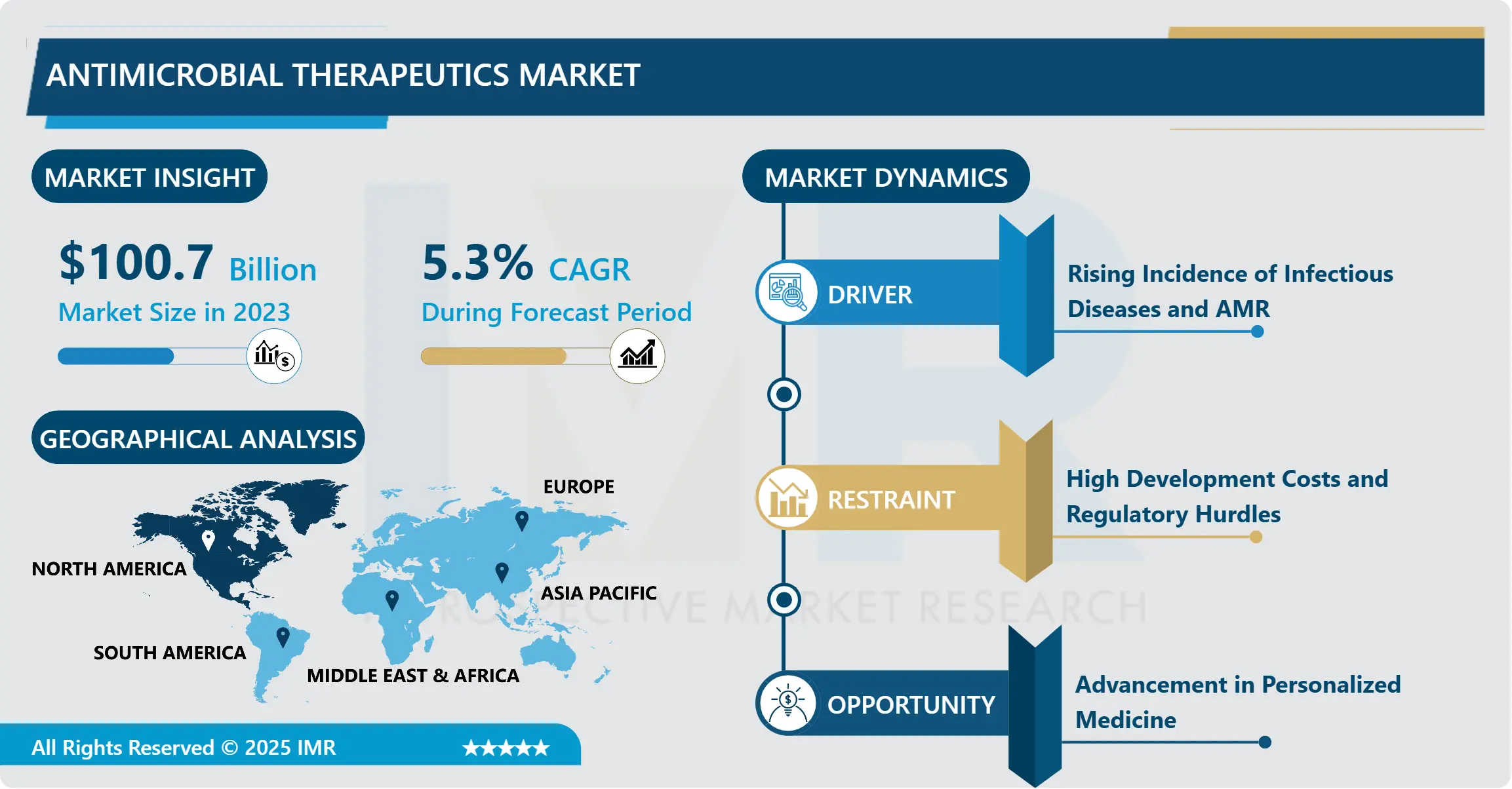
Antimicrobial Therapeutics Market- Comprehensive Study Report & Recent Trends By 2032
Antimicrobial Therapeutics Market Size Was Valued at USD 100.7 Billion in 2023, and is Projected to Reach USD 152.2 Billion by 2032, Growing at a CAGR of 5.30% From 2024-2032.

IMR Group
Description
Antimicrobial Therapeutics Market Synopsis:
Antimicrobial Therapeutics Market Size Was Valued at USD 100.7 Billion in 2023, and is Projected to Reach USD 152.2 Billion by 2032, Growing at a CAGR of 5.30% From 2024-2032.
The antimicrobial therapeutics market is the division of the healthcare sector that deals with the creation, production and sale of drugs and therapeutic solutions utilized in the treatment of microbial diseases that originate from bacteria, virus, fungi and parasites. These therapeutic agents are antibiotics, antiviral, antifungal, and antiparasitic, and are greatly used in the management of diseases ranging from the common cold to severe infections in hospitals, clinics, and home care.
The antimicrobial therapeutics market is a growing and significant segment in the global healthcare market driven by the global emergence of infectious diseases and AMR and related healthcare demand from a growing world population. Bacterial resistance continues to challenge both medical scientists and formulators to develop new ways of combating infections, which have become endemic globally through brands managed through prescriptions of antibiotics across varying severity levels involving flu, pneumonia, sepsis, and tuberculosis. The market has experienced massive enhancement due to continued research in the field of pharmaceuticals, improvements in various healthcare technology as well as factors such as development of new therapies and technologies among others. However the market faces problems, such as, emergence of drug resistant organisms that decrease the efficacy of current antimicrobial agents and the perpetuated demand for new therapies.
The global trend towards increased use of antimicrobial agents is pinned on the fight against AMR, where microbes mutate and rise in resistance to regular drugs. As a response to this threat, drug makers intent on investing in discovering novel antibiotics, antivirals and antifungal agents especially for MDR/GRAM negative organisms. Moreover, the steady growth of the number of surgical and transplantations, medical procedures require effective antimicrobial treatments, thus contributing to the adoption rate. It is particularly seen in developing areas as the health care delivery system is stretched and availability of cheap and efficacious antimicrobial agents is a huge challenge.
Antimicrobial Therapeutics Market Trend Analysis:
Rise in Antimicrobial Resistance (AMR)
One of the most influential trends developing within the antimicrobial therapeutics market has become the increasing problem of AMR. AMR happens when these microorganisms, including bacteria, virus, fungi, as well as parasites, mutate into forms that cannot be eradicated by the drugs that used to eliminate them. It causes treatments to become worthless, long-lasting diseases, a high cost of treatment, and even death. Misuse and overuse of antimicrobial agents for treating diseases in humans and animals as well as in promoting growth in food-producing animals has led to promotion of resistance thus hard to treat infections. AMR is now a global health issue which leaves it for authorities to act towards delaying its impacts and on the preservation of current antimicrobial agents and also on the search for new ones.
In response to this emerging crisis, there has been an increased attempt to design and synthesize new generation of antibiotics, anti-viral and anti-fungal compounds and other therapeutic moieties that can selectively act on these resistance strains. National ministries of health and global institutions including the WHO have put measures in place as a way of eliminating the threat posed by AMR and are equally funding the research of new treatment options. As the problem of resistance among microbes has evolved, there has been a rise of innovation in the antimicrobial therapeutics market with organisations seeking to make new drugs that will be effective against these microbes. Besides, the recent admission by WHO and other health organizations that AMR constitutes a public health emergency has also created a policy environment and new market opportunities for antimicrobial stewardship.
Expanding Demand for Personalized Medicine
One of the threats inherent in the antimicrobial therapeutics market is closely associated with the characteristic, that at present, there are tendencies towards the shift of its elite in the direction of the so-called individualized medicine. Personalization’s in the area of antimicrobial initiatives tend to be more accurate and hence better tailored in this sense than other thugs as they target specific pathogen types much more effectively, thereby reducing negative side effects. It provides an attractive approach to lessen the risk of AMR as patients get the best know treatment regimen for the specific infection they have. The latter might radically boost clinical effectiveness, decrease patients’ stay tendencies, and limit the use of antibiotics, therefore, minimizing the subject of drug resistance.
Realizations of genomics, bioinformatics, and molecular diagnostics are some of the factors that are pushing new personal antimicrobials forward. Due to these technologies can quickly diagnose the pathogen and its resistance, doctors can quickly choose the right treatment for each patient. It is this ability to individualize the management of an antimicrobial that brings much possible value in the treatment of infectious diseases, for patient care. As the larger sphere in healthcare inches towards the concept of precision medicine the antimicrobial therapeutics market is set to move towards a new change paradigm where solutions will be more targeted, efficient and personalized in addressing both the existing and future issue of AMR. This opportunity is as radical a change in the way infections are managed as it is in tune with the current need for better, targeted medical solutions.
Antimicrobial Therapeutics Market Segment Analysis:
Antimicrobial Therapeutics Market is Segmented on the basis of Type of Infection, Drug Class, End User, and Region.
By Type Of Infection , Bacterial Infections segment is expected to dominate the market during the forecast period
The antimicrobial therapeutics market is segmented by infection type and bacterial infection holds the largest market share. Surgical site infections as well as infections from routinely contracted diseases such as pneumonia, tuberculosis, and UTIs need antibiotics for management. The necessity to develop new antibiotics is currently higher than ever, due to the increasing antibiotic-resistant bacteria that spur the creation of new antibiotics to combat with the bacteria. Moreover, bacteria can superimpose other diseases, which logically requires proper and timely treatment; therefore, the demand for antimicrobial products increases the market for antimicrobial treatments.
Another major segment in the antimicrobial therapeutics market is the viral segment, it consists of viruses like influenza, HIV, and recently emerged Covid-19. Over the counter, antivirals mainly focus on infectious agents; however, due to the ever-emerging new virus types and their strains, there is an increased need for antivirals. Bacterial infections, including pneumonia and septicaemia, and fungal infections like candidiasis and aspergillosis and parasitic diseases like malaria and giardiasis, form the other important class of diseases for antimicrobial therapeutics. These infections require the use of antifungal and antiparasitic to treat and the cases are predominantly in specific geographical locations. Therefore, discovering and developing of proper targeted drugs for these diseases remain to be important priorities within the antimicrobial therapeutics market.
By drug class, Antibiotics segment expected to held the largest share
The antimicrobial therapeutics market can be categorized by drug class and Antibiotics retain the largest market share. Antibiotics are drugs that cure bacterial infections and form part of medications that are frequently prescribed worldwide. They include any group of antibiotics such as; Penicillin’s, Cephalosporins, Macrolides and Tetracyclines among others, since they function by affecting the bacterial pathogens in one way than the other. Currently, the rates of resistance to antibiotics are escalating the need for new antibiotics or other types of drugs in this class is increasing, and therefore the environment for developing new products in this therapeutic class is evolving. Efforts to produce antibiotics that can target a range of bacteria, and drugs that can overcome resistant bacteria, should fuel high growth in this segment.
Antivirals, antifungals and antiparasitic are other major categories of drugs that form part of the antimicrobial therapeutics market. Antiviral are medications administered to patients to tackle virus infections including HIV, influenza and COVID-19 recently. This category has been rapidly growing especially in today’s world where viral diseases have become so frequent and people need treatments during such ‘flu seasons’. Antifungal act on fungal parasites; it is a class of essential medicines, which can treat such diseases as athletes foot, candidiasis, and systematic mycoses. Likewise, there is the group of antiparasitic agents that treat parasitic diseases such as malaria and diseases caused by worms in our intestines and stomach. These changing health care requires further differentiation and expansion in all four categories; antibiotics, antivirals, antifungal and antiparasitic make up the demands of the antimicrobial therapeutics market.
Antimicrobial Therapeutics Market Regional Insights:
North America is Expected to Dominate the Market Over the Forecast period
North America is set to continue as the leading area in the antimicrobial therapeutics market with an estimated market share in 2023 and the United States as the leading market. This is partly led by a high healthcare spend, a well-developed pharma industry and research emphasis on the development of new antimicrobial agents. The increasing rates of infectious diseases and the emergence of AMR have created increased interest in novel antimicrobial agents. For instance, the United States has been most active in policy-making especially in regard to these problems through funding in development of new antibiotics and other antimicrobial agents. Consequently, a wide number of sources for clinical trials, research, and development can be found to maintain the market in United States.
Industry analysts predict that by 2023, North America market will account for nearly 40% of the overall antimicrobial therapeutics market; this is evidence of the region’s dominance. The region has a favourable legal framework that provides for faster clearance of new antimicrobial drugs while offering capacities to upscale mass production. In addition, the growth strategies launched by the governments across the region for containing the AMR, along with the presence of large pharma industries and budding biotechnology companies, have positioned North America at a vanguard of antimicrobial therapeutics markets. At the same time, high demand for the new generation of treatments, increased investment in the industry and further development of regulatory standards, all ensure that North America will retain its lead in the market in the future years.
Active Key Players in the Antimicrobial Therapeutics Market:
AbbVie (USA)
Amgen Inc. (USA)
Astellas Pharma Inc. (Japan)
AstraZeneca PLC (UK)
Bayer AG (Germany)
Bristol-Myers Squibb Company (USA)
Cipla Limited (India)
GlaxoSmithKline PLC (UK)
Johnson & Johnson (USA)
Merck & Co., Inc. (USA)
Novartis International AG (Switzerland)
Pfizer Inc. (USA)
Roche Holding AG (Switzerland)
Sanofi S.A. (France), and Other Active Players
Chapter 1: Introduction
1.1 Scope and Coverage
Chapter 2:Executive Summary
Chapter 3: Market Landscape
3.1 Market Dynamics
3.1.1 Drivers
3.1.2 Restraints
3.1.3 Opportunities
3.1.4 Challenges
3.2 Market Trend Analysis
3.3 PESTLE Analysis
3.4 Porter’s Five Forces Analysis
3.5 Industry Value Chain Analysis
3.6 Ecosystem
3.7 Regulatory Landscape
3.8 Price Trend Analysis
3.9 Patent Analysis
3.10 Technology Evolution
3.11 Investment Pockets
3.12 Import-Export Analysis
Chapter 4: Antimicrobial Therapeutics Market by Type of infection
4.1 Antimicrobial Therapeutics Market Snapshot and Growth Engine
4.2 Antimicrobial Therapeutics Market Overview
4.3 Bacterial Infections
4.3.1 Introduction and Market Overview
4.3.2 Historic and Forecasted Market Size in Value USD and Volume Units (2017-2032F)
4.3.3 Key Market Trends, Growth Factors and Opportunities
4.3.4 Bacterial Infections: Geographic Segmentation Analysis
4.4 Viral Infections
4.4.1 Introduction and Market Overview
4.4.2 Historic and Forecasted Market Size in Value USD and Volume Units (2017-2032F)
4.4.3 Key Market Trends, Growth Factors and Opportunities
4.4.4 Viral Infections: Geographic Segmentation Analysis
4.5 Fungal Infections
4.5.1 Introduction and Market Overview
4.5.2 Historic and Forecasted Market Size in Value USD and Volume Units (2017-2032F)
4.5.3 Key Market Trends, Growth Factors and Opportunities
4.5.4 Fungal Infections: Geographic Segmentation Analysis
4.6 Parasitic Infections
4.6.1 Introduction and Market Overview
4.6.2 Historic and Forecasted Market Size in Value USD and Volume Units (2017-2032F)
4.6.3 Key Market Trends, Growth Factors and Opportunities
4.6.4 Parasitic Infections: Geographic Segmentation Analysis
Chapter 5: Antimicrobial Therapeutics Market by Drug class
5.1 Antimicrobial Therapeutics Market Snapshot and Growth Engine
5.2 Antimicrobial Therapeutics Market Overview
5.3 Antibiotics
5.3.1 Introduction and Market Overview
5.3.2 Historic and Forecasted Market Size in Value USD and Volume Units (2017-2032F)
5.3.3 Key Market Trends, Growth Factors and Opportunities
5.3.4 Antibiotics: Geographic Segmentation Analysis
5.4 Antivirals
5.4.1 Introduction and Market Overview
5.4.2 Historic and Forecasted Market Size in Value USD and Volume Units (2017-2032F)
5.4.3 Key Market Trends, Growth Factors and Opportunities
5.4.4 Antivirals: Geographic Segmentation Analysis
5.5 Antifungals
5.5.1 Introduction and Market Overview
5.5.2 Historic and Forecasted Market Size in Value USD and Volume Units (2017-2032F)
5.5.3 Key Market Trends, Growth Factors and Opportunities
5.5.4 Antifungals: Geographic Segmentation Analysis
5.6 Antiparasitic
5.6.1 Introduction and Market Overview
5.6.2 Historic and Forecasted Market Size in Value USD and Volume Units (2017-2032F)
5.6.3 Key Market Trends, Growth Factors and Opportunities
5.6.4 Antiparasitic: Geographic Segmentation Analysis
Chapter 6: Antimicrobial Therapeutics Market by End User
6.1 Antimicrobial Therapeutics Market Snapshot and Growth Engine
6.2 Antimicrobial Therapeutics Market Overview
6.3 Hospitals
6.3.1 Introduction and Market Overview
6.3.2 Historic and Forecasted Market Size in Value USD and Volume Units (2017-2032F)
6.3.3 Key Market Trends, Growth Factors and Opportunities
6.3.4 Hospitals: Geographic Segmentation Analysis
6.4 Clinics
6.4.1 Introduction and Market Overview
6.4.2 Historic and Forecasted Market Size in Value USD and Volume Units (2017-2032F)
6.4.3 Key Market Trends, Growth Factors and Opportunities
6.4.4 Clinics: Geographic Segmentation Analysis
6.5 Homecare
6.5.1 Introduction and Market Overview
6.5.2 Historic and Forecasted Market Size in Value USD and Volume Units (2017-2032F)
6.5.3 Key Market Trends, Growth Factors and Opportunities
6.5.4 Homecare: Geographic Segmentation Analysis
6.6 Long-term Care Facilities
6.6.1 Introduction and Market Overview
6.6.2 Historic and Forecasted Market Size in Value USD and Volume Units (2017-2032F)
6.6.3 Key Market Trends, Growth Factors and Opportunities
6.6.4 Long-term Care Facilities: Geographic Segmentation Analysis
Chapter 7: Company Profiles and Competitive Analysis
7.1 Competitive Landscape
7.1.1 Competitive Benchmarking
7.1.2 Antimicrobial Therapeutics Market Share by Manufacturer (2023)
7.1.3 Industry BCG Matrix
7.1.4 Heat Map Analysis
7.1.5 Mergers and Acquisitions
7.2 ABBVIE (USA)
7.2.1 Company Overview
7.2.2 Key Executives
7.2.3 Company Snapshot
7.2.4 Role of the Company in the Market
7.2.5 Sustainability and Social Responsibility
7.2.6 Operating Business Segments
7.2.7 Product Portfolio
7.2.8 Business Performance
7.2.9 Key Strategic Moves and Recent Developments
7.2.10 SWOT Analysis
7.3 AMGEN INC. (USA)
7.4 ASTELLAS PHARMA INC. (JAPAN)
7.5 ASTRAZENECA PLC (UK)
7.6 BAYER AG (GERMANY)
7.7 OTHER ACTIVE PLAYERS
Chapter 8: Global Antimicrobial Therapeutics Market By Region
8.1 Overview
8.2. North America Antimicrobial Therapeutics Market
8.2.1 Key Market Trends, Growth Factors and Opportunities
8.2.2 Top Key Companies
8.2.3 Historic and Forecasted Market Size by Segments
8.2.4 Historic and Forecasted Market Size By Type of infection
8.2.4.1 Bacterial Infections
8.2.4.2 Viral Infections
8.2.4.3 Fungal Infections
8.2.4.4 Parasitic Infections
8.2.5 Historic and Forecasted Market Size By Drug class
8.2.5.1 Antibiotics
8.2.5.2 Antivirals
8.2.5.3 Antifungals
8.2.5.4 Antiparasitic
8.2.6 Historic and Forecasted Market Size By End User
8.2.6.1 Hospitals
8.2.6.2 Clinics
8.2.6.3 Homecare
8.2.6.4 Long-term Care Facilities
8.2.7 Historic and Forecast Market Size by Country
8.2.7.1 US
8.2.7.2 Canada
8.2.7.3 Mexico
8.3. Eastern Europe Antimicrobial Therapeutics Market
8.3.1 Key Market Trends, Growth Factors and Opportunities
8.3.2 Top Key Companies
8.3.3 Historic and Forecasted Market Size by Segments
8.3.4 Historic and Forecasted Market Size By Type of infection
8.3.4.1 Bacterial Infections
8.3.4.2 Viral Infections
8.3.4.3 Fungal Infections
8.3.4.4 Parasitic Infections
8.3.5 Historic and Forecasted Market Size By Drug class
8.3.5.1 Antibiotics
8.3.5.2 Antivirals
8.3.5.3 Antifungals
8.3.5.4 Antiparasitic
8.3.6 Historic and Forecasted Market Size By End User
8.3.6.1 Hospitals
8.3.6.2 Clinics
8.3.6.3 Homecare
8.3.6.4 Long-term Care Facilities
8.3.7 Historic and Forecast Market Size by Country
8.3.7.1 Russia
8.3.7.2 Bulgaria
8.3.7.3 The Czech Republic
8.3.7.4 Hungary
8.3.7.5 Poland
8.3.7.6 Romania
8.3.7.7 Rest of Eastern Europe
8.4. Western Europe Antimicrobial Therapeutics Market
8.4.1 Key Market Trends, Growth Factors and Opportunities
8.4.2 Top Key Companies
8.4.3 Historic and Forecasted Market Size by Segments
8.4.4 Historic and Forecasted Market Size By Type of infection
8.4.4.1 Bacterial Infections
8.4.4.2 Viral Infections
8.4.4.3 Fungal Infections
8.4.4.4 Parasitic Infections
8.4.5 Historic and Forecasted Market Size By Drug class
8.4.5.1 Antibiotics
8.4.5.2 Antivirals
8.4.5.3 Antifungals
8.4.5.4 Antiparasitic
8.4.6 Historic and Forecasted Market Size By End User
8.4.6.1 Hospitals
8.4.6.2 Clinics
8.4.6.3 Homecare
8.4.6.4 Long-term Care Facilities
8.4.7 Historic and Forecast Market Size by Country
8.4.7.1 Germany
8.4.7.2 UK
8.4.7.3 France
8.4.7.4 The Netherlands
8.4.7.5 Italy
8.4.7.6 Spain
8.4.7.7 Rest of Western Europe
8.5. Asia Pacific Antimicrobial Therapeutics Market
8.5.1 Key Market Trends, Growth Factors and Opportunities
8.5.2 Top Key Companies
8.5.3 Historic and Forecasted Market Size by Segments
8.5.4 Historic and Forecasted Market Size By Type of infection
8.5.4.1 Bacterial Infections
8.5.4.2 Viral Infections
8.5.4.3 Fungal Infections
8.5.4.4 Parasitic Infections
8.5.5 Historic and Forecasted Market Size By Drug class
8.5.5.1 Antibiotics
8.5.5.2 Antivirals
8.5.5.3 Antifungals
8.5.5.4 Antiparasitic
8.5.6 Historic and Forecasted Market Size By End User
8.5.6.1 Hospitals
8.5.6.2 Clinics
8.5.6.3 Homecare
8.5.6.4 Long-term Care Facilities
8.5.7 Historic and Forecast Market Size by Country
8.5.7.1 China
8.5.7.2 India
8.5.7.3 Japan
8.5.7.4 South Korea
8.5.7.5 Malaysia
8.5.7.6 Thailand
8.5.7.7 Vietnam
8.5.7.8 The Philippines
8.5.7.9 Australia
8.5.7.10 New Zealand
8.5.7.11 Rest of APAC
8.6. Middle East & Africa Antimicrobial Therapeutics Market
8.6.1 Key Market Trends, Growth Factors and Opportunities
8.6.2 Top Key Companies
8.6.3 Historic and Forecasted Market Size by Segments
8.6.4 Historic and Forecasted Market Size By Type of infection
8.6.4.1 Bacterial Infections
8.6.4.2 Viral Infections
8.6.4.3 Fungal Infections
8.6.4.4 Parasitic Infections
8.6.5 Historic and Forecasted Market Size By Drug class
8.6.5.1 Antibiotics
8.6.5.2 Antivirals
8.6.5.3 Antifungals
8.6.5.4 Antiparasitic
8.6.6 Historic and Forecasted Market Size By End User
8.6.6.1 Hospitals
8.6.6.2 Clinics
8.6.6.3 Homecare
8.6.6.4 Long-term Care Facilities
8.6.7 Historic and Forecast Market Size by Country
8.6.7.1 Turkiye
8.6.7.2 Bahrain
8.6.7.3 Kuwait
8.6.7.4 Saudi Arabia
8.6.7.5 Qatar
8.6.7.6 UAE
8.6.7.7 Israel
8.6.7.8 South Africa
8.7. South America Antimicrobial Therapeutics Market
8.7.1 Key Market Trends, Growth Factors and Opportunities
8.7.2 Top Key Companies
8.7.3 Historic and Forecasted Market Size by Segments
8.7.4 Historic and Forecasted Market Size By Type of infection
8.7.4.1 Bacterial Infections
8.7.4.2 Viral Infections
8.7.4.3 Fungal Infections
8.7.4.4 Parasitic Infections
8.7.5 Historic and Forecasted Market Size By Drug class
8.7.5.1 Antibiotics
8.7.5.2 Antivirals
8.7.5.3 Antifungals
8.7.5.4 Antiparasitic
8.7.6 Historic and Forecasted Market Size By End User
8.7.6.1 Hospitals
8.7.6.2 Clinics
8.7.6.3 Homecare
8.7.6.4 Long-term Care Facilities
8.7.7 Historic and Forecast Market Size by Country
8.7.7.1 Brazil
8.7.7.2 Argentina
8.7.7.3 Rest of SA
Chapter 9 Analyst Viewpoint and Conclusion
9.1 Recommendations and Concluding Analysis
9.2 Potential Market Strategies
Chapter 10 Research Methodology
10.1 Research Process
10.2 Primary Research
10.3 Secondary Research
Q1: What would be the forecast period in the Antimicrobial Therapeutics Market research report?
A1: The forecast period in the Antimicrobial Therapeutics Market research report is 2024-2032.
Q2: Who are the key players in the Antimicrobial Therapeutics Market?
A2: AbbVie (USA), Amgen Inc. (USA), Astellas Pharma Inc. (Japan), AstraZeneca PLC (UK), Bayer AG (Germany), Bristol-Myers Squibb Company (USA), Cipla Limited (India), GlaxoSmithKline PLC (UK), Johnson & Johnson (USA), Merck & Co., Inc. (USA), Novartis International AG (Switzerland), Pfizer Inc. (USA), Roche Holding AG (Switzerland), Sanofi S.A. (France), and Other Active Players.
Q3: What are the segments of the Antimicrobial Therapeutics Market?
A3: The Antimicrobial Therapeutics Market is segmented into Type of infection, Drug Class, End User, and Region. By Type of infection, the market is categorized into Bacterial Infections, Viral Infections, Fungal Infections, and Parasitic Infections. By drug class, the market is categorized into Antibiotics, Antivirals, Antifungals, and Antiparasitics. By End User, the market is categorized into Hospitals, Clinics, Homecare, and Long-term Care Facilities. By region, it is analyzed across North America (U.S., Canada, Mexico), Eastern Europe (Russia, Bulgaria, The Czech Republic, Hungary, Poland, Romania, Rest of Eastern Europe), Western Europe (Germany, UK, France, Netherlands, Italy, Spain, Rest of Western Europe), Asia Pacific (China, India, Japan, South Korea, Malaysia, Thailand, Vietnam, The Philippines, Australia, New Zealand, Rest of APAC), Middle East & Africa (Turkiye, Bahrain, Kuwait, Saudi Arabia, Qatar, UAE, Israel, South Africa), South America (Brazil, Argentina, Rest of SA).
Q4: What is the Antimicrobial Therapeutics Market?
A4: The antimicrobial therapeutics market is the division of the healthcare sector that deals with the creation, production and sale of drugs and therapeutic solutions utilized in the treatment of microbial diseases that originate from bacteria, virus, fungi and parasites. These therapeutic agents are antibiotics, antiviral, antifungal, and antiparasitic, and are greatly used in the management of diseases ranging from the common cold to severe infections in hospitals, clinics, and home care.
Q5: How big is the Antimicrobial Therapeutics Market?
A5: Antimicrobial Therapeutics Market Size Was Valued at USD 100.7 Billion in 2023, and is Projected to Reach USD 152.2 Billion by 2032, Growing at a CAGR of 5.30% From 2024-2032.
How to Buy a Report from eminsights.jp
On the product page, choose the license you want: Single-User License, Multi-User License or Enterprise License.
If you required report in your native language, then you can click on Translated Report button and fill out the form with report name and language you want, then our team will contact you as soon as possible.
Click the Buy Now button.
You will be redirected to the checkout page. Enter your company details and payment information.
Click Place Order to complete the purchase.
Confirmation: You’ll receive an order confirmation and our team will contact you shortly with your ordered report.
If you have any questions, fill out the contact form below or email us at bizdev@eminsights.net.
Thank you for choosing eminsights.jp!