Stay Ahead in Fast-Growing Economies.
Browse Reports Now




Animal Feed Market – Overview and Outlook by Potential Growth (2025-2032)
Animal prosperity is highly dependent on feed that reflects a well-balanced nutrition. In agriculture today, the well diet needs for various animals such as ruminants, poultry, swine, aqua and others are well understood and may be satisfied through natural fodder grass alone or concentrated form feed. In addition, the nutritional quality of feed is determined not only by the nutrient content, but also by many other factors such as feed preservation, hygiene, digestibility and effect on intestinal health.

IMR Group
Description
Animal Feed Market Synopsis
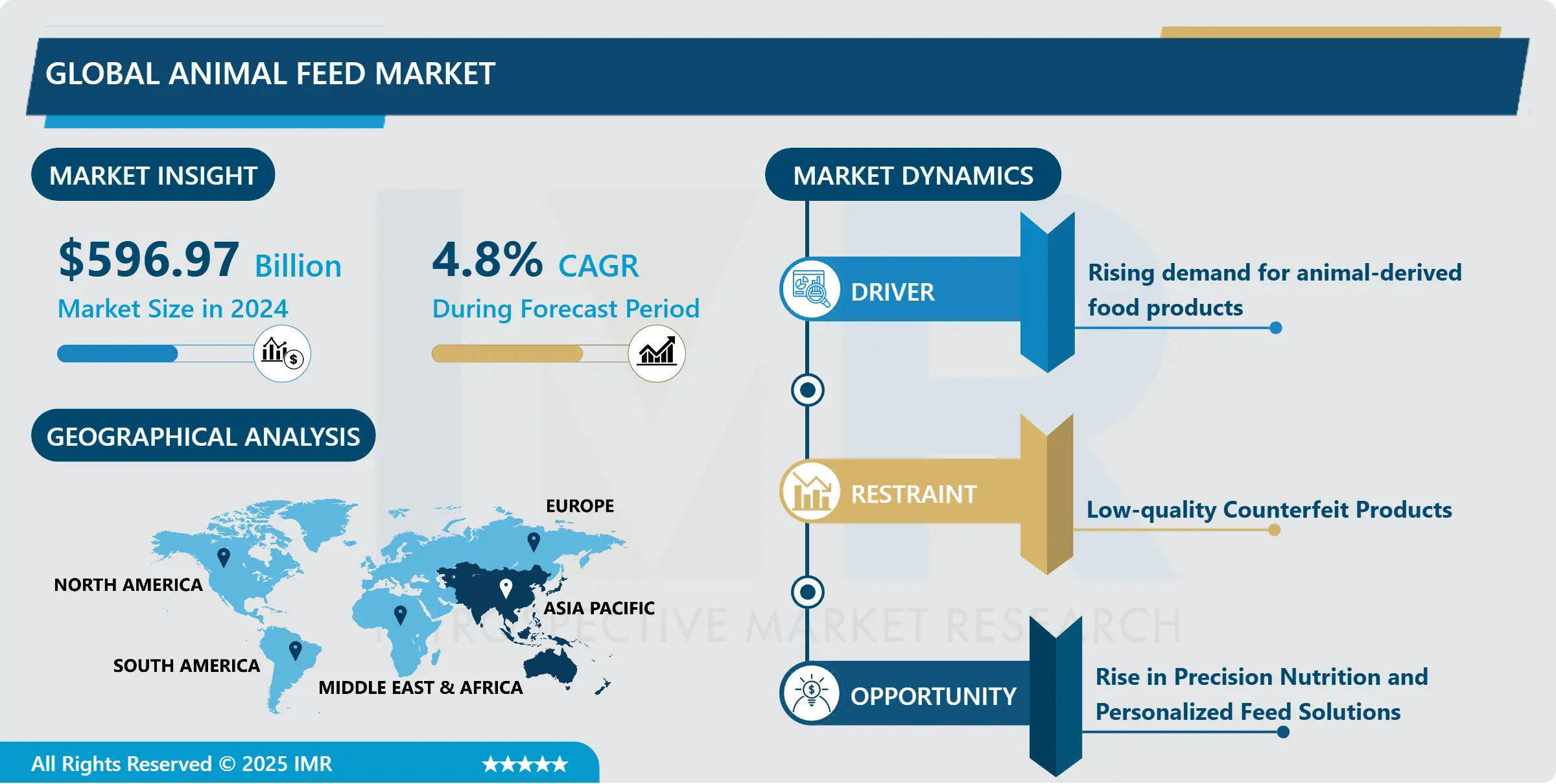
Animal Feed Market Size Was Valued at USD 596.97 Billion in 2024, and is Projected to Reach USD 868.65 Billion by 2032, Growing at a CAGR of 4.8% From 2025-2032.
Animal feed is a blend of grains, protein, vitamins, and minerals for livestock, poultry, and aquaculture. It supports growth, health, and productivity, and is crucial in modern agriculture. Well-balanced feed formulations improve feed conversion rates and contribute to producing high-quality meat, eggs, milk, and other animal-derived products for human consumption.
Animal feed is vital to modern agriculture, providing essential nutrients to livestock, poultry, aquaculture, and pets. Its benefits include nutritional balance, efficiency, disease prevention, cost-effectiveness, and convenience. Formulated feed formulations are designed to provide a balanced mix of proteins, carbohydrates, fats, vitamins, and minerals for animal growth, health, and reproduction. They also optimize feed utilization, reducing wastage and resulting in cost savings for farmers and producers.
Animal feed is primarily used in livestock, poultry, aquaculture, and pet nutrition. The demand for animal feed is driven by factors such as global population growth, rising disposable incomes, the expansion of livestock and poultry industries, the adoption of intensive farming practices, and rising awareness of balanced nutrition for animal health and productivity.
Market trends include the growth of specialty feeds, the shift towards sustainable feed ingredients, technological advancements, regulatory changes, and the expansion of the animal feed industry in emerging markets. These trends are driven by factors such as the growing global population, rising disposable incomes, adoption of intensive farming practices, and rising awareness about the importance of balanced nutrition for animal health and productivity.
The demand for organic, natural, and non-GMO animal products is driving the demand for feed formulations free from synthetic additives and genetically modified ingredients. Concerns about animal welfare are influencing ethical sourcing, humane treatment, and stress reduction strategies. Climate change mitigation is gaining traction through the adoption of feed additives and management practices.
Animal Feed Market Trend Analysis
Rising demand for animal-derived food products
The increasing desire for animal-derived food products stands as a pivotal driver of the animal feed market. As the global populace burgeons, particularly in emerging economies, dietary preferences lean toward higher consumption of meat, dairy, and eggs. This surge in demand for animal protein necessitates heightened production of livestock, poultry, and aquaculture, thereby intensifying the need for animal feed.
Animal feed forms the foundation for supplying essential nutrients vital for the growth, health, and productivity of livestock and poultry. With the rising demand for animal-derived food products, farmers and producers are impelled to enhance their production efficiency and output. This necessitates the use of top-quality feed formulations tailored to address the distinct nutritional requirements of various animal species at different developmental stages.
Ongoing technological advancements in feed formulation, production processes, and additives continually evolve to meet the escalating demand for animal protein sustainably and efficiently. Consequently, the increasing craving for animal-derived food products serves as a significant catalyst propelling the expansion and transformation of the animal feed market worldwide.
Rise in Precision Nutrition and Personalized Feed Solutions
The emergence of precision nutrition and personalized feed solutions represents a significant opportunity within the animal feed market. Advancements in technology and data analytics have revolutionized the capability to customize feed formulations to meet the unique nutritional requirements of individual animals or specific groups. Precision nutrition enables fine-tuning feed composition based on various factors such as animal breed, age, weight, health status, and production objectives.
This tailored approach not only optimizes nutrient intake but also enhances animal health, growth rates, feed efficiency, and overall productivity. Going beyond precision nutrition, personalized feed solutions consider additional factors like environmental conditions, management practices, and genetic profiles specific to each farm or production system.
Tailoring feed programs to these unique circumstances, producers can maximize effectiveness and achieve better performance outcomes while reducing costs. As consumer demand for sustainably produced animal products with improved nutritional profiles grows, the adoption of precision nutrition and personalized feed solutions offers feed manufacturers an opportunity to differentiate their offerings. With ongoing technological advancements making these solutions more scalable and cost-effective, the animal feed industry is poised for further growth and innovation.
Animal Feed Market Segment Analysis:
Animal Feed Market Segmented on the basis of Product, Animal Type, Form, Ingredient, Distribution Channel, and End-User.
By Product, Cereal Grains segment is expected to dominate the market during the forecast period
The dominance of the Cereal Grains segment in the animal feed market is attributed to several factors. Cereals like corn, wheat, and barley are fundamental components in many animal feed formulations, offering crucial nutrients at a cost-effective rate compared to other feed ingredients. These grains provide essential carbohydrates, proteins, and energy vital for the growth and well-being of animals.
Cereal grains are widely available globally and versatile in their application, making them accessible to feed manufacturers and producers across various regions. Their consistent availability contributes to the stability of the supply chain, ensuring a steady provision for feed production.
The escalating demand for meat, dairy, and eggs, spurred by population expansion and increasing incomes, propels the need for animal feed, further strengthening the prevalence of the cereal grains segment. As the livestock and poultry industries continue to expand to meet these heightened protein requirements, cereal grains are anticipated to maintain their prominence as the primary feed ingredient, cementing their role at the forefront of the animal feed market.
By Animal Type, Poultry segment is expected to dominate the market during the forecast period
The Poultry segment’s anticipated dominance in the animal feed market stems from several key factors. Firstly, poultry production, notably for broilers and egg-laying hens, stands as one of the swiftest-expanding sectors in the global livestock industry. This surge is propelled by population growth, increasing incomes, and shifting dietary preferences, which escalate the demand for poultry meat and eggs. poultry farming demonstrates remarkable efficiency compared to other livestock sectors, demanding fewer feed inputs to yield a unit of meat or eggs. This efficiency renders poultry farming financially appealing for producers, encouraging investment in feed inputs.
Furthermore, poultry feed formulations predominantly rely on cereal grains and protein meals—cost-effective, readily available commodities. The widespread accessibility of these ingredients ensures stability in poultry feed production and bolsters the poultry industry’s growth. Poultry feed formulations exhibit versatility and adaptability to various production systems and management practices, catering to both large-scale commercial operations and smallholder farms. The Poultry segment’s impending dominance in the animal feed market is underscored by the rapid expansion of poultry production, feed efficiency, ingredient availability, and the adaptable nature of poultry feed formulations.
Animal Feed Market Regional Insights:
Asia Pacific is Expected to Dominate the Market Over the Forecast period
Asia Pacific is anticipated to lead the animal feed market for several reasons. Firstly, the region’s expanding population, particularly in nations like China and India, drives significant demand for meat, dairy, and eggs, thereby increasing the necessity for animal feed to support livestock and poultry farming. Rapid urbanization and industrialization in Asia Pacific result in dietary shifts towards higher protein consumption, further boosting the requirement for animal feed. As urbanization advances, more individuals adopt Westernized diets, leading to increased consumption of animal-derived products.
Asia Pacific’s extensive agricultural sector and favorable climatic conditions facilitate the production of essential feed ingredients such as cereal grains, oilseeds, and protein meals, ensuring a consistent supply for feed manufacturers. Government initiatives and investments in the agriculture sector, along with advancements in technology and feed formulations, contribute to the region’s dominance in the animal feed market.
Asia Pacific plays a significant role in global aquaculture production, driving substantial demand for aquafeed. With a considerable share of the global aquaculture output, the demand for feed in this sector further solidifies Asia Pacific’s position in the animal feed market.
Animal Feed Market Top Key Players:
Cargill Incorporated (US)
ADM (Archer Daniels Midland, US)
Phibro Animal Health Corporation (US)
NOVUS INTERNATIONAL INC. (US)
Purina Animal Nutrition LLC (US)
Kemin Industries Inc. (US)
Kent Nutrition Group (US)
Alltech (US)
Land O’Lakes (US)
Tyson Foods (US)
BASF SE (Germany)
Evonik Industries AG (Germany)
Vetsfarma Ltd. (UK)
Nutreco (Netherlands)
De Heus Animal Nutrition (Netherlands)
DSM (Netherlands)
Yara (Norway)
Perstorp (Sweden)
Nutrex.EU (Belgium)
Henraajh Feeds India Pvt. Ltd. (India)
New Hope Group (China)
Guangxi Yangxiang Co., Ltd. (China)
Weston Stockfeed New Zealand (New Zealand)
JAPFA LTD (Indonesia)
Charoen Pokphand Foods PCL (Thailand), and Other Active Players.
Key Industry Developments in the Animal Feed Market:
In July 2023, Hendrix Genetics, a renowned company specializing in multi-species animal breeding, genetics, and technology, announced a collaboration with CSA Animal Nutrition, a prominent provider of professional nutrition services. This partnership aims to bolster nutrition support for Hendrix Genetics’ turkey business unit, Hybrid Turkeys, specifically within the Americas region. Under this agreement, CSA will deliver precise nutrition solutions tailored to meet the performance objectives of Hybrid Turkeys.
In November 2023, Alltech, a global leader with over four decades of experience in the agriculture industry, unveiled Egalis, a new line of premium silage inoculants. These innovative products are designed to optimize nutrient quality, enhance forage stability, and minimize dry matter loss. Egalis inoculants are formulated to support optimal animal performance by preserving the nutritional integrity of silage feed.
Chapter 1: Introduction
1.1 Scope and Coverage
Chapter 2:Executive Summary
Chapter 3: Market Landscape
3.1 Market Dynamics
3.1.1 Drivers
3.1.2 Restraints
3.1.3 Opportunities
3.1.4 Challenges
3.2 Market Trend Analysis
3.3 PESTLE Analysis
3.4 Porter’s Five Forces Analysis
3.5 Industry Value Chain Analysis
3.6 Ecosystem
3.7 Regulatory Landscape
3.8 Price Trend Analysis
3.9 Patent Analysis
3.10 Technology Evolution
3.11 Investment Pockets
3.12 Import-Export Analysis
Chapter 4: Animal Feed Market by Product (2018-2032)
4.1 Animal Feed Market Snapshot and Growth Engine
4.2 Market Overview
4.3 Cereal Grains
4.3.1 Introduction and Market Overview
4.3.2 Historic and Forecasted Market Size in Value USD and Volume Units
4.3.3 Key Market Trends, Growth Factors, and Opportunities
4.3.4 Geographic Segmentation Analysis
4.4 Protein Meals
4.5 Milk Replacer
4.6 Feed Additives
Chapter 5: Animal Feed Market by Animal Type (2018-2032)
5.1 Animal Feed Market Snapshot and Growth Engine
5.2 Market Overview
5.3 Ruminants
5.3.1 Introduction and Market Overview
5.3.2 Historic and Forecasted Market Size in Value USD and Volume Units
5.3.3 Key Market Trends, Growth Factors, and Opportunities
5.3.4 Geographic Segmentation Analysis
5.4 Swine
5.5 Poultry
5.6 Aquaculture
5.7 Pets
5.8 Equine
Chapter 6: Animal Feed Market by Form (2018-2032)
6.1 Animal Feed Market Snapshot and Growth Engine
6.2 Market Overview
6.3 Pellets
6.3.1 Introduction and Market Overview
6.3.2 Historic and Forecasted Market Size in Value USD and Volume Units
6.3.3 Key Market Trends, Growth Factors, and Opportunities
6.3.4 Geographic Segmentation Analysis
6.4 Crumbles
6.5 Mash
6.6 Liqui
6.7 Frozen
Chapter 7: Animal Feed Market by Ingredient (2018-2032)
7.1 Animal Feed Market Snapshot and Growth Engine
7.2 Market Overview
7.3 Plant-based feed
7.3.1 Introduction and Market Overview
7.3.2 Historic and Forecasted Market Size in Value USD and Volume Units
7.3.3 Key Market Trends, Growth Factors, and Opportunities
7.3.4 Geographic Segmentation Analysis
7.4 Animal-based feed
7.5 Additives
Chapter 8: Animal Feed Market by Distribution Channel (2018-2032)
8.1 Animal Feed Market Snapshot and Growth Engine
8.2 Market Overview
8.3 Direct sales to farmer
8.3.1 Introduction and Market Overview
8.3.2 Historic and Forecasted Market Size in Value USD and Volume Units
8.3.3 Key Market Trends, Growth Factors, and Opportunities
8.3.4 Geographic Segmentation Analysis
8.4 Retail stores
8.5 Online platforms
Chapter 9: Animal Feed Market by End User (2018-2032)
9.1 Animal Feed Market Snapshot and Growth Engine
9.2 Market Overview
9.3 Feed Manufacturers
9.3.1 Introduction and Market Overview
9.3.2 Historic and Forecasted Market Size in Value USD and Volume Units
9.3.3 Key Market Trends, Growth Factors, and Opportunities
9.3.4 Geographic Segmentation Analysis
9.4 Contract Manufacturers
9.5 Livestock Producers
9.6 Commercial farms
9.7 Household/family farms
Chapter 10: Company Profiles and Competitive Analysis
10.1 Competitive Landscape
10.1.1 Competitive Benchmarking
10.1.2 Animal Feed Market Share by Manufacturer (2024)
10.1.3 Industry BCG Matrix
10.1.4 Heat Map Analysis
10.1.5 Mergers and Acquisitions
10.2 HERBALIFE NUTRITION LTD. (US)
10.2.1 Company Overview
10.2.2 Key Executives
10.2.3 Company Snapshot
10.2.4 Role of the Company in the Market
10.2.5 Sustainability and Social Responsibility
10.2.6 Operating Business Segments
10.2.7 Product Portfolio
10.2.8 Business Performance
10.2.9 Key Strategic Moves and Recent Developments
10.2.10 SWOT Analysis
10.3 NUTRISYSTEM INC. (US)
10.4 WEIGHT WATCHERS INTERNATIONAL INC. (US)
10.5 ABBOTT LABORATORIES (US)
10.6 ATKINS NUTRITIONALS INC. (US)
10.7 GNC HOLDINGS INC. (US)
10.8 AMWAY CORPORATION (US)
10.9 SLIMFAST (US)
10.10 USANA HEALTH SCIENCES INC. (US)
10.11 GENERAL NUTRITION CENTERS INC. (GNC) (US)
10.12 MUSCLETECH (US)
10.13 THE COCA-COLA COMPANY (US)
10.14 PEPSICO INC. (US)
10.15 THE NATURE’S BOUNTY CO. (US)
10.16 KELLOGG COMPANY (US)
10.17 PROCTER & GAMBLE CO. (US)
10.18 JOHNSON & JOHNSON (US)
10.19 PFIZER INC. (US)
10.20 BAYER AG (GERMANY)
10.21 GLAXOSMITHKLINE PLC (UK)
10.22 UNILEVER (UK)
10.23 DANONE S.A. (FRANCE)
10.24 OTSUKA PHARMACEUTICAL COLTD. (JAPAN)
10.25 NESTLÉ S.A. (SWITZERLAND)
10.26 GLANBIA PLC (IRELAND)
10.27
Chapter 11: Global Animal Feed Market By Region
11.1 Overview
11.2. North America Animal Feed Market
11.2.1 Key Market Trends, Growth Factors and Opportunities
11.2.2 Top Key Companies
11.2.3 Historic and Forecasted Market Size by Segments
11.2.4 Historic and Forecasted Market Size by Product
11.2.4.1 Cereal Grains
11.2.4.2 Protein Meals
11.2.4.3 Milk Replacer
11.2.4.4 Feed Additives
11.2.5 Historic and Forecasted Market Size by Animal Type
11.2.5.1 Ruminants
11.2.5.2 Swine
11.2.5.3 Poultry
11.2.5.4 Aquaculture
11.2.5.5 Pets
11.2.5.6 Equine
11.2.6 Historic and Forecasted Market Size by Form
11.2.6.1 Pellets
11.2.6.2 Crumbles
11.2.6.3 Mash
11.2.6.4 Liqui
11.2.6.5 Frozen
11.2.7 Historic and Forecasted Market Size by Ingredient
11.2.7.1 Plant-based feed
11.2.7.2 Animal-based feed
11.2.7.3 Additives
11.2.8 Historic and Forecasted Market Size by Distribution Channel
11.2.8.1 Direct sales to farmer
11.2.8.2 Retail stores
11.2.8.3 Online platforms
11.2.9 Historic and Forecasted Market Size by End User
11.2.9.1 Feed Manufacturers
11.2.9.2 Contract Manufacturers
11.2.9.3 Livestock Producers
11.2.9.4 Commercial farms
11.2.9.5 Household/family farms
11.2.10 Historic and Forecast Market Size by Country
11.2.10.1 US
11.2.10.2 Canada
11.2.10.3 Mexico
11.3. Eastern Europe Animal Feed Market
11.3.1 Key Market Trends, Growth Factors and Opportunities
11.3.2 Top Key Companies
11.3.3 Historic and Forecasted Market Size by Segments
11.3.4 Historic and Forecasted Market Size by Product
11.3.4.1 Cereal Grains
11.3.4.2 Protein Meals
11.3.4.3 Milk Replacer
11.3.4.4 Feed Additives
11.3.5 Historic and Forecasted Market Size by Animal Type
11.3.5.1 Ruminants
11.3.5.2 Swine
11.3.5.3 Poultry
11.3.5.4 Aquaculture
11.3.5.5 Pets
11.3.5.6 Equine
11.3.6 Historic and Forecasted Market Size by Form
11.3.6.1 Pellets
11.3.6.2 Crumbles
11.3.6.3 Mash
11.3.6.4 Liqui
11.3.6.5 Frozen
11.3.7 Historic and Forecasted Market Size by Ingredient
11.3.7.1 Plant-based feed
11.3.7.2 Animal-based feed
11.3.7.3 Additives
11.3.8 Historic and Forecasted Market Size by Distribution Channel
11.3.8.1 Direct sales to farmer
11.3.8.2 Retail stores
11.3.8.3 Online platforms
11.3.9 Historic and Forecasted Market Size by End User
11.3.9.1 Feed Manufacturers
11.3.9.2 Contract Manufacturers
11.3.9.3 Livestock Producers
11.3.9.4 Commercial farms
11.3.9.5 Household/family farms
11.3.10 Historic and Forecast Market Size by Country
11.3.10.1 Russia
11.3.10.2 Bulgaria
11.3.10.3 The Czech Republic
11.3.10.4 Hungary
11.3.10.5 Poland
11.3.10.6 Romania
11.3.10.7 Rest of Eastern Europe
11.4. Western Europe Animal Feed Market
11.4.1 Key Market Trends, Growth Factors and Opportunities
11.4.2 Top Key Companies
11.4.3 Historic and Forecasted Market Size by Segments
11.4.4 Historic and Forecasted Market Size by Product
11.4.4.1 Cereal Grains
11.4.4.2 Protein Meals
11.4.4.3 Milk Replacer
11.4.4.4 Feed Additives
11.4.5 Historic and Forecasted Market Size by Animal Type
11.4.5.1 Ruminants
11.4.5.2 Swine
11.4.5.3 Poultry
11.4.5.4 Aquaculture
11.4.5.5 Pets
11.4.5.6 Equine
11.4.6 Historic and Forecasted Market Size by Form
11.4.6.1 Pellets
11.4.6.2 Crumbles
11.4.6.3 Mash
11.4.6.4 Liqui
11.4.6.5 Frozen
11.4.7 Historic and Forecasted Market Size by Ingredient
11.4.7.1 Plant-based feed
11.4.7.2 Animal-based feed
11.4.7.3 Additives
11.4.8 Historic and Forecasted Market Size by Distribution Channel
11.4.8.1 Direct sales to farmer
11.4.8.2 Retail stores
11.4.8.3 Online platforms
11.4.9 Historic and Forecasted Market Size by End User
11.4.9.1 Feed Manufacturers
11.4.9.2 Contract Manufacturers
11.4.9.3 Livestock Producers
11.4.9.4 Commercial farms
11.4.9.5 Household/family farms
11.4.10 Historic and Forecast Market Size by Country
11.4.10.1 Germany
11.4.10.2 UK
11.4.10.3 France
11.4.10.4 The Netherlands
11.4.10.5 Italy
11.4.10.6 Spain
11.4.10.7 Rest of Western Europe
11.5. Asia Pacific Animal Feed Market
11.5.1 Key Market Trends, Growth Factors and Opportunities
11.5.2 Top Key Companies
11.5.3 Historic and Forecasted Market Size by Segments
11.5.4 Historic and Forecasted Market Size by Product
11.5.4.1 Cereal Grains
11.5.4.2 Protein Meals
11.5.4.3 Milk Replacer
11.5.4.4 Feed Additives
11.5.5 Historic and Forecasted Market Size by Animal Type
11.5.5.1 Ruminants
11.5.5.2 Swine
11.5.5.3 Poultry
11.5.5.4 Aquaculture
11.5.5.5 Pets
11.5.5.6 Equine
11.5.6 Historic and Forecasted Market Size by Form
11.5.6.1 Pellets
11.5.6.2 Crumbles
11.5.6.3 Mash
11.5.6.4 Liqui
11.5.6.5 Frozen
11.5.7 Historic and Forecasted Market Size by Ingredient
11.5.7.1 Plant-based feed
11.5.7.2 Animal-based feed
11.5.7.3 Additives
11.5.8 Historic and Forecasted Market Size by Distribution Channel
11.5.8.1 Direct sales to farmer
11.5.8.2 Retail stores
11.5.8.3 Online platforms
11.5.9 Historic and Forecasted Market Size by End User
11.5.9.1 Feed Manufacturers
11.5.9.2 Contract Manufacturers
11.5.9.3 Livestock Producers
11.5.9.4 Commercial farms
11.5.9.5 Household/family farms
11.5.10 Historic and Forecast Market Size by Country
11.5.10.1 China
11.5.10.2 India
11.5.10.3 Japan
11.5.10.4 South Korea
11.5.10.5 Malaysia
11.5.10.6 Thailand
11.5.10.7 Vietnam
11.5.10.8 The Philippines
11.5.10.9 Australia
11.5.10.10 New Zealand
11.5.10.11 Rest of APAC
11.6. Middle East & Africa Animal Feed Market
11.6.1 Key Market Trends, Growth Factors and Opportunities
11.6.2 Top Key Companies
11.6.3 Historic and Forecasted Market Size by Segments
11.6.4 Historic and Forecasted Market Size by Product
11.6.4.1 Cereal Grains
11.6.4.2 Protein Meals
11.6.4.3 Milk Replacer
11.6.4.4 Feed Additives
11.6.5 Historic and Forecasted Market Size by Animal Type
11.6.5.1 Ruminants
11.6.5.2 Swine
11.6.5.3 Poultry
11.6.5.4 Aquaculture
11.6.5.5 Pets
11.6.5.6 Equine
11.6.6 Historic and Forecasted Market Size by Form
11.6.6.1 Pellets
11.6.6.2 Crumbles
11.6.6.3 Mash
11.6.6.4 Liqui
11.6.6.5 Frozen
11.6.7 Historic and Forecasted Market Size by Ingredient
11.6.7.1 Plant-based feed
11.6.7.2 Animal-based feed
11.6.7.3 Additives
11.6.8 Historic and Forecasted Market Size by Distribution Channel
11.6.8.1 Direct sales to farmer
11.6.8.2 Retail stores
11.6.8.3 Online platforms
11.6.9 Historic and Forecasted Market Size by End User
11.6.9.1 Feed Manufacturers
11.6.9.2 Contract Manufacturers
11.6.9.3 Livestock Producers
11.6.9.4 Commercial farms
11.6.9.5 Household/family farms
11.6.10 Historic and Forecast Market Size by Country
11.6.10.1 Turkiye
11.6.10.2 Bahrain
11.6.10.3 Kuwait
11.6.10.4 Saudi Arabia
11.6.10.5 Qatar
11.6.10.6 UAE
11.6.10.7 Israel
11.6.10.8 South Africa
11.7. South America Animal Feed Market
11.7.1 Key Market Trends, Growth Factors and Opportunities
11.7.2 Top Key Companies
11.7.3 Historic and Forecasted Market Size by Segments
11.7.4 Historic and Forecasted Market Size by Product
11.7.4.1 Cereal Grains
11.7.4.2 Protein Meals
11.7.4.3 Milk Replacer
11.7.4.4 Feed Additives
11.7.5 Historic and Forecasted Market Size by Animal Type
11.7.5.1 Ruminants
11.7.5.2 Swine
11.7.5.3 Poultry
11.7.5.4 Aquaculture
11.7.5.5 Pets
11.7.5.6 Equine
11.7.6 Historic and Forecasted Market Size by Form
11.7.6.1 Pellets
11.7.6.2 Crumbles
11.7.6.3 Mash
11.7.6.4 Liqui
11.7.6.5 Frozen
11.7.7 Historic and Forecasted Market Size by Ingredient
11.7.7.1 Plant-based feed
11.7.7.2 Animal-based feed
11.7.7.3 Additives
11.7.8 Historic and Forecasted Market Size by Distribution Channel
11.7.8.1 Direct sales to farmer
11.7.8.2 Retail stores
11.7.8.3 Online platforms
11.7.9 Historic and Forecasted Market Size by End User
11.7.9.1 Feed Manufacturers
11.7.9.2 Contract Manufacturers
11.7.9.3 Livestock Producers
11.7.9.4 Commercial farms
11.7.9.5 Household/family farms
11.7.10 Historic and Forecast Market Size by Country
11.7.10.1 Brazil
11.7.10.2 Argentina
11.7.10.3 Rest of SA
Chapter 12 Analyst Viewpoint and Conclusion
12.1 Recommendations and Concluding Analysis
12.2 Potential Market Strategies
Chapter 13 Research Methodology
13.1 Research Process
13.2 Primary Research
13.3 Secondary Research
Q1: What would be the forecast period in the Animal Feed Market research report?
A1: The forecast period in the Animal Feed Market research report is 2025-2032.
Q2: Who are the key players in Animal Feed Market?
A2: Cargill Incorporated (US), ADM (Archer Daniels Midland) (US), Phibro Animal Health Corporation (US), NOVUS INTERNATIONAL INC. (US), Purina Animal Nutrition LLC (US), Kemin Industries Inc. (US), Kent Nutrition Group (US), Alltech (US), Land O'Lakes (US), Tyson Foods (US), BASF SE (Germany), Evonik Industries AG (Germany), Vetsfarma Ltd. (UK), Nutreco (Netherlands), De Heus Animal Nutrition (Netherlands), DSM (Netherlands), Yara (Norway), Perstorp (Sweden), Nutrex.EU (Belgium), Henraajh Feeds India Pvt. Ltd. (India), New Hope Group (China), Guangxi Yangxiang Co., Ltd. (China), Weston Stockfeed New Zealand (New Zealand), JAPFA LTD (Indonesia), Charoen Pokphand Foods PCL (Thailand) and Other Active Players.
Q3: What are the segments of the Animal Feed Market?
A3: The Animal Feed Market is segmented into Product, Animal Type, Form, Ingredient, Distribution Channel, End User, and region. By Product, the market is categorized into Cereal Grains, Protein Meals, Milk Replacer, and Feed Additives. By Animal Type, the market is categorized into Ruminants, Swine, Poultry, Aquaculture, Pets, and Equine. By Form, the market is categorized into Pellets, Crumbles, Mash, Liquid, and Frozen. By Ingredient, the market is categorized into Plant-based feed, Animal-based feed, and Additives. By Distribution Channel, the market is categorized into Direct sales to farmers, Retail stores, and Online platforms. By End User, the market is categorized into Feed Manufacturers, Contract Manufacturers, Livestock Producers, Commercial farms, and Household/family farms. By region, it is analyzed across North America (U.S.; Canada; Mexico), Eastern Europe (Bulgaria; The Czech Republic; Hungary; Poland; Romania; Rest of Eastern Europe), Western Europe (Germany; UK; France; Netherlands; Italy; Russia; Spain; Rest of Western Europe), Asia-Pacific (China; India; Japan; Southeast Asia, etc.), South America (Brazil; Argentina, etc.), Middle East & Africa (Saudi Arabia; South Africa, etc.).
Q4: What is the Animal Feed Market?
A4: Animal feed is a blend of grains, protein, vitamins, and minerals for livestock, poultry, and aquaculture. It supports growth, health, and productivity, and is crucial in modern agriculture. Well-balanced feed formulations improve feed conversion rates and contribute to producing high-quality meat, eggs, milk, and other animal-derived products for human consumption.
Q5: How big is the Animal Feed Market?
A5: Animal Feed Market Size Was Valued at USD 596.97 Billion in 2024, and is Projected to Reach USD 868.65 Billion by 2032, Growing at a CAGR of 4.8% From 2025-2032.
How to Buy a Report from eminsights.jp
On the product page, choose the license you want: Single-User License, Multi-User License or Enterprise License.
If you required report in your native language, then you can click on Translated Report button and fill out the form with report name and language you want, then our team will contact you as soon as possible.
Click the Buy Now button.
You will be redirected to the checkout page. Enter your company details and payment information.
Click Place Order to complete the purchase.
Confirmation: You’ll receive an order confirmation and our team will contact you shortly with your ordered report.
If you have any questions, fill out the contact form below or email us at bizdev@eminsights.net.
Thank you for choosing eminsights.jp!