Stay Ahead in Fast-Growing Economies.
Browse Reports Now




Amphiprion Ocellaris Market – Overview and Outlook by Potential Growth
Amphiprion ocellaris, commonly known as the clownfish, is a small, vibrantly colored fish found in the warm waters of the Pacific and Indian Oceans. Renowned for its striking orange body adorned with bold white stripes outlined in black, it’s one of the most recognizable reef inhabitants. Belonging to the family Pomacentridae, this species forms symbiotic relationships with sea anemones, utilizing their tentacles for protection from predators and in return offering food scraps and protection against parasites.

IMR Group
Description
Amphiprion Ocellaris Market Synopsis
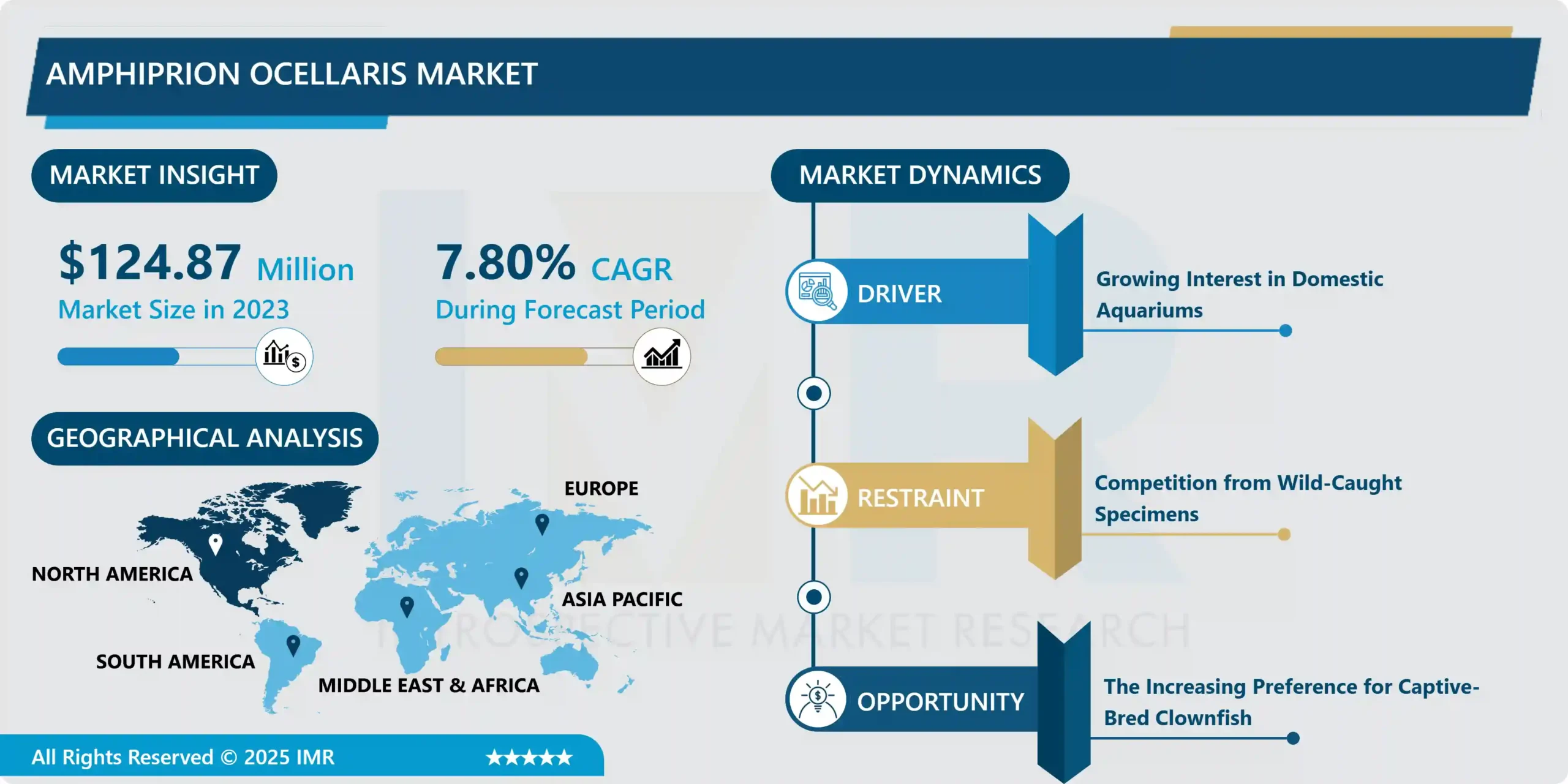
Amphiprion Ocellaris Market Size Was Valued at USD 124.87 Million in 2023, and is Projected to Reach USD 227.72 Million by 2032, Growing at a CAGR of 7.80% From 2024-2032.
Inside of fish keeping, the commercial demand for Amphiprion ocellaris, popularly named the clownfish or ocellaris clownfish, remains highly lucrative. The ornamental fish’s appealing appearance, coupled with its hardiness and compatibility with various species in the aquarium, renders it a favorite amongst hobbyists. Hobbyists and enthusiasts who want to provide their own tanks with a touch of tropical flair are the main forces of consumer demand. In the last few years, it seems to be a trend to use sustainable practices and captive breeding as measures which could reduce the risk of species loss due to overfishing on natural populations. In return, captive-bred specimens are gaining preference which result in the shape up of the market trend based on higher environmental awareness.
The far-reaching market for Amphiprion ocellaris is rapidly growing as a result of the enhanced need for marine aquariums. The greater the number of hobbyists the more they tend to want the most colorful and distinctive examples such as ocellaris clownfish.
Maturity of captive reproduction technology is another component that triggers the market’s growth. Through captive breeding program and the establishment of sustainable practices we have been able to relieve untamed populations of pressure and also meet customers’ ethical demands.
In addition to that, the latest reproductive technology in captivity is capable of fueling the market growth. We will alleviate the pressure on wild populations and satisfy the demand of the market with the capture of the captive-breeding species and adopting the sustainable principles.
Engineering advancements, such as automatic feeding devices, advanced filtration systems, and LED lighting, have revolutionized aquarium maintenance, making it easier and more enjoyable to aquarium owners. The rise of this sport becomes a catalyst for an increase in its popularity, leading to a booming market ocellaris clownfish and other sea organisms.
Amphiprion Ocellaris Market Trend Analysis
Captive Breeding to Boost the Market Growth
Our prediction is the significant growth of the market for clownfish, Amphiprion ocellaris, in association with a visible trend towards implementing captive breeding programs and sustainable operations. More and more consumers today are becoming environmental conservation-conscious bringing forth the choice of ethically sourced aquatic species.
Ocellaris clownfish breeding for the market has been spurred by shifts in consumer behavior that favor the eco-friendly choice of captive-bred fish over wild-harvested specimens.
Along with the production of stronger and more resilient specimens, captive breeding also assures the sustainability of supply which is adored by novice and experienced fish lovers alike
Besides, the upgraded captive breeding methods have contributed to increased market availability and variety of products. Through the process, breeders constantly improve their methods in order to produce captivatingly colorful specimens with outstanding markings to meet the discriminating eye of aquarium enthusiasts.
Yet, captive breeding also has some conservation benefits in the sense that it helps the conservation of coral reef ecosystems, where ocellaris clownfish naturally resides, by taking the pressure off the natural populations.
With the stated determinants, the marke The prospect that this celebrated marine species will be protected and the industry will thrive is high because of the consumer inclination for sustainability and possibility of innovation and gaining audience through captive breeding.
Commercial Aquarium that Gives the Market Extra Boost
The increasing popularity of commercial aquariums has a major influence on the market expansion of Amphiprion ocellaris in its fairly changing one. Tanks, ranging both the private sector and public ones, are being enjoyed by increasing number of people because of their recreational, educational and entertainment aspects.
These are the encounters that visitors have that enable them to explore underwater worlds full of moving life forms like ocellaris clownfish that is widely known and the main symbol of the Great Barrier Reef.
The commercial aquaria have had a tremendous effect on the market for ocellaris clownfish through various processes. Primarily, they serve as impressive displays of the richness and diversity of marine creatures which stimulate, in visitors of all ages, amazement and curiosity. With tourists flocking to such attractions, the exhibits become a source of demand for ocellaris and other species.
In addition, commercial aquariums generally cooperate with captive breeding programs and conservation efforts at the same time, thus meeting the increasing expectations of the consumer regarding sustainable practices.
The task of this kind of establishments is to encourage responsible attitude towards marine resources and introduce captive-bred specimens. It is accomplished by creating a link between people and the ocean and by maintaining healthy populations in the wild.
Besides this, partnership among all the actors in the industry, like suppliers, breeders, and conservation organizations, is built through commercial aquariums, which promotes creation of new products and market expansion.
The commercial aquariums, thanks to their ongoing achievements as the recreational and educational hubs, have enough power to influence much more the future of the jewelfish industry.
Amphiprion Ocellaris Market Segment Analysis:
Amphiprion Ocellaris Market Segmented based on By Type, and By Application
By Type, Black Types segment is expected to dominate the market during the forecast period
A coloured variation is an important reason which certainly impacts consumers choice and market dynamics among Amphiprion ocellaris market particularly, those in black or orange colours.
There exists some groups of aquarium enthusiasts who want to keep this type of fish in their aquarium, especially the black ocellaris race that appeals to those who need to make it a contrasting environment. No types similar to this one in terms of its one of a kind aesthetics therefore cause it to be the top pick for collectors and fans as they seek to own this special look on their shelves.
On the other hand, the orange variant of the Ocellaris clownfish, with its bright colors of orange, white, and black, has certainly become a permanent favorite in its category. In addition to its distinctive look that typically resembles the famous orange fish portrayed in popular culture, it is someone’s favorite whether a beginner or an expert. its energetic atmosphere and bright colors turns it into the most mesmerizing focal point of both aquariums be it residential or commercial ones.
The large range of color attributes that consumers in the Amphiprion ocellaris market can choose from give rise to a colorful and lively industry, as shown by the continued popularity of the orange variety, and also the mysterious attractiveness of the black variety.
By Application, Commercial Aquarium segment held the largest share in 2024
Clownfish Ocellaris play an indispensable role in the commercial aquariums for the reason that they add an element of vivacity and vigor to public exhibits and entertainment centers. They creatively use their physical features and humorous behavior to educate people of all ages about marine diversity and entertain their audience.
Ocellaris clownfish is constantly regarded by aquarium operators that are mainly commercial to enhance their aquariums’ aesthetics and economy of operation. Fish breeding for beautiful coloration and richness causes higher demand.
However, the main forces of ocellaris clownfish demand in private aquariums are the people who wish to build their own aquatic ecosystems for their household use. Ocellaris clownfish are well adapted to aquarium conditions and they would fit in almost any aquarium size and layout.
These luminescent fish either being the most dominant species in a reef tank or members in a community of marine life add the feeling of the tropic in aquariums at home.
The ocellaris clownfish market in home aquariums is currently experiencing stable growth as a result of enhancements in aquarium technology and more and more specimens being bred in captivity. This addresses the niche market of different types of aquatic lovers worldwide.
Amphiprion Ocellaris Market Regional Insights:
North America Dominating the Market Across the Globe
North America becomes the leading area in the global market for Clownfish, scientifically known as Amphiprion ocellaris. The robust infrastructure of the region and the thriving aquarium hobbyist community ensure that this region shapes the market trends and the demand for this species. There are several things that create a market supremacy of Ocellaris clownfish in North America.
Firstly, a widespread network of clownfish hobbyists, retailers, and wholesalers creates a solid foundation for the trade and commerce in the vicinity. Different aquarium retailers and digital platforms give aficionados quick access to a huge variety of organisms, including captive-bred individuals plus morphs of different colors.
Additionally, the prevailing culture of innovation and entrepreneurship in the aquarium industry in North America has fostered the evolution of environmentally friendly approaches and sophisticated breeding techniques. Through responsible stewardship investing, market can be assured, not only the availability of high-quality specimens but also consumer trust in continuous sustainability.
Secondly, the region’s wealthy population and strong purchasing power are major factors in the growing demand for premium aquarium species like ocellaris clownfish. As aquarium owners turn more and more to ensure the welfare and health of aquatic species, the North American market for naturally bred and ethically sourced clownfish is still going strong, which strengthens its leading role in the global market.
Active Key Players in the Amphiprion Ocellaris Market
ORA Clownfish
Fisheries Research Institute
Sustainable Aquatics
Sea & Reef
AMF
Zhejiang Mariculture Research Institute
Bali Aquarich
Captive Bred
Aquamarine International
Doni’s Reef.
Other Key Players
Chapter 1: Introduction
1.1 Scope and Coverage
Chapter 2:Executive Summary
Chapter 3: Market Landscape
3.1 Market Dynamics
3.1.1 Drivers
3.1.2 Restraints
3.1.3 Opportunities
3.1.4 Challenges
3.2 Market Trend Analysis
3.3 PESTLE Analysis
3.4 Porter’s Five Forces Analysis
3.5 Industry Value Chain Analysis
3.6 Ecosystem
3.7 Regulatory Landscape
3.8 Price Trend Analysis
3.9 Patent Analysis
3.10 Technology Evolution
3.11 Investment Pockets
3.12 Import-Export Analysis
Chapter 4: Amphiprion Ocellaris Market by Type (2018-2032)
4.1 Amphiprion Ocellaris Market Snapshot and Growth Engine
4.2 Market Overview
4.3 Black Types
4.3.1 Introduction and Market Overview
4.3.2 Historic and Forecasted Market Size in Value USD and Volume Units
4.3.3 Key Market Trends, Growth Factors, and Opportunities
4.3.4 Geographic Segmentation Analysis
4.4 Orange Types
Chapter 5: Amphiprion Ocellaris Market by Application (2018-2032)
5.1 Amphiprion Ocellaris Market Snapshot and Growth Engine
5.2 Market Overview
5.3 Commercial Aquarium
5.3.1 Introduction and Market Overview
5.3.2 Historic and Forecasted Market Size in Value USD and Volume Units
5.3.3 Key Market Trends, Growth Factors, and Opportunities
5.3.4 Geographic Segmentation Analysis
5.4 Home Aquarium
Chapter 6: Company Profiles and Competitive Analysis
6.1 Competitive Landscape
6.1.1 Competitive Benchmarking
6.1.2 Amphiprion Ocellaris Market Share by Manufacturer (2024)
6.1.3 Industry BCG Matrix
6.1.4 Heat Map Analysis
6.1.5 Mergers and Acquisitions
6.2 DOW CHEMICAL COMPANY (USA)
6.2.1 Company Overview
6.2.2 Key Executives
6.2.3 Company Snapshot
6.2.4 Role of the Company in the Market
6.2.5 Sustainability and Social Responsibility
6.2.6 Operating Business Segments
6.2.7 Product Portfolio
6.2.8 Business Performance
6.2.9 Key Strategic Moves and Recent Developments
6.2.10 SWOT Analysis
6.3 EASTMAN CHEMICAL COMPANY (USA)
6.4 VERTELLUS HOLDINGS LLC (USA)
6.5 VERTELLUS SPECIALTIES INC. (USA)
6.6 IFF (USA)
6.7 ADVANCED BIOTECH (USA)
6.8 PRINOVA (USA)
6.9 BOC SCIENCES (USA)
6.10 BASF SE (GERMANY)
6.11 VENTÓS (SPAIN)
6.12 INOUE PERFUMERY (JAPAN)
6.13 SHAANXI DIDEU MEDICHEM (CHINA)
6.14 TOKYO CHEMICAL INDUSTRY COLTD. (JAPAN)
6.15 AND OTHER MAJOR KEY PLAYERS
Chapter 7: Global Amphiprion Ocellaris Market By Region
7.1 Overview
7.2. North America Amphiprion Ocellaris Market
7.2.1 Key Market Trends, Growth Factors and Opportunities
7.2.2 Top Key Companies
7.2.3 Historic and Forecasted Market Size by Segments
7.2.4 Historic and Forecasted Market Size by Type
7.2.4.1 Black Types
7.2.4.2 Orange Types
7.2.5 Historic and Forecasted Market Size by Application
7.2.5.1 Commercial Aquarium
7.2.5.2 Home Aquarium
7.2.6 Historic and Forecast Market Size by Country
7.2.6.1 US
7.2.6.2 Canada
7.2.6.3 Mexico
7.3. Eastern Europe Amphiprion Ocellaris Market
7.3.1 Key Market Trends, Growth Factors and Opportunities
7.3.2 Top Key Companies
7.3.3 Historic and Forecasted Market Size by Segments
7.3.4 Historic and Forecasted Market Size by Type
7.3.4.1 Black Types
7.3.4.2 Orange Types
7.3.5 Historic and Forecasted Market Size by Application
7.3.5.1 Commercial Aquarium
7.3.5.2 Home Aquarium
7.3.6 Historic and Forecast Market Size by Country
7.3.6.1 Russia
7.3.6.2 Bulgaria
7.3.6.3 The Czech Republic
7.3.6.4 Hungary
7.3.6.5 Poland
7.3.6.6 Romania
7.3.6.7 Rest of Eastern Europe
7.4. Western Europe Amphiprion Ocellaris Market
7.4.1 Key Market Trends, Growth Factors and Opportunities
7.4.2 Top Key Companies
7.4.3 Historic and Forecasted Market Size by Segments
7.4.4 Historic and Forecasted Market Size by Type
7.4.4.1 Black Types
7.4.4.2 Orange Types
7.4.5 Historic and Forecasted Market Size by Application
7.4.5.1 Commercial Aquarium
7.4.5.2 Home Aquarium
7.4.6 Historic and Forecast Market Size by Country
7.4.6.1 Germany
7.4.6.2 UK
7.4.6.3 France
7.4.6.4 The Netherlands
7.4.6.5 Italy
7.4.6.6 Spain
7.4.6.7 Rest of Western Europe
7.5. Asia Pacific Amphiprion Ocellaris Market
7.5.1 Key Market Trends, Growth Factors and Opportunities
7.5.2 Top Key Companies
7.5.3 Historic and Forecasted Market Size by Segments
7.5.4 Historic and Forecasted Market Size by Type
7.5.4.1 Black Types
7.5.4.2 Orange Types
7.5.5 Historic and Forecasted Market Size by Application
7.5.5.1 Commercial Aquarium
7.5.5.2 Home Aquarium
7.5.6 Historic and Forecast Market Size by Country
7.5.6.1 China
7.5.6.2 India
7.5.6.3 Japan
7.5.6.4 South Korea
7.5.6.5 Malaysia
7.5.6.6 Thailand
7.5.6.7 Vietnam
7.5.6.8 The Philippines
7.5.6.9 Australia
7.5.6.10 New Zealand
7.5.6.11 Rest of APAC
7.6. Middle East & Africa Amphiprion Ocellaris Market
7.6.1 Key Market Trends, Growth Factors and Opportunities
7.6.2 Top Key Companies
7.6.3 Historic and Forecasted Market Size by Segments
7.6.4 Historic and Forecasted Market Size by Type
7.6.4.1 Black Types
7.6.4.2 Orange Types
7.6.5 Historic and Forecasted Market Size by Application
7.6.5.1 Commercial Aquarium
7.6.5.2 Home Aquarium
7.6.6 Historic and Forecast Market Size by Country
7.6.6.1 Turkiye
7.6.6.2 Bahrain
7.6.6.3 Kuwait
7.6.6.4 Saudi Arabia
7.6.6.5 Qatar
7.6.6.6 UAE
7.6.6.7 Israel
7.6.6.8 South Africa
7.7. South America Amphiprion Ocellaris Market
7.7.1 Key Market Trends, Growth Factors and Opportunities
7.7.2 Top Key Companies
7.7.3 Historic and Forecasted Market Size by Segments
7.7.4 Historic and Forecasted Market Size by Type
7.7.4.1 Black Types
7.7.4.2 Orange Types
7.7.5 Historic and Forecasted Market Size by Application
7.7.5.1 Commercial Aquarium
7.7.5.2 Home Aquarium
7.7.6 Historic and Forecast Market Size by Country
7.7.6.1 Brazil
7.7.6.2 Argentina
7.7.6.3 Rest of SA
Chapter 8 Analyst Viewpoint and Conclusion
8.1 Recommendations and Concluding Analysis
8.2 Potential Market Strategies
Chapter 9 Research Methodology
9.1 Research Process
9.2 Primary Research
9.3 Secondary Research
Q1: What would be the forecast period in the Amphiprion Ocellaris Market research report?
A1: The forecast period in the Amphiprion Ocellaris Market research report is 2024-2032.
Q2: Who are the key players in the Amphiprion Ocellaris Market?
A2: Vivid Aquariums (USA), Clownfish.org (USA), Biota Aquariums (Australia), Sustainable Aquatics (USA), Captive Bred (USA), LiveAquaria (USA), ORA (USA), Sea & Reef (USA), Blue Zoo Aquatics (USA), Proaquatix (USA), Clownfish Breeding (USA), Blue Earth Farms (USA), AlgaeBarn (USA), Sustainable Marine Canada (Canada), Marine Center Indonesia (Indonesia), and Other Major Players.
Q3: What are the segments of the Amphiprion Ocellaris Market?
A3: The Amphiprion Ocellaris Market is segmented into Type, Application, and region. By Type, the market is categorized into Black Types, Orange Types. By Application, the market is categorized into Commercial Aquarium, Home Aquarium. By region, it is analyzed across North America (U.S.; Canada; Mexico), Eastern Europe (Bulgaria; The Czech Republic; Hungary; Poland; Romania; Rest of Eastern Europe), Western Europe (Germany; UK; France; Netherlands; Italy; Russia; Spain; Rest of Western Europe), Asia-Pacific (China; India; Japan; Southeast Asia, etc.), South America (Brazil; Argentina, etc.), Middle East & Africa (Saudi Arabia; South Africa, etc.).
Q4: What is the Amphiprion Ocellaris Market?
A4: Amphiprion ocellaris, commonly known as the clownfish, is a small, vibrantly colored fish found in the warm waters of the Pacific and Indian Oceans. Renowned for its striking orange body adorned with bold white stripes outlined in black, it's one of the most recognizable reef inhabitants. Belonging to the family Pomacentridae, this species forms symbiotic relationships with sea anemones, utilizing their tentacles for protection from predators and in return offering food scraps and protection against parasites.
Q5: How big is the Amphiprion Ocellaris Market?
A5: Amphiprion Ocellaris Market Size Was Valued at USD 124.87 Million in 2023, and is Projected to Reach USD 227.72 Million by 2032, Growing at a CAGR of 7.80% From 2024-2032.
How to Buy a Report from eminsights.jp
On the product page, choose the license you want: Single-User License, Multi-User License or Enterprise License.
If you required report in your native language, then you can click on Translated Report button and fill out the form with report name and language you want, then our team will contact you as soon as possible.
Click the Buy Now button.
You will be redirected to the checkout page. Enter your company details and payment information.
Click Place Order to complete the purchase.
Confirmation: You’ll receive an order confirmation and our team will contact you shortly with your ordered report.
If you have any questions, fill out the contact form below or email us at bizdev@eminsights.net.
Thank you for choosing eminsights.jp!