Stay Ahead in Fast-Growing Economies.
Browse Reports Now
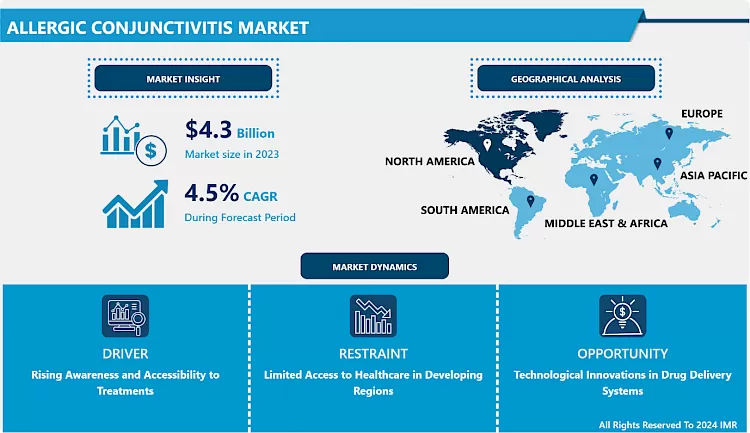
Allergic Conjunctivitis Market – Current Analysis 2024-2032
Allergic conjunctivitis is an inflammation of the conjunctiva, a thin membrane that covers the eye’s white part and the inner eyelid as a result of an allergic reaction. This is a commonly known eye condition that results when the eyes come into contact with allergens like pollen, dust, mites or even animal skin. The condition can be seasonal or perennial and its management includes; antihistamines, mast cell stabilizers, corticosteroids among others.

IMR Group
Description
Allergic Conjunctivitis Market Synopsis:
Allergic Conjunctivitis Market Size was valued at USD 4.3 Billion in 2023, and is Projected to Reach USD 6.39 Billion by 2032, Growing at a CAGR of 4.5% From 2024-2032.
Allergic conjunctivitis is an inflammation of the conjunctiva, a thin membrane that covers the eye’s white part and the inner eyelid as a result of an allergic reaction. This is a commonly known eye condition that results when the eyes come into contact with allergens like pollen, dust, mites or even animal skin. The condition can be seasonal or perennial and its management includes; antihistamines, mast cell stabilizers, corticosteroids among others.
This is one of the main reasons for the growth of the Allergic Conjunctivitis market; as allergies become more common around the world. Air pollution, altered life patterns, and growing interaction with allergens add to the considerably higher rates of allergic reactions such as conjunctivitis. Also, the increased visibility and accessibility of OT&E and prescription products are also driving the sales of allergy relief products.
Another factor that is causing this particular market to expand is the growing reliance to digital devices – with more time on the screens, most people experience eye strain and pauediculitis worsening the allergic conjunctivitis. Also, the prolonged existence of chronic allergies in people means that the target population is increasing along with the aging of society. Continual improvements in diagnostic equipment and a steady progress made in the development of superior medical drugs also contribute to the growing market.
Allergic Conjunctivitis Market Trend Analysis:
Increases the effectiveness of the treatments
It was identified that a significant driver of the Allergic Conjunctivitis dynamics is the transition to individualized treatment. Currently, with the help of better diagnostic procedures the therapy tends to be more directed to the eliciting allergens. It not only increases the effectiveness of the treatments being offered, but also reduces the effect of the side effects to make patients happier.
Another new direction in allergic diseases management is the use of biologic agents, like monoclonal antibodies, which are currently being produced to interfere with key processes involved in allergy. These treatments present new recognition or improved methodology or possibly safer approach to previously used therapies anticipated to grow in the near future due to more targeted action profiles.
Rising demand for natural and other marginal remedies
Allergic Conjunctivitis medication market has attributed the increasing growth to rising demand for natural and other marginal remedies to cure diseases. Health care consumers are more opting for harmless treatments which explains why herbal and homeopathic products are gradually being adopted. This could develop new demand areas for organizations that supply non-pharmacological therapies.
Thirdly, there remain several under explored growth opportunities, including growing markets, especially in the Asia Pacific and Latin America. It has to be noted that with the overall process of of urbanization and raise of allergic diseases incidence within these territories the demand on relevant treatments, such as those used for allergic conjunctivitis, will also be growing. The firms should be able to grow its distribution channel and also develop regional products which could easily address the market needs of these regions.
Allergic Conjunctivitis Market Segment Analysis:
Allergic Conjunctivitis Market is segmented on the basis of Type, Treatment, End-User, and Region
Type, Seasonal Allergic Conjunctivitis segment is expected to dominate the market during the forecast period
The Allergic Conjunctivitis market is primarily segmented into two types: Seasonal Allergic Conjunctivitis (SAC) and Perennial Allergic Conjunctivitis (PAC). SAC is initiated by environmental allergens such as pollen which offer higher incidences throughout spring or fall. PAC, on the hand, is a result of allergens that are present throughout the year such as dust mite, pet dander and mold. These two types also have different factors relating to the season and environment since patients with different conditions require different treatments while patients’ behaviors also vary depending on the type of chronic condition they have.
Treatment, Antihistamines segment expected to held the largest share
The treatment segment of Allergic Conjunctivitis contains different categories of therapies such as antihistamines, mast cell stabilizers, NSAIDs, corticosteroids and other therapies. Specifically, antihistamines are effectors which prevent histamine from provoking allergic reactions. Some of the desensitizers work by stabilising mast cells and therefore reduce the release of histamine and other inflammatory mediators. Aspirin and other NSAIDs act as antirheumatic drugs that decrease inflammation, but strong anti-inflammatory medication are corticosteroids used in more severe cases. Other treatments are decongestants and immunotherapy and may be used together to gain better control on the symptoms.
Allergic Conjunctivitis Market Regional Insights:
North America is Expected to Dominate the Market Over the Forecast period
North America leads the Allergic Conjunctivitis market because of concerns made about patient care, accessibility of treatments and sound healthcare facilities. Many pharma players are located in the region and are actively involved in the development of new product and technologies for treating allergy in the region hence boosting the market.
There is a growing concern with the different allergic condition thus the availability of better treatments in North America that is driving the market growth. There is great demand for OTC and essential prescription drugs; therefore, allergies are quickly on the rise within the people, meaning that the market will keep growing.
Active Key Players in the Allergic Conjunctivitis Market
AbbVie (USA)
Alcon (Switzerland)
Bausch & Lomb (USA)
Johnson & Johnson Vision Care (USA)
Meda Pharmaceuticals (Sweden)
Novartis (Switzerland)
Ocular Therapeutix (USA)
Regeneron Pharmaceuticals (USA)
Sanofi (France)
Santen Pharmaceutical (Japan)
Other Active Players
Industry Key Development in Allergic Conjunctivitis Market:
In July 2023, Harrow announced the signing of an agreement with Santen Pharmaceutical Co., Ltd. to acquire U.S. and Canadian commercial rights for six branded ophthalmic products. This strategic acquisition allowed Harrow to expand its ophthalmic product portfolio, enhancing its position in the global eye care market. The deal marks a significant milestone for Harrow, further strengthening its presence and capabilities in the ophthalmic sector. By acquiring these rights, Harrow aims to deliver innovative solutions to meet the growing needs of eye care patients in North America. The transaction underscores Harrow’s commitment to growth and leadership in ophthalmic healthcare.
Chapter 1: Introduction
1.1 Scope and Coverage
Chapter 2:Executive Summary
Chapter 3: Market Landscape
3.1 Market Dynamics
3.1.1 Drivers
3.1.2 Restraints
3.1.3 Opportunities
3.1.4 Challenges
3.2 Market Trend Analysis
3.3 PESTLE Analysis
3.4 Porter’s Five Forces Analysis
3.5 Industry Value Chain Analysis
3.6 Ecosystem
3.7 Regulatory Landscape
3.8 Price Trend Analysis
3.9 Patent Analysis
3.10 Technology Evolution
3.11 Investment Pockets
3.12 Import-Export Analysis
Chapter 4: Allergic Conjunctivitis Market by Type (2018-2032)
4.1 Allergic Conjunctivitis Market Snapshot and Growth Engine
4.2 Market Overview
4.3 Seasonal Allergic Conjunctivitis
4.3.1 Introduction and Market Overview
4.3.2 Historic and Forecasted Market Size in Value USD and Volume Units
4.3.3 Key Market Trends, Growth Factors, and Opportunities
4.3.4 Geographic Segmentation Analysis
4.4 Perennial Allergic Conjunctivitis
Chapter 5: Allergic Conjunctivitis Market by Treatment (2018-2032)
5.1 Allergic Conjunctivitis Market Snapshot and Growth Engine
5.2 Market Overview
5.3 Antihistamines
5.3.1 Introduction and Market Overview
5.3.2 Historic and Forecasted Market Size in Value USD and Volume Units
5.3.3 Key Market Trends, Growth Factors, and Opportunities
5.3.4 Geographic Segmentation Analysis
5.4 Mast Cell Stabilizers
5.5 Nonsteroidal Anti-inflammatory Drugs(NSAIDs)
5.6 Corticosteroids
5.7 Others
Chapter 6: Allergic Conjunctivitis Market by End-User (2018-2032)
6.1 Allergic Conjunctivitis Market Snapshot and Growth Engine
6.2 Market Overview
6.3 Hospitals
6.3.1 Introduction and Market Overview
6.3.2 Historic and Forecasted Market Size in Value USD and Volume Units
6.3.3 Key Market Trends, Growth Factors, and Opportunities
6.3.4 Geographic Segmentation Analysis
6.4 Ophthalmology Clinics
6.5 Home Care Settings
Chapter 7: Company Profiles and Competitive Analysis
7.1 Competitive Landscape
7.1.1 Competitive Benchmarking
7.1.2 Allergic Conjunctivitis Market Share by Manufacturer (2024)
7.1.3 Industry BCG Matrix
7.1.4 Heat Map Analysis
7.1.5 Mergers and Acquisitions
7.2 ABBVIE (USA)
7.2.1 Company Overview
7.2.2 Key Executives
7.2.3 Company Snapshot
7.2.4 Role of the Company in the Market
7.2.5 Sustainability and Social Responsibility
7.2.6 Operating Business Segments
7.2.7 Product Portfolio
7.2.8 Business Performance
7.2.9 Key Strategic Moves and Recent Developments
7.2.10 SWOT Analysis
7.3 ALCON (SWITZERLAND)
7.4 BAUSCH & LOMB (USA)
7.5 JOHNSON & JOHNSON VISION CARE (USA)
7.6 MEDA PHARMACEUTICALS (SWEDEN)
7.7 NOVARTIS (SWITZERLAND)
7.8 OCULAR THERAPEUTIX (USA)
7.9 REGENERON PHARMACEUTICALS (USA)
7.10 SANOFI (FRANCE)
7.11 SANTEN PHARMACEUTICAL (JAPAN)
7.12
Chapter 8: Global Allergic Conjunctivitis Market By Region
8.1 Overview
8.2. North America Allergic Conjunctivitis Market
8.2.1 Key Market Trends, Growth Factors and Opportunities
8.2.2 Top Key Companies
8.2.3 Historic and Forecasted Market Size by Segments
8.2.4 Historic and Forecasted Market Size By Type
8.2.4.1 Seasonal Allergic Conjunctivitis
8.2.4.2 Perennial Allergic Conjunctivitis
8.2.5 Historic and Forecasted Market Size By Treatment
8.2.5.1 Antihistamines
8.2.5.2 Mast Cell Stabilizers
8.2.5.3 Nonsteroidal Anti-inflammatory Drugs(NSAIDs)
8.2.5.4 Corticosteroids
8.2.5.5 Others
8.2.6 Historic and Forecasted Market Size By End-User
8.2.6.1 Hospitals
8.2.6.2 Ophthalmology Clinics
8.2.6.3 Home Care Settings
8.2.7 Historic and Forecast Market Size by Country
8.2.7.1 US
8.2.7.2 Canada
8.2.7.3 Mexico
8.3. Eastern Europe Allergic Conjunctivitis Market
8.3.1 Key Market Trends, Growth Factors and Opportunities
8.3.2 Top Key Companies
8.3.3 Historic and Forecasted Market Size by Segments
8.3.4 Historic and Forecasted Market Size By Type
8.3.4.1 Seasonal Allergic Conjunctivitis
8.3.4.2 Perennial Allergic Conjunctivitis
8.3.5 Historic and Forecasted Market Size By Treatment
8.3.5.1 Antihistamines
8.3.5.2 Mast Cell Stabilizers
8.3.5.3 Nonsteroidal Anti-inflammatory Drugs(NSAIDs)
8.3.5.4 Corticosteroids
8.3.5.5 Others
8.3.6 Historic and Forecasted Market Size By End-User
8.3.6.1 Hospitals
8.3.6.2 Ophthalmology Clinics
8.3.6.3 Home Care Settings
8.3.7 Historic and Forecast Market Size by Country
8.3.7.1 Russia
8.3.7.2 Bulgaria
8.3.7.3 The Czech Republic
8.3.7.4 Hungary
8.3.7.5 Poland
8.3.7.6 Romania
8.3.7.7 Rest of Eastern Europe
8.4. Western Europe Allergic Conjunctivitis Market
8.4.1 Key Market Trends, Growth Factors and Opportunities
8.4.2 Top Key Companies
8.4.3 Historic and Forecasted Market Size by Segments
8.4.4 Historic and Forecasted Market Size By Type
8.4.4.1 Seasonal Allergic Conjunctivitis
8.4.4.2 Perennial Allergic Conjunctivitis
8.4.5 Historic and Forecasted Market Size By Treatment
8.4.5.1 Antihistamines
8.4.5.2 Mast Cell Stabilizers
8.4.5.3 Nonsteroidal Anti-inflammatory Drugs(NSAIDs)
8.4.5.4 Corticosteroids
8.4.5.5 Others
8.4.6 Historic and Forecasted Market Size By End-User
8.4.6.1 Hospitals
8.4.6.2 Ophthalmology Clinics
8.4.6.3 Home Care Settings
8.4.7 Historic and Forecast Market Size by Country
8.4.7.1 Germany
8.4.7.2 UK
8.4.7.3 France
8.4.7.4 The Netherlands
8.4.7.5 Italy
8.4.7.6 Spain
8.4.7.7 Rest of Western Europe
8.5. Asia Pacific Allergic Conjunctivitis Market
8.5.1 Key Market Trends, Growth Factors and Opportunities
8.5.2 Top Key Companies
8.5.3 Historic and Forecasted Market Size by Segments
8.5.4 Historic and Forecasted Market Size By Type
8.5.4.1 Seasonal Allergic Conjunctivitis
8.5.4.2 Perennial Allergic Conjunctivitis
8.5.5 Historic and Forecasted Market Size By Treatment
8.5.5.1 Antihistamines
8.5.5.2 Mast Cell Stabilizers
8.5.5.3 Nonsteroidal Anti-inflammatory Drugs(NSAIDs)
8.5.5.4 Corticosteroids
8.5.5.5 Others
8.5.6 Historic and Forecasted Market Size By End-User
8.5.6.1 Hospitals
8.5.6.2 Ophthalmology Clinics
8.5.6.3 Home Care Settings
8.5.7 Historic and Forecast Market Size by Country
8.5.7.1 China
8.5.7.2 India
8.5.7.3 Japan
8.5.7.4 South Korea
8.5.7.5 Malaysia
8.5.7.6 Thailand
8.5.7.7 Vietnam
8.5.7.8 The Philippines
8.5.7.9 Australia
8.5.7.10 New Zealand
8.5.7.11 Rest of APAC
8.6. Middle East & Africa Allergic Conjunctivitis Market
8.6.1 Key Market Trends, Growth Factors and Opportunities
8.6.2 Top Key Companies
8.6.3 Historic and Forecasted Market Size by Segments
8.6.4 Historic and Forecasted Market Size By Type
8.6.4.1 Seasonal Allergic Conjunctivitis
8.6.4.2 Perennial Allergic Conjunctivitis
8.6.5 Historic and Forecasted Market Size By Treatment
8.6.5.1 Antihistamines
8.6.5.2 Mast Cell Stabilizers
8.6.5.3 Nonsteroidal Anti-inflammatory Drugs(NSAIDs)
8.6.5.4 Corticosteroids
8.6.5.5 Others
8.6.6 Historic and Forecasted Market Size By End-User
8.6.6.1 Hospitals
8.6.6.2 Ophthalmology Clinics
8.6.6.3 Home Care Settings
8.6.7 Historic and Forecast Market Size by Country
8.6.7.1 Turkiye
8.6.7.2 Bahrain
8.6.7.3 Kuwait
8.6.7.4 Saudi Arabia
8.6.7.5 Qatar
8.6.7.6 UAE
8.6.7.7 Israel
8.6.7.8 South Africa
8.7. South America Allergic Conjunctivitis Market
8.7.1 Key Market Trends, Growth Factors and Opportunities
8.7.2 Top Key Companies
8.7.3 Historic and Forecasted Market Size by Segments
8.7.4 Historic and Forecasted Market Size By Type
8.7.4.1 Seasonal Allergic Conjunctivitis
8.7.4.2 Perennial Allergic Conjunctivitis
8.7.5 Historic and Forecasted Market Size By Treatment
8.7.5.1 Antihistamines
8.7.5.2 Mast Cell Stabilizers
8.7.5.3 Nonsteroidal Anti-inflammatory Drugs(NSAIDs)
8.7.5.4 Corticosteroids
8.7.5.5 Others
8.7.6 Historic and Forecasted Market Size By End-User
8.7.6.1 Hospitals
8.7.6.2 Ophthalmology Clinics
8.7.6.3 Home Care Settings
8.7.7 Historic and Forecast Market Size by Country
8.7.7.1 Brazil
8.7.7.2 Argentina
8.7.7.3 Rest of SA
Chapter 9 Analyst Viewpoint and Conclusion
9.1 Recommendations and Concluding Analysis
9.2 Potential Market Strategies
Chapter 10 Research Methodology
10.1 Research Process
10.2 Primary Research
10.3 Secondary Research
Q1: What would be the forecast period in the Allergic Conjunctivitis Market research report?
A1: The forecast period in the Allergic Conjunctivitis Market research report is 2024-2032.
Q2: Who are the key players in the Allergic Conjunctivitis Market?
A2: Alcon (Switzerland), Novartis (Switzerland), Bausch & Lomb (USA), AbbVie (USA), Regeneron Pharmaceuticals (USA), Sanofi (France), Meda Pharmaceuticals (Sweden), Johnson & Johnson Vision Care (USA), Santen Pharmaceutical (Japan), Ocular Therapeutix (USA) and Other Active Players.
Q3: What are the segments of the Allergic Conjunctivitis Market?
A3: The Allergic Conjunctivitis Market is segmented into Type, Treatment, End-User and region. Type, the market is categorized into Seasonal Allergic Conjunctivitis, Perennial Allergic Conjunctivitis. Treatment, the market is categorized into Antihistamines, Mast Cell Stabilizers, Nonsteroidal Anti-inflammatory Drugs (NSAIDs), Corticosteroids, Others. End-User, the market is categorized into Hospitals, Ophthalmology Clinics, Home Care Settings. By region, it is analyzed across North America (U.S.; Canada; Mexico), Eastern Europe (Bulgaria; The Czech Republic; Hungary; Poland; Romania; Rest of Eastern Europe), Western Europe (Germany; UK; France; Netherlands; Italy; Russia; Spain; Rest of Western Europe), Asia-Pacific (China; India; Japan; Southeast Asia, etc.), South America (Brazil; Argentina, etc.), Middle East & Africa (Saudi Arabia; South Africa, etc.).
Q4: What is the Allergic Conjunctivitis Market?
A4: Allergic conjunctivitis is an inflammation of the conjunctiva, a thin membrane that covers the eye’s white part and the inner eyelid as a result of an allergic reaction. This is a commonly known eye condition that results when the eyes come into contact with allergens like pollen, dust, mites or even animal skin. The condition can be seasonal or perennial and its management includes; antihistamines, mast cell stabilizers, corticosteroids among others.
Q5: How big is the Allergic Conjunctivitis Market?
A5: Allergic Conjunctivitis Market Size Was Valued at USD 4.3 Billion in 2023, and is Projected to Reach USD 6.39 Billion by 2032, Growing at a CAGR of 4.5% From 2024-2032.
How to Buy a Report from eminsights.jp
On the product page, choose the license you want: Single-User License, Multi-User License or Enterprise License.
If you required report in your native language, then you can click on Translated Report button and fill out the form with report name and language you want, then our team will contact you as soon as possible.
Click the Buy Now button.
You will be redirected to the checkout page. Enter your company details and payment information.
Click Place Order to complete the purchase.
Confirmation: You’ll receive an order confirmation and our team will contact you shortly with your ordered report.
If you have any questions, fill out the contact form below or email us at bizdev@eminsights.net.
Thank you for choosing eminsights.jp!