Stay Ahead in Fast-Growing Economies.
Browse Reports Now




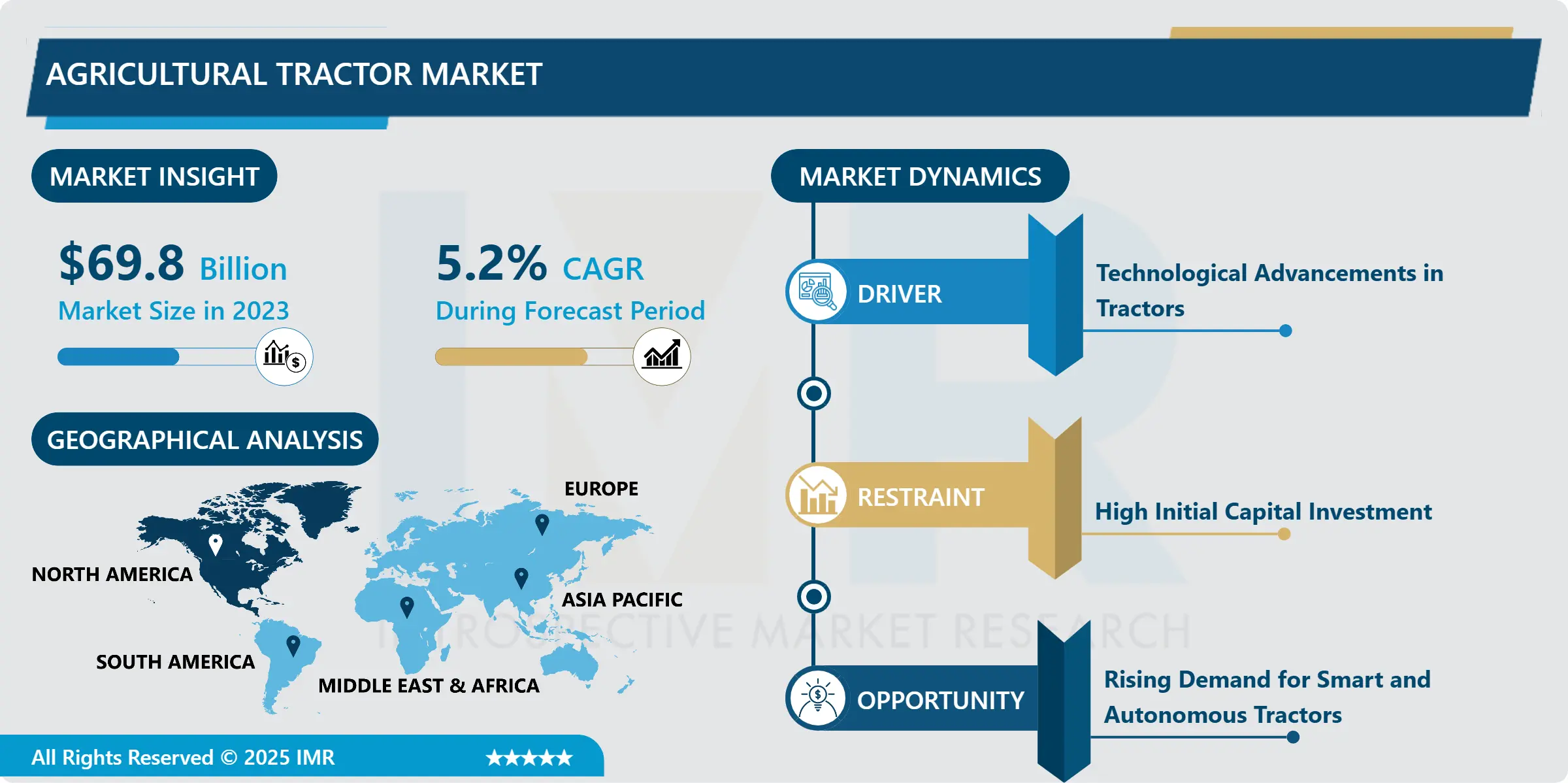
Agricultural Tractor Market Size, Share, Growth & Forecast (2024-2032)
Agricultural Tractor Market Size Was Valued at USD 69.80 Billion in 2023, and is Projected to Reach USD 105.61 Billion by 2032, Growing at a CAGR of 5.20%From 2024-2032.

IMR Group
Description
Agricultural Tractor Market Synopsis:
Agricultural Tractor Market Size Was Valued at USD 69.80 Billion in 2023, and is Projected to Reach USD 105.61 Billion by 2032, Growing at a CAGR of 5.20%From 2024-2032.
Agricultural tractor market means the global industry that deals with the production, distribution and sale of tractors that are used in agricultural activities including planting, harvesting, plowing and tilling. Today these tractors are seen as implements for contemporary farming, providing farming improvements through the efficiency of productivity, handling a variety of farming tasks. It is characterized by increased demand for mechanization, output demand for food, changing tractor design through technology factors such as automation, GPS among others and fuel efficiency. It involves many types of tractors for instance compact, utility, row crops tractors and the high horse power tractors for farmers and other individuals in agriculture related businesses with different regions.
The agricultural tractor market is a growing market and has shown a great deal of growth over the last decade due to increased demand for higher agricultural productivity and general mechanization of agricultural practices all over the world. Tractors play an important role of imitating a number of operations in agriculture including plowing, tilling, planting and harvesting among others. As the population increases and the world looks for ways to increase farm output to feed the ever-growing population, there has been development of new improved models of agricultural tractors to provide optimum solutions in terms of power and fuel efficiency as well as with concern for the environment. It is a market that comprises of both old traditional tractors as well as new tractors with GPS tracking systems, self-driving and self- operating options to improve on farming activities.
However, the demand for agricultural tractors differs across the regions – North America and European countries have the highest rate of adoption due to the increased use of modern methods in farming, and increased number of established farming companies. On the other hand, the Asia-Pacific region appears set to lead the volume all things considering due to the existence of many small-scale farms and polices towards mechanization. Also, the upsurge in the development of precision farming and the growing interest in advanced agricultural practices require hi-tech tractors in new generation markets. Other factors like the pressure to cut down on labor, increase crop yields and to attain higher productivity levels are deemed to drive other markets in future. However, the initial costs of acquiring the advanced tractors will remain high, as will the cost of maintaining and operating the machinery, which might prove to be a disadvantage for the small holder farmers in remote regions. However, the agricultural tractor market is expected to grow continuously in the future, limiting factors such as the introduction of electric tractors and smart farming equipment in development.
Agricultural Tractor Market Trend Analysis:
Automation, Technology, and Sustainability
The change that has taken place in the adoption of automation and technology in agriculture is most as a result of the efforts to increase farming per unit area hence productivity, down-surge the costs of labor, as well as to meet the increasing food demand due to population growth around the world. Cultivator which are a basic tool in today’s agriculture are important tools that are used in such processes as plowing, tilling and planting. Technological advancement, that includes a GPS system, automated steering, and telematics, has added a new level of efficiency to the agricultural tractors. Such technologies help farmers work more accurately which increases yield per unit area and use of resources efficiently. Farmers are embracing these innovations in order to keep their production relevant and capable of feeding the ever-growing population.
Besides these advancements, embedding features such as AI and IoT deliver advanced innovation solutions to agricultural tractors making them more intelligent and information based. Other tractors can offer the use to gather real-time data, with the help of which, farmers can make decision about irrigation, fertilizer application and other managerial issues. This technological change is not only increasing efficiency but is also leading towards maintaining a sustainable agriculture environment. With farmers increasingly utilizing higher value precision tools for operation, agricultural tractors continue to fulfill a leadership role in the effort toward bio-mimetic, resource efficient farming systems.
Growth Opportunities in the Agricultural Tractor Market
Because of growth in world population, farming companies have been forced to use modern technology to increase production and output. This transformation is greatly facilitated by tractors and other related vehicles that improve the speed of land preparation and planting, and also improve the harvesting time. They assist in chopping down the many operational cost which in turn raise the yield of crops hence being a vital equipment in farming. This change is even more noticeable when Southeast Asia and Central and Latin America have the largest portion of smallholders who use mechanical methods to increase production to feed the growing population. Currently, as some of these regions commence the process of modernization of agriculture, the market for tractors and related technologies still grows.
Such factors include government support for mechanization of agriculture business is also expected to fuel this market growth. This is that many countries are extending subsidies and requisite financial aids to farmers for utilizing sophisticated implements which includes tractors. These are alongside enhancing technologies like GPS tractor and accurate farming methods that enhance the farming practices. As they provide tractors to people and make tractors more efficient, these schemes are proving instrumental in the move to change towards mechanized farming. This demand from farmers and this support from governments are coming together to form a real and strong basis for the development of the agricultural tractor market, especially in developing countries.
Agricultural Tractor Market Segment Analysis:
Agricultural Tractor Market is Segmented on the basis of By Engine Power, Driveline, Propulsion, and Region
By Engine Power, more than 100 HP segment is expected to dominate the market during the forecast period
The second group of machines consists of those that are to be used in commercial farming, mining among others and hence they are fitted with engines that exceed 100 horsepower. These high-power machines are used for activities such as haulage, cultivation of large tracts of land and construction. Smaller machines cannot perform quite as complex of workloads, so they are able to take on much more work and provide better results. These include items such as large tractors, excavators and bulldozers which are generally needed in industries were tough working conditions are expected. In the developed nations, this demand remains high on account of the need to cater for higher capacity operations that are due to industrial growth.
Though these machines are enormous and highly productive, they are characterized by challenges such as high initial cost of purchase and high overhead costs. The larger engines have higher ongoing fuel costs and the need for more frequent maintenance of the fuel injection systems. Consequently, its demand is mostly confined to big companies or companies that will find the costs of their acquisition justified by the expected productivity boost. Concerning the limitations, small-scale operations or business people may lack the required cash to invest in these machines or the operational costs may exigently prove hard to meet hence are likely to deter adoption of the machines in some sectors or regions.
By Propulsion, Electric segment expected to held the largest share
Electric power systems in which electricity stored in batteries is used to drive machines or vehicles are fast finding their way in the market because of a number of advantages such as environmentally friendly and low operating cost. These systems are zero-emission, which goes well with the current trend of establishing products that do not harm the natural world. New breakthroughs in battery technology mean that electrically driven vehicles and equipment cost less and are more efficient. This is especially the case in such industries as agriculture where there is already a planning of electric tractors and harvesters in a bid to minimize the emissions of carbon by those industries. The construction industry too is reporting a growing trend of globally electrified equipment whose use is being propelled by sustainability and environmentalism.
An electrical motor, however, involves greater capital investment, but the fuel cost in terms of electricity, maintenance for a longer time span with low efficiency and higher fuel costs are anticipated to make the shift to electric machines popular among companies. With advancement in battery technology, we believe the cost of electric vehicles and machinery will gradually come down thus being able to penetrate deeper into many sectors. I would also like to add that numerous and strict emission and fossil fuel consumption standards also imply environmental factors as important in decision-making for companies intending to operate sustainably and in compliance with increasing legislation. Demand of electrical operated automobile and machineries is also anticipated to rise especially in areas which compliance with environmental and economic criteria is necessary.
Agricultural Tractor Market Regional Insights:
North America is Expected to Dominate the Market Over the Forecast period
The market of agricultural tractors in North America has been steady over the period due to high adoption rate of new technologies including precision farming and high demands for food production. Tractors are used extensively across the United States in big farms, particularly in mid-western and southern states the country, where most farming is carried out. Self-resources in the market are also helped by various government subsidies and policies for farmers making the advanced machinery more accessible to the market. These policies are still in place to encourage mechanization and thus the spread of modern high-performance tractors to improve productivity in the agriculture fornic.
As in Canada, there is a constant demand for the agricultural tractors and again it accentuates on equipment that can run efficiently in the climatic and geographical condition of the country. Due to the large farming practices in the country, tractors should be able to provide solving multiplicity of tasks and withstand different farming methodologies. In addition, general movements towards increased automation and the production of more electrically powered tractors are predicted to revolutionize the agriculture industry throughout North America. They render them sustainable and environmentally friendly innovations and enhances labour productivity to meet economic and ecological problems within the farming sector. These and other related technologies are expected to propel further advancement in the agricultural tractor market in the region.
Active Key Players in the Agricultural Tractor Market
AGCO Corp.
CLAAS KGaAmbH
CNH Industrial N.V.
Deere & Company
Escorts Ltd.
International Tractors Ltd.
KubotaCorp.
Mahindra & Mahindra Ltd.
Tractors and Farm Equipment Ltd.
YanmarCo., Ltd.
Other Active Players.
Chapter 1: Introduction
1.1 Scope and Coverage
Chapter 2:Executive Summary
Chapter 3: Market Landscape
3.1 Market Dynamics
3.1.1 Drivers
3.1.2 Restraints
3.1.3 Opportunities
3.1.4 Challenges
3.2 Market Trend Analysis
3.3 PESTLE Analysis
3.4 Porter’s Five Forces Analysis
3.5 Industry Value Chain Analysis
3.6 Ecosystem
3.7 Regulatory Landscape
3.8 Price Trend Analysis
3.9 Patent Analysis
3.10 Technology Evolution
3.11 Investment Pockets
3.12 Import-Export Analysis
Chapter 4: Agricultural Tractor Market by Engine Power
4.1 Agricultural Tractor Market Snapshot and Growth Engine
4.2 Agricultural Tractor Market Overview
4.3 Less than 40 HP
4.3.1 Introduction and Market Overview
4.3.2 Historic and Forecasted Market Size in Value USD and Volume Units (2017-2032F)
4.3.3 Key Market Trends, Growth Factors and Opportunities
4.3.4 Less than 40 HP: Geographic Segmentation Analysis
4.4 41 to 100 HP and More than 100 HP
4.4.1 Introduction and Market Overview
4.4.2 Historic and Forecasted Market Size in Value USD and Volume Units (2017-2032F)
4.4.3 Key Market Trends, Growth Factors and Opportunities
4.4.4 41 to 100 HP and More than 100 HP: Geographic Segmentation Analysis
Chapter 5: Agricultural Tractor Market by Driveline
5.1 Agricultural Tractor Market Snapshot and Growth Engine
5.2 Agricultural Tractor Market Overview
5.3 2WD and 4WD.
5.3.1 Introduction and Market Overview
5.3.2 Historic and Forecasted Market Size in Value USD and Volume Units (2017-2032F)
5.3.3 Key Market Trends, Growth Factors and Opportunities
5.3.4 2WD and 4WD. : Geographic Segmentation Analysis
Chapter 6: Agricultural Tractor Market by Propulsion
6.1 Agricultural Tractor Market Snapshot and Growth Engine
6.2 Agricultural Tractor Market Overview
6.3 Electric and ICE.
6.3.1 Introduction and Market Overview
6.3.2 Historic and Forecasted Market Size in Value USD and Volume Units (2017-2032F)
6.3.3 Key Market Trends, Growth Factors and Opportunities
6.3.4 Electric and ICE.: Geographic Segmentation Analysis
Chapter 7: Company Profiles and Competitive Analysis
7.1 Competitive Landscape
7.1.1 Competitive Benchmarking
7.1.2 Agricultural Tractor Market Share by Manufacturer (2023)
7.1.3 Industry BCG Matrix
7.1.4 Heat Map Analysis
7.1.5 Mergers and Acquisitions
7.2 AGCO CORP.
7.2.1 Company Overview
7.2.2 Key Executives
7.2.3 Company Snapshot
7.2.4 Role of the Company in the Market
7.2.5 Sustainability and Social Responsibility
7.2.6 Operating Business Segments
7.2.7 Product Portfolio
7.2.8 Business Performance
7.2.9 Key Strategic Moves and Recent Developments
7.2.10 SWOT Analysis
7.3 CLAAS KGA AMBH
7.4 CNH INDUSTRIAL N.V.
7.5 DEERE & COMPANY
7.6 ESCORTS LTD.
7.7 INTERNATIONAL TRACTORS LTD/
7.8 KUBOTA CORP.
7.9 MAHINDRA & MAHINDRA LTD.
7.10 TRACTORS AND FARM EQUIPMENT LTD.
7.11 YANMARCO. LTD
7.12 OTHER ACTIVE PLAYERS
Chapter 8: Global Agricultural Tractor Market By Region
8.1 Overview
8.2. North America Agricultural Tractor Market
8.2.1 Key Market Trends, Growth Factors and Opportunities
8.2.2 Top Key Companies
8.2.3 Historic and Forecasted Market Size by Segments
8.2.4 Historic and Forecasted Market Size By Engine Power
8.2.4.1 Less than 40 HP
8.2.4.2 41 to 100 HP and More than 100 HP
8.2.5 Historic and Forecasted Market Size By Driveline
8.2.5.1 2WD and 4WD.
8.2.6 Historic and Forecasted Market Size By Propulsion
8.2.6.1 Electric and ICE.
8.2.7 Historic and Forecast Market Size by Country
8.2.7.1 US
8.2.7.2 Canada
8.2.7.3 Mexico
8.3. Eastern Europe Agricultural Tractor Market
8.3.1 Key Market Trends, Growth Factors and Opportunities
8.3.2 Top Key Companies
8.3.3 Historic and Forecasted Market Size by Segments
8.3.4 Historic and Forecasted Market Size By Engine Power
8.3.4.1 Less than 40 HP
8.3.4.2 41 to 100 HP and More than 100 HP
8.3.5 Historic and Forecasted Market Size By Driveline
8.3.5.1 2WD and 4WD.
8.3.6 Historic and Forecasted Market Size By Propulsion
8.3.6.1 Electric and ICE.
8.3.7 Historic and Forecast Market Size by Country
8.3.7.1 Russia
8.3.7.2 Bulgaria
8.3.7.3 The Czech Republic
8.3.7.4 Hungary
8.3.7.5 Poland
8.3.7.6 Romania
8.3.7.7 Rest of Eastern Europe
8.4. Western Europe Agricultural Tractor Market
8.4.1 Key Market Trends, Growth Factors and Opportunities
8.4.2 Top Key Companies
8.4.3 Historic and Forecasted Market Size by Segments
8.4.4 Historic and Forecasted Market Size By Engine Power
8.4.4.1 Less than 40 HP
8.4.4.2 41 to 100 HP and More than 100 HP
8.4.5 Historic and Forecasted Market Size By Driveline
8.4.5.1 2WD and 4WD.
8.4.6 Historic and Forecasted Market Size By Propulsion
8.4.6.1 Electric and ICE.
8.4.7 Historic and Forecast Market Size by Country
8.4.7.1 Germany
8.4.7.2 UK
8.4.7.3 France
8.4.7.4 The Netherlands
8.4.7.5 Italy
8.4.7.6 Spain
8.4.7.7 Rest of Western Europe
8.5. Asia Pacific Agricultural Tractor Market
8.5.1 Key Market Trends, Growth Factors and Opportunities
8.5.2 Top Key Companies
8.5.3 Historic and Forecasted Market Size by Segments
8.5.4 Historic and Forecasted Market Size By Engine Power
8.5.4.1 Less than 40 HP
8.5.4.2 41 to 100 HP and More than 100 HP
8.5.5 Historic and Forecasted Market Size By Driveline
8.5.5.1 2WD and 4WD.
8.5.6 Historic and Forecasted Market Size By Propulsion
8.5.6.1 Electric and ICE.
8.5.7 Historic and Forecast Market Size by Country
8.5.7.1 China
8.5.7.2 India
8.5.7.3 Japan
8.5.7.4 South Korea
8.5.7.5 Malaysia
8.5.7.6 Thailand
8.5.7.7 Vietnam
8.5.7.8 The Philippines
8.5.7.9 Australia
8.5.7.10 New Zealand
8.5.7.11 Rest of APAC
8.6. Middle East & Africa Agricultural Tractor Market
8.6.1 Key Market Trends, Growth Factors and Opportunities
8.6.2 Top Key Companies
8.6.3 Historic and Forecasted Market Size by Segments
8.6.4 Historic and Forecasted Market Size By Engine Power
8.6.4.1 Less than 40 HP
8.6.4.2 41 to 100 HP and More than 100 HP
8.6.5 Historic and Forecasted Market Size By Driveline
8.6.5.1 2WD and 4WD.
8.6.6 Historic and Forecasted Market Size By Propulsion
8.6.6.1 Electric and ICE.
8.6.7 Historic and Forecast Market Size by Country
8.6.7.1 Turkiye
8.6.7.2 Bahrain
8.6.7.3 Kuwait
8.6.7.4 Saudi Arabia
8.6.7.5 Qatar
8.6.7.6 UAE
8.6.7.7 Israel
8.6.7.8 South Africa
8.7. South America Agricultural Tractor Market
8.7.1 Key Market Trends, Growth Factors and Opportunities
8.7.2 Top Key Companies
8.7.3 Historic and Forecasted Market Size by Segments
8.7.4 Historic and Forecasted Market Size By Engine Power
8.7.4.1 Less than 40 HP
8.7.4.2 41 to 100 HP and More than 100 HP
8.7.5 Historic and Forecasted Market Size By Driveline
8.7.5.1 2WD and 4WD.
8.7.6 Historic and Forecasted Market Size By Propulsion
8.7.6.1 Electric and ICE.
8.7.7 Historic and Forecast Market Size by Country
8.7.7.1 Brazil
8.7.7.2 Argentina
8.7.7.3 Rest of SA
Chapter 9 Analyst Viewpoint and Conclusion
9.1 Recommendations and Concluding Analysis
9.2 Potential Market Strategies
Chapter 10 Research Methodology
10.1 Research Process
10.2 Primary Research
10.3 Secondary Research
Q1: What would be the forecast period in the Agricultural Tractor Market research report?
A1: The forecast period in the Agricultural Tractor Market research report is 2024-2032.
Q2: Who are the key players in the Agricultural Tractor Market?
A2: AGCO Corp.; CLAAS KGa AmbH; CNH Industrial N.V.; Deere & Company, Escorts Ltd., International Tractors Ltd, Kubota Corp., Mahindra & Mahindra Ltd., Tractors and Farm Equipment Ltd., YanmarCo., Ltd. and Other Active Players.
Q3: What are the segments of the Agricultural Tractor Market?
A3: The Agricultural Tractor Market is segmented into By Engine Power, By Driveline, By Propulsion and region. By Engine Power, the market is categorized into Less than 40 HP, 41 to 100 HP and More than 100 HP. By Driveline, the market is categorized into 2WD and 4WD. By Propulsion, the market is categorized into Electric and ICE. By region, it is analyzed across North America (U.S., Canada, Mexico), Eastern Europe (Russia, Bulgaria, The Czech Republic, Hungary, Poland, Romania, Rest of Eastern Europe), Western Europe (Germany, UK, France, The Netherlands, Italy, Russia, Spain, Rest of Western Europe), Asia Pacific (China, India, Japan, South Korea, Malaysia, Thailand, Vietnam, The Philippines, Australia, New-Zealand, Rest of APAC), Middle East & Africa (Turkiye, Bahrain, Kuwait, Saudi Arabia, Qatar, UAE, Israel, South Africa), South America (Brazil, Argentina, Rest of SA).
Q4: What is the Agricultural Tractor Market?
A4: The agricultural tractor market refers to the global industry focused on the manufacturing, distribution, and sales of tractors designed for use in agricultural activities such as planting, harvesting, plowing, and tilling. These tractors serve as essential equipment for modern farming, offering increased productivity, efficiency, and the ability to handle a wide range of agricultural tasks. The market is driven by the need for improved mechanization in agriculture, rising food production demands, and technological advancements in tractor design, such as automation, GPS integration, and improved fuel efficiency. It encompasses various tractor types, including compact, utility, row crop, and high-horsepower tractors, serving farmers and agricultural businesses across different regions.
Q5: How big is the Agricultural Tractor Market?
A5: Agricultural Tractor Market Size Was Valued at USD 69.80 Billion in 2023, and is Projected to Reach USD 105.61 Billion by 2032, Growing at a CAGR of 5.20%From 2024-2032.
How to Buy a Report from eminsights.jp
On the product page, choose the license you want: Single-User License, Multi-User License or Enterprise License.
If you required report in your native language, then you can click on Translated Report button and fill out the form with report name and language you want, then our team will contact you as soon as possible.
Click the Buy Now button.
You will be redirected to the checkout page. Enter your company details and payment information.
Click Place Order to complete the purchase.
Confirmation: You’ll receive an order confirmation and our team will contact you shortly with your ordered report.
If you have any questions, fill out the contact form below or email us at bizdev@eminsights.net.
Thank you for choosing eminsights.jp!