Stay Ahead in Fast-Growing Economies.
Browse Reports Now
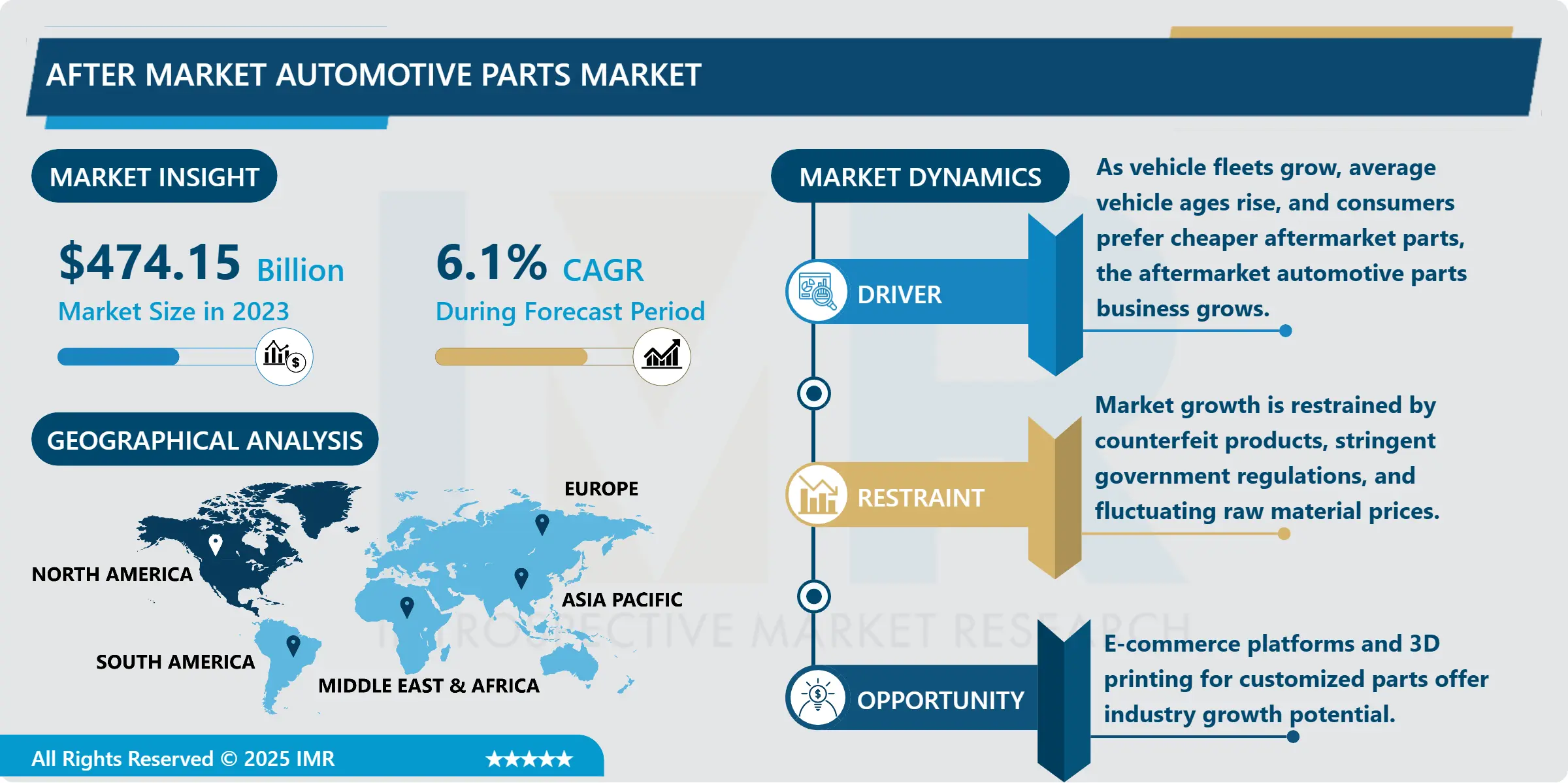
After Market Automotive Parts Market Emerging Trends, Challenges & Strategic Forecast (2024-2032)
After Market Automotive Parts Market Size Was Valued at USD 474.15 Billion in 2023, and is Projected to Reach USD 704.77 Billion by 2032, Growing at a CAGR of 6.1% From 2024-2032.

IMR Group
Description
After Market Automotive Parts Market Synopsis:
After Market Automotive Parts Market Size Was Valued at USD 474.15 Billion in 2023, and is Projected to Reach USD 704.77 Billion by 2032, Growing at a CAGR of 6.1% From 2024-2032.
The After Market Automotive Parts Market means the range of automotive parts for almost all car parts and automobile accessories which are being sold after the first sale of automobiles. These components are essentially service parts or refurbished parts for cars that have been already sold, and that offers support and improvements to the car as it endures use all through its life cycle. It sources a vast array of products including mechanical parts and electricals, accessories, power and enhancement parts, and aesthetics. The growth in this market is attributed by the existence of a growing vehicle fleet, growing age of the average vehicle, and the emerging trends of vehicle ownership customization and repair.
The market for aftermarket parts comprises in the main elements like requirement for automotive accessories, including spare parts, in line with periodic maintenance and repair services as well as replacement requirement arising from increasing number of car owners globally. Increased complexity in automobiles due to introduction of sophisticated features have conspicuous changes in vehicle components and their manufacturing materials, thereby enabling manufacturing companies to develop new high-performance aftermarket auto spare parts. There is also the element of increased environmental consciousness which not only calls for more use of recycled and green auto parts. Due to the e-commerce industry, the consumption of the aftermarket automotive part has witnessed substantial growth for consumers.
The After Market Automotive Parts Market is very fragmented, with a large number of players influencing the market both, domestically and internationally. The market is dominated by leading automotive suppliers Bosch, Magna International, and Denso have significant shares of the market but many more medium and small-sized specialist companies as well as a number of newcomers are adding innovative and specialized products to the market. The new trends such as online purchasing and application-based parts searching and vehicle repair have totally changed the automotive part buying process. The urbane demand for electric vehicles/ EV and mechanic parts necessary for sustenance and repairs of these new models will be an added strength to the future growth of the aftermarket automotive parts.
After Market Automotive Parts Market Trend Analysis:
Growth of E-commerce and Online Platforms
The rise of e-commerce has significantly impacted the After Market Automotive Parts Market, allowing consumers to easily search for, compare, and purchase automotive parts from the comfort of their homes. Online platforms like Amazon, eBay, and specialized auto parts websites have made it more convenient for customers to access a wide range of aftermarket parts, often at competitive prices. This trend has also led to the emergence of mobile applications that help consumers identify the right parts for their vehicles, enhancing the overall customer experience. The convenience of online shopping is expected to continue driving the growth of the aftermarket automotive parts sector.
Increasing Demand for Eco-friendly and Sustainable Automotive Parts
With each passing day the issue of the environment becomes more and more sensitive all over the world, and, therefore, the use of automotive aftermarket parts which are environmentally conscious is increasing. People and companies involved in the automotive market are seeking to adopt better quality materials like used parts and materials that have environmentally friendly production. Manufacturers are moving towards dependency on the production of parts that consume less energy and have a reduced impact on the availability of carbon during their production. This is not only the result of the latest regulations but also a consumer tendency of moving towards environmentally friendly products, thus the market for eco-friendly automotive spare parts in the aftermarket segment is gradually developing. This change towards the adoption of sustainable practices is forecasted to increase as both vehicle producers and automotive components suppliers integrate with the goal of attaining global environmental objectives.
After Market Automotive Parts Market Segment Analysis:
After Market Automotive Parts Market is Segmented on the basis of By Product Type, Vehicle Type, Sales Channel, and Region.
By Product Type, Engine Components segment is expected to dominate the market during the forecast period
Engine components are very dominant positions because it is the main component of vehicles; it is required to assess the overall performance and durability of cars. Habits such as using pistons, cylinders, gaskets, and belts may sometimes reach their time line for replacement or calling for repair then the business suffers. Electrical accessories like battery, alternators, starters, sensors etc are also essential in a car and are more often replaced in the aftermarket segments because these vehicle parts wear off after some time. Other large groups provided suspension and steering components, most of which are crucial for the safe operation of a vehicle, and brake parts inclusive of pads, rotor and caliper since vehicle brakes require standard service to execute their function efficiently.
Another important group of products is exhaust parts including catalytic converters, mufflers, and pipes that have a good demand in the aftermarket due to the necessity of replacing damaged or worn out components to enhance the vehicle emissions, performance. The Others category contains a vast number of automotive parts such as body parts, lighting equipment, wheels, and other interior and exterior Additional accessories or components that improve the Looks or utility of the vehicle. Since assembled vehicle part wears out over time and the need for frequent repairs and adjustments grows alongside almost similar to the vehicle’s aging, it would mean high market demands hence the growth. In the aftermarket automotive parts market, product types are vast and varied which guarantees every automobile owner opportunity to fix, maintain, upgrade, replace or modify an aspect of their car thereby improving the market capacity.
By Sales Channel, Offline segment expected to held the largest share
The Offline sales channel has been the largest channel for the After Market Automotive Parts Market, the market players include auto parts retail shops, local automotive mechanics, automotive repair stores, authorized automotive dealers, among others. Such offline channels provide consumers with benefits such as ability to physically inspect the products, achieve instantaneous purchase and getting quality customer treatment. Across many of these regions and especially in the rural markets, it is customary for customers to rely on the offline channels to purchase auto parts. Many repair shops and service centers utilizing these offline channels for purchasing automotive equipment and spare parts in large quantities, has expanded this segment.
The Online Sales Channel has been rapidly growing for the many conveniences that are realised by the consumer. Internet sale forums or B2B markets from Amazon to eBay and specialty auto parts websites offer the consumers much more opportunities to search for the parts comparing prices, reading the customers’ feedback, and having the parts delivered straight to their doorstep with a few mouse clicks. The growing use of mobile applications for automotive maintenance and parts identification is also influencing online buying behavior because parts required for repairs can be obtained online and delivered quickly in urban areas. Internet sources provide a wide range of products, including simple and advanced performant substitution parts, and has a special attraction to the C2D consumers actively seeking affordable prices and home delivery. Due to the current global shift in the consumer buying behaviour towards online purchasing, it has been promulgated that the online sales segment is expected to experience steady high growth within the aftermarket automotive parts segment.
After Market Automotive Parts Market Regional Insights:
North America is Expected to Dominate the Market Over the Forecast period
North America appears to be the most significant market for aftermarket automotive parts in the forecast period due to amongst other factors a large vehicle population, high spending power towards vehicle maintenance, and superior supply chain of the major aftermarket auto part suppliers. America specifically hence, the United States has one of the biggest markets for automobiles globally, many of which are operational automobiles with older models that will need servicing and automotive spare parts. There is a solid base of aftermarket car accessories distribution in the region, through numerous stores, wholesalers and Internet sites and this makes it easy for consumers to acquire the automotive parts.
North America automotive market min howing signs robust demand for vehicle customization and performance care lets, thus fuelling the market for aftermarket car parts. Developments being witnessed in the auto industry, including vehicle telematics and diagnostics, are also driving the market for the specialty parts and related service. The popularity of internet retailing is growing in the area consumers can buy automotive parts without leaving their homes, thus promoting the market’s growth. Due to the robust automotive tradition in North America and the growth in supply chain sophistication apart from consumers’ preferences, North America is again anticipated to remain dominant in the aftermarket automotive parts market.
Active Key Players in the After Market Automotive Parts Market
3M Company (USA)
Aisin Seiki Co. (Japan)
AutoZone, Inc. (USA)
Bridgestone Corporation (Japan)
Continental AG (Germany)
Denso Corporation (Japan)
Faurecia (France)
Goodyear Tire and Rubber Company (USA)
Hyundai Mobis (South Korea)
Lear Corporation (USA)
Magneti Marelli (Italy)
Robert Bosch GmbH (Germany)
Tenneco (USA)
Valeo SA (France)
ZF Friedrichshafen AG (Germany)
Other Active Players.
Chapter 1: Introduction
1.1 Scope and Coverage
Chapter 2:Executive Summary
Chapter 3: Market Landscape
3.1 Market Dynamics
3.1.1 Drivers
3.1.2 Restraints
3.1.3 Opportunities
3.1.4 Challenges
3.2 Market Trend Analysis
3.3 PESTLE Analysis
3.4 Porter’s Five Forces Analysis
3.5 Industry Value Chain Analysis
3.6 Ecosystem
3.7 Regulatory Landscape
3.8 Price Trend Analysis
3.9 Patent Analysis
3.10 Technology Evolution
3.11 Investment Pockets
3.12 Import-Export Analysis
Chapter 4: After Automotive Parts Market by Product Type
4.1 After Automotive Parts Market Snapshot and Growth Engine
4.2 After Automotive Parts Market Overview
4.3 Engine Components
4.3.1 Introduction and Market Overview
4.3.2 Historic and Forecasted Market Size in Value USD and Volume Units (2017-2032F)
4.3.3 Key Market Trends, Growth Factors and Opportunities
4.3.4 Engine Components: Geographic Segmentation Analysis
4.4 Electrical Parts
4.4.1 Introduction and Market Overview
4.4.2 Historic and Forecasted Market Size in Value USD and Volume Units (2017-2032F)
4.4.3 Key Market Trends, Growth Factors and Opportunities
4.4.4 Electrical Parts: Geographic Segmentation Analysis
4.5 Suspension and Steering Parts
4.5.1 Introduction and Market Overview
4.5.2 Historic and Forecasted Market Size in Value USD and Volume Units (2017-2032F)
4.5.3 Key Market Trends, Growth Factors and Opportunities
4.5.4 Suspension and Steering Parts: Geographic Segmentation Analysis
4.6 Brake Parts
4.6.1 Introduction and Market Overview
4.6.2 Historic and Forecasted Market Size in Value USD and Volume Units (2017-2032F)
4.6.3 Key Market Trends, Growth Factors and Opportunities
4.6.4 Brake Parts: Geographic Segmentation Analysis
4.7 Exhaust Parts
4.7.1 Introduction and Market Overview
4.7.2 Historic and Forecasted Market Size in Value USD and Volume Units (2017-2032F)
4.7.3 Key Market Trends, Growth Factors and Opportunities
4.7.4 Exhaust Parts: Geographic Segmentation Analysis
4.8 and Others
4.8.1 Introduction and Market Overview
4.8.2 Historic and Forecasted Market Size in Value USD and Volume Units (2017-2032F)
4.8.3 Key Market Trends, Growth Factors and Opportunities
4.8.4 and Others: Geographic Segmentation Analysis
Chapter 5: After Automotive Parts Market by Vehicle Type
5.1 After Automotive Parts Market Snapshot and Growth Engine
5.2 After Automotive Parts Market Overview
5.3 Passenger Cars
5.3.1 Introduction and Market Overview
5.3.2 Historic and Forecasted Market Size in Value USD and Volume Units (2017-2032F)
5.3.3 Key Market Trends, Growth Factors and Opportunities
5.3.4 Passenger Cars: Geographic Segmentation Analysis
5.4 Commercial Vehicles
5.4.1 Introduction and Market Overview
5.4.2 Historic and Forecasted Market Size in Value USD and Volume Units (2017-2032F)
5.4.3 Key Market Trends, Growth Factors and Opportunities
5.4.4 Commercial Vehicles: Geographic Segmentation Analysis
5.5 and Two-Wheelers
5.5.1 Introduction and Market Overview
5.5.2 Historic and Forecasted Market Size in Value USD and Volume Units (2017-2032F)
5.5.3 Key Market Trends, Growth Factors and Opportunities
5.5.4 and Two-Wheelers: Geographic Segmentation Analysis
Chapter 6: After Automotive Parts Market by Sales Channel
6.1 After Automotive Parts Market Snapshot and Growth Engine
6.2 After Automotive Parts Market Overview
6.3 Offline and Online
6.3.1 Introduction and Market Overview
6.3.2 Historic and Forecasted Market Size in Value USD and Volume Units (2017-2032F)
6.3.3 Key Market Trends, Growth Factors and Opportunities
6.3.4 Offline and Online: Geographic Segmentation Analysis
Chapter 7: Company Profiles and Competitive Analysis
7.1 Competitive Landscape
7.1.1 Competitive Benchmarking
7.1.2 After Automotive Parts Market Share by Manufacturer (2023)
7.1.3 Industry BCG Matrix
7.1.4 Heat Map Analysis
7.1.5 Mergers and Acquisitions
7.2 AISIN SEIKI CO. (JAPAN)
7.2.1 Company Overview
7.2.2 Key Executives
7.2.3 Company Snapshot
7.2.4 Role of the Company in the Market
7.2.5 Sustainability and Social Responsibility
7.2.6 Operating Business Segments
7.2.7 Product Portfolio
7.2.8 Business Performance
7.2.9 Key Strategic Moves and Recent Developments
7.2.10 SWOT Analysis
7.3 AUTOZONE INC. (USA)
7.4 BRIDGESTONE CORPORATION (JAPAN)
7.5 CONTINENTAL AG (GERMANY)
7.6 DENSO CORPORATION (JAPAN)
7.7 FAURECIA (FRANCE)
7.8 GOODYEAR TIRE AND RUBBER COMPANY (USA)
7.9 HYUNDAI MOBIS (SOUTH KOREA)
7.10 LEAR CORPORATION (USA)
7.11 MAGNETI MARELLI (ITALY)
7.12 ROBERT BOSCH GMBH (GERMANY)
7.13 TENNECO (USA)
7.14 VALEO SA (FRANCE)
7.15 ZF FRIEDRICHSHAFEN AG (GERMANY)
7.16 3M COMPANY (USA)
7.17 OTHER ACTIVE PLAYERS
Chapter 8: Global After Automotive Parts Market By Region
8.1 Overview
8.2. North America After Automotive Parts Market
8.2.1 Key Market Trends, Growth Factors and Opportunities
8.2.2 Top Key Companies
8.2.3 Historic and Forecasted Market Size by Segments
8.2.4 Historic and Forecasted Market Size By Product Type
8.2.4.1 Engine Components
8.2.4.2 Electrical Parts
8.2.4.3 Suspension and Steering Parts
8.2.4.4 Brake Parts
8.2.4.5 Exhaust Parts
8.2.4.6 and Others
8.2.5 Historic and Forecasted Market Size By Vehicle Type
8.2.5.1 Passenger Cars
8.2.5.2 Commercial Vehicles
8.2.5.3 and Two-Wheelers
8.2.6 Historic and Forecasted Market Size By Sales Channel
8.2.6.1 Offline and Online
8.2.7 Historic and Forecast Market Size by Country
8.2.7.1 US
8.2.7.2 Canada
8.2.7.3 Mexico
8.3. Eastern Europe After Automotive Parts Market
8.3.1 Key Market Trends, Growth Factors and Opportunities
8.3.2 Top Key Companies
8.3.3 Historic and Forecasted Market Size by Segments
8.3.4 Historic and Forecasted Market Size By Product Type
8.3.4.1 Engine Components
8.3.4.2 Electrical Parts
8.3.4.3 Suspension and Steering Parts
8.3.4.4 Brake Parts
8.3.4.5 Exhaust Parts
8.3.4.6 and Others
8.3.5 Historic and Forecasted Market Size By Vehicle Type
8.3.5.1 Passenger Cars
8.3.5.2 Commercial Vehicles
8.3.5.3 and Two-Wheelers
8.3.6 Historic and Forecasted Market Size By Sales Channel
8.3.6.1 Offline and Online
8.3.7 Historic and Forecast Market Size by Country
8.3.7.1 Russia
8.3.7.2 Bulgaria
8.3.7.3 The Czech Republic
8.3.7.4 Hungary
8.3.7.5 Poland
8.3.7.6 Romania
8.3.7.7 Rest of Eastern Europe
8.4. Western Europe After Automotive Parts Market
8.4.1 Key Market Trends, Growth Factors and Opportunities
8.4.2 Top Key Companies
8.4.3 Historic and Forecasted Market Size by Segments
8.4.4 Historic and Forecasted Market Size By Product Type
8.4.4.1 Engine Components
8.4.4.2 Electrical Parts
8.4.4.3 Suspension and Steering Parts
8.4.4.4 Brake Parts
8.4.4.5 Exhaust Parts
8.4.4.6 and Others
8.4.5 Historic and Forecasted Market Size By Vehicle Type
8.4.5.1 Passenger Cars
8.4.5.2 Commercial Vehicles
8.4.5.3 and Two-Wheelers
8.4.6 Historic and Forecasted Market Size By Sales Channel
8.4.6.1 Offline and Online
8.4.7 Historic and Forecast Market Size by Country
8.4.7.1 Germany
8.4.7.2 UK
8.4.7.3 France
8.4.7.4 The Netherlands
8.4.7.5 Italy
8.4.7.6 Spain
8.4.7.7 Rest of Western Europe
8.5. Asia Pacific After Automotive Parts Market
8.5.1 Key Market Trends, Growth Factors and Opportunities
8.5.2 Top Key Companies
8.5.3 Historic and Forecasted Market Size by Segments
8.5.4 Historic and Forecasted Market Size By Product Type
8.5.4.1 Engine Components
8.5.4.2 Electrical Parts
8.5.4.3 Suspension and Steering Parts
8.5.4.4 Brake Parts
8.5.4.5 Exhaust Parts
8.5.4.6 and Others
8.5.5 Historic and Forecasted Market Size By Vehicle Type
8.5.5.1 Passenger Cars
8.5.5.2 Commercial Vehicles
8.5.5.3 and Two-Wheelers
8.5.6 Historic and Forecasted Market Size By Sales Channel
8.5.6.1 Offline and Online
8.5.7 Historic and Forecast Market Size by Country
8.5.7.1 China
8.5.7.2 India
8.5.7.3 Japan
8.5.7.4 South Korea
8.5.7.5 Malaysia
8.5.7.6 Thailand
8.5.7.7 Vietnam
8.5.7.8 The Philippines
8.5.7.9 Australia
8.5.7.10 New Zealand
8.5.7.11 Rest of APAC
8.6. Middle East & Africa After Automotive Parts Market
8.6.1 Key Market Trends, Growth Factors and Opportunities
8.6.2 Top Key Companies
8.6.3 Historic and Forecasted Market Size by Segments
8.6.4 Historic and Forecasted Market Size By Product Type
8.6.4.1 Engine Components
8.6.4.2 Electrical Parts
8.6.4.3 Suspension and Steering Parts
8.6.4.4 Brake Parts
8.6.4.5 Exhaust Parts
8.6.4.6 and Others
8.6.5 Historic and Forecasted Market Size By Vehicle Type
8.6.5.1 Passenger Cars
8.6.5.2 Commercial Vehicles
8.6.5.3 and Two-Wheelers
8.6.6 Historic and Forecasted Market Size By Sales Channel
8.6.6.1 Offline and Online
8.6.7 Historic and Forecast Market Size by Country
8.6.7.1 Turkiye
8.6.7.2 Bahrain
8.6.7.3 Kuwait
8.6.7.4 Saudi Arabia
8.6.7.5 Qatar
8.6.7.6 UAE
8.6.7.7 Israel
8.6.7.8 South Africa
8.7. South America After Automotive Parts Market
8.7.1 Key Market Trends, Growth Factors and Opportunities
8.7.2 Top Key Companies
8.7.3 Historic and Forecasted Market Size by Segments
8.7.4 Historic and Forecasted Market Size By Product Type
8.7.4.1 Engine Components
8.7.4.2 Electrical Parts
8.7.4.3 Suspension and Steering Parts
8.7.4.4 Brake Parts
8.7.4.5 Exhaust Parts
8.7.4.6 and Others
8.7.5 Historic and Forecasted Market Size By Vehicle Type
8.7.5.1 Passenger Cars
8.7.5.2 Commercial Vehicles
8.7.5.3 and Two-Wheelers
8.7.6 Historic and Forecasted Market Size By Sales Channel
8.7.6.1 Offline and Online
8.7.7 Historic and Forecast Market Size by Country
8.7.7.1 Brazil
8.7.7.2 Argentina
8.7.7.3 Rest of SA
Chapter 9 Analyst Viewpoint and Conclusion
9.1 Recommendations and Concluding Analysis
9.2 Potential Market Strategies
Chapter 10 Research Methodology
10.1 Research Process
10.2 Primary Research
10.3 Secondary Research
Q1: What would be the forecast period in the After Market Automotive Parts Market research report?
A1: The forecast period in the After Market Automotive Parts Market research report is 2024-2032.
Q2: Who are the key players in the After Market Automotive Parts Market?
A2: Aisin Seiki Co. (Japan), AutoZone, Inc. (USA), Bridgestone Corporation (Japan), Continental AG (Germany), Denso Corporation (Japan), Faurecia (France), Goodyear Tire and Rubber Company (USA), Hyundai Mobis (South Korea), Lear Corporation (USA), Magneti Marelli (Italy), Robert Bosch GmbH (Germany), Tenneco (USA), Valeo SA (France), ZF Friedrichshafen AG (Germany), 3M Company (USA), Other Active Players.
Q3: What are the segments of the After Market Automotive Parts Market?
A3: The After Market Automotive Parts Market is segmented into By Product Type, By Vehicle Type, By Sales Channel and region. By Product Type (Engine Components, Electrical Parts, Suspension and Steering Parts, Brake Parts, Exhaust Parts, and Others), By Vehicle Type (Passenger Cars, Commercial Vehicles, and Two-Wheelers), By Sales Channel (Offline and Online). By region, it is analyzed across North America (U.S., Canada, Mexico), Eastern Europe (Russia, Bulgaria, The Czech Republic, Hungary, Poland, Romania, Rest of Eastern Europe), Western Europe (Germany, UK, France, The Netherlands, Italy, Russia, Spain, Rest of Western Europe), Asia Pacific (China, India, Japan, South Korea, Malaysia, Thailand, Vietnam, The Philippines, Australia, New-Zealand, Rest of APAC), Middle East & Africa (Turkiye, Bahrain, Kuwait, Saudi Arabia, Qatar, UAE, Israel, South Africa), South America (Brazil, Argentina, Rest of SA).
Q4: What is the After Market Automotive Parts Market?
A4: Aftermarket automotive parts refer to components and accessories that are produced by manufacturers other than the original equipment manufacturer (OEM) and are designed to replace or enhance vehicle parts after the vehicle has been sold. These parts include replacement items such as brakes, tires, batteries, and filters, as well as performance-enhancing and aesthetic components like exhaust systems, custom wheels, and interior accessories. They are widely used for vehicle repair, maintenance, or personalization, offering consumers a variety of options in terms of cost, quality, and functionality compared to OEM parts.
Q5: How big is the After Market Automotive Parts Market?
A5: After Market Automotive Parts Market Size Was Valued at USD 474.15 Billion in 2023, and is Projected to Reach USD 704.77 Billion by 2032, Growing at a CAGR of 6.1% From 2024-2032.
How to Buy a Report from eminsights.jp
On the product page, choose the license you want: Single-User License, Multi-User License or Enterprise License.
If you required report in your native language, then you can click on Translated Report button and fill out the form with report name and language you want, then our team will contact you as soon as possible.
Click the Buy Now button.
You will be redirected to the checkout page. Enter your company details and payment information.
Click Place Order to complete the purchase.
Confirmation: You’ll receive an order confirmation and our team will contact you shortly with your ordered report.
If you have any questions, fill out the contact form below or email us at bizdev@eminsights.net.
Thank you for choosing eminsights.jp!