Stay Ahead in Fast-Growing Economies.
Browse Reports Now




Affective Computing Market Size, Share, Growth & Forecast (2024-2032)
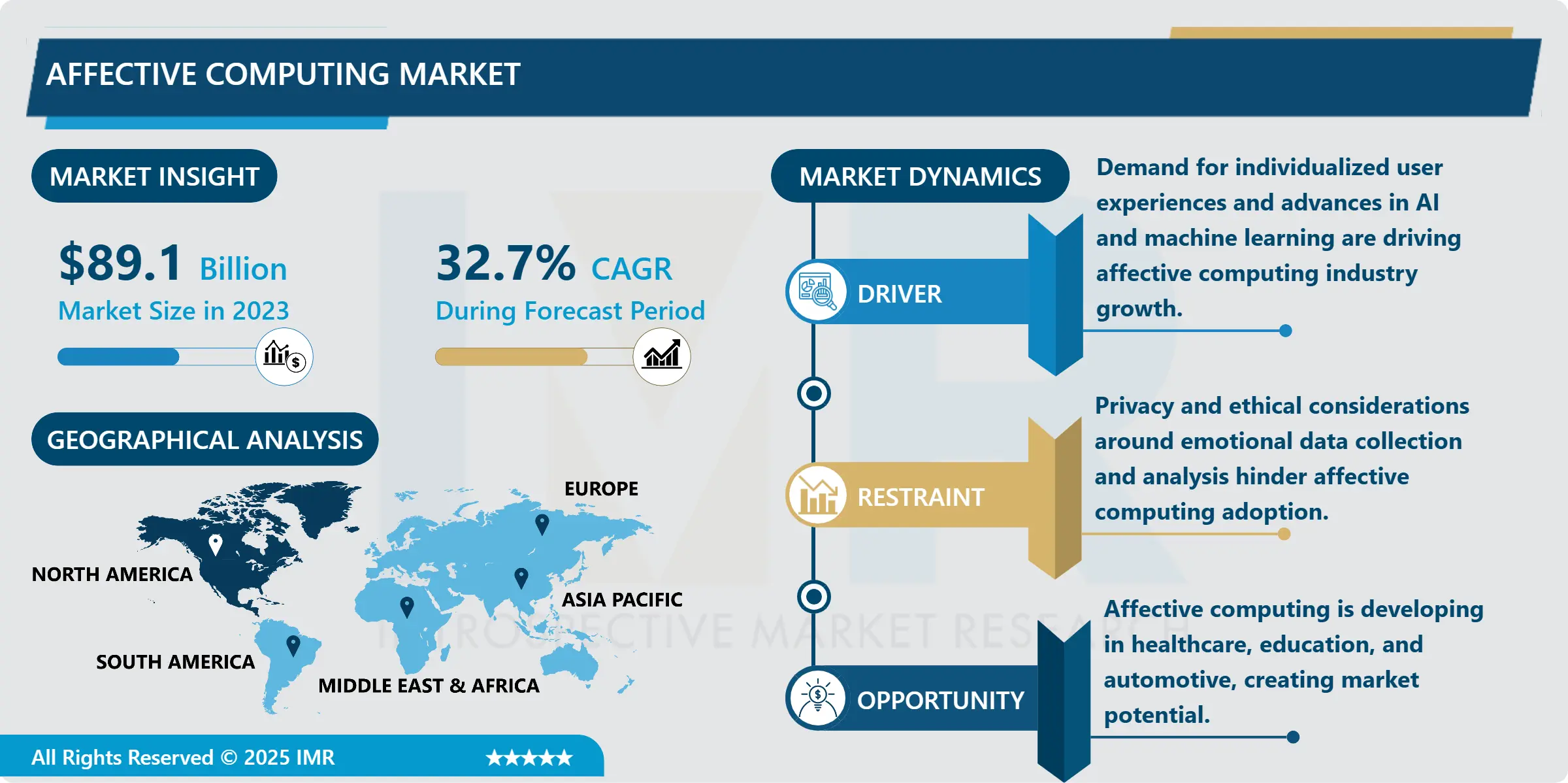
Affective Computing Market Size Was Valued at USD 89.10 Billion in 2023, and is Projected to Reach USD 1,130.8 Billion by 2032, Growing at a CAGR of 32.7% From 2024-2032.

IMR Group
Description
Affective Computing Market Synopsis:
Affective Computing Market Size Was Valued at USD 89.10 Billion in 2023, and is Projected to Reach USD 1,130.8 Billion by 2032, Growing at a CAGR of 32.7% From 2024-2032.
The Affective Computing Market is a new category that aims to create technologies for the systems to identify and analyse emotions in people. Affective computing is an interdisciplinary field that uses advanced sensors, machine learning algorithms, AI, and other related technologies with an objective of improving HMI in different application domains such as healthcare, education, gaming, and the customer service domain. This market has grown rather fast within the last couple of years, due to the growth in the usage of artificial intelligence technologies, and people’s need for individual attention.
One the most important factor for the market is the penetration into the healthcare industry where affective computing systems are used to detect patients’ emotional condition and deliver individual treatments. Likewise, in customer service areas, there are recent trends of implementing emotion detection technology in order to increase the quality of a company’s interaction with their customers. Furthermore, affective computing as a part of the learning environment focuses on improving students’ educational results due to the assessment of their emotional state.
The market is further driven by the development on wearable and smart phones with biosensors that are sensitive in detecting changes in emotions. Lately, North America contributes to the highest affective computing market growing rapidly due to technological development and most importantly, increased Research and developmental activities. On the other hand, Asia-Pacific is expected to show fast growth as industries there accelerate their digitalization process and start integrating AI into their operations more actively.
Affective Computing Market Trend Analysis:
Growing Integration of Affective Computing in Wearable Devices
The use of affective computing technology in wearable devices is currently revolutionarily becoming popular in the market. Wearable technologies – the latest gadgets including smartwatches and fitness trackers – are being integrated with intelligent sensors for measuring physiological indices including heart rate variability, skin conductivity, and facial EMG. These signs are then pre-processed using Artificial Intelligence algorithms to determine the emotional state of users so that they can be used in areas such as stress and mental health and general optimized user experience. In particular, this phenomenon will remain relevant as consumer interest in individualized health and wellbeing solutions with the use of wearable technology grows.
Rising Adoption in the Automotive Industry
The automotive industry is Avangarding affective computing to improve automotive experience and safety while on the road. Examples of smart technologies include emotion-sensing technologies in today’s cars and can detect stress, fatigue, and lack of concentration, and provide interventions to avoid an accident. Moreover, these systems improve the wellbeing and enjoyment of passengers by modifying parameters of a car such as lighting and music, depending on the detected emotions. As the world shifts attention towards the self-driven automobiles and smart car environments, the intervention of affect computing to determine the future of mobility is expanding more significantly.
Affective Computing Market Segment Analysis:
Affective Computing Market is Segmented on the basis of By Technology, Software, Hardware, End user, and Region.
By Technology, Touchless segment is expected to dominate the market during the forecast period
The touchless segment uses contact-less systems such as face detection, voice monitoring, and motion tracking to analyze the emotional attributes of consumers. This approach is also increasing in its usage in those areas where hygiene and interaction are essential, for example automotive, gaming, and customer care. Touchless affective computing systems are most suitable for the use in tele-monitoring and virtual surroundings, the ability to perform real-time assessments of feelings without physical contact. Increased uptake of AI and machine learning when applying touchless data also increases accuracy and the ability to scale a significant growth enabler for the market.
By End-Use Industry, IT & Telecommunications segment expected to held the largest share
In the IT & Telecommunications industry, affective computing is applied to increase the quality of clients’ communication by allowing call centers and chatbots to recognize customers’ emotions in order to enhance the interaction. In automobiles, it underpins safety because heart rate can be used as an index of fatigue or stress, and it further optimizes cabin entertainment that is best delivered based on the passenger’s mood. BFSI organisations use this technology for analysing the customer sentiments to take effective decisions and transforming financial services.
The application area of affective computing is healthcare business where it views the patient’s emotional condition and helps in mental health treatment. Customers and marketing & e-retailing agencies use emotional recognition to measure the shopping experience and sales promotion techniques. In media & entertainment industry the technology is evident in gaming & virtual reality environments. Various bureaucracies rely on affective computing for security and administration, other fields consider its application in developing and improving learning and development, staff motivation, and man-machine relations. This widespread across different industries simply proves the fact that this market is fast growing.
Affective Computing Market Regional Insights:
North America is Expected to Dominate the Market Over the Forecast period
North America is projected to hold the largest share of the Affective Computing Market in the projected timeframe due to factors such as well-developed technology, the high rate of adoption of AI solutions, and tremendous funding towards development. The area has large tech firms that are at the forefront of developing new affective computing solutions especially in areas such as healthcare, automotive and consumer electronics. The current era has seen the significant boosting into the health sector especially, and more especially within the North American region, of technologies that can sense human emotion of which has also informed the increased adoption of those technologies into the health systems. We have also seen that the presence of leading research institutions and funding opportunism asserts the regions dominance in the market.
In the same way, the people of North America have embarked on massive technology spending, particularly in the digital space; on top of this, they have pioneered the use of artificial intelligence and Machine learning in their operations, and all these attributes point towards the possibility of a high level of affective computing. particularly demand for facial recognition software in the United States has remained high across such sectors as retail where facial sentiment analysis is useful when having to determine the kind of service or product to provide to a customer. The leadership in the region’s market will persist as industries and governments focus on using emotion-aware technologies for enhancing user experiences and operations.
Active Key Players in the Affective Computing Market
Affectiva (USA)
Cognitec Systems GmbH (Germany)
Emotibot Technologies Limited (China)
Google LLC (USA)
IBM Corporation (USA)
Intel Corporation (USA)
Kairos AR, Inc. (USA)
Microsoft Corporation (USA)
NuraLogix Corporation (Canada)
nViso SA (Switzerland)
Qualcomm Technologies, Inc. (USA)
Other Active Players.
Chapter 1: Introduction
1.1 Scope and Coverage
Chapter 2:Executive Summary
Chapter 3: Market Landscape
3.1 Market Dynamics
3.1.1 Drivers
3.1.2 Restraints
3.1.3 Opportunities
3.1.4 Challenges
3.2 Market Trend Analysis
3.3 PESTLE Analysis
3.4 Porter’s Five Forces Analysis
3.5 Industry Value Chain Analysis
3.6 Ecosystem
3.7 Regulatory Landscape
3.8 Price Trend Analysis
3.9 Patent Analysis
3.10 Technology Evolution
3.11 Investment Pockets
3.12 Import-Export Analysis
Chapter 4: Affective Computing Market by Technology
4.1 Affective Computing Market Snapshot and Growth Engine
4.2 Affective Computing Market Overview
4.3 Touchless
4.3.1 Introduction and Market Overview
4.3.2 Historic and Forecasted Market Size in Value USD and Volume Units (2017-2032F)
4.3.3 Key Market Trends, Growth Factors and Opportunities
4.3.4 Touchless: Geographic Segmentation Analysis
4.4 Touch-Based
4.4.1 Introduction and Market Overview
4.4.2 Historic and Forecasted Market Size in Value USD and Volume Units (2017-2032F)
4.4.3 Key Market Trends, Growth Factors and Opportunities
4.4.4 Touch-Based: Geographic Segmentation Analysis
Chapter 5: Affective Computing Market by Software
5.1 Affective Computing Market Snapshot and Growth Engine
5.2 Affective Computing Market Overview
5.3 Analytics Software
5.3.1 Introduction and Market Overview
5.3.2 Historic and Forecasted Market Size in Value USD and Volume Units (2017-2032F)
5.3.3 Key Market Trends, Growth Factors and Opportunities
5.3.4 Analytics Software: Geographic Segmentation Analysis
5.4 Speech Recognition
5.4.1 Introduction and Market Overview
5.4.2 Historic and Forecasted Market Size in Value USD and Volume Units (2017-2032F)
5.4.3 Key Market Trends, Growth Factors and Opportunities
5.4.4 Speech Recognition: Geographic Segmentation Analysis
5.5 Gesture Recognition
5.5.1 Introduction and Market Overview
5.5.2 Historic and Forecasted Market Size in Value USD and Volume Units (2017-2032F)
5.5.3 Key Market Trends, Growth Factors and Opportunities
5.5.4 Gesture Recognition: Geographic Segmentation Analysis
5.6 Enterprise Software
5.6.1 Introduction and Market Overview
5.6.2 Historic and Forecasted Market Size in Value USD and Volume Units (2017-2032F)
5.6.3 Key Market Trends, Growth Factors and Opportunities
5.6.4 Enterprise Software: Geographic Segmentation Analysis
5.7 Facial Recognition
5.7.1 Introduction and Market Overview
5.7.2 Historic and Forecasted Market Size in Value USD and Volume Units (2017-2032F)
5.7.3 Key Market Trends, Growth Factors and Opportunities
5.7.4 Facial Recognition: Geographic Segmentation Analysis
Chapter 6: Affective Computing Market by Hardware
6.1 Affective Computing Market Snapshot and Growth Engine
6.2 Affective Computing Market Overview
6.3 Cameras
6.3.1 Introduction and Market Overview
6.3.2 Historic and Forecasted Market Size in Value USD and Volume Units (2017-2032F)
6.3.3 Key Market Trends, Growth Factors and Opportunities
6.3.4 Cameras: Geographic Segmentation Analysis
6.4 Storage Devices & Processors
6.4.1 Introduction and Market Overview
6.4.2 Historic and Forecasted Market Size in Value USD and Volume Units (2017-2032F)
6.4.3 Key Market Trends, Growth Factors and Opportunities
6.4.4 Storage Devices & Processors: Geographic Segmentation Analysis
6.5 Sensors
6.5.1 Introduction and Market Overview
6.5.2 Historic and Forecasted Market Size in Value USD and Volume Units (2017-2032F)
6.5.3 Key Market Trends, Growth Factors and Opportunities
6.5.4 Sensors: Geographic Segmentation Analysis
6.6 Other Hardware
6.6.1 Introduction and Market Overview
6.6.2 Historic and Forecasted Market Size in Value USD and Volume Units (2017-2032F)
6.6.3 Key Market Trends, Growth Factors and Opportunities
6.6.4 Other Hardware: Geographic Segmentation Analysis
Chapter 7: Affective Computing Market by End-Use Industry
7.1 Affective Computing Market Snapshot and Growth Engine
7.2 Affective Computing Market Overview
7.3 IT & Telecommunications
7.3.1 Introduction and Market Overview
7.3.2 Historic and Forecasted Market Size in Value USD and Volume Units (2017-2032F)
7.3.3 Key Market Trends, Growth Factors and Opportunities
7.3.4 IT & Telecommunications: Geographic Segmentation Analysis
7.4 Automotive
7.4.1 Introduction and Market Overview
7.4.2 Historic and Forecasted Market Size in Value USD and Volume Units (2017-2032F)
7.4.3 Key Market Trends, Growth Factors and Opportunities
7.4.4 Automotive: Geographic Segmentation Analysis
7.5 BFSI
7.5.1 Introduction and Market Overview
7.5.2 Historic and Forecasted Market Size in Value USD and Volume Units (2017-2032F)
7.5.3 Key Market Trends, Growth Factors and Opportunities
7.5.4 BFSI: Geographic Segmentation Analysis
7.6 Healthcare
7.6.1 Introduction and Market Overview
7.6.2 Historic and Forecasted Market Size in Value USD and Volume Units (2017-2032F)
7.6.3 Key Market Trends, Growth Factors and Opportunities
7.6.4 Healthcare: Geographic Segmentation Analysis
7.7 Retail & E-commerce
7.7.1 Introduction and Market Overview
7.7.2 Historic and Forecasted Market Size in Value USD and Volume Units (2017-2032F)
7.7.3 Key Market Trends, Growth Factors and Opportunities
7.7.4 Retail & E-commerce: Geographic Segmentation Analysis
7.8 Media & Entertainment
7.8.1 Introduction and Market Overview
7.8.2 Historic and Forecasted Market Size in Value USD and Volume Units (2017-2032F)
7.8.3 Key Market Trends, Growth Factors and Opportunities
7.8.4 Media & Entertainment: Geographic Segmentation Analysis
7.9 Government
7.9.1 Introduction and Market Overview
7.9.2 Historic and Forecasted Market Size in Value USD and Volume Units (2017-2032F)
7.9.3 Key Market Trends, Growth Factors and Opportunities
7.9.4 Government: Geographic Segmentation Analysis
7.10 Other End-Use Industries
7.10.1 Introduction and Market Overview
7.10.2 Historic and Forecasted Market Size in Value USD and Volume Units (2017-2032F)
7.10.3 Key Market Trends, Growth Factors and Opportunities
7.10.4 Other End-Use Industries: Geographic Segmentation Analysis
Chapter 8: Company Profiles and Competitive Analysis
8.1 Competitive Landscape
8.1.1 Competitive Benchmarking
8.1.2 Affective Computing Market Share by Manufacturer (2023)
8.1.3 Industry BCG Matrix
8.1.4 Heat Map Analysis
8.1.5 Mergers and Acquisitions
8.2 MICROSOFT CORPORATION (USA)
8.2.1 Company Overview
8.2.2 Key Executives
8.2.3 Company Snapshot
8.2.4 Role of the Company in the Market
8.2.5 Sustainability and Social Responsibility
8.2.6 Operating Business Segments
8.2.7 Product Portfolio
8.2.8 Business Performance
8.2.9 Key Strategic Moves and Recent Developments
8.2.10 SWOT Analysis
8.3 IBM CORPORATION (USA)
8.4 GOOGLE LLC (USA)
8.5 INTEL CORPORATION (USA)
8.6 AFFECTIVA (USA)
8.7 COGNITEC SYSTEMS GMBH (GERMANY)
8.8 KAIROS AR INC. (USA)
8.9 QUALCOMM TECHNOLOGIES INC. (USA)
8.10 NURALOGIX CORPORATION (CANADA)
8.11 NVISO SA (SWITZERLAND)
8.12 EMOTIBOT TECHNOLOGIES LIMITED (CHINA)
8.13 OTHER ACTIVE PLAYERS
Chapter 9: Global Affective Computing Market By Region
9.1 Overview
9.2. North America Affective Computing Market
9.2.1 Key Market Trends, Growth Factors and Opportunities
9.2.2 Top Key Companies
9.2.3 Historic and Forecasted Market Size by Segments
9.2.4 Historic and Forecasted Market Size By Technology
9.2.4.1 Touchless
9.2.4.2 Touch-Based
9.2.5 Historic and Forecasted Market Size By Software
9.2.5.1 Analytics Software
9.2.5.2 Speech Recognition
9.2.5.3 Gesture Recognition
9.2.5.4 Enterprise Software
9.2.5.5 Facial Recognition
9.2.6 Historic and Forecasted Market Size By Hardware
9.2.6.1 Cameras
9.2.6.2 Storage Devices & Processors
9.2.6.3 Sensors
9.2.6.4 Other Hardware
9.2.7 Historic and Forecasted Market Size By End-Use Industry
9.2.7.1 IT & Telecommunications
9.2.7.2 Automotive
9.2.7.3 BFSI
9.2.7.4 Healthcare
9.2.7.5 Retail & E-commerce
9.2.7.6 Media & Entertainment
9.2.7.7 Government
9.2.7.8 Other End-Use Industries
9.2.8 Historic and Forecast Market Size by Country
9.2.8.1 US
9.2.8.2 Canada
9.2.8.3 Mexico
9.3. Eastern Europe Affective Computing Market
9.3.1 Key Market Trends, Growth Factors and Opportunities
9.3.2 Top Key Companies
9.3.3 Historic and Forecasted Market Size by Segments
9.3.4 Historic and Forecasted Market Size By Technology
9.3.4.1 Touchless
9.3.4.2 Touch-Based
9.3.5 Historic and Forecasted Market Size By Software
9.3.5.1 Analytics Software
9.3.5.2 Speech Recognition
9.3.5.3 Gesture Recognition
9.3.5.4 Enterprise Software
9.3.5.5 Facial Recognition
9.3.6 Historic and Forecasted Market Size By Hardware
9.3.6.1 Cameras
9.3.6.2 Storage Devices & Processors
9.3.6.3 Sensors
9.3.6.4 Other Hardware
9.3.7 Historic and Forecasted Market Size By End-Use Industry
9.3.7.1 IT & Telecommunications
9.3.7.2 Automotive
9.3.7.3 BFSI
9.3.7.4 Healthcare
9.3.7.5 Retail & E-commerce
9.3.7.6 Media & Entertainment
9.3.7.7 Government
9.3.7.8 Other End-Use Industries
9.3.8 Historic and Forecast Market Size by Country
9.3.8.1 Russia
9.3.8.2 Bulgaria
9.3.8.3 The Czech Republic
9.3.8.4 Hungary
9.3.8.5 Poland
9.3.8.6 Romania
9.3.8.7 Rest of Eastern Europe
9.4. Western Europe Affective Computing Market
9.4.1 Key Market Trends, Growth Factors and Opportunities
9.4.2 Top Key Companies
9.4.3 Historic and Forecasted Market Size by Segments
9.4.4 Historic and Forecasted Market Size By Technology
9.4.4.1 Touchless
9.4.4.2 Touch-Based
9.4.5 Historic and Forecasted Market Size By Software
9.4.5.1 Analytics Software
9.4.5.2 Speech Recognition
9.4.5.3 Gesture Recognition
9.4.5.4 Enterprise Software
9.4.5.5 Facial Recognition
9.4.6 Historic and Forecasted Market Size By Hardware
9.4.6.1 Cameras
9.4.6.2 Storage Devices & Processors
9.4.6.3 Sensors
9.4.6.4 Other Hardware
9.4.7 Historic and Forecasted Market Size By End-Use Industry
9.4.7.1 IT & Telecommunications
9.4.7.2 Automotive
9.4.7.3 BFSI
9.4.7.4 Healthcare
9.4.7.5 Retail & E-commerce
9.4.7.6 Media & Entertainment
9.4.7.7 Government
9.4.7.8 Other End-Use Industries
9.4.8 Historic and Forecast Market Size by Country
9.4.8.1 Germany
9.4.8.2 UK
9.4.8.3 France
9.4.8.4 The Netherlands
9.4.8.5 Italy
9.4.8.6 Spain
9.4.8.7 Rest of Western Europe
9.5. Asia Pacific Affective Computing Market
9.5.1 Key Market Trends, Growth Factors and Opportunities
9.5.2 Top Key Companies
9.5.3 Historic and Forecasted Market Size by Segments
9.5.4 Historic and Forecasted Market Size By Technology
9.5.4.1 Touchless
9.5.4.2 Touch-Based
9.5.5 Historic and Forecasted Market Size By Software
9.5.5.1 Analytics Software
9.5.5.2 Speech Recognition
9.5.5.3 Gesture Recognition
9.5.5.4 Enterprise Software
9.5.5.5 Facial Recognition
9.5.6 Historic and Forecasted Market Size By Hardware
9.5.6.1 Cameras
9.5.6.2 Storage Devices & Processors
9.5.6.3 Sensors
9.5.6.4 Other Hardware
9.5.7 Historic and Forecasted Market Size By End-Use Industry
9.5.7.1 IT & Telecommunications
9.5.7.2 Automotive
9.5.7.3 BFSI
9.5.7.4 Healthcare
9.5.7.5 Retail & E-commerce
9.5.7.6 Media & Entertainment
9.5.7.7 Government
9.5.7.8 Other End-Use Industries
9.5.8 Historic and Forecast Market Size by Country
9.5.8.1 China
9.5.8.2 India
9.5.8.3 Japan
9.5.8.4 South Korea
9.5.8.5 Malaysia
9.5.8.6 Thailand
9.5.8.7 Vietnam
9.5.8.8 The Philippines
9.5.8.9 Australia
9.5.8.10 New Zealand
9.5.8.11 Rest of APAC
9.6. Middle East & Africa Affective Computing Market
9.6.1 Key Market Trends, Growth Factors and Opportunities
9.6.2 Top Key Companies
9.6.3 Historic and Forecasted Market Size by Segments
9.6.4 Historic and Forecasted Market Size By Technology
9.6.4.1 Touchless
9.6.4.2 Touch-Based
9.6.5 Historic and Forecasted Market Size By Software
9.6.5.1 Analytics Software
9.6.5.2 Speech Recognition
9.6.5.3 Gesture Recognition
9.6.5.4 Enterprise Software
9.6.5.5 Facial Recognition
9.6.6 Historic and Forecasted Market Size By Hardware
9.6.6.1 Cameras
9.6.6.2 Storage Devices & Processors
9.6.6.3 Sensors
9.6.6.4 Other Hardware
9.6.7 Historic and Forecasted Market Size By End-Use Industry
9.6.7.1 IT & Telecommunications
9.6.7.2 Automotive
9.6.7.3 BFSI
9.6.7.4 Healthcare
9.6.7.5 Retail & E-commerce
9.6.7.6 Media & Entertainment
9.6.7.7 Government
9.6.7.8 Other End-Use Industries
9.6.8 Historic and Forecast Market Size by Country
9.6.8.1 Turkiye
9.6.8.2 Bahrain
9.6.8.3 Kuwait
9.6.8.4 Saudi Arabia
9.6.8.5 Qatar
9.6.8.6 UAE
9.6.8.7 Israel
9.6.8.8 South Africa
9.7. South America Affective Computing Market
9.7.1 Key Market Trends, Growth Factors and Opportunities
9.7.2 Top Key Companies
9.7.3 Historic and Forecasted Market Size by Segments
9.7.4 Historic and Forecasted Market Size By Technology
9.7.4.1 Touchless
9.7.4.2 Touch-Based
9.7.5 Historic and Forecasted Market Size By Software
9.7.5.1 Analytics Software
9.7.5.2 Speech Recognition
9.7.5.3 Gesture Recognition
9.7.5.4 Enterprise Software
9.7.5.5 Facial Recognition
9.7.6 Historic and Forecasted Market Size By Hardware
9.7.6.1 Cameras
9.7.6.2 Storage Devices & Processors
9.7.6.3 Sensors
9.7.6.4 Other Hardware
9.7.7 Historic and Forecasted Market Size By End-Use Industry
9.7.7.1 IT & Telecommunications
9.7.7.2 Automotive
9.7.7.3 BFSI
9.7.7.4 Healthcare
9.7.7.5 Retail & E-commerce
9.7.7.6 Media & Entertainment
9.7.7.7 Government
9.7.7.8 Other End-Use Industries
9.7.8 Historic and Forecast Market Size by Country
9.7.8.1 Brazil
9.7.8.2 Argentina
9.7.8.3 Rest of SA
Chapter 10 Analyst Viewpoint and Conclusion
10.1 Recommendations and Concluding Analysis
10.2 Potential Market Strategies
Chapter 11 Research Methodology
11.1 Research Process
11.2 Primary Research
11.3 Secondary Research
Global Affective Computing Market
Base Year:
2023
Forecast Period:
2024-2032
Historical Data:
2017 to 2023
Market Size in 2023:
USD 89.10 Billion
Forecast Period 2024-32 CAGR:
32.7%
Market Size in 2032:
USD 1,130.8 Billion
Segments Covered:
By Technology
Touchless
Touch-Based
By Software
Analytics Software
Speech Recognition
Gesture Recognition
Enterprise Software
Facial Recognition
By Hardware
Cameras
Storage Devices & Processors
Sensors
Other Hardware
By End-Use Industry
IT & Telecommunications
Automotive
BFSI
Healthcare,
Retail & E-commerce
Media & Entertainment
Government
Other End-Use Industries
By Region
North America (U.S., Canada, Mexico)
Eastern Europe (Russia, Bulgaria, The Czech Republic, Hungary, Poland, Romania, Rest of Eastern Europe)
Western Europe (Germany, UK, France, The Netherlands, Italy, Spain, Rest of Western Europe)
Asia Pacific (China, India, Japan, South Korea, Malaysia, Thailand, Vietnam, The Philippines, Australia, New-Zealand, Rest of APAC)
Middle East & Africa (Turkiye, Bahrain, Kuwait, Saudi Arabia, Qatar, UAE, Israel, South Africa)
South America (Brazil, Argentina, Rest of SA)
Key Market Drivers:
Demand for Individualized User Experiences
Key Market Restraints:
Privacy and Ethical Considerations Around Emotional Data Collection
Key Opportunities:
Affective computing is developing in healthcare, education, and automotive, creating market potential.
Companies Covered in the report:
Microsoft Corporation (USA), IBM Corporation (USA), Google LLC (USA), Intel Corporation (USA), Affectiva (USA), Cognitec Systems GmbH (Germany), and Other Active Players.
Q1: What would be the forecast period in the Affective Computing Market research report?
A1: The forecast period in the Affective Computing Market research report is 2024-2032.
Q2: Who are the key players in the Affective Computing Market?
A2: Microsoft Corporation (USA), IBM Corporation (USA), Google LLC (USA), Intel Corporation (USA), Affectiva (USA), Cognitec Systems GmbH (Germany), Kairos AR, Inc. (USA), Qualcomm Technologies, Inc. (USA), NuraLogix Corporation (Canada), nViso SA (Switzerland), Emotibot Technologies Limited (China), and Other Active Players.
Q3: What are the segments of the Affective Computing Market?
A3: The Affective Computing Market is segmented into By Technology, By Software, By Hardware By End-Use Industry and region. By Technology (Touchless, Touch-Based), By Software (Analytics Software, Speech Recognition, Gesture Recognition, Enterprise Software, Facial Recognition), By Hardware (Cameras, Storage Devices & Processors, Sensors, Other Hardware), By End-Use Industry (IT & Telecommunications, Automotive, BFSI, Healthcare, Retail & E-commerce, Media & Entertainment, Government, Other End-Use Industries). By region, it is analyzed across North America (U.S., Canada, Mexico), Eastern Europe (Russia, Bulgaria, The Czech Republic, Hungary, Poland, Romania, Rest of Eastern Europe), Western Europe (Germany, UK, France, The Netherlands, Italy, Russia, Spain, Rest of Western Europe), Asia Pacific (China, India, Japan, South Korea, Malaysia, Thailand, Vietnam, The Philippines, Australia, New-Zealand, Rest of APAC), Middle East & Africa (Turkiye, Bahrain, Kuwait, Saudi Arabia, Qatar, UAE, Israel, South Africa), South America (Brazil, Argentina, Rest of SA).
Q4: What is the Affective Computing Market?
A4: Affective computing refers to the development of systems and devices that can recognize, interpret, and simulate human emotions. It combines artificial intelligence (AI), machine learning, and sensor technologies to detect emotional states through facial expressions, voice tone, body language, and physiological responses such as heart rate or skin conductance. The goal of affective computing is to create more intuitive and empathetic human-computer interactions by enabling machines to respond appropriately to users' emotional cues. This technology is used in various applications, including healthcare for emotional well-being monitoring, customer service for enhancing user experiences, and in entertainment and education to engage users more effectively.
Q5: How big is the Affective Computing Market?
A5: Affective Computing Market Size Was Valued at USD 89.10 Billion in 2023, and is Projected to Reach USD 1,130.8 Billion by 2032, Growing at a CAGR of 32.7% From 2024-2032.
How to Buy a Report from eminsights.jp
On the product page, choose the license you want: Single-User License, Multi-User License or Enterprise License.
If you required report in your native language, then you can click on Translated Report button and fill out the form with report name and language you want, then our team will contact you as soon as possible.
Click the Buy Now button.
You will be redirected to the checkout page. Enter your company details and payment information.
Click Place Order to complete the purchase.
Confirmation: You’ll receive an order confirmation and our team will contact you shortly with your ordered report.
If you have any questions, fill out the contact form below or email us at bizdev@eminsights.net.
Thank you for choosing eminsights.jp!