Stay Ahead in Fast-Growing Economies.
Browse Reports Now




Actuators Market- In Deep Analysis Focusing on Market Share
Actuators are devices that convert energy into motion and are primarily used to move or control mechanisms and systems. Actuators are powered by an external power source, typically electrical power, hydraulic fluid pressure, or pneumatic pressure, which is then converted into motion.

IMR Group
Description
Global Actuators Market Overview
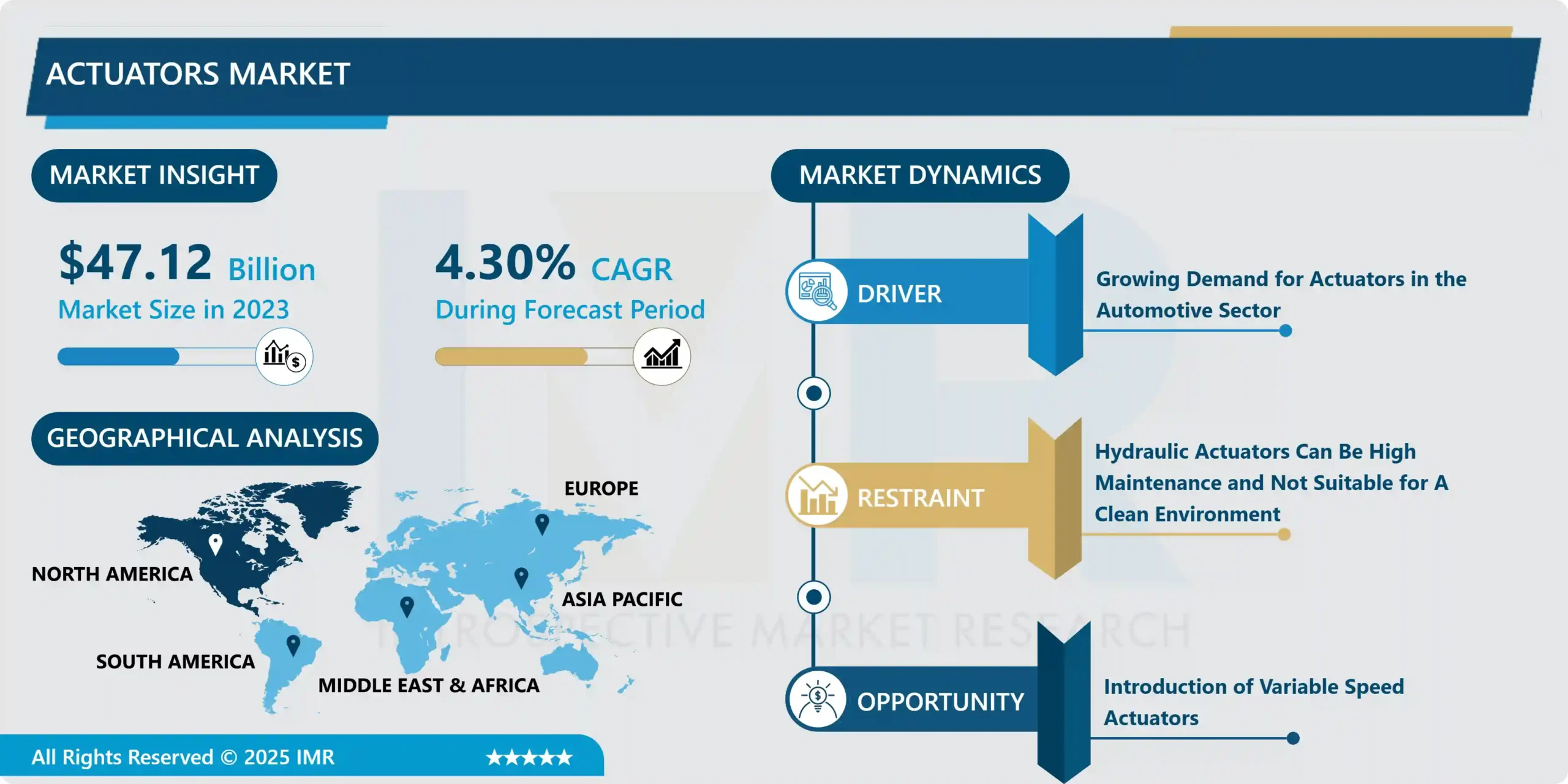
Global Actuators Market Size Was Valued at USD 47.12 Billion In 2023 And Is Projected to Reach USD 68.83 Billion By 2032, Growing at a CAGR of 4.3% From 2024 To 2032.
An actuator is a mechanism that transforms energy from various sources like electricity, hydraulics, or pneumatics into physical movement or power. This transformation enables actuators to carry out tasks, which are vital elements in a diverse range of uses.
Actuators, especially electrical ones, provide a means of high power conversion efficiency suitable for energy-saving purposes. They have the ability to function using different types of power sources and offer accurate positioning control for precise motion.
Actuators are capable of producing significant force and functioning at high speeds to meet the demands of robotics and heavy machinery tasks. Due to their effectiveness and minimal maintenance needs, electric actuators are both dependable and eco-friendly.
They can be smoothly incorporated into advanced control systems for complex control and monitoring. Actuators are made to last and offer reliable functionality even in severe environments.
Actuators are essential in many sectors, including automotive, aerospace, robotics, manufacturing, medical devices, agriculture, construction, consumer electronics, industrial plants, and renewable energy.
Market Dynamics And Factors of Actuators Market
Drivers:
The healthcare industry develops and produces innovative machines that require actuators and are used in medical devices such as wheelchairs, patient lifts, treatment chairs, dentist chairs, beds for medical purposes, and CT, MRI, and PT scanning instruments. The growth in the global healthcare actuator market is primarily attributed to factors such as healthcare facility expansion and the increasing elderly population. A common example is a use of moving coil actuators and control valves in ventilators to facilitate air supply to patients who cannot breathe on their own. due to lung disease, surgery, or other serious illness or accident. In addition, the RTPCR test, which is very effective in detecting the SARSCoV2 virus, uses linear actuators (they simply act as a conveyor belt) for its linear motion systems and to perform a large number of RTPCR tests that are required in emergencies such as COVID19. Linear drives support the loading, unloading, and moving of samples as well as the necessary liquid handling process in important test phases. Linear drives support sample labeling and the barcode process and can work faster and longer than humans. A leading company called MecVel uses actuators for various applications such as linear automation systems in incubators for newborns and electric linear actuators for X-ray machines etc.
The automotive sector contributes majorly to the growth of the actuators market globally due to one of the essential components in the automotive vehicles. Commercial vehicle and passenger car sales continue to grow, and OEMs have made the interior a key focus to improve passenger safety and comfort. so that the seats are more comfortable and smarter. Actuators are used in seats to adjust lumbar support systems, seat positioning, angles, and seat rail actuators. Various types of actuators for car seat adjustment are available on the market, including gear motors for tilt adjustment, double output shafts for caterpillar drives, and linear actuators for height and tilt adjustment. Due to the worldwide increase in sales of SUVs and premium vehicles, it is expected that the market segment for seat adjustment drives will be expanded. the passenger experiences.
Restraints:
The restraining factor of the actuator depends on the type and application. Electric actuators can be poor in dynamic response and compliance and wear issues can cause inaccuracies. Hydraulic actuators can be high maintenance and not suitable for a clean environment and also leakage can be a major restraining factor of hydraulic actuators.
Opportunities:
The actuators market hold massive growth opportunity due to the wide array of industries that uses actuators in numerous mechanical and automatic equipment and machines. The actuators are widely used in industries such as Agriculture, Construction, Electronics, and Electrical engineering, Shipping machinery, Aerospace and Defense, Oil and Gas, Food and Beverage industry, and healthcare equipment and devices. The growing use of actuators in materials handling gear, robotics, Window Automation, Cutting equipment. Such vast applications in various machinery create high demand from all over the globe which supports local as well as international players.
Variable speed actuators open up new application opportunities in sophisticated speed actuators in various applications. More cultured actuators with variable speed offer possibilities like water hammers can be a major problem in many applications. Valve seats suffer if they are forcibly pushed into their end position when the valve is closed. A speed-controlled actuator gives the control engineer the option of specifying the actuating speed at different points in the cycle. The usual way to do this is to move the valve quickly for most of its cycle and slow it down as it approaches the closed position. A fast closing speed can be specified for emergencies. The speed actuator provides high-performance characteristics and supports the growth of the Actuators Market.
Challenges:
Pneumatic actuators convert the energy generated from compressed air into mechanical movement. The installation of pneumatic actuators is very troublesome work, and the maintenance costs of these actuators are high. Pneumatic actuators are a combination of different systems including compressors, air filters, lubrication hoses, etc., dryers, and regulators. Negligence or inadequate maintenance of these systems can lead to problems such as excessive noise and air leaks. With hydraulic drives, the hydraulic fluid is pumped through a storage tank, which converts the energy into mechanical movement. Hydraulic actuators have several advantages over pneumatic actuators in terms of power generation and process control. However, the likelihood of fluid leaks, fire hazards, and actuator system degradation due to erosion caused by fluid leaks are significant threats. Therefore, leakage problems are expected, along with the high level of noise caused by the operation of pneumatic and hydraulic actuators. affect the market growth prospects over the forecast period.
Market Segmentation
Segmentation Analysis of Actuators Market
By Actuation, the Electrical actuator is the dominating segment in the Actuators Market. Electric actuator holds a large portion of the Actuators Market due to their large application in a wide array of industrial application, food and beverage, automotive industry, material handling and robotic, electronics, and electronic assembly. The automotive sector utilized the actuators in driverless transport vehicles due to extensive automation in automotive parts and machines making it utilization of electric actuator automotive segment, such integration causing the growth of Actuators Market.
By Type, the Linear actuator segment is the dominating segment in the Actuators Market. The linear actuator provides Actual accurate control and positioning which enhances the performance. Linear actuator able to stop at any point of the stroke without external sensors and low operating costs creates the most viable and opted actuators in the operation. The linear actuator is used in automotive applications which is one of the largest demanding segments in the Actuators Market. The dependency of linear on automotive sector reflects on the growth of the segment on Actuators Market.
By Application, Vehicles and Equipment held the largest share in terms of application in the Actuators Market. The actuator is a major component in vehicles that dispense power and fluid into various parts of the engine. Actuator usage in equipment including mechanical road gates, garage doors, and gates, small hoists, and cranes. In the automotive sector, these actuators are used as mechanisms for opening windows and frames of cargo or engine compartments. Electric linear actuators They are also widely used to create Electronic DIY -Mechanisms for various budgetary purposes. Thus, it supports the growth of the actuator market globally.
By Vertical, the Automotive segment is the dominating segment in the Actuators Market. Actuators are one of the vital parts of the electric control system in passenger and commercial vehicle Actuator are generally electric motor or electric valves. An electric actuator work as a movement of a load, or an action requiring a force such as clamping, using an electric motor to create the necessary force. The actuator is used in Internal combustion engines and electric vehicles which makes it global demand generating component, supporting local manufacturers as well as global export of actuators. The automotive segment is expected to grow at a fast pace during the forecasted period.
Regional Analysis of Actuators Market
The Asia-Pacific region stands as a powerhouse in the Actuators Market, commanding a dominant position driven by several factors. Booming industrialization across countries like China, India, Japan, and South Korea has fueled the demand for actuators across various sectors including manufacturing, automotive, aerospace, and healthcare. Additionally, rapid urbanization, infrastructure development projects, and increasing investments in automation technologies have further propelled market growth.
Moreover, the region benefits from a robust manufacturing ecosystem, technological advancements, and a skilled labor force, which contribute to the development and adoption of advanced actuators. Government initiatives supporting industrial growth and innovation also play a significant role in driving the market forward.
Asia-Pacific region’s strategic focus on renewable energy and sustainability has led to a growing demand for actuators in the renewable energy sector, particularly in wind turbines and solar panels, adding to its market dominance. With its dynamic economic landscape and continuous advancements, the Asia-Pacific region is poised to maintain its stronghold in the global Actuators Market for the foreseeable future.
Players Covered in Actuators Market are:
Honeywell International Inc.
Siemens AG
Emerson Electric Co.
Schneider Electric SE
ABB Ltd.
Rotork plc
Parker Hannifin Corporation
SMC Corporation
Festo AG & Co. KG
Johnson Controls International plc
Belimo Holding AG
Danfoss A/S
Moog Inc.
Curtiss-Wright Corporation
Altra Industrial Motion Corp.
AUMA Riester GmbH & Co. KG
Eaton Corporation plc
IMI plc
Tsubakimoto Chain Co.
Nihon Koso Co., Ltd.
Key Industry Developments of Actuators Market
In May 2024, Flowserve has launched the new Limitorque QX Series B (QXb) quarter-turn smart electric actuator, designed to provide unmatched reliability and precision in demanding applications across various industries, such as oil and gas, water and wastewater, commercial power, chemical, and general industries.
In November 2023, ADVICS, a well-known brake system products manufacturer, introduced a new line of electric parking brake (EPB) actuator kits in North America. These kits attach to a vehicle’s caliper, making it easier to engage the parking brake. EPBs have become the standard in modern vehicles, providing convenience and efficiency compared to traditional parking brakes.
Chapter 1: Introduction
1.1 Scope and Coverage
Chapter 2:Executive Summary
Chapter 3: Market Landscape
3.1 Market Dynamics
3.1.1 Drivers
3.1.2 Restraints
3.1.3 Opportunities
3.1.4 Challenges
3.2 Market Trend Analysis
3.3 PESTLE Analysis
3.4 Porter’s Five Forces Analysis
3.5 Industry Value Chain Analysis
3.6 Ecosystem
3.7 Regulatory Landscape
3.8 Price Trend Analysis
3.9 Patent Analysis
3.10 Technology Evolution
3.11 Investment Pockets
3.12 Import-Export Analysis
Chapter 4: Actuators Market by Type (2018-2032)
4.1 Actuators Market Snapshot and Growth Engine
4.2 Market Overview
4.3 Linear Actuator
4.3.1 Introduction and Market Overview
4.3.2 Historic and Forecasted Market Size in Value USD and Volume Units
4.3.3 Key Market Trends, Growth Factors, and Opportunities
4.3.4 Geographic Segmentation Analysis
4.4 Rotary Actuator
Chapter 5: Actuators Market by System (2018-2032)
5.1 Actuators Market Snapshot and Growth Engine
5.2 Market Overview
5.3 Electrical
5.3.1 Introduction and Market Overview
5.3.2 Historic and Forecasted Market Size in Value USD and Volume Units
5.3.3 Key Market Trends, Growth Factors, and Opportunities
5.3.4 Geographic Segmentation Analysis
5.4 Pneumatic
5.5 Hydraulic
5.6 Others
Chapter 6: Actuators Market by End-Users (2018-2032)
6.1 Actuators Market Snapshot and Growth Engine
6.2 Market Overview
6.3 Oil & Gas
6.3.1 Introduction and Market Overview
6.3.2 Historic and Forecasted Market Size in Value USD and Volume Units
6.3.3 Key Market Trends, Growth Factors, and Opportunities
6.3.4 Geographic Segmentation Analysis
6.4 Pharmaceutical & Healthcare
6.5 Automotive
6.6 Aerospace & Defense
6.7 Marine
6.8 Others
Chapter 7: Company Profiles and Competitive Analysis
7.1 Competitive Landscape
7.1.1 Competitive Benchmarking
7.1.2 Actuators Market Share by Manufacturer (2024)
7.1.3 Industry BCG Matrix
7.1.4 Heat Map Analysis
7.1.5 Mergers and Acquisitions
7.2 CISCO SYSTEMS
7.2.1 Company Overview
7.2.2 Key Executives
7.2.3 Company Snapshot
7.2.4 Role of the Company in the Market
7.2.5 Sustainability and Social Responsibility
7.2.6 Operating Business Segments
7.2.7 Product Portfolio
7.2.8 Business Performance
7.2.9 Key Strategic Moves and Recent Developments
7.2.10 SWOT Analysis
7.3 NEC CORPORATION
7.4 THALES CORPORATION
7.5 INTERNATIONAL BUSINESS MACHINE CORPORATION
7.6 HONEYWELL INTERNATIONAL
7.7 HUAWEI TECHNOLOGIES
7.8 NORTHROP GERMAN CORPORATION
7.9 ALCATEL-LUCENT
7.10 HARRIS CORPORATION
7.11 MOTOROLA SOLUTIONS
Chapter 8: Global Actuators Market By Region
8.1 Overview
8.2. North America Actuators Market
8.2.1 Key Market Trends, Growth Factors and Opportunities
8.2.2 Top Key Companies
8.2.3 Historic and Forecasted Market Size by Segments
8.2.4 Historic and Forecasted Market Size by Type
8.2.4.1 Linear Actuator
8.2.4.2 Rotary Actuator
8.2.5 Historic and Forecasted Market Size by System
8.2.5.1 Electrical
8.2.5.2 Pneumatic
8.2.5.3 Hydraulic
8.2.5.4 Others
8.2.6 Historic and Forecasted Market Size by End-Users
8.2.6.1 Oil & Gas
8.2.6.2 Pharmaceutical & Healthcare
8.2.6.3 Automotive
8.2.6.4 Aerospace & Defense
8.2.6.5 Marine
8.2.6.6 Others
8.2.7 Historic and Forecast Market Size by Country
8.2.7.1 US
8.2.7.2 Canada
8.2.7.3 Mexico
8.3. Eastern Europe Actuators Market
8.3.1 Key Market Trends, Growth Factors and Opportunities
8.3.2 Top Key Companies
8.3.3 Historic and Forecasted Market Size by Segments
8.3.4 Historic and Forecasted Market Size by Type
8.3.4.1 Linear Actuator
8.3.4.2 Rotary Actuator
8.3.5 Historic and Forecasted Market Size by System
8.3.5.1 Electrical
8.3.5.2 Pneumatic
8.3.5.3 Hydraulic
8.3.5.4 Others
8.3.6 Historic and Forecasted Market Size by End-Users
8.3.6.1 Oil & Gas
8.3.6.2 Pharmaceutical & Healthcare
8.3.6.3 Automotive
8.3.6.4 Aerospace & Defense
8.3.6.5 Marine
8.3.6.6 Others
8.3.7 Historic and Forecast Market Size by Country
8.3.7.1 Russia
8.3.7.2 Bulgaria
8.3.7.3 The Czech Republic
8.3.7.4 Hungary
8.3.7.5 Poland
8.3.7.6 Romania
8.3.7.7 Rest of Eastern Europe
8.4. Western Europe Actuators Market
8.4.1 Key Market Trends, Growth Factors and Opportunities
8.4.2 Top Key Companies
8.4.3 Historic and Forecasted Market Size by Segments
8.4.4 Historic and Forecasted Market Size by Type
8.4.4.1 Linear Actuator
8.4.4.2 Rotary Actuator
8.4.5 Historic and Forecasted Market Size by System
8.4.5.1 Electrical
8.4.5.2 Pneumatic
8.4.5.3 Hydraulic
8.4.5.4 Others
8.4.6 Historic and Forecasted Market Size by End-Users
8.4.6.1 Oil & Gas
8.4.6.2 Pharmaceutical & Healthcare
8.4.6.3 Automotive
8.4.6.4 Aerospace & Defense
8.4.6.5 Marine
8.4.6.6 Others
8.4.7 Historic and Forecast Market Size by Country
8.4.7.1 Germany
8.4.7.2 UK
8.4.7.3 France
8.4.7.4 The Netherlands
8.4.7.5 Italy
8.4.7.6 Spain
8.4.7.7 Rest of Western Europe
8.5. Asia Pacific Actuators Market
8.5.1 Key Market Trends, Growth Factors and Opportunities
8.5.2 Top Key Companies
8.5.3 Historic and Forecasted Market Size by Segments
8.5.4 Historic and Forecasted Market Size by Type
8.5.4.1 Linear Actuator
8.5.4.2 Rotary Actuator
8.5.5 Historic and Forecasted Market Size by System
8.5.5.1 Electrical
8.5.5.2 Pneumatic
8.5.5.3 Hydraulic
8.5.5.4 Others
8.5.6 Historic and Forecasted Market Size by End-Users
8.5.6.1 Oil & Gas
8.5.6.2 Pharmaceutical & Healthcare
8.5.6.3 Automotive
8.5.6.4 Aerospace & Defense
8.5.6.5 Marine
8.5.6.6 Others
8.5.7 Historic and Forecast Market Size by Country
8.5.7.1 China
8.5.7.2 India
8.5.7.3 Japan
8.5.7.4 South Korea
8.5.7.5 Malaysia
8.5.7.6 Thailand
8.5.7.7 Vietnam
8.5.7.8 The Philippines
8.5.7.9 Australia
8.5.7.10 New Zealand
8.5.7.11 Rest of APAC
8.6. Middle East & Africa Actuators Market
8.6.1 Key Market Trends, Growth Factors and Opportunities
8.6.2 Top Key Companies
8.6.3 Historic and Forecasted Market Size by Segments
8.6.4 Historic and Forecasted Market Size by Type
8.6.4.1 Linear Actuator
8.6.4.2 Rotary Actuator
8.6.5 Historic and Forecasted Market Size by System
8.6.5.1 Electrical
8.6.5.2 Pneumatic
8.6.5.3 Hydraulic
8.6.5.4 Others
8.6.6 Historic and Forecasted Market Size by End-Users
8.6.6.1 Oil & Gas
8.6.6.2 Pharmaceutical & Healthcare
8.6.6.3 Automotive
8.6.6.4 Aerospace & Defense
8.6.6.5 Marine
8.6.6.6 Others
8.6.7 Historic and Forecast Market Size by Country
8.6.7.1 Turkiye
8.6.7.2 Bahrain
8.6.7.3 Kuwait
8.6.7.4 Saudi Arabia
8.6.7.5 Qatar
8.6.7.6 UAE
8.6.7.7 Israel
8.6.7.8 South Africa
8.7. South America Actuators Market
8.7.1 Key Market Trends, Growth Factors and Opportunities
8.7.2 Top Key Companies
8.7.3 Historic and Forecasted Market Size by Segments
8.7.4 Historic and Forecasted Market Size by Type
8.7.4.1 Linear Actuator
8.7.4.2 Rotary Actuator
8.7.5 Historic and Forecasted Market Size by System
8.7.5.1 Electrical
8.7.5.2 Pneumatic
8.7.5.3 Hydraulic
8.7.5.4 Others
8.7.6 Historic and Forecasted Market Size by End-Users
8.7.6.1 Oil & Gas
8.7.6.2 Pharmaceutical & Healthcare
8.7.6.3 Automotive
8.7.6.4 Aerospace & Defense
8.7.6.5 Marine
8.7.6.6 Others
8.7.7 Historic and Forecast Market Size by Country
8.7.7.1 Brazil
8.7.7.2 Argentina
8.7.7.3 Rest of SA
Chapter 9 Analyst Viewpoint and Conclusion
9.1 Recommendations and Concluding Analysis
9.2 Potential Market Strategies
Chapter 10 Research Methodology
10.1 Research Process
10.2 Primary Research
10.3 Secondary Research
Q1: What would be the forecast period in the Actuators Market research report?
A1: The forecast period in the Actuators Market research report is 2024-2032.
Q2: Who are the key players in Actuators Market?
A2: The Emerson Electric Company, Honeywell International Inc, Moog Inc, Rotork Plc, Parker Hannifin Corporation, ABB Group, Cameron International Corporation, Eaton Corporation Plc. and other major players.
Q3: What are the segments of the Actuators Market?
A3: The Actuators Market has been segmented into Type, System, End-Users, and region. By Type, the market is categorized into Linear Actuator, Rotary Actuator. By System, the market is categorized into Electrical, Pneumatic, Hydraulic, and Others. By End-Users, the market is categorized into Oil & Gas, Pharmaceutical & Healthcare, Automotive, Aerospace & Defense, Marine, and Others. By region, it is analyzed across North America (U.S.; Canada; Mexico), Europe (Germany; U.K.; France; Italy; Russia; Spain, etc.), Asia-Pacific (China; India; Japan; Southeast Asia, etc.), South America (Brazil; Argentina, etc.), Middle East & Africa (Saudi Arabia; South Africa, etc.).
Q4: What is the Actuators Market?
A4: Actuators are devices that convert energy into motion and are primarily used to move or control mechanisms and systems. Actuators are powered by an external power source, typically electrical power, hydraulic fluid pressure, or pneumatic pressure, which is then converted into motion.
Q5: How big is the Actuators Market?
A5: Global Actuators Market Size Was Valued at USD 47.12 Billion In 2023 And Is Projected to Reach USD 68.83 Billion By 2032, Growing at a CAGR of 4.3% From 2024 To 2032.
How to Buy a Report from eminsights.jp
On the product page, choose the license you want: Single-User License, Multi-User License or Enterprise License.
If you required report in your native language, then you can click on Translated Report button and fill out the form with report name and language you want, then our team will contact you as soon as possible.
Click the Buy Now button.
You will be redirected to the checkout page. Enter your company details and payment information.
Click Place Order to complete the purchase.
Confirmation: You’ll receive an order confirmation and our team will contact you shortly with your ordered report.
If you have any questions, fill out the contact form below or email us at bizdev@eminsights.net.
Thank you for choosing eminsights.jp!