Stay Ahead in Fast-Growing Economies.
Browse Reports Now




Achondroplasia Treatment Market Size, Growth Dynamics & Forecast (2024-2032)
The Achondroplasia Treatment Market captures all the kinds of treatment that are available for achondroplasia, a genetic disorder that leads to dwarfism due malformation of bones and cartilage. This market is centred on the development of technologies that will enhance patient’s quality of life; it is directed to address growth of bones, physical growth and the complications associated with these aspects.

IMR Group
Description
Achondroplasia Treatment Market Synopsis:
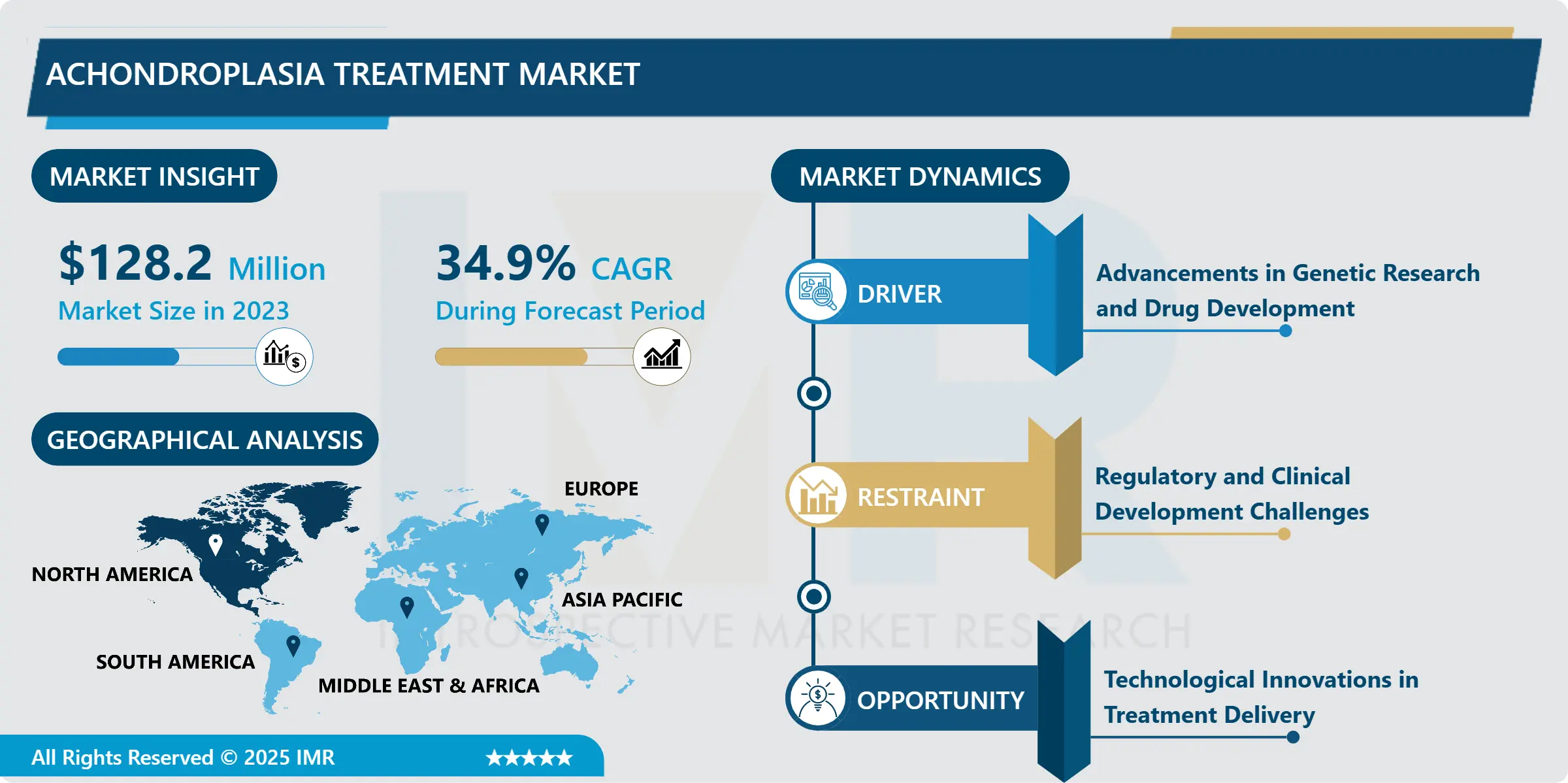
Achondroplasia Treatment Market Size Was Valued at USD 128.20 Million in 2023, and is Projected to Reach USD 1896.68 Million by 2032, Growing at a CAGR of 34.90% From 2024-2032.
The Achondroplasia Treatment Market captures all the kinds of treatment that are available for achondroplasia, a genetic disorder that leads to dwarfism due malformation of bones and cartilage. This market is centred on the development of technologies that will enhance patient’s quality of life; it is directed to address growth of bones, physical growth and the complications associated with these aspects.
The increasing prevalence of birth conditions like achondroplasia due to the early detection and diagnosing equipment also fuel the growth of the market. Progress in genetics have increase the chance of early diagnoses which has increased the demand for proper treatment. Open data indicates that about 0.5 per 10 000 individuals are affected by achondroplasia making this condition more prevalent with increasing need for individualized treatments all over the world.
Growth through new products and effective government support systems are some of the factors driving the market. Such drugs as CNP analogs and FGFR3 inhibitors are in late stages of clinical trials hence having effective treatments. Apart from the FDA and EMA’s provisions of the fast-track approval for orphan drugs, there is encouragement and more investment on achondroplasia treatment by pharmaceutical firms in the market.
Achondroplasia Treatment Market Trend Analysis:
Increasing Adoption of Non-Surgical Therapies
One of the strongest trends emerging in the market is the focus of FGFR3 inhibitors that target achondroplasia at the source. Molecular basis of treatment precision, genetic especially, is opening possibilities to eliminating negative outcomes and improving the chronic kidney disease longevity. These advancements are in synch with the recently emerging global trends that emphasize individualization of treatment.
Another trend important for the market is that clients tend to choose minimally invasive procedures. Injectable therapies especially CNP-based drugs are finding their spin in the ability to spur bone regeneration without the need for surgery. This behaviour may be as a result of patients and providers’ predilection for safer and convenient treatments.
Integration of Digital Technologies
It is also possible to identify attractive opportunities in emerging markets such as Asia-Pacific and, to a lesser degree, Latin America. Increasing HC expenditure and a relatively enhanced knowledge of rare disease modalities are opening up opportunities for achondroplasia remedy. The increased focus of governments to improve heathcare accessibility in such areas increases market potential.
Telemedicine and other AI-enabled genetic screening tools are now units of the disease management process they have become part of the achondroplasia treatment. These innovations improve patient care, facilitate customization of therapies, and maximize therapy effectiveness, providing a profitable potential for stakeholders to boost their market share.
Achondroplasia Treatment Market Segment Analysis:
Achondroplasia Treatment Market is Segmented on the basis of Treatment type, Drug Class, Route of Administration, End User, and Region.
By Treatment Type, Pharmacological Therapy segment is expected to dominate the market during the forecast period
The management of achondroplasia can be discussed under pharmacological intervention, surgical management and supportive care. Medical treatment is directed by drugs like RDA inhibitors and CNP mimetics that work on genetic defects to bring about growth of bones and correct developmental anomalies. Major surgery is usually used in treatment to fix deformities, enhance the function of limbs, or reduce pressure on the spinal cord. Adjuvant therapy includes PT, OT, and any other means that is not invasive as a way of improving the patient’s mobility, reducing pain, and as a generally supportive treatment alongside the other treatments.
By Drug Class, FGFR3 Inhibitors segment expected to held the largest share
The classes of drugs that can be administered to control achondroplasia are FGFR3 inhibitors, CNP, growth hormones, amongst others. There is a mutation in fibroblast growth factor receptor 3 that leads to abnormal bone growth, and FGFR3 inhibitors improve bone growth because they directly antagonize the responsible receptor. CNP analogs exert effects on osteogenesis through the stimulation of endochondral bone formation and mediate the detrimental influence of the gene mutation on bone formation. Growths hormones are used to encourage general growth, and to improve height in general, but they are somewhat helpful in achondroplasia treatment. The other category is made up of research drugs and complementary therapies with a focus on symptomology and comorbidity related to the disorder.
Achondroplasia Treatment Market Regional Insights:
North America is Expected to Dominate the Market Over the Forecast period
The treatment that is used to cure achondroplasia disorders is most popular in North America. This leadership is as a result of increased healthcare infrastructure, good regulation, and large numbers of key pharma players. In addition, enhanced government and corporate sponsorship towards research work or analytical trials augments the posture of this market in the region.
Adding to the leadership of the region, the implementation of the modern technologies and increased concern towards the fewer known types of dysmorphisms such as achondroplasia. Different organizations and advocacy groups help in pushing research and support for the market hence growing. Besides, North America is characterized by a highly developed specialized health care infrastructure and human capital.
Active Key Players in the Achondroplasia Treatment Market
Alexion Pharmaceuticals, Inc. (United States)
Ascendis Pharma A/S (Denmark)
BioMarin Pharmaceutical Inc. (United States)
Ipsen Biopharmaceuticals, Inc. (France)
Pfizer Inc. (United States)
QED Therapeutics, Inc. (United States)
Recursion Pharmaceuticals (United States)
Regeneron Pharmaceuticals, Inc. (United States)
Ribomic Inc. (Japan)
Therachon AG (Switzerland)
Other Active Players.
Chapter 1: Introduction
1.1 Scope and Coverage
Chapter 2:Executive Summary
Chapter 3: Market Landscape
3.1 Market Dynamics
3.1.1 Drivers
3.1.2 Restraints
3.1.3 Opportunities
3.1.4 Challenges
3.2 Market Trend Analysis
3.3 PESTLE Analysis
3.4 Porter’s Five Forces Analysis
3.5 Industry Value Chain Analysis
3.6 Ecosystem
3.7 Regulatory Landscape
3.8 Price Trend Analysis
3.9 Patent Analysis
3.10 Technology Evolution
3.11 Investment Pockets
3.12 Import-Export Analysis
Chapter 4: Achondroplasia Treatment Market by Treatment Type
4.1 Achondroplasia Treatment Market Snapshot and Growth Engine
4.2 Achondroplasia Treatment Market Overview
4.3 Pharmacological Therapy
4.3.1 Introduction and Market Overview
4.3.2 Historic and Forecasted Market Size in Value USD and Volume Units (2017-2032F)
4.3.3 Key Market Trends, Growth Factors and Opportunities
4.3.4 Pharmacological Therapy: Geographic Segmentation Analysis
4.4 Surgical Intervention
4.4.1 Introduction and Market Overview
4.4.2 Historic and Forecasted Market Size in Value USD and Volume Units (2017-2032F)
4.4.3 Key Market Trends, Growth Factors and Opportunities
4.4.4 Surgical Intervention: Geographic Segmentation Analysis
4.5 Supportive Therapy
4.5.1 Introduction and Market Overview
4.5.2 Historic and Forecasted Market Size in Value USD and Volume Units (2017-2032F)
4.5.3 Key Market Trends, Growth Factors and Opportunities
4.5.4 Supportive Therapy: Geographic Segmentation Analysis
Chapter 5: Achondroplasia Treatment Market by Drug Class
5.1 Achondroplasia Treatment Market Snapshot and Growth Engine
5.2 Achondroplasia Treatment Market Overview
5.3 FGFR3 Inhibitors
5.3.1 Introduction and Market Overview
5.3.2 Historic and Forecasted Market Size in Value USD and Volume Units (2017-2032F)
5.3.3 Key Market Trends, Growth Factors and Opportunities
5.3.4 FGFR3 Inhibitors: Geographic Segmentation Analysis
5.4 C-Type Natriuretic Peptides (CNP)
5.4.1 Introduction and Market Overview
5.4.2 Historic and Forecasted Market Size in Value USD and Volume Units (2017-2032F)
5.4.3 Key Market Trends, Growth Factors and Opportunities
5.4.4 C-Type Natriuretic Peptides (CNP): Geographic Segmentation Analysis
5.5 Growth Hormones
5.5.1 Introduction and Market Overview
5.5.2 Historic and Forecasted Market Size in Value USD and Volume Units (2017-2032F)
5.5.3 Key Market Trends, Growth Factors and Opportunities
5.5.4 Growth Hormones: Geographic Segmentation Analysis
5.6 Others
5.6.1 Introduction and Market Overview
5.6.2 Historic and Forecasted Market Size in Value USD and Volume Units (2017-2032F)
5.6.3 Key Market Trends, Growth Factors and Opportunities
5.6.4 Others: Geographic Segmentation Analysis
Chapter 6: Achondroplasia Treatment Market by Administration Route
6.1 Achondroplasia Treatment Market Snapshot and Growth Engine
6.2 Achondroplasia Treatment Market Overview
6.3 Oral
6.3.1 Introduction and Market Overview
6.3.2 Historic and Forecasted Market Size in Value USD and Volume Units (2017-2032F)
6.3.3 Key Market Trends, Growth Factors and Opportunities
6.3.4 Oral: Geographic Segmentation Analysis
6.4 Injectable
6.4.1 Introduction and Market Overview
6.4.2 Historic and Forecasted Market Size in Value USD and Volume Units (2017-2032F)
6.4.3 Key Market Trends, Growth Factors and Opportunities
6.4.4 Injectable: Geographic Segmentation Analysis
Chapter 7: Achondroplasia Treatment Market by End User
7.1 Achondroplasia Treatment Market Snapshot and Growth Engine
7.2 Achondroplasia Treatment Market Overview
7.3 Hospitals
7.3.1 Introduction and Market Overview
7.3.2 Historic and Forecasted Market Size in Value USD and Volume Units (2017-2032F)
7.3.3 Key Market Trends, Growth Factors and Opportunities
7.3.4 Hospitals: Geographic Segmentation Analysis
7.4 Specialty Clinicsm
7.4.1 Introduction and Market Overview
7.4.2 Historic and Forecasted Market Size in Value USD and Volume Units (2017-2032F)
7.4.3 Key Market Trends, Growth Factors and Opportunities
7.4.4 Specialty Clinicsm: Geographic Segmentation Analysis
7.5 Homecare Settings
7.5.1 Introduction and Market Overview
7.5.2 Historic and Forecasted Market Size in Value USD and Volume Units (2017-2032F)
7.5.3 Key Market Trends, Growth Factors and Opportunities
7.5.4 Homecare Settings: Geographic Segmentation Analysis
Chapter 8: Company Profiles and Competitive Analysis
8.1 Competitive Landscape
8.1.1 Competitive Benchmarking
8.1.2 Achondroplasia Treatment Market Share by Manufacturer (2023)
8.1.3 Industry BCG Matrix
8.1.4 Heat Map Analysis
8.1.5 Mergers and Acquisitions
8.2 BIOMARIN PHARMACEUTICAL INC. (UNITED STATES)
8.2.1 Company Overview
8.2.2 Key Executives
8.2.3 Company Snapshot
8.2.4 Role of the Company in the Market
8.2.5 Sustainability and Social Responsibility
8.2.6 Operating Business Segments
8.2.7 Product Portfolio
8.2.8 Business Performance
8.2.9 Key Strategic Moves and Recent Developments
8.2.10 SWOT Analysis
8.3 ASCENDIS PHARMA A/S (DENMARK)
8.4 THERACHON AG (SWITZERLAND)
8.5 PFIZER INC. (UNITED STATES)
8.6 IPSEN BIOPHARMACEUTICALS INC. (FRANCE)
8.7 RIBOMIC INC. (JAPAN)
8.8 QED THERAPEUTICS INC. (UNITED STATES)
8.9 RECURSION PHARMACEUTICALS (UNITED STATES)
8.10 REGENERON PHARMACEUTICALS INC. (UNITED STATES)
8.11 ALEXION PHARMACEUTICALS INC. (UNITED STATES)
8.12 OTHER ACTIVE PLAYERS
Chapter 9: Global Achondroplasia Treatment Market By Region
9.1 Overview
9.2. North America Achondroplasia Treatment Market
9.2.1 Key Market Trends, Growth Factors and Opportunities
9.2.2 Top Key Companies
9.2.3 Historic and Forecasted Market Size by Segments
9.2.4 Historic and Forecasted Market Size By Treatment Type
9.2.4.1 Pharmacological Therapy
9.2.4.2 Surgical Intervention
9.2.4.3 Supportive Therapy
9.2.5 Historic and Forecasted Market Size By Drug Class
9.2.5.1 FGFR3 Inhibitors
9.2.5.2 C-Type Natriuretic Peptides (CNP)
9.2.5.3 Growth Hormones
9.2.5.4 Others
9.2.6 Historic and Forecasted Market Size By Administration Route
9.2.6.1 Oral
9.2.6.2 Injectable
9.2.7 Historic and Forecasted Market Size By End User
9.2.7.1 Hospitals
9.2.7.2 Specialty Clinicsm
9.2.7.3 Homecare Settings
9.2.8 Historic and Forecast Market Size by Country
9.2.8.1 US
9.2.8.2 Canada
9.2.8.3 Mexico
9.3. Eastern Europe Achondroplasia Treatment Market
9.3.1 Key Market Trends, Growth Factors and Opportunities
9.3.2 Top Key Companies
9.3.3 Historic and Forecasted Market Size by Segments
9.3.4 Historic and Forecasted Market Size By Treatment Type
9.3.4.1 Pharmacological Therapy
9.3.4.2 Surgical Intervention
9.3.4.3 Supportive Therapy
9.3.5 Historic and Forecasted Market Size By Drug Class
9.3.5.1 FGFR3 Inhibitors
9.3.5.2 C-Type Natriuretic Peptides (CNP)
9.3.5.3 Growth Hormones
9.3.5.4 Others
9.3.6 Historic and Forecasted Market Size By Administration Route
9.3.6.1 Oral
9.3.6.2 Injectable
9.3.7 Historic and Forecasted Market Size By End User
9.3.7.1 Hospitals
9.3.7.2 Specialty Clinicsm
9.3.7.3 Homecare Settings
9.3.8 Historic and Forecast Market Size by Country
9.3.8.1 Russia
9.3.8.2 Bulgaria
9.3.8.3 The Czech Republic
9.3.8.4 Hungary
9.3.8.5 Poland
9.3.8.6 Romania
9.3.8.7 Rest of Eastern Europe
9.4. Western Europe Achondroplasia Treatment Market
9.4.1 Key Market Trends, Growth Factors and Opportunities
9.4.2 Top Key Companies
9.4.3 Historic and Forecasted Market Size by Segments
9.4.4 Historic and Forecasted Market Size By Treatment Type
9.4.4.1 Pharmacological Therapy
9.4.4.2 Surgical Intervention
9.4.4.3 Supportive Therapy
9.4.5 Historic and Forecasted Market Size By Drug Class
9.4.5.1 FGFR3 Inhibitors
9.4.5.2 C-Type Natriuretic Peptides (CNP)
9.4.5.3 Growth Hormones
9.4.5.4 Others
9.4.6 Historic and Forecasted Market Size By Administration Route
9.4.6.1 Oral
9.4.6.2 Injectable
9.4.7 Historic and Forecasted Market Size By End User
9.4.7.1 Hospitals
9.4.7.2 Specialty Clinicsm
9.4.7.3 Homecare Settings
9.4.8 Historic and Forecast Market Size by Country
9.4.8.1 Germany
9.4.8.2 UK
9.4.8.3 France
9.4.8.4 The Netherlands
9.4.8.5 Italy
9.4.8.6 Spain
9.4.8.7 Rest of Western Europe
9.5. Asia Pacific Achondroplasia Treatment Market
9.5.1 Key Market Trends, Growth Factors and Opportunities
9.5.2 Top Key Companies
9.5.3 Historic and Forecasted Market Size by Segments
9.5.4 Historic and Forecasted Market Size By Treatment Type
9.5.4.1 Pharmacological Therapy
9.5.4.2 Surgical Intervention
9.5.4.3 Supportive Therapy
9.5.5 Historic and Forecasted Market Size By Drug Class
9.5.5.1 FGFR3 Inhibitors
9.5.5.2 C-Type Natriuretic Peptides (CNP)
9.5.5.3 Growth Hormones
9.5.5.4 Others
9.5.6 Historic and Forecasted Market Size By Administration Route
9.5.6.1 Oral
9.5.6.2 Injectable
9.5.7 Historic and Forecasted Market Size By End User
9.5.7.1 Hospitals
9.5.7.2 Specialty Clinicsm
9.5.7.3 Homecare Settings
9.5.8 Historic and Forecast Market Size by Country
9.5.8.1 China
9.5.8.2 India
9.5.8.3 Japan
9.5.8.4 South Korea
9.5.8.5 Malaysia
9.5.8.6 Thailand
9.5.8.7 Vietnam
9.5.8.8 The Philippines
9.5.8.9 Australia
9.5.8.10 New Zealand
9.5.8.11 Rest of APAC
9.6. Middle East & Africa Achondroplasia Treatment Market
9.6.1 Key Market Trends, Growth Factors and Opportunities
9.6.2 Top Key Companies
9.6.3 Historic and Forecasted Market Size by Segments
9.6.4 Historic and Forecasted Market Size By Treatment Type
9.6.4.1 Pharmacological Therapy
9.6.4.2 Surgical Intervention
9.6.4.3 Supportive Therapy
9.6.5 Historic and Forecasted Market Size By Drug Class
9.6.5.1 FGFR3 Inhibitors
9.6.5.2 C-Type Natriuretic Peptides (CNP)
9.6.5.3 Growth Hormones
9.6.5.4 Others
9.6.6 Historic and Forecasted Market Size By Administration Route
9.6.6.1 Oral
9.6.6.2 Injectable
9.6.7 Historic and Forecasted Market Size By End User
9.6.7.1 Hospitals
9.6.7.2 Specialty Clinicsm
9.6.7.3 Homecare Settings
9.6.8 Historic and Forecast Market Size by Country
9.6.8.1 Turkiye
9.6.8.2 Bahrain
9.6.8.3 Kuwait
9.6.8.4 Saudi Arabia
9.6.8.5 Qatar
9.6.8.6 UAE
9.6.8.7 Israel
9.6.8.8 South Africa
9.7. South America Achondroplasia Treatment Market
9.7.1 Key Market Trends, Growth Factors and Opportunities
9.7.2 Top Key Companies
9.7.3 Historic and Forecasted Market Size by Segments
9.7.4 Historic and Forecasted Market Size By Treatment Type
9.7.4.1 Pharmacological Therapy
9.7.4.2 Surgical Intervention
9.7.4.3 Supportive Therapy
9.7.5 Historic and Forecasted Market Size By Drug Class
9.7.5.1 FGFR3 Inhibitors
9.7.5.2 C-Type Natriuretic Peptides (CNP)
9.7.5.3 Growth Hormones
9.7.5.4 Others
9.7.6 Historic and Forecasted Market Size By Administration Route
9.7.6.1 Oral
9.7.6.2 Injectable
9.7.7 Historic and Forecasted Market Size By End User
9.7.7.1 Hospitals
9.7.7.2 Specialty Clinicsm
9.7.7.3 Homecare Settings
9.7.8 Historic and Forecast Market Size by Country
9.7.8.1 Brazil
9.7.8.2 Argentina
9.7.8.3 Rest of SA
Chapter 10 Analyst Viewpoint and Conclusion
10.1 Recommendations and Concluding Analysis
10.2 Potential Market Strategies
Chapter 11 Research Methodology
11.1 Research Process
11.2 Primary Research
11.3 Secondary Research
Q1: What would be the forecast period in the Achondroplasia Treatment Market research report?
A1: The forecast period in the Achondroplasia Treatment Market research report is 2024-2032.
Q2: Who are the key players in the Achondroplasia Treatment Market?
A2: BioMarin Pharmaceutical Inc. (United States), Ascendis Pharma A/S (Denmark), Therachon AG (Switzerland), Pfizer Inc. (United States), Ipsen Biopharmaceuticals, Inc. (France), Ribomic Inc. (Japan), QED Therapeutics, Inc. (United States), Recursion Pharmaceuticals (United States), Regeneron Pharmaceuticals, Inc. (United States), Alexion Pharmaceuticals, Inc. (United States). and Other Active Players.
Q3: What are the segments of the Achondroplasia Treatment Market?
A3: The Achondroplasia Treatment Market is segmented into by Treatment Type (Pharmacological Therapy, Surgical Intervention, Supportive Therapy), By Drug Class (FGFR3 Inhibitors, C-Type Natriuretic Peptides (CNP), Growth Hormones, Others) By Administration Route (Oral, Injectable), End User (Hospitals, Specialty Clinicsm, Homecare Settings). By region, it is analyzed across North America (U.S., Canada, Mexico), Eastern Europe (Russia, Bulgaria, The Czech Republic, Hungary, Poland, Romania, Rest of Eastern Europe), Western Europe (Germany, UK, France, The Netherlands, Italy, Russia, Spain, Rest of Western Europe), Asia Pacific (China, India, Japan, South Korea, Malaysia, Thailand, Vietnam, The Philippines, Australia, New-Zealand, Rest of APAC), Middle East & Africa (Turkiye, Bahrain, Kuwait, Saudi Arabia, Qatar, UAE, Israel, South Africa), South America (Brazil, Argentina, Rest of SA).
Q4: What is the Achondroplasia Treatment Market?
A4: The Achondroplasia Treatment Market captures all the kinds of treatment that are available for achondroplasia, a genetic disorder that leads to dwarfism due malformation of bones and cartilage. This market is centred on the development of technologies that will enhance patient’s quality of life; it is directed to address growth of bones, physical growth and the complications associated with these aspects.
Q5: How big is the Achondroplasia Treatment Market?
A5: Achondroplasia Treatment Market Size Was Valued at USD 128.20 Million in 2023, and is Projected to Reach USD 1896.68 Million by 2032, Growing at a CAGR of 34.90% From 2024-2032.
How to Buy a Report from eminsights.jp
On the product page, choose the license you want: Single-User License, Multi-User License or Enterprise License.
If you required report in your native language, then you can click on Translated Report button and fill out the form with report name and language you want, then our team will contact you as soon as possible.
Click the Buy Now button.
You will be redirected to the checkout page. Enter your company details and payment information.
Click Place Order to complete the purchase.
Confirmation: You’ll receive an order confirmation and our team will contact you shortly with your ordered report.
If you have any questions, fill out the contact form below or email us at bizdev@eminsights.net.
Thank you for choosing eminsights.jp!