Stay Ahead in Fast-Growing Economies.
Browse Reports Now




3D Printing Technology Market- In Depth Analysis by Size (2024-2032)
3D printing, also called as additive manufacturing, is a technique for creating three-dimensional objects layer by layer using a computer created design. Computer-aided design (CAD) is used to create three-dimensional objects in 3D printing.

IMR Group
Description
3D Printing Technology Market Synopsis
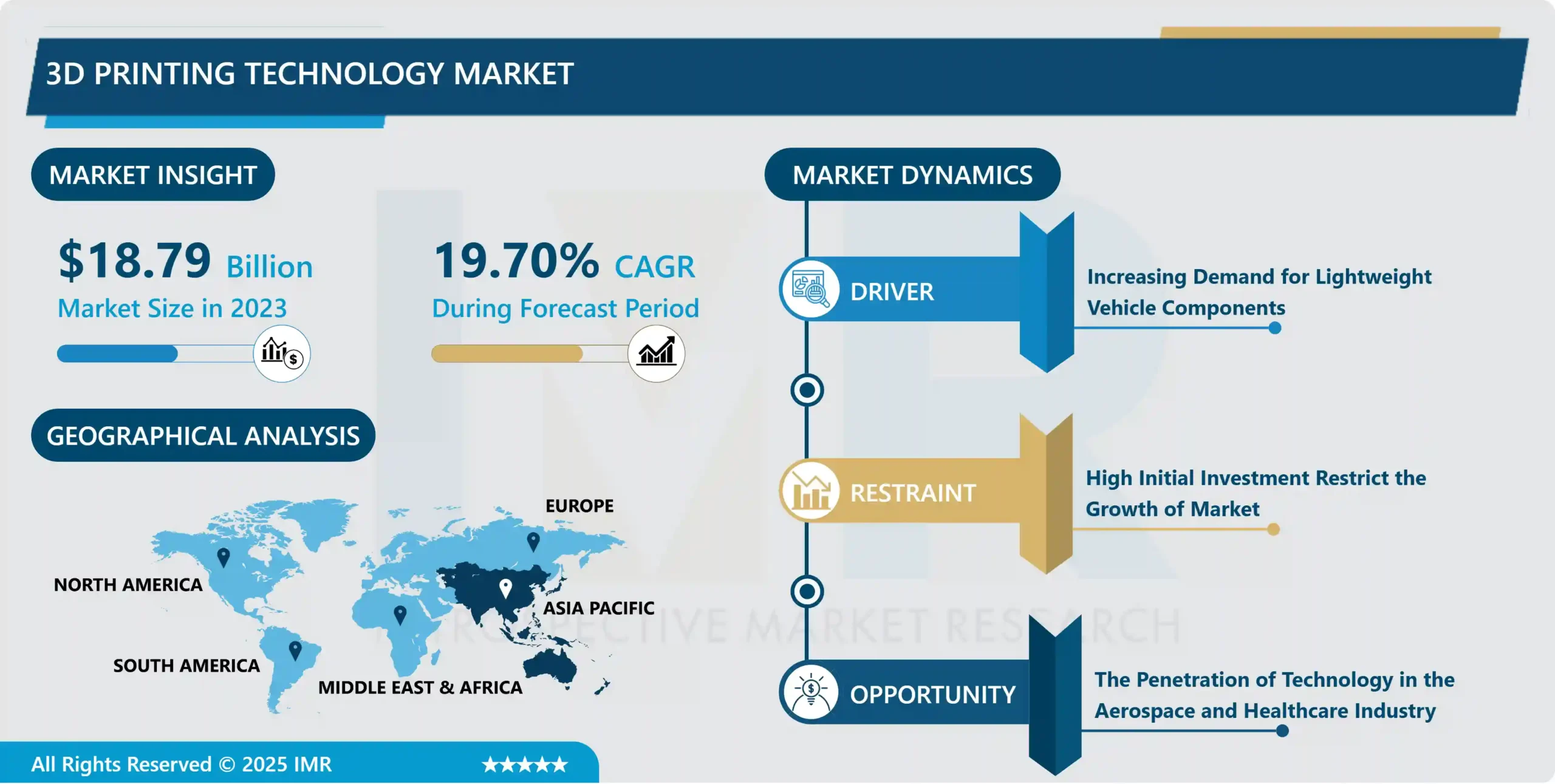
3D Printing Technology Market Size Was Valued at USD 18.79 Billion in 2023, and is Projected to Reach USD 94.79 Billion by 2032, Growing at a CAGR of 19.70% From 2024-2032.
3D printing, also called as additive manufacturing, is a technique for creating three-dimensional objects layer by layer using a computer created design. Computer-aided design (CAD) is used to create three-dimensional objects in 3D printing.
3D printing technology market has been witnessing significant growth and innovation. 3D printing, also known as additive manufacturing, involves creating three-dimensional objects layer by layer from digital models. This technology has found applications across various industries, including manufacturing, healthcare, aerospace, automotive, and consumer goods.
Key drivers for the growth of the 3D printing technology market include the increasing demand for customized and complex products, cost-effectiveness in prototyping, and the potential for on-demand manufacturing. The healthcare sector has particularly embraced 3D printing for creating patient-specific implants, prosthetics, and medical devices.
The market has seen advancements in materials used for 3D printing, expanded capabilities of printing technologies, and a growing ecosystem of software solutions for design and printing processes. While the market has shown immense potential, challenges such as material limitations, regulatory concerns, and intellectual property issues continue to be addressed.
3D Printing Technology Market Trend Analysis
Increasing Demand for Lightweight Vehicle Components
The increasing demand for lightweight vehicle components has emerged as a significant driving factor for the 3D printing technology market. As automotive manufacturers strive to enhance fuel efficiency and reduce carbon emissions, the adoption of 3D printing in the production of lightweight components has gained substantial momentum. This innovative technology allows for the creation of intricate and complex geometries, optimizing the design of automotive parts to achieve a balance between strength and weight.
3D printing enables the production of components with reduced material usage and increased structural efficiency, contributing to overall weight reduction in vehicles. This not only enhances fuel efficiency but also positively impacts performance and environmental sustainability. Moreover, the ability of 3D printing to manufacture customized and on-demand parts aligns with the automotive industry’s trend towards personalized and bespoke vehicle solutions.
The automotive sector’s increasing reliance on 3D printing for lightweight components underscores the technology’s pivotal role in shaping the future of vehicle manufacturing, as it offers a cost-effective and agile solution for producing complex, lightweight structures that meet the evolving demands of the modern automotive landscape.
The Penetration of Technology in the Aerospace and Healthcare Industry Creates an Opportunity
The integration of 3D printing technology has revolutionized both the aerospace and healthcare industries, showcasing its versatility and transformative potential. In the aerospace sector, 3D printing has become a cornerstone in the manufacturing process, enabling the production of complex and lightweight components with enhanced efficiency. This technology allows for rapid prototyping, cost-effective customization, and the creation of intricate designs that were previously challenging or impossible. The aerospace industry benefits from reduced material waste, shortened production cycles, and improved overall performance of aircraft components.
In the healthcare realm, 3D printing has significantly impacted medical device manufacturing and personalized medicine. Customized implants, prosthetics, and anatomical models are now feasible, tailored to individual patient needs. This innovation has not only improved patient outcomes but has also streamlined surgical planning and training. Moreover, the technology plays a crucial role in the development of pharmaceuticals, enabling precise drug dosage forms and enhancing research capabilities.
3D Printing Technology Market Segment Analysis:
3D Printing Technology Market Segmented on the basis of Application, Technology, Industry Vertical.
By Industry Vertical, healthcare segment is expected to dominate the market during the forecast period
The healthcare segment is poised to assert its dominance in the 3D Printing Technology Market, marking a paradigm shift in the industry landscape. The integration of 3D printing technology within healthcare has unlocked unprecedented possibilities, revolutionizing medical practices and patient care. One of the key drivers for this dominance is the ability of 3D printing to produce customized and patient-specific medical devices, implants, and prosthetics with remarkable precision.
In the realm of personalized medicine, 3D printing facilitates the creation of bespoke pharmaceuticals and drug delivery systems, optimizing treatment outcomes. Additionally, the technology has proven invaluable in anatomical modeling, enabling surgeons to enhance preoperative planning and training through lifelike replicas of patient-specific organs and structures.
By Technology, Selective Laser Sintering (SLS) segment held the largest share of 42.1% in 2022
Selective Laser Sintering (SLS) is anticipated to emerge as a dominant force in the 3D Printing Technology Market, leveraging its advanced capabilities and applications. SLS is a cutting-edge additive manufacturing technique that utilizes a high-powered laser to selectively fuse powdered materials, typically polymers or metals, layer by layer, to create intricate three-dimensional objects.
The dominance of SLS can be attributed to several factors. Firstly, it offers unparalleled design flexibility and precision, enabling the production of complex structures with high accuracy. This versatility makes it a preferred choice across various industries, including aerospace, automotive, healthcare, and consumer goods. Additionally, SLS facilitates the use of a wide range of materials, expanding its applicability and meeting diverse industry requirements.
3D Printing Technology Market Regional Insights:
Asia Pacific is Expected to Dominate the Market Over the Forecast Period
The Asia Pacific region is poised to emerge as a dominant force in the 3D printing technology market, exhibiting substantial growth and innovation. This projection is fueled by a combination of factors that position the region as a key player in the rapidly evolving landscape of additive manufacturing.
Key drivers for the expected dominance of the Asia Pacific in the 3D printing technology market include a robust manufacturing ecosystem, burgeoning technological infrastructure, and a proactive approach towards research and development. Countries like China, Japan, and South Korea have been at the forefront of integrating 3D printing into diverse industries, ranging from automotive and aerospace to healthcare and consumer goods.
Moreover, the region benefits from a skilled workforce and a proactive governmental stance, fostering an environment conducive to technological advancements. Investments in cutting-edge 3D printing technologies, along with strategic partnerships between industry players, further amplify the growth potential in the Asia Pacific.
3D Printing Technology Market Top Key Players:
3D Systems (USA)
Stratasys (USA)
Desktop Metal (USA)
SLM Solutions Group (Germany)
EOS GmbH Electro Optical Systems (Germany)
Renishaw plc (England)
ExOne Company (USA)
Markforged Inc. (USA)
Carbon, Inc. (USA)
Metal AM (England)
Voxeljet AG (Germany)
BigRep GmbH (Germany)
Ultimaker BV (Netherlands)
Formlabs Inc. (USA)
EnvisionTEC, Inc. (USA)
Proto Labs, Inc. (USA)
XYZprinting Inc. (Taiwan)
Sindoh Co., Ltd. (South Korea)
HP Inc. (USA)
Key Industry Developments in the 3D Printing Technology Market:
In May 2024, Europe announced that Europe’s Ariane 6 rocket, set for a July 2024 debut, represents a new era for European space missions. Orbital Matter’s Replicator mission, part of the launch, will showcase 3D printing technology in space. The mission aims to produce a 20-inch beam from a custom polymer material while orbiting at 360 miles, marking the first 3D printing demonstration outside the ISS.
In May 2024, BMF launched the industry’s first hybrid micro-precision 3D printer series, starting with the microArch D1025 Dual-Resolution 3D Printer. This printer offers flexible, high-precision printing for parts requiring micron-level accuracy. With the ability to print in 10µm or 25µm resolution, or a hybrid mode combining both, customers in various industries can benefit from improved 3D printing efficiency and flexibility.
Chapter 1: Introduction
1.1 Scope and Coverage
Chapter 2:Executive Summary
Chapter 3: Market Landscape
3.1 Market Dynamics
3.1.1 Drivers
3.1.2 Restraints
3.1.3 Opportunities
3.1.4 Challenges
3.2 Market Trend Analysis
3.3 PESTLE Analysis
3.4 Porter’s Five Forces Analysis
3.5 Industry Value Chain Analysis
3.6 Ecosystem
3.7 Regulatory Landscape
3.8 Price Trend Analysis
3.9 Patent Analysis
3.10 Technology Evolution
3.11 Investment Pockets
3.12 Import-Export Analysis
Chapter 4: 3D Printing Technology Market by Application (2018-2032)
4.1 3D Printing Technology Market Snapshot and Growth Engine
4.2 Market Overview
4.3 Tooling
4.3.1 Introduction and Market Overview
4.3.2 Historic and Forecasted Market Size in Value USD and Volume Units
4.3.3 Key Market Trends, Growth Factors, and Opportunities
4.3.4 Geographic Segmentation Analysis
4.4 Prototyping
4.5 Functional Part Manufacturing
Chapter 5: 3D Printing Technology Market by Technology (2018-2032)
5.1 3D Printing Technology Market Snapshot and Growth Engine
5.2 Market Overview
5.3 FDM
5.3.1 Introduction and Market Overview
5.3.2 Historic and Forecasted Market Size in Value USD and Volume Units
5.3.3 Key Market Trends, Growth Factors, and Opportunities
5.3.4 Geographic Segmentation Analysis
5.4 SLM
5.5 SLS
5.6 MJP
Chapter 6: 3D Printing Technology Market by Industry Vertical (2018-2032)
6.1 3D Printing Technology Market Snapshot and Growth Engine
6.2 Market Overview
6.3 Automotive
6.3.1 Introduction and Market Overview
6.3.2 Historic and Forecasted Market Size in Value USD and Volume Units
6.3.3 Key Market Trends, Growth Factors, and Opportunities
6.3.4 Geographic Segmentation Analysis
6.4 Healthcare
6.5 Aerospace & Defense
6.6 Consumer Electronics
6.7 Power & Energy
Chapter 7: Company Profiles and Competitive Analysis
7.1 Competitive Landscape
7.1.1 Competitive Benchmarking
7.1.2 3D Printing Technology Market Share by Manufacturer (2024)
7.1.3 Industry BCG Matrix
7.1.4 Heat Map Analysis
7.1.5 Mergers and Acquisitions
7.2 GSKY PLANT SYSTEMS (U.S.)
7.2.1 Company Overview
7.2.2 Key Executives
7.2.3 Company Snapshot
7.2.4 Role of the Company in the Market
7.2.5 Sustainability and Social Responsibility
7.2.6 Operating Business Segments
7.2.7 Product Portfolio
7.2.8 Business Performance
7.2.9 Key Strategic Moves and Recent Developments
7.2.10 SWOT Analysis
7.3 GREENWORKS (U.S.)
7.4 MOSS TREND (U.S.)
7.5 AMBIUS INC. (U.S.)
7.6 GREENSCREEN (U.S.)
7.7 SAGEGREENLIFE (U.S.)
7.8 LIVEWALL
7.9 LLC (U.S.)
7.10 NEDLAW LIVING WALLS (CANADA)
7.11 SACNDIA MOSS (SPAIN)
7.12 SUITEPLANTS (SPAIN)
7.13 ARTAQUA (SPAIN)
7.14 MEAMEA (SPAIN)
7.15 BYNATUREDESIGN (FRANCE)
7.16 DÉCO VÉGÉTALE (FRANCE)
7.17 SEMPERGREEN (NERTHELANDS)
7.18 ANS GROUP GLOBAL LTD (UK)
7.19 BIOTECTURE LTD. (UK)
7.20 GREENBLUE URBAN LTD (UK)
7.21 THE GREENWALL COMPANY (AUSTRALIA)
7.22 FYTOGREEN PTY LTD (AUSTRALIA)
7.23 ELT INDIA (INDIA)
7.24
Chapter 8: Global 3D Printing Technology Market By Region
8.1 Overview
8.2. North America 3D Printing Technology Market
8.2.1 Key Market Trends, Growth Factors and Opportunities
8.2.2 Top Key Companies
8.2.3 Historic and Forecasted Market Size by Segments
8.2.4 Historic and Forecasted Market Size by Application
8.2.4.1 Tooling
8.2.4.2 Prototyping
8.2.4.3 Functional Part Manufacturing
8.2.5 Historic and Forecasted Market Size by Technology
8.2.5.1 FDM
8.2.5.2 SLM
8.2.5.3 SLS
8.2.5.4 MJP
8.2.6 Historic and Forecasted Market Size by Industry Vertical
8.2.6.1 Automotive
8.2.6.2 Healthcare
8.2.6.3 Aerospace & Defense
8.2.6.4 Consumer Electronics
8.2.6.5 Power & Energy
8.2.7 Historic and Forecast Market Size by Country
8.2.7.1 US
8.2.7.2 Canada
8.2.7.3 Mexico
8.3. Eastern Europe 3D Printing Technology Market
8.3.1 Key Market Trends, Growth Factors and Opportunities
8.3.2 Top Key Companies
8.3.3 Historic and Forecasted Market Size by Segments
8.3.4 Historic and Forecasted Market Size by Application
8.3.4.1 Tooling
8.3.4.2 Prototyping
8.3.4.3 Functional Part Manufacturing
8.3.5 Historic and Forecasted Market Size by Technology
8.3.5.1 FDM
8.3.5.2 SLM
8.3.5.3 SLS
8.3.5.4 MJP
8.3.6 Historic and Forecasted Market Size by Industry Vertical
8.3.6.1 Automotive
8.3.6.2 Healthcare
8.3.6.3 Aerospace & Defense
8.3.6.4 Consumer Electronics
8.3.6.5 Power & Energy
8.3.7 Historic and Forecast Market Size by Country
8.3.7.1 Russia
8.3.7.2 Bulgaria
8.3.7.3 The Czech Republic
8.3.7.4 Hungary
8.3.7.5 Poland
8.3.7.6 Romania
8.3.7.7 Rest of Eastern Europe
8.4. Western Europe 3D Printing Technology Market
8.4.1 Key Market Trends, Growth Factors and Opportunities
8.4.2 Top Key Companies
8.4.3 Historic and Forecasted Market Size by Segments
8.4.4 Historic and Forecasted Market Size by Application
8.4.4.1 Tooling
8.4.4.2 Prototyping
8.4.4.3 Functional Part Manufacturing
8.4.5 Historic and Forecasted Market Size by Technology
8.4.5.1 FDM
8.4.5.2 SLM
8.4.5.3 SLS
8.4.5.4 MJP
8.4.6 Historic and Forecasted Market Size by Industry Vertical
8.4.6.1 Automotive
8.4.6.2 Healthcare
8.4.6.3 Aerospace & Defense
8.4.6.4 Consumer Electronics
8.4.6.5 Power & Energy
8.4.7 Historic and Forecast Market Size by Country
8.4.7.1 Germany
8.4.7.2 UK
8.4.7.3 France
8.4.7.4 The Netherlands
8.4.7.5 Italy
8.4.7.6 Spain
8.4.7.7 Rest of Western Europe
8.5. Asia Pacific 3D Printing Technology Market
8.5.1 Key Market Trends, Growth Factors and Opportunities
8.5.2 Top Key Companies
8.5.3 Historic and Forecasted Market Size by Segments
8.5.4 Historic and Forecasted Market Size by Application
8.5.4.1 Tooling
8.5.4.2 Prototyping
8.5.4.3 Functional Part Manufacturing
8.5.5 Historic and Forecasted Market Size by Technology
8.5.5.1 FDM
8.5.5.2 SLM
8.5.5.3 SLS
8.5.5.4 MJP
8.5.6 Historic and Forecasted Market Size by Industry Vertical
8.5.6.1 Automotive
8.5.6.2 Healthcare
8.5.6.3 Aerospace & Defense
8.5.6.4 Consumer Electronics
8.5.6.5 Power & Energy
8.5.7 Historic and Forecast Market Size by Country
8.5.7.1 China
8.5.7.2 India
8.5.7.3 Japan
8.5.7.4 South Korea
8.5.7.5 Malaysia
8.5.7.6 Thailand
8.5.7.7 Vietnam
8.5.7.8 The Philippines
8.5.7.9 Australia
8.5.7.10 New Zealand
8.5.7.11 Rest of APAC
8.6. Middle East & Africa 3D Printing Technology Market
8.6.1 Key Market Trends, Growth Factors and Opportunities
8.6.2 Top Key Companies
8.6.3 Historic and Forecasted Market Size by Segments
8.6.4 Historic and Forecasted Market Size by Application
8.6.4.1 Tooling
8.6.4.2 Prototyping
8.6.4.3 Functional Part Manufacturing
8.6.5 Historic and Forecasted Market Size by Technology
8.6.5.1 FDM
8.6.5.2 SLM
8.6.5.3 SLS
8.6.5.4 MJP
8.6.6 Historic and Forecasted Market Size by Industry Vertical
8.6.6.1 Automotive
8.6.6.2 Healthcare
8.6.6.3 Aerospace & Defense
8.6.6.4 Consumer Electronics
8.6.6.5 Power & Energy
8.6.7 Historic and Forecast Market Size by Country
8.6.7.1 Turkiye
8.6.7.2 Bahrain
8.6.7.3 Kuwait
8.6.7.4 Saudi Arabia
8.6.7.5 Qatar
8.6.7.6 UAE
8.6.7.7 Israel
8.6.7.8 South Africa
8.7. South America 3D Printing Technology Market
8.7.1 Key Market Trends, Growth Factors and Opportunities
8.7.2 Top Key Companies
8.7.3 Historic and Forecasted Market Size by Segments
8.7.4 Historic and Forecasted Market Size by Application
8.7.4.1 Tooling
8.7.4.2 Prototyping
8.7.4.3 Functional Part Manufacturing
8.7.5 Historic and Forecasted Market Size by Technology
8.7.5.1 FDM
8.7.5.2 SLM
8.7.5.3 SLS
8.7.5.4 MJP
8.7.6 Historic and Forecasted Market Size by Industry Vertical
8.7.6.1 Automotive
8.7.6.2 Healthcare
8.7.6.3 Aerospace & Defense
8.7.6.4 Consumer Electronics
8.7.6.5 Power & Energy
8.7.7 Historic and Forecast Market Size by Country
8.7.7.1 Brazil
8.7.7.2 Argentina
8.7.7.3 Rest of SA
Chapter 9 Analyst Viewpoint and Conclusion
9.1 Recommendations and Concluding Analysis
9.2 Potential Market Strategies
Chapter 10 Research Methodology
10.1 Research Process
10.2 Primary Research
10.3 Secondary Research
Q1: What would be the forecast period in the 3D Printing Technology Market research report?
A1: The forecast period in the 3D Printing Technology Market research report is 2024-2032.
Q2: Who are the key players in the 3D Printing Technology Market?
A2: 3D Systems (USA), Stratasys (USA), Desktop Metal (USA), SLM Solutions Group (Germany), EOS GmbH Electro Optical Systems (Germany), Renishaw plc (England), ExOne Company (USA), Markforged Inc. (USA), Carbon, Inc. (USA), Metal AM (England), Voxeljet AG (Germany), BigRep GmbH (Germany), Ultimaker BV (Netherlands), Formlabs Inc. (USA), EnvisionTEC, Inc. (USA), Proto Labs, Inc. (USA), XYZprinting Inc. (Taiwan), Sindoh Co., Ltd. (South Korea), HP Inc. (USA) and Other Major Players.
Q3: What are the segments of the 3D Printing Technology Market?
A3: 3D Printing Technology Market is segmented into Application, Technology, Industry Vertical and region. By Application, the market is categorized into Tooling, Prototyping, and Functional Part Manufacturing. By Technology, the market is categorized into FDM, SLM, SLS, MJP, Others. By Industry Vertical the market is categorized into Automotive, Healthcare, Aerospace & Defense, Consumer Electronics, and Power & Energy. By region, it is analyzed across North America (U.S.; Canada; Mexico), Eastern Europe (Bulgaria; The Czech Republic; Hungary; Poland; Romania; Rest of Eastern Europe), Western Europe (Germany; UK; France; Netherlands; Italy; Russia; Spain; Rest of Western Europe), Asia-Pacific (China; India; Japan; Southeast Asia, etc.), South America (Brazil; Argentina, etc.), Middle East & Africa (Saudi Arabia; South Africa, etc.).
Q4: What is the 3D Printing Technology Market?
A4: 3D printing, also called as additive manufacturing, is a technique for creating three-dimensional objects layer by layer using a computer created design. Computer-aided design (CAD) is used to create three-dimensional objects in 3D printing.
Q5: How big is the 3D Printing Technology Market?
A5: 3D Printing Technology Market Size Was Valued at USD 18.79 Billion in 2023, and is Projected to Reach USD 94.79 Billion by 2032, Growing at a CAGR of 19.7% From 2024-2032.
How to Buy a Report from eminsights.jp
On the product page, choose the license you want: Single-User License, Multi-User License or Enterprise License.
If you required report in your native language, then you can click on Translated Report button and fill out the form with report name and language you want, then our team will contact you as soon as possible.
Click the Buy Now button.
You will be redirected to the checkout page. Enter your company details and payment information.
Click Place Order to complete the purchase.
Confirmation: You’ll receive an order confirmation and our team will contact you shortly with your ordered report.
If you have any questions, fill out the contact form below or email us at bizdev@eminsights.net.
Thank you for choosing eminsights.jp!