Stay Ahead in Fast-Growing Economies.
Browse Reports Now
3D Imaging Market Size, Share, Growth & Forecast (2024-2032)
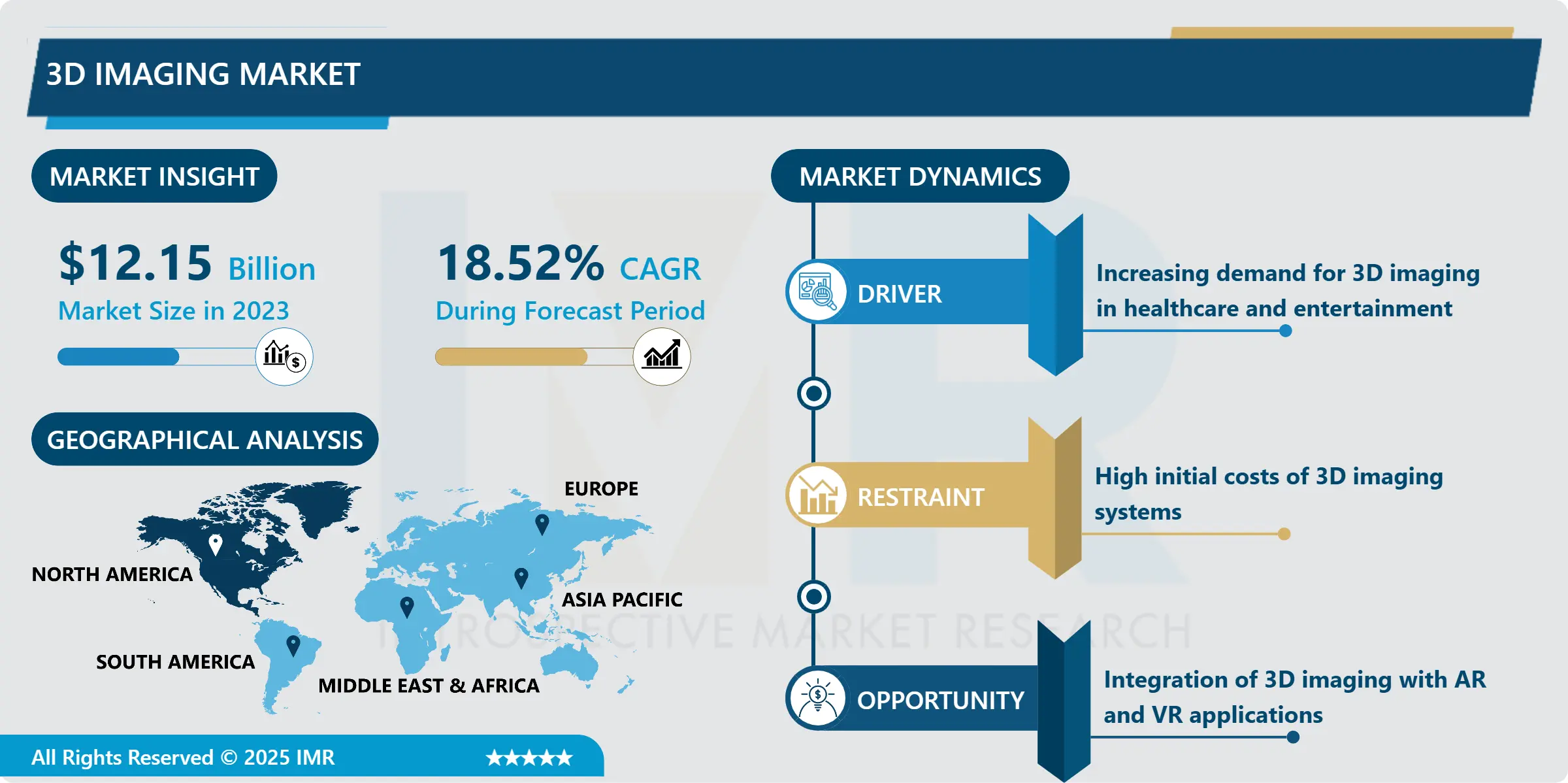
3D Imaging Market Size Was Valued at USD 12.15 Billion in 2023, and is Projected to Reach USD 47.3 Billion by 2032, Growing at a CAGR of 18.52% From 2024-2032.

IMR Group
Description
3D Imaging Market Synopsis:
3D Imaging Market Size Was Valued at USD 12.15 Billion in 2023, and is Projected to Reach USD 47.3 Billion by 2032, Growing at a CAGR of 18.52% From 2024-2032.
The 3D imaging market is defined as the science and methodology of identifying, storing, manipulating and illustrating 3-D images of objects, surface or environment. These technologies have become common in healthcare, entertainment, automobile, aeronautics, construction, and retail among others. With the help of stereoscopic imaging, volumetric imaging, and some types of holography technologies, 3D imaging provides an increased depth of field, improved spatial orientation, and precision to execute the assigned tasks in different fields.
The global 3D imaging market holds a high growth rate right now due to the integration of this technology across industries. Photorealistic Imaging Technologies are already changing the face of diagnostics and therapy planning in healthcare through optical imaging that helps in creating detailed images of tissues and organs to ensure proper accuracy during surgeries and therapy. In the same way, through the use of movies, video games, and site reliability engineering virtual reality, entertainment creates the need for 3D imaging. Also, it has been adopted through the enhancement of the 3D imaging software, and hardware enhanced by artificial intelligence and machine learning.
Automotive and aerospace industries also play a major role in market expansion as they apply 3D imaging to inspect, develop and create precise products. Furthermore, the retail and e-commerce sectors are using 3D imaging to offer users a chance to try products virtually and improve the look of the online store. As for the benefits, the primary P’s of technology promise accurate real-time information, and the reduced need for human input so crucial in a diverse range of uses. Due to continuous advancements and rapid growth of end-user industries, more growth is expected in this market in the future.
3D Imaging Market Trend Analysis:
AI-Powered 3D Imaging
3D imaging is the future as rapid advances in artificial intelligence (AI) have made it easier, faster, and accurate to produce imaging systems. AI algorithms are now being embedded into a 3D imaging solution for automatic processing of data for immediate interpretation and forecast. For instance, in the healthcare sector, AI-enabled 3D imaging solutions are able to reveal problems predisposing a patient to particular treatments with stunning accuracy. In industrial relations, it improves on the discovery of defects within production lines. The process of combining the applications of artificial intelligence and the use of 3D imaging is considered to open new opportunities, pushing forward the development of new solutions and overall optimising performance in numerous fields.
Expanding Applications in AR and VR
The threat posed by the advanced and rapidly growing use of augmented reality and virtual reality will be beneficial to the growth of the 3D imaging market. AR and VR both heavily based on the 3D imagery that is used to provide the public with applied applications in the fields such as gaming, educational, healthcare and training exercises etc. As the trend toward hearing and experiencing rather than merely seeing the content increases, especially in the metaverse and virtual collaboration environments, 3D imaging technologies will be especially important. New forestry in AR/VR development, and growing utilise of head-mounted display as well as other wearable devices will continue to drive the market.
3D Imaging Market Segment Analysis:
3D Imaging Market is Segmented on the basis of Component, Technology, End User, and Region.
By Component, Hardware segment is expected to dominate the market during the forecast period
The 3D imaging market segment that comprises of 3D Scanners, Sensors and Cameras is expected to remain globally dominant in the hardware segment throughout the forecast period. This dominance could be attributed to the rising demand for better image capturing devices especially in healthcare and automotive applications. 3D scanners for example are used to create better images of an organs of the body or for dimensional measurements in manufacturing. Their usage is attributed to the new generations of thin-client devices, where the improvements like higher screen resolutions and fast data conversions are ongoing.
Moreover, the decline in prices of 3D imaging accessories contributes to the greater popularity of such equipment and devices among SMEs and, accordingly, to the growth of the market. 3D imaging software is on the rise as business establishments continue to realize the positive impacts of the technology in enhancing efficiency and precision and this segment is likely to be edged out by the hardware segment.
By Technology, Stereo Imaging segment expected to held the largest share
The stereo imaging segment is expected to dominate the 3D imaging market for the longest time now. Stereo imaging refers to taking two pictures from slightly different angles with the aim of making an image to look deeper. This is found to be widely used in electronics like smartphone, camera and many more industrial applications like robots and cars. Due to its versatility and affordability, stereo imaging has become one of the most sought techniques in different fields.
Besides, its tasks for building up stereo views in games, virtual reality, and movies have greatly enhanced the demand for it. It is also expected that, with ever increasing demand for better imaging solutions, the stereo imaging segment will continue to dominate the 3D imaging market.
3D Imaging Market Regional Insights:
North America is Expected to Dominate the Market Over the Forecast period
North America became the largest regional market for 3D imaging by 2023. This may be attributed to well-developed technologies in the region, high usage of latest imaging technologies, and high spending on research. The United States of America has been highly influential especially health care, entertainment and automotive industries in embracing 3D imaging technologies. Also, key chain players are located in North America and the increasing use in sectors such as retail and aerospace strengthen North America’s leading position in this market.
Active Key Players in the 3D Imaging Market
3D Systems (United States)
Agilent Technologies (United States)
Autodesk Inc. (United States)
Dassault Systèmes (France)
Faro Technologies (United States)
GE Healthcare (United States)
Google LLC (United States)
HP Inc. (United States)
Koninklijke Philips N.V. (Netherlands)
LMI Technologies (Canada)
Matterport Inc. (United States)
Microsoft Corporation (United States)
Samsung Electronics Co., Ltd. (South Korea)
Siemens Healthineers (Germany)
Sony Corporation (Japan)
Other Active Players.
Chapter 1: Introduction
1.1 Scope and Coverage
Chapter 2:Executive Summary
Chapter 3: Market Landscape
3.1 Market Dynamics
3.1.1 Drivers
3.1.2 Restraints
3.1.3 Opportunities
3.1.4 Challenges
3.2 Market Trend Analysis
3.3 PESTLE Analysis
3.4 Porter’s Five Forces Analysis
3.5 Industry Value Chain Analysis
3.6 Ecosystem
3.7 Regulatory Landscape
3.8 Price Trend Analysis
3.9 Patent Analysis
3.10 Technology Evolution
3.11 Investment Pockets
3.12 Import-Export Analysis
Chapter 4: 3D Imaging Market by Component
4.1 3D Imaging Market Snapshot and Growth Engine
4.2 3D Imaging Market Overview
4.3 Hardware
4.3.1 Introduction and Market Overview
4.3.2 Historic and Forecasted Market Size in Value USD and Volume Units (2017-2032F)
4.3.3 Key Market Trends, Growth Factors and Opportunities
4.3.4 Hardware: Geographic Segmentation Analysis
4.4 Software
4.4.1 Introduction and Market Overview
4.4.2 Historic and Forecasted Market Size in Value USD and Volume Units (2017-2032F)
4.4.3 Key Market Trends, Growth Factors and Opportunities
4.4.4 Software: Geographic Segmentation Analysis
4.5 Service
4.5.1 Introduction and Market Overview
4.5.2 Historic and Forecasted Market Size in Value USD and Volume Units (2017-2032F)
4.5.3 Key Market Trends, Growth Factors and Opportunities
4.5.4 Service: Geographic Segmentation Analysis
Chapter 5: 3D Imaging Market by Technology
5.1 3D Imaging Market Snapshot and Growth Engine
5.2 3D Imaging Market Overview
5.3 Stereo Imaging
5.3.1 Introduction and Market Overview
5.3.2 Historic and Forecasted Market Size in Value USD and Volume Units (2017-2032F)
5.3.3 Key Market Trends, Growth Factors and Opportunities
5.3.4 Stereo Imaging: Geographic Segmentation Analysis
5.4 Time-of-Flight (ToF)
5.4.1 Introduction and Market Overview
5.4.2 Historic and Forecasted Market Size in Value USD and Volume Units (2017-2032F)
5.4.3 Key Market Trends, Growth Factors and Opportunities
5.4.4 Time-of-Flight (ToF): Geographic Segmentation Analysis
5.5 Structured Light
5.5.1 Introduction and Market Overview
5.5.2 Historic and Forecasted Market Size in Value USD and Volume Units (2017-2032F)
5.5.3 Key Market Trends, Growth Factors and Opportunities
5.5.4 Structured Light: Geographic Segmentation Analysis
5.6 Laser-based Imaging
5.6.1 Introduction and Market Overview
5.6.2 Historic and Forecasted Market Size in Value USD and Volume Units (2017-2032F)
5.6.3 Key Market Trends, Growth Factors and Opportunities
5.6.4 Laser-based Imaging: Geographic Segmentation Analysis
Chapter 6: 3D Imaging Market by End User
6.1 3D Imaging Market Snapshot and Growth Engine
6.2 3D Imaging Market Overview
6.3 Healthcare
6.3.1 Introduction and Market Overview
6.3.2 Historic and Forecasted Market Size in Value USD and Volume Units (2017-2032F)
6.3.3 Key Market Trends, Growth Factors and Opportunities
6.3.4 Healthcare: Geographic Segmentation Analysis
6.4 Manufacturing
6.4.1 Introduction and Market Overview
6.4.2 Historic and Forecasted Market Size in Value USD and Volume Units (2017-2032F)
6.4.3 Key Market Trends, Growth Factors and Opportunities
6.4.4 Manufacturing: Geographic Segmentation Analysis
6.5 Government
6.5.1 Introduction and Market Overview
6.5.2 Historic and Forecasted Market Size in Value USD and Volume Units (2017-2032F)
6.5.3 Key Market Trends, Growth Factors and Opportunities
6.5.4 Government: Geographic Segmentation Analysis
6.6 Media & Entertainment
6.6.1 Introduction and Market Overview
6.6.2 Historic and Forecasted Market Size in Value USD and Volume Units (2017-2032F)
6.6.3 Key Market Trends, Growth Factors and Opportunities
6.6.4 Media & Entertainment: Geographic Segmentation Analysis
6.7 Retail and E-commerce
6.7.1 Introduction and Market Overview
6.7.2 Historic and Forecasted Market Size in Value USD and Volume Units (2017-2032F)
6.7.3 Key Market Trends, Growth Factors and Opportunities
6.7.4 Retail and E-commerce: Geographic Segmentation Analysis
Chapter 7: Company Profiles and Competitive Analysis
7.1 Competitive Landscape
7.1.1 Competitive Benchmarking
7.1.2 3D Imaging Market Share by Manufacturer (2023)
7.1.3 Industry BCG Matrix
7.1.4 Heat Map Analysis
7.1.5 Mergers and Acquisitions
7.2 3D SYSTEMS (UNITED STATES)
7.2.1 Company Overview
7.2.2 Key Executives
7.2.3 Company Snapshot
7.2.4 Role of the Company in the Market
7.2.5 Sustainability and Social Responsibility
7.2.6 Operating Business Segments
7.2.7 Product Portfolio
7.2.8 Business Performance
7.2.9 Key Strategic Moves and Recent Developments
7.2.10 SWOT Analysis
7.3 AGILENT TECHNOLOGIES (UNITED STATES)
7.4 AUTODESK INC. (UNITED STATES)
7.5 DASSAULT SYSTÈMES (FRANCE)
7.6 FARO TECHNOLOGIES (UNITED STATES)
7.7 GE HEALTHCARE (UNITED STATES)
7.8 GOOGLE LLC (UNITED STATES)
7.9 HP INC. (UNITED STATES)
7.10 KONINKLIJKE PHILIPS N.V. (NETHERLANDS)
7.11 LMI TECHNOLOGIES (CANADA)
7.12 MATTERPORT INC. (UNITED STATES)
7.13 MICROSOFT CORPORATION (UNITED STATES)
7.14 SAMSUNG ELECTRONICS CO. LTD. (SOUTH KOREA)
7.15 SIEMENS HEALTHINEERS (GERMANY)
7.16 SONY CORPORATION (JAPAN)
7.17 OTHER ACTIVE PLAYERS
Chapter 8: Global 3D Imaging Market By Region
8.1 Overview
8.2. North America 3D Imaging Market
8.2.1 Key Market Trends, Growth Factors and Opportunities
8.2.2 Top Key Companies
8.2.3 Historic and Forecasted Market Size by Segments
8.2.4 Historic and Forecasted Market Size By Component
8.2.4.1 Hardware
8.2.4.2 Software
8.2.4.3 Service
8.2.5 Historic and Forecasted Market Size By Technology
8.2.5.1 Stereo Imaging
8.2.5.2 Time-of-Flight (ToF)
8.2.5.3 Structured Light
8.2.5.4 Laser-based Imaging
8.2.6 Historic and Forecasted Market Size By End User
8.2.6.1 Healthcare
8.2.6.2 Manufacturing
8.2.6.3 Government
8.2.6.4 Media & Entertainment
8.2.6.5 Retail and E-commerce
8.2.7 Historic and Forecast Market Size by Country
8.2.7.1 US
8.2.7.2 Canada
8.2.7.3 Mexico
8.3. Eastern Europe 3D Imaging Market
8.3.1 Key Market Trends, Growth Factors and Opportunities
8.3.2 Top Key Companies
8.3.3 Historic and Forecasted Market Size by Segments
8.3.4 Historic and Forecasted Market Size By Component
8.3.4.1 Hardware
8.3.4.2 Software
8.3.4.3 Service
8.3.5 Historic and Forecasted Market Size By Technology
8.3.5.1 Stereo Imaging
8.3.5.2 Time-of-Flight (ToF)
8.3.5.3 Structured Light
8.3.5.4 Laser-based Imaging
8.3.6 Historic and Forecasted Market Size By End User
8.3.6.1 Healthcare
8.3.6.2 Manufacturing
8.3.6.3 Government
8.3.6.4 Media & Entertainment
8.3.6.5 Retail and E-commerce
8.3.7 Historic and Forecast Market Size by Country
8.3.7.1 Russia
8.3.7.2 Bulgaria
8.3.7.3 The Czech Republic
8.3.7.4 Hungary
8.3.7.5 Poland
8.3.7.6 Romania
8.3.7.7 Rest of Eastern Europe
8.4. Western Europe 3D Imaging Market
8.4.1 Key Market Trends, Growth Factors and Opportunities
8.4.2 Top Key Companies
8.4.3 Historic and Forecasted Market Size by Segments
8.4.4 Historic and Forecasted Market Size By Component
8.4.4.1 Hardware
8.4.4.2 Software
8.4.4.3 Service
8.4.5 Historic and Forecasted Market Size By Technology
8.4.5.1 Stereo Imaging
8.4.5.2 Time-of-Flight (ToF)
8.4.5.3 Structured Light
8.4.5.4 Laser-based Imaging
8.4.6 Historic and Forecasted Market Size By End User
8.4.6.1 Healthcare
8.4.6.2 Manufacturing
8.4.6.3 Government
8.4.6.4 Media & Entertainment
8.4.6.5 Retail and E-commerce
8.4.7 Historic and Forecast Market Size by Country
8.4.7.1 Germany
8.4.7.2 UK
8.4.7.3 France
8.4.7.4 The Netherlands
8.4.7.5 Italy
8.4.7.6 Spain
8.4.7.7 Rest of Western Europe
8.5. Asia Pacific 3D Imaging Market
8.5.1 Key Market Trends, Growth Factors and Opportunities
8.5.2 Top Key Companies
8.5.3 Historic and Forecasted Market Size by Segments
8.5.4 Historic and Forecasted Market Size By Component
8.5.4.1 Hardware
8.5.4.2 Software
8.5.4.3 Service
8.5.5 Historic and Forecasted Market Size By Technology
8.5.5.1 Stereo Imaging
8.5.5.2 Time-of-Flight (ToF)
8.5.5.3 Structured Light
8.5.5.4 Laser-based Imaging
8.5.6 Historic and Forecasted Market Size By End User
8.5.6.1 Healthcare
8.5.6.2 Manufacturing
8.5.6.3 Government
8.5.6.4 Media & Entertainment
8.5.6.5 Retail and E-commerce
8.5.7 Historic and Forecast Market Size by Country
8.5.7.1 China
8.5.7.2 India
8.5.7.3 Japan
8.5.7.4 South Korea
8.5.7.5 Malaysia
8.5.7.6 Thailand
8.5.7.7 Vietnam
8.5.7.8 The Philippines
8.5.7.9 Australia
8.5.7.10 New Zealand
8.5.7.11 Rest of APAC
8.6. Middle East & Africa 3D Imaging Market
8.6.1 Key Market Trends, Growth Factors and Opportunities
8.6.2 Top Key Companies
8.6.3 Historic and Forecasted Market Size by Segments
8.6.4 Historic and Forecasted Market Size By Component
8.6.4.1 Hardware
8.6.4.2 Software
8.6.4.3 Service
8.6.5 Historic and Forecasted Market Size By Technology
8.6.5.1 Stereo Imaging
8.6.5.2 Time-of-Flight (ToF)
8.6.5.3 Structured Light
8.6.5.4 Laser-based Imaging
8.6.6 Historic and Forecasted Market Size By End User
8.6.6.1 Healthcare
8.6.6.2 Manufacturing
8.6.6.3 Government
8.6.6.4 Media & Entertainment
8.6.6.5 Retail and E-commerce
8.6.7 Historic and Forecast Market Size by Country
8.6.7.1 Turkiye
8.6.7.2 Bahrain
8.6.7.3 Kuwait
8.6.7.4 Saudi Arabia
8.6.7.5 Qatar
8.6.7.6 UAE
8.6.7.7 Israel
8.6.7.8 South Africa
8.7. South America 3D Imaging Market
8.7.1 Key Market Trends, Growth Factors and Opportunities
8.7.2 Top Key Companies
8.7.3 Historic and Forecasted Market Size by Segments
8.7.4 Historic and Forecasted Market Size By Component
8.7.4.1 Hardware
8.7.4.2 Software
8.7.4.3 Service
8.7.5 Historic and Forecasted Market Size By Technology
8.7.5.1 Stereo Imaging
8.7.5.2 Time-of-Flight (ToF)
8.7.5.3 Structured Light
8.7.5.4 Laser-based Imaging
8.7.6 Historic and Forecasted Market Size By End User
8.7.6.1 Healthcare
8.7.6.2 Manufacturing
8.7.6.3 Government
8.7.6.4 Media & Entertainment
8.7.6.5 Retail and E-commerce
8.7.7 Historic and Forecast Market Size by Country
8.7.7.1 Brazil
8.7.7.2 Argentina
8.7.7.3 Rest of SA
Chapter 9 Analyst Viewpoint and Conclusion
9.1 Recommendations and Concluding Analysis
9.2 Potential Market Strategies
Chapter 10 Research Methodology
10.1 Research Process
10.2 Primary Research
10.3 Secondary Research
Q1: What would be the forecast period in the 3D Imaging Market research report?
A1: The forecast period in the 3D Imaging Market research report is 2024-2032.
Q2: Who are the key players in the 3D Imaging Market?
A2: 3D Systems, Autodesk Inc., Google LLC, Samsung Electronics Co., Ltd., Microsoft Corporation and Other Active Players.
Q3: What are the segments of the 3D Imaging Market?
A3: The 3D Imaging Market is segmented into Component, Technology, End User and region. By Component, the market is categorized into Hardware, Software, Service. By Technology, the market is categorized into Stereo Imaging, Time-of-Flight (ToF), Structured Light, Laser-based Imaging. By End User, the market is categorized into Healthcare, Manufacturing, Government, Media & Entertainment, Retail and E-commerce. By region, it is analyzed across North America (U.S., Canada, Mexico), Eastern Europe (Russia, Bulgaria, The Czech Republic, Hungary, Poland, Romania, Rest of Eastern Europe), Western Europe (Germany, UK, France, The Netherlands, Italy, Russia, Spain, Rest of Western Europe), Asia Pacific (China, India, Japan, South Korea, Malaysia, Thailand, Vietnam, The Philippines, Australia, New-Zealand, Rest of APAC), Middle East & Africa (Turkiye, Bahrain, Kuwait, Saudi Arabia, Qatar, UAE, Israel, South Africa), South America (Brazil, Argentina, Rest of SA).
Q4: What is the 3D Imaging Market?
A4: The 3D imaging market is defined as the science and methodology of identifying, storing, manipulating and illustrating 3-D images of objects, surface or environment. These technologies have become common in healthcare, entertainment, automobile, aeronautics, construction, and retail among others. With the help of stereoscopic imaging, volumetric imaging, and some types of holography technologies, 3D imaging provides an increased depth of field, improved spatial orientation, and precision to execute the assigned tasks in different fields.
Q5: How big is the 3D Imaging Market?
A5: 3D Imaging Market Size Was Valued at USD 12.15 Billion in 2023, and is Projected to Reach USD 47.3 Billion by 2032, Growing at a CAGR of 18.52% From 2024-2032.
How to Buy a Report from eminsights.jp
On the product page, choose the license you want: Single-User License, Multi-User License or Enterprise License.
If you required report in your native language, then you can click on Translated Report button and fill out the form with report name and language you want, then our team will contact you as soon as possible.
Click the Buy Now button.
You will be redirected to the checkout page. Enter your company details and payment information.
Click Place Order to complete the purchase.
Confirmation: You’ll receive an order confirmation and our team will contact you shortly with your ordered report.
If you have any questions, fill out the contact form below or email us at bizdev@eminsights.net.
Thank you for choosing eminsights.jp!