Stay Ahead in Fast-Growing Economies.
Browse Reports Now
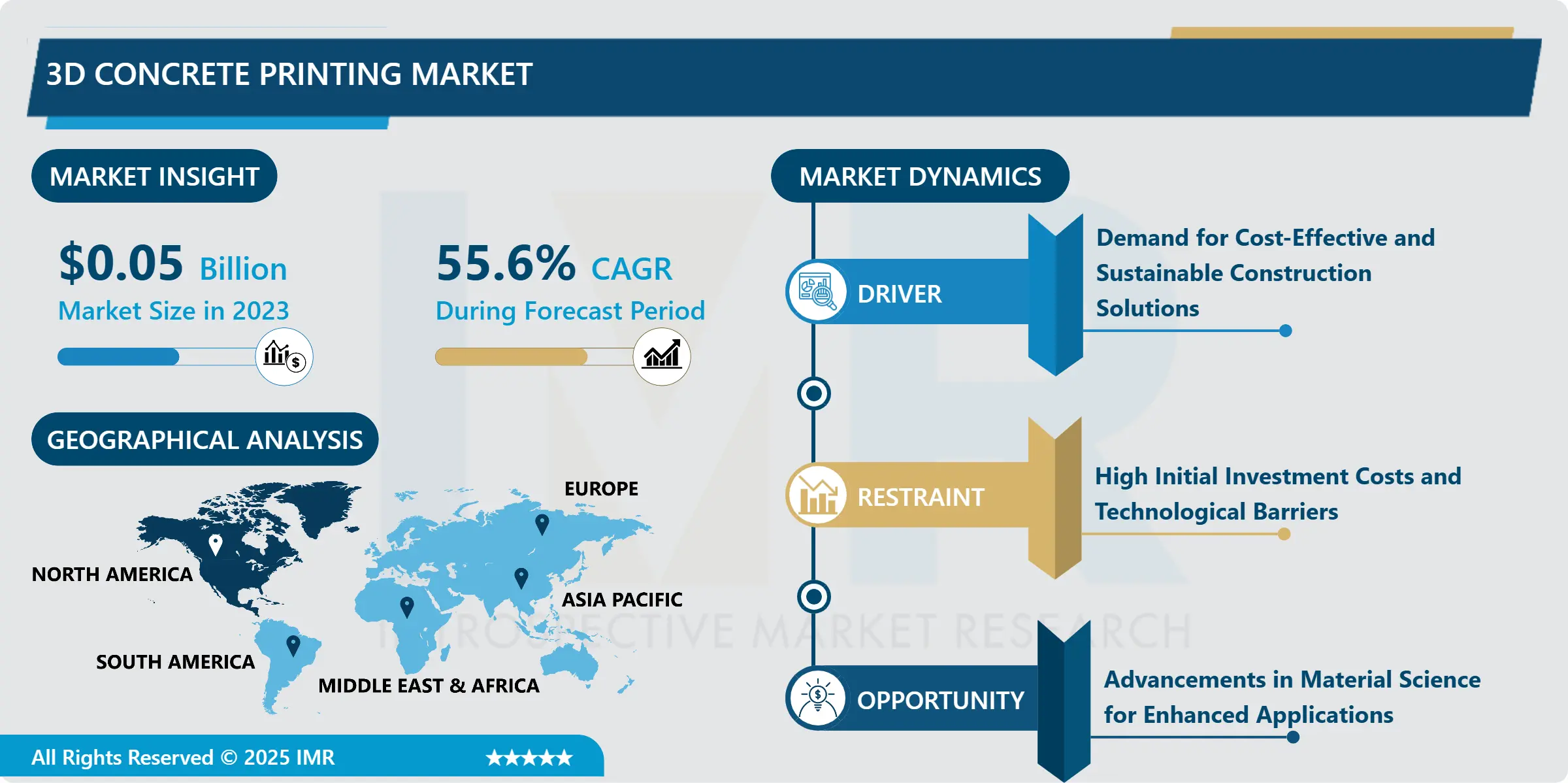
3D Concrete Printing Market Size, Share, Growth & Forecast (2024-2032)
3D Concrete Printing Market Size Was Valued at USD 0.05 Billion in 2023, and is Projected to Reach USD 2.67 Billion by 2032, Growing at a CAGR of 55.60% From 2024-2032.

IMR Group
Description
3D Concrete Printing Market Synopsis:
3D Concrete Printing Market Size Was Valued at USD 0.05 Billion in 2023, and is Projected to Reach USD 2.67 Billion by 2032, Growing at a CAGR of 55.60% From 2024-2032.
3D concrete printing refers to the construction technology that utilizes highly computerized machines that spray well-measured parts of concrete and place them down in a layered way to form intricate structures within a limited time frame and minimum wastage. This new way of construction relies on digital design and materials optimization, which results in efficient construction that does not have to rely on human labor and breaks the constraints of conventional architectural design.
The global 3D concrete printing market has exposed tremendous growth with high demand for efficient constructions. Currently, the technology is widely used in residential, commercial and industrial construction due to the desire for efficiency, minimal material losses and shortened project timetables. Governments and private organizations around the world are putting their money into the technology to meet such obstacles as shortage of labour and strict environmental laws. The application of 3D concrete printing has been most profound in developed countries; courses of green building solutions are oriented to this technology.
Newly industrialized nations are as well using the 3D concrete printing to tackle housing needs and better urbanization. By incorporating Building Information Modeling (BIM) with 3D printing technology, its application is enhanced because of the integration with the design-construction process. This has occurred through integration of these technologies and has made it possible to produce structures that incorporate tailor made components, enhanced material utilization and brought about unique opportunities in architectural designing. Therefore, market is expected to witness a strong growth in the coming years.
3D Concrete Printing Market Trend Analysis:
Integration of Sustainable Materials in 3D Concrete Printing
The element that is key in distinguishing the 3D concrete printing market today is the integration of environmentally friendly materials that are global competitive in green construction. Certain cement makers and construction contractors are now beginning to look at ways of developing environmentally sustainable concrete by incorporating materials such as fly ash, slag and waste materials in form of aggregates. These materials eradicate carbon footprint impact within construction projects and consistently deliver value in relative costs. This trend fits into the global sustainability agenda since most organizations seek to achieve net-zero emissions. In addition, regulatory authorities are fostering this development on the back of subsidies and incentives dedicated to the integration of green materials in the process of 3D concrete printing.
Rapid Urbanization and Affordable Housing Needs
High growth in urban civilization in developing countries offer a great chance to 3D concrete printing market. Governments and organizations are more and more turning to the technology to solve the global affordable housing problem. In light of this, 3D concrete printing technology propounds a significant solution to mass housing practices given that homes can be constructed with less costs, shorter durations, and within improved materials efficiency. For example, the civil projects such as community housing in Africa and Asia have really shown the potential of this technology in redesigning cities. In addition, the rising trends such as smart city and modular construction are expected to reinforced the utilization of 3D concrete printing for construction of infrastructures in forthcoming years.
3D Concrete Printing Market Segment Analysis:
3D Concrete Printing Market is Segmented on the basis of Printing Type, Technique End User, and Region.
By Printing Type, Gantry system segment is expected to dominate the market during the forecast period
Out of all the segments discussed in this report, the gantry system segment is projected to remain the most significant during the forecast period due to the large-scale structures for which it is effective for in 3D concrete printing market. The stationary and portable printer head, known as gantry systems has proved to provide high accuracy and the capacity to produce large constructional parts for homes and businesses. This is mainly due to their effectiveness in dealing with complex designs and at the same time offer strength in construction projects.
Such systems are also most preferred under the flexibility since they can be easily adjusted to suit a given scale of the project. Further, since their implementation is relatively uncomplicated and they are cheap to adopt, construction firms gravitate towards them. Due to technological enhancements, gantry systems are now more adaptable than before, which explains why they have a near monopoly over the market.
By Technique, Powder-based segment expected to held the largest share
The 3D concrete printing market’s powder-based segment should continue to have the greatest market share. It involves the use of thin materials and the binding agents to give easily intricate designs with the very best surfaces. However, powder-based printing is very useful for micro-realization of architectural details like facades, columns or other individual elements and parts.
Which has led to its popularity and frequent use in a range of models owing to good performance in various tasks ranging from small petty decorative jobs to the construction of large infrastructure projects. Continued innovation for customizable construction parts will further enhance the use of the powder-based technique in determining the future direction of the 3D concrete printing market.
3D Concrete Printing Market Regional Insights:
North America is Expected to Dominate the Market Over the Forecast period
North America led the 3D concrete printing market in 2023 on account of having a market. The leadership of the region can be well explained by the fact that there has been huge investment in new and innovation construction technology; there is elaborate infrastructure development market and there are key players in the construction sector. The United States has led other countries in the number of applied pilot projects and large-scale realization of 3D concrete printing technology. Supported by friendly laws and policies as well as governmental drive towards the intensive usage of eco-friendly technologies in construction projects, the market in North America has been further boosted.
Active Key Players in the 3D Concrete Printing Market
Apis Cor (Russia)
Baumit GmbH (Austria)
COBOD International A/S (Denmark)
CyBe Construction (Netherlands)
D-shape (Italy)
Heidelberg Materials AG (Germany)
ICON Technology, Inc. (USA)
LafargeHolcim Ltd (Switzerland)
Mighty Buildings (USA)
MX3D (Netherlands)
PERI Group (Germany)
Sika AG (Switzerland)
Skanska AB (Sweden)
Vertico (Netherlands)
WinSun (China)
Other Active Players.
Chapter 1: Introduction
1.1 Scope and Coverage
Chapter 2:Executive Summary
Chapter 3: Market Landscape
3.1 Market Dynamics
3.1.1 Drivers
3.1.2 Restraints
3.1.3 Opportunities
3.1.4 Challenges
3.2 Market Trend Analysis
3.3 PESTLE Analysis
3.4 Porter’s Five Forces Analysis
3.5 Industry Value Chain Analysis
3.6 Ecosystem
3.7 Regulatory Landscape
3.8 Price Trend Analysis
3.9 Patent Analysis
3.10 Technology Evolution
3.11 Investment Pockets
3.12 Import-Export Analysis
Chapter 4: 3D Concrete Printing Market by Printing Type
4.1 3D Concrete Printing Market Snapshot and Growth Engine
4.2 3D Concrete Printing Market Overview
4.3 Gantry system
4.3.1 Introduction and Market Overview
4.3.2 Historic and Forecasted Market Size in Value USD and Volume Units (2017-2032F)
4.3.3 Key Market Trends, Growth Factors and Opportunities
4.3.4 Gantry system: Geographic Segmentation Analysis
4.4 Robotic arm
4.4.1 Introduction and Market Overview
4.4.2 Historic and Forecasted Market Size in Value USD and Volume Units (2017-2032F)
4.4.3 Key Market Trends, Growth Factors and Opportunities
4.4.4 Robotic arm: Geographic Segmentation Analysis
Chapter 5: 3D Concrete Printing Market by Technique
5.1 3D Concrete Printing Market Snapshot and Growth Engine
5.2 3D Concrete Printing Market Overview
5.3 Powder-based
5.3.1 Introduction and Market Overview
5.3.2 Historic and Forecasted Market Size in Value USD and Volume Units (2017-2032F)
5.3.3 Key Market Trends, Growth Factors and Opportunities
5.3.4 Powder-based: Geographic Segmentation Analysis
5.4 Extrusion-based
5.4.1 Introduction and Market Overview
5.4.2 Historic and Forecasted Market Size in Value USD and Volume Units (2017-2032F)
5.4.3 Key Market Trends, Growth Factors and Opportunities
5.4.4 Extrusion-based: Geographic Segmentation Analysis
Chapter 6: 3D Concrete Printing Market by End User
6.1 3D Concrete Printing Market Snapshot and Growth Engine
6.2 3D Concrete Printing Market Overview
6.3 Residential
6.3.1 Introduction and Market Overview
6.3.2 Historic and Forecasted Market Size in Value USD and Volume Units (2017-2032F)
6.3.3 Key Market Trends, Growth Factors and Opportunities
6.3.4 Residential: Geographic Segmentation Analysis
6.4 Commercial
6.4.1 Introduction and Market Overview
6.4.2 Historic and Forecasted Market Size in Value USD and Volume Units (2017-2032F)
6.4.3 Key Market Trends, Growth Factors and Opportunities
6.4.4 Commercial: Geographic Segmentation Analysis
6.5 Infrastructure
6.5.1 Introduction and Market Overview
6.5.2 Historic and Forecasted Market Size in Value USD and Volume Units (2017-2032F)
6.5.3 Key Market Trends, Growth Factors and Opportunities
6.5.4 Infrastructure: Geographic Segmentation Analysis
Chapter 7: Company Profiles and Competitive Analysis
7.1 Competitive Landscape
7.1.1 Competitive Benchmarking
7.1.2 3D Concrete Printing Market Share by Manufacturer (2023)
7.1.3 Industry BCG Matrix
7.1.4 Heat Map Analysis
7.1.5 Mergers and Acquisitions
7.2 APIS COR (RUSSIA)
7.2.1 Company Overview
7.2.2 Key Executives
7.2.3 Company Snapshot
7.2.4 Role of the Company in the Market
7.2.5 Sustainability and Social Responsibility
7.2.6 Operating Business Segments
7.2.7 Product Portfolio
7.2.8 Business Performance
7.2.9 Key Strategic Moves and Recent Developments
7.2.10 SWOT Analysis
7.3 BAUMIT GMBH (AUSTRIA)
7.4 COBOD INTERNATIONAL A/S (DENMARK)
7.5 CYBE CONSTRUCTION (NETHERLANDS)
7.6 D-SHAPE (ITALY)
7.7 HEIDELBERG MATERIALS AG (GERMANY)
7.8 ICON TECHNOLOGY INC. (USA)
7.9 LAFARGEHOLCIM LTD (SWITZERLAND)
7.10 MIGHTY BUILDINGS (USA)
7.11 MX3D (NETHERLANDS)
7.12 PERI GROUP (GERMANY)
7.13 SIKA AG (SWITZERLAND)
7.14 SKANSKA AB (SWEDEN)
7.15 VERTICO (NETHERLANDS)
7.16 WINSUN (CHINA)
7.17 OTHER ACTIVE PLAYERS
Chapter 8: Global 3D Concrete Printing Market By Region
8.1 Overview
8.2. North America 3D Concrete Printing Market
8.2.1 Key Market Trends, Growth Factors and Opportunities
8.2.2 Top Key Companies
8.2.3 Historic and Forecasted Market Size by Segments
8.2.4 Historic and Forecasted Market Size By Printing Type
8.2.4.1 Gantry system
8.2.4.2 Robotic arm
8.2.5 Historic and Forecasted Market Size By Technique
8.2.5.1 Powder-based
8.2.5.2 Extrusion-based
8.2.6 Historic and Forecasted Market Size By End User
8.2.6.1 Residential
8.2.6.2 Commercial
8.2.6.3 Infrastructure
8.2.7 Historic and Forecast Market Size by Country
8.2.7.1 US
8.2.7.2 Canada
8.2.7.3 Mexico
8.3. Eastern Europe 3D Concrete Printing Market
8.3.1 Key Market Trends, Growth Factors and Opportunities
8.3.2 Top Key Companies
8.3.3 Historic and Forecasted Market Size by Segments
8.3.4 Historic and Forecasted Market Size By Printing Type
8.3.4.1 Gantry system
8.3.4.2 Robotic arm
8.3.5 Historic and Forecasted Market Size By Technique
8.3.5.1 Powder-based
8.3.5.2 Extrusion-based
8.3.6 Historic and Forecasted Market Size By End User
8.3.6.1 Residential
8.3.6.2 Commercial
8.3.6.3 Infrastructure
8.3.7 Historic and Forecast Market Size by Country
8.3.7.1 Russia
8.3.7.2 Bulgaria
8.3.7.3 The Czech Republic
8.3.7.4 Hungary
8.3.7.5 Poland
8.3.7.6 Romania
8.3.7.7 Rest of Eastern Europe
8.4. Western Europe 3D Concrete Printing Market
8.4.1 Key Market Trends, Growth Factors and Opportunities
8.4.2 Top Key Companies
8.4.3 Historic and Forecasted Market Size by Segments
8.4.4 Historic and Forecasted Market Size By Printing Type
8.4.4.1 Gantry system
8.4.4.2 Robotic arm
8.4.5 Historic and Forecasted Market Size By Technique
8.4.5.1 Powder-based
8.4.5.2 Extrusion-based
8.4.6 Historic and Forecasted Market Size By End User
8.4.6.1 Residential
8.4.6.2 Commercial
8.4.6.3 Infrastructure
8.4.7 Historic and Forecast Market Size by Country
8.4.7.1 Germany
8.4.7.2 UK
8.4.7.3 France
8.4.7.4 The Netherlands
8.4.7.5 Italy
8.4.7.6 Spain
8.4.7.7 Rest of Western Europe
8.5. Asia Pacific 3D Concrete Printing Market
8.5.1 Key Market Trends, Growth Factors and Opportunities
8.5.2 Top Key Companies
8.5.3 Historic and Forecasted Market Size by Segments
8.5.4 Historic and Forecasted Market Size By Printing Type
8.5.4.1 Gantry system
8.5.4.2 Robotic arm
8.5.5 Historic and Forecasted Market Size By Technique
8.5.5.1 Powder-based
8.5.5.2 Extrusion-based
8.5.6 Historic and Forecasted Market Size By End User
8.5.6.1 Residential
8.5.6.2 Commercial
8.5.6.3 Infrastructure
8.5.7 Historic and Forecast Market Size by Country
8.5.7.1 China
8.5.7.2 India
8.5.7.3 Japan
8.5.7.4 South Korea
8.5.7.5 Malaysia
8.5.7.6 Thailand
8.5.7.7 Vietnam
8.5.7.8 The Philippines
8.5.7.9 Australia
8.5.7.10 New Zealand
8.5.7.11 Rest of APAC
8.6. Middle East & Africa 3D Concrete Printing Market
8.6.1 Key Market Trends, Growth Factors and Opportunities
8.6.2 Top Key Companies
8.6.3 Historic and Forecasted Market Size by Segments
8.6.4 Historic and Forecasted Market Size By Printing Type
8.6.4.1 Gantry system
8.6.4.2 Robotic arm
8.6.5 Historic and Forecasted Market Size By Technique
8.6.5.1 Powder-based
8.6.5.2 Extrusion-based
8.6.6 Historic and Forecasted Market Size By End User
8.6.6.1 Residential
8.6.6.2 Commercial
8.6.6.3 Infrastructure
8.6.7 Historic and Forecast Market Size by Country
8.6.7.1 Turkiye
8.6.7.2 Bahrain
8.6.7.3 Kuwait
8.6.7.4 Saudi Arabia
8.6.7.5 Qatar
8.6.7.6 UAE
8.6.7.7 Israel
8.6.7.8 South Africa
8.7. South America 3D Concrete Printing Market
8.7.1 Key Market Trends, Growth Factors and Opportunities
8.7.2 Top Key Companies
8.7.3 Historic and Forecasted Market Size by Segments
8.7.4 Historic and Forecasted Market Size By Printing Type
8.7.4.1 Gantry system
8.7.4.2 Robotic arm
8.7.5 Historic and Forecasted Market Size By Technique
8.7.5.1 Powder-based
8.7.5.2 Extrusion-based
8.7.6 Historic and Forecasted Market Size By End User
8.7.6.1 Residential
8.7.6.2 Commercial
8.7.6.3 Infrastructure
8.7.7 Historic and Forecast Market Size by Country
8.7.7.1 Brazil
8.7.7.2 Argentina
8.7.7.3 Rest of SA
Chapter 9 Analyst Viewpoint and Conclusion
9.1 Recommendations and Concluding Analysis
9.2 Potential Market Strategies
Chapter 10 Research Methodology
10.1 Research Process
10.2 Primary Research
10.3 Secondary Research
Q1: What would be the forecast period in the 3D Concrete Printing Market research report?
A1: The forecast period in the 3D Concrete Printing Market research report is 2024-2032.
Q2: Who are the key players in the 3D Concrete Printing Market?
A2: Apis Cor, COBOD International A/S, ICON Technology, Inc., LafargeHolcim Ltd, PERI Group and Other Active Players.
Q3: What are the segments of the 3D Concrete Printing Market?
A3: The 3D Concrete Printing Market is segmented into Printing Type, Technique, End User and region. By Printing Type, the market is categorized into Gantry system, Robotic arm. By Technique, the market is categorized into Powder-based, Extrusion-based. By End User, the market is categorized into Residential, Commercial, Infrastructure. By region, it is analyzed across North America (U.S., Canada, Mexico), Eastern Europe (Russia, Bulgaria, The Czech Republic, Hungary, Poland, Romania, Rest of Eastern Europe), Western Europe (Germany, UK, France, The Netherlands, Italy, Russia, Spain, Rest of Western Europe), Asia Pacific (China, India, Japan, South Korea, Malaysia, Thailand, Vietnam, The Philippines, Australia, New-Zealand, Rest of APAC), Middle East & Africa (Turkiye, Bahrain, Kuwait, Saudi Arabia, Qatar, UAE, Israel, South Africa), South America (Brazil, Argentina, Rest of SA).
Q4: What is the 3D Concrete Printing Market?
A4: 3D concrete printing refers to the construction technology that utilizes highly computerized machines that spray well-measured parts of concrete and place them down in a layered way to form intricate structures within a limited time frame and minimum wastage. This new way of construction relies on digital design and materials optimization, which results in efficient construction that does not have to rely on human labor and breaks the constraints of conventional architectural design.
Q5: How big is the 3D Concrete Printing Market?
A5: 3D Concrete Printing Market Size Was Valued at USD 0.05 Billion in 2023, and is Projected to Reach USD 2.67 Billion by 2032, Growing at a CAGR of 55.60% From 2024-2032.
How to Buy a Report from eminsights.jp
On the product page, choose the license you want: Single-User License, Multi-User License or Enterprise License.
If you required report in your native language, then you can click on Translated Report button and fill out the form with report name and language you want, then our team will contact you as soon as possible.
Click the Buy Now button.
You will be redirected to the checkout page. Enter your company details and payment information.
Click Place Order to complete the purchase.
Confirmation: You’ll receive an order confirmation and our team will contact you shortly with your ordered report.
If you have any questions, fill out the contact form below or email us at bizdev@eminsights.net.
Thank you for choosing eminsights.jp!