Stay Ahead in Fast-Growing Economies.
Browse Reports Now




Reservoir Management Market – Comprehensive Study Report & Recent Trends
Reservoir management is a systematic approach to optimizing and sustainable utilization of subsurface reservoirs containing hydrocarbons or water resources, integrating geological, engineering, and economic principles to maximize recovery while minimizing environmental impact, using advanced techniques like reservoir simulation and enhanced oil recovery methods. Reservoir management involves overseeing and controlling water resources within a reservoir. It encompasses activities such as adjusting water levels, regulating the inflow and outflow of water, and overseeing inputs from rainfall or other origins.

IMR Group
Description
Reservoir Management Market Synopsis
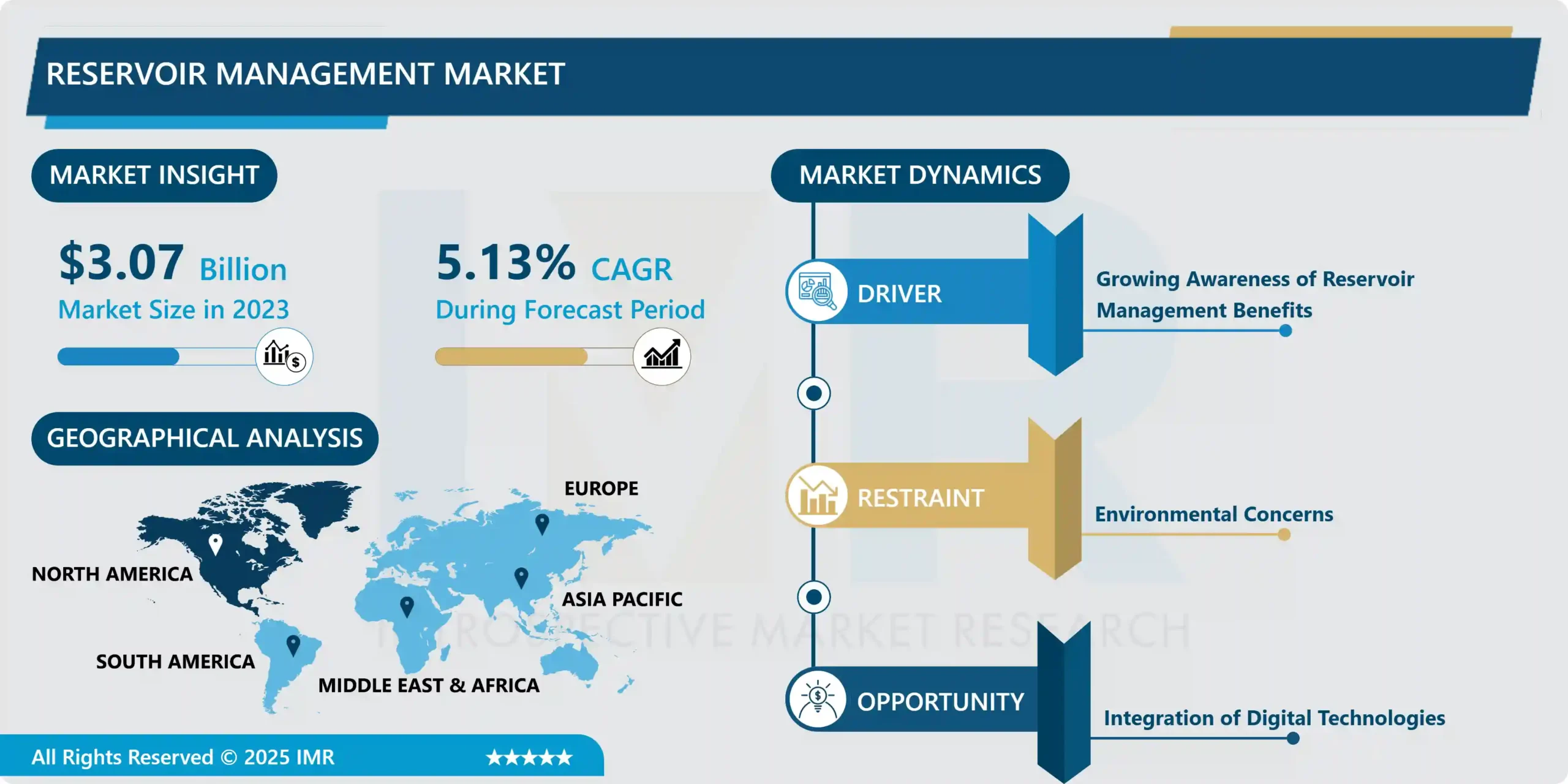
Global Reservoir Management Market size is expected to grow from USD 3.07 Billion in 2023 to USD 4.82 Billion by 2032, at a CAGR of 5.13% during the forecast period (2024-2032).
Reservoir management is a systematic approach to optimizing and sustainable utilization of subsurface reservoirs containing hydrocarbons or water resources, integrating geological, engineering, and economic principles to maximize recovery while minimizing environmental impact, using advanced techniques like reservoir simulation and enhanced oil recovery methods.
Reservoir management involves overseeing and controlling water resources within a reservoir. It encompasses activities such as adjusting water levels, regulating the inflow and outflow of water, and overseeing inputs from rainfall or other origins. The primary objective of reservoir management is to enhance its utilization for various purposes, including hydroelectric power generation, irrigation, municipal water supply, flood regulation, and other related functions.
Reservoirs play a pivotal role across various sectors, serving as essential components for hydroelectric power generation and aiding in agricultural irrigation to enhance crop growth. These reservoirs act as primary sources for municipal water systems, ensuring consistent and reliable urban water supply for domestic, industrial, and commercial needs. Additionally, they contribute significantly to flood control by effectively managing water flow during periods of heavy rainfall. Moreover, beyond their utilitarian functions, reservoirs offer recreational spaces, attracting tourism by providing opportunities for leisure activities. Prioritizing proper reservoir management also encompasses ecosystem preservation, benefiting aquatic life and biodiversity. Furthermore, these reservoirs cater to industrial demands by providing water for various manufacturing and operational purposes.
Efficient reservoir management optimizes water resources for diverse purposes such as hydroelectric power, irrigation, urban supply, flood control, and industrial use. Well-managed reservoirs play a crucial role in ensuring sustainable energy production, boosting agricultural productivity, and providing reliable urban water sources. Their effective management aids in flood prevention offers spaces for recreational activities, supports ecosystem preservation efforts, and meets industrial water needs, consequently benefiting local economies and contributing to environmental conservation endeavors.
Reservoir Management Market Trend Analysis:
Growing Awareness of Reservoir Management Benefits
The growing awareness among oil and gas companies regarding the advantages of reservoir management has emerged as a pivotal factor driving the expansion of the global reservoir management market. These companies are increasingly acknowledging the substantial benefits associated with reservoir management practices, including enhanced production efficiency, decreased operating expenses, and prolonged well life. This recognition has led to a noticeable surge in the adoption of reservoir management technologies within the industry.
Primarily, the realization of the positive impact of reservoir management on production efficiency has prompted oil and gas companies to embrace these methodologies. By implementing effective reservoir management strategies, companies can optimize the extraction process, leading to increased productivity from reservoirs. This enhanced efficiency directly contributes to improved overall production output.
Furthermore, the adoption of reservoir management technologies enables oil and gas firms to streamline operations and reduce operating costs. By employing advanced tools and methodologies for reservoir monitoring and predictive analysis, companies can make informed decisions, leading to more efficient resource allocation and cost-effective operations.
Integration of Digital Technologies
The integration of digital technologies, notably big data analytics and the Internet of Things (IoT), within reservoir management solutions is emerging as a key driver propelling the growth of the global reservoir management market. The incorporation of these advanced digital tools is facilitating the creation of smarter and more efficient systems, revolutionizing the way reservoirs are managed and optimized.
Big data analytics plays a crucial role in reservoir management by processing vast amounts of data collected from various sources such as sensors, well logs, and production records. Analyzing this data enables reservoir engineers and managers to gain valuable insights into reservoir behavior, performance trends, and potential optimization opportunities. By leveraging predictive analytics and machine learning algorithms, they can make informed decisions, forecast reservoir behavior, and optimize production strategies.
Furthermore, the integration of IoT devices contributes significantly to reservoir management. IoT sensors installed within reservoirs gather real-time data on parameters like temperature, pressure, flow rates, and water levels. This continuous data collection allows for proactive monitoring and rapid response to changes or anomalies within the reservoir. IoT-enabled devices enable remote monitoring and control, facilitating prompt adjustments in reservoir operations for improved efficiency and performance.
The synergy between big data analytics and IoT technologies empowers reservoir management solutions to become more intelligent and responsive. The combination of data-driven insights and real-time monitoring capabilities enhances decision-making processes, enabling proactive management strategies that optimize production, reduce operational inefficiencies, and minimize risks.
Reservoir Management Market Segment Analysis:
By Type, Dynamic Model segment is expected to dominate the market during the forecast period
The Dynamic Model segment holds a predominant position due to its capability to simulate and predict real-time reservoir behavior and performance by considering various dynamic factors such as fluid flow, pressure changes, and production data.
Dynamic models offer a more comprehensive and accurate representation of reservoir characteristics and behaviors, allowing for better decision-making regarding production strategies, reservoir optimization, and recovery enhancement.
Their ability to incorporate evolving data, adapt to changes, and simulate dynamic reservoir conditions makes them a primary choice for effective reservoir management, thereby dominating the global market in comparison to static models.
By Application, Oil & Gas segment is expected to dominate the market during the forecast period
The oil and gas industry extensively utilizes reservoir management practices and technologies to optimize production, enhance recovery rates, and prolong the lifespan of reservoirs. Reservoir management plays a critical role in the oil and gas sector by enabling companies to make informed decisions regarding well drilling, production strategies, and reservoir characterization.
The complexities involved in oil and gas reservoirs necessitate advanced management techniques for efficient resource extraction. Reservoir management solutions aid in maximizing hydrocarbon recovery, optimizing production, and minimizing operational costs, thereby making the Oil & Gas segment a dominant force in the global reservoir management market.
The industry’s continuous demand for innovative reservoir management technologies to address challenges related to reservoir depletion, well productivity, and operational efficiency contributes significantly to the dominance of this segment in the market.
Reservoir Management Market Regional Insights:
Asia Pacific Region Dominate the Market
The region’s rapid economic expansion fuels substantial investments in infrastructural projects like dams, hydroelectric ventures, and extensive irrigation networks. This surge necessitates the implementation of robust reservoir management solutions to optimize resource allocation and ensure efficient water utilization. As such, the demand for reservoir management technologies is amplified to sustain and enhance these critical projects.
Asia Pacific confronts mounting water scarcity concerns due to climate change, burgeoning population, and industrial growth. This heightened awareness of water conservation compels the deployment of advanced reservoir management technologies to effectively manage and conserve dwindling water resources. These technologies play a pivotal role in ensuring long-term water security in the face of escalating challenges.
Governments in the region increasingly emphasize sustainable water management strategies. Through supportive policies and initiatives, they advocate for the adoption of advanced reservoir management technologies. These governmental endorsements act as significant drivers, catalyzing market growth by encouraging widespread implementation among various sectors and industries.
Asia Pacific boasts a thriving landscape of technological innovations, particularly in sensors, data analytics, and artificial intelligence. These advancements pave the way for cutting-edge reservoir management solutions, enabling real-time data insights and predictive capabilities. Such innovations empower more efficient, data-driven decision-making and streamlined reservoir operations, further solidifying the region’s dominance.
Reservoir Management Market Key Players:
Schlumberger NV (U.S.)
Halliburton (U.S.)
Baker Hughes Company (U.S.)
DiNatale Water Consultants (U.S.)
Weatherford International plc (U.S.)
Emerson Electric Co. (U.S.)
Bentley Systems (U.S.)
AGR (U.S.)
Tetra Tech, Inc. (U.S.)
Occidental Petroleum Corporation (U.S)
Schneider Electric SE (France)
CGG SA (France)
The Mott MacDonald Group (UK)
Jeremy Benn Associates Ltd. (UK)
Juvicle (India), and Other Major Players
Key Industry Developments in the Reservoir Management Market:
In April 2024: SLB introduced two advanced artificial lift systems: The Reda™ Agile™ compact wide-range electric submersible pump (ESP) system and the rodless Reda PowerEdge™ electric submersible progressing cavity pump (ESPCP) system. Their breakthrough designs deliver enhanced reliability and efficiency.
In October 2023, Bentley Systems, the infrastructure engineering software company, announced that Seequent, The Bentley Subsurface Company, has signed an agreement to acquire Flow State Solutions, an industry leader in geothermal simulation software. The move further solidifies Seequent’s position as the most comprehensive subsurface software provider for the geothermal industry.
Chapter 1: Introduction
1.1 Scope and Coverage
Chapter 2:Executive Summary
Chapter 3: Market Landscape
3.1 Market Dynamics
3.1.1 Drivers
3.1.2 Restraints
3.1.3 Opportunities
3.1.4 Challenges
3.2 Market Trend Analysis
3.3 PESTLE Analysis
3.4 Porter’s Five Forces Analysis
3.5 Industry Value Chain Analysis
3.6 Ecosystem
3.7 Regulatory Landscape
3.8 Price Trend Analysis
3.9 Patent Analysis
3.10 Technology Evolution
3.11 Investment Pockets
3.12 Import-Export Analysis
Chapter 4: Reservoir Management Market by Type (2018-2032)
4.1 Reservoir Management Market Snapshot and Growth Engine
4.2 Market Overview
4.3 Static Model
4.3.1 Introduction and Market Overview
4.3.2 Historic and Forecasted Market Size in Value USD and Volume Units
4.3.3 Key Market Trends, Growth Factors, and Opportunities
4.3.4 Geographic Segmentation Analysis
4.4 Dynamic Model
Chapter 5: Reservoir Management Market by Reservoir Type (2018-2032)
5.1 Reservoir Management Market Snapshot and Growth Engine
5.2 Market Overview
5.3 Conventional
5.3.1 Introduction and Market Overview
5.3.2 Historic and Forecasted Market Size in Value USD and Volume Units
5.3.3 Key Market Trends, Growth Factors, and Opportunities
5.3.4 Geographic Segmentation Analysis
5.4 Unconventional
Chapter 6: Reservoir Management Market by Service (2018-2032)
6.1 Reservoir Management Market Snapshot and Growth Engine
6.2 Market Overview
6.3 Monitoring & Control
6.3.1 Introduction and Market Overview
6.3.2 Historic and Forecasted Market Size in Value USD and Volume Units
6.3.3 Key Market Trends, Growth Factors, and Opportunities
6.3.4 Geographic Segmentation Analysis
6.4 Data Management
6.5 Planning & Implementation
Chapter 7: Reservoir Management Market by Solution (2018-2032)
7.1 Reservoir Management Market Snapshot and Growth Engine
7.2 Market Overview
7.3 Hardware
7.3.1 Introduction and Market Overview
7.3.2 Historic and Forecasted Market Size in Value USD and Volume Units
7.3.3 Key Market Trends, Growth Factors, and Opportunities
7.3.4 Geographic Segmentation Analysis
7.4 Software
7.5 Services
Chapter 8: Reservoir Management Market by Technique (2018-2032)
8.1 Reservoir Management Market Snapshot and Growth Engine
8.2 Market Overview
8.3 Seismic
8.3.1 Introduction and Market Overview
8.3.2 Historic and Forecasted Market Size in Value USD and Volume Units
8.3.3 Key Market Trends, Growth Factors, and Opportunities
8.3.4 Geographic Segmentation Analysis
8.4 Tracer
8.5 Gravimetric
8.6 Geochemical
8.7 Electromagnetic
Chapter 9: Reservoir Management Market by Application (2018-2032)
9.1 Reservoir Management Market Snapshot and Growth Engine
9.2 Market Overview
9.3 Drinking Water
9.3.1 Introduction and Market Overview
9.3.2 Historic and Forecasted Market Size in Value USD and Volume Units
9.3.3 Key Market Trends, Growth Factors, and Opportunities
9.3.4 Geographic Segmentation Analysis
9.4 Oil & Gas
9.5 Agriculture
9.6 Industrial
Chapter 10: Company Profiles and Competitive Analysis
10.1 Competitive Landscape
10.1.1 Competitive Benchmarking
10.1.2 Reservoir Management Market Share by Manufacturer (2024)
10.1.3 Industry BCG Matrix
10.1.4 Heat Map Analysis
10.1.5 Mergers and Acquisitions
10.2 BLACK LAGOON (US)
10.2.1 Company Overview
10.2.2 Key Executives
10.2.3 Company Snapshot
10.2.4 Role of the Company in the Market
10.2.5 Sustainability and Social Responsibility
10.2.6 Operating Business Segments
10.2.7 Product Portfolio
10.2.8 Business Performance
10.2.9 Key Strategic Moves and Recent Developments
10.2.10 SWOT Analysis
10.3 SOLITUDE LAKE MANAGEMENT (US)
10.4 LAKEPRO INC. (US)
10.5 OMEX (UK)
10.6 RF WASTEWATER (US)
10.7 SUEZ (FRANCE)
10.8 AQUATIC BIOLOGISTS INC. (THE US)
10.9 PARKLINK LIMITED (NEW ZEALAND)
10.10 WET USA (US)
10.11 BARBER’S CHEMICALS (US)
10.12 SKYHAWK GLOBAL (UK)
10.13 KURITA WATER INDUSTRIES LTD. (JAPAN)
10.14 ACTI-ZYME PRODUCTS LTD. (CANADA)
10.15 AQUATIC PLUS POND MANAGEMENT LLC (US)
10.16 OXYBEESOLUTIONS (INDIA)
10.17 ENVA (IRELAND)
Chapter 11: Global Reservoir Management Market By Region
11.1 Overview
11.2. North America Reservoir Management Market
11.2.1 Key Market Trends, Growth Factors and Opportunities
11.2.2 Top Key Companies
11.2.3 Historic and Forecasted Market Size by Segments
11.2.4 Historic and Forecasted Market Size by Type
11.2.4.1 Static Model
11.2.4.2 Dynamic Model
11.2.5 Historic and Forecasted Market Size by Reservoir Type
11.2.5.1 Conventional
11.2.5.2 Unconventional
11.2.6 Historic and Forecasted Market Size by Service
11.2.6.1 Monitoring & Control
11.2.6.2 Data Management
11.2.6.3 Planning & Implementation
11.2.7 Historic and Forecasted Market Size by Solution
11.2.7.1 Hardware
11.2.7.2 Software
11.2.7.3 Services
11.2.8 Historic and Forecasted Market Size by Technique
11.2.8.1 Seismic
11.2.8.2 Tracer
11.2.8.3 Gravimetric
11.2.8.4 Geochemical
11.2.8.5 Electromagnetic
11.2.9 Historic and Forecasted Market Size by Application
11.2.9.1 Drinking Water
11.2.9.2 Oil & Gas
11.2.9.3 Agriculture
11.2.9.4 Industrial
11.2.10 Historic and Forecast Market Size by Country
11.2.10.1 US
11.2.10.2 Canada
11.2.10.3 Mexico
11.3. Eastern Europe Reservoir Management Market
11.3.1 Key Market Trends, Growth Factors and Opportunities
11.3.2 Top Key Companies
11.3.3 Historic and Forecasted Market Size by Segments
11.3.4 Historic and Forecasted Market Size by Type
11.3.4.1 Static Model
11.3.4.2 Dynamic Model
11.3.5 Historic and Forecasted Market Size by Reservoir Type
11.3.5.1 Conventional
11.3.5.2 Unconventional
11.3.6 Historic and Forecasted Market Size by Service
11.3.6.1 Monitoring & Control
11.3.6.2 Data Management
11.3.6.3 Planning & Implementation
11.3.7 Historic and Forecasted Market Size by Solution
11.3.7.1 Hardware
11.3.7.2 Software
11.3.7.3 Services
11.3.8 Historic and Forecasted Market Size by Technique
11.3.8.1 Seismic
11.3.8.2 Tracer
11.3.8.3 Gravimetric
11.3.8.4 Geochemical
11.3.8.5 Electromagnetic
11.3.9 Historic and Forecasted Market Size by Application
11.3.9.1 Drinking Water
11.3.9.2 Oil & Gas
11.3.9.3 Agriculture
11.3.9.4 Industrial
11.3.10 Historic and Forecast Market Size by Country
11.3.10.1 Russia
11.3.10.2 Bulgaria
11.3.10.3 The Czech Republic
11.3.10.4 Hungary
11.3.10.5 Poland
11.3.10.6 Romania
11.3.10.7 Rest of Eastern Europe
11.4. Western Europe Reservoir Management Market
11.4.1 Key Market Trends, Growth Factors and Opportunities
11.4.2 Top Key Companies
11.4.3 Historic and Forecasted Market Size by Segments
11.4.4 Historic and Forecasted Market Size by Type
11.4.4.1 Static Model
11.4.4.2 Dynamic Model
11.4.5 Historic and Forecasted Market Size by Reservoir Type
11.4.5.1 Conventional
11.4.5.2 Unconventional
11.4.6 Historic and Forecasted Market Size by Service
11.4.6.1 Monitoring & Control
11.4.6.2 Data Management
11.4.6.3 Planning & Implementation
11.4.7 Historic and Forecasted Market Size by Solution
11.4.7.1 Hardware
11.4.7.2 Software
11.4.7.3 Services
11.4.8 Historic and Forecasted Market Size by Technique
11.4.8.1 Seismic
11.4.8.2 Tracer
11.4.8.3 Gravimetric
11.4.8.4 Geochemical
11.4.8.5 Electromagnetic
11.4.9 Historic and Forecasted Market Size by Application
11.4.9.1 Drinking Water
11.4.9.2 Oil & Gas
11.4.9.3 Agriculture
11.4.9.4 Industrial
11.4.10 Historic and Forecast Market Size by Country
11.4.10.1 Germany
11.4.10.2 UK
11.4.10.3 France
11.4.10.4 The Netherlands
11.4.10.5 Italy
11.4.10.6 Spain
11.4.10.7 Rest of Western Europe
11.5. Asia Pacific Reservoir Management Market
11.5.1 Key Market Trends, Growth Factors and Opportunities
11.5.2 Top Key Companies
11.5.3 Historic and Forecasted Market Size by Segments
11.5.4 Historic and Forecasted Market Size by Type
11.5.4.1 Static Model
11.5.4.2 Dynamic Model
11.5.5 Historic and Forecasted Market Size by Reservoir Type
11.5.5.1 Conventional
11.5.5.2 Unconventional
11.5.6 Historic and Forecasted Market Size by Service
11.5.6.1 Monitoring & Control
11.5.6.2 Data Management
11.5.6.3 Planning & Implementation
11.5.7 Historic and Forecasted Market Size by Solution
11.5.7.1 Hardware
11.5.7.2 Software
11.5.7.3 Services
11.5.8 Historic and Forecasted Market Size by Technique
11.5.8.1 Seismic
11.5.8.2 Tracer
11.5.8.3 Gravimetric
11.5.8.4 Geochemical
11.5.8.5 Electromagnetic
11.5.9 Historic and Forecasted Market Size by Application
11.5.9.1 Drinking Water
11.5.9.2 Oil & Gas
11.5.9.3 Agriculture
11.5.9.4 Industrial
11.5.10 Historic and Forecast Market Size by Country
11.5.10.1 China
11.5.10.2 India
11.5.10.3 Japan
11.5.10.4 South Korea
11.5.10.5 Malaysia
11.5.10.6 Thailand
11.5.10.7 Vietnam
11.5.10.8 The Philippines
11.5.10.9 Australia
11.5.10.10 New Zealand
11.5.10.11 Rest of APAC
11.6. Middle East & Africa Reservoir Management Market
11.6.1 Key Market Trends, Growth Factors and Opportunities
11.6.2 Top Key Companies
11.6.3 Historic and Forecasted Market Size by Segments
11.6.4 Historic and Forecasted Market Size by Type
11.6.4.1 Static Model
11.6.4.2 Dynamic Model
11.6.5 Historic and Forecasted Market Size by Reservoir Type
11.6.5.1 Conventional
11.6.5.2 Unconventional
11.6.6 Historic and Forecasted Market Size by Service
11.6.6.1 Monitoring & Control
11.6.6.2 Data Management
11.6.6.3 Planning & Implementation
11.6.7 Historic and Forecasted Market Size by Solution
11.6.7.1 Hardware
11.6.7.2 Software
11.6.7.3 Services
11.6.8 Historic and Forecasted Market Size by Technique
11.6.8.1 Seismic
11.6.8.2 Tracer
11.6.8.3 Gravimetric
11.6.8.4 Geochemical
11.6.8.5 Electromagnetic
11.6.9 Historic and Forecasted Market Size by Application
11.6.9.1 Drinking Water
11.6.9.2 Oil & Gas
11.6.9.3 Agriculture
11.6.9.4 Industrial
11.6.10 Historic and Forecast Market Size by Country
11.6.10.1 Turkiye
11.6.10.2 Bahrain
11.6.10.3 Kuwait
11.6.10.4 Saudi Arabia
11.6.10.5 Qatar
11.6.10.6 UAE
11.6.10.7 Israel
11.6.10.8 South Africa
11.7. South America Reservoir Management Market
11.7.1 Key Market Trends, Growth Factors and Opportunities
11.7.2 Top Key Companies
11.7.3 Historic and Forecasted Market Size by Segments
11.7.4 Historic and Forecasted Market Size by Type
11.7.4.1 Static Model
11.7.4.2 Dynamic Model
11.7.5 Historic and Forecasted Market Size by Reservoir Type
11.7.5.1 Conventional
11.7.5.2 Unconventional
11.7.6 Historic and Forecasted Market Size by Service
11.7.6.1 Monitoring & Control
11.7.6.2 Data Management
11.7.6.3 Planning & Implementation
11.7.7 Historic and Forecasted Market Size by Solution
11.7.7.1 Hardware
11.7.7.2 Software
11.7.7.3 Services
11.7.8 Historic and Forecasted Market Size by Technique
11.7.8.1 Seismic
11.7.8.2 Tracer
11.7.8.3 Gravimetric
11.7.8.4 Geochemical
11.7.8.5 Electromagnetic
11.7.9 Historic and Forecasted Market Size by Application
11.7.9.1 Drinking Water
11.7.9.2 Oil & Gas
11.7.9.3 Agriculture
11.7.9.4 Industrial
11.7.10 Historic and Forecast Market Size by Country
11.7.10.1 Brazil
11.7.10.2 Argentina
11.7.10.3 Rest of SA
Chapter 12 Analyst Viewpoint and Conclusion
12.1 Recommendations and Concluding Analysis
12.2 Potential Market Strategies
Chapter 13 Research Methodology
13.1 Research Process
13.2 Primary Research
13.3 Secondary Research
Q1: What would be the forecast period in the Reservoir Management Market research report?
A1: The forecast period in the Reservoir Management Market research report is 2024-2032.
Q2: Who are the key players in the Reservoir Management Market?
A2: Schlumberger NV (U.S.), Halliburton (U.S.), Baker Hughes Company (U.S.), DiNatale Water Consultants (U.S.), Weatherford International plc (U.S.), Emerson Electric Co. (U.S.), Bentley Systems (U.S.), AGR (U.S.), Tetra Tech, Inc. (U.S.), Occidental Petroleum Corporation (U.S), Schneider Electric SE (France), CGG SA (France), The Mott MacDonald Group (UK), Jeremy Benn Associates Ltd. (UK), Juvicle (India), and Other Major Players.
Q3: What are the segments of the Reservoir Management Market?
A3: The Reservoir Management Market is segmented into Type, Reservoir Type, Service, End-User, Solution, Technique, Application, and Region. By Software Type, the market is categorized into Static Model and Dynamic Model. By Reservoir Type, the market is categorized into Conventional and Unconventional. By Service, the market is categorized into Monitoring & Control, Data Management, and Planning & Implementation. By Solution, the market is categorized into Hardware, Software, and Services. Technique, the market is categorized into Seismic, Tracer, Gravimetric, Geochemical, and Electromagnetic. Application, the market is categorized into Drinking Water, Oil & Gas, Agriculture, and Industrial. By region, it is analyzed across North America (U.S.; Canada; Mexico), Eastern Europe (Bulgaria; The Czech Republic; Hungary; Poland; Romania; Rest of Eastern Europe), Western Europe (Germany; UK; France; Netherlands; Italy; Russia; Spain; Rest of Western Europe), Asia-Pacific (China; India; Japan; Southeast Asia, etc.), South America (Brazil; Argentina, etc.), Middle East & Africa (Saudi Arabia; South Africa, etc.).
Q4: What is the Reservoir Management Market?
A4: Reservoir management is a systematic approach to optimizing and sustainable utilization of subsurface reservoirs containing hydrocarbons or water resources, integrating geological, engineering, and economic principles to maximize recovery while minimizing environmental impact, using advanced techniques like reservoir simulation and enhanced oil recovery methods.
Q5: How big is the Reservoir Management Market?
A5: Global Reservoir Management Market size is expected to grow from USD 3.07 Billion in 2023 to USD 4.82 Billion by 2032, at a CAGR of 5.13% during the forecast period (2024-2032).
How to Buy a Report from eminsights.jp
On the product page, choose the license you want: Single-User License, Multi-User License or Enterprise License.
If you required report in your native language, then you can click on Translated Report button and fill out the form with report name and language you want, then our team will contact you as soon as possible.
Click the Buy Now button.
You will be redirected to the checkout page. Enter your company details and payment information.
Click Place Order to complete the purchase.
Confirmation: You’ll receive an order confirmation and our team will contact you shortly with your ordered report.
If you have any questions, fill out the contact form below or email us at [email protected].
Thank you for choosing eminsights.jp!