Stay Ahead in Fast-Growing Economies.
Browse Reports Now




Bale Net Wrap Market – Size & Upcoming Industry Trends
The report offers Bale Net Wrap Market Dynamics, Comprises Industry development drivers, challenges, opportunities, threats and limitations. A report also incorporates Cost Trend of products, Mergers & Acquisitions, Expansion, Crucial Suppliers of products, Concentration Rate of Steel Coupling Economy. Global Bale Net Wrap Market Research Report covers Market Effect Factors investigation chiefly included Technology Progress, Consumer Requires Trend, External Environmental Change.

IMR Group
Description
Bale Net Wrap Market Synopsis
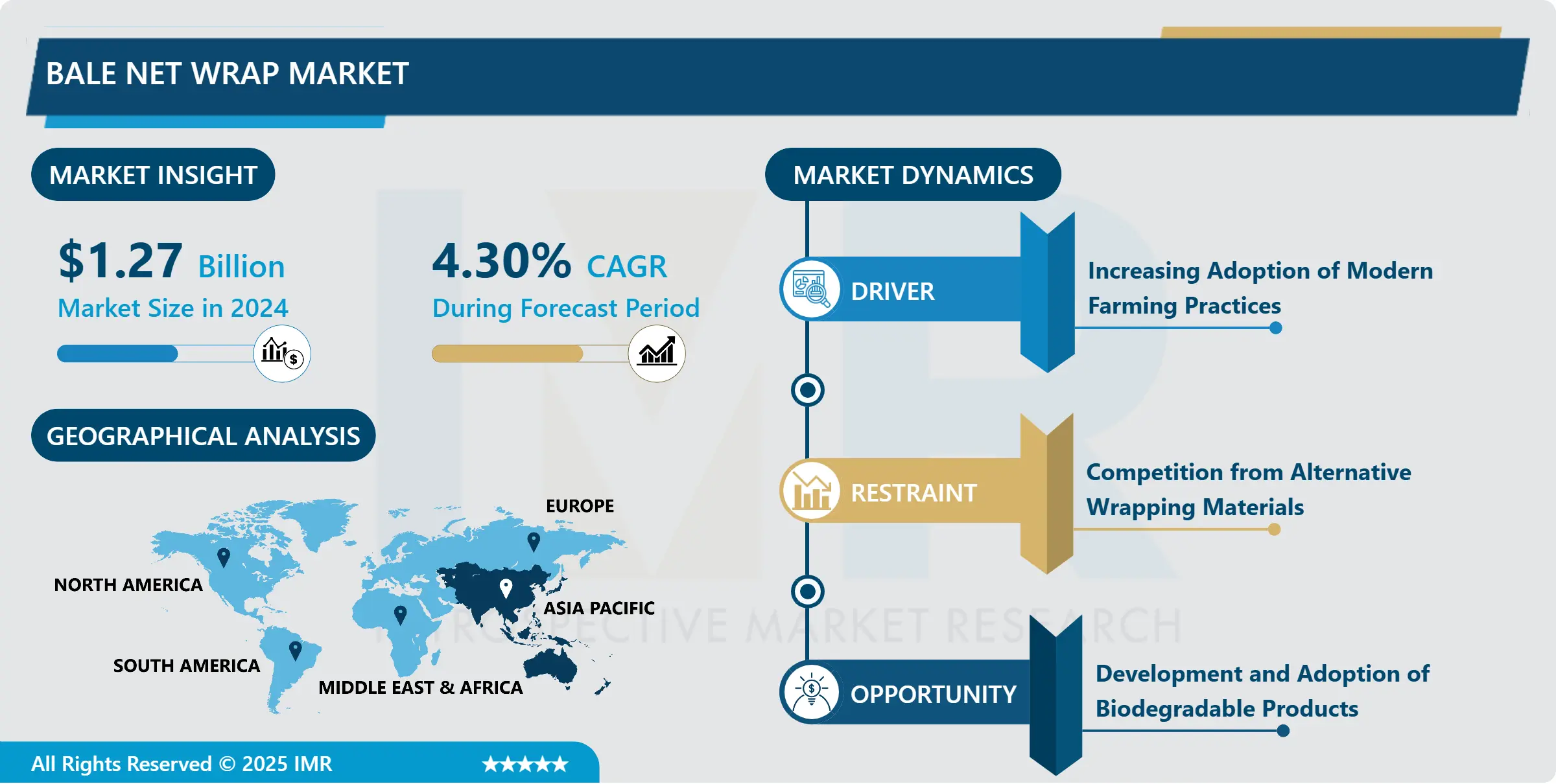
Bale Net Wrap Market Size Was Valued at USD 1.27 Billion in 2024 and is Projected to Reach USD 1.78 Billion by 2032, Growing at a CAGR of 4.30% From 2025-2032.
Bale net wrap is a material used in agricultural machinery to secure bales of hay, straw, or other forage materials. It is typically made of polyethylene and comes in rolls. Bale net wrap is applied around cylindrical bales, often used in large-scale farming operations, to protect them from weathering, maintain their shape, and ease handling and transportation. The netting allows for airflow, preventing moisture buildup and potential spoilage. It offers an efficient alternative to traditional methods like twine, reducing labor and ensuring bales remain intact during storage or transport, ultimately optimizing the efficiency of hay and forage management.
The Bale Net Wrap Market is a segment within the agricultural industry that provides packaging solutions for baled crops such as hay, straw, and silage. It involves the production and distribution of netting materials specifically designed to wrap around cylindrical bales, securing them for storage, transportation, and protection against weather elements.
The increasing mechanization of farming practices has led to higher baling volumes, creating a need for efficient and durable packaging solutions. Bale net wrap offers advantages over traditional methods like twine, including faster baling speeds, reduced labor costs, and improved bale integrity.
The emphasis on crop preservation and quality maintenance has prompted the adoption of bale net wrap. By tightly encasing the bales, the netting helps prevent spoilage, mold growth, and nutrient loss, ensuring the nutritional value and marketability of the stored fodder.
Furthermore, environmental concerns and sustainability considerations are influencing market trends. Bale net wraps made from recyclable materials and those designed for easy disposal or recycling after use are gaining traction among environmentally conscious farmers and regulatory bodies.
The market exhibits variation based on agricultural practices, climate conditions, and technological advancements. Regions with extensive livestock farming and high demand for animal feed, such as North America, Europe, and parts of Asia-Pacific, are prominent contributors to market growth.
Bale Net Wrap Market Trend Analysis
Increasing Applications in the Automotive Industry
Modern farming practices are pushing the Bale Net Wrap Market forward with significant momentum. This surge is attributed to several key factors, all actively contributing to the increased adoption of modern techniques in agriculture. There is growing awareness among farmers about the benefits of modern farming practices. With access to information through various channels, including online resources and agricultural extension services, farmers are becoming more informed about the advantages of using Bale Net Wrap.
The demanding need for efficiency and productivity in agricultural operations is driving farmers to embrace modern technologies. Bale Net Wrap offers substantial advantages over traditional methods, such as reduced labor requirements and improved bale protection, attracting farmers to the switch. Furthermore, the emphasis on sustainability and the environment is influencing farmers to adopt practices to minimize waste and resource usage. Bale Net Wrap facilitates the conservation of fodder quality, reducing spoilage and promoting more sustainable farming practices.
The increasing demand for high-quality forage and animal feed necessitates the adoption of Bale Net Wrap to preserve nutrient value and minimize losses during storage and transportation. The Bale Net Wrap Market’s growth is largely driven by the adoption of modern farming practices, focusing on awareness, efficiency, sustainability, and quality, and is expected to continue growing as farmers prioritize these factors.
Development and Adoption of Biodegradable Products
Farmers and agricultural stakeholders are increasingly recognizing the importance of reducing carbon footprint and minimizing plastic waste. Biodegradable net wraps offer a convincing solution to the challenge. These innovative products are designed to break down naturally over time, significantly reducing the environmental impact associated with traditional plastic net wraps.
The adoption of biodegradable net wraps aligns with changing consumer preferences toward eco-friendly practices. With consumers becoming more conscious of the environmental consequences of their purchasing decisions, there’s a rising demand for products that demonstrate sustainability and responsibility.
The shift towards biodegradable net wraps also presents an opportunity for companies operating in the Bale Net Wrap Market to differentiate themselves in a competitive landscape. Manufacturers and suppliers prioritize sustainability and offer environmentally friendly solutions to attract a growing segment of environmentally conscious customers.
Furthermore, government regulations and initiatives aimed at reducing plastic usage further drive the adoption of biodegradable alternatives. As policies worldwide implement measures to curb plastic pollution, the demand for biodegradable net wraps is expected to escalate, creating a lucrative market opportunity for industry players.
Bale Net Wrap Market Segment Analysis:
Bale Net Wrap Market Segmented based on Product, Application, and Distribution Channel
By Product Type, Knitted Net Wrap segment is expected to dominate the market during the forecast period
Knitted Net Wrap offers a myriad of advantages, it has superior strength and durability. Engineered with precision, Knitted Net Wrap provides robust protection to baled crops, ensuring their integrity during handling, transportation, and storage. This durability translates into cost savings for farmers, as they can rely on Knitted Net Wrap to safeguard their valuable harvests effectively.
Knitted Net Wrap offers excellent breathability, allowing for proper airflow around the bales. This ventilation helps prevent moisture buildup, reducing the risk of mold and mildew formation and preserving the quality of the stored crops. The knitted construction of the net ensures consistent coverage and tension, resulting in neat, tightly wrapped bales that are easier to handle and stack.
Furthermore, the versatility of Knitted Net Wrap makes it suitable for various crop types and baling conditions, further contributing to its market dominance. Its compatibility with different baling machinery and its ease of use make it a practical choice for farmers seeking efficiency and reliability in their baling operations.
The Knitted Net Wrap segment’s dominance in the Bale Net Wrap Market is fuelled by its strength, durability, breathability, and versatility, making it the preferred choice for modern agricultural practices.
By Application, Baling Hay segment held the largest share
Baling hay is a crucial activity in agricultural settings, particularly in livestock farming and animal husbandry. Bale net wraps serve as essential tools in this process, facilitating efficient bundling and preservation of hay for storage and feeding purposes. Hay production is a widespread agricultural practice globally, with a substantial demand for efficient packaging solutions. Bale net wraps offer superior protection against weather elements, preserving the quality of hay bales during storage and transportation.
Moreover, advancements in farming technology and mechanization have increased the efficiency and scale of hay baling operations, further driving the demand for Bale Net Wraps in this segment. The growing adoption of modern agricultural practices, such as silage production and intensive animal farming, fuels the need for reliable hay packaging solutions like Bale Net Wraps.
The emphasis on cost-effectiveness and sustainability in agriculture enhances the attractiveness of Bale Net Wraps, as they provide a reusable and eco-friendly alternative to traditional packaging materials. The Baling Hay segment is expected to maintain its dominance in the Bale Net Wrap Market, driven by the indispensable role of hay baling in modern agriculture and the continuous innovation in packaging solutions to meet the evolving needs of farmers and agricultural businesses.
Bale Net Wrap Market Regional Insights:
Asia Pacific is Expected to Dominate the Market Over the Forecast Period
Asia Pacific is the world’s most popular region boasting a vast agricultural landscape with diverse crop cultivation practices. With the growing population and increasing demand for food, there is an amplified emphasis on maximizing agricultural productivity and efficiency. This has led to a surge in the adoption of advanced farming techniques, including the use of bale net wrap for hay and forage preservation.
The Asia Pacific region is composed of significant dominance in the global bale net wrap market, driven by various factors including agricultural expansion, modernization of farming practices, and increasing demand for high-quality forage packaging solutions.
The region’s rapid economic development has prompted investments in mechanization and agricultural technologies, fuelling the demand for bale net wrap products. Farmers are increasingly recognizing the benefits of using net wrap over traditional twine, such as improved bale integrity, reduced spoilage, and enhanced handling efficiency.
Government initiatives aimed at promoting sustainable agriculture and enhancing crop yields are also driving market growth in the region. The increasing awareness about environmental conservation and the need for eco-friendly farming practices are encouraging farmers to opt for biodegradable and recyclable net wrap materials.
Furthermore, the presence of key market players and strategic collaborations between manufacturers and distributors are contributing to the expansion of the bale net wrap market in Asia Pacific. These factors collectively position the region as a powerhouse in the global bale net wrap market, with sustained growth expected in the predictable future.
Bale Net Wrap Market Top Key Players:
UPU Industries (Canada)
Syfilco (Canada)
Bridon Cordage (UK)
CLAAS KGaA mbH (Germany)
RKW Group (Germany)
KARATZIS (Greece)
Piippo Oyj (Finland)
Filesan (Italy)
TENAX (Italy)
Novatex Italia S.p.A (Italy)
Tama (Israel)
AERO AB (Sweden)
Ruian Jiacheng (China)
Qingdao Agri (China)
Changzhou LiBo (China)
Changzhou Xinhui Netting (China), and Other Active Players.
Key Industry Developments in the Bale Net Wrap Market:
In March 2024, Nature’s Net Wrap collaborated with CNH Ventures, the investment division of CNH, the parent company of New Holland and Case IH, to launch the product and sell it through CNH brand dealers. It is anticipated to be on the market by the start of the 2024 planting season.
In January 2024, CNH, via CNH Ventures, is backing the scientific advancement of a new compostable net wrap for bales in agriculture. Their support for Canadian start-up Nature’s Net Wrap aims to accelerate its goal of reducing waste in crop collection and storage.
Chapter 1: Introduction
1.1 Scope and Coverage
Chapter 2:Executive Summary
Chapter 3: Market Landscape
3.1 Market Dynamics
3.1.1 Drivers
3.1.2 Restraints
3.1.3 Opportunities
3.1.4 Challenges
3.2 Market Trend Analysis
3.3 PESTLE Analysis
3.4 Porter’s Five Forces Analysis
3.5 Industry Value Chain Analysis
3.6 Ecosystem
3.7 Regulatory Landscape
3.8 Price Trend Analysis
3.9 Patent Analysis
3.10 Technology Evolution
3.11 Investment Pockets
3.12 Import-Export Analysis
Chapter 4: Bale Net Wrap Market by Product Type (2018-2032)
4.1 Bale Net Wrap Market Snapshot and Growth Engine
4.2 Market Overview
4.3 Knitted Net Wrap
4.3.1 Introduction and Market Overview
4.3.2 Historic and Forecasted Market Size in Value USD and Volume Units
4.3.3 Key Market Trends, Growth Factors, and Opportunities
4.3.4 Geographic Segmentation Analysis
4.4 Extruded Net Wrap
Chapter 5: Bale Net Wrap Market by Application (2018-2032)
5.1 Bale Net Wrap Market Snapshot and Growth Engine
5.2 Market Overview
5.3 Baling Hay
5.3.1 Introduction and Market Overview
5.3.2 Historic and Forecasted Market Size in Value USD and Volume Units
5.3.3 Key Market Trends, Growth Factors, and Opportunities
5.3.4 Geographic Segmentation Analysis
5.4 Baling Straw
Chapter 6: Bale Net Wrap Market by Distribution Channel (2018-2032)
6.1 Bale Net Wrap Market Snapshot and Growth Engine
6.2 Market Overview
6.3 Direct Sales
6.3.1 Introduction and Market Overview
6.3.2 Historic and Forecasted Market Size in Value USD and Volume Units
6.3.3 Key Market Trends, Growth Factors, and Opportunities
6.3.4 Geographic Segmentation Analysis
6.4 Distributors
6.5 Online Retail
Chapter 7: Company Profiles and Competitive Analysis
7.1 Competitive Landscape
7.1.1 Competitive Benchmarking
7.1.2 Bale Net Wrap Market Share by Manufacturer (2024)
7.1.3 Industry BCG Matrix
7.1.4 Heat Map Analysis
7.1.5 Mergers and Acquisitions
7.2 TRACKS USA (UNITED STATES)
7.2.1 Company Overview
7.2.2 Key Executives
7.2.3 Company Snapshot
7.2.4 Role of the Company in the Market
7.2.5 Sustainability and Social Responsibility
7.2.6 Operating Business Segments
7.2.7 Product Portfolio
7.2.8 Business Performance
7.2.9 Key Strategic Moves and Recent Developments
7.2.10 SWOT Analysis
7.3 AUBURN EXTREME POWERSPORTS (UNITED STATES)
7.4 ARCTIC CAT (UNITED STATES)
7.5 POLARIS (UNITED STATES)
7.6 AURORA POWERTRAINS (CANADA)
7.7 RUMBLEON (UNITED STATES)
7.8 BRP (CANADA)
7.9 ALPINA SNOWMOBILES (ITALY)
7.10 TAIGA MOTORS INC. (CANADA)
7.11 YAMAHA (JAPAN)
7.12
Chapter 8: Global Bale Net Wrap Market By Region
8.1 Overview
8.2. North America Bale Net Wrap Market
8.2.1 Key Market Trends, Growth Factors and Opportunities
8.2.2 Top Key Companies
8.2.3 Historic and Forecasted Market Size by Segments
8.2.4 Historic and Forecasted Market Size by Product Type
8.2.4.1 Knitted Net Wrap
8.2.4.2 Extruded Net Wrap
8.2.5 Historic and Forecasted Market Size by Application
8.2.5.1 Baling Hay
8.2.5.2 Baling Straw
8.2.6 Historic and Forecasted Market Size by Distribution Channel
8.2.6.1 Direct Sales
8.2.6.2 Distributors
8.2.6.3 Online Retail
8.2.7 Historic and Forecast Market Size by Country
8.2.7.1 US
8.2.7.2 Canada
8.2.7.3 Mexico
8.3. Eastern Europe Bale Net Wrap Market
8.3.1 Key Market Trends, Growth Factors and Opportunities
8.3.2 Top Key Companies
8.3.3 Historic and Forecasted Market Size by Segments
8.3.4 Historic and Forecasted Market Size by Product Type
8.3.4.1 Knitted Net Wrap
8.3.4.2 Extruded Net Wrap
8.3.5 Historic and Forecasted Market Size by Application
8.3.5.1 Baling Hay
8.3.5.2 Baling Straw
8.3.6 Historic and Forecasted Market Size by Distribution Channel
8.3.6.1 Direct Sales
8.3.6.2 Distributors
8.3.6.3 Online Retail
8.3.7 Historic and Forecast Market Size by Country
8.3.7.1 Russia
8.3.7.2 Bulgaria
8.3.7.3 The Czech Republic
8.3.7.4 Hungary
8.3.7.5 Poland
8.3.7.6 Romania
8.3.7.7 Rest of Eastern Europe
8.4. Western Europe Bale Net Wrap Market
8.4.1 Key Market Trends, Growth Factors and Opportunities
8.4.2 Top Key Companies
8.4.3 Historic and Forecasted Market Size by Segments
8.4.4 Historic and Forecasted Market Size by Product Type
8.4.4.1 Knitted Net Wrap
8.4.4.2 Extruded Net Wrap
8.4.5 Historic and Forecasted Market Size by Application
8.4.5.1 Baling Hay
8.4.5.2 Baling Straw
8.4.6 Historic and Forecasted Market Size by Distribution Channel
8.4.6.1 Direct Sales
8.4.6.2 Distributors
8.4.6.3 Online Retail
8.4.7 Historic and Forecast Market Size by Country
8.4.7.1 Germany
8.4.7.2 UK
8.4.7.3 France
8.4.7.4 The Netherlands
8.4.7.5 Italy
8.4.7.6 Spain
8.4.7.7 Rest of Western Europe
8.5. Asia Pacific Bale Net Wrap Market
8.5.1 Key Market Trends, Growth Factors and Opportunities
8.5.2 Top Key Companies
8.5.3 Historic and Forecasted Market Size by Segments
8.5.4 Historic and Forecasted Market Size by Product Type
8.5.4.1 Knitted Net Wrap
8.5.4.2 Extruded Net Wrap
8.5.5 Historic and Forecasted Market Size by Application
8.5.5.1 Baling Hay
8.5.5.2 Baling Straw
8.5.6 Historic and Forecasted Market Size by Distribution Channel
8.5.6.1 Direct Sales
8.5.6.2 Distributors
8.5.6.3 Online Retail
8.5.7 Historic and Forecast Market Size by Country
8.5.7.1 China
8.5.7.2 India
8.5.7.3 Japan
8.5.7.4 South Korea
8.5.7.5 Malaysia
8.5.7.6 Thailand
8.5.7.7 Vietnam
8.5.7.8 The Philippines
8.5.7.9 Australia
8.5.7.10 New Zealand
8.5.7.11 Rest of APAC
8.6. Middle East & Africa Bale Net Wrap Market
8.6.1 Key Market Trends, Growth Factors and Opportunities
8.6.2 Top Key Companies
8.6.3 Historic and Forecasted Market Size by Segments
8.6.4 Historic and Forecasted Market Size by Product Type
8.6.4.1 Knitted Net Wrap
8.6.4.2 Extruded Net Wrap
8.6.5 Historic and Forecasted Market Size by Application
8.6.5.1 Baling Hay
8.6.5.2 Baling Straw
8.6.6 Historic and Forecasted Market Size by Distribution Channel
8.6.6.1 Direct Sales
8.6.6.2 Distributors
8.6.6.3 Online Retail
8.6.7 Historic and Forecast Market Size by Country
8.6.7.1 Turkiye
8.6.7.2 Bahrain
8.6.7.3 Kuwait
8.6.7.4 Saudi Arabia
8.6.7.5 Qatar
8.6.7.6 UAE
8.6.7.7 Israel
8.6.7.8 South Africa
8.7. South America Bale Net Wrap Market
8.7.1 Key Market Trends, Growth Factors and Opportunities
8.7.2 Top Key Companies
8.7.3 Historic and Forecasted Market Size by Segments
8.7.4 Historic and Forecasted Market Size by Product Type
8.7.4.1 Knitted Net Wrap
8.7.4.2 Extruded Net Wrap
8.7.5 Historic and Forecasted Market Size by Application
8.7.5.1 Baling Hay
8.7.5.2 Baling Straw
8.7.6 Historic and Forecasted Market Size by Distribution Channel
8.7.6.1 Direct Sales
8.7.6.2 Distributors
8.7.6.3 Online Retail
8.7.7 Historic and Forecast Market Size by Country
8.7.7.1 Brazil
8.7.7.2 Argentina
8.7.7.3 Rest of SA
Chapter 9 Analyst Viewpoint and Conclusion
9.1 Recommendations and Concluding Analysis
9.2 Potential Market Strategies
Chapter 10 Research Methodology
10.1 Research Process
10.2 Primary Research
10.3 Secondary Research
Q1: What would be the forecast period in the Bale Net Wrap Market research report?
A1: The forecast period in the Bale Net Wrap Market research report is 2025-2032.
Q2: Who are the key players in the Bale Net Wrap Market?
A2: UPU Industries (Canada), Syfilco (Canada), Bridon Cordage (UK), CLAAS KGaA mbH (Germany), RKW Group (Germany), KARATZIS (Greece), Piippo Oyj (Finland), Filesan (Italy), TENAX (Italy), Novatex Italia S.p.A (Italy), Tama (Israel), AERO AB (Sweden), Ruian Jiacheng (China), Qingdao Agri (China), Changzhou LiBo (China), Changzhou Xinhui Netting (China), and Other Active Players.
Q3: What are the segments of the Bale Net Wrap Market?
A3: The Bale Net Wrap Market is segmented into Product Type, Application, Distribution Channel, and region. By Product Type, the market is categorized into Knitted Net Wrap, and Extruded Net Wrap. By Application, the market is categorized into Baling Hay and Baling Straw. By Distribution Channel, the market is categorized into Direct Sales, Distributors, and Online Retail. By region, it is analyzed across North America (U.S.; Canada; Mexico), Eastern Europe (Bulgaria; The Czech Republic; Hungary; Poland; Romania; Rest of Eastern Europe), Western Europe (Germany; UK; France; Netherlands; Italy; Russia; Spain; Rest of Western Europe), Asia-Pacific (China; India; Japan; Southeast Asia, etc.), South America (Brazil; Argentina, etc.), Middle East & Africa (Saudi Arabia; South Africa, etc.)
Q4: What is the Bale Net Wrap Market?
A4: Bale net wrap is a material used in agricultural machinery to secure bales of hay, straw, or other forage materials. It is typically made of polyethylene and comes in rolls. Bale net wrap is applied around cylindrical bales, often used in large-scale farming operations, to protect them from weathering, maintain their shape, and ease handling and transportation. The netting allows for airflow, preventing moisture buildup and potential spoilage. It offers an efficient alternative to traditional methods like twine, reducing labor and ensuring bales remain intact during storage or transport, ultimately optimizing the efficiency of hay and forage management.
Q5: How big is the Bale Net Wrap Market?
A5: Bale Net Wrap Market Size Was Valued at USD 1.27 Billion in 2024 and is Projected to Reach USD 1.78 Billion by 2032, Growing at a CAGR of 4.30% From 2025-2032.
How to Buy a Report from eminsights.jp
On the product page, choose the license you want: Single-User License, Multi-User License or Enterprise License.
If you required report in your native language, then you can click on Translated Report button and fill out the form with report name and language you want, then our team will contact you as soon as possible.
Click the Buy Now button.
You will be redirected to the checkout page. Enter your company details and payment information.
Click Place Order to complete the purchase.
Confirmation: You’ll receive an order confirmation and our team will contact you shortly with your ordered report.
If you have any questions, fill out the contact form below or email us at [email protected].
Thank you for choosing eminsights.jp!