Stay Ahead in Fast-Growing Economies.
Browse Reports Now
Next-Generation Sequencing Market – Latest Advancement And Analysis
The next-gen sequencing (NGS) refers to a really fast growing industry focused on using advanced methods of sequencing DNA or RNA. NGS technologies enable high-throughput, cost-effective sequencing of nucleic acids, opening a wide range of research possibilities involving genomes, transcriptomes, and epigenomes. This market includes a wide variety of goods and services such as sequencing platforms, reagents, software, as well as sequencing services provided by companies and research institutes. The NGS sector develops due to technological growth, cost cutting, and new applications in personal medicine, oncology, agricultural biotechnology and microbiology.

IMR Group
Description
Next-Generation Sequencing Market Synopsis
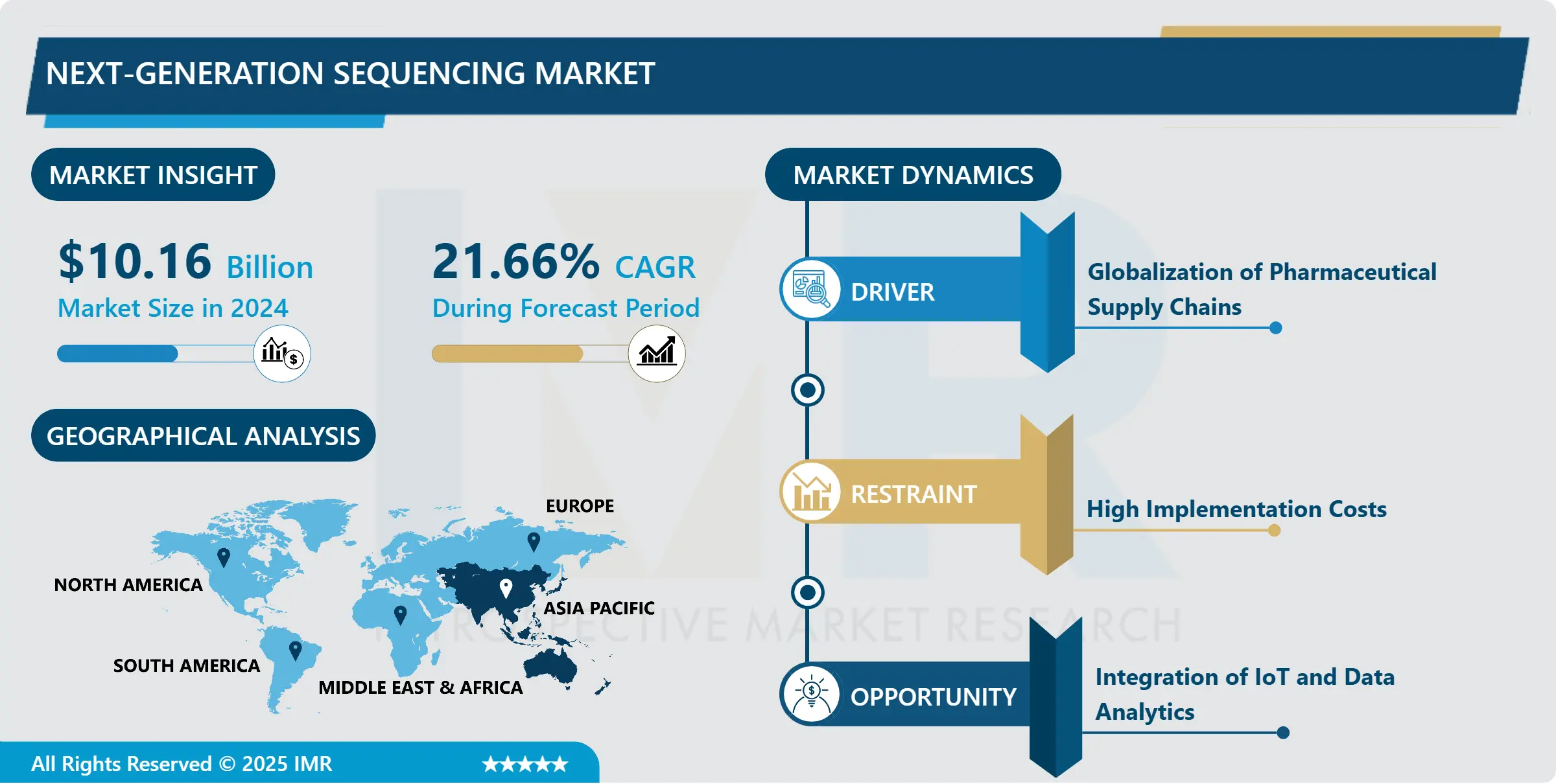
Next-Generation Sequencing Market Size Was Valued at USD 10.16 Billion in 2024, and is Projected to Reach USD 48.76 Billion by 2032, Growing at a CAGR of 21.66% From 2025-2032.
The next-gen sequencing (NGS) refers to a really fast growing industry focused on using advanced methods of sequencing DNA or RNA. NGS technologies enable high-throughput, cost-effective sequencing of nucleic acids, opening a wide range of research possibilities involving genomes, transcriptomes, and epigenomes. This market includes a wide variety of goods and services such as sequencing platforms, reagents, software, as well as sequencing services provided by companies and research institutes. The NGS sector develops due to technological growth, cost cutting, and new applications in personal medicine, oncology, agricultural biotechnology and microbiology. Consequently, the discipline of NGS plays an important role in expanding our knowledge of genetic variations, disease mechanisms, and biological functions, which ultimately contributes to improved clinical diagnostics and therapeutic development.
The executive summary of the Next-Generation Sequencing (NGS) market greatly summarizes the current state of the industry and the prospects in the future NGS has completely transformed the genomic research and clinical diagnosis; it allows high-throughput, low-cost sequencing of the DNA and RNA. This summary highlights the main trends, issues, and drivers that shape the NGS market.
NGS is rapidly advancing, going forwards as driven by improvements in sequencing platforms, bioinformatics tools, and applications at the intersection of genomics and oncology, infectious diseases, and agriculture. This market is typified by a cut-throat competition among the major players who are joined by a fast-growing number of startups in NGS solutions field.
Market growth is a result of continuously expanding demand among consumers in the areas of personalized medicine, precision oncology, non-invasive prenatal testing, and other clinical applications. Research organizations and medical centers are embracing NGS to gain much understanding of genetic differences and the processes of disease, increasing the precision and effectiveness of diagnosis and treatment.
Unfortunately, the challenges still exist, such as data management complexities, protocols standardization, and reimbursements issues in health care units. Despite those barriers, the NGS market is destined for a vigorous expansion thanks to the increasing investments in research and development, expanding applications in clinical settings, and falling sequencing costs.
The executive summary highlights the remarkable role of NGS technologies in healthcare and life sciences discussing the importance of strategic partnerships, regulatory alignment as well as continuous innovation to reach the full potential of genomics in bettering patients outcomes and advancing scientific discoveries.
Next-Generation Sequencing Market Trend Analysis
Emerging Trends in Next-Generation Sequencing (NGS) for Clinical Diagnostics
The growing popularity of next-gen sequencing (NGS) in clinical diagnostics marks an innovative move towards the implementation of personalized medicine. The genetic makeup of an individual can be studied in depth with the advent of NGS technologies, which reveals the genetic variations related to different diseases and enables the designing of precision treatment strategies. The high level of specificity in diagnosis provided by NGS is especially beneficial in oncology, when NGS is used to define the exact mutation that drives cancer growth, making it possible for clinicians to choose the best targeted therapy.
Furthermore, in some rare genetic disorders, NGS allows the identification of causative gene variants that lead to an accurate diagnosis and prognosis. The price decline of sequencing makes NGS affordable for medical providers and individuals, and therefore, expands access of advanced genetic testing to the public. Such an accessibility delivers the possibility of earlier detections of genetic disorders, progressive management of inherited conditions, and tailored therapeutic interventions in accordance with a patient’s genetic profile.
On the other hand, the application of NGS in clinical practice is completely changing the preventive healthcare and healthcare administration. Professionals in healthcare can use NGS tool for the genetic screening to determine those people who are in a higher risk of having a disease, allowing for early intervention and personalized preventive measures. For illustration, genetic screening utilising NGS can identify hereditary risk factors for cardiovascular diseases, which may lead to targeted lifestyle interventions and drug therapies to possibly prevent the occurrence of the disease.
Additionally, NIPT, an NGS-based non-invasive prenatal test used to assess fetal genetic health before birth, helps parents make informed decisions concerning the management of their pregnancies. As the NGS technologies continue to develop and improve, their use in clinical diagnostics will go on expanding and testing the new horizons, making the manner of making healthcare decisions more and more concentrated on a patient’s genetic information and thus bettering health outcomes and creating a new standard in modern medicine.
Diversification of Next-Generation Sequencing (NGS) Applications
The expansion of NGS (next-generation sequencing) applications from genomics to other omics like transcriptomics, epigenomics, and metagenomics symbolizes a major evolution in life sciences research. With NGS technology, scientists are allowed to examine gene expression patterns, detect DNA modifications, and characterize microbiomes with an unparalleled depth and precision.
Transcriptomics is evident in the process of sequencing of the RNA molecules to the study the dynamic landscape of gene expression across various tissues and conditions. This makes it possible to find new transcripts, alternative splicing events, and regulatory mechanisms involved in the cellular processes and disease. However, epigenomics involves DNA mark mapping, mainly DNA methylation and histone modifications which together illuminate how these epigenetic marks control gene regulation and expression (phenotype).
In addition to that, metagenomics, underpinned by NGS, facilitates the study of intricate microbial communities without the need of culture. Through metagenomic sequencing, the diversity, composition, and function of the microbiome in different environments such as the human gut, soil, water, and air may be uncovered. Such insights are paramount in elucidating the functions of microbiota for health and disease, and in that way paving the way for directed treatments and approaches.
The combination of these ‘omics’ methodologies in addition to providing a more comprehensive perspective of biological systems at a molecular level, also accelerate development through high-throughput technologies producing data for computational biology and bioinformatics researchers. It, therefore, portrays how NGS not only improves genetics but also medical, agricultural, and environmental research and paves the way for the acceleration of discoveries.
Next-Generation Sequencing Market Segment Analysis:
Next-Generation Sequencing Market Segmented based on Technology, Product, Application, Workflow, End-user and Region
Whole genome sequencing (WGS) has been a dominant technology employed in genomic research as well as clinical applications due to it’s ability to give a complete view of an individual’s genetic composition. In academic research, WGS is the driving force behind studies identifying genetic causes of diverse diseases including inherited conditions and idiopathic disorders where the exact genetic basis is not so clear. Scientists can use whole genome sequencing to detect rare genetic variants and mutations which are related to the susceptibility to disease, subsequent of which personalized treatment strategies can be developed. Besides, in clinical investigations, WGS plays a significant role in oncology by identifying cancer-driving genetic alterations as well. These findings are important for the detection of specific cancer types, prediction of treatment responses and design of personalised therapies that suits different individuals, thus improving precision medicine in cancer care.
Moreover, aside from its advantage in research and clinical practice, WGS also gets more popular for its application on population-wide research and public health. Through analysis of large numbers of genomes, scientists discover those genetic factors that are linked to the most prevalent diseases such as diabetes, cardiovascular disorders, and neurodegenerative conditions. It is this understanding that not only helps to uncover the underlying mechanisms of the diseases but also informs about the preventive measures and early intervention. In addition, WGS plays a vital role in discovering the genetic markers related to drugs response and adverse reactions, which in turn is used in the development of personalized medicine. With the advancement and accessibility of sequencing technologies, the extensive uptake of WGS is prepared to transform the delivery of healthcare by providing patients with interventions designed based on their unique genetic makeup which in turn contributes to improved patient outcomes cutting across many diseases.
By Application, Oncology segment held the largest share in 2024
Oncology occupies the largest share of applications in the area of genomics and medical diagnostics and testing. This industry is highly instrumental for cancer detection, treatment choice and on-going care of patients. Within the oncology diagnostics, genetic sequencing technologies are employed for several important reasons.
The other important area is Oncology Screening, which includes identifying those at risk of cancer and for early-stage diseases. Genetic sequencing helps to identify specific mutations or genetic changes that are unique to certain types of cancer. Through this, it assists in early detection and prevention, ultimately making patient outcomes better by granting timely treatment commencement.
Similarly important is the area of Personalized Medicine which uses genetic sequencing to match a patient with the most effective treatment based on their individual genetic make-up. Through analysis of the genetic features of tumor clinicians can identify the treatments which are supposed to be more effective by minimizing the possibilities of adverse effects and optimizing the course of disease.
Besides, the main role of genetic sequencing is to determine whether the cancer is Sporadic (arising due to random mutations) or Inherited (caused by inherited genetic mutations). This difference is vital for identifying cancer risk factors within families and designing customized screening and prevention plans.
Beyond diagnostics, genetic sequencing in oncology is also utilized in the Research studies that aim at the discovery of new cancer biomarkers, the study of disease mechanisms, and the development of innovative therapeutic methods. These studies utilize genomic data on a mass scale to identify new drug targets and refinement of treatment techniques that improve on precision in oncology.
In conclusion, the profound effect of genetic sequencing in cancer care is well illustrated by the popularity of oncology applications. Along with the usage of genomic data, physicians will be able to improve early detection, design individual treatment approaches, and advance our knowledge of cancer biology. As technology continuously evolves, genetic sequencing will continue to be key to clinical outcomes in cancer treatment and drive innovations in oncology research and medical practice.
Next-Generation Sequencing Market Regional Insights:
Asia Pacific is Expected to Dominate the Market Over the Forecast period
In the Asia Pacific region, where NGS dominates the market due to key factors such as: China, with its large population and increasing middle class, is dedicating a great deal of resources into the healthcare sector and research. The Chinese government focuses on precision medicine and genomics research and thus application of NGS technologies widens throughout the country. The local firms are collaborating with the global players in order to utilize their expertise and resources for the incorporation of modern NGS platforms that are suitably tailored to meet the region’s needs.
Japan, one of the leading technological companies, is well represented in the next generation sequencing market. The nation’s health care industry actually has adopted genomics and personalized medicine, which facilitate investments in NGS technologies for both research and clinical purposes. Japanese firms develop new sequencing technologies creating more competition that powers market growth. Likewise, India is experiencing an expansion of genetic research and health care investments specifically targeted at the management of chronic diseases and healthcare issues for the masses. Local startups and established firms are working together with international partners to be able to be reliant on NGS services, which in turn contributes to the region being ahead of others in next generation sequencing technologies. The coalescence of growing healthcare spending, favorable government policies and synergies between the local and offshore players is the main driver for the growth of the NGS market in the Asia-Pacific region.
Active Key Players in the Next-Generation Sequencing Market
Illumina
F. Hoffman-La Roche Ltd.
QIAGEN
Thermo Fisher Scientific, Inc.
Bio-Rad Laboratories, Inc.
Oxford Nanopore Technologies
PierianDx
Genomatix GmbH
DNASTAR, Inc.
Perkin Elmer, Inc.
Eurofins GATC Biotech GmbH
BGI
Other Active Players
Key Industry Developments in the Next-Generation Sequencing Market:
In December 2023, Oxford Nanopore jointly with Tecan launched TurBOT beta access. The buyers are due to receive the products in Q1 2024. TurBOT, a benchtop tool, provides faster and effective basecalling, data analysis, automated extraction, and library preparation of multiple samples in a single unit.
In December 2023, Illumina and African Society for Laboratory Medicine signed a memorandum of understanding that will help to increase access to genomics within the African region and fight infectious diseases.
In December 2023, Illumina signed a partnership with HaploX to produce sequencing instruments locally in China.
In November 2022, MedGenome and PacBio announced De Novo Genome Assembly and Annotation grant. The research funds are anticipated to boost research and development efforts in the sector.
In November 2023, Yourgene Health and PacBio partnered to have a better long read sequencing workflow. PacBio LightBench instrument by Yourgene Health approved for size selection of long DNA fragments.
In September 2023, Integrated DNA Technologies (IDT) announced the launch of their xGen NGS products, including primers, adaptors and universal blockers for the Ultima Genomics UG 100 platform.
Chapter 1: Introduction
1.1 Scope and Coverage
Chapter 2:Executive Summary
Chapter 3: Market Landscape
3.1 Market Dynamics
3.1.1 Drivers
3.1.2 Restraints
3.1.3 Opportunities
3.1.4 Challenges
3.2 Market Trend Analysis
3.3 PESTLE Analysis
3.4 Porter’s Five Forces Analysis
3.5 Industry Value Chain Analysis
3.6 Ecosystem
3.7 Regulatory Landscape
3.8 Price Trend Analysis
3.9 Patent Analysis
3.10 Technology Evolution
3.11 Investment Pockets
3.12 Import-Export Analysis
Chapter 4: Next-Generation Sequencing Market by Technology (2018-2032)
4.1 Next-Generation Sequencing Market Snapshot and Growth Engine
4.2 Market Overview
4.3 WGS
4.3.1 Introduction and Market Overview
4.3.2 Historic and Forecasted Market Size in Value USD and Volume Units
4.3.3 Key Market Trends, Growth Factors, and Opportunities
4.3.4 Geographic Segmentation Analysis
4.4 Whole Exome Sequencing
4.5 Targeted Sequencing & Resequencing
4.6 Other
Chapter 5: Next-Generation Sequencing Market by Product (2018-2032)
5.1 Next-Generation Sequencing Market Snapshot and Growth Engine
5.2 Market Overview
5.3 Platform
5.3.1 Introduction and Market Overview
5.3.2 Historic and Forecasted Market Size in Value USD and Volume Units
5.3.3 Key Market Trends, Growth Factors, and Opportunities
5.3.4 Geographic Segmentation Analysis
5.4 Consumables
Chapter 6: Next-Generation Sequencing Market by Application (2018-2032)
6.1 Next-Generation Sequencing Market Snapshot and Growth Engine
6.2 Market Overview
6.3 Oncology
6.3.1 Introduction and Market Overview
6.3.2 Historic and Forecasted Market Size in Value USD and Volume Units
6.3.3 Key Market Trends, Growth Factors, and Opportunities
6.3.4 Geographic Segmentation Analysis
6.4 Clinical Investigation
6.5 Reproductive Health
6.6 HLA Typing/Immune System Monitoring
6.7 Metagenomics
6.8 Epidemiology & Drug Development
6.9 Agrigenomics & Forensics
6.10 Consumer Genomics
Chapter 7: Next-Generation Sequencing Market by Workflow (2018-2032)
7.1 Next-Generation Sequencing Market Snapshot and Growth Engine
7.2 Market Overview
7.3 Pre-Sequencing
7.3.1 Introduction and Market Overview
7.3.2 Historic and Forecasted Market Size in Value USD and Volume Units
7.3.3 Key Market Trends, Growth Factors, and Opportunities
7.3.4 Geographic Segmentation Analysis
7.4 Sequencing
7.5 NGS Data Analysis
Chapter 8: Next-Generation Sequencing Market by End-user (2018-2032)
8.1 Next-Generation Sequencing Market Snapshot and Growth Engine
8.2 Market Overview
8.3 Academic Research
8.3.1 Introduction and Market Overview
8.3.2 Historic and Forecasted Market Size in Value USD and Volume Units
8.3.3 Key Market Trends, Growth Factors, and Opportunities
8.3.4 Geographic Segmentation Analysis
8.4 Clinical Research
8.5 Hospitals & Clinics
8.6 Pharma & Biotech Entities
8.7 Other Users
Chapter 9: Company Profiles and Competitive Analysis
9.1 Competitive Landscape
9.1.1 Competitive Benchmarking
9.1.2 Next-Generation Sequencing Market Share by Manufacturer (2024)
9.1.3 Industry BCG Matrix
9.1.4 Heat Map Analysis
9.1.5 Mergers and Acquisitions
9.2 CISCO SYSTEMS (U.S.)
9.2.1 Company Overview
9.2.2 Key Executives
9.2.3 Company Snapshot
9.2.4 Role of the Company in the Market
9.2.5 Sustainability and Social Responsibility
9.2.6 Operating Business Segments
9.2.7 Product Portfolio
9.2.8 Business Performance
9.2.9 Key Strategic Moves and Recent Developments
9.2.10 SWOT Analysis
9.3 EFFICIENTIP (U.S.)
9.4 BT DIAMOND IP (U.S.)
9.5 PC NETWORK (U.S.)
9.6 TCPWAVE INC. (U.S.)
9.7 SOLARWINDS NETWORK (U.S.)
9.8 NS1 (U.S.)
9.9 MICROSOFT CORPORATION (U.S.)
9.10 INFOBLOX (U.S.)
9.11 BLUECAT NETWORKS (CANADA)
9.12 EMPOWERED NETWORKS (CANADA)
9.13 MEN & MICE (ICELAND)
9.14 FUSIONLAYER (FINLAND)
9.15 APTERIKS (NETHERLANDS)
9.16 APPLIANSYS (UK)
9.17 NCC GROUP (UK)
9.18 ALCATEL-LUCENT (FRANCE)
9.19 NOKIA CORPORATION (FRANCE)
9.20 DATACOMM (INDONESIA)
9.21 INVETICO (AUSTRALIA)
9.22
Chapter 10: Global Next-Generation Sequencing Market By Region
10.1 Overview
10.2. North America Next-Generation Sequencing Market
10.2.1 Key Market Trends, Growth Factors and Opportunities
10.2.2 Top Key Companies
10.2.3 Historic and Forecasted Market Size by Segments
10.2.4 Historic and Forecasted Market Size by Technology
10.2.4.1 WGS
10.2.4.2 Whole Exome Sequencing
10.2.4.3 Targeted Sequencing & Resequencing
10.2.4.4 Other
10.2.5 Historic and Forecasted Market Size by Product
10.2.5.1 Platform
10.2.5.2 Consumables
10.2.6 Historic and Forecasted Market Size by Application
10.2.6.1 Oncology
10.2.6.2 Clinical Investigation
10.2.6.3 Reproductive Health
10.2.6.4 HLA Typing/Immune System Monitoring
10.2.6.5 Metagenomics
10.2.6.6 Epidemiology & Drug Development
10.2.6.7 Agrigenomics & Forensics
10.2.6.8 Consumer Genomics
10.2.7 Historic and Forecasted Market Size by Workflow
10.2.7.1 Pre-Sequencing
10.2.7.2 Sequencing
10.2.7.3 NGS Data Analysis
10.2.8 Historic and Forecasted Market Size by End-user
10.2.8.1 Academic Research
10.2.8.2 Clinical Research
10.2.8.3 Hospitals & Clinics
10.2.8.4 Pharma & Biotech Entities
10.2.8.5 Other Users
10.2.9 Historic and Forecast Market Size by Country
10.2.9.1 US
10.2.9.2 Canada
10.2.9.3 Mexico
10.3. Eastern Europe Next-Generation Sequencing Market
10.3.1 Key Market Trends, Growth Factors and Opportunities
10.3.2 Top Key Companies
10.3.3 Historic and Forecasted Market Size by Segments
10.3.4 Historic and Forecasted Market Size by Technology
10.3.4.1 WGS
10.3.4.2 Whole Exome Sequencing
10.3.4.3 Targeted Sequencing & Resequencing
10.3.4.4 Other
10.3.5 Historic and Forecasted Market Size by Product
10.3.5.1 Platform
10.3.5.2 Consumables
10.3.6 Historic and Forecasted Market Size by Application
10.3.6.1 Oncology
10.3.6.2 Clinical Investigation
10.3.6.3 Reproductive Health
10.3.6.4 HLA Typing/Immune System Monitoring
10.3.6.5 Metagenomics
10.3.6.6 Epidemiology & Drug Development
10.3.6.7 Agrigenomics & Forensics
10.3.6.8 Consumer Genomics
10.3.7 Historic and Forecasted Market Size by Workflow
10.3.7.1 Pre-Sequencing
10.3.7.2 Sequencing
10.3.7.3 NGS Data Analysis
10.3.8 Historic and Forecasted Market Size by End-user
10.3.8.1 Academic Research
10.3.8.2 Clinical Research
10.3.8.3 Hospitals & Clinics
10.3.8.4 Pharma & Biotech Entities
10.3.8.5 Other Users
10.3.9 Historic and Forecast Market Size by Country
10.3.9.1 Russia
10.3.9.2 Bulgaria
10.3.9.3 The Czech Republic
10.3.9.4 Hungary
10.3.9.5 Poland
10.3.9.6 Romania
10.3.9.7 Rest of Eastern Europe
10.4. Western Europe Next-Generation Sequencing Market
10.4.1 Key Market Trends, Growth Factors and Opportunities
10.4.2 Top Key Companies
10.4.3 Historic and Forecasted Market Size by Segments
10.4.4 Historic and Forecasted Market Size by Technology
10.4.4.1 WGS
10.4.4.2 Whole Exome Sequencing
10.4.4.3 Targeted Sequencing & Resequencing
10.4.4.4 Other
10.4.5 Historic and Forecasted Market Size by Product
10.4.5.1 Platform
10.4.5.2 Consumables
10.4.6 Historic and Forecasted Market Size by Application
10.4.6.1 Oncology
10.4.6.2 Clinical Investigation
10.4.6.3 Reproductive Health
10.4.6.4 HLA Typing/Immune System Monitoring
10.4.6.5 Metagenomics
10.4.6.6 Epidemiology & Drug Development
10.4.6.7 Agrigenomics & Forensics
10.4.6.8 Consumer Genomics
10.4.7 Historic and Forecasted Market Size by Workflow
10.4.7.1 Pre-Sequencing
10.4.7.2 Sequencing
10.4.7.3 NGS Data Analysis
10.4.8 Historic and Forecasted Market Size by End-user
10.4.8.1 Academic Research
10.4.8.2 Clinical Research
10.4.8.3 Hospitals & Clinics
10.4.8.4 Pharma & Biotech Entities
10.4.8.5 Other Users
10.4.9 Historic and Forecast Market Size by Country
10.4.9.1 Germany
10.4.9.2 UK
10.4.9.3 France
10.4.9.4 The Netherlands
10.4.9.5 Italy
10.4.9.6 Spain
10.4.9.7 Rest of Western Europe
10.5. Asia Pacific Next-Generation Sequencing Market
10.5.1 Key Market Trends, Growth Factors and Opportunities
10.5.2 Top Key Companies
10.5.3 Historic and Forecasted Market Size by Segments
10.5.4 Historic and Forecasted Market Size by Technology
10.5.4.1 WGS
10.5.4.2 Whole Exome Sequencing
10.5.4.3 Targeted Sequencing & Resequencing
10.5.4.4 Other
10.5.5 Historic and Forecasted Market Size by Product
10.5.5.1 Platform
10.5.5.2 Consumables
10.5.6 Historic and Forecasted Market Size by Application
10.5.6.1 Oncology
10.5.6.2 Clinical Investigation
10.5.6.3 Reproductive Health
10.5.6.4 HLA Typing/Immune System Monitoring
10.5.6.5 Metagenomics
10.5.6.6 Epidemiology & Drug Development
10.5.6.7 Agrigenomics & Forensics
10.5.6.8 Consumer Genomics
10.5.7 Historic and Forecasted Market Size by Workflow
10.5.7.1 Pre-Sequencing
10.5.7.2 Sequencing
10.5.7.3 NGS Data Analysis
10.5.8 Historic and Forecasted Market Size by End-user
10.5.8.1 Academic Research
10.5.8.2 Clinical Research
10.5.8.3 Hospitals & Clinics
10.5.8.4 Pharma & Biotech Entities
10.5.8.5 Other Users
10.5.9 Historic and Forecast Market Size by Country
10.5.9.1 China
10.5.9.2 India
10.5.9.3 Japan
10.5.9.4 South Korea
10.5.9.5 Malaysia
10.5.9.6 Thailand
10.5.9.7 Vietnam
10.5.9.8 The Philippines
10.5.9.9 Australia
10.5.9.10 New Zealand
10.5.9.11 Rest of APAC
10.6. Middle East & Africa Next-Generation Sequencing Market
10.6.1 Key Market Trends, Growth Factors and Opportunities
10.6.2 Top Key Companies
10.6.3 Historic and Forecasted Market Size by Segments
10.6.4 Historic and Forecasted Market Size by Technology
10.6.4.1 WGS
10.6.4.2 Whole Exome Sequencing
10.6.4.3 Targeted Sequencing & Resequencing
10.6.4.4 Other
10.6.5 Historic and Forecasted Market Size by Product
10.6.5.1 Platform
10.6.5.2 Consumables
10.6.6 Historic and Forecasted Market Size by Application
10.6.6.1 Oncology
10.6.6.2 Clinical Investigation
10.6.6.3 Reproductive Health
10.6.6.4 HLA Typing/Immune System Monitoring
10.6.6.5 Metagenomics
10.6.6.6 Epidemiology & Drug Development
10.6.6.7 Agrigenomics & Forensics
10.6.6.8 Consumer Genomics
10.6.7 Historic and Forecasted Market Size by Workflow
10.6.7.1 Pre-Sequencing
10.6.7.2 Sequencing
10.6.7.3 NGS Data Analysis
10.6.8 Historic and Forecasted Market Size by End-user
10.6.8.1 Academic Research
10.6.8.2 Clinical Research
10.6.8.3 Hospitals & Clinics
10.6.8.4 Pharma & Biotech Entities
10.6.8.5 Other Users
10.6.9 Historic and Forecast Market Size by Country
10.6.9.1 Turkiye
10.6.9.2 Bahrain
10.6.9.3 Kuwait
10.6.9.4 Saudi Arabia
10.6.9.5 Qatar
10.6.9.6 UAE
10.6.9.7 Israel
10.6.9.8 South Africa
10.7. South America Next-Generation Sequencing Market
10.7.1 Key Market Trends, Growth Factors and Opportunities
10.7.2 Top Key Companies
10.7.3 Historic and Forecasted Market Size by Segments
10.7.4 Historic and Forecasted Market Size by Technology
10.7.4.1 WGS
10.7.4.2 Whole Exome Sequencing
10.7.4.3 Targeted Sequencing & Resequencing
10.7.4.4 Other
10.7.5 Historic and Forecasted Market Size by Product
10.7.5.1 Platform
10.7.5.2 Consumables
10.7.6 Historic and Forecasted Market Size by Application
10.7.6.1 Oncology
10.7.6.2 Clinical Investigation
10.7.6.3 Reproductive Health
10.7.6.4 HLA Typing/Immune System Monitoring
10.7.6.5 Metagenomics
10.7.6.6 Epidemiology & Drug Development
10.7.6.7 Agrigenomics & Forensics
10.7.6.8 Consumer Genomics
10.7.7 Historic and Forecasted Market Size by Workflow
10.7.7.1 Pre-Sequencing
10.7.7.2 Sequencing
10.7.7.3 NGS Data Analysis
10.7.8 Historic and Forecasted Market Size by End-user
10.7.8.1 Academic Research
10.7.8.2 Clinical Research
10.7.8.3 Hospitals & Clinics
10.7.8.4 Pharma & Biotech Entities
10.7.8.5 Other Users
10.7.9 Historic and Forecast Market Size by Country
10.7.9.1 Brazil
10.7.9.2 Argentina
10.7.9.3 Rest of SA
Chapter 11 Analyst Viewpoint and Conclusion
11.1 Recommendations and Concluding Analysis
11.2 Potential Market Strategies
Chapter 12 Research Methodology
12.1 Research Process
12.2 Primary Research
12.3 Secondary Research
Q1: What would be the forecast period in the Next-Generation Sequencing Market research report?
A1: The forecast period in the Next-Generation Sequencing Market research report is 2025-2032.
Q2: Who are the key players in the Next-Generation Sequencing Market ?
A2: Illumina; QIAGEN; Thermo Fisher Scientific, Inc.; F. Hoffman-La Roche Ltd.; Oxford Nanopore Technologies; Genomatix GmbH; PierianDx; DNASTAR, Inc.; Eurofins GATC Biotech GmbH; Perkin Elmer, Inc.; BGI; Bio-Rad Laboratories, Inc., and Other Active Players
Q3: What are the segments of the Next-Generation Sequencing Market ?
A3: The Next-Generation Sequencing Market is segmented into By Technology, By Product, By Application, By Workflow and By End-user and region. By Technology, the market is categorized into WGS, Whole Exome Sequencing, Targeted Sequencing & Resequencing and Other. By Product, the market is categorized into Platform , Consumables and Others. By Application, the market is categorized into Oncology ,Clinical Investigation, Reproductive Health , HLA Typing/Immune System Monitoring, Metagenomics, Epidemiology & Drug Development, Agrigenomics & Forensics and Consumer Genomics. By Workflow, the market is categorized into Pre-Sequencing, Sequencing and NGS Data Analysis. By End User, the market is categorized into Academic Research, Clinical Research, Hospitals & Clinics, Pharma & Biotech Entities and Other Users. By Region, it is analyzed across North America (U.S.; Canada; Mexico), Eastern Europe (Russia; Bulgaria; The Czech Republic; Hungary; Poland; Romania; Rest of Eastern Europe), Western Europe (Germany; UK; France; The Netherlands; Italy; ; Spain; Rest of Western Europe), Asia-Pacific (China, India, Japan, South Korea, Malaysia, Thailand, Vietnam, The Philippines, Australia, New Zealand, Rest of APAC), Middle East & Africa (Türkiye, Bahrain, Kuwait, Saudi Arabia, Qatar, UAE, Israel, South Africa), South America (Brazil; Argentina, etc.).
Q4: What is the Next-Generation Sequencing Market ?
A4: The next-generation sequencing (NGS) market refers to the rapidly expanding industry focused on advanced techniques for sequencing DNA or RNA. NGS technologies allow for high-throughput, cost-effective sequencing of nucleic acids, enabling researchers to analyze genomes, transcriptomes, and epigenomes with unprecedented speed and accuracy. This market encompasses a range of products and services including sequencing platforms, reagents, software, and sequencing services offered by various companies and research institutions. The NGS market is driven by continuous technological advancements, decreasing sequencing costs, and expanding applications in areas such as personalized medicine, oncology, agricultural biotechnology, and microbiology. As a result, the field of NGS is pivotal in advancing our understanding of genetic variations, disease mechanisms, and biological functions, with significant implications for clinical diagnostics and therapeutic development.
Q5: How big is the Next-Generation Sequencing Market ?
A5: Next-Generation Sequencing Market Size Was Valued at USD 10.16 Billion in 2024, and is Projected to Reach USD 48.76 Billion by 2032, Growing at a CAGR of 21.66% From 2025-2032.
How to Buy a Report from eminsights.jp
On the product page, choose the license you want: Single-User License, Multi-User License or Enterprise License.
If you required report in your native language, then you can click on Translated Report button and fill out the form with report name and language you want, then our team will contact you as soon as possible.
Click the Buy Now button.
You will be redirected to the checkout page. Enter your company details and payment information.
Click Place Order to complete the purchase.
Confirmation: You’ll receive an order confirmation and our team will contact you shortly with your ordered report.
If you have any questions, fill out the contact form below or email us at [email protected].
Thank you for choosing eminsights.jp!