Stay Ahead in Fast-Growing Economies.
Browse Reports Now
Animal Feed Antioxidants Market: Advancements & Analysis
The report offers Animal Feed Antioxidant Market Dynamics, Comprises Industry development drivers, challenges, opportunities, threats and limitations. A report also incorporates Cost Trend of products, Mergers & Acquisitions, Expansion, Crucial Suppliers of products, Concentration Rate of Steel Coupling Economy. Global Animal Feed Antioxidant Market Research Report covers Market Effect Factors investigation chiefly included Technology Progress, Consumer Requires Trend, External Environmental Change.

IMR Group
Description
Animal Feed Antioxidants Market Synopsis
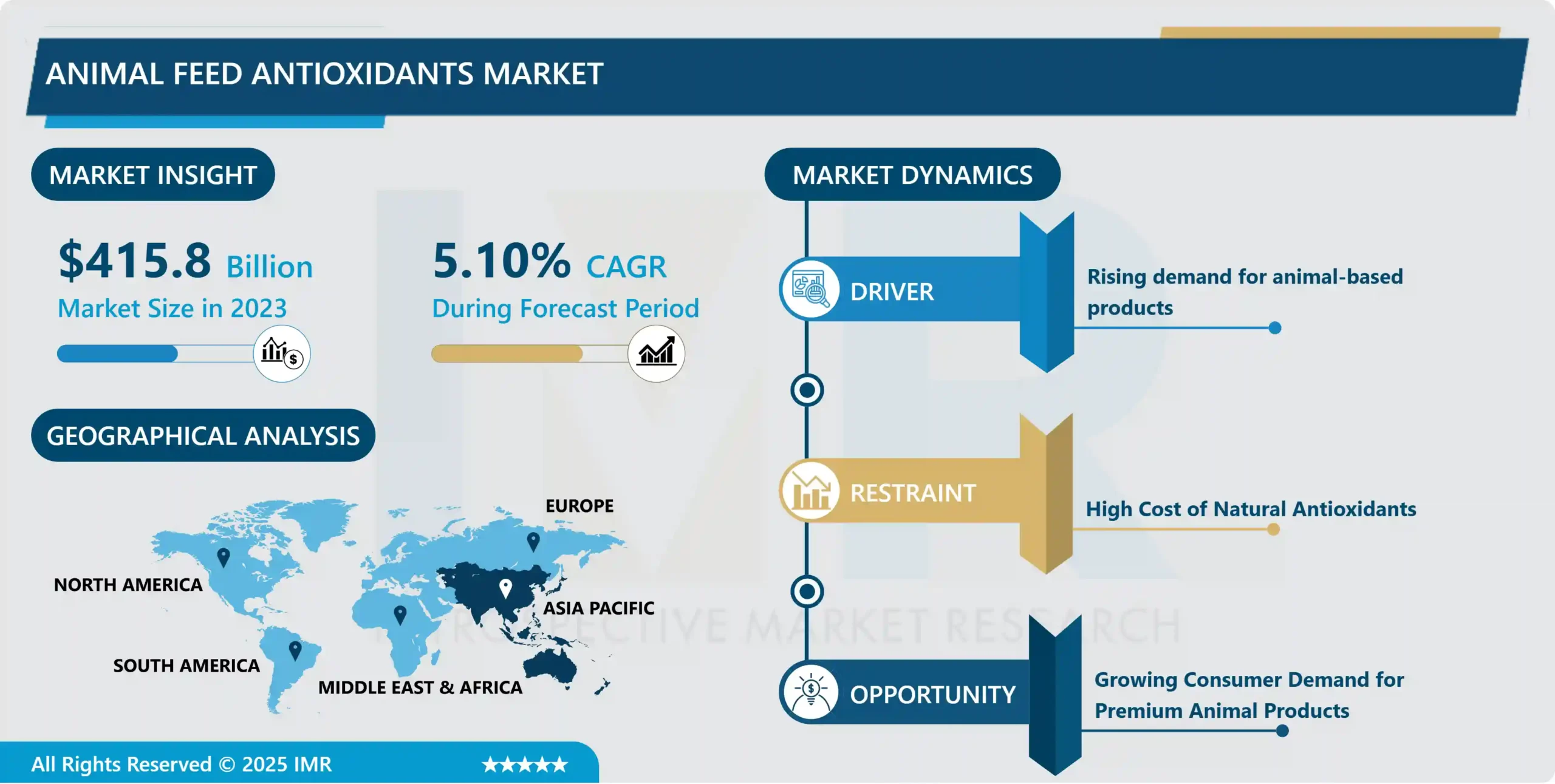
Animal Feed Antioxidants Market Size Was Valued at USD 415.8 Billion in 2023, and is Projected to Reach 612.23 USD Billion by 2032, Growing at a CAGR of 5.1 % From 2024-2032.
Animal feed antioxidants are substances added to animal diets to prevent or delay the oxidative deterioration of feed components. They function by inhibiting or scavenging free radicals, which contribute to oxidative stress. Common antioxidants in animal feed include vitamins E and C, selenium, and synthetic antioxidants like BHA and BHT. These antioxidants support animal health, growth, and performance while extending the feed’s shelf life.
Antioxidants in animal feed are essential to the nutrition of contemporary cattle and poultry and offer several benefits to the animal husbandry industry. Antioxidants that assist reduce oxidative stress in feed components include selenium, vitamins E and C, and synthetic additives like BHA and BHT. Antioxidants boost animal health, development, and performance by stopping the deterioration of vital nutrients and lowering the production of toxic chemicals. They are also essential in extending the feed’s shelf life and maintaining its nutritional value until cattle eat it.
Growing awareness of the value of animal nutrition and the necessity of sustainable agricultural techniques is driving a favorable trend in the animal feed antioxidant industry. Demand for feed additives that improve the nutritional content of animal diets is rising as customers grow more aware of the quality of animal products.
The market dynamics are also being influenced by regulatory demands and a move toward natural and sustainable solutions, which is resulting in the creation of innovative antioxidant formulations with increased efficacy and less environmental impact. As the livestock sector develops and emphasizes the value of antioxidants and balanced nutrition in achieving optimal animal well-being, there will likely be an increase in the global demand for antioxidants in animal feed.
Animal Feed Antioxidants Market Trend Analysis:
Rising demand for animal-based products
The use of antioxidants in animal feed is significantly influenced by the growing market for goods derived from animals. Meat, dairy, and other goods generated from animals are consumed at an increasing rate in tandem with increases in the world’s population and affluence. This increased demand puts a lot of pressure on livestock farming methods to improve animal welfare and production efficiency.
Antioxidants in animal feed are essential for preserving cattle health and productivity. These antioxidants assist in reducing the harmful effects of oxidative stress, which may be caused by a number of things, including dietary imbalances, stressful environments, and high-intensity manufacturing systems. Animal producers can maximize reproductive success, growth rates, and overall health of their animals by adding antioxidants to their diet.
Moreover, as customers become more aware of the quality of the animal products they buy, the welfare of livestock is becoming more and more important. Because of this, farmers and feed producers are spending money on nutritional tactics, such as using antioxidants, to satisfy changing customer demands and maintain effective and sustainable animal husbandry methods. Their vital importance in contemporary livestock production is highlighted by the mutually beneficial interaction between the growing demand for animal-based goods and the requirement for antioxidants in animal feed.
Growing Consumer Demand for Premium Animal Products
The market for antioxidants in animal feed offers a substantial opportunity due to the rising consumer demand for high-quality animal products. Consumers are prepared to spend more on premium animal goods, such organic meats and eggs, as long as they can demonstrate that sustainability and health are important to them. A change in purchasing habits is being caused by the perception that these high-end items are healthier and more ethically manufactured.
Livestock producers are implementing improved animal nutrition techniques, such as adding antioxidants to animal feed, to satisfy these customer desires. In order to preserve animal health and raise the caliber of animal products, antioxidants are essential. They improve immunological response, lessen oxidative stress, and improve the general health of cattle.
As the demand for premium animal products rises, the need for superior feed formulations grows. Animal feed antioxidants not only aid in maintaining the health and performance of livestock but also contribute to the production of high-quality meat, dairy, and eggs. This presents a lucrative market opportunity for companies in the animal feed antioxidant sector, aligning with the evolving consumer landscape and fostering sustainable agricultural practices.
Animal Feed Antioxidants Market Segment Analysis:
Animal Feed Antioxidants Market Segmented on the basis of Product Type, Source, Animal Type, End-User and Distribution Channel.
By Animal Type, Poultry segment is expected to dominate the market during the forecast period
Antioxidants included in animal feed are mostly consumed by poultry for a number of reasons. As the need for inexpensive, lean protein sources rises globally, the chicken sector has grown significantly. Large-scale chicken farming has thus grown to be a significant participant in the cattle industry. Oxidative stress is quite common in poultry, and it can affect the production and health of birds. In chicken, antioxidants are essential for reducing oxidative stress and improving growth rates, feed efficiency, and overall performance.
Furthermore, the shorter production cycle of poultry allows for a faster and more direct response to dietary changes, making it easier to incorporate antioxidants into their feed formulations. This combination of market dominance and specific nutritional needs makes the poultry industry a key driver for the utilization of animal feed antioxidants in modern agricultural practices.
By Product Type, Synthetic Antioxidants segment is expected to dominate the market during the forecast period
A number of reasons will contribute to the Synthetic Antioxidants segment’s dominance in the animal feed antioxidants market throughout the projected timeframe. As of their stability, affordability, and excellent oxidative stress mitigation, synthetic antioxidants like ethoxyquin and butylated hydroxytoluene (BHT) are preferred. These artificial substances offer an affordable and dependable means of halting feed component degradation and preserving the nutritious content of animal meals over an extended period of time. Their ability to consistently maintain feed component quality throughout storage and guarantee the general well-being and productivity of livestock is the driving force behind their extensive usage in the animal nutrition sector.
Moreover, synthetic antioxidants often exhibit a longer shelf life compared to their natural counterparts, making them a preferred choice for feed manufacturers seeking extended product stability. The cost efficiency and efficacy of synthetic antioxidants position this segment as a dominant force in the market, appealing to livestock producers and feed industry players aiming to achieve optimal animal performance and product quality while maintaining economic viability.
Animal Feed Antioxidants Market Regional Insights:
Asia Pacific is Expected to Dominate the Market Over the Forecast period
Asia Pacific dominates the animal feed antioxidants market for several key reasons. Firstly, the region is home to a significant share of the global livestock population, including poultry, swine, and cattle, driven by the increasing demand for animal products in densely populated countries like China and India. As the livestock industry expands to meet the growing protein needs of the population, there is a parallel surge in the demand for effective and sustainable animal nutrition solutions.
Furthermore, Asia Pacific economies are experiencing rapid urbanization and rising incomes, leading to a shift in dietary preferences towards higher-quality animal products. This shift fuels the demand for premium animal feed formulations that enhance the health and productivity of livestock. In response to these market dynamics, the animal feed antioxidants sector in the region has witnessed substantial investments in research and development, innovation, and production.
Governments in the Asia Pacific region are increasingly focusing on improving the efficiency and sustainability of agriculture, including animal husbandry. This emphasis on sustainable practices further propels the adoption of advanced feed additives, including antioxidants, to optimize animal health and productivity. Given these factors, Asia Pacific stands out as a dominant force in the global animal feed antioxidants market, driven by its significant livestock population, changing consumer preferences, and the commitment to sustainable agricultural practices.
Animal Feed Antioxidants Market Top Key Players:
Cargill (US)
Archer Daniels Midland Company (US)
Kemin (US)
Alltech (US)
Novus International (US)
FoodSafe Technologies (US)
Videka (US)
Lallemand Animal Nutrition (Canada)
Caldic (Canada)
BASF SE (Germany)
Koninklijke DSM N.V. (Netherlands)
Nutreco (Netherlands)
Adisseo (France)
BTSA (Spain)
Oxiris Chemical (Spain)
Industrial Tecnica Pecuária (Spain)
Perstorp (Sweden)
Chemical Fine Sciences (India)
VDH Chemicals (India)
Zhejiang Medicine Co. Ltd. (China) and Other Major Players.
Key Industry Developments in the Animal Feed Antioxidants Market:
In October 2024, Brenntag Specialties announced an exclusive distribution agreement with BTSA for Oxabiol, natural antioxidants, in Europe. This agreement expands Brenntag’s Animal Nutrition portfolio, providing customers in the Pet Food, Rendering, and Animal Nutrition industries access to BTSA’s high-quality antioxidants, including organic versions. Oxabiol helps extend shelf-life, protect nutrients, and improve product quality. This partnership builds on the successful cooperation between Brenntag and BTSA since 2019, supporting Brenntag’s strategic goal of strengthening its position in the EMEA region.
Chapter 1: Introduction
1.1 Scope and Coverage
Chapter 2:Executive Summary
Chapter 3: Market Landscape
3.1 Market Dynamics
3.1.1 Drivers
3.1.2 Restraints
3.1.3 Opportunities
3.1.4 Challenges
3.2 Market Trend Analysis
3.3 PESTLE Analysis
3.4 Porter’s Five Forces Analysis
3.5 Industry Value Chain Analysis
3.6 Ecosystem
3.7 Regulatory Landscape
3.8 Price Trend Analysis
3.9 Patent Analysis
3.10 Technology Evolution
3.11 Investment Pockets
3.12 Import-Export Analysis
Chapter 4: Animal Feed Antioxidants Market by Product Type (2018-2032)
4.1 Animal Feed Antioxidants Market Snapshot and Growth Engine
4.2 Market Overview
4.3 Synthetic Antioxidants
4.3.1 Introduction and Market Overview
4.3.2 Historic and Forecasted Market Size in Value USD and Volume Units
4.3.3 Key Market Trends, Growth Factors, and Opportunities
4.3.4 Geographic Segmentation Analysis
4.4 Natural Antioxidants
Chapter 5: Animal Feed Antioxidants Market by Source (2018-2032)
5.1 Animal Feed Antioxidants Market Snapshot and Growth Engine
5.2 Market Overview
5.3 Natural Sources
5.3.1 Introduction and Market Overview
5.3.2 Historic and Forecasted Market Size in Value USD and Volume Units
5.3.3 Key Market Trends, Growth Factors, and Opportunities
5.3.4 Geographic Segmentation Analysis
5.4 Plant-based
5.5 Animal-based
5.6 Synthetic Sources
Chapter 6: Animal Feed Antioxidants Market by Animal Type (2018-2032)
6.1 Animal Feed Antioxidants Market Snapshot and Growth Engine
6.2 Market Overview
6.3 Poultry
6.3.1 Introduction and Market Overview
6.3.2 Historic and Forecasted Market Size in Value USD and Volume Units
6.3.3 Key Market Trends, Growth Factors, and Opportunities
6.3.4 Geographic Segmentation Analysis
6.4 Swine
6.5 Ruminants
6.6 Aquaculture
6.7 Pets
Chapter 7: Animal Feed Antioxidants Market by End-User (2018-2032)
7.1 Animal Feed Antioxidants Market Snapshot and Growth Engine
7.2 Market Overview
7.3 Feed Manufacturers
7.3.1 Introduction and Market Overview
7.3.2 Historic and Forecasted Market Size in Value USD and Volume Units
7.3.3 Key Market Trends, Growth Factors, and Opportunities
7.3.4 Geographic Segmentation Analysis
7.4 Farmers
7.5 Integrators
Chapter 8: Animal Feed Antioxidants Market by Distribution Channel (2018-2032)
8.1 Animal Feed Antioxidants Market Snapshot and Growth Engine
8.2 Market Overview
8.3 Direct Sales
8.3.1 Introduction and Market Overview
8.3.2 Historic and Forecasted Market Size in Value USD and Volume Units
8.3.3 Key Market Trends, Growth Factors, and Opportunities
8.3.4 Geographic Segmentation Analysis
8.4 Distributors
8.5 Online Retail
Chapter 9: Company Profiles and Competitive Analysis
9.1 Competitive Landscape
9.1.1 Competitive Benchmarking
9.1.2 Animal Feed Antioxidants Market Share by Manufacturer (2024)
9.1.3 Industry BCG Matrix
9.1.4 Heat Map Analysis
9.1.5 Mergers and Acquisitions
9.2 SCHOTT AG (GERMANY)
9.2.1 Company Overview
9.2.2 Key Executives
9.2.3 Company Snapshot
9.2.4 Role of the Company in the Market
9.2.5 Sustainability and Social Responsibility
9.2.6 Operating Business Segments
9.2.7 Product Portfolio
9.2.8 Business Performance
9.2.9 Key Strategic Moves and Recent Developments
9.2.10 SWOT Analysis
9.3 ZEISS GROUP (GERMANY)
9.4 AGC INC. (JAPAN)
9.5 PANASONIC CORPORATION (JAPAN)
9.6 KANTATSU (JAPAN)
9.7 KINKO (JAPAN)
9.8 SEIKO OPTICAL PRODUCTS CO.LTD (JAPAN)
9.9 SEKONIX (JAPAN)
9.10 CANON INDIA PVT LTD. (INDIA)
9.11 COASIA OPTICS (CHINA)
9.12 HUAXIN OPTICAL TECH (CHINA)
9.13 AOET (CHINA)
9.14 SUNNY OPTICAL TECHNOLOGY (CHINA)
9.15 NEWMAX (CHINA)
9.16 OFILM (CHINA)
9.17 GENIUS ELECTRONIC OPTICAL (GSEO) (TAIWAN)
9.18 ASIA OPTICAL (TAIWAN)
9.19 LARGAN PRECISION CO.LTD. (TAIWAN)
9.20 HOYA VISION CARE COMPANY (THAILAND)
9.21 AAC TECHNOLOGIES (SOUTH KOREA)
Chapter 10: Global Animal Feed Antioxidants Market By Region
10.1 Overview
10.2. North America Animal Feed Antioxidants Market
10.2.1 Key Market Trends, Growth Factors and Opportunities
10.2.2 Top Key Companies
10.2.3 Historic and Forecasted Market Size by Segments
10.2.4 Historic and Forecasted Market Size by Product Type
10.2.4.1 Synthetic Antioxidants
10.2.4.2 Natural Antioxidants
10.2.5 Historic and Forecasted Market Size by Source
10.2.5.1 Natural Sources
10.2.5.2 Plant-based
10.2.5.3 Animal-based
10.2.5.4 Synthetic Sources
10.2.6 Historic and Forecasted Market Size by Animal Type
10.2.6.1 Poultry
10.2.6.2 Swine
10.2.6.3 Ruminants
10.2.6.4 Aquaculture
10.2.6.5 Pets
10.2.7 Historic and Forecasted Market Size by End-User
10.2.7.1 Feed Manufacturers
10.2.7.2 Farmers
10.2.7.3 Integrators
10.2.8 Historic and Forecasted Market Size by Distribution Channel
10.2.8.1 Direct Sales
10.2.8.2 Distributors
10.2.8.3 Online Retail
10.2.9 Historic and Forecast Market Size by Country
10.2.9.1 US
10.2.9.2 Canada
10.2.9.3 Mexico
10.3. Eastern Europe Animal Feed Antioxidants Market
10.3.1 Key Market Trends, Growth Factors and Opportunities
10.3.2 Top Key Companies
10.3.3 Historic and Forecasted Market Size by Segments
10.3.4 Historic and Forecasted Market Size by Product Type
10.3.4.1 Synthetic Antioxidants
10.3.4.2 Natural Antioxidants
10.3.5 Historic and Forecasted Market Size by Source
10.3.5.1 Natural Sources
10.3.5.2 Plant-based
10.3.5.3 Animal-based
10.3.5.4 Synthetic Sources
10.3.6 Historic and Forecasted Market Size by Animal Type
10.3.6.1 Poultry
10.3.6.2 Swine
10.3.6.3 Ruminants
10.3.6.4 Aquaculture
10.3.6.5 Pets
10.3.7 Historic and Forecasted Market Size by End-User
10.3.7.1 Feed Manufacturers
10.3.7.2 Farmers
10.3.7.3 Integrators
10.3.8 Historic and Forecasted Market Size by Distribution Channel
10.3.8.1 Direct Sales
10.3.8.2 Distributors
10.3.8.3 Online Retail
10.3.9 Historic and Forecast Market Size by Country
10.3.9.1 Russia
10.3.9.2 Bulgaria
10.3.9.3 The Czech Republic
10.3.9.4 Hungary
10.3.9.5 Poland
10.3.9.6 Romania
10.3.9.7 Rest of Eastern Europe
10.4. Western Europe Animal Feed Antioxidants Market
10.4.1 Key Market Trends, Growth Factors and Opportunities
10.4.2 Top Key Companies
10.4.3 Historic and Forecasted Market Size by Segments
10.4.4 Historic and Forecasted Market Size by Product Type
10.4.4.1 Synthetic Antioxidants
10.4.4.2 Natural Antioxidants
10.4.5 Historic and Forecasted Market Size by Source
10.4.5.1 Natural Sources
10.4.5.2 Plant-based
10.4.5.3 Animal-based
10.4.5.4 Synthetic Sources
10.4.6 Historic and Forecasted Market Size by Animal Type
10.4.6.1 Poultry
10.4.6.2 Swine
10.4.6.3 Ruminants
10.4.6.4 Aquaculture
10.4.6.5 Pets
10.4.7 Historic and Forecasted Market Size by End-User
10.4.7.1 Feed Manufacturers
10.4.7.2 Farmers
10.4.7.3 Integrators
10.4.8 Historic and Forecasted Market Size by Distribution Channel
10.4.8.1 Direct Sales
10.4.8.2 Distributors
10.4.8.3 Online Retail
10.4.9 Historic and Forecast Market Size by Country
10.4.9.1 Germany
10.4.9.2 UK
10.4.9.3 France
10.4.9.4 The Netherlands
10.4.9.5 Italy
10.4.9.6 Spain
10.4.9.7 Rest of Western Europe
10.5. Asia Pacific Animal Feed Antioxidants Market
10.5.1 Key Market Trends, Growth Factors and Opportunities
10.5.2 Top Key Companies
10.5.3 Historic and Forecasted Market Size by Segments
10.5.4 Historic and Forecasted Market Size by Product Type
10.5.4.1 Synthetic Antioxidants
10.5.4.2 Natural Antioxidants
10.5.5 Historic and Forecasted Market Size by Source
10.5.5.1 Natural Sources
10.5.5.2 Plant-based
10.5.5.3 Animal-based
10.5.5.4 Synthetic Sources
10.5.6 Historic and Forecasted Market Size by Animal Type
10.5.6.1 Poultry
10.5.6.2 Swine
10.5.6.3 Ruminants
10.5.6.4 Aquaculture
10.5.6.5 Pets
10.5.7 Historic and Forecasted Market Size by End-User
10.5.7.1 Feed Manufacturers
10.5.7.2 Farmers
10.5.7.3 Integrators
10.5.8 Historic and Forecasted Market Size by Distribution Channel
10.5.8.1 Direct Sales
10.5.8.2 Distributors
10.5.8.3 Online Retail
10.5.9 Historic and Forecast Market Size by Country
10.5.9.1 China
10.5.9.2 India
10.5.9.3 Japan
10.5.9.4 South Korea
10.5.9.5 Malaysia
10.5.9.6 Thailand
10.5.9.7 Vietnam
10.5.9.8 The Philippines
10.5.9.9 Australia
10.5.9.10 New Zealand
10.5.9.11 Rest of APAC
10.6. Middle East & Africa Animal Feed Antioxidants Market
10.6.1 Key Market Trends, Growth Factors and Opportunities
10.6.2 Top Key Companies
10.6.3 Historic and Forecasted Market Size by Segments
10.6.4 Historic and Forecasted Market Size by Product Type
10.6.4.1 Synthetic Antioxidants
10.6.4.2 Natural Antioxidants
10.6.5 Historic and Forecasted Market Size by Source
10.6.5.1 Natural Sources
10.6.5.2 Plant-based
10.6.5.3 Animal-based
10.6.5.4 Synthetic Sources
10.6.6 Historic and Forecasted Market Size by Animal Type
10.6.6.1 Poultry
10.6.6.2 Swine
10.6.6.3 Ruminants
10.6.6.4 Aquaculture
10.6.6.5 Pets
10.6.7 Historic and Forecasted Market Size by End-User
10.6.7.1 Feed Manufacturers
10.6.7.2 Farmers
10.6.7.3 Integrators
10.6.8 Historic and Forecasted Market Size by Distribution Channel
10.6.8.1 Direct Sales
10.6.8.2 Distributors
10.6.8.3 Online Retail
10.6.9 Historic and Forecast Market Size by Country
10.6.9.1 Turkiye
10.6.9.2 Bahrain
10.6.9.3 Kuwait
10.6.9.4 Saudi Arabia
10.6.9.5 Qatar
10.6.9.6 UAE
10.6.9.7 Israel
10.6.9.8 South Africa
10.7. South America Animal Feed Antioxidants Market
10.7.1 Key Market Trends, Growth Factors and Opportunities
10.7.2 Top Key Companies
10.7.3 Historic and Forecasted Market Size by Segments
10.7.4 Historic and Forecasted Market Size by Product Type
10.7.4.1 Synthetic Antioxidants
10.7.4.2 Natural Antioxidants
10.7.5 Historic and Forecasted Market Size by Source
10.7.5.1 Natural Sources
10.7.5.2 Plant-based
10.7.5.3 Animal-based
10.7.5.4 Synthetic Sources
10.7.6 Historic and Forecasted Market Size by Animal Type
10.7.6.1 Poultry
10.7.6.2 Swine
10.7.6.3 Ruminants
10.7.6.4 Aquaculture
10.7.6.5 Pets
10.7.7 Historic and Forecasted Market Size by End-User
10.7.7.1 Feed Manufacturers
10.7.7.2 Farmers
10.7.7.3 Integrators
10.7.8 Historic and Forecasted Market Size by Distribution Channel
10.7.8.1 Direct Sales
10.7.8.2 Distributors
10.7.8.3 Online Retail
10.7.9 Historic and Forecast Market Size by Country
10.7.9.1 Brazil
10.7.9.2 Argentina
10.7.9.3 Rest of SA
Chapter 11 Analyst Viewpoint and Conclusion
11.1 Recommendations and Concluding Analysis
11.2 Potential Market Strategies
Chapter 12 Research Methodology
12.1 Research Process
12.2 Primary Research
12.3 Secondary Research
Q1: What would be the forecast period in the Animal Feed Antioxidants Market research report?
A1: The forecast period in the Animal Feed Antioxidants Market research report is 2024-2032.
Q2: Who are the key players in the Animal Feed Antioxidants Market?
A2: Cargill (US), Archer Daniels Midland Company (US), Kemin (US), Alltech (US), Novus International (US), FoodSafe Technologies (US), Videka (US), Lallemand Animal Nutrition (Canada), Caldic (Canada), BASF SE (Germany), Koninklijke DSM N.V. (Netherlands), Nutreco (Netherlands), Adisseo (France), BTSA (Spain), Oxiris Chemical (Spain), Industrial Tecnica Pecuária (Spain), Perstorp (Sweden), Chemical Fine Sciences (India), VDH Chemicals (India), Zhejiang Medicine Co. Ltd. (China) and Other Major Players and Other Major Players.
Q3: What are the segments of the Animal Feed Antioxidants Market?
A3: The Animal Feed Antioxidants Market is segmented into Product Type, Source, Animal Type, End-User, Distribution Channel, and region. By Product Type, the market is categorized into Synthetic Antioxidants, Natural Antioxidants. By Source, the market is categorized into Natural Sources, Plant-based, Animal-based, and Synthetic Sources. By Animal Type, the market is categorized into Poultry, Swine, Ruminants, Aquaculture, and Pets. By End-User, the market is categorized into Feed Manufacturers, Farmers, and Integrators. By Distribution Channel, the market is categorized into Direct Sales, Distributors, and Online Retail. By region, it is analyzed across North America (U.S.; Canada; Mexico), Eastern Europe (Bulgaria; The Czech Republic; Hungary; Poland; Romania; Rest of Eastern Europe), Western Europe (Germany; UK; France; Netherlands; Italy; Russia; Spain; Rest of Western Europe), Asia-Pacific (China; India; Japan; Southeast Asia, etc.), South America (Brazil; Argentina, etc.), Middle East & Africa (Saudi Arabia; South Africa, etc.).
Q4: What is the Animal Feed Antioxidants Market?
A4: Animal feed antioxidants are substances added to animal diets to prevent or delay oxidative deterioration of feed components. They function by inhibiting or scavenging free radicals, which contribute to oxidative stress. Common antioxidants in animal feed include vitamins E and C, selenium, and synthetic antioxidants like BHA and BHT. These antioxidants support animal health, growth, and performance while extending the feed's shelf life.
Q5: How big is the Animal Feed Antioxidants Market?
A5: Animal Feed Antioxidants Market Size Was Valued at USD 415.8 Billion in 2023, and is Projected to Reach 612.23 USD Billion by 2032, Growing at a CAGR of 5.1 % From 2024-2032.
How to Buy a Report from eminsights.jp
On the product page, choose the license you want: Single-User License, Multi-User License or Enterprise License.
If you required report in your native language, then you can click on Translated Report button and fill out the form with report name and language you want, then our team will contact you as soon as possible.
Click the Buy Now button.
You will be redirected to the checkout page. Enter your company details and payment information.
Click Place Order to complete the purchase.
Confirmation: You’ll receive an order confirmation and our team will contact you shortly with your ordered report.
If you have any questions, fill out the contact form below or email us at [email protected].
Thank you for choosing eminsights.jp!