Stay Ahead in Fast-Growing Economies.
Browse Reports Now
Music Composing Software Market | Industry Research Report
Music composition software program or Digital audio workstations (DAWs) refers to specialized applications designed for musicians and composers to create, edit, and set up tracks electronically. The music composition software program, a sheet track maker, is an application that easily creates sheet music. These programs provide an extensive variety of tools and capabilities that allow composers to experiment with special sounds, units, and musical patterns.

IMR Group
Description
Music Composing Software Market Synopsis
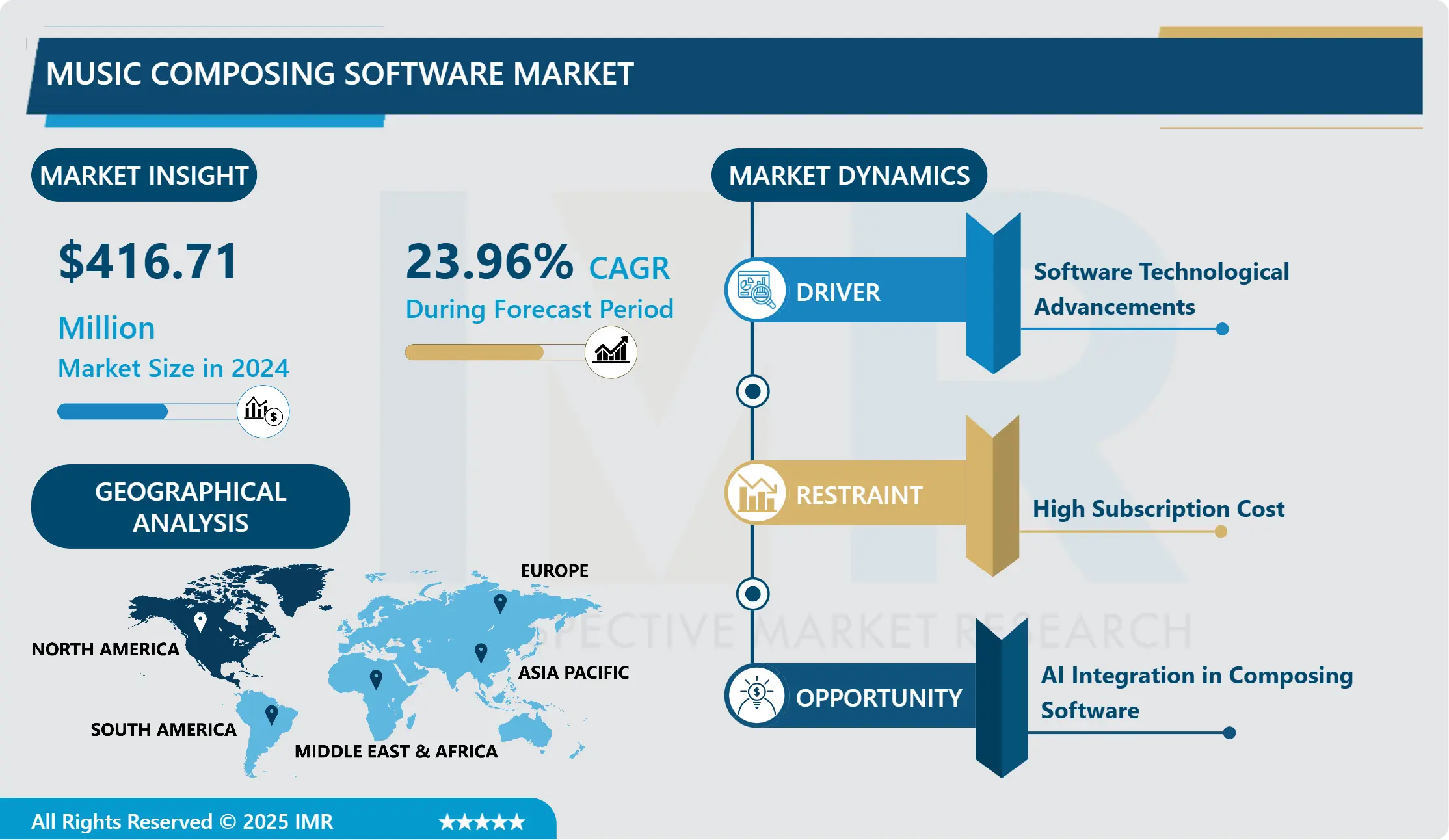
Music Composing Software Market Size Was Valued at USD 516.55 Million in 2024 and is Projected to Reach USD 2879.82 Million by 2032, Growing at a CAGR of 23.96 % From 2025-2032.
Music composition software program or Digital audio workstations (DAWs) refers to specialized applications designed for musicians and composers to create, edit, and set up tracks electronically. The music composition software program, a sheet track maker, is an application that easily creates sheet music. These programs provide an extensive variety of tools and capabilities that allow composers to experiment with special sounds, units, and musical patterns.
Music composition software or Digital audio workstations (DAWs) refers to specialized applications designed for musicians and composers to create, edit, and set up tracks electronically. The music composition software program, additionally called a sheet tune maker, is software that easily creates sheet music. These programs offer various tools and facilities that allow composers to experiment with different sounds, instruments, and musical styles.
One of the primary drivers of the tune composition software marketplace is the increase of home studios and independent musicians. These software programs allow artists to provide high-quality music without expensive recording equipment or professional studios, contributing to the increase of the marketplace.
However, unauthorized distribution of tune software programs remains a first-rate challenge that hinders market increase. In addition, the continued improvement of software program technology along with artificial intelligence and machine learning knowledge leads to the improvement of innovative features together with automatic music creation, intelligent harmonization, and intelligent editing equipment. These improvements enhance the features of the music composition software program and attract more customers, creating opportunities for market growth.
Music Composing Software Market Trend Analysis
Software Technological Advancements
Over the beyond 20 years, digital audio workstations (DAWs) have revolutionized music production. This software program has taken the place of traditional recording equipment and provides loads of features and tools for music recording, modifying, and mixing. The improvement of digital technology has introduced approximately fundamental adjustments in most areas of the music industry. Early digital recording hardware and software made the recording system a little cheaper and less difficult. CDs improved sound high-quality for customers and decreased production and distribution costs. Digital technologies to start with brought about the boom of the music industry.
The development of virtual audio workstations (DAW) has not simply made song production easier for all, but it has also made it simpler for artists from different parts of the world to work together. Cloud-based virtual audio workstations and online collaboration tools, musicians can now without difficulty painting collectively in actual time, no matter where they are located. This connection has cultivated a lively global music scene, allowing artists to locate notions from diverse cultural resources and work with talented people they would not have met otherwise.
Furthermore, advancements in artificial intelligence and machine learning are beginning to transform the creative process, as AI-driven devices help musicians compose, arrange, and study tunes. Advancements in technology continue to push the limits of track manufacturing, providing limitless possibilities for creativity and innovation inside the virtual generation.
AI Integration in Composing Software
Artificial intelligence (AI) is beginning to appear in music composition tools. These technologies offer features consisting of intelligent sample generation, real-time melody and harmonic feedback, and automated program improvement. This makes it simpler for creators, specifically beginners, to discover musical thoughts and allows bridge the space between musical ideas and execution.
The integration of artificial intelligence (AI) into track manufacturing is shaping the landscape of the tune industry and offers unprecedented opportunities and new challenges for the music industry and educational establishments alike. Several AI music generators have stood out for their technologies, capabilities, and the interest they’ve generated within the music and technology groups.
The advancement of artificial intelligence is its potential to investigate big records, identify patterns, and predict trends, which helps producers and marketers create content that engages audiences. AI music generators allow artists to test thoughts, automate recordings, and focus more on creativity than technology.
Music Composing Software Market Segment Analysis:
Music Composing Software Market is segmented based on type, deployment mode, device type, application, operating system, pricing strategy, pricing model, end-users, and region.
By Type, Casual segment is expected to dominate the market during the forecast period
Free and affordable music-making software is easily available, making it accessible to a wide range of users, from hobbyists and beginners to music lecture room teachers and students. This affordability allows people to experiment and explore music-making without a significant financial investment. In addition, many freeware programmers offer freemium models, in which basic capabilities are to be had without cost, and extra capabilities are unlocked for a subscription charge. This allows customers to attempt the software program before making a purchase.
Many casual tune manufacturers use this software program to create quick portions of tracks or clips specially designed to be shared on social media like TikTok, Instagram, and YouTube. The ease of use of these programs and the availability of loose loops and samples make it easy to create a song that conforms to the demands and trends of these structures. Music creators can use this software program to construct a following, collaborate with different musicians, and even advantage of reputation from file labels and skills scouts, who increasingly use social media to discover new talent.
By Application, the recording segment is expected to dominate the market during the forecast period
The recording segment has the largest market share and the mixer segment is expected to grow the most during the forecast period. Music production software allows the user to record audio, multiple tracks, or live instruments such as a drum kit or acoustic guitar individually or together.
Additionally, a constant trend in music remixing is to use a music app to mix tracks. Users can use existing music tracks and mix them to create new music. The software comes with advanced features such as reverb, delay, compression, reverb trend, Virtual Studio Technology (VST) plug-ins, and more that allow artists to produce enhanced and edited music.
The recording segment is fueled using the increasing availability of high-quality recording equipment and software and the growing number of independent musicians and content material producers getting into the market. With the proliferation of low-priced recording interfaces, microphones, and studio video display units, aspiring artists can now create professional recording studios in their very own houses or even on their laptops. This democratization of song manufacturing caused a pointy boom in creative manufacturing and the diversification of music genres and styles.
Music Composing Software Market Regional Insights:
North America is Expected to Dominate the Market Over the Forecast Period
The North American music composition software program market is growing rapidly. This is due to several factors, such as the upward push in recognition of digital music production, the rise of streaming services, and the growing demand for song production software. The North American market is also driven by the growing availability of less costly music production software and the increase in the range of track production specialists within the region. Also, the growth of music festivals and live music events within the region is likewise growing the demand for music production software.
The growth within the wide variety of music production schools and courses within the region is likewise contributing to the growth of the music production software program market. This is because the number of students interested in getting to know music production is increasing, and the number of professionals adding skills is increasing.
Overall, the North American music composition software market is experiencing a period of fast boom because of factors including the demand in recognition of digital music production, the increase of streaming services, the increasing availability of low-priced music production software programs, and the growing number of music production professionals and courses inside the area.
Active Key Players in the Music Composing Software Market
Make Music (US)
Maestro Music Software (US)
PreSonus Audio Electronics (US)
Noteworthy Software (US)
Passport Music Software (US)
Sion Software (US)
PreSonus Audio Electronics (US)
Avid Pro Tools (US)
Waveform Free (US)
Audacity (US)
Adobe Audition (US)
GarageBand (US)
Studio One (US)
Logic Pro (US)
REAPER (US)
Maestro Music Software (US)
Acid Pro (Canada)
Cubase (Germany)
Lugert Verlag (Germany)
Notation Software (Germany)
Ableton Live (Germany)
Bitwig Studio (Germany)
FL Studio (Belgium)
Universal Music Group (Netherlands)
BandLab (Singapore), and other Active Key Players
Key Industry Developments in the Music Composing Software Market:
In May 2024, Apple announced the all-new Logic Pro for iPad 2 and Logic Pro for Mac 11, offering stunning professional experiences for song writing, beat making, production and mixing. Powered by artificial intelligence, the new Logic Pro offers incredible studio-assist features that streamline music production and help artists exactly when they need it – while ensuring they retain full creative control.
In February 2024, Adobe is exploring new ways for newbie musicians and podcasters to effortlessly create custom tune tracks. The software large these days announced Project Music GenAI Control, a prototype device that creates musical compositions the usage of simple text commands. While AI-produced tune isn’t always new, Adobe’s providing pursuits to simplify the editing method so all of us can customize AI compositions to their liking.
Chapter 1: Introduction
1.1 Scope and Coverage
Chapter 2:Executive Summary
Chapter 3: Market Landscape
3.1 Market Dynamics
3.1.1 Drivers
3.1.2 Restraints
3.1.3 Opportunities
3.1.4 Challenges
3.2 Market Trend Analysis
3.3 PESTLE Analysis
3.4 Porter’s Five Forces Analysis
3.5 Industry Value Chain Analysis
3.6 Ecosystem
3.7 Regulatory Landscape
3.8 Price Trend Analysis
3.9 Patent Analysis
3.10 Technology Evolution
3.11 Investment Pockets
3.12 Import-Export Analysis
Chapter 4: Music Composing Software Market by Type (2018-2032)
4.1 Music Composing Software Market Snapshot and Growth Engine
4.2 Market Overview
4.3 Professional
4.3.1 Introduction and Market Overview
4.3.2 Historic and Forecasted Market Size in Value USD and Volume Units
4.3.3 Key Market Trends, Growth Factors, and Opportunities
4.3.4 Geographic Segmentation Analysis
4.4 Casual
Chapter 5: Music Composing Software Market by Deployment Mode (2018-2032)
5.1 Music Composing Software Market Snapshot and Growth Engine
5.2 Market Overview
5.3 On-premises
5.3.1 Introduction and Market Overview
5.3.2 Historic and Forecasted Market Size in Value USD and Volume Units
5.3.3 Key Market Trends, Growth Factors, and Opportunities
5.3.4 Geographic Segmentation Analysis
5.4 Cloud
Chapter 6: Music Composing Software Market by Device Type (2018-2032)
6.1 Music Composing Software Market Snapshot and Growth Engine
6.2 Market Overview
6.3 Desktop/ Laptop
6.3.1 Introduction and Market Overview
6.3.2 Historic and Forecasted Market Size in Value USD and Volume Units
6.3.3 Key Market Trends, Growth Factors, and Opportunities
6.3.4 Geographic Segmentation Analysis
6.4 Tablets/Smartphones
6.5 Other (Cloud-based
6.6 Score writers
6.7 Loop-based
6.8 Algorithmic/Generative)
Chapter 7: Music Composing Software Market by Application (2018-2032)
7.1 Music Composing Software Market Snapshot and Growth Engine
7.2 Market Overview
7.3 Editing
7.3.1 Introduction and Market Overview
7.3.2 Historic and Forecasted Market Size in Value USD and Volume Units
7.3.3 Key Market Trends, Growth Factors, and Opportunities
7.3.4 Geographic Segmentation Analysis
7.4 Mixing
7.5 Recording
Chapter 8: Music Composing Software Market by Operating System (2018-2032)
8.1 Music Composing Software Market Snapshot and Growth Engine
8.2 Market Overview
8.3 Windows
8.3.1 Introduction and Market Overview
8.3.2 Historic and Forecasted Market Size in Value USD and Volume Units
8.3.3 Key Market Trends, Growth Factors, and Opportunities
8.3.4 Geographic Segmentation Analysis
8.4 Android
8.5 MacOS
8.6 Linux
Chapter 9: Music Composing Software Market by Pricing Strategy (2018-2032)
9.1 Music Composing Software Market Snapshot and Growth Engine
9.2 Market Overview
9.3 Monthly
9.3.1 Introduction and Market Overview
9.3.2 Historic and Forecasted Market Size in Value USD and Volume Units
9.3.3 Key Market Trends, Growth Factors, and Opportunities
9.3.4 Geographic Segmentation Analysis
9.4 Annually
Chapter 10: Company Profiles and Competitive Analysis
10.1 Competitive Landscape
10.1.1 Competitive Benchmarking
10.1.2 Music Composing Software Market Share by Manufacturer (2024)
10.1.3 Industry BCG Matrix
10.1.4 Heat Map Analysis
10.1.5 Mergers and Acquisitions
10.2 TWITCH INTERACTIVE INC. (US)
10.2.1 Company Overview
10.2.2 Key Executives
10.2.3 Company Snapshot
10.2.4 Role of the Company in the Market
10.2.5 Sustainability and Social Responsibility
10.2.6 Operating Business Segments
10.2.7 Product Portfolio
10.2.8 Business Performance
10.2.9 Key Strategic Moves and Recent Developments
10.2.10 SWOT Analysis
10.3 YOUTUBE (GOOGLE LLC) (US)
10.4 FACEBOOK GAMING (META PLATFORMS INC.) (US)
10.5 TWITTER INC. (US)
10.6 INSTAGRAM (META PLATFORMS INC.) (US)
10.7 LINKEDIN (MICROSOFT CORPORATION) (US)
10.8 DISCORD INC. (US)
10.9 SNAP INC. (US)
10.10 PERISCOPE (TWITTER INC.) (US)
10.11 VIMEO
10.12 LLC (US)
10.13 AZUBU (US)
10.14 MIXER (MICROSOFT CORPORATION) (US)
10.15 USTREAM (IBM CORPORATION) (US)
10.16 BRIGHTCOVE INC. (US)
10.17 STREAMLABS (LOGITECH INTERNATIONAL S.A.) (US)
10.18 MIXCLOUD LIMITED (UK)
10.19 DAILYMOTION SA (FRANCE)
10.20 DOUYU INTERNATIONAL HOLDINGS LIMITED (CHINA)
10.21 HUYA INC. (CHINA)
10.22 BILIBILI INC. (CHINA)
10.23 YY INC. (CHINA)
10.24 TENCENT HOLDINGS LIMITED (CHINA)
10.25 NIMO TV (HUYA INC.) (CHINA)
10.26 TIKTOK (BYTEDANCE LTD.) (CHINA)
10.27
Chapter 11: Global Music Composing Software Market By Region
11.1 Overview
11.2. North America Music Composing Software Market
11.2.1 Key Market Trends, Growth Factors and Opportunities
11.2.2 Top Key Companies
11.2.3 Historic and Forecasted Market Size by Segments
11.2.4 Historic and Forecasted Market Size by Type
11.2.4.1 Professional
11.2.4.2 Casual
11.2.5 Historic and Forecasted Market Size by Deployment Mode
11.2.5.1 On-premises
11.2.5.2 Cloud
11.2.6 Historic and Forecasted Market Size by Device Type
11.2.6.1 Desktop/ Laptop
11.2.6.2 Tablets/Smartphones
11.2.6.3 Other (Cloud-based
11.2.6.4 Score writers
11.2.6.5 Loop-based
11.2.6.6 Algorithmic/Generative)
11.2.7 Historic and Forecasted Market Size by Application
11.2.7.1 Editing
11.2.7.2 Mixing
11.2.7.3 Recording
11.2.8 Historic and Forecasted Market Size by Operating System
11.2.8.1 Windows
11.2.8.2 Android
11.2.8.3 MacOS
11.2.8.4 Linux
11.2.9 Historic and Forecasted Market Size by Pricing Strategy
11.2.9.1 Monthly
11.2.9.2 Annually
11.2.10 Historic and Forecast Market Size by Country
11.2.10.1 US
11.2.10.2 Canada
11.2.10.3 Mexico
11.3. Eastern Europe Music Composing Software Market
11.3.1 Key Market Trends, Growth Factors and Opportunities
11.3.2 Top Key Companies
11.3.3 Historic and Forecasted Market Size by Segments
11.3.4 Historic and Forecasted Market Size by Type
11.3.4.1 Professional
11.3.4.2 Casual
11.3.5 Historic and Forecasted Market Size by Deployment Mode
11.3.5.1 On-premises
11.3.5.2 Cloud
11.3.6 Historic and Forecasted Market Size by Device Type
11.3.6.1 Desktop/ Laptop
11.3.6.2 Tablets/Smartphones
11.3.6.3 Other (Cloud-based
11.3.6.4 Score writers
11.3.6.5 Loop-based
11.3.6.6 Algorithmic/Generative)
11.3.7 Historic and Forecasted Market Size by Application
11.3.7.1 Editing
11.3.7.2 Mixing
11.3.7.3 Recording
11.3.8 Historic and Forecasted Market Size by Operating System
11.3.8.1 Windows
11.3.8.2 Android
11.3.8.3 MacOS
11.3.8.4 Linux
11.3.9 Historic and Forecasted Market Size by Pricing Strategy
11.3.9.1 Monthly
11.3.9.2 Annually
11.3.10 Historic and Forecast Market Size by Country
11.3.10.1 Russia
11.3.10.2 Bulgaria
11.3.10.3 The Czech Republic
11.3.10.4 Hungary
11.3.10.5 Poland
11.3.10.6 Romania
11.3.10.7 Rest of Eastern Europe
11.4. Western Europe Music Composing Software Market
11.4.1 Key Market Trends, Growth Factors and Opportunities
11.4.2 Top Key Companies
11.4.3 Historic and Forecasted Market Size by Segments
11.4.4 Historic and Forecasted Market Size by Type
11.4.4.1 Professional
11.4.4.2 Casual
11.4.5 Historic and Forecasted Market Size by Deployment Mode
11.4.5.1 On-premises
11.4.5.2 Cloud
11.4.6 Historic and Forecasted Market Size by Device Type
11.4.6.1 Desktop/ Laptop
11.4.6.2 Tablets/Smartphones
11.4.6.3 Other (Cloud-based
11.4.6.4 Score writers
11.4.6.5 Loop-based
11.4.6.6 Algorithmic/Generative)
11.4.7 Historic and Forecasted Market Size by Application
11.4.7.1 Editing
11.4.7.2 Mixing
11.4.7.3 Recording
11.4.8 Historic and Forecasted Market Size by Operating System
11.4.8.1 Windows
11.4.8.2 Android
11.4.8.3 MacOS
11.4.8.4 Linux
11.4.9 Historic and Forecasted Market Size by Pricing Strategy
11.4.9.1 Monthly
11.4.9.2 Annually
11.4.10 Historic and Forecast Market Size by Country
11.4.10.1 Germany
11.4.10.2 UK
11.4.10.3 France
11.4.10.4 The Netherlands
11.4.10.5 Italy
11.4.10.6 Spain
11.4.10.7 Rest of Western Europe
11.5. Asia Pacific Music Composing Software Market
11.5.1 Key Market Trends, Growth Factors and Opportunities
11.5.2 Top Key Companies
11.5.3 Historic and Forecasted Market Size by Segments
11.5.4 Historic and Forecasted Market Size by Type
11.5.4.1 Professional
11.5.4.2 Casual
11.5.5 Historic and Forecasted Market Size by Deployment Mode
11.5.5.1 On-premises
11.5.5.2 Cloud
11.5.6 Historic and Forecasted Market Size by Device Type
11.5.6.1 Desktop/ Laptop
11.5.6.2 Tablets/Smartphones
11.5.6.3 Other (Cloud-based
11.5.6.4 Score writers
11.5.6.5 Loop-based
11.5.6.6 Algorithmic/Generative)
11.5.7 Historic and Forecasted Market Size by Application
11.5.7.1 Editing
11.5.7.2 Mixing
11.5.7.3 Recording
11.5.8 Historic and Forecasted Market Size by Operating System
11.5.8.1 Windows
11.5.8.2 Android
11.5.8.3 MacOS
11.5.8.4 Linux
11.5.9 Historic and Forecasted Market Size by Pricing Strategy
11.5.9.1 Monthly
11.5.9.2 Annually
11.5.10 Historic and Forecast Market Size by Country
11.5.10.1 China
11.5.10.2 India
11.5.10.3 Japan
11.5.10.4 South Korea
11.5.10.5 Malaysia
11.5.10.6 Thailand
11.5.10.7 Vietnam
11.5.10.8 The Philippines
11.5.10.9 Australia
11.5.10.10 New Zealand
11.5.10.11 Rest of APAC
11.6. Middle East & Africa Music Composing Software Market
11.6.1 Key Market Trends, Growth Factors and Opportunities
11.6.2 Top Key Companies
11.6.3 Historic and Forecasted Market Size by Segments
11.6.4 Historic and Forecasted Market Size by Type
11.6.4.1 Professional
11.6.4.2 Casual
11.6.5 Historic and Forecasted Market Size by Deployment Mode
11.6.5.1 On-premises
11.6.5.2 Cloud
11.6.6 Historic and Forecasted Market Size by Device Type
11.6.6.1 Desktop/ Laptop
11.6.6.2 Tablets/Smartphones
11.6.6.3 Other (Cloud-based
11.6.6.4 Score writers
11.6.6.5 Loop-based
11.6.6.6 Algorithmic/Generative)
11.6.7 Historic and Forecasted Market Size by Application
11.6.7.1 Editing
11.6.7.2 Mixing
11.6.7.3 Recording
11.6.8 Historic and Forecasted Market Size by Operating System
11.6.8.1 Windows
11.6.8.2 Android
11.6.8.3 MacOS
11.6.8.4 Linux
11.6.9 Historic and Forecasted Market Size by Pricing Strategy
11.6.9.1 Monthly
11.6.9.2 Annually
11.6.10 Historic and Forecast Market Size by Country
11.6.10.1 Turkiye
11.6.10.2 Bahrain
11.6.10.3 Kuwait
11.6.10.4 Saudi Arabia
11.6.10.5 Qatar
11.6.10.6 UAE
11.6.10.7 Israel
11.6.10.8 South Africa
11.7. South America Music Composing Software Market
11.7.1 Key Market Trends, Growth Factors and Opportunities
11.7.2 Top Key Companies
11.7.3 Historic and Forecasted Market Size by Segments
11.7.4 Historic and Forecasted Market Size by Type
11.7.4.1 Professional
11.7.4.2 Casual
11.7.5 Historic and Forecasted Market Size by Deployment Mode
11.7.5.1 On-premises
11.7.5.2 Cloud
11.7.6 Historic and Forecasted Market Size by Device Type
11.7.6.1 Desktop/ Laptop
11.7.6.2 Tablets/Smartphones
11.7.6.3 Other (Cloud-based
11.7.6.4 Score writers
11.7.6.5 Loop-based
11.7.6.6 Algorithmic/Generative)
11.7.7 Historic and Forecasted Market Size by Application
11.7.7.1 Editing
11.7.7.2 Mixing
11.7.7.3 Recording
11.7.8 Historic and Forecasted Market Size by Operating System
11.7.8.1 Windows
11.7.8.2 Android
11.7.8.3 MacOS
11.7.8.4 Linux
11.7.9 Historic and Forecasted Market Size by Pricing Strategy
11.7.9.1 Monthly
11.7.9.2 Annually
11.7.10 Historic and Forecast Market Size by Country
11.7.10.1 Brazil
11.7.10.2 Argentina
11.7.10.3 Rest of SA
Chapter 12 Analyst Viewpoint and Conclusion
12.1 Recommendations and Concluding Analysis
12.2 Potential Market Strategies
Chapter 13 Research Methodology
13.1 Research Process
13.2 Primary Research
13.3 Secondary Research
Q1: What would be the forecast period in the Music Composing Software Market research report?
A1: The forecast period in the Music Composing Software Market research report is 2025-2032.
Q2: Who are the key players in the Music Composing Software Market?
A2: Make Music (US), Maestro Music Software (US), PreSonus Audio Electronics (US), Noteworthy Software (US), Passport Music Software (US), Sion Software (US), PreSonus Audio Electronics (US), Avid Pro Tools (US), Waveform Free (US), Audacity (US), Adobe Audition (US), GarageBand (US), Studio One (US), Logic Pro (US), REAPER (US), Maestro Music Software (US), Acid Pro (Canada), Cubase (Germany), Lugert Verlag (Germany), Notation Software (Germany), Ableton Live (Germany), Bitwig Studio (Germany), FL Studio (Belgium), Universal Music Group (Netherlands), BandLab (Singapore), and other Active Players.
Q3: What are the segments of the Music Composing Software Market?
A3: The Music Composing Software Market is segmented into Type, Deployment Mode, Device Type, Application, Operating System, Pricing Strategy, Pricing Model, End User and region. By Type, the market is categorized into Professional and Casual. By Deployment Mode, the market is categorized into On-premises and Cloud. By Device Type, the market is categorized into Desktop/ Laptop, Tablets/Smartphones, and Others (Cloud-based, Score writers, Loop-based, Algorithmic/Generative). By Application, the market is categorized into Editing, Mixing, and Recording. By Operating System, the market is categorized into Windows, Android, MacOS, and Linux. By Pricing Strategy, the market is categorized into Monthly and Annually. By Pricing Model, the market is categorized into Subscription-based and One-time Purchases. By End User, the market is categorized into Music Production Companies, Independent Musician, Home Studios (Personal), and Others (Photographers, Enterprise, Schools & Universities, and Professional/Audio Engineers. By region, it is analyzed across North America (U.S.; Canada; Mexico), Eastern Europe (Bulgaria; The Czech Republic; Hungary; Poland; Romania; Rest of Eastern Europe), Western Europe (Germany; UK; France; Netherlands; Italy; Russia; Spain; Rest of Western Europe), Asia-Pacific (China; India; Japan; Southeast Asia, etc.), South America (Brazil; Argentina, etc.), Middle East & Africa (Saudi Arabia; South Africa, etc.).
Q4: What is the Music Composing Software Market?
A4: Music composition software or Digital audio workstations (DAWs) refers to specialized applications designed for musicians and composers to create, edit, and set up tracks electronically. The music composition software program, a sheet track maker, is an application that easily creates sheet music. These packages provide a wide range of gear and capabilities that allow composers to experiment with special sounds, units, and musical patterns.
Q5: How big is the Music Composing Software Market?
A5: Music Composing Software Market Size Was Valued at USD 516.55 Million in 2024 and is Projected to Reach USD 2879.82 Million by 2032, Growing at a CAGR of 23.96 % From 2025-2032.
How to Buy a Report from eminsights.jp
On the product page, choose the license you want: Single-User License, Multi-User License or Enterprise License.
If you required report in your native language, then you can click on Translated Report button and fill out the form with report name and language you want, then our team will contact you as soon as possible.
Click the Buy Now button.
You will be redirected to the checkout page. Enter your company details and payment information.
Click Place Order to complete the purchase.
Confirmation: You’ll receive an order confirmation and our team will contact you shortly with your ordered report.
If you have any questions, fill out the contact form below or email us at [email protected].
Thank you for choosing eminsights.jp!