Stay Ahead in Fast-Growing Economies.
Browse Reports Now




Attendance Tracking Software Market – In-Depth Insights & Analysis
A digital tool used to monitor and document staff attendance is called attendance tracking software. Its complete automation eliminates the need for human attendance management procedures, including spreadsheets or paper-based registers. For employees to clock in and out, the software usually makes use of RFID cards or mobile applications, or it may use biometric technology like facial recognition or fingerprint scanning. Organizations may effectively manage attendance records, keep an eye on employee timeliness, and provide accurate reports by storing the collected data in a centralized system.

IMR Group
Description
Attendance Tracking Software Market Synopsis
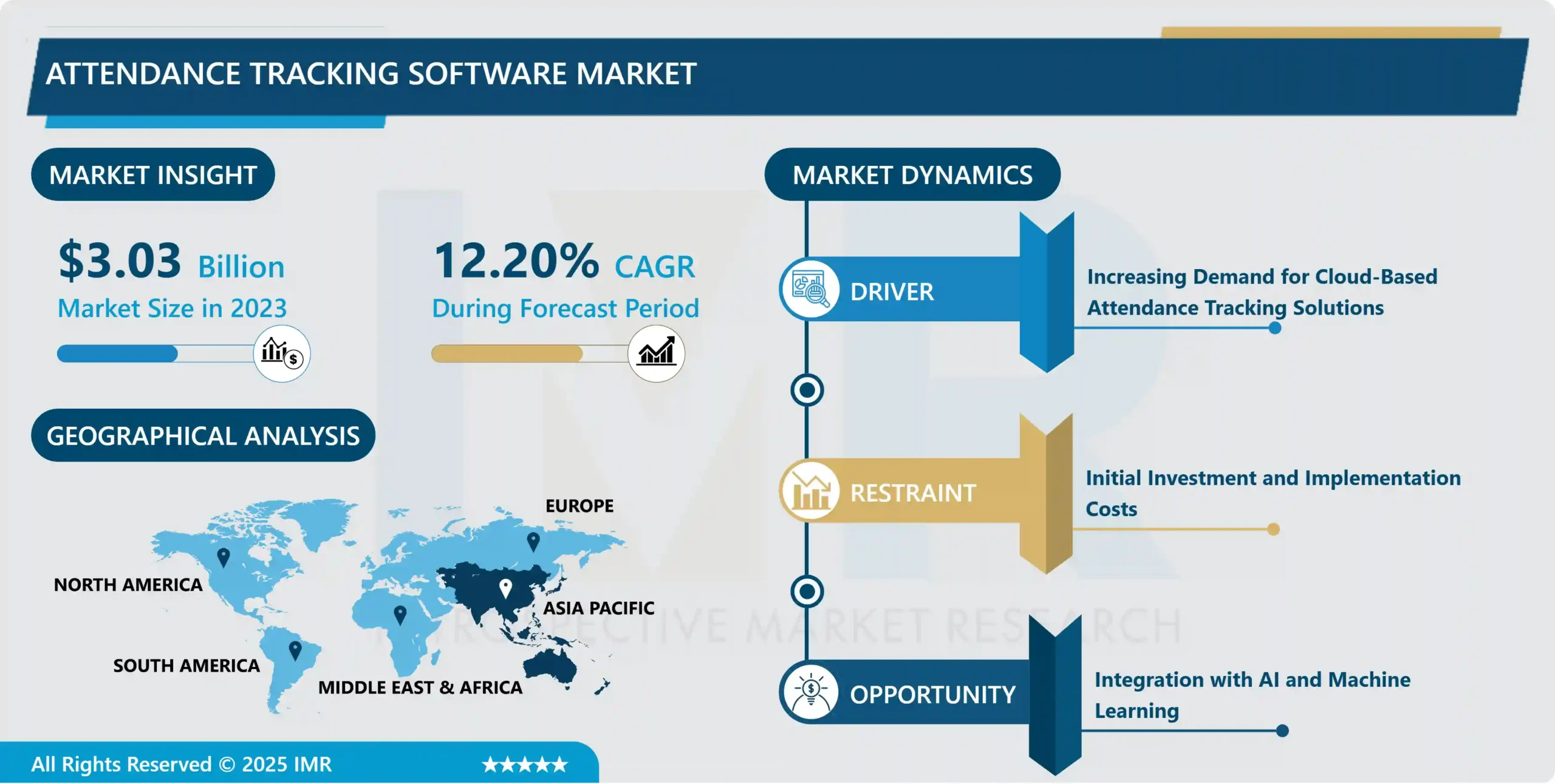
The global Attendance Tracking Software Market was valued at USD 3.03 Billion in 2023 and is projected to reach USD 8.54 billion by 2032, growing at a CAGR of 12.2% from 2024 to 2032.
A digital tool used to monitor and document staff attendance is called attendance tracking software. Its complete automation eliminates the need for human attendance management procedures, including spreadsheets or paper-based registers. For employees to clock in and out, the software usually makes use of RFID cards or mobile applications, or it may use biometric technology like facial recognition or fingerprint scanning. Organizations may effectively manage attendance records, keep an eye on employee timeliness, and provide accurate reports by storing the collected data in a centralized system.
Attendance tracking software is crucial for businesses, educational institutions, and event management. It ensures accurate record-keeping of employee attendance, helps in punctuality, and manages leave requests. Schools and universities use it to identify attendance patterns, manage class rosters, and enhance campus security. It also tracks participant attendance for conferences, seminars, or workshops.
Automation in attendance tracking reduces errors and time spent on manual methods, ensuring accurate records. Real-time monitoring allows for quick decision-making and compliance with labor laws. Attendance tracking software generates detailed reports for payroll, performance evaluation, and audits. Automating the process saves paper, printing, and manual data entry costs. Biometric authentication features enhance security by ensuring only authorized individuals can access records, reducing the risk of fraudulent activity.
Attendance Tracking Software Market Trend Analysis:
Increasing Demand for Cloud-Based Attendance Tracking Solutions
The industry for attendance monitoring software is expanding due in large part to the rising demand for cloud-based solutions. Enterprises across many sectors are progressively realizing the advantages linked to the use of cloud-based attendance monitoring systems. With the unparalleled accessibility offered by these systems, attendance data may be accessed in real-time and from any place at any time. In today’s dynamic work contexts, where remote and flexible work arrangements are becoming more and more common, this becomes very important.
The need for scalability, flexibility, and efficient operations is driving the shift to cloud-based attendance tracking. By overcoming the constraints of physical infrastructure, these solutions enable businesses to manage attendance data effectively and spare themselves the headaches of managing servers that are located on-site. Furthermore, cloud-based solutions enable smooth updates and upgrades, guaranteeing that companies may quickly adopt the newest features and security improvements.
Additionally, the cloud reduces the possibility of data loss and improves overall data security by acting as a safe, centralized store for attendance data. It is anticipated that demand for cloud-based attendance monitoring systems will continue to rise as more and more firms prioritize digital transformation and actively look for solutions that fit the characteristics of the modern workplace. This trend has the potential to spur innovation and change the attendance management scene in some different sectors.
Integration with AI and Machine Learning
A key opportunity for market development appears to be the integration of machine learning and artificial intelligence (AI) capabilities into attendance tracking software. With this connection, firms may make use of a wide range of cutting-edge personnel management solutions. The program can forecast attendance patterns, spot trends, and provide insightful information about employee behaviour thanks to AI’s predictive analytics capabilities. By using AI-powered algorithms on past attendance data, companies may improve overall operational efficiency, manage personnel levels, and expedite scheduling through precise predictions.
Moreover, the automation of attendance-related chores is greatly aided by the combination of AI and ML. With the help of previous data, machine learning algorithms are quite good at identifying patterns and anomalies. This automation improves the accuracy of attendance records while also saving administrative staff members a significant amount of time.
AI-driven biometric authentication further improves security protocols by reducing the possibility of unwanted access and guaranteeing the accuracy of attendance records. The incorporation of AI and ML into attendance tracking software presents a compelling opportunity for market expansion, offering enhanced functionalities and opening the door for more sophisticated and automated workforce management solutions, as businesses place an increasing emphasis on efficiency, accuracy, and data-driven decision-making.
Attendance Tracking Software Market Segment Analysis:
Attendance Tracking Software Market is Segmented Based on By Deployment, Organization Size, and End-User.
By End-User, IT & Telecom Segment Is Expected to Dominate the Market During the Forecast Period
The Information Technology (IT) and Telecommunications sector is anticipated to exert its influence over the Attendance Tracking Software market, impacting its trajectory for compelling reasons. Advanced attendance monitoring systems are essential for effective labour management since IT and telecom companies are always giving priority to technology improvements. These solutions are compatible with a variety of communication platforms and seamlessly integrate with the current IT infrastructure since they are specifically designed to satisfy the needs of tech-savvy settings.
Moreover, the dynamic nature of the telecom and IT industries, which is marked by remote cooperation and variable work schedules, increases the need for advanced attendance tracking systems. The IT & Telecom market is well-positioned to spearhead the adoption and deployment of Attendance Tracking Software as these firms endeavor to maximize operational efficiency and adjust to changing work trends. The industry’s commitment to using cutting-edge technology for efficient personnel management, in line with the modern dynamics of the digital workplace, is what drives this leadership.
By Deployment, Cloud Segment Held the Largest Share of 54.2% In 2022
Cloud-based systems, which provide unmatched accessibility, scalability, and flexibility, have emerged as the mainstay of contemporary attendance tracking. Because cloud deployment eliminates dependency on physical infrastructure and allows for convenient access to real-time data from any place, organizations are increasingly choosing it over other options when it comes to attendance monitoring software.
The Cloud segment’s supremacy is further underscored by its ability to seamlessly integrate with other cloud-based services and apps, offering a comprehensive and networked solution. This strategy fits in well with the changing demands of companies in a variety of industries, especially those that prioritize flexible scheduling and remote work options. The Cloud category is well-positioned to maintain its substantial market share in the face of the continued trend toward digital transformation. It is driving innovation in attendance monitoring systems and transforming international workforce management methods.
Attendance Tracking Software Market Regional Insights:
Asia Pacific is Expected to Dominate the Market Over the Forecast Period
Asia Pacific is positioned to take the lead and develop market domination in the attendance tracking software industry for many strong reasons. This domination is largely due to the region’s strong economic growth, quick technology developments, and growing use of digital solutions across a wide range of businesses. In keeping with the worldwide trend of digital transformation, businesses in Asia Pacific are realizing the value of effective attendance monitoring to optimize labour management.
Moreover, there is a growing need for sophisticated attendance monitoring systems across the many industries in the Asia Pacific, including manufacturing, IT, healthcare, and education. The market for attendance tracking software is expected to grow significantly as companies in the area focus on streamlining operational procedures and adjusting to contemporary work environments. Because of its commitment to technological innovation and the need to improve workforce productivity, Asia Pacific is leading the way in the adoption and use of attendance-tracking solutions and will have a significant impact on the direction of the market going forward.
Key Players Covered in Attendance Tracking Software Market:
Machines Corporation (U.S.)
Kronos, Inc. (U.S.)
Automatic Data Processing LLC. (U.S.)
Oracle Corporation (U.S.)
Ultimate Software Group, Inc. (U.S.)
Workday, Inc. (U.S.)
Workforce Software, LLC. (U.S.)
Reflexis Systems (U.S.)
IBM Corporation (U.S.)
BambooHR LLC (U.S.)
Paycom Software, Inc. (U.S.)
TimeClock Plus, LLC (U.S.)
Zoho Corporation Pvt. Ltd. (U.S.)
clockit.io (U.S.)
isolved HCM (U.S.)
Replicon Time and Attendance (Canada)
SAP SE (Germany)
Calamari (Poland)
RITEQ Pty Ltd. (Australia)
absence.io GmbH (Germany), and Other Major Players
Key Industry Development in The Attendance Tracking Software Market:
In January 2024, Poll Everywhere, the world’s first real-time audience response technology, announced the launch of Attendance Management, a feature that automates attendance tracking and reporting. Designed to engage students and improve learning outcomes, it captures in-person attendance via geolocation and incentivizes engagement. Starting today, Attendance Management is free to users on Engage, Teams, Enterprise, and Individual Instructor plans. This innovative tool empowers educators with enhanced capabilities for student participation.
In February 2022, the southeast Pakistani province of Sindh announced the implementation of a new biometric attendance tracking system that will be made available at all government colleges in response to ongoing complaints about widespread absenteeism in the area.
In March 2022, A recent technological integration by XTM, Inc., a Miami and Toronto-based FinTech company in the neo-banking space that provides mobile banking and payment solutions globally, has made it possible to access twenty Point-of-Sale (POS) and time-and-attendance software systems tailored to the restaurant industry across the United States.
Chapter 1: Introduction
1.1 Scope and Coverage
Chapter 2:Executive Summary
Chapter 3: Market Landscape
3.1 Market Dynamics
3.1.1 Drivers
3.1.2 Restraints
3.1.3 Opportunities
3.1.4 Challenges
3.2 Market Trend Analysis
3.3 PESTLE Analysis
3.4 Porter’s Five Forces Analysis
3.5 Industry Value Chain Analysis
3.6 Ecosystem
3.7 Regulatory Landscape
3.8 Price Trend Analysis
3.9 Patent Analysis
3.10 Technology Evolution
3.11 Investment Pockets
3.12 Import-Export Analysis
Chapter 4: Attendance Tracking Software Market by Deployment (2018-2032)
4.1 Attendance Tracking Software Market Snapshot and Growth Engine
4.2 Market Overview
4.3 On-Premise
4.3.1 Introduction and Market Overview
4.3.2 Historic and Forecasted Market Size in Value USD and Volume Units
4.3.3 Key Market Trends, Growth Factors, and Opportunities
4.3.4 Geographic Segmentation Analysis
4.4 Cloud
Chapter 5: Attendance Tracking Software Market by Organization Size (2018-2032)
5.1 Attendance Tracking Software Market Snapshot and Growth Engine
5.2 Market Overview
5.3 SMEs Enterprises
5.3.1 Introduction and Market Overview
5.3.2 Historic and Forecasted Market Size in Value USD and Volume Units
5.3.3 Key Market Trends, Growth Factors, and Opportunities
5.3.4 Geographic Segmentation Analysis
5.4 Large Enterprises
Chapter 6: Attendance Tracking Software Market by End-User (2018-2032)
6.1 Attendance Tracking Software Market Snapshot and Growth Engine
6.2 Market Overview
6.3 BFSI
6.3.1 Introduction and Market Overview
6.3.2 Historic and Forecasted Market Size in Value USD and Volume Units
6.3.3 Key Market Trends, Growth Factors, and Opportunities
6.3.4 Geographic Segmentation Analysis
6.4 IT & Telecom
6.5 Healthcare
6.6 Retail
6.7 Manufacturing
Chapter 7: Company Profiles and Competitive Analysis
7.1 Competitive Landscape
7.1.1 Competitive Benchmarking
7.1.2 Attendance Tracking Software Market Share by Manufacturer (2024)
7.1.3 Industry BCG Matrix
7.1.4 Heat Map Analysis
7.1.5 Mergers and Acquisitions
7.2 COLLIBRA NV (US)
7.2.1 Company Overview
7.2.2 Key Executives
7.2.3 Company Snapshot
7.2.4 Role of the Company in the Market
7.2.5 Sustainability and Social Responsibility
7.2.6 Operating Business Segments
7.2.7 Product Portfolio
7.2.8 Business Performance
7.2.9 Key Strategic Moves and Recent Developments
7.2.10 SWOT Analysis
7.3 SAS INSTITUTE INC. (US)
7.4 TIBCO SOFTWARE INC. (US)
7.5 ALATION INC. (US)
7.6 ALFRESCO SOFTWARE INC. (US)
7.7 INFORMATICA INC. (US)
7.8 MICROSOFT CORPORATION (US)
7.9 IBM CORPORATION (US)
7.10 ORACLE CORPORATION (US)
7.11 TALEND SA (US)
7.12 VARONIS SYSTEMS INC. (US)
7.13 DATA ADVANTAGE GROUP (US)
7.14 INFOGIX (US)
7.15 MAGNITUDE SOFTWARE (US)
7.16 ATACCAMA (US)
7.17 GLOBAL DATA EXCELLENCE (SWITZERLAND)
7.18 RELTIO (US)
7.19 INNOVATIVE ROUTINES INTERNATIONAL (US)
7.20 ALEX SOLUTIONS (AUSTRALIA)
7.21 MICROFOCUS (UK)
7.22 SAP SE (GERMANY)
7.23
Chapter 8: Global Attendance Tracking Software Market By Region
8.1 Overview
8.2. North America Attendance Tracking Software Market
8.2.1 Key Market Trends, Growth Factors and Opportunities
8.2.2 Top Key Companies
8.2.3 Historic and Forecasted Market Size by Segments
8.2.4 Historic and Forecasted Market Size by Deployment
8.2.4.1 On-Premise
8.2.4.2 Cloud
8.2.5 Historic and Forecasted Market Size by Organization Size
8.2.5.1 SMEs Enterprises
8.2.5.2 Large Enterprises
8.2.6 Historic and Forecasted Market Size by End-User
8.2.6.1 BFSI
8.2.6.2 IT & Telecom
8.2.6.3 Healthcare
8.2.6.4 Retail
8.2.6.5 Manufacturing
8.2.7 Historic and Forecast Market Size by Country
8.2.7.1 US
8.2.7.2 Canada
8.2.7.3 Mexico
8.3. Eastern Europe Attendance Tracking Software Market
8.3.1 Key Market Trends, Growth Factors and Opportunities
8.3.2 Top Key Companies
8.3.3 Historic and Forecasted Market Size by Segments
8.3.4 Historic and Forecasted Market Size by Deployment
8.3.4.1 On-Premise
8.3.4.2 Cloud
8.3.5 Historic and Forecasted Market Size by Organization Size
8.3.5.1 SMEs Enterprises
8.3.5.2 Large Enterprises
8.3.6 Historic and Forecasted Market Size by End-User
8.3.6.1 BFSI
8.3.6.2 IT & Telecom
8.3.6.3 Healthcare
8.3.6.4 Retail
8.3.6.5 Manufacturing
8.3.7 Historic and Forecast Market Size by Country
8.3.7.1 Russia
8.3.7.2 Bulgaria
8.3.7.3 The Czech Republic
8.3.7.4 Hungary
8.3.7.5 Poland
8.3.7.6 Romania
8.3.7.7 Rest of Eastern Europe
8.4. Western Europe Attendance Tracking Software Market
8.4.1 Key Market Trends, Growth Factors and Opportunities
8.4.2 Top Key Companies
8.4.3 Historic and Forecasted Market Size by Segments
8.4.4 Historic and Forecasted Market Size by Deployment
8.4.4.1 On-Premise
8.4.4.2 Cloud
8.4.5 Historic and Forecasted Market Size by Organization Size
8.4.5.1 SMEs Enterprises
8.4.5.2 Large Enterprises
8.4.6 Historic and Forecasted Market Size by End-User
8.4.6.1 BFSI
8.4.6.2 IT & Telecom
8.4.6.3 Healthcare
8.4.6.4 Retail
8.4.6.5 Manufacturing
8.4.7 Historic and Forecast Market Size by Country
8.4.7.1 Germany
8.4.7.2 UK
8.4.7.3 France
8.4.7.4 The Netherlands
8.4.7.5 Italy
8.4.7.6 Spain
8.4.7.7 Rest of Western Europe
8.5. Asia Pacific Attendance Tracking Software Market
8.5.1 Key Market Trends, Growth Factors and Opportunities
8.5.2 Top Key Companies
8.5.3 Historic and Forecasted Market Size by Segments
8.5.4 Historic and Forecasted Market Size by Deployment
8.5.4.1 On-Premise
8.5.4.2 Cloud
8.5.5 Historic and Forecasted Market Size by Organization Size
8.5.5.1 SMEs Enterprises
8.5.5.2 Large Enterprises
8.5.6 Historic and Forecasted Market Size by End-User
8.5.6.1 BFSI
8.5.6.2 IT & Telecom
8.5.6.3 Healthcare
8.5.6.4 Retail
8.5.6.5 Manufacturing
8.5.7 Historic and Forecast Market Size by Country
8.5.7.1 China
8.5.7.2 India
8.5.7.3 Japan
8.5.7.4 South Korea
8.5.7.5 Malaysia
8.5.7.6 Thailand
8.5.7.7 Vietnam
8.5.7.8 The Philippines
8.5.7.9 Australia
8.5.7.10 New Zealand
8.5.7.11 Rest of APAC
8.6. Middle East & Africa Attendance Tracking Software Market
8.6.1 Key Market Trends, Growth Factors and Opportunities
8.6.2 Top Key Companies
8.6.3 Historic and Forecasted Market Size by Segments
8.6.4 Historic and Forecasted Market Size by Deployment
8.6.4.1 On-Premise
8.6.4.2 Cloud
8.6.5 Historic and Forecasted Market Size by Organization Size
8.6.5.1 SMEs Enterprises
8.6.5.2 Large Enterprises
8.6.6 Historic and Forecasted Market Size by End-User
8.6.6.1 BFSI
8.6.6.2 IT & Telecom
8.6.6.3 Healthcare
8.6.6.4 Retail
8.6.6.5 Manufacturing
8.6.7 Historic and Forecast Market Size by Country
8.6.7.1 Turkiye
8.6.7.2 Bahrain
8.6.7.3 Kuwait
8.6.7.4 Saudi Arabia
8.6.7.5 Qatar
8.6.7.6 UAE
8.6.7.7 Israel
8.6.7.8 South Africa
8.7. South America Attendance Tracking Software Market
8.7.1 Key Market Trends, Growth Factors and Opportunities
8.7.2 Top Key Companies
8.7.3 Historic and Forecasted Market Size by Segments
8.7.4 Historic and Forecasted Market Size by Deployment
8.7.4.1 On-Premise
8.7.4.2 Cloud
8.7.5 Historic and Forecasted Market Size by Organization Size
8.7.5.1 SMEs Enterprises
8.7.5.2 Large Enterprises
8.7.6 Historic and Forecasted Market Size by End-User
8.7.6.1 BFSI
8.7.6.2 IT & Telecom
8.7.6.3 Healthcare
8.7.6.4 Retail
8.7.6.5 Manufacturing
8.7.7 Historic and Forecast Market Size by Country
8.7.7.1 Brazil
8.7.7.2 Argentina
8.7.7.3 Rest of SA
Chapter 9 Analyst Viewpoint and Conclusion
9.1 Recommendations and Concluding Analysis
9.2 Potential Market Strategies
Chapter 10 Research Methodology
10.1 Research Process
10.2 Primary Research
10.3 Secondary Research
Q1: What would be forecast period in the market research report?
A1: The forecast period in the market research report is 2024-2032.
Q2: Who are the key players in Attendance Tracking Software market?
A2: Machines Corporation (U.S.), Kronos, Inc. (U.S.), Automatic Data Processing LLC. (U.S.),Oracle Corporation (U.S.), Ultimate Software Group, Inc. (U.S.), Workday, Inc. (U.S.), Workforce Software, LLC. (U.S.),Reflexis Systems (U.S.), IBM Corporation (U.S.), BambooHR LLC (U.S.), Paycom Software, Inc. (U.S.), TimeClock Plus, LLC (U.S.), Zoho Corporation Pvt. Ltd. (U.S.),clockit. io (U.S.),isolved HCM (U.S.), Replicon Time and Attendance (Canada), SAP SE (Germany), Calamari (Poland), RITEQ Pty Ltd. (Australia), absence. io GmbH (Germany), and Other Major Players.
Q3: What are the segments of Attendance Tracking Software market?
A3: The Attendance Tracking Software Market is segmented into Deployment, Organization Size, End-User and Region. By Deployment, the market is categorized into On-Premise and Cloud. By Application, the market is categorized into SMEs Enterprises and large Enterprises. By End-User Industry, the market is categorized into BFSI, IT & Telecom, Healthcare, Retail, and Manufacturing. By region, it is analyzed across North America (U.S.; Canada; Mexico), Eastern Europe (Bulgaria; The Czech Republic; Hungary; Poland; Romania; Rest of Eastern Europe), Western Europe (Germany; UK; France; Netherlands; Italy; Russia; Spain; Rest of Western Europe), Asia-Pacific (China; India; Japan; Southeast Asia, etc.), South America (Brazil; Argentina, etc.), Middle East & Africa (Saudi Arabia; South Africa, etc.).
Q4: What is the Attendance Tracking Software market?
A4: A digital tool used to monitor and document staff attendance is called attendance tracking software. Its complete automation eliminates the need for human attendance management procedures, including spreadsheets or paper-based registers. For employees to clock in and out, the software usually makes use of RFID cards or mobile applications, or it may use biometric technology like facial recognition or fingerprint scanning.
Q5: How big is the Attendance Tracking Software market?
A5: The global Attendance Tracking Software Market was valued at USD 3.03 Billion in 2023 and is projected to reach USD 8.54 billion by 2032, growing at a CAGR of 12.2% from 2024 to 2032.
How to Buy a Report from eminsights.jp
On the product page, choose the license you want: Single-User License, Multi-User License or Enterprise License.
If you required report in your native language, then you can click on Translated Report button and fill out the form with report name and language you want, then our team will contact you as soon as possible.
Click the Buy Now button.
You will be redirected to the checkout page. Enter your company details and payment information.
Click Place Order to complete the purchase.
Confirmation: You’ll receive an order confirmation and our team will contact you shortly with your ordered report.
If you have any questions, fill out the contact form below or email us at [email protected].
Thank you for choosing eminsights.jp!