Stay Ahead in Fast-Growing Economies.
Browse Reports Now




Deep Learning Market – Analysis, Trends and Growth and Forecast to 2024- 2032
Deep learning technology is going through rapid advances across different machine learning domains, including natural language processing, reinforcement learning, and ML frameworks, and many more. Industrial equipment is effectively turning out be more useful and smart functioning in predictive support and condition monitoring. Deep learning finds diverse applications such as voice control in consumer electronics, driverless cars, and other.

IMR Group
Description
Global Deep Learning Market Overview
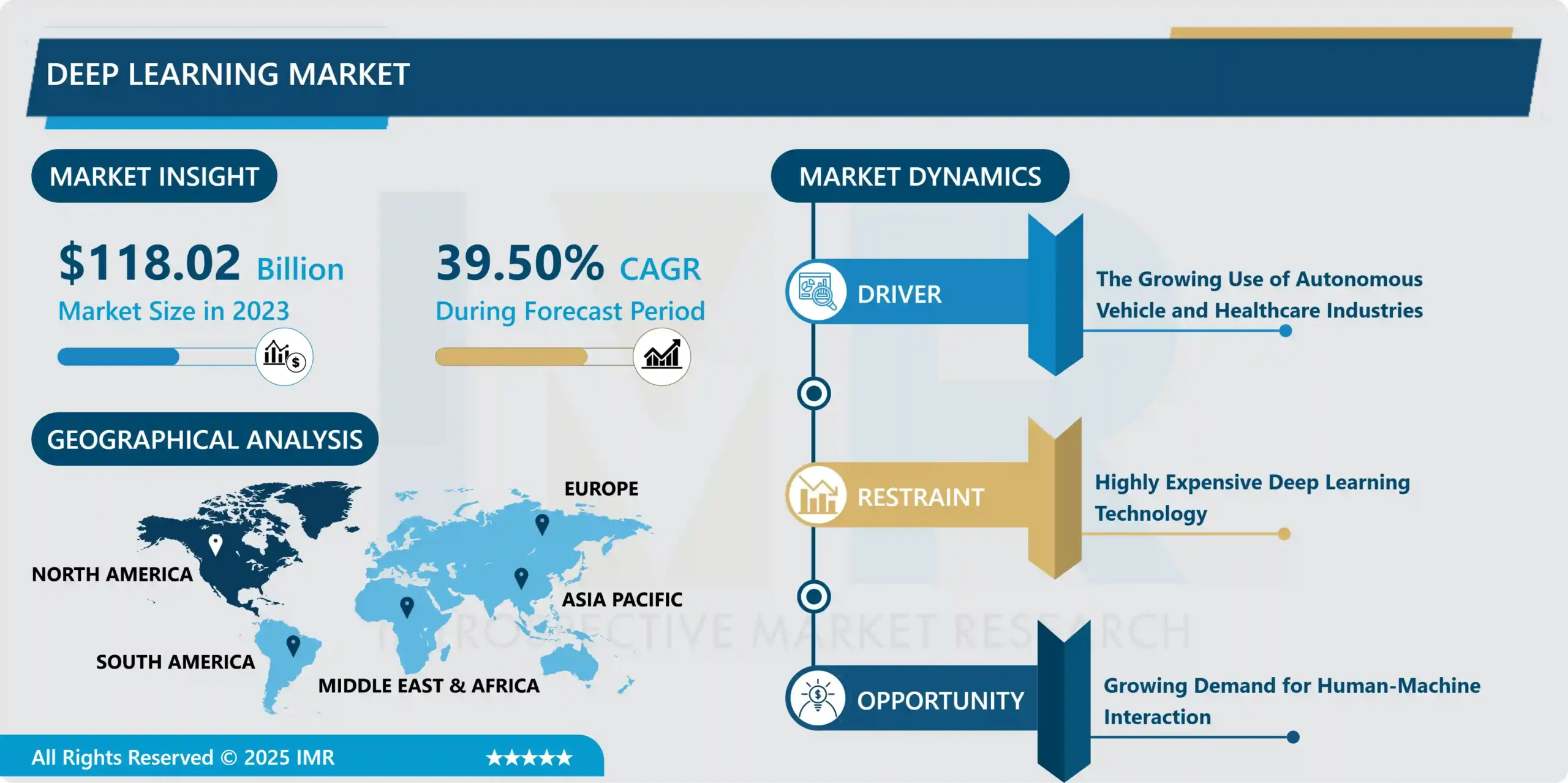
The Global Deep Learning Market size is expected to grow from USD 118.02 billion in 2023 to USD 2361.15 billion by 2032, at a CAGR of 39.50% during the forecast period (2024-2032).
Deep learning also referred to as deep structured learning is a subset of machine learning and artificial intelligence. It is an important component of data science which contain statistics and predictive modeling. It is very useful for those data scientists who are engaged in collecting, analyzing, and interpreting huge amounts of data, and data learning assists to make this process makes faster and easier. Deep learning manages several applications of artificial intelligence and services that develop automation, performing analytical, and physical tasks without interruption of humans. Deep learning contains deep neural networks, deep reinforcement learning, deep belief networks, recurrent neural networks, and convolutional neural networks that have been used in various fields like speech recognition, computer vision, natural language processing, drug design, and medical image analysis, machine translation, and bioinformatics. These applications support the growth of the market.
Market Dynamics and Factors of Deep Learning Market
Drivers:
The Growing Use of Autonomous Vehicle and Healthcare Industries
The deep learning technology used in autonomous vehicles is self-driving. The main role of deep learning in an autonomous vehicle is to interpret complex vision tasks, enhance perception, localize itself in the environment, and actuate kinematic maneuvers. This assures road safety and also commute easily. In addition to this, deep learning is also used in the healthcare sector. It is already seen in medical imaging solutions, and chatbots that can help to find the patient’s symptoms, and identify the types of cancer, rare diseases, and pathology types. Deep learning also analyzes the electronic health records including structured and unstructured data it contains laboratory test results, clinical notes, diagnoses, and medications. It also offers personalized medical treatments and helps to find the errors in the prescription and correct them. These all beneficial factors propel the growth of the market of deep learning in the forecast year.
Restraints:
Highly Expensive Deep Learning Technology
Deep learning technology is too expensive because complex data models are a key factor hindering the market growth. For deep learning technology multicore high-performing graphics processing units (GPUs) and tensor processing units (TPUs) are required. They are expensive and use a large amount of energy. This increase the cost of deep learning technology which is restricted the growth of the market of deep learning in the forecast period.
Opportunity:
Growing Demand for Human-Machine Interaction
The human-machine interaction demand is rising which offers a lucrative opportunity for the market of deep learning. The human-machine interaction (HMI) is termed communication and interaction between the human and a machine through a user interface. The human-machine interface provides numerous advantages such as enhancing the efficiency of the machine, the ability to effectively control any system or device, high efficiency in recording the data, and assistance to translate the industrial control system data into readable and visual representations by human and decline the hardware cost. These are all beneficial factors that provide the profitable opportunity for the growth of the deep learning market in the analysis year.
Segmentation Analysis of Deep Learning Market
By Type, the software segment is projected to have the maximum market share in deep learning in the analysis period. This is owing to the growing adoption of software solutions in different applications like ATMs that can read checks, voice and image recognition systems, and smartphone assistants on social networks. In addition to this, the number of software that provide the ads on many websites. These are driving the growth of the market of deep learning. Several companies engaged in the manufacturing and development system and provide the software online as well as offline based on applications. Most major players offer the installation and training of these systems with online assistance and post-maintenance of software. These factors contributed to the market growth of the software segment in the deep learning market.
By Application, the Image recognition segment dominates the deep learning market. It is one of the crucial fields of image processing and computer vision. The rising demand for pattern recognition, optical character recognition, code recognition, facial recognition, object recognition, and digital image processing propels the growth of the market. Deep learning techniques assist in the development of natural language processing and visual data mining. The data mining technology is used in sentiment analysis, machine translation, fingerprint identification, cybersecurity, and bioinformatics. These all remarkable factors propel the growth of deep learning in the image recognition application.
By End User, the Automotive segment is anticipated to have maximum growth in the deep learning market in the analysis year. Deep learning technology has a number of automotive applications such as visual inspection in manufacturing, social media analytics, autonomous driving, robots, smart machines, and conversational user interface that are contributed to the growth of the market of deep learning. Additionally, deep learning is the subtype of Artificial intelligence (AI). The growing penetration rate of AI technology in the manufacturing, design, supply chain, production, post-production, driver assistance, and driver risk assessment systems also supported the growth of the deep learning market over the forecast period.
Regional Analysis of Deep Learning Market
North America has projected too high market growth in deep learning owing to growing investments in artificial intelligence and neural networks by major players in this region. For the purpose of image recognition, voice recognition, data mining, signal recognition, and diagnostic purposes cognition, the adoption of DL application models is increasing. The digital businesses in this region are rising rapidly. These factors supported the growth of the deep learning market over the forecast period. Mexico, Canada, and the United States are the dominating country in this region. This is due to the quick adoption of advanced technology in this country, government support, and growing application of deep learning in the healthcare, automotive, IT and telecommunications, aerospace & defense sectors in this country. These all factors contribute to the growth of the market.
Europe is the second dominating region in the deep learning market. The growing adoption of artificial intelligence and neural networks among the various businesses in this region is a key factor that propels the growth of the market of this region. The UK country is dominating the market in the Europe region. Increase the application of deep learning for image recognition, data mining, and signal recognition purposes. Government investment is rising in the development of deep learning technology. These factors help the growth of the deep learning market. Additionally, the growing use in healthcare, IT and telecommunications, and automotive sectors in this region also supported the growth of the market over the forecast period.
The Asia Pacific has significant growth in the market of deep learning. This is owing to the growing penetration rate and development in deep learning technology. Increasing the digitalization, image recognition platforms, and voice recognition platforms support the growth of the market in this region. In addition to this, the governments of various countries in this region increase their investment in the advancement of technology, and the growing adoption of AI and machine learning technology also boosts the market growth. The rising popularity of deep learning in electrical items such as smartphones, tablets, PCs, and in healthcare, automotive products. China and India are the dominating countries in this region because of the rising research and development of advanced technology.
Covid 19 impact Analysis on Deep Learning Market
COVID-19 starts in Wuhan (China) in December 2019 and has since rapidly spread throughout the world. In terms of confirmed cases and reported deaths, the US, India, Brazil, Russia, France, the UK, Turkey, Italy, and Spain are among the countries that have been most severely impacted. Due to lockdowns, travel restrictions, and business closures, COVID-19 has had an impact on the businesses and industries of numerous nations. The Covid 19 spread has positively impacted the deep learning market. The adoption of developed technology such as artificial intelligence, learning techniques, machine learning, and DevOps during the pandemic period. Additionally, anti-money laundering (AML), fraud detection solutions, and various other solutions are highly demanded at the time of covid 19. Thus, the Deep learning market had significant growth during the pandemic.
Top Key Players Covered In Deep Learning Market
Advanced Micro Devices (US)
ARM Ltd (UK)
Clarifai (US)
Entilic(US)
Google (US)
HyperVerge(US)
IBM (US)
Intel (US)
Microsoft (US)
NVIDIA (US) and other major players.
Key Industry Development In The Deep Learning Market:
In March 2024, Nikon Industrial Metrology Business Unit released AI Reconstruction, an innovative 3D computed tomography (CT) reconstruction software solution powered by artificial intelligence that lifts the traditional trade-off between scan speed and image quality. By applying Deep Learning techniques to enhance image quality, Nikon’s breakthrough technology enables rapid results and superior analysis.
In November 2023, GE HealthCare’s Artificial Intelligence (AI) models predict patient response to immunotherapies with 70 to 80 percent accuracy, based on a pan-cancer cohort, according to findings to be presented at the Society for Immunotherapy of Cancer (SITC) in San Diego, U.S., by GE HealthCare, Vanderbilt University Medical Center (VUMC) and the University Medicine Essen (UME), Germany.
Chapter 1: Introduction
1.1 Scope and Coverage
Chapter 2:Executive Summary
Chapter 3: Market Landscape
3.1 Market Dynamics
3.1.1 Drivers
3.1.2 Restraints
3.1.3 Opportunities
3.1.4 Challenges
3.2 Market Trend Analysis
3.3 PESTLE Analysis
3.4 Porter’s Five Forces Analysis
3.5 Industry Value Chain Analysis
3.6 Ecosystem
3.7 Regulatory Landscape
3.8 Price Trend Analysis
3.9 Patent Analysis
3.10 Technology Evolution
3.11 Investment Pockets
3.12 Import-Export Analysis
Chapter 4: Deep Learning Market by Type (2018-2032)
4.1 Deep Learning Market Snapshot and Growth Engine
4.2 Market Overview
4.3 Software
4.3.1 Introduction and Market Overview
4.3.2 Historic and Forecasted Market Size in Value USD and Volume Units
4.3.3 Key Market Trends, Growth Factors, and Opportunities
4.3.4 Geographic Segmentation Analysis
4.4 Hardware
4.5 Service
Chapter 5: Deep Learning Market by Application (2018-2032)
5.1 Deep Learning Market Snapshot and Growth Engine
5.2 Market Overview
5.3 Signal Recognition
5.3.1 Introduction and Market Overview
5.3.2 Historic and Forecasted Market Size in Value USD and Volume Units
5.3.3 Key Market Trends, Growth Factors, and Opportunities
5.3.4 Geographic Segmentation Analysis
5.4 Image Recognition
5.5 Others
Chapter 6: Deep Learning Market by End User (2018-2032)
6.1 Deep Learning Market Snapshot and Growth Engine
6.2 Market Overview
6.3 Aerospace & Defense
6.3.1 Introduction and Market Overview
6.3.2 Historic and Forecasted Market Size in Value USD and Volume Units
6.3.3 Key Market Trends, Growth Factors, and Opportunities
6.3.4 Geographic Segmentation Analysis
6.4 Automotive
6.5 Manufacturing
6.6 Healthcare
Chapter 7: Company Profiles and Competitive Analysis
7.1 Competitive Landscape
7.1.1 Competitive Benchmarking
7.1.2 Deep Learning Market Share by Manufacturer (2024)
7.1.3 Industry BCG Matrix
7.1.4 Heat Map Analysis
7.1.5 Mergers and Acquisitions
7.2 BINANCE (CAYMAN ISLANDS)
7.2.1 Company Overview
7.2.2 Key Executives
7.2.3 Company Snapshot
7.2.4 Role of the Company in the Market
7.2.5 Sustainability and Social Responsibility
7.2.6 Operating Business Segments
7.2.7 Product Portfolio
7.2.8 Business Performance
7.2.9 Key Strategic Moves and Recent Developments
7.2.10 SWOT Analysis
7.3 COINBASE (SAN FRANCISCO
7.4 USA)
7.5 KRAKEN (SAN FRANCISCO
7.6 USA)
7.7 BITFINEX (HONG KONG)
7.8 HUOBI (SINGAPORE)
7.9 OKEX (MALTA)
7.10 RIPPLE LABS (SAN FRANCISCO
7.11 USA)
7.12 BITMAIN (BEIJING
7.13 CHINA)
7.14 GEMINI (NEW YORK
7.15 USA)
7.16 BLOCKFI (JERSEY CITY
7.17 USA)
7.18 OTHER KEY PLAYERS
7.19
Chapter 8: Global Deep Learning Market By Region
8.1 Overview
8.2. North America Deep Learning Market
8.2.1 Key Market Trends, Growth Factors and Opportunities
8.2.2 Top Key Companies
8.2.3 Historic and Forecasted Market Size by Segments
8.2.4 Historic and Forecasted Market Size by Type
8.2.4.1 Software
8.2.4.2 Hardware
8.2.4.3 Service
8.2.5 Historic and Forecasted Market Size by Application
8.2.5.1 Signal Recognition
8.2.5.2 Image Recognition
8.2.5.3 Others
8.2.6 Historic and Forecasted Market Size by End User
8.2.6.1 Aerospace & Defense
8.2.6.2 Automotive
8.2.6.3 Manufacturing
8.2.6.4 Healthcare
8.2.7 Historic and Forecast Market Size by Country
8.2.7.1 US
8.2.7.2 Canada
8.2.7.3 Mexico
8.3. Eastern Europe Deep Learning Market
8.3.1 Key Market Trends, Growth Factors and Opportunities
8.3.2 Top Key Companies
8.3.3 Historic and Forecasted Market Size by Segments
8.3.4 Historic and Forecasted Market Size by Type
8.3.4.1 Software
8.3.4.2 Hardware
8.3.4.3 Service
8.3.5 Historic and Forecasted Market Size by Application
8.3.5.1 Signal Recognition
8.3.5.2 Image Recognition
8.3.5.3 Others
8.3.6 Historic and Forecasted Market Size by End User
8.3.6.1 Aerospace & Defense
8.3.6.2 Automotive
8.3.6.3 Manufacturing
8.3.6.4 Healthcare
8.3.7 Historic and Forecast Market Size by Country
8.3.7.1 Russia
8.3.7.2 Bulgaria
8.3.7.3 The Czech Republic
8.3.7.4 Hungary
8.3.7.5 Poland
8.3.7.6 Romania
8.3.7.7 Rest of Eastern Europe
8.4. Western Europe Deep Learning Market
8.4.1 Key Market Trends, Growth Factors and Opportunities
8.4.2 Top Key Companies
8.4.3 Historic and Forecasted Market Size by Segments
8.4.4 Historic and Forecasted Market Size by Type
8.4.4.1 Software
8.4.4.2 Hardware
8.4.4.3 Service
8.4.5 Historic and Forecasted Market Size by Application
8.4.5.1 Signal Recognition
8.4.5.2 Image Recognition
8.4.5.3 Others
8.4.6 Historic and Forecasted Market Size by End User
8.4.6.1 Aerospace & Defense
8.4.6.2 Automotive
8.4.6.3 Manufacturing
8.4.6.4 Healthcare
8.4.7 Historic and Forecast Market Size by Country
8.4.7.1 Germany
8.4.7.2 UK
8.4.7.3 France
8.4.7.4 The Netherlands
8.4.7.5 Italy
8.4.7.6 Spain
8.4.7.7 Rest of Western Europe
8.5. Asia Pacific Deep Learning Market
8.5.1 Key Market Trends, Growth Factors and Opportunities
8.5.2 Top Key Companies
8.5.3 Historic and Forecasted Market Size by Segments
8.5.4 Historic and Forecasted Market Size by Type
8.5.4.1 Software
8.5.4.2 Hardware
8.5.4.3 Service
8.5.5 Historic and Forecasted Market Size by Application
8.5.5.1 Signal Recognition
8.5.5.2 Image Recognition
8.5.5.3 Others
8.5.6 Historic and Forecasted Market Size by End User
8.5.6.1 Aerospace & Defense
8.5.6.2 Automotive
8.5.6.3 Manufacturing
8.5.6.4 Healthcare
8.5.7 Historic and Forecast Market Size by Country
8.5.7.1 China
8.5.7.2 India
8.5.7.3 Japan
8.5.7.4 South Korea
8.5.7.5 Malaysia
8.5.7.6 Thailand
8.5.7.7 Vietnam
8.5.7.8 The Philippines
8.5.7.9 Australia
8.5.7.10 New Zealand
8.5.7.11 Rest of APAC
8.6. Middle East & Africa Deep Learning Market
8.6.1 Key Market Trends, Growth Factors and Opportunities
8.6.2 Top Key Companies
8.6.3 Historic and Forecasted Market Size by Segments
8.6.4 Historic and Forecasted Market Size by Type
8.6.4.1 Software
8.6.4.2 Hardware
8.6.4.3 Service
8.6.5 Historic and Forecasted Market Size by Application
8.6.5.1 Signal Recognition
8.6.5.2 Image Recognition
8.6.5.3 Others
8.6.6 Historic and Forecasted Market Size by End User
8.6.6.1 Aerospace & Defense
8.6.6.2 Automotive
8.6.6.3 Manufacturing
8.6.6.4 Healthcare
8.6.7 Historic and Forecast Market Size by Country
8.6.7.1 Turkiye
8.6.7.2 Bahrain
8.6.7.3 Kuwait
8.6.7.4 Saudi Arabia
8.6.7.5 Qatar
8.6.7.6 UAE
8.6.7.7 Israel
8.6.7.8 South Africa
8.7. South America Deep Learning Market
8.7.1 Key Market Trends, Growth Factors and Opportunities
8.7.2 Top Key Companies
8.7.3 Historic and Forecasted Market Size by Segments
8.7.4 Historic and Forecasted Market Size by Type
8.7.4.1 Software
8.7.4.2 Hardware
8.7.4.3 Service
8.7.5 Historic and Forecasted Market Size by Application
8.7.5.1 Signal Recognition
8.7.5.2 Image Recognition
8.7.5.3 Others
8.7.6 Historic and Forecasted Market Size by End User
8.7.6.1 Aerospace & Defense
8.7.6.2 Automotive
8.7.6.3 Manufacturing
8.7.6.4 Healthcare
8.7.7 Historic and Forecast Market Size by Country
8.7.7.1 Brazil
8.7.7.2 Argentina
8.7.7.3 Rest of SA
Chapter 9 Analyst Viewpoint and Conclusion
9.1 Recommendations and Concluding Analysis
9.2 Potential Market Strategies
Chapter 10 Research Methodology
10.1 Research Process
10.2 Primary Research
10.3 Secondary Research
Q1: What would be the forecast period in the Deep Learning Market research report?
A1: The forecast period in the Deep Learning Market research report is 2024-2032.
Q2: Who are the key players in Deep Learning Market?
A2: Advanced Micro Devices, ARM Ltd, Clarifai, Entilic, Google, HyperVerge, and other major players.
Q3: What are the segments of the Deep Learning Market?
A3: The Deep Learning Market is segmented into type, application, and region. By Type, the market is categorized into Software, Hardware, and Service. By Application, the market is categorized into Signal Recognition, Image Recognition, and Others. By End-users, the market is categorized into Aerospace & Defense, Automotive, Manufacturing, and Healthcare. By region, it is analyzed across North America (U.S.; Canada; Mexico), Europe (Germany; U.K.; France; Italy; Russia; Spain, etc.), Asia-Pacific (China; India; Japan; Southeast Asia, etc.), South America (Brazil; Argentina, etc.), Middle East & Africa (Saudi Arabia; South Africa, etc.).
Q4: What is the Deep Learning Market?
A4: Deep learning also referred to as deep structured learning is a subset of machine learning and artificial intelligence. It is an important component of data science which contain statistics and predictive modeling. It is very useful for those data scientists who are engaged in collecting, analyzing, and interpreting huge amounts of data, and data learning assists to make this process makes faster and easier.
Q5: How big is the Deep Learning Market?
A5: The Global Deep Learning Market size is expected to grow from USD 118.02 billion in 2023 to USD 2361.15 billion by 2032, at a CAGR of 39.5% during the forecast period (2024-2032).
How to Buy a Report from eminsights.jp
On the product page, choose the license you want: Single-User License, Multi-User License or Enterprise License.
If you required report in your native language, then you can click on Translated Report button and fill out the form with report name and language you want, then our team will contact you as soon as possible.
Click the Buy Now button.
You will be redirected to the checkout page. Enter your company details and payment information.
Click Place Order to complete the purchase.
Confirmation: You’ll receive an order confirmation and our team will contact you shortly with your ordered report.
If you have any questions, fill out the contact form below or email us at [email protected].
Thank you for choosing eminsights.jp!