Stay Ahead in Fast-Growing Economies.
Browse Reports Now

Stereo Audio Codecs Market – In-Deep Analysis Focusing on Market Share
Stereo audio codecs, essential elements in digital audio processing, have diverse applications spanning various industries. They facilitate efficient transmission of high-fidelity stereo audio in music streaming, ensuring uninterrupted listening experiences globally. Additionally, in video conferencing setups, stereo codecs enable clear and immersive audio communication, boosting collaboration and productivity in remote meetings. Their integration into multimedia entertainment systems enhances the delivery of surround sound experiences, enriching the enjoyment of movies, games, and virtual reality content.

IMR Group
Description
Stereo Audio Codecs Market Synopsis
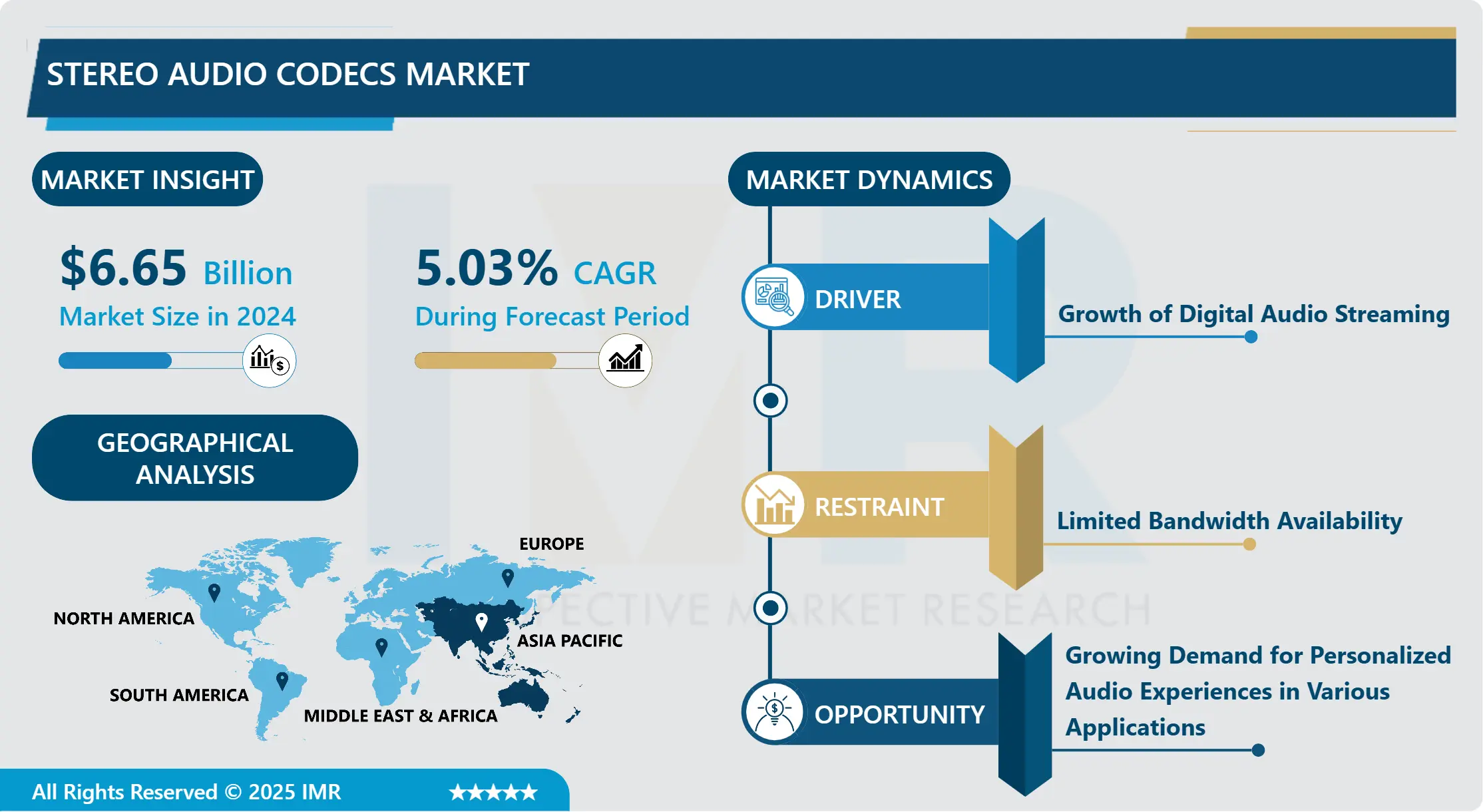
Global Stereo Audio Codecs Market Size Was Valued at USD 6.65 Billion in 2024 and is Projected to Reach USD 9.85 Billion by 2032, Growing at a CAGR of 5.03% From 2025-2032.
Stereo audio codecs encode and decode digital audio signals to produce stereo sound. They compress audio data to optimize storage and transmission without compromising quality. These codecs are essential in music streaming, video conferencing, and multimedia entertainment systems.
Stereo audio codecs, essential elements in digital audio processing, have diverse applications spanning various industries. They facilitate efficient transmission of high-fidelity stereo audio in music streaming, ensuring uninterrupted listening experiences globally. Additionally, in video conferencing setups, stereo codecs enable clear and immersive audio communication, boosting collaboration and productivity in remote meetings. Their integration into multimedia entertainment systems enhances the delivery of surround sound experiences, enriching the enjoyment of movies, games, and virtual reality content.
They efficiently compress audio data while preserving quality, resulting in compact file sizes ideal for storage and transmission. Moreover, these codecs support a wide array of audio formats and bitrates, ensuring compatibility with various playback devices and platforms. Ongoing advancements in codec technology further enhance audio fidelity, reducing latency and enhancing overall performance in real-time applications.
The future demand for stereo audio codecs appears promising, driven by the proliferation of digital audio content and the expansion of online streaming services. With consumers increasingly seeking high-quality audio experiences across multiple devices, the necessity for efficient audio compression and transmission solutions is expected to rise. Additionally, emerging technologies like 5G networks and immersive audio formats are poised to accelerate the adoption of stereo codecs in next-generation multimedia applications, fostering further innovation and market growth.
Stereo Audio Codecs Market Trend Analysis:
Growth of Digital Audio Streaming
The rapid expansion of the stereo audio codecs market is largely driven by the exponential rise of digital audio streaming. As consumers increasingly turn to online platforms for accessing music, podcasts, and other audio content, the need for top-notch audio reproduction becomes increasingly vital. Stereo audio codecs are instrumental in this scenario, facilitating efficient compression and transmission of audio data across the internet, thereby ensuring a smooth streaming experience for users worldwide.
Furthermore, the widespread adoption of smartphones, tablets, and smart speakers has further bolstered the demand for stereo audio codecs. These devices serve as primary conduits for accessing digital audio content, underscoring the necessity for optimized audio compression technologies to deliver immersive sound experiences. Additionally, the advent of high-speed internet connectivity and the widespread uptake of streaming services have democratized access to audio content, fostering a broad and diverse market for stereo audio codecs catering to various consumer demographics.
Moreover, ongoing advancements in audio codec technology continuously refine audio fidelity and efficiency, propelling further growth in the market. Manufacturers are persistently innovating to create codecs capable of delivering superior sound quality while minimizing bandwidth requirements, thereby addressing the evolving demands of the digital audio streaming landscape. With the escalating demand for high-quality audio streaming experiences driven by consumer preferences for convenience, accessibility, and immersive audio content, the stereo audio codecs market is poised for sustained expansion in the foreseeable future.
Growing Demand for Personalized Audio Experiences in Various Applications
The rising need for customized audio experiences across various sectors offers a significant growth opportunity for the stereo audio codecs market. In segments like music streaming, podcasting, and gaming, there’s a growing demand for tailored audio content that aligns with individual preferences. Stereo audio codecs play a crucial role by facilitating efficient compression and transmission of high-fidelity audio data, ensuring seamless delivery of personalized experiences to users worldwide.
Additionally, the proliferation of mobile devices and smart technologies has intensified the desire for personalized audio experiences. With the emergence of smartphones, tablets, and wearables, consumers expect audio content to adapt seamlessly to their dynamic lifestyles. Stereo audio codecs optimize audio data for different playback devices, ensuring consistent and immersive experiences across various platforms.
Furthermore, the integration of artificial intelligence and machine learning introduces novel avenues for delivering personalized audio content. Through the analysis of user preferences, behaviors, and listening habits, AI-driven audio platforms can curate customized playlists, recommendations, and audio enhancements tailored to individual users. This presents a unique opportunity for stereo audio codecs to evolve and adapt to the ever-changing landscape of personalized audio experiences, fostering innovation and market expansion. As the demand for personalized audio continues to rise across diverse sectors, the stereo audio codecs market is well-positioned to capitalize on this trend and expand its global presence.
Stereo Audio Codecs Market Segment Analysis:
Stereo Audio Codecs Market Segmented on the basis of Type, Component, and Application
By Component, Hardware segment is expected to dominate the market during the forecast period
The hardware segment is expected to lead the growth of the stereo audio codecs market. With technology advancing and a rising demand for high-quality audio solutions, hardware components play a crucial role in meeting consumer expectations. Hardware-based stereo audio codecs provide robust performance and reliability, serving various applications across industries like automotive, consumer electronics, and telecommunications. Their capability to deliver superior sound quality, low power consumption, and compatibility with a wide range of devices positions them as the primary drivers of market expansion.
Moreover, the hardware segment’s dominance is fueled by continuous innovations in semiconductor technology. This enables manufacturers to create more efficient and compact audio codec solutions. With companies striving to improve their product offerings and remain competitive, investments in research and development for hardware-based solutions remain a priority. This proactive approach ensures that the hardware segment maintains its leading position in the stereo audio codecs market, addressing the evolving needs of consumers and industries while fostering overall market growth.
By Application, Headphone, Headset, and Wearable Devices segment held the largest share
The headphone, headset, and wearable devices segment has emerged as the primary driver of growth in the stereo audio codecs market, capturing the largest share. This dominance stems from the increasing adoption of headphones, headsets, and wearable audio devices across diverse consumer demographics. As consumers seek immersive audio experiences for both leisure and professional use, the demand for high-quality audio codecs integrated into these devices has seen a significant surge. Furthermore, advancements in wireless connectivity technologies, such as Bluetooth, have contributed to the widespread adoption of stereo audio codecs in headphones, headsets, and wearable devices.
Additionally, the continuous evolution of audio technology has reinforced the dominance of this segment. Integration of advanced features like noise cancellation, voice assistant support, and personalized sound profiles further solidifies its position. Manufacturers are actively investing in research and development efforts to enhance the performance and functionality of stereo audio codecs within these devices, ensuring their continued dominance in the market. As consumer preferences lean towards portable and immersive audio solutions, the headphone, headset, and wearable devices segment is expected to maintain its substantial share and propel further growth in the stereo audio codecs market.
Stereo Audio Codecs Market Regional Insights:
Asia Pacific is Expected to Dominate the Market Over the Forecast period
Asia Pacific is positioned to lead the region in the growth of the stereo audio codecs market. The region benefits from a swiftly expanding consumer electronics sector and rising disposable incomes, driving the demand for top-notch audio solutions. Nations like China, Japan, South Korea, and India are experiencing notable strides in technology adoption, spurring the integration of stereo audio codecs across various applications, including smartphones, tablets, automotive infotainment systems, and smart home devices.
Furthermore, Asia Pacific boasts numerous key players in the consumer electronics realm and prominent semiconductor manufacturers. This dynamic ecosystem encourages innovation and collaboration, facilitating the advancement of state-of-the-art audio technologies and products. Additionally, government initiatives geared towards promoting digitalization and technological progress further propel the expansion of the stereo audio codecs market in the region. Consequently, Asia Pacific is anticipated to uphold its dominant position in the stereo audio codecs market, meeting the evolving audio demands of consumers and industries throughout the region.
Stereo Audio Codecs Market Top Key Players:
Analog Devices (U.S.)
Synaptics (U.S.)
Cirrus Logic (U.S.)
Dolby Laboratories (U.S.)
DSP Group (U.S.)
Knowles (U.S.)
Maxim Integrated (U.S.)
Texas Instruments (U.S.)
Analog Devices (U.S.)
ON Semiconductor (U.S.)
Silicon Laboratories (U.S.)
Infineon Technologies (Germany)
Fraunhofer IIS (Germany)
STMicroelectronics (Switzerland)
Technicolor (France)
Dialog Semiconductor (UK)
NXP Semiconductors (Netherlands)
Realtek Semiconductor Corp (Taiwan)
Asahi Kasei Microdevices (Japan)
Rohm (Japan), and Other Active Players
Key Industry Developments in the Stereo Audio Codecs Market:
In February 2024, Cirrus Logic Intel, and Microsoft unveiled a collaborative effort on a fresh PC reference design. This design showcased Cirrus Logic’s advanced audio and power technologies alongside Intel’s upcoming client processor, known as Lunar Lake. The partnership aimed to enhance laptops with a more immersive audio experience while simultaneously curbing heat generation, prolonging battery life, and facilitating the creation of sleeker, more compact designs. This initiative underscored a commitment to delivering “cool, quiet, and high-performance” PCs, promising users an optimized computing experience with superior audio quality and improved efficiency.
In April 2023, Microsoft Corp. and Epic expanded their enduring strategic partnership on Monday, unveiling plans to integrate generative AI into healthcare by merging Azure OpenAI Service1 with Epic’s renowned electronic health record (EHR) software. This collaboration marked an extension of their longstanding alliance, aimed at empowering organizations to deploy Epic environments on the Microsoft Azure cloud platform. Leveraging the scale and capabilities of Azure OpenAI Service, the integration promised to enhance healthcare solutions with advanced AI capabilities, further solidifying the collaboration’s commitment to driving innovation and improving patient care through the convergence of technology and healthcare expertise.
Chapter 1: Introduction
1.1 Scope and Coverage
Chapter 2:Executive Summary
Chapter 3: Market Landscape
3.1 Market Dynamics
3.1.1 Drivers
3.1.2 Restraints
3.1.3 Opportunities
3.1.4 Challenges
3.2 Market Trend Analysis
3.3 PESTLE Analysis
3.4 Porter’s Five Forces Analysis
3.5 Industry Value Chain Analysis
3.6 Ecosystem
3.7 Regulatory Landscape
3.8 Price Trend Analysis
3.9 Patent Analysis
3.10 Technology Evolution
3.11 Investment Pockets
3.12 Import-Export Analysis
Chapter 4: Stereo Audio Codecs Market by Type (2018-2032)
4.1 Stereo Audio Codecs Market Snapshot and Growth Engine
4.2 Market Overview
4.3 Analog
4.3.1 Introduction and Market Overview
4.3.2 Historic and Forecasted Market Size in Value USD and Volume Units
4.3.3 Key Market Trends, Growth Factors, and Opportunities
4.3.4 Geographic Segmentation Analysis
4.4 Digital
4.5 Hardware
4.6 Software
Chapter 5: Stereo Audio Codecs Market by Application (2018-2032)
5.1 Stereo Audio Codecs Market Snapshot and Growth Engine
5.2 Market Overview
5.3 Mobile Phone & Tablet
5.3.1 Introduction and Market Overview
5.3.2 Historic and Forecasted Market Size in Value USD and Volume Units
5.3.3 Key Market Trends, Growth Factors, and Opportunities
5.3.4 Geographic Segmentation Analysis
5.4 Music & Media Devices and Home Theatre
5.5 Television & Gaming Console
5.6 Automotive Infotainment
5.7 Headphone
5.8 Headset
5.9 & Wearable Devices
Chapter 6: Company Profiles and Competitive Analysis
6.1 Competitive Landscape
6.1.1 Competitive Benchmarking
6.1.2 Stereo Audio Codecs Market Share by Manufacturer (2024)
6.1.3 Industry BCG Matrix
6.1.4 Heat Map Analysis
6.1.5 Mergers and Acquisitions
6.2 IBM CORPORATION (U.S.)
6.2.1 Company Overview
6.2.2 Key Executives
6.2.3 Company Snapshot
6.2.4 Role of the Company in the Market
6.2.5 Sustainability and Social Responsibility
6.2.6 Operating Business Segments
6.2.7 Product Portfolio
6.2.8 Business Performance
6.2.9 Key Strategic Moves and Recent Developments
6.2.10 SWOT Analysis
6.3 ROCKWELL AUTOMATION INC. (U.S.)
6.4 GENERAL ELECTRIC (U.S.)
6.5 JOHNSON CONTROLS (U.S.)
6.6 HONEYWELL INTERNATIONAL (U.S.)
6.7 GRIDPOINT (U.S.)
6.8 C3.AI INC. (U.S.)
6.9 VERTIV CO. (U.S.)
6.10 CUMMINS INC (U.S.)
6.11 SIEMENS AG (GERMANY)
6.12 ELSTER ENERGY (GERMANY)
6.13 EATON (IRELAND)
6.14 SCHNEIDER ELECTRIC SE (FRANCE)
6.15 HUAWEI TECHNOLOGIES COLTD (CHINA)
6.16
Chapter 7: Global Stereo Audio Codecs Market By Region
7.1 Overview
7.2. North America Stereo Audio Codecs Market
7.2.1 Key Market Trends, Growth Factors and Opportunities
7.2.2 Top Key Companies
7.2.3 Historic and Forecasted Market Size by Segments
7.2.4 Historic and Forecasted Market Size by Type
7.2.4.1 Analog
7.2.4.2 Digital
7.2.4.3 Hardware
7.2.4.4 Software
7.2.5 Historic and Forecasted Market Size by Application
7.2.5.1 Mobile Phone & Tablet
7.2.5.2 Music & Media Devices and Home Theatre
7.2.5.3 Television & Gaming Console
7.2.5.4 Automotive Infotainment
7.2.5.5 Headphone
7.2.5.6 Headset
7.2.5.7 & Wearable Devices
7.2.6 Historic and Forecast Market Size by Country
7.2.6.1 US
7.2.6.2 Canada
7.2.6.3 Mexico
7.3. Eastern Europe Stereo Audio Codecs Market
7.3.1 Key Market Trends, Growth Factors and Opportunities
7.3.2 Top Key Companies
7.3.3 Historic and Forecasted Market Size by Segments
7.3.4 Historic and Forecasted Market Size by Type
7.3.4.1 Analog
7.3.4.2 Digital
7.3.4.3 Hardware
7.3.4.4 Software
7.3.5 Historic and Forecasted Market Size by Application
7.3.5.1 Mobile Phone & Tablet
7.3.5.2 Music & Media Devices and Home Theatre
7.3.5.3 Television & Gaming Console
7.3.5.4 Automotive Infotainment
7.3.5.5 Headphone
7.3.5.6 Headset
7.3.5.7 & Wearable Devices
7.3.6 Historic and Forecast Market Size by Country
7.3.6.1 Russia
7.3.6.2 Bulgaria
7.3.6.3 The Czech Republic
7.3.6.4 Hungary
7.3.6.5 Poland
7.3.6.6 Romania
7.3.6.7 Rest of Eastern Europe
7.4. Western Europe Stereo Audio Codecs Market
7.4.1 Key Market Trends, Growth Factors and Opportunities
7.4.2 Top Key Companies
7.4.3 Historic and Forecasted Market Size by Segments
7.4.4 Historic and Forecasted Market Size by Type
7.4.4.1 Analog
7.4.4.2 Digital
7.4.4.3 Hardware
7.4.4.4 Software
7.4.5 Historic and Forecasted Market Size by Application
7.4.5.1 Mobile Phone & Tablet
7.4.5.2 Music & Media Devices and Home Theatre
7.4.5.3 Television & Gaming Console
7.4.5.4 Automotive Infotainment
7.4.5.5 Headphone
7.4.5.6 Headset
7.4.5.7 & Wearable Devices
7.4.6 Historic and Forecast Market Size by Country
7.4.6.1 Germany
7.4.6.2 UK
7.4.6.3 France
7.4.6.4 The Netherlands
7.4.6.5 Italy
7.4.6.6 Spain
7.4.6.7 Rest of Western Europe
7.5. Asia Pacific Stereo Audio Codecs Market
7.5.1 Key Market Trends, Growth Factors and Opportunities
7.5.2 Top Key Companies
7.5.3 Historic and Forecasted Market Size by Segments
7.5.4 Historic and Forecasted Market Size by Type
7.5.4.1 Analog
7.5.4.2 Digital
7.5.4.3 Hardware
7.5.4.4 Software
7.5.5 Historic and Forecasted Market Size by Application
7.5.5.1 Mobile Phone & Tablet
7.5.5.2 Music & Media Devices and Home Theatre
7.5.5.3 Television & Gaming Console
7.5.5.4 Automotive Infotainment
7.5.5.5 Headphone
7.5.5.6 Headset
7.5.5.7 & Wearable Devices
7.5.6 Historic and Forecast Market Size by Country
7.5.6.1 China
7.5.6.2 India
7.5.6.3 Japan
7.5.6.4 South Korea
7.5.6.5 Malaysia
7.5.6.6 Thailand
7.5.6.7 Vietnam
7.5.6.8 The Philippines
7.5.6.9 Australia
7.5.6.10 New Zealand
7.5.6.11 Rest of APAC
7.6. Middle East & Africa Stereo Audio Codecs Market
7.6.1 Key Market Trends, Growth Factors and Opportunities
7.6.2 Top Key Companies
7.6.3 Historic and Forecasted Market Size by Segments
7.6.4 Historic and Forecasted Market Size by Type
7.6.4.1 Analog
7.6.4.2 Digital
7.6.4.3 Hardware
7.6.4.4 Software
7.6.5 Historic and Forecasted Market Size by Application
7.6.5.1 Mobile Phone & Tablet
7.6.5.2 Music & Media Devices and Home Theatre
7.6.5.3 Television & Gaming Console
7.6.5.4 Automotive Infotainment
7.6.5.5 Headphone
7.6.5.6 Headset
7.6.5.7 & Wearable Devices
7.6.6 Historic and Forecast Market Size by Country
7.6.6.1 Turkiye
7.6.6.2 Bahrain
7.6.6.3 Kuwait
7.6.6.4 Saudi Arabia
7.6.6.5 Qatar
7.6.6.6 UAE
7.6.6.7 Israel
7.6.6.8 South Africa
7.7. South America Stereo Audio Codecs Market
7.7.1 Key Market Trends, Growth Factors and Opportunities
7.7.2 Top Key Companies
7.7.3 Historic and Forecasted Market Size by Segments
7.7.4 Historic and Forecasted Market Size by Type
7.7.4.1 Analog
7.7.4.2 Digital
7.7.4.3 Hardware
7.7.4.4 Software
7.7.5 Historic and Forecasted Market Size by Application
7.7.5.1 Mobile Phone & Tablet
7.7.5.2 Music & Media Devices and Home Theatre
7.7.5.3 Television & Gaming Console
7.7.5.4 Automotive Infotainment
7.7.5.5 Headphone
7.7.5.6 Headset
7.7.5.7 & Wearable Devices
7.7.6 Historic and Forecast Market Size by Country
7.7.6.1 Brazil
7.7.6.2 Argentina
7.7.6.3 Rest of SA
Chapter 8 Analyst Viewpoint and Conclusion
8.1 Recommendations and Concluding Analysis
8.2 Potential Market Strategies
Chapter 9 Research Methodology
9.1 Research Process
9.2 Primary Research
9.3 Secondary Research
Q1: What would be the forecast period in the Stereo Audio Codecs Market research report?
A1: The forecast period in the Stereo Audio Codecs Market research report is 2025-2032.
Q2: Who are the key players in the Stereo Audio Codecs Market?
A2: Analog Devices (U.S.), Synaptics (U.S.), Cirrus Logic (U.S.), Dolby Laboratories (U.S.), DSP Group (U.S.), Knowles (U.S.), Maxim Integrated (U.S.), Texas Instruments (U.S.), Analog Devices (U.S.), ON Semiconductor (U.S.), Silicon Laboratories (U.S.), Infineon Technologies (Germany), Fraunhofer IIS (Germany), STMicroelectronics (Switzerland), Technicolor (France), Dialog Semiconductor (UK), NXP Semiconductors (Netherlands), Realtek Semiconductor Corp (Taiwan), Asahi Kasei Microdevices (Japan), Rohm (Japan), and Other Active Players.
Q3: What are the segments of the Stereo Audio Codecs Market?
A3: The Stereo Audio Codecs Market is segmented into Type, Component, Application, and region. By Type, the market is categorized into Analog and Digital. By Component, the market is categorized into Hardware and Software. By Application, the market is categorized into Mobile Phone & Tablet, Music & Media Devices and Home Theatre, Television & Gaming Console Automotive Infotainment, and Headphone, Headset, & Wearable Devices. By region, it is analyzed across North America (U.S.; Canada; Mexico), Eastern Europe (Bulgaria; The Czech Republic; Hungary; Poland; Romania; Rest of Eastern Europe), Western Europe (Germany; UK; France; Netherlands; Italy; Russia; Spain; Rest of Western Europe), Asia-Pacific (China; India; Japan; Southeast Asia, etc.), South America (Brazil; Argentina, etc.), Middle East & Africa (Saudi Arabia; South Africa, etc.).
Q4: What is the Stereo Audio Codecs Market?
A4: Stereo audio codecs encode and decode digital audio signals to produce stereo sound. They compress audio data to optimize storage and transmission without compromising quality. These codecs are essential in music streaming, video conferencing, and multimedia entertainment systems.
Q5: How big is the Stereo Audio Codecs Market?
A5: Global Stereo Audio Codecs Market Size Was Valued at USD 6.65 Billion in 2024 and is Projected to Reach USD 9.85 Billion by 2032, Growing at a CAGR of 5.03% From 2025-2032.
How to Buy a Report from eminsights.jp
On the product page, choose the license you want: Single-User License, Multi-User License or Enterprise License.
If you required report in your native language, then you can click on Translated Report button and fill out the form with report name and language you want, then our team will contact you as soon as possible.
Click the Buy Now button.
You will be redirected to the checkout page. Enter your company details and payment information.
Click Place Order to complete the purchase.
Confirmation: You’ll receive an order confirmation and our team will contact you shortly with your ordered report.
If you have any questions, fill out the contact form below or email us at [email protected].
Thank you for choosing eminsights.jp!