Stay Ahead in Fast-Growing Economies.
Browse Reports Now




Healthcare Robotics Market: Global Industry Analysis and Forecast (2024-2032)
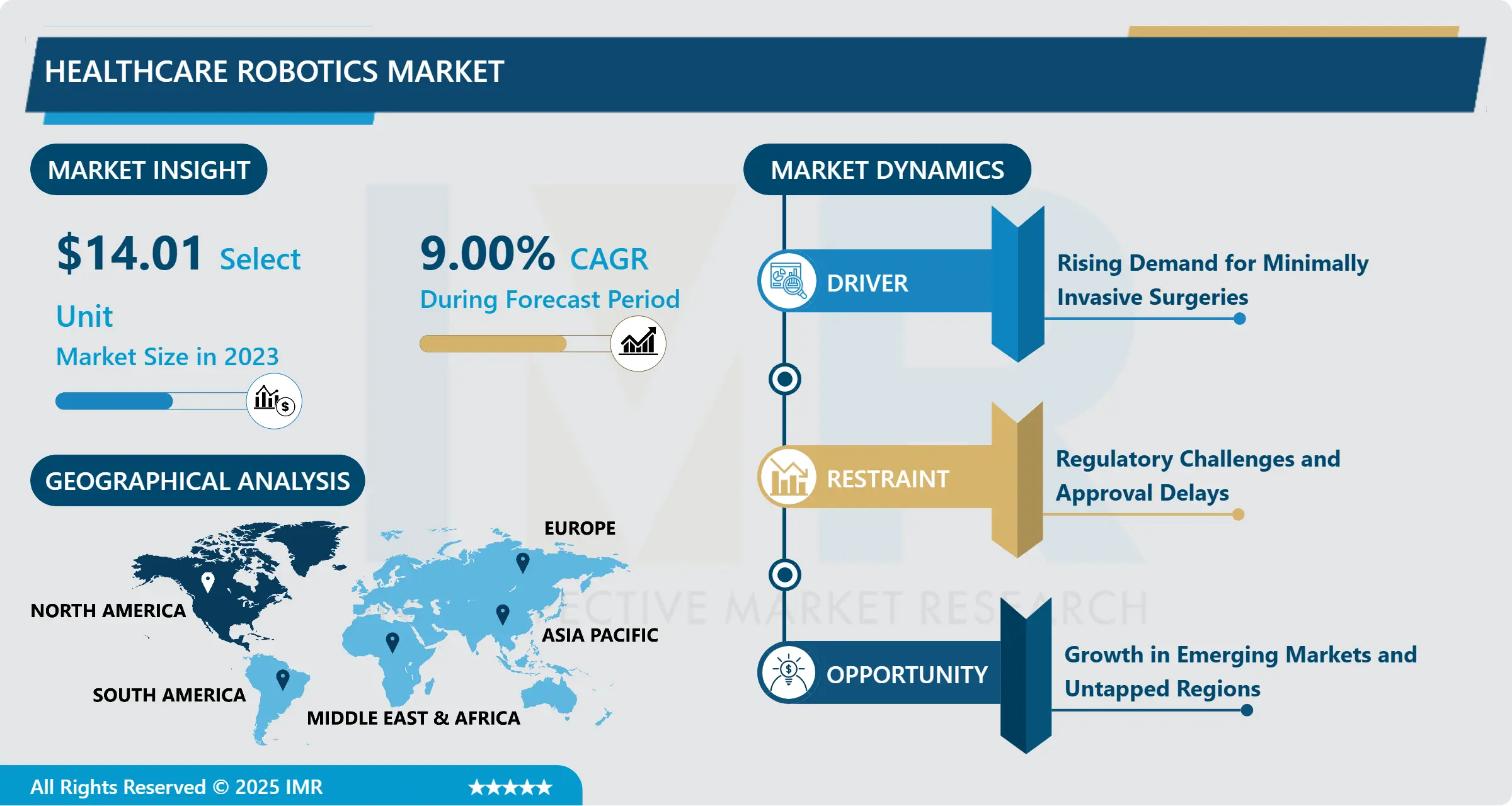
Healthcare Robotics Market Size Was Valued at USD 14.01 Billion in 2023, and is Projected to Reach USD 56.30 Billion by 2032, Growing at a CAGR of 9.00% From 2024-2032

IMR Group
Description
Healthcare Robotics Market Synopsis:
Healthcare Robotics Market Size Was Valued at USD 14.01 Billion in 2023, and is Projected to Reach USD 56.30 Billion by 2032, Growing at a CAGR of 9.00% From 2024-2032
The term ‘healthcare robotics market’ applies to a number of technological platforms and products that are able to facilitate a number of different tasks in the healthcare field, including surgical operations, physical therapy and extraneous care, administration and transportation of patients and medical supplies in clinical settings. This market combines application of robotics techniques and artificial intelligence together with trends in automation technology to increase accuracy in surgeries, drive patients’ results, and manage workflow processes in clinics and hospitals. As the significance of providing better and more effective and efficient services in the field of healthcare is growing thus with the specialised demands in robotic technologies this sector is growing more due to the factors like increasing old age population, increasing diseases related to chronic ailments and to bring down the overall expenses for the better and efficient health care. Consequently, healthcare robotics looks set to become a key area of growth in terms of where health care is being delivered in the future.
A breakdown of the market is as follows: healthcare robotics has been growing fast owing to the rising deployment of robo automation in the healthcare industry. Robotics is transforming the face of patient handling and attending surgical procedures, the general management of hospitals in terms of efficiency as well as the quality of service delivery to patents. Healthcare robots, therefore, has expanded with the aid of newly developed technologies like artificial intelligence (AI), machine learning and machine vision that has enhanced the flexibility of the robots to execute various challenging tasks. This tendency is most apparent in surgical robotics when operations with robotic tools that allow using minimally invasive methods are increasingly becoming the norm rather than the exception because of the opportunities to shortening the time required for surgery and exclude postoperative complications.
Furthermore, it can be pointed out that the increasing number of elderly and chronic disease patients is important for the adoption of healthcare robotics. Many healthcare facilities in the globe continue to face challenges in the shortage of human resource and the ever growing role of caring for patients and realizing the benefits of the use of robotics to supplement the human resource is irrefutable. Robots are being used for many uses such as surgical robotic systems, rehabilitative robots, telepresence robots, and logistics robots. All these segments tackles certain aspects of healthcare delivery from performing complicated operations to helping patients with mobility problems thus enhancing the quality of service delivery.
The market also observed strong investment trends in terms of both public and private interests, to bring about advancement in new age robotic solutions. Technology integration into healthcare facilities has encouraged technology firms and healthcare stakeholders to work together to create new generation robotic systems for use in different healthcare establishments. Moreover, future improvements in regulations and compensation systems should only increase the growth of these markets by providing its applications being affordable and sustainable for healthcare organizations.
Therefore, the future of healthcare robotics market looks promising for the next few years in light of new technologies, demography change and ever rising demand for effectiveness in healthcare industry. Since robots are evolving more and more to be an essential part of numerous healthcare sectors, they will be described as key deterministic factors to future patient care, operational procedures, and international healthcare structures.
Healthcare Robotics Market Trend Analysis:
Surgical Precision and AI Integration
Possibly the most prominent ongoing trend in the global market for healthcare robotics is the emerging prevalence of surgical robots. The former are modern systems that increase the accuracy during operations – this is especially useful in operations performed with minimal invasions. They found that robotic assistance gives the surgeons improved precision, steadiness and dexterity and hence enhances patients’ results, lesser surgical adverse effects, and faster rehabilitation periods. Different techniques are more advantageous because the new operations lead to smaller incisions, less pain and fast recovery. With facilities such as surgical hospitals and centers setting higher stakes in robotic solutions, the creation of karman surgical robots should be anticipated to increase and incorporate these surgical systems into common surgical procedures.
Another ongoing revolution is the incorporation of artificial intelligence (AI) into healthcare robotics a phenomenon currently changing the outcomes and possibilities of these solutions. By applying AI technology in robots, mass data can be collected and processed, prior surgical experiences, and multiple surgical situations will also be acknowledged and responded to simultaneously. Such flexibility does not only add levels of accuracy to sequences of surgeries, it also caters to the individual patients’ needs. With the help of AI integrated analytics, the robotic systems can help in designing surgery, prognosis and adapting the surgery strategies based on patient requirements. AI and robotics are two systems that complement each other and may produce drastic change in the means of how health care is delivered to meet patient demand.
The Role of Healthcare Robotics in Supporting an Aging Population
The upsurge of elderly people across the world is slowly turning out to be one of the most significant trends that is going to boost the healthcare robotics market. According to NAYLA; With increasing population of the elderly people there is need for assisted living to support the elderly people and at the same time allowing them live their lives independently. Service robots in eldercare can fill the need of social companionship and that is maybe one of the most important aspects which can help prevent loneliness and finally have positive effect on elders’ mental condition. Also these robots can accommodate general tasks; concerning mobility aid, feeding, and prescribed dose prompts for elderly thereby improving their functionality and at the same time reducing the load for caregivers as well as the healthcare facilities.
Businesses should capitalize on this demographic shift by designing new form of robotic solutions that targets elderly. They can be fitted with prescriptive sensors and artificial intelligence to track and diagnose human health conditions in the course of any emergency. In addition, mobility problems solved by means of robotics in form of an exoskeleton or a mobility scooter can help elderly citizens to maintain active social lives. As such, organizations can develop multipurpose applications that incorporate well-being applications like fitness and social interface applications to meet all the healthcare needs of the elderly and thereby revolutionize the delivery of eldercare services and the healthcare delivery system.
Healthcare Robotics Market Segment Analysis:
Healthcare Robotics Market is Segmented on the basis of Type, Application, End-User, and Region
By Type, Surgical Robots segment is expected to dominate the market during the forecast period
Surgical Robots have enhanced today’s surgery through increased surgical precision and control allowing for minimally invasive surgery which yields better results. These robots are widely used in procedures in neurosurgical operations, urology, and orthopedics, and cardiac surgery where robots are capable of very accurate and rapid incisions and movements than a surgeon. The technology minimizes human intervention hence lesser errors, it also spares tissue and has short recovery periods, which are factors of importance in delicate surgeries. Therefore, the demands for surgical robots are escalating as those strategic medical devices are chosen frequently in advanced health-care centers especially in the developed countries. It has been observed that increasing demand in less invasive procedures and enhanced strategies of healthcare have been key factors to the growth of the market.
For instance, real-time imaging, AI integration, and robotic vision systems are other development trends defining the growth of the surgical robots market. Such enhancements enable the surgeon to have better view of body organs, improve accuracy in the operations and the ability to give real-time feedback that boosts decision making during operations. The factor of Intelligence in surgical robotics has made it possible to do predictive analytics in that, the robotic system is able to know what humans need, during surgery in terms of efficiency. Risks remain in extensive costs associated with operative procedures, and, with a growing emphasis placed on operative excellence and quicker procedure turnaround, the global market for surgical robots shows further opportunity for substantial growth in regions actively investing in healthcare technology.
By End-User, Hospitals segment expected to held the largest share
The largest and most frequent customer for medical robotics systems is the hospital, particularly in the operating theatre and intensive care units. Adoption of robots in hospitals is informed by the need to achieve high precision especially in surgical operations, thus reducing errors, time to recovery and, patients’ suffering. Robots are especially applied in intricate surgeries including cardiothoracic, neurological as well as Orthopedic surgeries because the robots are very much in control and precise than manually operated surgeries. Due to the pressure on healthcare providers to deliver quality services to patients, and at the same time keep operating costs low, hospitals are looking for technological sophistication of medical robots to enhance efficiency, decrease post-surgical complications, and provide efficient patient care.
Further, with hospitals increasingly incorporating some of the latest robotic technologies, the use of identity medical robots is projected to grow. Rising concern to increase productivity, shorten the hospital stay, and the need to perform according to patient expectation are some factors contributing to the demand for ambulatory care services. As for technology advancement on robotic system, real-time data integration, artificial intelligence (AI), machine learning; hospitals are now able to offer better and accurate form of treatment. Such a trend is especially observable in the developed healthcare systems where the hospitals have enough money to buy new generation medical equipment. So, it is expected that the hospitals will continue to be the largest sub-market in terms of medical robots and will also aid in shaping the growth of the market mostly.
Healthcare Robotics Market Regional Insights:
North America is Expected to Dominate the Market Over the Forecast period
The healthcare robotics market in North America is predisposed to early implementation of advanced robotics technologies coupled with huge health care spending. The region therefore has a high index in the improvement of developing a health care system that fulforms innovation whereby several hospitals and institutions have invested on robotic surgeries, Rehabilitation devices and patient handling robotic systems. The leaders in the key industries including Intuitive Surgical and Medtronic have equally greatly contributed to the evolution and application of healthcare robotics solutions. More and more of these companies are launching new innovative robotic systems that have become very vital in many surgical procedures, particularly in operations that require finesse, in processes that needs a small incision and in general, improving the comfort of the patient.
In North America, especially the United States holds the largest market share for healthcare robotics due to an advanced innovative environment and the near-ubiquitous use of robotics in healthcare procedures. Promising reimbursement policies have been provided to determine the increased rate of implementing robotic mastectomy in both, large and small healthcare organizations. Furthermore, gaining healthcare infrastructure and more backing from administration for the medical innovative technologies helps to enhance the regional IOU in the global market for healthcare robotics. Such trends, as well as the relatively high penetration of robotic surgery across the North American region especially in the focused disciplines including orthopedic, urologic and neurologic surgery, still entail strong growth perspectives.
Active Key Players in the Healthcare Robotics Market:
Intuitive Surgical, Inc.
Stryker Corporation
Medtronic plc
ABB Ltd.
Cyberdyne Inc.
Omnicare, Inc.
KUKA AG
Accuray Incorporated
Auris Health (acquired by Johnson & Johnson)
RoboKind
Other Active Players
Chapter 1: Introduction
1.1 Scope and Coverage
Chapter 2:Executive Summary
Chapter 3: Market Landscape
3.1 Market Dynamics
3.1.1 Drivers
3.1.2 Restraints
3.1.3 Opportunities
3.1.4 Challenges
3.2 Market Trend Analysis
3.3 PESTLE Analysis
3.4 Porter’s Five Forces Analysis
3.5 Industry Value Chain Analysis
3.6 Ecosystem
3.7 Regulatory Landscape
3.8 Price Trend Analysis
3.9 Patent Analysis
3.10 Technology Evolution
3.11 Investment Pockets
3.12 Import-Export Analysis
Chapter 4: Healthcare Robotics Market by Type
4.1 Healthcare Robotics Market Snapshot and Growth Engine
4.2 Healthcare Robotics Market Overview
4.3 Surgical Robots
4.3.1 Introduction and Market Overview
4.3.2 Historic and Forecasted Market Size in Value USD and Volume Units (2017-2032F)
4.3.3 Key Market Trends, Growth Factors and Opportunities
4.3.4 Surgical Robots: Geographic Segmentation Analysis
4.4 Rehabilitation Robots
4.4.1 Introduction and Market Overview
4.4.2 Historic and Forecasted Market Size in Value USD and Volume Units (2017-2032F)
4.4.3 Key Market Trends, Growth Factors and Opportunities
4.4.4 Rehabilitation Robots: Geographic Segmentation Analysis
4.5 Telepresence Robots
4.5.1 Introduction and Market Overview
4.5.2 Historic and Forecasted Market Size in Value USD and Volume Units (2017-2032F)
4.5.3 Key Market Trends, Growth Factors and Opportunities
4.5.4 Telepresence Robots: Geographic Segmentation Analysis
4.6 Pharmacy Automation Robots and Exoskeletons
4.6.1 Introduction and Market Overview
4.6.2 Historic and Forecasted Market Size in Value USD and Volume Units (2017-2032F)
4.6.3 Key Market Trends, Growth Factors and Opportunities
4.6.4 Pharmacy Automation Robots and Exoskeletons: Geographic Segmentation Analysis
Chapter 5: Healthcare Robotics Market by Application
5.1 Healthcare Robotics Market Snapshot and Growth Engine
5.2 Healthcare Robotics Market Overview
5.3 Surgery
5.3.1 Introduction and Market Overview
5.3.2 Historic and Forecasted Market Size in Value USD and Volume Units (2017-2032F)
5.3.3 Key Market Trends, Growth Factors and Opportunities
5.3.4 Surgery: Geographic Segmentation Analysis
5.4 Rehabilitation
5.4.1 Introduction and Market Overview
5.4.2 Historic and Forecasted Market Size in Value USD and Volume Units (2017-2032F)
5.4.3 Key Market Trends, Growth Factors and Opportunities
5.4.4 Rehabilitation: Geographic Segmentation Analysis
5.5 Patient Care
5.5.1 Introduction and Market Overview
5.5.2 Historic and Forecasted Market Size in Value USD and Volume Units (2017-2032F)
5.5.3 Key Market Trends, Growth Factors and Opportunities
5.5.4 Patient Care: Geographic Segmentation Analysis
5.6 Pharmaceuticals and Diagnostics
5.6.1 Introduction and Market Overview
5.6.2 Historic and Forecasted Market Size in Value USD and Volume Units (2017-2032F)
5.6.3 Key Market Trends, Growth Factors and Opportunities
5.6.4 Pharmaceuticals and Diagnostics: Geographic Segmentation Analysis
Chapter 6: Healthcare Robotics Market by End-User
6.1 Healthcare Robotics Market Snapshot and Growth Engine
6.2 Healthcare Robotics Market Overview
6.3 Hospitals
6.3.1 Introduction and Market Overview
6.3.2 Historic and Forecasted Market Size in Value USD and Volume Units (2017-2032F)
6.3.3 Key Market Trends, Growth Factors and Opportunities
6.3.4 Hospitals: Geographic Segmentation Analysis
6.4 Clinics
6.4.1 Introduction and Market Overview
6.4.2 Historic and Forecasted Market Size in Value USD and Volume Units (2017-2032F)
6.4.3 Key Market Trends, Growth Factors and Opportunities
6.4.4 Clinics: Geographic Segmentation Analysis
6.5 Home Healthcare and Pharmacies
6.5.1 Introduction and Market Overview
6.5.2 Historic and Forecasted Market Size in Value USD and Volume Units (2017-2032F)
6.5.3 Key Market Trends, Growth Factors and Opportunities
6.5.4 Home Healthcare and Pharmacies: Geographic Segmentation Analysis
Chapter 7: Company Profiles and Competitive Analysis
7.1 Competitive Landscape
7.1.1 Competitive Benchmarking
7.1.2 Healthcare Robotics Market Share by Manufacturer (2023)
7.1.3 Industry BCG Matrix
7.1.4 Heat Map Analysis
7.1.5 Mergers and Acquisitions
7.2 INTUITIVE SURGICAL INC.
7.2.1 Company Overview
7.2.2 Key Executives
7.2.3 Company Snapshot
7.2.4 Role of the Company in the Market
7.2.5 Sustainability and Social Responsibility
7.2.6 Operating Business Segments
7.2.7 Product Portfolio
7.2.8 Business Performance
7.2.9 Key Strategic Moves and Recent Developments
7.2.10 SWOT Analysis
7.3 STRYKER CORPORATION
7.4 MEDTRONIC PLC
7.5 ABB LTD.
7.6 CYBERDYNE INC.
7.7 OMNICARE INC.
7.8 KUKA AG
7.9 ACCURAY INCORPORATED
7.10 AURIS HEALTH (ACQUIRED BY JOHNSON & JOHNSON)
7.11 ROBOKIND
7.12 OTHER ACTIVE PLAYERS
Chapter 8: Global Healthcare Robotics Market By Region
8.1 Overview
8.2. North America Healthcare Robotics Market
8.2.1 Key Market Trends, Growth Factors and Opportunities
8.2.2 Top Key Companies
8.2.3 Historic and Forecasted Market Size by Segments
8.2.4 Historic and Forecasted Market Size By Type
8.2.4.1 Surgical Robots
8.2.4.2 Rehabilitation Robots
8.2.4.3 Telepresence Robots
8.2.4.4 Pharmacy Automation Robots and Exoskeletons
8.2.5 Historic and Forecasted Market Size By Application
8.2.5.1 Surgery
8.2.5.2 Rehabilitation
8.2.5.3 Patient Care
8.2.5.4 Pharmaceuticals and Diagnostics
8.2.6 Historic and Forecasted Market Size By End-User
8.2.6.1 Hospitals
8.2.6.2 Clinics
8.2.6.3 Home Healthcare and Pharmacies
8.2.7 Historic and Forecast Market Size by Country
8.2.7.1 US
8.2.7.2 Canada
8.2.7.3 Mexico
8.3. Eastern Europe Healthcare Robotics Market
8.3.1 Key Market Trends, Growth Factors and Opportunities
8.3.2 Top Key Companies
8.3.3 Historic and Forecasted Market Size by Segments
8.3.4 Historic and Forecasted Market Size By Type
8.3.4.1 Surgical Robots
8.3.4.2 Rehabilitation Robots
8.3.4.3 Telepresence Robots
8.3.4.4 Pharmacy Automation Robots and Exoskeletons
8.3.5 Historic and Forecasted Market Size By Application
8.3.5.1 Surgery
8.3.5.2 Rehabilitation
8.3.5.3 Patient Care
8.3.5.4 Pharmaceuticals and Diagnostics
8.3.6 Historic and Forecasted Market Size By End-User
8.3.6.1 Hospitals
8.3.6.2 Clinics
8.3.6.3 Home Healthcare and Pharmacies
8.3.7 Historic and Forecast Market Size by Country
8.3.7.1 Russia
8.3.7.2 Bulgaria
8.3.7.3 The Czech Republic
8.3.7.4 Hungary
8.3.7.5 Poland
8.3.7.6 Romania
8.3.7.7 Rest of Eastern Europe
8.4. Western Europe Healthcare Robotics Market
8.4.1 Key Market Trends, Growth Factors and Opportunities
8.4.2 Top Key Companies
8.4.3 Historic and Forecasted Market Size by Segments
8.4.4 Historic and Forecasted Market Size By Type
8.4.4.1 Surgical Robots
8.4.4.2 Rehabilitation Robots
8.4.4.3 Telepresence Robots
8.4.4.4 Pharmacy Automation Robots and Exoskeletons
8.4.5 Historic and Forecasted Market Size By Application
8.4.5.1 Surgery
8.4.5.2 Rehabilitation
8.4.5.3 Patient Care
8.4.5.4 Pharmaceuticals and Diagnostics
8.4.6 Historic and Forecasted Market Size By End-User
8.4.6.1 Hospitals
8.4.6.2 Clinics
8.4.6.3 Home Healthcare and Pharmacies
8.4.7 Historic and Forecast Market Size by Country
8.4.7.1 Germany
8.4.7.2 UK
8.4.7.3 France
8.4.7.4 The Netherlands
8.4.7.5 Italy
8.4.7.6 Spain
8.4.7.7 Rest of Western Europe
8.5. Asia Pacific Healthcare Robotics Market
8.5.1 Key Market Trends, Growth Factors and Opportunities
8.5.2 Top Key Companies
8.5.3 Historic and Forecasted Market Size by Segments
8.5.4 Historic and Forecasted Market Size By Type
8.5.4.1 Surgical Robots
8.5.4.2 Rehabilitation Robots
8.5.4.3 Telepresence Robots
8.5.4.4 Pharmacy Automation Robots and Exoskeletons
8.5.5 Historic and Forecasted Market Size By Application
8.5.5.1 Surgery
8.5.5.2 Rehabilitation
8.5.5.3 Patient Care
8.5.5.4 Pharmaceuticals and Diagnostics
8.5.6 Historic and Forecasted Market Size By End-User
8.5.6.1 Hospitals
8.5.6.2 Clinics
8.5.6.3 Home Healthcare and Pharmacies
8.5.7 Historic and Forecast Market Size by Country
8.5.7.1 China
8.5.7.2 India
8.5.7.3 Japan
8.5.7.4 South Korea
8.5.7.5 Malaysia
8.5.7.6 Thailand
8.5.7.7 Vietnam
8.5.7.8 The Philippines
8.5.7.9 Australia
8.5.7.10 New Zealand
8.5.7.11 Rest of APAC
8.6. Middle East & Africa Healthcare Robotics Market
8.6.1 Key Market Trends, Growth Factors and Opportunities
8.6.2 Top Key Companies
8.6.3 Historic and Forecasted Market Size by Segments
8.6.4 Historic and Forecasted Market Size By Type
8.6.4.1 Surgical Robots
8.6.4.2 Rehabilitation Robots
8.6.4.3 Telepresence Robots
8.6.4.4 Pharmacy Automation Robots and Exoskeletons
8.6.5 Historic and Forecasted Market Size By Application
8.6.5.1 Surgery
8.6.5.2 Rehabilitation
8.6.5.3 Patient Care
8.6.5.4 Pharmaceuticals and Diagnostics
8.6.6 Historic and Forecasted Market Size By End-User
8.6.6.1 Hospitals
8.6.6.2 Clinics
8.6.6.3 Home Healthcare and Pharmacies
8.6.7 Historic and Forecast Market Size by Country
8.6.7.1 Turkiye
8.6.7.2 Bahrain
8.6.7.3 Kuwait
8.6.7.4 Saudi Arabia
8.6.7.5 Qatar
8.6.7.6 UAE
8.6.7.7 Israel
8.6.7.8 South Africa
8.7. South America Healthcare Robotics Market
8.7.1 Key Market Trends, Growth Factors and Opportunities
8.7.2 Top Key Companies
8.7.3 Historic and Forecasted Market Size by Segments
8.7.4 Historic and Forecasted Market Size By Type
8.7.4.1 Surgical Robots
8.7.4.2 Rehabilitation Robots
8.7.4.3 Telepresence Robots
8.7.4.4 Pharmacy Automation Robots and Exoskeletons
8.7.5 Historic and Forecasted Market Size By Application
8.7.5.1 Surgery
8.7.5.2 Rehabilitation
8.7.5.3 Patient Care
8.7.5.4 Pharmaceuticals and Diagnostics
8.7.6 Historic and Forecasted Market Size By End-User
8.7.6.1 Hospitals
8.7.6.2 Clinics
8.7.6.3 Home Healthcare and Pharmacies
8.7.7 Historic and Forecast Market Size by Country
8.7.7.1 Brazil
8.7.7.2 Argentina
8.7.7.3 Rest of SA
Chapter 9 Analyst Viewpoint and Conclusion
9.1 Recommendations and Concluding Analysis
9.2 Potential Market Strategies
Chapter 10 Research Methodology
10.1 Research Process
10.2 Primary Research
10.3 Secondary Research
Q1: What are the segments of the Healthcare Robotics Market?
A1: The Healthcare Robotics Market is segmented into By Type, By Application, By End-User and region. By Type, the market is categorized into Surgical Robots, Rehabilitation Robots, Telepresence Robots, Pharmacy Automation Robots and Exoskeletons. By Application, the market is categorized into Surgery, Rehabilitation, Patient Care, Pharmaceuticals and Diagnostics. By End-User, the market is categorized into Hospitals, Clinics, Home Healthcare and Pharmacies. By region, it is analyzed across North America (U.S., Canada, Mexico), Eastern Europe (Russia, Bulgaria, The Czech Republic, Hungary, Poland, Romania, Rest of Eastern Europe), Western Europe (Germany, UK, France, The Netherlands, Italy, Spain, Rest of Western Europe), Asia Pacific (China, India, Japan, South Korea, Malaysia, Thailand, Vietnam, The Philippines, Australia, New-Zealand, Rest of APAC), Middle East & Africa (Turkiye, Bahrain, Kuwait, Saudi Arabia, Qatar, UAE, Israel, South Africa), South America (Brazil, Argentina, Rest of SA).
Q2: Who are the key players in the Healthcare Robotics Market?
A2: Intuitive Surgical, Inc., Stryker Corporation, Medtronic plc, ABB Ltd., Cyberdyne Inc., Omnicare, Inc., KUKA AG, Accuray Incorporated, Auris Health (acquired by Johnson & Johnson), RoboKind and Other Active Players.
Q3: What would be the forecast period in the Healthcare Robotics Market research report?
A3: The forecast period in the Healthcare Robotics Market research report is 2024-2032.
Q4: How big is the Healthcare Robotics Market?
A4: Healthcare Robotics Market Size Was Valued at USD 14.01 Billion in 2023, and is Projected to Reach USD 56.30 Billion by 2032, Growing at a CAGR of 9.00% From 2024-2032
Q5: What is the Healthcare Robotics Market?
A5: The healthcare robotics market encompasses a range of robotic technologies and systems designed to assist in various healthcare applications, including surgery, rehabilitation, patient care, and logistics within healthcare facilities. This market integrates advanced robotics, artificial intelligence, and automation to enhance surgical precision, improve patient outcomes, and streamline operations in hospitals and clinics. With the increasing demand for efficient healthcare services, coupled with advancements in robotic technologies, this sector is witnessing significant growth, driven by factors such as an aging population, rising chronic diseases, and the need for cost-effective healthcare solutions. As a result, healthcare robotics is poised to play a pivotal role in transforming the delivery of healthcare services globally.
How to Buy a Report from eminsights.jp
On the product page, choose the license you want: Single-User License, Multi-User License or Enterprise License.
If you required report in your native language, then you can click on Translated Report button and fill out the form with report name and language you want, then our team will contact you as soon as possible.
Click the Buy Now button.
You will be redirected to the checkout page. Enter your company details and payment information.
Click Place Order to complete the purchase.
Confirmation: You’ll receive an order confirmation and our team will contact you shortly with your ordered report.
If you have any questions, fill out the contact form below or email us at [email protected].
Thank you for choosing eminsights.jp!