Stay Ahead in Fast-Growing Economies.
Browse Reports Now
Hollow Fiber Filtration Market – Share & Industry Trends
The Hollow Fiber Filtration Market is the process of employing hollow fiber membranes to filter out particles suspended in liquids or gasses This is through micro filtration, ultra-filtering, nanofiltration and reverse osmosis.

IMR Group
Description
Hollow Fiber Filtration Market Synopsis:
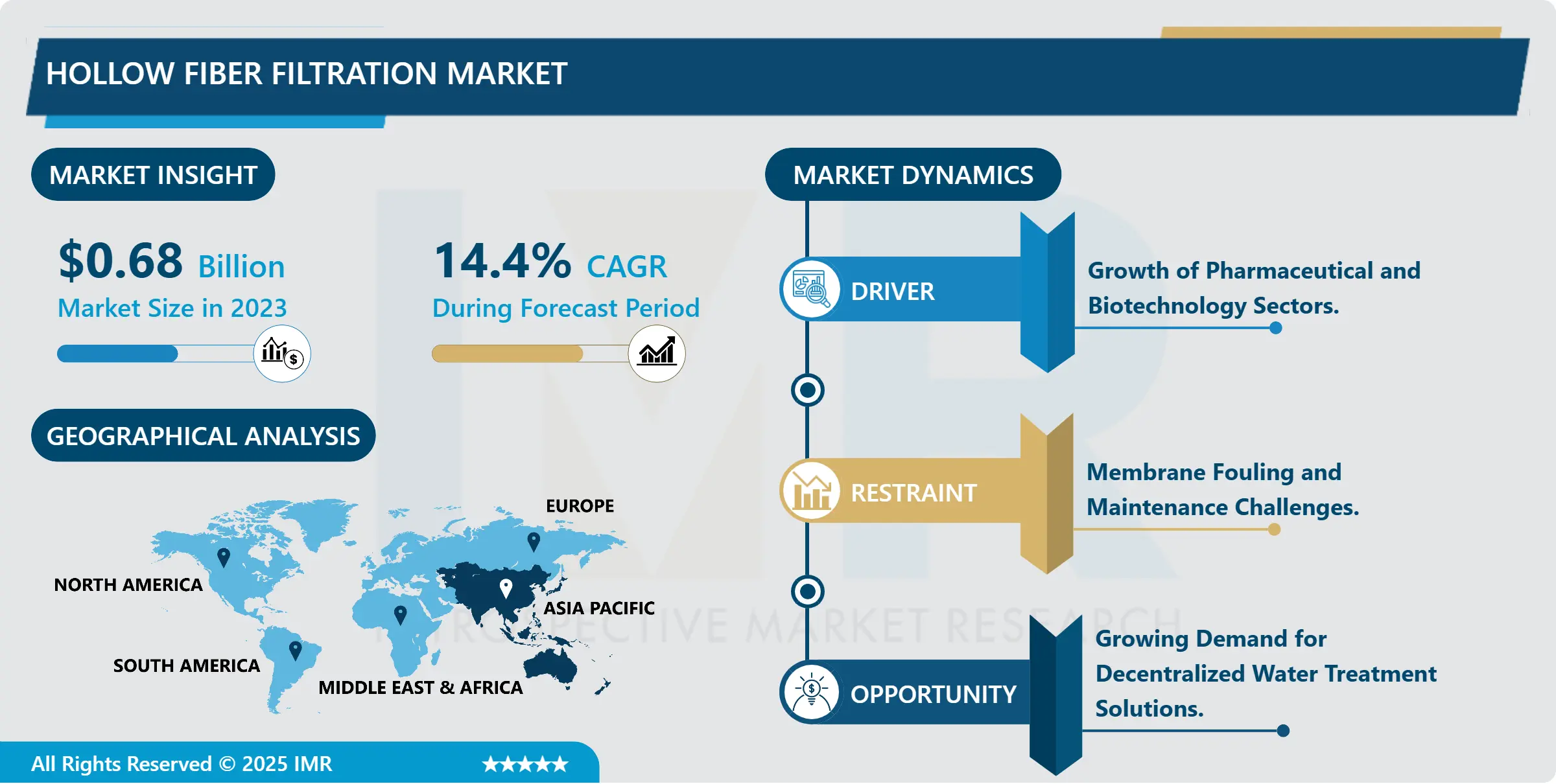
Hollow Fiber Filtration Market Size Was Valued at USD 0.68 Billion in 2023, and is Projected to Reach USD 2.28 Billion by 2032, Growing at a CAGR of 14.40% From 2024-2032.
The Hollow Fiber Filtration Market is the process of employing hollow fiber membranes to filter out particles suspended in liquids or gasses This is through micro filtration, ultra-filtering, nanofiltration and reverse osmosis. It is made by a large number of microfibers of small diameter which give a great unveil and provide an area of contact for filtration and subsequently permit separation of dirt, bacteria or other pollutants and particles from liquids. It is applied commonly in water treatment, food and beverage processing, pharmaceuticals, and biotechnology because of its efficiency in delivering high quality filtrate and since it can respond to various operation requirements.
The strict legislation and health consciousness mandatory for intake of clean and hygienically prepared water is one of the biggest growth drivers for the Hollow Fiber Filtration Market. Emergence and spread of waterborne diseases and the consequent spur in the demand for efficient water treatment solutions has strengthen the filtration technology. Also, the growing regulatory pressures, imposed by governments around the world to ensure high water quality and protecting the environment, is encouraging the municipalities and industries to incorporate higher end filtration systems in the water industry which is driving the demand for water filtration systems.
Another important growth factor is the growth of the pharmaceutical and biotechnology industries where hollow fiber filtration is used for uses such as sterilization filtration, cell spanning and process brightening. With these industries expanding there is the need to adopt top-notch solutions for filtration with an aim of sustaining on the product quality besides meeting the recommendations of individual states. This increasing need further fosters the growth of the market indicating how the hollow fiber membranes importance in preserving the safety and reliability of the manufactured drugs.
Hollow Fiber Filtration Market Trend Analysis:
The advancement of membrane technology.
The one major trend observed for the global Hollow Fiber Filtration Market is in terms of the membrane technology that has improved to support higher quality and durable hollow fiber membranes. Technological advancement through surface modification, pore size and shape modification and the use of new materials will improve the performance and durability of these membranes. Also, distinct countries have invested in the automation and smart monitoring system integration in filtration systems, a practice that enhances systems efficient data feeds.
Another new development is the movement to rely more heavily on hollow fiber filtration systems in de-centralized water treatment systems. When people move to the cities and multiple people in one home increase the pressure that centralized water supply systems face, filtration at the point of use becomes more possible. Due to offering flexibility, less capital investment and operation and maintenance costs these systems fit well in many areas like rural water supply and on site wastewater treatment systems.
Expansion in Emerging Markets
The global Hollow Fiber Filtration Market has opened and growing opportunities in the emerging economies, mainly due to the increase in growth rate in urbanization and industrialization that leads to high demand for water and waste water treatment. There is a good potential that fit in with the APEC member’s goals and objectives, and other regions like Asia-Pacific, Africa, and Latin America, all which are seeking ways to enhance on their systems in order to address the increasing demand of water by its people through application of hollow fiber filtration technologies. This increasing demand for new technologies and enhanced service solutions is good news for companies looking to establish a stronger foothold in these markets.
In addition, there are many prospects for technological improvement in the membrane systems that create continuing opportunities for the market participants to gauge the potential of their products. This is due to the enhancement of new materials including bio-based and nanocomposite membranes to improve filtration performances and at the same time creating sustainable solutions. Businesses that make a conscious effort to find new strategies to enhance the efficiency of manufacturing hollow fibre membranes that are cheaper, and have a lower or negligible impact on the environment should be able to set themselves apart amidst hold competition meaning that more customers should be attracted and long-term profitability should be achievable.
Hollow Fiber Filtration Market Segment Analysis:
Hollow Fiber Filtration Market is Segmented on the basis of Type, Material, Application, End User, and Region
By Type, Microfiltration segment is expected to dominate the market during the forecast period
The global hollow fiber filtration market is categorized based on type into micro, ultra, nano, and reverse osmosis, which meets precise separation requirements. Regarding its turnout, microfiltration is the roughest process as it filters larger particles like bacteria, viri and defile water and mostly used in water treatment industries, food industries, and related sectors. Ultrafiltration achieves a higher level of filtration than micron or even submicron, it traps more particles and macromolecules which are significant in the functionalities of; pharmaceutical and Bio-tech industries. Nanofiltration is situated between ultrafiltration and reverse osmosis which filters divalent ions with small organic molecules for softening of water and selected applications. Reverse osmosis removals nearly all dissolved salts, organics, and soluble contaminants and, therefore, is essential for desalination and high-quality water uses. These two filtration types are very significant to make sure that the quality and safety of numerous products and many processes in different industries.
By Application, Food and Beverage segment expected to held the largest share
The category breakdown of the global-hollow fiber filtration market is based on its application in water and wastewater treatment, food and beverages, pharmaceuticals and biotechnology, medicine, aquaculture, and others. As an application, the hollow fiber filtration is used in water and wastewater treatment to filter out impurities and pathogens and provide clean water for drinking as well as treat industrial and municipal wastewaters appropriately. This technology is used by the food and beverage industry in clarification, sterilization and separation processes in order to provide high quality and safe food. In the pharmaceutical and biotechnology industries, autonomous plant hollow fiber filtration is an imperative technology process used in sterlizing, concentrating, and purifying products to meet technical regulatory requirements. The medical application entails uses in dialysis and all the other therapeutic process that require high quality filtration. Hollow fiber membranes used in aquaculture to foster good aquatic health since they assist in removing wastes and pathogen in water. Other applications include those where the industrial and/or commercial processes can be improved by the effectiveness of hollow fiber filtration across several processes.
Hollow Fiber Filtration Market Regional Insights:
Asia Pacific is Expected to Dominate the Market Over the Forecast period
Currently, the most important region for consumption of hollow fiber filtration products is the Asia-Pacific region as it includes a large population, is actively developing industrialization and urbanization processes. The situation of water deficit and poor quality are severe in the region and this compel governments and industries to look for efficient technologies for water treatment. Today, dozens of countries have been immersed in the construction of large-scale water purification facilities, for example, Chinese and Indian ones. Also, an increased focus on environmental conservation is extending pressure to other segments to develop effective filtration systems, thereby complementing market growth in the region.
However, the biggest market for HFNF is expected to be the Asia-Pacific region where the pharmaceutical and biotechnology industries are rapidly growing beyond the water treatment business. These sectors are now placing much emphasis on research and development, in particular relating to quality assurance and filtration techniques in order to meet international standards. Therefore, significant demand for the technologies such as the hollow fiber filtration technologies is being witnessed in the region making the region to be the world’s largest market.
Active Key Players in the Hollow Fiber Filtration Market:
Toray Industries, Inc. (Japan)
Pall Corporation (United States)
Parker Hannifin Corporation (United States)
Membrana (a division of Evonik Industries AG) (Germany)
Koch Membrane Systems, Inc. (United States)
Mitsubishi Rayon Co., Ltd. (Japan)
Asahi Kasei Corporation (Japan)
SUEZ Water Technologies & Solutions (United States)
GE Water & Process Technologies (United States)
Veolia Water Technologies (France)
Other Active Players
Chapter 1: Introduction
1.1 Scope and Coverage
Chapter 2:Executive Summary
Chapter 3: Market Landscape
3.1 Market Dynamics
3.1.1 Drivers
3.1.2 Restraints
3.1.3 Opportunities
3.1.4 Challenges
3.2 Market Trend Analysis
3.3 PESTLE Analysis
3.4 Porter’s Five Forces Analysis
3.5 Industry Value Chain Analysis
3.6 Ecosystem
3.7 Regulatory Landscape
3.8 Price Trend Analysis
3.9 Patent Analysis
3.10 Technology Evolution
3.11 Investment Pockets
3.12 Import-Export Analysis
Chapter 4: Hollow Fiber Filtration Market by Type
4.1 Hollow Fiber Filtration Market Snapshot and Growth Engine
4.2 Hollow Fiber Filtration Market Overview
4.3 Microfiltration
4.3.1 Introduction and Market Overview
4.3.2 Historic and Forecasted Market Size in Value USD and Volume Units (2017-2032F)
4.3.3 Key Market Trends, Growth Factors and Opportunities
4.3.4 Microfiltration: Geographic Segmentation Analysis
4.4 Ultrafiltration
4.4.1 Introduction and Market Overview
4.4.2 Historic and Forecasted Market Size in Value USD and Volume Units (2017-2032F)
4.4.3 Key Market Trends, Growth Factors and Opportunities
4.4.4 Ultrafiltration: Geographic Segmentation Analysis
4.5 Nanofiltration
4.5.1 Introduction and Market Overview
4.5.2 Historic and Forecasted Market Size in Value USD and Volume Units (2017-2032F)
4.5.3 Key Market Trends, Growth Factors and Opportunities
4.5.4 Nanofiltration: Geographic Segmentation Analysis
4.6 Reverse Osmosis
4.6.1 Introduction and Market Overview
4.6.2 Historic and Forecasted Market Size in Value USD and Volume Units (2017-2032F)
4.6.3 Key Market Trends, Growth Factors and Opportunities
4.6.4 Reverse Osmosis: Geographic Segmentation Analysis
Chapter 5: Hollow Fiber Filtration Market by Material
5.1 Hollow Fiber Filtration Market Snapshot and Growth Engine
5.2 Hollow Fiber Filtration Market Overview
5.3 Polymeric
5.3.1 Introduction and Market Overview
5.3.2 Historic and Forecasted Market Size in Value USD and Volume Units (2017-2032F)
5.3.3 Key Market Trends, Growth Factors and Opportunities
5.3.4 Polymeric: Geographic Segmentation Analysis
5.4 Ceramic
5.4.1 Introduction and Market Overview
5.4.2 Historic and Forecasted Market Size in Value USD and Volume Units (2017-2032F)
5.4.3 Key Market Trends, Growth Factors and Opportunities
5.4.4 Ceramic: Geographic Segmentation Analysis
Chapter 6: Hollow Fiber Filtration Market by Application
6.1 Hollow Fiber Filtration Market Snapshot and Growth Engine
6.2 Hollow Fiber Filtration Market Overview
6.3 Water and Wastewater Treatment
6.3.1 Introduction and Market Overview
6.3.2 Historic and Forecasted Market Size in Value USD and Volume Units (2017-2032F)
6.3.3 Key Market Trends, Growth Factors and Opportunities
6.3.4 Water and Wastewater Treatment: Geographic Segmentation Analysis
6.4 Food and Beverage
6.4.1 Introduction and Market Overview
6.4.2 Historic and Forecasted Market Size in Value USD and Volume Units (2017-2032F)
6.4.3 Key Market Trends, Growth Factors and Opportunities
6.4.4 Food and Beverage: Geographic Segmentation Analysis
6.5 Pharmaceutical and Biotechnology
6.5.1 Introduction and Market Overview
6.5.2 Historic and Forecasted Market Size in Value USD and Volume Units (2017-2032F)
6.5.3 Key Market Trends, Growth Factors and Opportunities
6.5.4 Pharmaceutical and Biotechnology: Geographic Segmentation Analysis
6.6 Medical
6.6.1 Introduction and Market Overview
6.6.2 Historic and Forecasted Market Size in Value USD and Volume Units (2017-2032F)
6.6.3 Key Market Trends, Growth Factors and Opportunities
6.6.4 Medical: Geographic Segmentation Analysis
6.7 Aquaculture
6.7.1 Introduction and Market Overview
6.7.2 Historic and Forecasted Market Size in Value USD and Volume Units (2017-2032F)
6.7.3 Key Market Trends, Growth Factors and Opportunities
6.7.4 Aquaculture: Geographic Segmentation Analysis
6.8 Others
6.8.1 Introduction and Market Overview
6.8.2 Historic and Forecasted Market Size in Value USD and Volume Units (2017-2032F)
6.8.3 Key Market Trends, Growth Factors and Opportunities
6.8.4 Others: Geographic Segmentation Analysis
Chapter 7: Hollow Fiber Filtration Market by End User
7.1 Hollow Fiber Filtration Market Snapshot and Growth Engine
7.2 Hollow Fiber Filtration Market Overview
7.3 Industrial
7.3.1 Introduction and Market Overview
7.3.2 Historic and Forecasted Market Size in Value USD and Volume Units (2017-2032F)
7.3.3 Key Market Trends, Growth Factors and Opportunities
7.3.4 Industrial: Geographic Segmentation Analysis
7.4 Municipal
7.4.1 Introduction and Market Overview
7.4.2 Historic and Forecasted Market Size in Value USD and Volume Units (2017-2032F)
7.4.3 Key Market Trends, Growth Factors and Opportunities
7.4.4 Municipal: Geographic Segmentation Analysis
7.5 Residential
7.5.1 Introduction and Market Overview
7.5.2 Historic and Forecasted Market Size in Value USD and Volume Units (2017-2032F)
7.5.3 Key Market Trends, Growth Factors and Opportunities
7.5.4 Residential: Geographic Segmentation Analysis
Chapter 8: Company Profiles and Competitive Analysis
8.1 Competitive Landscape
8.1.1 Competitive Benchmarking
8.1.2 Hollow Fiber Filtration Market Share by Manufacturer (2023)
8.1.3 Industry BCG Matrix
8.1.4 Heat Map Analysis
8.1.5 Mergers and Acquisitions
8.2 TORAY INDUSTRIES INC. (JAPAN)
8.2.1 Company Overview
8.2.2 Key Executives
8.2.3 Company Snapshot
8.2.4 Role of the Company in the Market
8.2.5 Sustainability and Social Responsibility
8.2.6 Operating Business Segments
8.2.7 Product Portfolio
8.2.8 Business Performance
8.2.9 Key Strategic Moves and Recent Developments
8.2.10 SWOT Analysis
8.3 PALL CORPORATION (UNITED STATES)
8.4 PARKER HANNIFIN CORPORATION (UNITED STATES)
8.5 MEMBRANA (A DIVISION OF EVONIK INDUSTRIES AG) (GERMANY)
8.6 KOCH MEMBRANE SYSTEMS INC. (UNITED STATES)
8.7 MITSUBISHI RAYON CO. LTD. (JAPAN)
8.8 ASAHI KASEI CORPORATION (JAPAN)
8.9 SUEZ WATER TECHNOLOGIES & SOLUTIONS (UNITED STATES)
8.10 GE WATER & PROCESS TECHNOLOGIES (UNITED STATES)
8.11 VEOLIA WATER TECHNOLOGIES (FRANCE)
8.12 OTHER ACTIVE PLAYERS
Chapter 9: Global Hollow Fiber Filtration Market By Region
9.1 Overview
9.2. North America Hollow Fiber Filtration Market
9.2.1 Key Market Trends, Growth Factors and Opportunities
9.2.2 Top Key Companies
9.2.3 Historic and Forecasted Market Size by Segments
9.2.4 Historic and Forecasted Market Size By Type
9.2.4.1 Microfiltration
9.2.4.2 Ultrafiltration
9.2.4.3 Nanofiltration
9.2.4.4 Reverse Osmosis
9.2.5 Historic and Forecasted Market Size By Material
9.2.5.1 Polymeric
9.2.5.2 Ceramic
9.2.6 Historic and Forecasted Market Size By Application
9.2.6.1 Water and Wastewater Treatment
9.2.6.2 Food and Beverage
9.2.6.3 Pharmaceutical and Biotechnology
9.2.6.4 Medical
9.2.6.5 Aquaculture
9.2.6.6 Others
9.2.7 Historic and Forecasted Market Size By End User
9.2.7.1 Industrial
9.2.7.2 Municipal
9.2.7.3 Residential
9.2.8 Historic and Forecast Market Size by Country
9.2.8.1 US
9.2.8.2 Canada
9.2.8.3 Mexico
9.3. Eastern Europe Hollow Fiber Filtration Market
9.3.1 Key Market Trends, Growth Factors and Opportunities
9.3.2 Top Key Companies
9.3.3 Historic and Forecasted Market Size by Segments
9.3.4 Historic and Forecasted Market Size By Type
9.3.4.1 Microfiltration
9.3.4.2 Ultrafiltration
9.3.4.3 Nanofiltration
9.3.4.4 Reverse Osmosis
9.3.5 Historic and Forecasted Market Size By Material
9.3.5.1 Polymeric
9.3.5.2 Ceramic
9.3.6 Historic and Forecasted Market Size By Application
9.3.6.1 Water and Wastewater Treatment
9.3.6.2 Food and Beverage
9.3.6.3 Pharmaceutical and Biotechnology
9.3.6.4 Medical
9.3.6.5 Aquaculture
9.3.6.6 Others
9.3.7 Historic and Forecasted Market Size By End User
9.3.7.1 Industrial
9.3.7.2 Municipal
9.3.7.3 Residential
9.3.8 Historic and Forecast Market Size by Country
9.3.8.1 Russia
9.3.8.2 Bulgaria
9.3.8.3 The Czech Republic
9.3.8.4 Hungary
9.3.8.5 Poland
9.3.8.6 Romania
9.3.8.7 Rest of Eastern Europe
9.4. Western Europe Hollow Fiber Filtration Market
9.4.1 Key Market Trends, Growth Factors and Opportunities
9.4.2 Top Key Companies
9.4.3 Historic and Forecasted Market Size by Segments
9.4.4 Historic and Forecasted Market Size By Type
9.4.4.1 Microfiltration
9.4.4.2 Ultrafiltration
9.4.4.3 Nanofiltration
9.4.4.4 Reverse Osmosis
9.4.5 Historic and Forecasted Market Size By Material
9.4.5.1 Polymeric
9.4.5.2 Ceramic
9.4.6 Historic and Forecasted Market Size By Application
9.4.6.1 Water and Wastewater Treatment
9.4.6.2 Food and Beverage
9.4.6.3 Pharmaceutical and Biotechnology
9.4.6.4 Medical
9.4.6.5 Aquaculture
9.4.6.6 Others
9.4.7 Historic and Forecasted Market Size By End User
9.4.7.1 Industrial
9.4.7.2 Municipal
9.4.7.3 Residential
9.4.8 Historic and Forecast Market Size by Country
9.4.8.1 Germany
9.4.8.2 UK
9.4.8.3 France
9.4.8.4 The Netherlands
9.4.8.5 Italy
9.4.8.6 Spain
9.4.8.7 Rest of Western Europe
9.5. Asia Pacific Hollow Fiber Filtration Market
9.5.1 Key Market Trends, Growth Factors and Opportunities
9.5.2 Top Key Companies
9.5.3 Historic and Forecasted Market Size by Segments
9.5.4 Historic and Forecasted Market Size By Type
9.5.4.1 Microfiltration
9.5.4.2 Ultrafiltration
9.5.4.3 Nanofiltration
9.5.4.4 Reverse Osmosis
9.5.5 Historic and Forecasted Market Size By Material
9.5.5.1 Polymeric
9.5.5.2 Ceramic
9.5.6 Historic and Forecasted Market Size By Application
9.5.6.1 Water and Wastewater Treatment
9.5.6.2 Food and Beverage
9.5.6.3 Pharmaceutical and Biotechnology
9.5.6.4 Medical
9.5.6.5 Aquaculture
9.5.6.6 Others
9.5.7 Historic and Forecasted Market Size By End User
9.5.7.1 Industrial
9.5.7.2 Municipal
9.5.7.3 Residential
9.5.8 Historic and Forecast Market Size by Country
9.5.8.1 China
9.5.8.2 India
9.5.8.3 Japan
9.5.8.4 South Korea
9.5.8.5 Malaysia
9.5.8.6 Thailand
9.5.8.7 Vietnam
9.5.8.8 The Philippines
9.5.8.9 Australia
9.5.8.10 New Zealand
9.5.8.11 Rest of APAC
9.6. Middle East & Africa Hollow Fiber Filtration Market
9.6.1 Key Market Trends, Growth Factors and Opportunities
9.6.2 Top Key Companies
9.6.3 Historic and Forecasted Market Size by Segments
9.6.4 Historic and Forecasted Market Size By Type
9.6.4.1 Microfiltration
9.6.4.2 Ultrafiltration
9.6.4.3 Nanofiltration
9.6.4.4 Reverse Osmosis
9.6.5 Historic and Forecasted Market Size By Material
9.6.5.1 Polymeric
9.6.5.2 Ceramic
9.6.6 Historic and Forecasted Market Size By Application
9.6.6.1 Water and Wastewater Treatment
9.6.6.2 Food and Beverage
9.6.6.3 Pharmaceutical and Biotechnology
9.6.6.4 Medical
9.6.6.5 Aquaculture
9.6.6.6 Others
9.6.7 Historic and Forecasted Market Size By End User
9.6.7.1 Industrial
9.6.7.2 Municipal
9.6.7.3 Residential
9.6.8 Historic and Forecast Market Size by Country
9.6.8.1 Turkiye
9.6.8.2 Bahrain
9.6.8.3 Kuwait
9.6.8.4 Saudi Arabia
9.6.8.5 Qatar
9.6.8.6 UAE
9.6.8.7 Israel
9.6.8.8 South Africa
9.7. South America Hollow Fiber Filtration Market
9.7.1 Key Market Trends, Growth Factors and Opportunities
9.7.2 Top Key Companies
9.7.3 Historic and Forecasted Market Size by Segments
9.7.4 Historic and Forecasted Market Size By Type
9.7.4.1 Microfiltration
9.7.4.2 Ultrafiltration
9.7.4.3 Nanofiltration
9.7.4.4 Reverse Osmosis
9.7.5 Historic and Forecasted Market Size By Material
9.7.5.1 Polymeric
9.7.5.2 Ceramic
9.7.6 Historic and Forecasted Market Size By Application
9.7.6.1 Water and Wastewater Treatment
9.7.6.2 Food and Beverage
9.7.6.3 Pharmaceutical and Biotechnology
9.7.6.4 Medical
9.7.6.5 Aquaculture
9.7.6.6 Others
9.7.7 Historic and Forecasted Market Size By End User
9.7.7.1 Industrial
9.7.7.2 Municipal
9.7.7.3 Residential
9.7.8 Historic and Forecast Market Size by Country
9.7.8.1 Brazil
9.7.8.2 Argentina
9.7.8.3 Rest of SA
Chapter 10 Analyst Viewpoint and Conclusion
10.1 Recommendations and Concluding Analysis
10.2 Potential Market Strategies
Chapter 11 Research Methodology
11.1 Research Process
11.2 Primary Research
11.3 Secondary Research
Q1: What would be the forecast period in the Hollow Fiber Filtration Market research report?
A1: The forecast period in the Hollow Fiber Filtration Market research report is 2024-2032.
Q2: Who are the key players in the Hollow Fiber Filtration Market?
A2: Toray Industries, Inc. (Japan), Pall Corporation (United States), Parker Hannifin Corporation (United States), Membrana (a division of Evonik Industries AG) (Germany), Koch Membrane Systems, Inc. (United States), Mitsubishi Rayon Co., Ltd. (Japan), Asahi Kasei Corporation (Japan), SUEZ Water Technologies & Solutions (United States), GE Water & Process Technologies (United States), Veolia Water Technologies (France), and Other Active Players.
Q3: What are the segments of the Hollow Fiber Filtration Market?
A3: The Hollow Fiber Filtration Market is segmented into by Type (Microfiltration, Ultrafiltration, Nanofiltration, Reverse Osmosis), By Material (Polymeric, Ceramic), Application (Water and Wastewater Treatment, Food and Beverage, Pharmaceutical and Biotechnology, Medical, Aquaculture, Others), End User (Industrial, Municipal, Residential). By region, it is analyzed across North America (U.S., Canada, Mexico), Eastern Europe (Russia, Bulgaria, The Czech Republic, Hungary, Poland, Romania, Rest of Eastern Europe), Western Europe (Germany, UK, France, The Netherlands, Italy, Spain, Rest of Western Europe), Asia Pacific (China, India, Japan, South Korea, Malaysia, Thailand, Vietnam, The Philippines, Australia, New-Zealand, Rest of APAC), Middle East & Africa (Turkiye, Bahrain, Kuwait, Saudi Arabia, Qatar, UAE, Israel, South Africa), South America (Brazil, Argentina, Rest of SA).
Q4: What is the Hollow Fiber Filtration Market?
A4: The Hollow Fiber Filtration Market is the process of employing hollow fiber membranes to filter out particles suspended in liquids or gasses This is through micro filtration, ultra-filtering, nanofiltration and reverse osmosis. It is made by a large number of microfibers of small diameter which give a great unveil and provide an area of contact for filtration and subsequently permit separation of dirt, bacteria or other pollutants and particles from liquids. It is applied commonly in water treatment, food and beverage processing, pharmaceuticals, and biotechnology because of its efficiency in delivering high quality filtrate and since it can respond to various operation requirements.
Q5: How big is the Hollow Fiber Filtration Market?
A5: Hollow Fiber Filtration Market Size Was Valued at USD 0.68 Billion in 2023, and is Projected to Reach USD 2.28 Billion by 2032, Growing at a CAGR of 14.40% From 2024-2032.
How to Buy a Report from eminsights.jp
On the product page, choose the license you want: Single-User License, Multi-User License or Enterprise License.
If you required report in your native language, then you can click on Translated Report button and fill out the form with report name and language you want, then our team will contact you as soon as possible.
Click the Buy Now button.
You will be redirected to the checkout page. Enter your company details and payment information.
Click Place Order to complete the purchase.
Confirmation: You’ll receive an order confirmation and our team will contact you shortly with your ordered report.
If you have any questions, fill out the contact form below or email us at [email protected].
Thank you for choosing eminsights.jp!