Stay Ahead in Fast-Growing Economies.
Browse Reports Now
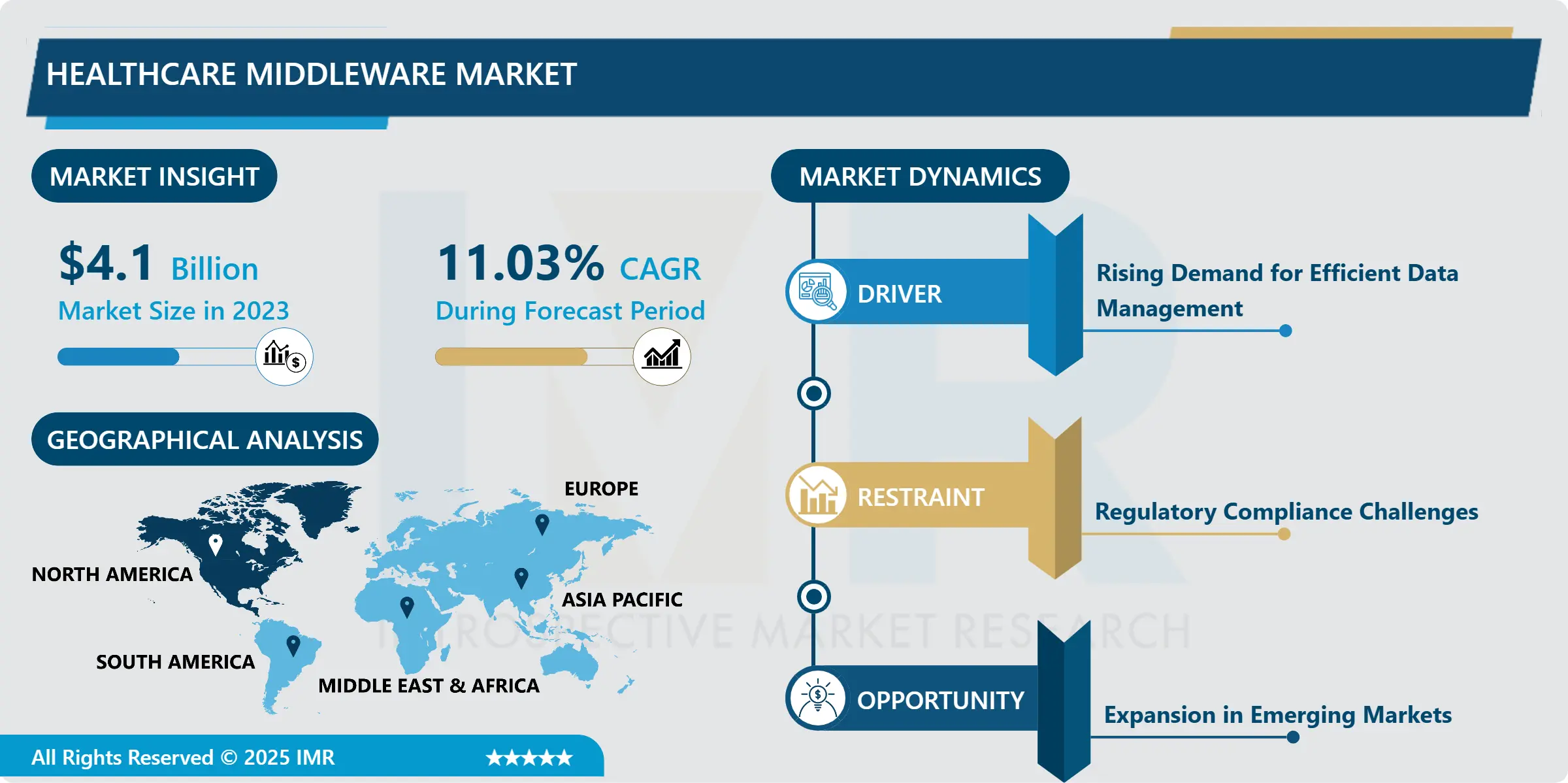
Healthcare Middleware Market – Current Analysis by Market Share 2024-2032
Healthcare Middleware Market Size Was Valued at USD 4.10 Billion in 2023, and is Projected to Reach USD 10.51 Billion by 2032, Growing at a CAGR of 11.03% From 2024-2032.

IMR Group
Description
Healthcare Middleware Market Synopsis:
Healthcare Middleware Market Size Was Valued at USD 4.10 Billion in 2023, and is Projected to Reach USD 10.51 Billion by 2032, Growing at a CAGR of 11.03% From 2024-2032.
Healthcare middleware can be defined as software interfaces that enable connectivity and interoperability between individual health systems, applications and devices. It connects different interfaces to align processes, facilitate information exchange, and guarantee that the clinicians obtain relevant and current data to drive patients’ outcomes and organizational performance.
The healthcare middleware market has been steadily growing over the years for two main reasons; enhanced exchange of data in healthcare facilities and improved interoperability. As EHRs are increasingly implemented, telemedicine, and connected devices, there is a need for strong middleware to element numerous apps and devices. This market is fueled by the desire to get better means of patient treatment, better ways of running the business and meeting lawful requirements like the HIPAA.
Moreover, to thrive or survive in today’s value based care business environment, dumfounding need for real time exchange of data and unified, complete picture of patients arises. Middleware solutions help healthcare organizations accomplish this through supporting the integration of patient care, financial and administrative data. This helps providers offer a more integrated service, spend less, and get better results. Big data analytics and AI in Healthcare also offer another argument because these technologies need large databases from various sources to analyze and apply data.
Healthcare Middleware Market Trend Analysis:
Increased Focus on Interoperability
Another emerging interest area in the healthcare middleware market is the ability of the middleware to interconnect with other healthcare systems. The increasing amount of health-related information also means that the simple and effective exchange and availability of data is becoming increasingly important for improving the treatment of patients and organization effectiveness. Governments and regulatory agencies are putting the squeeze on follow-on standards that require more interoperability, thereby forcing healthcare institutions to seek out middleware that can enable this type of interaction.
This also as a result of increased use of health information exchange systems (HIEs) and ACOs in related entities which call for efficient interaction. As more and more stakeholders focus on benefit that comes with integrated data to enhance clinical decision making and patient care—healthcare middleware will inevitably become invaluable in order to guarantee proper information flow through different systems.
Expansion in Emerging Markets
However, the emerging trend that Msotek is yet to fully explore in the healthcare middleware market is the international market. Indeed as these regions continue to experience high economic growth and fully develop their health care systems, it emerges that the level of middleware technology in healthcare higher and efficient middle ware solutions to enable health of communication betwen disparate halth care IT systems & systems is highly demanded. One main factor that is culminating to this demand is the rising incidences of chronic diseases besides the overall requirement of enhanced health care systems.
The stakeholders in the developing countries are in constant lookout for products that can help in handling patients, making operations better and increasing connectivity. As key markets, offering specific middleware solutions to these markets will unlock new and valuable customers and help build the right systems for healthcare success. This expansion not only makes it a good business model but also let emerging market providers deliver better healthcare services.
Healthcare Middleware Market Segment Analysis:
Healthcare Middleware Market is Segmented on the basis of Type, Mode, Application, End User, and Region
By Type, Platform Middleware segment is expected to dominate the market during the forecast period
The types of healthcare middleware could be diverse such as integration middleware, communication middleware, platform middleware and others. Integration middleware mainly adapted in healthcare prefer to concentrate on harmonizing different applications and systems involved in the health sector that are involved in the exchange of information. It is a key component for enhancing EHR connectivity to laboratory systems and radiology information including providing real-time patient data to care givers.
Communication middleware on the other hand works to provide communication between the various health care units such as hospitals, clinics and laboratories. The middleware of this nature helps in ensuring the transfer of data, if it is to be shared among various health care practitioners, is done securely and with lot of ease. Platform middleware also offers a framework and infrastructure where different healthcare applications can be developed independently and integrated to suit multiple healthcare organization’s particular requirements. Due to the rising need for compatibility and seamless exchange of data, both of these types of middleware remain crucial in healthcare delivery.
By Application, Financial segment expected to held the largest share
Based on applications, the healthcare middleware market encompasses clinical /care, financial/scientific and operational/administrative. Applying it into a clinical point of view, middleware solutions help improve the quality of a particular patient’s care by sealing the divide between the patient and the individual who needs information about the patient. This facilitates improved clinical decision, decrease of mistakes which consequently enhance teamwork by involving multidisciplinary teams.
In terms of finance, middleware assists in billing, processing of claims besides supporting revenue management cycles. The presented thesis states that the functional integration of financial systems and clinical data enhances not only financial performance but also operational effectiveness in healthcare organisations. Application of middleware in operational as well as administrative area targets more at affording general organizational optimization by using middleware to automate tasks and maintain consistency in organizational communications. Since healthcare facilities may pursue better utilization of their resources and enhanced client results, the necessity for middleware in each of these applications remains high.
Healthcare Middleware Market Regional Insights:
North America is Expected to Dominate the Market Over the Forecast period
As it is, the healthcare middleware market in North America is dominating the global market which is due to its health care infrastructure, the usage of technology and its emphasis on interoperability. C: Existence of large scale health care organizations and technology organizations within United States and Canada generates demand and encourages product development of middleware. Also, the regulatory authorities impose pressure to adopt technologies that facilitate data sharing and integration in North America, thereby stimulating the market’s growth.
The trend towards value based as well as patient centred models of care delivery in North America has also amplified the role of data management and integration to support the intelligent processing and analysis of data. This trend will put further pressure on healthcare providers to act and, as a result, compile demand for the healthcare middleware business, which is set to remain in its leadership of North America.
Active Key Players in the Healthcare Middleware Market:
Cerner Corporation (USA)
IBM Corporation (USA)
Allscripts Healthcare Solutions (USA)
Oracle Corporation (USA)
Red Hat, Inc. (USA)
Mirth Corporation (USA)
Infor, Inc. (USA)
InterSystems Corporation (USA)
Epic Systems Corporation (USA)
Microsoft Corporation (USA)
Siemens Healthineers (Germany)
TIBCO Software Inc. (USA)
Other Active Players
Key Industry Developments in the Healthcare Middleware Market:
On April 2023, InterSystems a software company launched its new healthcare middleware platform, HealthShare Health Connect Cloud. This platform is designed to help healthcare organizations connect and share data across their enterprise, regardless of the different systems they use.
On March 2022, Microsoft a technology company launched Azure Health Data Services. This platform is a cloud-based solution that allows healthcare organizations to store, manage, and analyze healthcare data in the open standards Fast Healthcare Interoperability Resources (FHIR) and Digital Imaging and Communications in Medicine (DICOM).
On September 18, 2023, Oracle Explain this Summarize X althcare organizations. Integrated with Oracle’s electronic health record (EHR) solutions, the new Oracle Clinical Digital Assistant enables providers to leverage the power of generative Al together with voice commands to reduce manual work so that they can focus more attention on patient care.
Chapter 1: Introduction
1.1 Scope and Coverage
Chapter 2:Executive Summary
Chapter 3: Market Landscape
3.1 Market Dynamics
3.1.1 Drivers
3.1.2 Restraints
3.1.3 Opportunities
3.1.4 Challenges
3.2 Market Trend Analysis
3.3 PESTLE Analysis
3.4 Porter’s Five Forces Analysis
3.5 Industry Value Chain Analysis
3.6 Ecosystem
3.7 Regulatory Landscape
3.8 Price Trend Analysis
3.9 Patent Analysis
3.10 Technology Evolution
3.11 Investment Pockets
3.12 Import-Export Analysis
Chapter 4: Healthcare Middleware Market by Type
4.1 Healthcare Middleware Market Snapshot and Growth Engine
4.2 Healthcare Middleware Market Overview
4.3 Integration Middleware
4.3.1 Introduction and Market Overview
4.3.2 Historic and Forecasted Market Size in Value USD and Volume Units (2017-2032F)
4.3.3 Key Market Trends, Growth Factors and Opportunities
4.3.4 Integration Middleware: Geographic Segmentation Analysis
4.4 Communication Middleware
4.4.1 Introduction and Market Overview
4.4.2 Historic and Forecasted Market Size in Value USD and Volume Units (2017-2032F)
4.4.3 Key Market Trends, Growth Factors and Opportunities
4.4.4 Communication Middleware: Geographic Segmentation Analysis
4.5 Platform Middleware
4.5.1 Introduction and Market Overview
4.5.2 Historic and Forecasted Market Size in Value USD and Volume Units (2017-2032F)
4.5.3 Key Market Trends, Growth Factors and Opportunities
4.5.4 Platform Middleware: Geographic Segmentation Analysis
4.6 Others)
4.6.1 Introduction and Market Overview
4.6.2 Historic and Forecasted Market Size in Value USD and Volume Units (2017-2032F)
4.6.3 Key Market Trends, Growth Factors and Opportunities
4.6.4 Others): Geographic Segmentation Analysis
4.7 Mode (Cloud Based
4.7.1 Introduction and Market Overview
4.7.2 Historic and Forecasted Market Size in Value USD and Volume Units (2017-2032F)
4.7.3 Key Market Trends, Growth Factors and Opportunities
4.7.4 Mode (Cloud Based: Geographic Segmentation Analysis
4.8 On-Premise
4.8.1 Introduction and Market Overview
4.8.2 Historic and Forecasted Market Size in Value USD and Volume Units (2017-2032F)
4.8.3 Key Market Trends, Growth Factors and Opportunities
4.8.4 On-Premise: Geographic Segmentation Analysis
4.9 Hybrid
4.9.1 Introduction and Market Overview
4.9.2 Historic and Forecasted Market Size in Value USD and Volume Units (2017-2032F)
4.9.3 Key Market Trends, Growth Factors and Opportunities
4.9.4 Hybrid: Geographic Segmentation Analysis
Chapter 5: Healthcare Middleware Market by Application
5.1 Healthcare Middleware Market Snapshot and Growth Engine
5.2 Healthcare Middleware Market Overview
5.3 Clinical
5.3.1 Introduction and Market Overview
5.3.2 Historic and Forecasted Market Size in Value USD and Volume Units (2017-2032F)
5.3.3 Key Market Trends, Growth Factors and Opportunities
5.3.4 Clinical: Geographic Segmentation Analysis
5.4 Financial
5.4.1 Introduction and Market Overview
5.4.2 Historic and Forecasted Market Size in Value USD and Volume Units (2017-2032F)
5.4.3 Key Market Trends, Growth Factors and Opportunities
5.4.4 Financial: Geographic Segmentation Analysis
5.5 and Operational & Administrative
5.5.1 Introduction and Market Overview
5.5.2 Historic and Forecasted Market Size in Value USD and Volume Units (2017-2032F)
5.5.3 Key Market Trends, Growth Factors and Opportunities
5.5.4 and Operational & Administrative: Geographic Segmentation Analysis
Chapter 6: Healthcare Middleware Market by End-User
6.1 Healthcare Middleware Market Snapshot and Growth Engine
6.2 Healthcare Middleware Market Overview
6.3 Hospitals
6.3.1 Introduction and Market Overview
6.3.2 Historic and Forecasted Market Size in Value USD and Volume Units (2017-2032F)
6.3.3 Key Market Trends, Growth Factors and Opportunities
6.3.4 Hospitals: Geographic Segmentation Analysis
6.4 Clinical Laboratories
6.4.1 Introduction and Market Overview
6.4.2 Historic and Forecasted Market Size in Value USD and Volume Units (2017-2032F)
6.4.3 Key Market Trends, Growth Factors and Opportunities
6.4.4 Clinical Laboratories: Geographic Segmentation Analysis
6.5 and Others
6.5.1 Introduction and Market Overview
6.5.2 Historic and Forecasted Market Size in Value USD and Volume Units (2017-2032F)
6.5.3 Key Market Trends, Growth Factors and Opportunities
6.5.4 and Others: Geographic Segmentation Analysis
Chapter 7: Company Profiles and Competitive Analysis
7.1 Competitive Landscape
7.1.1 Competitive Benchmarking
7.1.2 Healthcare Middleware Market Share by Manufacturer (2023)
7.1.3 Industry BCG Matrix
7.1.4 Heat Map Analysis
7.1.5 Mergers and Acquisitions
7.2 CERNER CORPORATION (USA)
7.2.1 Company Overview
7.2.2 Key Executives
7.2.3 Company Snapshot
7.2.4 Role of the Company in the Market
7.2.5 Sustainability and Social Responsibility
7.2.6 Operating Business Segments
7.2.7 Product Portfolio
7.2.8 Business Performance
7.2.9 Key Strategic Moves and Recent Developments
7.2.10 SWOT Analysis
7.3 IBM CORPORATION (USA)
7.4 ALLSCRIPTS HEALTHCARE SOLUTIONS (USA)
7.5 ORACLE CORPORATION (USA)
7.6 RED HAT INC. (USA)
7.7 MIRTH CORPORATION (USA)
7.8 INFOR INC. (USA)
7.9 INTERSYSTEMS CORPORATION (USA)
7.10 EPIC SYSTEMS CORPORATION (USA)
7.11 MICROSOFT CORPORATION (USA)
7.12 SIEMENS HEALTHINEERS (GERMANY)
7.13 TIBCO SOFTWARE INC. (USA)
7.14 .
7.15 OTHER ACTIVE PLAYERS
Chapter 8: Global Healthcare Middleware Market By Region
8.1 Overview
8.2. North America Healthcare Middleware Market
8.2.1 Key Market Trends, Growth Factors and Opportunities
8.2.2 Top Key Companies
8.2.3 Historic and Forecasted Market Size by Segments
8.2.4 Historic and Forecasted Market Size By Type
8.2.4.1 Integration Middleware
8.2.4.2 Communication Middleware
8.2.4.3 Platform Middleware
8.2.4.4 Others)
8.2.4.5 Mode (Cloud Based
8.2.4.6 On-Premise
8.2.4.7 Hybrid
8.2.5 Historic and Forecasted Market Size By Application
8.2.5.1 Clinical
8.2.5.2 Financial
8.2.5.3 and Operational & Administrative
8.2.6 Historic and Forecasted Market Size By End-User
8.2.6.1 Hospitals
8.2.6.2 Clinical Laboratories
8.2.6.3 and Others
8.2.7 Historic and Forecast Market Size by Country
8.2.7.1 US
8.2.7.2 Canada
8.2.7.3 Mexico
8.3. Eastern Europe Healthcare Middleware Market
8.3.1 Key Market Trends, Growth Factors and Opportunities
8.3.2 Top Key Companies
8.3.3 Historic and Forecasted Market Size by Segments
8.3.4 Historic and Forecasted Market Size By Type
8.3.4.1 Integration Middleware
8.3.4.2 Communication Middleware
8.3.4.3 Platform Middleware
8.3.4.4 Others)
8.3.4.5 Mode (Cloud Based
8.3.4.6 On-Premise
8.3.4.7 Hybrid
8.3.5 Historic and Forecasted Market Size By Application
8.3.5.1 Clinical
8.3.5.2 Financial
8.3.5.3 and Operational & Administrative
8.3.6 Historic and Forecasted Market Size By End-User
8.3.6.1 Hospitals
8.3.6.2 Clinical Laboratories
8.3.6.3 and Others
8.3.7 Historic and Forecast Market Size by Country
8.3.7.1 Russia
8.3.7.2 Bulgaria
8.3.7.3 The Czech Republic
8.3.7.4 Hungary
8.3.7.5 Poland
8.3.7.6 Romania
8.3.7.7 Rest of Eastern Europe
8.4. Western Europe Healthcare Middleware Market
8.4.1 Key Market Trends, Growth Factors and Opportunities
8.4.2 Top Key Companies
8.4.3 Historic and Forecasted Market Size by Segments
8.4.4 Historic and Forecasted Market Size By Type
8.4.4.1 Integration Middleware
8.4.4.2 Communication Middleware
8.4.4.3 Platform Middleware
8.4.4.4 Others)
8.4.4.5 Mode (Cloud Based
8.4.4.6 On-Premise
8.4.4.7 Hybrid
8.4.5 Historic and Forecasted Market Size By Application
8.4.5.1 Clinical
8.4.5.2 Financial
8.4.5.3 and Operational & Administrative
8.4.6 Historic and Forecasted Market Size By End-User
8.4.6.1 Hospitals
8.4.6.2 Clinical Laboratories
8.4.6.3 and Others
8.4.7 Historic and Forecast Market Size by Country
8.4.7.1 Germany
8.4.7.2 UK
8.4.7.3 France
8.4.7.4 The Netherlands
8.4.7.5 Italy
8.4.7.6 Spain
8.4.7.7 Rest of Western Europe
8.5. Asia Pacific Healthcare Middleware Market
8.5.1 Key Market Trends, Growth Factors and Opportunities
8.5.2 Top Key Companies
8.5.3 Historic and Forecasted Market Size by Segments
8.5.4 Historic and Forecasted Market Size By Type
8.5.4.1 Integration Middleware
8.5.4.2 Communication Middleware
8.5.4.3 Platform Middleware
8.5.4.4 Others)
8.5.4.5 Mode (Cloud Based
8.5.4.6 On-Premise
8.5.4.7 Hybrid
8.5.5 Historic and Forecasted Market Size By Application
8.5.5.1 Clinical
8.5.5.2 Financial
8.5.5.3 and Operational & Administrative
8.5.6 Historic and Forecasted Market Size By End-User
8.5.6.1 Hospitals
8.5.6.2 Clinical Laboratories
8.5.6.3 and Others
8.5.7 Historic and Forecast Market Size by Country
8.5.7.1 China
8.5.7.2 India
8.5.7.3 Japan
8.5.7.4 South Korea
8.5.7.5 Malaysia
8.5.7.6 Thailand
8.5.7.7 Vietnam
8.5.7.8 The Philippines
8.5.7.9 Australia
8.5.7.10 New Zealand
8.5.7.11 Rest of APAC
8.6. Middle East & Africa Healthcare Middleware Market
8.6.1 Key Market Trends, Growth Factors and Opportunities
8.6.2 Top Key Companies
8.6.3 Historic and Forecasted Market Size by Segments
8.6.4 Historic and Forecasted Market Size By Type
8.6.4.1 Integration Middleware
8.6.4.2 Communication Middleware
8.6.4.3 Platform Middleware
8.6.4.4 Others)
8.6.4.5 Mode (Cloud Based
8.6.4.6 On-Premise
8.6.4.7 Hybrid
8.6.5 Historic and Forecasted Market Size By Application
8.6.5.1 Clinical
8.6.5.2 Financial
8.6.5.3 and Operational & Administrative
8.6.6 Historic and Forecasted Market Size By End-User
8.6.6.1 Hospitals
8.6.6.2 Clinical Laboratories
8.6.6.3 and Others
8.6.7 Historic and Forecast Market Size by Country
8.6.7.1 Turkiye
8.6.7.2 Bahrain
8.6.7.3 Kuwait
8.6.7.4 Saudi Arabia
8.6.7.5 Qatar
8.6.7.6 UAE
8.6.7.7 Israel
8.6.7.8 South Africa
8.7. South America Healthcare Middleware Market
8.7.1 Key Market Trends, Growth Factors and Opportunities
8.7.2 Top Key Companies
8.7.3 Historic and Forecasted Market Size by Segments
8.7.4 Historic and Forecasted Market Size By Type
8.7.4.1 Integration Middleware
8.7.4.2 Communication Middleware
8.7.4.3 Platform Middleware
8.7.4.4 Others)
8.7.4.5 Mode (Cloud Based
8.7.4.6 On-Premise
8.7.4.7 Hybrid
8.7.5 Historic and Forecasted Market Size By Application
8.7.5.1 Clinical
8.7.5.2 Financial
8.7.5.3 and Operational & Administrative
8.7.6 Historic and Forecasted Market Size By End-User
8.7.6.1 Hospitals
8.7.6.2 Clinical Laboratories
8.7.6.3 and Others
8.7.7 Historic and Forecast Market Size by Country
8.7.7.1 Brazil
8.7.7.2 Argentina
8.7.7.3 Rest of SA
Chapter 9 Analyst Viewpoint and Conclusion
9.1 Recommendations and Concluding Analysis
9.2 Potential Market Strategies
Chapter 10 Research Methodology
10.1 Research Process
10.2 Primary Research
10.3 Secondary Research
Q1: What is the Healthcare Middleware Market?
A1: Healthcare middleware can be defined as software interfaces that enable connectivity and interoperability between individual health systems, applications and devices. It connects different interfaces to align processes, facilitate information exchange, and guarantee that the clinicians obtain relevant and current data to drive patients’ outcomes and organizational performance.
Q2: How big is the Healthcare Middleware Market?
A2: Healthcare Middleware Market Size Was Valued at USD 4.10 Billion in 2023, and is Projected to Reach USD 10.51 Billion by 2032, Growing at a CAGR of 11.03% From 2024-2032.
Q3: What are the segments of the Healthcare Middleware Market?
A3: The Healthcare Middleware Market is segmented into Type, Mode, Application, End User and region. By Type, the market is categorized into Integration Middleware, Communication Middleware, Platform Middleware, Others. By Mode, the market is categorized into Cloud Based, On-Premise, Hybrid. By Application, the market is categorized into Clinical, Financial, and Operational & Administrative. By End-User, the market is categorized into Hospitals, Clinical Laboratories, and Others. By region, it is analyzed across North America (U.S., Canada, Mexico), Eastern Europe (Russia, Bulgaria, The Czech Republic, Hungary, Poland, Romania, Rest of Eastern Europe), Western Europe (Germany, UK, France, The Netherlands, Italy, Spain, Rest of Western Europe), Asia Pacific (China, India, Japan, South Korea, Malaysia, Thailand, Vietnam, The Philippines, Australia, New-Zealand, Rest of APAC), Middle East & Africa (Turkiye, Bahrain, Kuwait, Saudi Arabia, Qatar, UAE, Israel, South Africa), South America (Brazil, Argentina, Rest of SA).
Q4: Who are the key players in the Healthcare Middleware Market?
A4: Cerner Corporation (USA), IBM Corporation (USA), Allscripts Healthcare Solutions (USA), Oracle Corporation (USA), Red Hat, Inc. (USA), Mirth Corporation (USA), Infor, Inc. (USA), InterSystems Corporation (USA), Epic Systems Corporation (USA), Microsoft Corporation (USA), Siemens Healthineers (Germany), TIBCO Software Inc. (USA), and Other Active Players.
Q5: What would be the forecast period in the Healthcare Middleware Market research report?
A5: The forecast period in the Healthcare Middleware Market research report is 2024-2032.
How to Buy a Report from eminsights.jp
On the product page, choose the license you want: Single-User License, Multi-User License or Enterprise License.
If you required report in your native language, then you can click on Translated Report button and fill out the form with report name and language you want, then our team will contact you as soon as possible.
Click the Buy Now button.
You will be redirected to the checkout page. Enter your company details and payment information.
Click Place Order to complete the purchase.
Confirmation: You’ll receive an order confirmation and our team will contact you shortly with your ordered report.
If you have any questions, fill out the contact form below or email us at [email protected].
Thank you for choosing eminsights.jp!