Stay Ahead in Fast-Growing Economies.
Browse Reports Now




Serotonin Norepinephrine Inhibitor Market – Demand Analysis & Trend Insights (2024–2032)
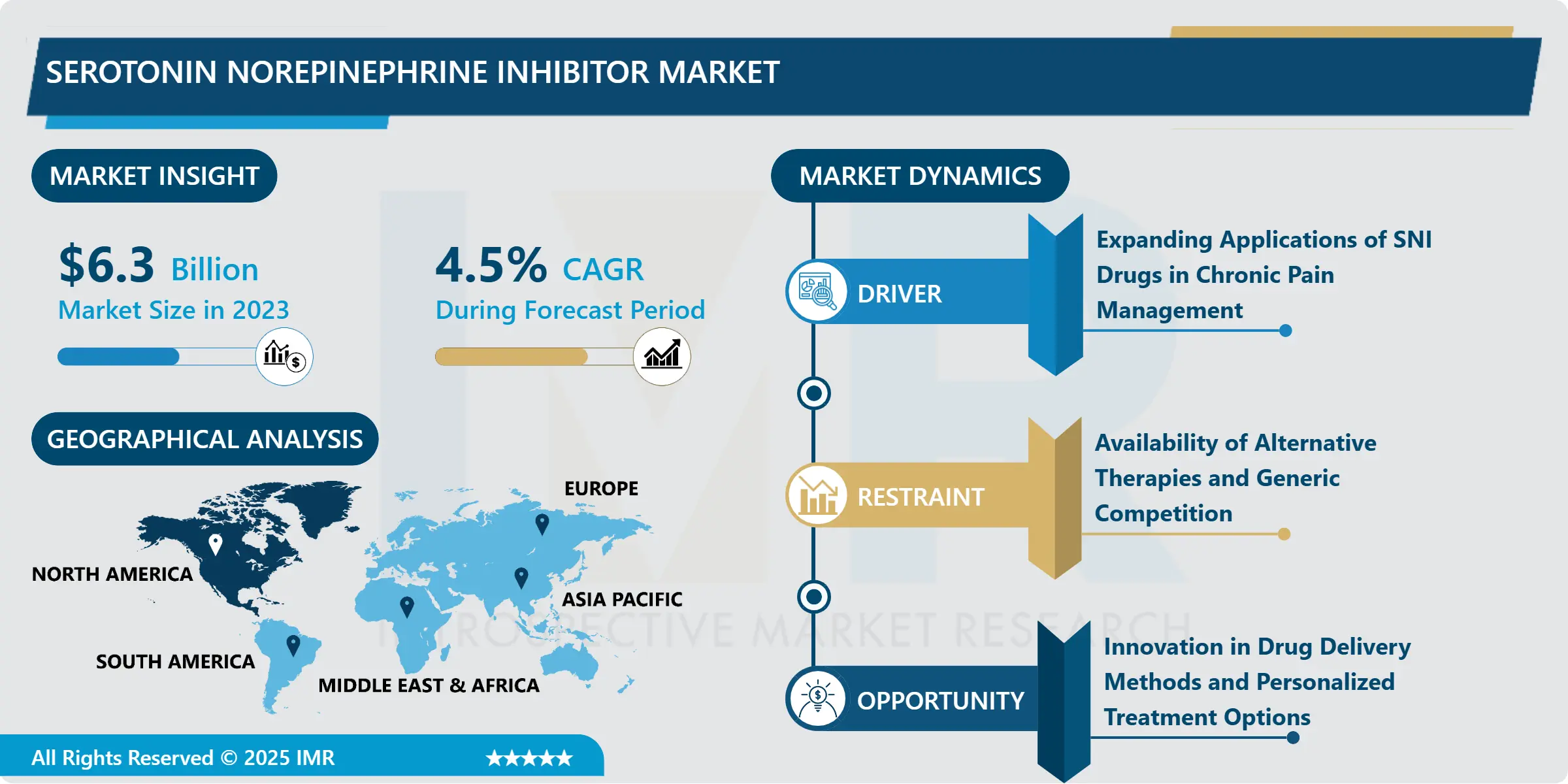
Serotonin Norepinephrine Inhibitor Market Size Was Valued at USD 6.30 Billion in 2023, and is Projected to Reach USD 9.36 Billion by 2032, Growing at a CAGR of 4.50% From 2024-2032.

IMR Group
Description
Serotonin Norepinephrine Inhibitor Market Synopsis:
Serotonin Norepinephrine Inhibitor Market Size Was Valued at USD 6.30 Billion in 2023, and is Projected to Reach USD 9.36 Billion by 2032, Growing at a CAGR of 4.50% From 2024-2032.
The Serotonin Norepinephrine Inhibitor (SNI) Market relates to the worldwide trade of drugs that act as reuptake inhibitors for serotonin and norepinephrine, two important neurotransmitters involved in mood and pain-modulatory processes. They are also used for the treatment of MDD, anxiety disorders, fibromyalgia and neuropathic pain among others. Efforts of these medications are in a way that they boost the percentage of serotonin and norepinephrine in the brain and thus assist in treating mood disorders and chronic pain. The SNI market has developed due to growth in mental health awareness, innovation in neuropharmacology and the higher incidence of depressive and anxiety disorders.
Increasing Awareness of Mental Health Disorders: Modern society has become much more attuned to the effects that mental health has on the person’s overall well-being, so diagnosis rates of diseases, such as depression and anxiety have risen steeply. Consequently, the need for SNI drugs has been boosted as these drugs are a choice for major depressive and generalized anxiety disorders. Governments and health organizations across the world are daily launching awareness programs which promote mental health, and this has continued to increase the demand for better treatments such as SNIs. Furthermore, the use of mental health treatment by the virtue of the young group is changing the trend of early treatment.
Prevalence of Chronic Pain and Fibromyalgia: Another factor for the rising trends in SNI market is the raised incidence of chronic pain syndrome and fibromyalgia that are treated with these inhibitors. The population increasingly turns to seek management of pain conditions related to nerve damage or fibromyalgia leading to high-demand SNIs. However, majority of healthcare provider are starting to recommend SNIs as a better option to opioids due to their tendency to cause dependency. It has backed SNI drugs in place of opioid prescriptions even in areas where opioid crisis has affected the health of the public.
Serotonin Norepinephrine Inhibitor Market Trend Analysis:
Rising Interest in Personalized Medicine:
Personalized medicine is becoming the major trend in the growth of the SNI market particularly in the field of neuropsychiatry. Application of genetic testing as well as biomarkers are making it possible for the prescribers of SNI to consider the profile of the patients before prescribing SNI to suit the needs of the patients in terms of therapeutic effectiveness. The lowering of side effects and enhancement of SNIs efficacy make the personalized treatment appealing to both providers and patients. Large pharma is already funding research to fine-tune the treatment regimens to make SNIs even more versatile.
Expansion of Online Pharmacies and Digital Health Platforms: The availability of SNI medicines through digital platforms and online pharmacies has been made easier by advancement in technology and heath informatics in developing countries. Said platforms allow people to activate prescription and get medications without face-to-face meetings, effectively delivering mental health and pain management remedies. Telemedicine improvements are also enabling all patients to be assessed for the correct SNI prescription where general mental health issues are involved. This trend is believed to promote market growth as digitization is becoming more and more integrated into healthcare.
Expansion into Emerging Markets:
Development of Novel Drug Formulations: Current strategies of pharmaceutical firms involve developing new SNIs drug formulations and new drug delivery systems that will ensure improved patient compliance and improved treatment outcomes. There are various types of modified-release dosage forms such as extended-release immediate-release preparations and transdermal systems, which aims at enhancing regularity, reducing side effects and patients’ comfort. They may be considered as a business development opportunity in SNI market since the patient wants a non-oral formulation, which has posed a challenge in the past.
The most significant opportunity for SNI drug manufacturers can be found in emerging economies. Places like Asia-Pacific and Latin America have increasing rates of depression and chronic pain due to change such as urbanization. Further, the development in the health care sector and the growing concern towards mental health also headed towards getting in to SNIs in these areas. With current market leaders not fully realizing its full potential, companies interested in super targeting these emerging markets could easily gain a large market share within this honey pot.
Serotonin Norepinephrine Inhibitor Market Segment Analysis:
Serotonin Norepinephrine Inhibitor Market is Segmented on the basis of Type, Application, End User, and Region.
By Drug Type, Duloxetine segment is expected to dominate the market during the forecast period
The market of Serotonin Norepinephrine Inhibitor (SNI) is divided by the type of drugs used to help those suffering from different disorders. Most of the SNIs prescribed are duloxetine which is used in managing cases of major depressive disorder, anxiety and chronic pain like the fibromyalgia and neuropathy. Another SNI widely used with the same result is venlafaxine; its extended-release form maintains patients’ symptoms at a steady, low level, assisting them with depression and generalized anxiety disorder. Desvenlafaxine is a metabolite of venlafaxine and used in the treatment of major depressive disorders and may have fewer side effects, the tolerability of which are better for some patients. Milnacipran has a primary indication in fibromyalgia; it is effective for this disorder but is used less frequently in depression. Among these SNIs, the most recent one is Levomilnacipran which is specifically approved only for MDD and is specifically known to have stronger norepinephrine reuptake inhibition than others, which also sets some distinctive difference about its mechanism of action and that too on usefulness.
By Application, Depression segment expected to held the largest share
The market of Serotonin Norepinephrine Inhibitor (SNI) finds its applicability in wide variety of applications related to mental health issues and pains. Another of the biggest uses of SNIs is for treating depression and this function is successfully performed as SNIs have mood enhancing properties balancing neurotransmitters. Generalised anxiety disorder, and social anxiety disorders are other anxiety disorders that can be managed through the use of SNIs as these drugs tend narrow down anxiety symptoms’ severity and their frequency. In the field of pain management SNIs are used for chronic pain, where they work by altering the way pain signals are processed within the brain. Fibromyalgia, a chronic disorder affecting musculoskeletal tissues and causing wide spread tender points, is one disorder which can be managed with SNI treatment since the drugs used act on both the painful as well as the mood-altering aspects of the illness. Another use for SNIs is neuropathy or nerve related pain especially for diabetic neuropathy. Lastly there are other uses of SNIs some of which are off-counsel uses meaning physicians may use these drugs in treatment areas apart from the one they are recommend for based on previous experience and seen benefits.
Serotonin Norepinephrine Inhibitor Market Regional Insights:
North America is Expected to Dominate the Market Over the Forecast period
At the present time, North America is the largest consumer in the global Serotonin Norepinephrine Inhibitor Market, holding more than 40% market share. This is so due to high mental health literacy, increased health expenditure, and favourable availability and utilisation of mental health services. It also boasts of the maximum number of large firms that are involved in research and marketing of SNI drugs. Also, the health-related organizations from the North American region, including the FDA, have encouraged the fast approval of SNIs and, therefore, their deployment.
North America’s opioid crisis has driven the need for non-opioid analgesic products, specifically SNIs, for effectively treating chronic pain besides having a strong established pharma industry. Outcries campaigns and programmes which have been employed to reduce prescriptions of opioids in the treatment of chronic and depression pain have forced healthcare providers to look for alternative drugs like SNIs. These factors have combined well to entrench North America as the leading SNI market growth region.
Active Key Players in the Serotonin Norepinephrine Inhibitor Market:
AbbVie Inc. (United States)
AstraZeneca plc (United Kingdom)
Eli Lilly and Company (United States)
GlaxoSmithKline plc (United Kingdom)
Johnson & Johnson (United States)
Lupin Limited (India)
Novartis AG (Switzerland)
Pfizer Inc. (United States)
Sanofi S.A. (France)
Takeda Pharmaceutical Company (Japan)
Other Active Players
Chapter 1: Introduction
1.1 Scope and Coverage
Chapter 2:Executive Summary
Chapter 3: Market Landscape
3.1 Market Dynamics
3.1.1 Drivers
3.1.2 Restraints
3.1.3 Opportunities
3.1.4 Challenges
3.2 Market Trend Analysis
3.3 PESTLE Analysis
3.4 Porter’s Five Forces Analysis
3.5 Industry Value Chain Analysis
3.6 Ecosystem
3.7 Regulatory Landscape
3.8 Price Trend Analysis
3.9 Patent Analysis
3.10 Technology Evolution
3.11 Investment Pockets
3.12 Import-Export Analysis
Chapter 4: Serotonin Norepinephrine Inhibitor Market by Drug Type
4.1 Serotonin Norepinephrine Inhibitor Market Snapshot and Growth Engine
4.2 Serotonin Norepinephrine Inhibitor Market Overview
4.3 Duloxetine
4.3.1 Introduction and Market Overview
4.3.2 Historic and Forecasted Market Size in Value USD and Volume Units (2017-2032F)
4.3.3 Key Market Trends, Growth Factors and Opportunities
4.3.4 Duloxetine: Geographic Segmentation Analysis
4.4 Venlafaxine
4.4.1 Introduction and Market Overview
4.4.2 Historic and Forecasted Market Size in Value USD and Volume Units (2017-2032F)
4.4.3 Key Market Trends, Growth Factors and Opportunities
4.4.4 Venlafaxine: Geographic Segmentation Analysis
4.5 Desvenlafaxine
4.5.1 Introduction and Market Overview
4.5.2 Historic and Forecasted Market Size in Value USD and Volume Units (2017-2032F)
4.5.3 Key Market Trends, Growth Factors and Opportunities
4.5.4 Desvenlafaxine: Geographic Segmentation Analysis
4.6 Milnacipran
4.6.1 Introduction and Market Overview
4.6.2 Historic and Forecasted Market Size in Value USD and Volume Units (2017-2032F)
4.6.3 Key Market Trends, Growth Factors and Opportunities
4.6.4 Milnacipran: Geographic Segmentation Analysis
4.7 Levomilnacipran)
4.7.1 Introduction and Market Overview
4.7.2 Historic and Forecasted Market Size in Value USD and Volume Units (2017-2032F)
4.7.3 Key Market Trends, Growth Factors and Opportunities
4.7.4 Levomilnacipran): Geographic Segmentation Analysis
4.8
4.8.1 Introduction and Market Overview
4.8.2 Historic and Forecasted Market Size in Value USD and Volume Units (2017-2032F)
4.8.3 Key Market Trends, Growth Factors and Opportunities
4.8.4 : Geographic Segmentation Analysis
Chapter 5: Serotonin Norepinephrine Inhibitor Market by Application
5.1 Serotonin Norepinephrine Inhibitor Market Snapshot and Growth Engine
5.2 Serotonin Norepinephrine Inhibitor Market Overview
5.3 Depression
5.3.1 Introduction and Market Overview
5.3.2 Historic and Forecasted Market Size in Value USD and Volume Units (2017-2032F)
5.3.3 Key Market Trends, Growth Factors and Opportunities
5.3.4 Depression: Geographic Segmentation Analysis
5.4 Anxiety Disorders
5.4.1 Introduction and Market Overview
5.4.2 Historic and Forecasted Market Size in Value USD and Volume Units (2017-2032F)
5.4.3 Key Market Trends, Growth Factors and Opportunities
5.4.4 Anxiety Disorders: Geographic Segmentation Analysis
5.5 Chronic Pain
5.5.1 Introduction and Market Overview
5.5.2 Historic and Forecasted Market Size in Value USD and Volume Units (2017-2032F)
5.5.3 Key Market Trends, Growth Factors and Opportunities
5.5.4 Chronic Pain: Geographic Segmentation Analysis
5.6 Fibromyalgia
5.6.1 Introduction and Market Overview
5.6.2 Historic and Forecasted Market Size in Value USD and Volume Units (2017-2032F)
5.6.3 Key Market Trends, Growth Factors and Opportunities
5.6.4 Fibromyalgia: Geographic Segmentation Analysis
5.7 Neuropathy
5.7.1 Introduction and Market Overview
5.7.2 Historic and Forecasted Market Size in Value USD and Volume Units (2017-2032F)
5.7.3 Key Market Trends, Growth Factors and Opportunities
5.7.4 Neuropathy: Geographic Segmentation Analysis
5.8 Others)
5.8.1 Introduction and Market Overview
5.8.2 Historic and Forecasted Market Size in Value USD and Volume Units (2017-2032F)
5.8.3 Key Market Trends, Growth Factors and Opportunities
5.8.4 Others): Geographic Segmentation Analysis
5.9
5.9.1 Introduction and Market Overview
5.9.2 Historic and Forecasted Market Size in Value USD and Volume Units (2017-2032F)
5.9.3 Key Market Trends, Growth Factors and Opportunities
5.9.4 : Geographic Segmentation Analysis
Chapter 6: Company Profiles and Competitive Analysis
6.1 Competitive Landscape
6.1.1 Competitive Benchmarking
6.1.2 Serotonin Norepinephrine Inhibitor Market Share by Manufacturer (2023)
6.1.3 Industry BCG Matrix
6.1.4 Heat Map Analysis
6.1.5 Mergers and Acquisitions
6.2 PFIZER INC. (UNITED STATES)
6.2.1 Company Overview
6.2.2 Key Executives
6.2.3 Company Snapshot
6.2.4 Role of the Company in the Market
6.2.5 Sustainability and Social Responsibility
6.2.6 Operating Business Segments
6.2.7 Product Portfolio
6.2.8 Business Performance
6.2.9 Key Strategic Moves and Recent Developments
6.2.10 SWOT Analysis
6.3 ELI LILLY AND COMPANY (UNITED STATES)
6.4 GLAXOSMITHKLINE PLC (UNITED KINGDOM)
6.5 JOHNSON & JOHNSON (UNITED STATES)
6.6 NOVARTIS AG (SWITZERLAND)
6.7 SANOFI S.A. (FRANCE)
6.8 ASTRAZENECA PLC (UNITED KINGDOM)
6.9 ABBVIE INC. (UNITED STATES)
6.10 TAKEDA PHARMACEUTICAL COMPANY (JAPAN)
6.11 LUPIN LIMITED (INDIA)
6.12 OTHER ACTIVE PLAYERS
Chapter 7: Global Serotonin Norepinephrine Inhibitor Market By Region
7.1 Overview
7.2. North America Serotonin Norepinephrine Inhibitor Market
7.2.1 Key Market Trends, Growth Factors and Opportunities
7.2.2 Top Key Companies
7.2.3 Historic and Forecasted Market Size by Segments
7.2.4 Historic and Forecasted Market Size By Drug Type
7.2.4.1 Duloxetine
7.2.4.2 Venlafaxine
7.2.4.3 Desvenlafaxine
7.2.4.4 Milnacipran
7.2.4.5 Levomilnacipran)
7.2.4.6
7.2.5 Historic and Forecasted Market Size By Application
7.2.5.1 Depression
7.2.5.2 Anxiety Disorders
7.2.5.3 Chronic Pain
7.2.5.4 Fibromyalgia
7.2.5.5 Neuropathy
7.2.5.6 Others)
7.2.5.7
7.2.6 Historic and Forecast Market Size by Country
7.2.6.1 US
7.2.6.2 Canada
7.2.6.3 Mexico
7.3. Eastern Europe Serotonin Norepinephrine Inhibitor Market
7.3.1 Key Market Trends, Growth Factors and Opportunities
7.3.2 Top Key Companies
7.3.3 Historic and Forecasted Market Size by Segments
7.3.4 Historic and Forecasted Market Size By Drug Type
7.3.4.1 Duloxetine
7.3.4.2 Venlafaxine
7.3.4.3 Desvenlafaxine
7.3.4.4 Milnacipran
7.3.4.5 Levomilnacipran)
7.3.4.6
7.3.5 Historic and Forecasted Market Size By Application
7.3.5.1 Depression
7.3.5.2 Anxiety Disorders
7.3.5.3 Chronic Pain
7.3.5.4 Fibromyalgia
7.3.5.5 Neuropathy
7.3.5.6 Others)
7.3.5.7
7.3.6 Historic and Forecast Market Size by Country
7.3.6.1 Russia
7.3.6.2 Bulgaria
7.3.6.3 The Czech Republic
7.3.6.4 Hungary
7.3.6.5 Poland
7.3.6.6 Romania
7.3.6.7 Rest of Eastern Europe
7.4. Western Europe Serotonin Norepinephrine Inhibitor Market
7.4.1 Key Market Trends, Growth Factors and Opportunities
7.4.2 Top Key Companies
7.4.3 Historic and Forecasted Market Size by Segments
7.4.4 Historic and Forecasted Market Size By Drug Type
7.4.4.1 Duloxetine
7.4.4.2 Venlafaxine
7.4.4.3 Desvenlafaxine
7.4.4.4 Milnacipran
7.4.4.5 Levomilnacipran)
7.4.4.6
7.4.5 Historic and Forecasted Market Size By Application
7.4.5.1 Depression
7.4.5.2 Anxiety Disorders
7.4.5.3 Chronic Pain
7.4.5.4 Fibromyalgia
7.4.5.5 Neuropathy
7.4.5.6 Others)
7.4.5.7
7.4.6 Historic and Forecast Market Size by Country
7.4.6.1 Germany
7.4.6.2 UK
7.4.6.3 France
7.4.6.4 The Netherlands
7.4.6.5 Italy
7.4.6.6 Spain
7.4.6.7 Rest of Western Europe
7.5. Asia Pacific Serotonin Norepinephrine Inhibitor Market
7.5.1 Key Market Trends, Growth Factors and Opportunities
7.5.2 Top Key Companies
7.5.3 Historic and Forecasted Market Size by Segments
7.5.4 Historic and Forecasted Market Size By Drug Type
7.5.4.1 Duloxetine
7.5.4.2 Venlafaxine
7.5.4.3 Desvenlafaxine
7.5.4.4 Milnacipran
7.5.4.5 Levomilnacipran)
7.5.4.6
7.5.5 Historic and Forecasted Market Size By Application
7.5.5.1 Depression
7.5.5.2 Anxiety Disorders
7.5.5.3 Chronic Pain
7.5.5.4 Fibromyalgia
7.5.5.5 Neuropathy
7.5.5.6 Others)
7.5.5.7
7.5.6 Historic and Forecast Market Size by Country
7.5.6.1 China
7.5.6.2 India
7.5.6.3 Japan
7.5.6.4 South Korea
7.5.6.5 Malaysia
7.5.6.6 Thailand
7.5.6.7 Vietnam
7.5.6.8 The Philippines
7.5.6.9 Australia
7.5.6.10 New Zealand
7.5.6.11 Rest of APAC
7.6. Middle East & Africa Serotonin Norepinephrine Inhibitor Market
7.6.1 Key Market Trends, Growth Factors and Opportunities
7.6.2 Top Key Companies
7.6.3 Historic and Forecasted Market Size by Segments
7.6.4 Historic and Forecasted Market Size By Drug Type
7.6.4.1 Duloxetine
7.6.4.2 Venlafaxine
7.6.4.3 Desvenlafaxine
7.6.4.4 Milnacipran
7.6.4.5 Levomilnacipran)
7.6.4.6
7.6.5 Historic and Forecasted Market Size By Application
7.6.5.1 Depression
7.6.5.2 Anxiety Disorders
7.6.5.3 Chronic Pain
7.6.5.4 Fibromyalgia
7.6.5.5 Neuropathy
7.6.5.6 Others)
7.6.5.7
7.6.6 Historic and Forecast Market Size by Country
7.6.6.1 Turkiye
7.6.6.2 Bahrain
7.6.6.3 Kuwait
7.6.6.4 Saudi Arabia
7.6.6.5 Qatar
7.6.6.6 UAE
7.6.6.7 Israel
7.6.6.8 South Africa
7.7. South America Serotonin Norepinephrine Inhibitor Market
7.7.1 Key Market Trends, Growth Factors and Opportunities
7.7.2 Top Key Companies
7.7.3 Historic and Forecasted Market Size by Segments
7.7.4 Historic and Forecasted Market Size By Drug Type
7.7.4.1 Duloxetine
7.7.4.2 Venlafaxine
7.7.4.3 Desvenlafaxine
7.7.4.4 Milnacipran
7.7.4.5 Levomilnacipran)
7.7.4.6
7.7.5 Historic and Forecasted Market Size By Application
7.7.5.1 Depression
7.7.5.2 Anxiety Disorders
7.7.5.3 Chronic Pain
7.7.5.4 Fibromyalgia
7.7.5.5 Neuropathy
7.7.5.6 Others)
7.7.5.7
7.7.6 Historic and Forecast Market Size by Country
7.7.6.1 Brazil
7.7.6.2 Argentina
7.7.6.3 Rest of SA
Chapter 8 Analyst Viewpoint and Conclusion
8.1 Recommendations and Concluding Analysis
8.2 Potential Market Strategies
Chapter 9 Research Methodology
9.1 Research Process
9.2 Primary Research
9.3 Secondary Research
Q1: What would be the forecast period in the Serotonin Norepinephrine Inhibitor Market research report?
A1: The forecast period in the Serotonin Norepinephrine Inhibitor Market research report is 2024-2032.
Q2: Who are the key players in the Serotonin Norepinephrine Inhibitor Market?
A2: AbbVie Inc. (United States), AstraZeneca plc (United Kingdom), Eli Lilly and Company (United States), GlaxoSmithKline plc (United Kingdom), Johnson & Johnson (United States), Lupin Limited (India), Novartis AG (Switzerland), Pfizer Inc. (United States), Sanofi S.A. (France), Takeda Pharmaceutical Company (Japan), and Other Active Players.
Q3: What are the segments of the Serotonin Norepinephrine Inhibitor Market?
A3: The Serotonin Norepinephrine Inhibitor Market is segmented into by Drug Type (Duloxetine, Venlafaxine, Desvenlafaxine, Milnacipran, Levomilnacipran), Application (Depression, Anxiety Disorders, Chronic Pain, Fibromyalgia, Neuropathy, Others). By region, it is analyzed across North America (U.S., Canada, Mexico), Eastern Europe (Russia, Bulgaria, The Czech Republic, Hungary, Poland, Romania, Rest of Eastern Europe), Western Europe (Germany, UK, France, The Netherlands, Italy, Russia, Spain, Rest of Western Europe), Asia Pacific (China, India, Japan, South Korea, Malaysia, Thailand, Vietnam, The Philippines, Australia, New-Zealand, Rest of APAC), Middle East & Africa (Turkiye, Bahrain, Kuwait, Saudi Arabia, Qatar, UAE, Israel, South Africa), South America (Brazil, Argentina, Rest of SA).
Q4: What is the Serotonin Norepinephrine Inhibitor Market?
A4: The Serotonin Norepinephrine Inhibitor (SNI) Market relates to the worldwide trade of drugs that act as reuptake inhibitors for serotonin and norepinephrine, two important neurotransmitters involved in mood and pain-modulatory processes. They are also used for the treatment of MDD, anxiety disorders, fibromyalgia and neuropathic pain among others. Efforts of these medications are in a way that they boost the percentage of serotonin and norepinephrine in the brain and thus assist in treating mood disorders and chronic pain. The SNI market has developed due to growth in mental health awareness, innovation in neuropharmacology and the higher incidence of depressive and anxiety disorders.
Q5: How big is the Serotonin Norepinephrine Inhibitor Market?
A5: Serotonin Norepinephrine Inhibitor Market Size Was Valued at USD 6.30 Billion in 2023, and is Projected to Reach USD 9.36 Billion by 2032, Growing at a CAGR of 4.50% From 2024-2032.
How to Buy a Report from eminsights.jp
On the product page, choose the license you want: Single-User License, Multi-User License or Enterprise License.
If you required report in your native language, then you can click on Translated Report button and fill out the form with report name and language you want, then our team will contact you as soon as possible.
Click the Buy Now button.
You will be redirected to the checkout page. Enter your company details and payment information.
Click Place Order to complete the purchase.
Confirmation: You’ll receive an order confirmation and our team will contact you shortly with your ordered report.
If you have any questions, fill out the contact form below or email us at [email protected].
Thank you for choosing eminsights.jp!