Stay Ahead in Fast-Growing Economies.
Browse Reports Now
Aircraft Seating Market – Demand Analysis & Trend Insights (2024–2032)
Aircraft Seating Market

IMR Group
Description
Aircraft Seating Market Synopsis:
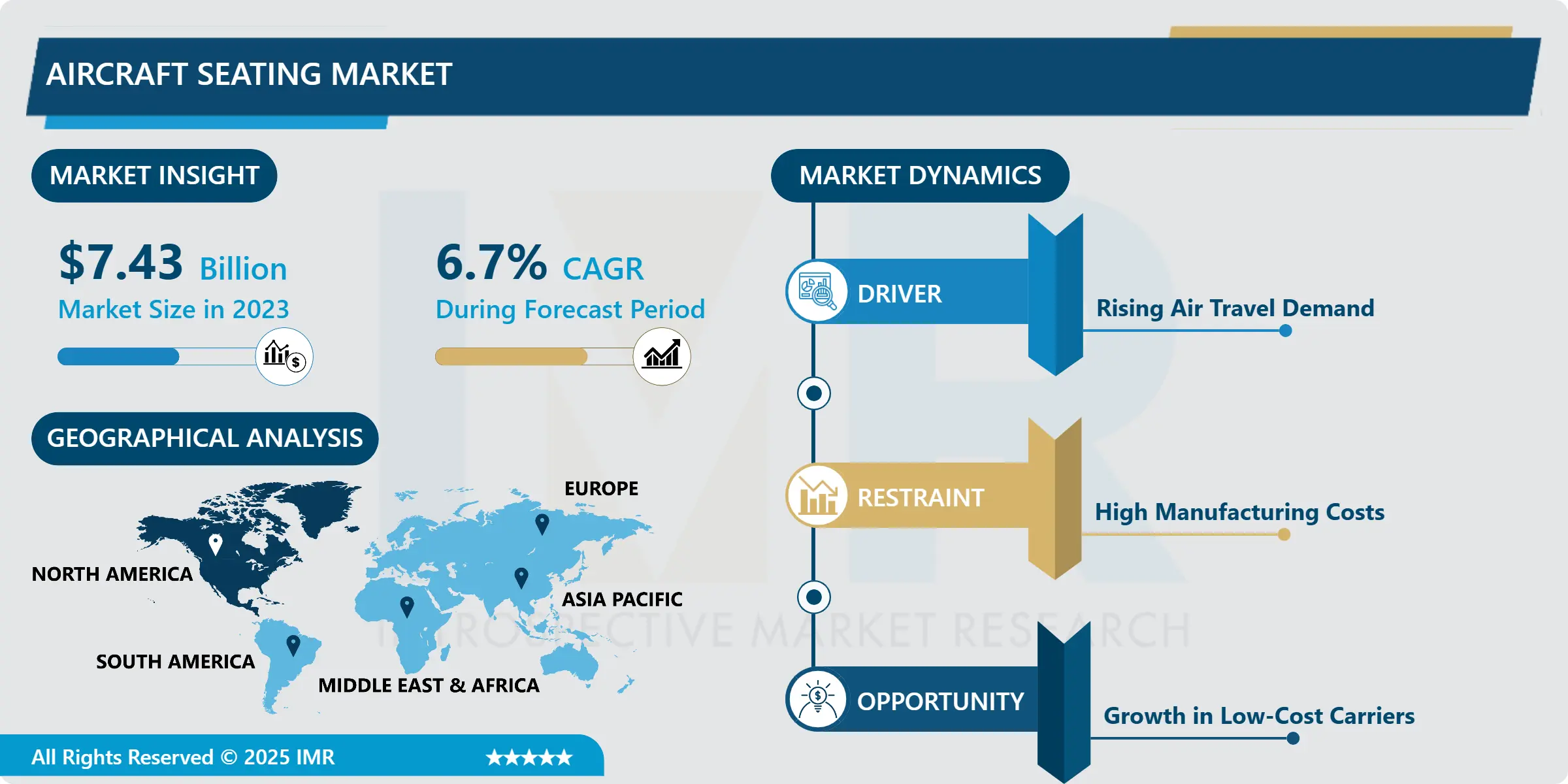
Aircraft Seating Market Size Was Valued at USD 7.43 Billion in 2023, and is Projected to Reach USD 13.32 Billion by 2032, Growing at a CAGR of 6.7% From 2024-2032.
The Aircraft Seating Market is defined here as the business world that deals with designing and producing aircraft seats that are used in commercial/wider use, military and personal aircrafts. Some of these products include; seat frames, cushions, recliners and electronic systems which are put in the aircraft to ensure that passengers are comfortable, safe and can perform their activities comfortably during flight.
Aircraft seating is a flourishing market, especially during the past few years this market grows rapidly due to increased globalization for travel, the continuously growing number of Low Cost Carriers, and advancements in aircraft seating products. With airline companies and aircraft manufacturers continually seeking to provide greater comfort to their passengers within limited space and also increase spaciousness in aircraft, a number of technologies related to aircraft seating have emerged to include new concepts like adjustable seats, facilities for in-flight entertainment and better ergonomics. Also, more business and luxury aircraft that are focused on premium comfort have driven the industry’s increasing need for better seating options.
Other factors driving the market include use of different materials and advancement in technology as far as manufacturing of seating is concerned. Whereas the airplane seats themselves have evolved through new-generation lightweight materials such as, advanced composites, memory foam, and synthetic textiles, some Airlines use these to enhance fuel efficiency while fixing the comfortable standards. They also include electrification in designing seats; for instance, seats that power recline or have a controlled lumbar support besides improving the in-flight comfort. In addition, it seems to address increasing customer concern for environmental protection by pursuing weight loss and recycling of materials in compliance with environmental standards.
The market is also somewhat fuelled with the development of flights passengers around the world. Increased disposable income across the global citizenry have enhanced the demand for air travel which has in turn enhanced the demand for both the low end and high end class seats. Further, there has been immense pressure from the regulators demanding safety and comfort of passengers which hasevtually made manufacturers to produce sophisticated concept of seats such as leg space, reclining features and technological incorporations. Therefore, many aircraft seating suppliers and manufacturers can anticipate further market expansion arising from the growing efforts of airlines to satisfy the varying demands of their passengers.
Based on the market categorization, the market is segmented in the form of seat structures and foams, actuators, electrical fittings and other parts. The segmentation is as follows, because each of these parts has a significance in the operation and comfort of the seat. There are main players in the market that strive at providing good and compatible components to make the seats which are comfortable to use and also safe. There are also regional differences some regions are major in luxury seats for business aircraft others are the main supplier of cost effective seats for LCCs.
Aircraft Seating Market Trend Analysis:
Evolution of Premium Seating
Innovation in the aircraft seating market is mainly fuelled by the trend of gradual enhancement of premium seating. This paired with the airline’s tightening of the purse strings and acting more like a hotel the product that is the seat itself has developed more than mere sitting capabilities. New seats in business-class cabins are increasingly able to convert into fully flat sleeping-berths accompanied by privacy screens and onboard entertainment facilities. This change is on the way being dictated by need to create a unique measure of comfort that would attract customers belonging to the elite, the upper class.
In future with increasing competition big airlines are coming up with the difference by offering elite class seating services. For example, entry names ‘suites’ in first-class cabins: small, separate enclosures with controllable light, more stowage space, and better security. This trend is not purely applicable to long-haul flights; even the short-haul flight competitor is enclosure for Business Class and Premium Economic seats as they tap into lots of high net worth travelers. In this sequence, it can be argued that the aircraft seating market is yet to be developed further regarding bringing new ideas to the table, which include improving comfort, functionality, personal space, etc.
Growth in Low-Cost Carriers
One trend that will propel the growth of the aircraft seating market is growth of low-cost carrier (LCCs). The increase in middle class segments in emergent countries also the tendency towards the shift in the focus from commmercial to low-cost airlines is evidentiong the stratgeic significance of LCCs in the global airline market. These carriers tend to opt for efficiency and cost cutting measures, all of which has a bearing on the make and model aircraft seating. The opportunity area is to introduce new affordable, yet long-lasting and lightweight solutions that will meet the requirements of LCCs.
Growing demand for air travel both globally and in the Asia Pacific and Latin American markets means LCCs are anticipated at gaining additional fleets. This lays a good market base for seating solutions that are both inexpensive and great in quality. Thus, the demand for seating that is as comfortable as possible while consuming as little space as possible can be met by manufacturers. Moreover, occupied seating with improved ergonomics or integrated options to have personal entertainment during the flight, make the LCCs look keen to add more sophisticated seating with costs model, leading to the growth of new technologies for quality seating.
Aircraft Seating Market Segment Analysis:
Aircraft Seating Market is Segmented on the basis of Component, Class, Aircraft, Standard, End User, and Region.
By Component, Structure segment is expected to dominate the market during the forecast period
The aircraft seating market has product segments which are as follows: structure, foams, actuators, electrical fittings, and other components. AAll of these sections are important to the functionality and usability of the seat, as will be discussed later on. The seat structure is the fundamental component; the main load-carrying part of the car; while foams are used for soft stuffing. Sensors and switches, and electrical connection enable changes, or additional comforts, like the ability to recline or having a vibrating feature to make the journey more comfortable for the passenger.
The needs for these components are dependent with the technology and material development. For instance, lightweight composite materials used in structures of seats enhance the work of decreasing the weight of an aircraft so that it will consume less fuel. In the same way, the enhanced foams and actuators enhance passenger comfort and preferences. As the airline companies target to provide better and more customized and convenient luxurious seating services, the manufacturers of aircraft seating components are always coming up with better solutions for the growing aircraft services needs.
By Aircraft, Narrow Body Aircraft segment expected to held the largest share
The aircraft seating market is mainly classified by the aircraft such as narrow body aircraft, wide body aircraft, business aircrafts and regional transport aircraft. Narrow body aircrafts specifically fall under a single aisle design and they used for short haul flights. Sky gauge instead are utilized in long hall flight and gives more additional space and better esteeming quality of seats. Business jets are targeted for delivering exclusive and sophisticated seating solutions concerning innovative facilities for VVIP guests. Regional transport aircraft are used for short regional transport needs and thus need efficient and comfortable seating in confined spaces.
There is this diverse demand for seating depending on the types of these aircrafts. Cost-saving Airlines, especially the points stated above, mainly purchase narrow-body aircraft that focus on economy seating arrangements while wide body aircraft airplanes and business jets provide a range of classes such as premium. With increased uptake of air travel, there will be increased demand for seats in each of these categories of aircraft as travelers seek comfort, luxury and customization.
Aircraft Seating Market Regional Insights:
North America is Expected to Dominate the Market Over the Forecast period
North America is the most dominating region of the aircraft seating market mainly because of the situated leading aircraft manufacturing and airline companies. Being part of the developed countries; the United States and Canada possess strategic airline industry whereby principal airlines including American Airlines, delta and United Airlines have embarked on manners on aircraft seating solutions. They also prefer the comfort of high end seating and such aspects as premium economy offers and business class, which are other factors that create the need for more improved and commercially attractive seating solutions within North American airlines.
In addition, the region enjoys significant technology development of the aerospace industry. Manufacturers of Aircraft seating are based in North America and they are constantly coming up with new designs that are lightweight; durable; and, easily customiseable. The growth of LCCs and increased popularity of luxury and business class travel add to the steady dominance seen from North America in the aircraft seating market. It is anticipated to progress this way due to increasing traveler preferences for comfort and ease during flight.
Active Key Players in the Aircraft Seating Market:
Recaro Aircraft Seating – (Germany)
Zodiac Aerospace – (France)
B/E Aerospace – (USA)
Safran Seats – (France)
Thompson Aero Seating – (UK)
Aviointeriors – (Italy)
Collins Aerospace – (USA)
Geven S.p.A – (Italy)
Acro Aircraft Seating – (UK)
Mirus Aircraft Seating – (UK), and Other Active Players
Key Industry Developments in the Aircraft Seating Market:
In August 2024, RECARO Aircraft Seating received a contract from IndiGo Airlines (InterGlobe Aviation Limited) to install R5 seats into the business class cabins of their A321neo aircraft featuring 12 business class seats and 208 economy class seats. The RECARO R5 seats provide robust functionality and advanced comfort with a 38-inch pitch and a customized, lightweight design
In May 2024, Collins Aerospace, an RTX Corporation company launched the main cabin seat named Helix for narrow body aircraft at the 2024 Aircraft Interiors Expo. This new aircraft seat has been engineered to reduce weight while providing improved living space and ergonomic comfort. The seat back is optimized to integrate numerous in-flight entertainment solutions, full-sized meal trays and literature pockets
In May 2024, Jazz Aviation LP signed a purchase agreement with Expliseat S.A.S.to deloy TiSeat 2 V sets to renew the cabins of its 25 Dash 8-400 aircrafts. These seats come in two different finishes and trims for preferred economy and standard economy class. It comprises a personal electronic device holder, 3D generous cushion, and recline for an enhanced passenger experience.
Chapter 1: Introduction
1.1 Scope and Coverage
Chapter 2:Executive Summary
Chapter 3: Market Landscape
3.1 Market Dynamics
3.1.1 Drivers
3.1.2 Restraints
3.1.3 Opportunities
3.1.4 Challenges
3.2 Market Trend Analysis
3.3 PESTLE Analysis
3.4 Porter’s Five Forces Analysis
3.5 Industry Value Chain Analysis
3.6 Ecosystem
3.7 Regulatory Landscape
3.8 Price Trend Analysis
3.9 Patent Analysis
3.10 Technology Evolution
3.11 Investment Pockets
3.12 Import-Export Analysis
Chapter 4: Aircraft Seating Market by Component
4.1 Aircraft Seating Market Snapshot and Growth Engine
4.2 Aircraft Seating Market Overview
4.3 Structure
4.3.1 Introduction and Market Overview
4.3.2 Historic and Forecasted Market Size in Value USD and Volume Units (2017-2032F)
4.3.3 Key Market Trends, Growth Factors and Opportunities
4.3.4 Structure: Geographic Segmentation Analysis
4.4 Foams
4.4.1 Introduction and Market Overview
4.4.2 Historic and Forecasted Market Size in Value USD and Volume Units (2017-2032F)
4.4.3 Key Market Trends, Growth Factors and Opportunities
4.4.4 Foams: Geographic Segmentation Analysis
4.5 Actuators
4.5.1 Introduction and Market Overview
4.5.2 Historic and Forecasted Market Size in Value USD and Volume Units (2017-2032F)
4.5.3 Key Market Trends, Growth Factors and Opportunities
4.5.4 Actuators: Geographic Segmentation Analysis
4.6 Electrical Fittings
4.6.1 Introduction and Market Overview
4.6.2 Historic and Forecasted Market Size in Value USD and Volume Units (2017-2032F)
4.6.3 Key Market Trends, Growth Factors and Opportunities
4.6.4 Electrical Fittings: Geographic Segmentation Analysis
4.7 Others
4.7.1 Introduction and Market Overview
4.7.2 Historic and Forecasted Market Size in Value USD and Volume Units (2017-2032F)
4.7.3 Key Market Trends, Growth Factors and Opportunities
4.7.4 Others: Geographic Segmentation Analysis
Chapter 5: Aircraft Seating Market by Class
5.1 Aircraft Seating Market Snapshot and Growth Engine
5.2 Aircraft Seating Market Overview
5.3 Business Class
5.3.1 Introduction and Market Overview
5.3.2 Historic and Forecasted Market Size in Value USD and Volume Units (2017-2032F)
5.3.3 Key Market Trends, Growth Factors and Opportunities
5.3.4 Business Class: Geographic Segmentation Analysis
5.4 Economy Class
5.4.1 Introduction and Market Overview
5.4.2 Historic and Forecasted Market Size in Value USD and Volume Units (2017-2032F)
5.4.3 Key Market Trends, Growth Factors and Opportunities
5.4.4 Economy Class: Geographic Segmentation Analysis
5.5 Premium Economy Class
5.5.1 Introduction and Market Overview
5.5.2 Historic and Forecasted Market Size in Value USD and Volume Units (2017-2032F)
5.5.3 Key Market Trends, Growth Factors and Opportunities
5.5.4 Premium Economy Class: Geographic Segmentation Analysis
5.6 First Class
5.6.1 Introduction and Market Overview
5.6.2 Historic and Forecasted Market Size in Value USD and Volume Units (2017-2032F)
5.6.3 Key Market Trends, Growth Factors and Opportunities
5.6.4 First Class: Geographic Segmentation Analysis
5.7 Pilot & Crew Seating
5.7.1 Introduction and Market Overview
5.7.2 Historic and Forecasted Market Size in Value USD and Volume Units (2017-2032F)
5.7.3 Key Market Trends, Growth Factors and Opportunities
5.7.4 Pilot & Crew Seating: Geographic Segmentation Analysis
Chapter 6: Aircraft Seating Market by Aircraft
6.1 Aircraft Seating Market Snapshot and Growth Engine
6.2 Aircraft Seating Market Overview
6.3 Narrow Body Aircraft
6.3.1 Introduction and Market Overview
6.3.2 Historic and Forecasted Market Size in Value USD and Volume Units (2017-2032F)
6.3.3 Key Market Trends, Growth Factors and Opportunities
6.3.4 Narrow Body Aircraft: Geographic Segmentation Analysis
6.4 Wide Body Aircraft
6.4.1 Introduction and Market Overview
6.4.2 Historic and Forecasted Market Size in Value USD and Volume Units (2017-2032F)
6.4.3 Key Market Trends, Growth Factors and Opportunities
6.4.4 Wide Body Aircraft: Geographic Segmentation Analysis
6.5 Business Jets
6.5.1 Introduction and Market Overview
6.5.2 Historic and Forecasted Market Size in Value USD and Volume Units (2017-2032F)
6.5.3 Key Market Trends, Growth Factors and Opportunities
6.5.4 Business Jets: Geographic Segmentation Analysis
6.6 Regional Transport Aircraft
6.6.1 Introduction and Market Overview
6.6.2 Historic and Forecasted Market Size in Value USD and Volume Units (2017-2032F)
6.6.3 Key Market Trends, Growth Factors and Opportunities
6.6.4 Regional Transport Aircraft: Geographic Segmentation Analysis
Chapter 7: Aircraft Seating Market by Standard
7.1 Aircraft Seating Market Snapshot and Growth Engine
7.2 Aircraft Seating Market Overview
7.3 9G
7.3.1 Introduction and Market Overview
7.3.2 Historic and Forecasted Market Size in Value USD and Volume Units (2017-2032F)
7.3.3 Key Market Trends, Growth Factors and Opportunities
7.3.4 9G: Geographic Segmentation Analysis
7.4 16G
7.4.1 Introduction and Market Overview
7.4.2 Historic and Forecasted Market Size in Value USD and Volume Units (2017-2032F)
7.4.3 Key Market Trends, Growth Factors and Opportunities
7.4.4 16G: Geographic Segmentation Analysis
7.5 21G
7.5.1 Introduction and Market Overview
7.5.2 Historic and Forecasted Market Size in Value USD and Volume Units (2017-2032F)
7.5.3 Key Market Trends, Growth Factors and Opportunities
7.5.4 21G: Geographic Segmentation Analysis
Chapter 8: Aircraft Seating Market by End Use
8.1 Aircraft Seating Market Snapshot and Growth Engine
8.2 Aircraft Seating Market Overview
8.3 OEM
8.3.1 Introduction and Market Overview
8.3.2 Historic and Forecasted Market Size in Value USD and Volume Units (2017-2032F)
8.3.3 Key Market Trends, Growth Factors and Opportunities
8.3.4 OEM: Geographic Segmentation Analysis
8.4 After
8.4.1 Introduction and Market Overview
8.4.2 Historic and Forecasted Market Size in Value USD and Volume Units (2017-2032F)
8.4.3 Key Market Trends, Growth Factors and Opportunities
8.4.4 After: Geographic Segmentation Analysis
Chapter 9: Company Profiles and Competitive Analysis
9.1 Competitive Landscape
9.1.1 Competitive Benchmarking
9.1.2 Aircraft Seating Market Share by Manufacturer (2023)
9.1.3 Industry BCG Matrix
9.1.4 Heat Map Analysis
9.1.5 Mergers and Acquisitions
9.2 RECARO AIRCRAFT SEATING – (GERMANY)
9.2.1 Company Overview
9.2.2 Key Executives
9.2.3 Company Snapshot
9.2.4 Role of the Company in the Market
9.2.5 Sustainability and Social Responsibility
9.2.6 Operating Business Segments
9.2.7 Product Portfolio
9.2.8 Business Performance
9.2.9 Key Strategic Moves and Recent Developments
9.2.10 SWOT Analysis
9.3 ZODIAC AEROSPACE – (FRANCE)
9.4 B/E AEROSPACE – (USA)
9.5 SAFRAN SEATS – (FRANCE)
9.6 THOMPSON AERO SEATING – (UK)
9.7 AVIOINTERIORS – (ITALY)
9.8 COLLINS AEROSPACE – (USA)
9.9 GEVEN S.P.A – (ITALY)
9.10 ACRO AIRCRAFT SEATING – (UK)
9.11 MIRUS AIRCRAFT SEATING – (UK)
9.12 OTHER ACTIVE PLAYERS
Chapter 10: Global Aircraft Seating Market By Region
10.1 Overview
10.2. North America Aircraft Seating Market
10.2.1 Key Market Trends, Growth Factors and Opportunities
10.2.2 Top Key Companies
10.2.3 Historic and Forecasted Market Size by Segments
10.2.4 Historic and Forecasted Market Size By Component
10.2.4.1 Structure
10.2.4.2 Foams
10.2.4.3 Actuators
10.2.4.4 Electrical Fittings
10.2.4.5 Others
10.2.5 Historic and Forecasted Market Size By Class
10.2.5.1 Business Class
10.2.5.2 Economy Class
10.2.5.3 Premium Economy Class
10.2.5.4 First Class
10.2.5.5 Pilot & Crew Seating
10.2.6 Historic and Forecasted Market Size By Aircraft
10.2.6.1 Narrow Body Aircraft
10.2.6.2 Wide Body Aircraft
10.2.6.3 Business Jets
10.2.6.4 Regional Transport Aircraft
10.2.7 Historic and Forecasted Market Size By Standard
10.2.7.1 9G
10.2.7.2 16G
10.2.7.3 21G
10.2.8 Historic and Forecasted Market Size By End Use
10.2.8.1 OEM
10.2.8.2 After
10.2.9 Historic and Forecast Market Size by Country
10.2.9.1 US
10.2.9.2 Canada
10.2.9.3 Mexico
10.3. Eastern Europe Aircraft Seating Market
10.3.1 Key Market Trends, Growth Factors and Opportunities
10.3.2 Top Key Companies
10.3.3 Historic and Forecasted Market Size by Segments
10.3.4 Historic and Forecasted Market Size By Component
10.3.4.1 Structure
10.3.4.2 Foams
10.3.4.3 Actuators
10.3.4.4 Electrical Fittings
10.3.4.5 Others
10.3.5 Historic and Forecasted Market Size By Class
10.3.5.1 Business Class
10.3.5.2 Economy Class
10.3.5.3 Premium Economy Class
10.3.5.4 First Class
10.3.5.5 Pilot & Crew Seating
10.3.6 Historic and Forecasted Market Size By Aircraft
10.3.6.1 Narrow Body Aircraft
10.3.6.2 Wide Body Aircraft
10.3.6.3 Business Jets
10.3.6.4 Regional Transport Aircraft
10.3.7 Historic and Forecasted Market Size By Standard
10.3.7.1 9G
10.3.7.2 16G
10.3.7.3 21G
10.3.8 Historic and Forecasted Market Size By End Use
10.3.8.1 OEM
10.3.8.2 After
10.3.9 Historic and Forecast Market Size by Country
10.3.9.1 Bulgaria
10.3.9.2 The Czech Republic
10.3.9.3 Hungary
10.3.9.4 Poland
10.3.9.5 Romania
10.3.9.6 Rest of Eastern Europe
10.4. Western Europe Aircraft Seating Market
10.4.1 Key Market Trends, Growth Factors and Opportunities
10.4.2 Top Key Companies
10.4.3 Historic and Forecasted Market Size by Segments
10.4.4 Historic and Forecasted Market Size By Component
10.4.4.1 Structure
10.4.4.2 Foams
10.4.4.3 Actuators
10.4.4.4 Electrical Fittings
10.4.4.5 Others
10.4.5 Historic and Forecasted Market Size By Class
10.4.5.1 Business Class
10.4.5.2 Economy Class
10.4.5.3 Premium Economy Class
10.4.5.4 First Class
10.4.5.5 Pilot & Crew Seating
10.4.6 Historic and Forecasted Market Size By Aircraft
10.4.6.1 Narrow Body Aircraft
10.4.6.2 Wide Body Aircraft
10.4.6.3 Business Jets
10.4.6.4 Regional Transport Aircraft
10.4.7 Historic and Forecasted Market Size By Standard
10.4.7.1 9G
10.4.7.2 16G
10.4.7.3 21G
10.4.8 Historic and Forecasted Market Size By End Use
10.4.8.1 OEM
10.4.8.2 After
10.4.9 Historic and Forecast Market Size by Country
10.4.9.1 Germany
10.4.9.2 UK
10.4.9.3 France
10.4.9.4 Netherlands
10.4.9.5 Italy
10.4.9.6 Russia
10.4.9.7 Spain
10.4.9.8 Rest of Western Europe
10.5. Asia Pacific Aircraft Seating Market
10.5.1 Key Market Trends, Growth Factors and Opportunities
10.5.2 Top Key Companies
10.5.3 Historic and Forecasted Market Size by Segments
10.5.4 Historic and Forecasted Market Size By Component
10.5.4.1 Structure
10.5.4.2 Foams
10.5.4.3 Actuators
10.5.4.4 Electrical Fittings
10.5.4.5 Others
10.5.5 Historic and Forecasted Market Size By Class
10.5.5.1 Business Class
10.5.5.2 Economy Class
10.5.5.3 Premium Economy Class
10.5.5.4 First Class
10.5.5.5 Pilot & Crew Seating
10.5.6 Historic and Forecasted Market Size By Aircraft
10.5.6.1 Narrow Body Aircraft
10.5.6.2 Wide Body Aircraft
10.5.6.3 Business Jets
10.5.6.4 Regional Transport Aircraft
10.5.7 Historic and Forecasted Market Size By Standard
10.5.7.1 9G
10.5.7.2 16G
10.5.7.3 21G
10.5.8 Historic and Forecasted Market Size By End Use
10.5.8.1 OEM
10.5.8.2 After
10.5.9 Historic and Forecast Market Size by Country
10.5.9.1 China
10.5.9.2 India
10.5.9.3 Japan
10.5.9.4 South Korea
10.5.9.5 Malaysia
10.5.9.6 Thailand
10.5.9.7 Vietnam
10.5.9.8 The Philippines
10.5.9.9 Australia
10.5.9.10 New Zealand
10.5.9.11 Rest of APAC
10.6. Middle East & Africa Aircraft Seating Market
10.6.1 Key Market Trends, Growth Factors and Opportunities
10.6.2 Top Key Companies
10.6.3 Historic and Forecasted Market Size by Segments
10.6.4 Historic and Forecasted Market Size By Component
10.6.4.1 Structure
10.6.4.2 Foams
10.6.4.3 Actuators
10.6.4.4 Electrical Fittings
10.6.4.5 Others
10.6.5 Historic and Forecasted Market Size By Class
10.6.5.1 Business Class
10.6.5.2 Economy Class
10.6.5.3 Premium Economy Class
10.6.5.4 First Class
10.6.5.5 Pilot & Crew Seating
10.6.6 Historic and Forecasted Market Size By Aircraft
10.6.6.1 Narrow Body Aircraft
10.6.6.2 Wide Body Aircraft
10.6.6.3 Business Jets
10.6.6.4 Regional Transport Aircraft
10.6.7 Historic and Forecasted Market Size By Standard
10.6.7.1 9G
10.6.7.2 16G
10.6.7.3 21G
10.6.8 Historic and Forecasted Market Size By End Use
10.6.8.1 OEM
10.6.8.2 After
10.6.9 Historic and Forecast Market Size by Country
10.6.9.1 Turkey
10.6.9.2 Bahrain
10.6.9.3 Kuwait
10.6.9.4 Saudi Arabia
10.6.9.5 Qatar
10.6.9.6 UAE
10.6.9.7 Israel
10.6.9.8 South Africa
10.7. South America Aircraft Seating Market
10.7.1 Key Market Trends, Growth Factors and Opportunities
10.7.2 Top Key Companies
10.7.3 Historic and Forecasted Market Size by Segments
10.7.4 Historic and Forecasted Market Size By Component
10.7.4.1 Structure
10.7.4.2 Foams
10.7.4.3 Actuators
10.7.4.4 Electrical Fittings
10.7.4.5 Others
10.7.5 Historic and Forecasted Market Size By Class
10.7.5.1 Business Class
10.7.5.2 Economy Class
10.7.5.3 Premium Economy Class
10.7.5.4 First Class
10.7.5.5 Pilot & Crew Seating
10.7.6 Historic and Forecasted Market Size By Aircraft
10.7.6.1 Narrow Body Aircraft
10.7.6.2 Wide Body Aircraft
10.7.6.3 Business Jets
10.7.6.4 Regional Transport Aircraft
10.7.7 Historic and Forecasted Market Size By Standard
10.7.7.1 9G
10.7.7.2 16G
10.7.7.3 21G
10.7.8 Historic and Forecasted Market Size By End Use
10.7.8.1 OEM
10.7.8.2 After
10.7.9 Historic and Forecast Market Size by Country
10.7.9.1 Brazil
10.7.9.2 Argentina
10.7.9.3 Rest of SA
Chapter 11 Analyst Viewpoint and Conclusion
11.1 Recommendations and Concluding Analysis
11.2 Potential Market Strategies
Chapter 12 Research Methodology
12.1 Research Process
12.2 Primary Research
12.3 Secondary Research
Q1: What would be the forecast period in the Aircraft Seating Market research report?
A1: The forecast period in the Aircraft Seating Market research report is 2024-2032.
Q2: Who are the key players in the Aircraft Seating Market?
A2: Recaro Aircraft Seating (Germany), Zodiac Aerospace (France), B/E Aerospace (USA), Safran Seats (France), Thompson Aero Seating (UK), Aviointeriors (Italy), Collins Aerospace (USA), Geven S.p.A (Italy), Acro Aircraft Seating (UK), Mirus Aircraft Seating (UK), and Other Active Players.
Q3: What are the segments of the Aircraft Seating Market?
A3: The Aircraft Seating Market is segmented into Component, Class, Aircraft, Standard, End User and Region. By Component, the market is categorized into Structure, Foams, Actuators, Electrical Fittings, Others. By Class, the market is categorized into Business Class, Economy Class, Premium Economy Class, First Class, Pilot & Crew Seating. By Aircraft, the market is categorized into Narrow Body Aircraft, Wide Body Aircraft, Business Jets, Regional Transport Aircraft. By Standard, the market is categorized into 9G, 16G, 21G. By End Use, the market is categorized into OEM, Aftermarket. By region, it is analyzed across North America (U.S., Canada, Mexico), Eastern Europe (Russia, Bulgaria, The Czech Republic, Hungary, Poland, Romania, Rest of Eastern Europe), Western Europe (Germany, UK, France, Netherlands, Italy, Spain, Rest of Western Europe), Asia Pacific (China, India, Japan, South Korea, Malaysia, Thailand, Vietnam, The Philippines, Australia, New Zealand, Rest of APAC), Middle East & Africa (Turkiye, Bahrain, Kuwait, Saudi Arabia, Qatar, UAE, Israel, South Africa), South America (Brazil, Argentina, Rest of SA).
Q4: What is the Aircraft Seating Market?
A4: The Aircraft Seating Market is defined here as the business world that deals with designing and producing aircraft seats that are used in commercial/wider use, military and personal aircrafts. Some of these products include; seat frames, cushions, recliners and electronic systems which are put in the aircraft to ensure that passengers are comfortable, safe and can perform their activities comfortably during flight.
Q5: How big is the Aircraft Seating Market?
A5: Aircraft Seating Market Size Was Valued at USD 7.43 Billion in 2023, and is Projected to Reach USD 13.32 Billion by 2032, Growing at a CAGR of 6.7% From 2024-2032.
How to Buy a Report from eminsights.jp
On the product page, choose the license you want: Single-User License, Multi-User License or Enterprise License.
If you required report in your native language, then you can click on Translated Report button and fill out the form with report name and language you want, then our team will contact you as soon as possible.
Click the Buy Now button.
You will be redirected to the checkout page. Enter your company details and payment information.
Click Place Order to complete the purchase.
Confirmation: You’ll receive an order confirmation and our team will contact you shortly with your ordered report.
If you have any questions, fill out the contact form below or email us at [email protected].
Thank you for choosing eminsights.jp!