Stay Ahead in Fast-Growing Economies.
Browse Reports Now
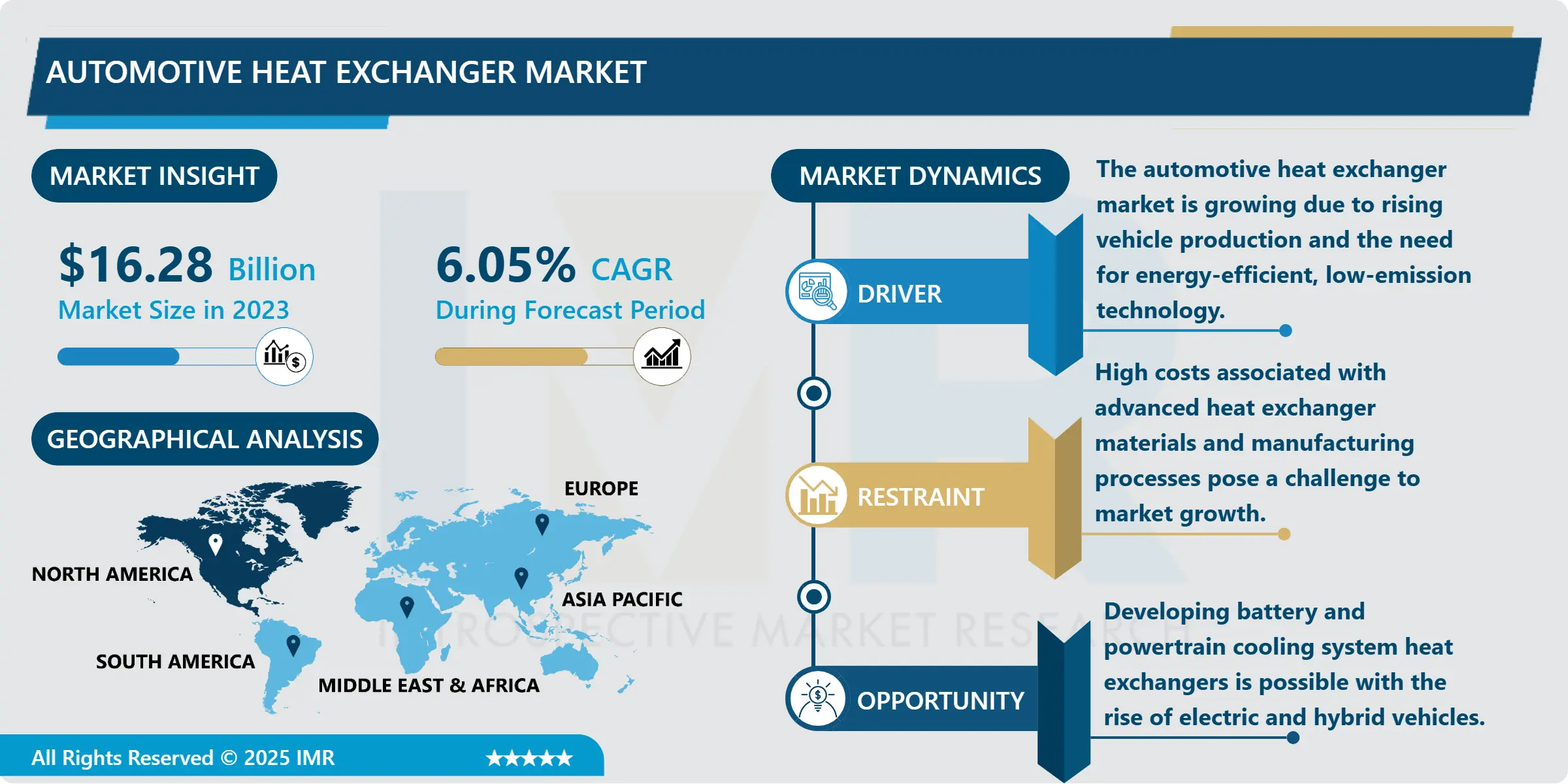
Automotive Heat Exchanger Market – Insights for Business Growth Report 2024-2032
Automotive Heat Exchanger Market Size Was Valued at USD 16.28 Billion in 2023, and is Projected to Reach USD 27.55 Billion by 2032, Growing at a CAGR of 6.05% From 2024-2032.

IMR Group
Description
Automotive Heat Exchanger Market Synopsis:
Automotive Heat Exchanger Market Size Was Valued at USD 16.28 Billion in 2023, and is Projected to Reach USD 27.55 Billion by 2032, Growing at a CAGR of 6.05% From 2024-2032.
The Automotive Heat Exchanger Market geared towards vehicles are highly significant since these components are inherent aspects of temperature control by transferring heat in different systems of the car, such as the engine, air conditioning, and transmission. Heat exchangers play a useful role in controlling the operating temperatures, enhancing the fuel economy and lowering the amount of pollution. As people now turn towards fuel-efficient vehicles and environmentally friendly products, the heat exchangers market is gradually expanding across the global market especially in the highly regulated areas of North America, Europe, and Asia-Pacific.
Other trends in the automotive area, like Electric Vehicles or hybrid power plants, also envoke developments in heat exchanger constructions. For example, thermal management of EVs, especially batteries and powertrains involved in the transport of electricity or conversion of it, is considerably high. As a result, we have seen manufacturers come up with improved smaller, lighter, and more efficient heat exchangers for use with the emerging thermal system technologies. Moreover, in aluminum and other light metal alloys, improvements in material have made it possible to build more reliable and effective heat exchangers.
The Asia-Pacific has been forecasted to be the leading market mainly due to the increasing automotive output within the developing countries such as China, Japan and India. Fortune 1000 automotive companies are to benefit a lot through increase in consumer demand of better fuel efficiency vehicles and enhanced climate control systems causing growth of the market especially in emergent economies. Third, the market gets constant innovation, as car manufacturers pay attention to creating heat exchangers suited for the existing and emergent standards and requirements. Because of the development of types of vehicles, key by EVs and hybrid automobiles, the living space of automotive heat exchanger market will last perpetually.
Automotive Heat Exchanger Market Trend Analysis:
Shift Toward Lightweight and Compact Heat Exchangers
The market for small and light weight heat exchangers is increasing due to the automobile industry’s attempt to increase the fuel efficiency along with reducing the vehicle’s weight. Advanced automotive heat exchangers are being built from light materials like aluminum and advanced composites that contribute to the small overall weight of vehicles being produced today. This trend is particularly important in electric vehicles (EVs) as effective thermal management of battery and powertrain is important for extending range and improving performance. New generations of heat exchangers are characterized by ever greater compactness and ever greater efficiency for meeting the requirements of modern low-emission cars.
Focus on Lightweight and Compact Heat Exchangers
The third major trend that speaks to the future of automotive heat exchangers is that making systems lighter and more compact is a top priority for other reasons including fuel efficiency and emissions. The automobile manufacturers are always coming up with heat exchangers that not only enhance the thermal efficiency but also the lightweight heat exchangers. Better, lighter, more durable and efficient heat exchanging materials such as aluminum and advanced composites are being used in developing heat exchanging parts, in an effort to satisfy the need for fuel efficient and green automobiles. This trend is set to accelerate the market growth in the future due to increasing standard of restrictions to fuel economy and emissions.
Automotive Heat Exchanger Market Segment Analysis:
Automotive Heat Exchanger Market Segmented on the basis of Application, Design Type, Material, Propulsion Type, Vehicle Type, and Region.
By Application, Intercooler segment is expected to dominate the market during the forecast period
By application, the market for automotive heat exchanger has been categorized into intercooler, radiator, air conditioning, oil cooler and other. Intercoolers are now used to cool compressed air for charged engines that stabilize performance of supercharged/turbo charged engines. Large,horizontal radiators are indispensable to cool engine coolant, to avoid extremely high temperature within the engine chamber. HVAC heat exchangers are responsible for conditioning the passenger cabin so as to provide comfort while in the vehicle. Intercooler coolers are devices that are fitted to the engine to help in conditioning of engine oil hence need to be in good state to prevent damaging of the engine. The others segment comprises a number of heat exchangers applied to different applications including transmission cooling, HVAC/R, and battery thermal management in electric vehicles. The increasing need for effective thermal management mechanisms across the mentioned applications is boosting market expansion.
Automotive Heat Exchanger Market Regional Insights:
North America is Expected to Dominate the Market Over the Forecast period
North America is expected to dominate the Automotive Heat Exchanger Market over the forecast period, driven by the region’s strong automotive manufacturing base, particularly in the United States and Canada, which are key hubs for both traditional and electric vehicle production. The increasing demand for fuel-efficient, low-emission vehicles, coupled with stringent environmental regulations, is pushing automakers to adopt advanced heat exchanger technologies for thermal management. Additionally, the rapid growth of electric and hybrid vehicles in the region is further boosting the demand for specialized heat exchangers designed for EV batteries and powertrains. The presence of leading market players and ongoing investments in automotive innovation also contribute to North America’s dominant market position.
Active Key Players in the Automotive Heat Exchanger Market:
Aisin Seiki Co., Ltd. (Japan)
BorgWarner Inc. (United States)
Calsonic Kansei (Japan)
Delphi Technologies (United Kingdom)
Denso Corporation (Japan)
Hanon Systems (South Korea)
Hitachi Automotive Systems, Ltd. (Japan)
Keihin Corporation (Japan)
MAHLE GmbH (Germany)
Mannigel (Germany)
Mitsubishi Heavy Industries Automotive Thermal Systems Co., Ltd. (Japan)
Modine Manufacturing Company (United States)
Sanden Holdings Corporation (Japan)
T.RAD (Japan)
Valeo (France)
Other Active Players
Chapter 1: Introduction
1.1 Scope and Coverage
Chapter 2:Executive Summary
Chapter 3: Market Landscape
3.1 Market Dynamics
3.1.1 Drivers
3.1.2 Restraints
3.1.3 Opportunities
3.1.4 Challenges
3.2 Market Trend Analysis
3.3 PESTLE Analysis
3.4 Porter’s Five Forces Analysis
3.5 Industry Value Chain Analysis
3.6 Ecosystem
3.7 Regulatory Landscape
3.8 Price Trend Analysis
3.9 Patent Analysis
3.10 Technology Evolution
3.11 Investment Pockets
3.12 Import-Export Analysis
Chapter 4: Automotive Heat Exchanger Market by Application
4.1 Automotive Heat Exchanger Market Snapshot and Growth Engine
4.2 Automotive Heat Exchanger Market Overview
4.3 Intercooler
4.3.1 Introduction and Market Overview
4.3.2 Historic and Forecasted Market Size in Value USD and Volume Units (2017-2032F)
4.3.3 Key Market Trends, Growth Factors and Opportunities
4.3.4 Intercooler: Geographic Segmentation Analysis
4.4 Radiator
4.4.1 Introduction and Market Overview
4.4.2 Historic and Forecasted Market Size in Value USD and Volume Units (2017-2032F)
4.4.3 Key Market Trends, Growth Factors and Opportunities
4.4.4 Radiator: Geographic Segmentation Analysis
4.5 Air Conditioning
4.5.1 Introduction and Market Overview
4.5.2 Historic and Forecasted Market Size in Value USD and Volume Units (2017-2032F)
4.5.3 Key Market Trends, Growth Factors and Opportunities
4.5.4 Air Conditioning: Geographic Segmentation Analysis
4.6 Oil Cooler
4.6.1 Introduction and Market Overview
4.6.2 Historic and Forecasted Market Size in Value USD and Volume Units (2017-2032F)
4.6.3 Key Market Trends, Growth Factors and Opportunities
4.6.4 Oil Cooler: Geographic Segmentation Analysis
4.7 and Others
4.7.1 Introduction and Market Overview
4.7.2 Historic and Forecasted Market Size in Value USD and Volume Units (2017-2032F)
4.7.3 Key Market Trends, Growth Factors and Opportunities
4.7.4 and Others: Geographic Segmentation Analysis
Chapter 5: Automotive Heat Exchanger Market by Design Type
5.1 Automotive Heat Exchanger Market Snapshot and Growth Engine
5.2 Automotive Heat Exchanger Market Overview
5.3 Tube Fin
5.3.1 Introduction and Market Overview
5.3.2 Historic and Forecasted Market Size in Value USD and Volume Units (2017-2032F)
5.3.3 Key Market Trends, Growth Factors and Opportunities
5.3.4 Tube Fin: Geographic Segmentation Analysis
5.4 Plate Bar
5.4.1 Introduction and Market Overview
5.4.2 Historic and Forecasted Market Size in Value USD and Volume Units (2017-2032F)
5.4.3 Key Market Trends, Growth Factors and Opportunities
5.4.4 Plate Bar: Geographic Segmentation Analysis
5.5 and Others
5.5.1 Introduction and Market Overview
5.5.2 Historic and Forecasted Market Size in Value USD and Volume Units (2017-2032F)
5.5.3 Key Market Trends, Growth Factors and Opportunities
5.5.4 and Others: Geographic Segmentation Analysis
Chapter 6: Automotive Heat Exchanger Market by Material
6.1 Automotive Heat Exchanger Market Snapshot and Growth Engine
6.2 Automotive Heat Exchanger Market Overview
6.3 Aluminium
6.3.1 Introduction and Market Overview
6.3.2 Historic and Forecasted Market Size in Value USD and Volume Units (2017-2032F)
6.3.3 Key Market Trends, Growth Factors and Opportunities
6.3.4 Aluminium: Geographic Segmentation Analysis
6.4 Copper
6.4.1 Introduction and Market Overview
6.4.2 Historic and Forecasted Market Size in Value USD and Volume Units (2017-2032F)
6.4.3 Key Market Trends, Growth Factors and Opportunities
6.4.4 Copper: Geographic Segmentation Analysis
6.5 and Others
6.5.1 Introduction and Market Overview
6.5.2 Historic and Forecasted Market Size in Value USD and Volume Units (2017-2032F)
6.5.3 Key Market Trends, Growth Factors and Opportunities
6.5.4 and Others: Geographic Segmentation Analysis
Chapter 7: Automotive Heat Exchanger Market by Propulsion Type
7.1 Automotive Heat Exchanger Market Snapshot and Growth Engine
7.2 Automotive Heat Exchanger Market Overview
7.3 Internal Combustion Engine (ICE) and Electric Vehicle (EV)
7.3.1 Introduction and Market Overview
7.3.2 Historic and Forecasted Market Size in Value USD and Volume Units (2017-2032F)
7.3.3 Key Market Trends, Growth Factors and Opportunities
7.3.4 Internal Combustion Engine (ICE) and Electric Vehicle (EV): Geographic Segmentation Analysis
Chapter 8: Automotive Heat Exchanger Market by Vehicle Type
8.1 Automotive Heat Exchanger Market Snapshot and Growth Engine
8.2 Automotive Heat Exchanger Market Overview
8.3 Passenger Car
8.3.1 Introduction and Market Overview
8.3.2 Historic and Forecasted Market Size in Value USD and Volume Units (2017-2032F)
8.3.3 Key Market Trends, Growth Factors and Opportunities
8.3.4 Passenger Car: Geographic Segmentation Analysis
8.4 Light Commercial Vehicle
8.4.1 Introduction and Market Overview
8.4.2 Historic and Forecasted Market Size in Value USD and Volume Units (2017-2032F)
8.4.3 Key Market Trends, Growth Factors and Opportunities
8.4.4 Light Commercial Vehicle: Geographic Segmentation Analysis
8.5 and Heavy Commercial Vehicle
8.5.1 Introduction and Market Overview
8.5.2 Historic and Forecasted Market Size in Value USD and Volume Units (2017-2032F)
8.5.3 Key Market Trends, Growth Factors and Opportunities
8.5.4 and Heavy Commercial Vehicle: Geographic Segmentation Analysis
Chapter 9: Company Profiles and Competitive Analysis
9.1 Competitive Landscape
9.1.1 Competitive Benchmarking
9.1.2 Automotive Heat Exchanger Market Share by Manufacturer (2023)
9.1.3 Industry BCG Matrix
9.1.4 Heat Map Analysis
9.1.5 Mergers and Acquisitions
9.2 CALSONIC KANSEI (JAPAN)
9.2.1 Company Overview
9.2.2 Key Executives
9.2.3 Company Snapshot
9.2.4 Role of the Company in the Market
9.2.5 Sustainability and Social Responsibility
9.2.6 Operating Business Segments
9.2.7 Product Portfolio
9.2.8 Business Performance
9.2.9 Key Strategic Moves and Recent Developments
9.2.10 SWOT Analysis
9.3 AISIN SEIKI CO. LTD. (JAPAN)
9.4 DELPHI TECHNOLOGIES (UNITED KINGDOM)
9.5 MANNIGEL (GERMANY)
9.6 SANDEN HOLDINGS CORPORATION (JAPAN)
9.7 HITACHI AUTOMOTIVE SYSTEMS
9.8 LTD. (JAPAN)
9.9 MODINE MANUFACTURING COMPANY (UNITED STATES)
9.10 MITSUBISHI HEAVY INDUSTRIES AUTOMOTIVE THERMAL SYSTEMS CO. LTD. (JAPAN)
9.11 HANON SYSTEMS (SOUTH KOREA)
9.12 DENSO CORPORATION (JAPAN)
9.13 BORGWARNER INC. (UNITED STATES)
9.14 T.RAD (JAPAN)
9.15 VALEO (FRANCE)
9.16 MAHLE GMBH (GERMANY)
9.17 KEIHIN CORPORATION (JAPAN)
9.18 OTHER ACTIVE PLAYERS
Chapter 10: Global Automotive Heat Exchanger Market By Region
10.1 Overview
10.2. North America Automotive Heat Exchanger Market
10.2.1 Key Market Trends, Growth Factors and Opportunities
10.2.2 Top Key Companies
10.2.3 Historic and Forecasted Market Size by Segments
10.2.4 Historic and Forecasted Market Size By Application
10.2.4.1 Intercooler
10.2.4.2 Radiator
10.2.4.3 Air Conditioning
10.2.4.4 Oil Cooler
10.2.4.5 and Others
10.2.5 Historic and Forecasted Market Size By Design Type
10.2.5.1 Tube Fin
10.2.5.2 Plate Bar
10.2.5.3 and Others
10.2.6 Historic and Forecasted Market Size By Material
10.2.6.1 Aluminium
10.2.6.2 Copper
10.2.6.3 and Others
10.2.7 Historic and Forecasted Market Size By Propulsion Type
10.2.7.1 Internal Combustion Engine (ICE) and Electric Vehicle (EV)
10.2.8 Historic and Forecasted Market Size By Vehicle Type
10.2.8.1 Passenger Car
10.2.8.2 Light Commercial Vehicle
10.2.8.3 and Heavy Commercial Vehicle
10.2.9 Historic and Forecast Market Size by Country
10.2.9.1 US
10.2.9.2 Canada
10.2.9.3 Mexico
10.3. Eastern Europe Automotive Heat Exchanger Market
10.3.1 Key Market Trends, Growth Factors and Opportunities
10.3.2 Top Key Companies
10.3.3 Historic and Forecasted Market Size by Segments
10.3.4 Historic and Forecasted Market Size By Application
10.3.4.1 Intercooler
10.3.4.2 Radiator
10.3.4.3 Air Conditioning
10.3.4.4 Oil Cooler
10.3.4.5 and Others
10.3.5 Historic and Forecasted Market Size By Design Type
10.3.5.1 Tube Fin
10.3.5.2 Plate Bar
10.3.5.3 and Others
10.3.6 Historic and Forecasted Market Size By Material
10.3.6.1 Aluminium
10.3.6.2 Copper
10.3.6.3 and Others
10.3.7 Historic and Forecasted Market Size By Propulsion Type
10.3.7.1 Internal Combustion Engine (ICE) and Electric Vehicle (EV)
10.3.8 Historic and Forecasted Market Size By Vehicle Type
10.3.8.1 Passenger Car
10.3.8.2 Light Commercial Vehicle
10.3.8.3 and Heavy Commercial Vehicle
10.3.9 Historic and Forecast Market Size by Country
10.3.9.1 Russia
10.3.9.2 Bulgaria
10.3.9.3 The Czech Republic
10.3.9.4 Hungary
10.3.9.5 Poland
10.3.9.6 Romania
10.3.9.7 Rest of Eastern Europe
10.4. Western Europe Automotive Heat Exchanger Market
10.4.1 Key Market Trends, Growth Factors and Opportunities
10.4.2 Top Key Companies
10.4.3 Historic and Forecasted Market Size by Segments
10.4.4 Historic and Forecasted Market Size By Application
10.4.4.1 Intercooler
10.4.4.2 Radiator
10.4.4.3 Air Conditioning
10.4.4.4 Oil Cooler
10.4.4.5 and Others
10.4.5 Historic and Forecasted Market Size By Design Type
10.4.5.1 Tube Fin
10.4.5.2 Plate Bar
10.4.5.3 and Others
10.4.6 Historic and Forecasted Market Size By Material
10.4.6.1 Aluminium
10.4.6.2 Copper
10.4.6.3 and Others
10.4.7 Historic and Forecasted Market Size By Propulsion Type
10.4.7.1 Internal Combustion Engine (ICE) and Electric Vehicle (EV)
10.4.8 Historic and Forecasted Market Size By Vehicle Type
10.4.8.1 Passenger Car
10.4.8.2 Light Commercial Vehicle
10.4.8.3 and Heavy Commercial Vehicle
10.4.9 Historic and Forecast Market Size by Country
10.4.9.1 Germany
10.4.9.2 UK
10.4.9.3 France
10.4.9.4 The Netherlands
10.4.9.5 Italy
10.4.9.6 Spain
10.4.9.7 Rest of Western Europe
10.5. Asia Pacific Automotive Heat Exchanger Market
10.5.1 Key Market Trends, Growth Factors and Opportunities
10.5.2 Top Key Companies
10.5.3 Historic and Forecasted Market Size by Segments
10.5.4 Historic and Forecasted Market Size By Application
10.5.4.1 Intercooler
10.5.4.2 Radiator
10.5.4.3 Air Conditioning
10.5.4.4 Oil Cooler
10.5.4.5 and Others
10.5.5 Historic and Forecasted Market Size By Design Type
10.5.5.1 Tube Fin
10.5.5.2 Plate Bar
10.5.5.3 and Others
10.5.6 Historic and Forecasted Market Size By Material
10.5.6.1 Aluminium
10.5.6.2 Copper
10.5.6.3 and Others
10.5.7 Historic and Forecasted Market Size By Propulsion Type
10.5.7.1 Internal Combustion Engine (ICE) and Electric Vehicle (EV)
10.5.8 Historic and Forecasted Market Size By Vehicle Type
10.5.8.1 Passenger Car
10.5.8.2 Light Commercial Vehicle
10.5.8.3 and Heavy Commercial Vehicle
10.5.9 Historic and Forecast Market Size by Country
10.5.9.1 China
10.5.9.2 India
10.5.9.3 Japan
10.5.9.4 South Korea
10.5.9.5 Malaysia
10.5.9.6 Thailand
10.5.9.7 Vietnam
10.5.9.8 The Philippines
10.5.9.9 Australia
10.5.9.10 New Zealand
10.5.9.11 Rest of APAC
10.6. Middle East & Africa Automotive Heat Exchanger Market
10.6.1 Key Market Trends, Growth Factors and Opportunities
10.6.2 Top Key Companies
10.6.3 Historic and Forecasted Market Size by Segments
10.6.4 Historic and Forecasted Market Size By Application
10.6.4.1 Intercooler
10.6.4.2 Radiator
10.6.4.3 Air Conditioning
10.6.4.4 Oil Cooler
10.6.4.5 and Others
10.6.5 Historic and Forecasted Market Size By Design Type
10.6.5.1 Tube Fin
10.6.5.2 Plate Bar
10.6.5.3 and Others
10.6.6 Historic and Forecasted Market Size By Material
10.6.6.1 Aluminium
10.6.6.2 Copper
10.6.6.3 and Others
10.6.7 Historic and Forecasted Market Size By Propulsion Type
10.6.7.1 Internal Combustion Engine (ICE) and Electric Vehicle (EV)
10.6.8 Historic and Forecasted Market Size By Vehicle Type
10.6.8.1 Passenger Car
10.6.8.2 Light Commercial Vehicle
10.6.8.3 and Heavy Commercial Vehicle
10.6.9 Historic and Forecast Market Size by Country
10.6.9.1 Turkiye
10.6.9.2 Bahrain
10.6.9.3 Kuwait
10.6.9.4 Saudi Arabia
10.6.9.5 Qatar
10.6.9.6 UAE
10.6.9.7 Israel
10.6.9.8 South Africa
10.7. South America Automotive Heat Exchanger Market
10.7.1 Key Market Trends, Growth Factors and Opportunities
10.7.2 Top Key Companies
10.7.3 Historic and Forecasted Market Size by Segments
10.7.4 Historic and Forecasted Market Size By Application
10.7.4.1 Intercooler
10.7.4.2 Radiator
10.7.4.3 Air Conditioning
10.7.4.4 Oil Cooler
10.7.4.5 and Others
10.7.5 Historic and Forecasted Market Size By Design Type
10.7.5.1 Tube Fin
10.7.5.2 Plate Bar
10.7.5.3 and Others
10.7.6 Historic and Forecasted Market Size By Material
10.7.6.1 Aluminium
10.7.6.2 Copper
10.7.6.3 and Others
10.7.7 Historic and Forecasted Market Size By Propulsion Type
10.7.7.1 Internal Combustion Engine (ICE) and Electric Vehicle (EV)
10.7.8 Historic and Forecasted Market Size By Vehicle Type
10.7.8.1 Passenger Car
10.7.8.2 Light Commercial Vehicle
10.7.8.3 and Heavy Commercial Vehicle
10.7.9 Historic and Forecast Market Size by Country
10.7.9.1 Brazil
10.7.9.2 Argentina
10.7.9.3 Rest of SA
Chapter 11 Analyst Viewpoint and Conclusion
11.1 Recommendations and Concluding Analysis
11.2 Potential Market Strategies
Chapter 12 Research Methodology
12.1 Research Process
12.2 Primary Research
12.3 Secondary Research
Q1: What would be the forecast period in the Automotive Heat Exchanger Market research report?
A1: The forecast period in the Automotive Heat Exchanger Market research report is 2024-2032.
Q2: Who are the key players in the Automotive Heat Exchanger Market?
A2: Calsonic Kansei (Japan), Aisin Seiki Co., Ltd. (Japan), Delphi Technologies (United Kingdom), Mannigel (Germany), Sanden Holdings Corporation (Japan), Hitachi Automotive Systems, Ltd. (Japan), Modine Manufacturing Company (United States), Mitsubishi Heavy Industries Automotive Thermal Systems Co., Ltd. (Japan), Hanon Systems (South Korea), Denso Corporation (Japan), BorgWarner Inc. (United States), T.RAD (Japan), Valeo (France), MAHLE GmbH (Germany), Keihin Corporation (Japan), Other Active Players.
Q3: What are the segments of the Automotive Heat Exchanger Market?
A3: The Automotive Heat Exchanger Market is segmented into By Application, Design Type, By Material, Propulsion Type, Vehicle Type and region. By Application (Intercooler, Radiator, Air Conditioning, Oil Cooler, and Others), Design Type (Tube Fin, Plate Bar, and Others), Material (Aluminium, Copper, and Others), Propulsion Type (Internal Combustion Engine (ICE) and Electric Vehicle (EV)), Vehicle Type (Passenger Car, Light Commercial Vehicle, and Heavy Commercial Vehicle). By region, it is analyzed across North America (U.S., Canada, Mexico), Eastern Europe (Russia, Bulgaria, The Czech Republic, Hungary, Poland, Romania, Rest of Eastern Europe), Western Europe (Germany, UK, France, The Netherlands, Italy, Russia, Spain, Rest of Western Europe), Asia Pacific (China, India, Japan, South Korea, Malaysia, Thailand, Vietnam, The Philippines, Australia, New-Zealand, Rest of APAC), Middle East & Africa (Turkiye, Bahrain, Kuwait, Saudi Arabia, Qatar, UAE, Israel, South Africa), South America (Brazil, Argentina, Rest of SA).
Q4: What is the Automotive Heat Exchanger Market?
A4: An automotive heat exchanger is a critical component in a vehicle's thermal management system, designed to transfer heat between fluids or between a fluid and the surrounding air to maintain optimal operating temperatures. It is commonly used in various applications, such as cooling the engine, transmission, and air conditioning systems, as well as managing the temperature of electric vehicle (EV) batteries and powertrains. Heat exchangers enhance energy efficiency, reduce emissions, and prevent overheating, ensuring the vehicle's performance, safety, and longevity. These systems are essential for both traditional internal combustion engine (ICE) vehicles and modern electric and hybrid vehicles.
Q5: How big is Automotive Heat Exchanger Market?
A5: Automotive Heat Exchanger Market Size Was Valued at USD 16.28 Billion in 2023, and is Projected to Reach USD 27.55 Billion by 2032, Growing at a CAGR of 6.05% From 2024-2032.
How to Buy a Report from eminsights.jp
On the product page, choose the license you want: Single-User License, Multi-User License or Enterprise License.
If you required report in your native language, then you can click on Translated Report button and fill out the form with report name and language you want, then our team will contact you as soon as possible.
Click the Buy Now button.
You will be redirected to the checkout page. Enter your company details and payment information.
Click Place Order to complete the purchase.
Confirmation: You’ll receive an order confirmation and our team will contact you shortly with your ordered report.
If you have any questions, fill out the contact form below or email us at [email protected].
Thank you for choosing eminsights.jp!