Stay Ahead in Fast-Growing Economies.
Browse Reports Now
Automotive Differential Market – Opportunities & Growth Forecast
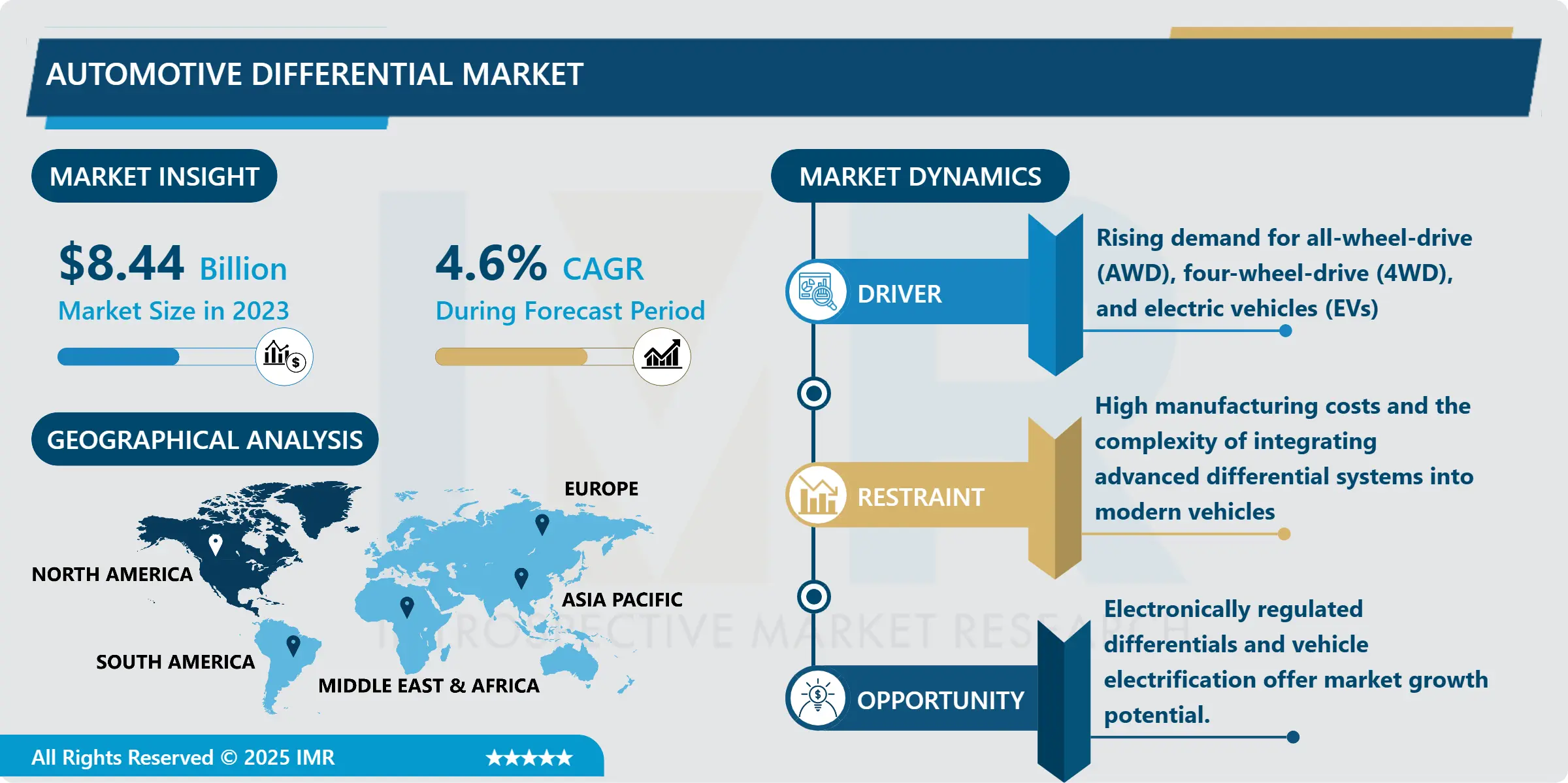
Automotive Differential Market Size Was Valued at USD 8.44 Billion in 2023, and is Projected to Reach USD 44.05 Billion by 2032, Growing at a CAGR of 4.60% From 2024-2032.

IMR Group
Description
Automotive Differential Market Synopsis:
Automotive Differential Market Size Was Valued at USD 8.44 Billion in 2023, and is Projected to Reach USD 44.05 Billion by 2032, Growing at a CAGR of 4.60% From 2024-2032.
Automotive differential is the market that deals with manufacturing and selling of differential system, which are used as parts of the drivetrain. These systems govern how the rotational speed of wheels differs, some of which makes turns much smoother and have better grip. In the market, there are open, locking, limited-slip and the electronically controlled differentials required for different cars and trucks, cars, commercial and off-road vehicles. A demand for high-performance car and progressing automotive technology has also played a major role to the growth of the market.
Some of the advances in technology, for example incorporating electric control systems in differential mechanisms, are making vehicles better and safer. Another changing trend is the emergence of electric vehicles (EVs) that are triggering manufacturers’ to design electric differential systems to enhance the range of the vehicles’ performance. Further, the growing incorporation of all-wheel-drive (AWD) and four-wheel-drive (4WD) systems in passenger cars for their tractive force in rigorous topography is driving the demand for sophisticated differential systems in the global market.
Market is regionalized and Asia-Pacific dominate cause by growing automotive industry and high vehicle manufacturing rate from countries such as China, Japan and India. North America and Europe are the other locations, because the demand for luxury and high-performance cars is high. Nonetheless, factors such as unpredictable supply prices of raw materials and issues in incorporating advanced differentials in most of the current models may act as constraints to market progression. Despite these challenges, the industry is likely to record significant growth in the automotive differential market since vehicle units will continue to circulate due to a growing global population and other drivetrain improvements.
Automotive Differential Market Trend Analysis:
Rising Integration of Electronically Controlled Differentials
Electronically controlled differentials are increasingly being integrated into modern vehicles as a response to the growing demand for enhanced vehicle stability, improved traction, and superior overall performance. These advanced systems require the precise installation of a network of sensors and electronic control units (ECUs) that work together to actively manage and adjust torque distribution between the wheels. By dynamically modifying the torque, the system greatly improves the vehicle’s handling, particularly during complex driving conditions such as cornering, accelerating, or driving on slippery surfaces.
Technology plays a crucial role in enhancing driver confidence and vehicle safety. High-level electrical architectures, including electronically controlled differentials, are becoming standard features, especially in pure electric vehicles (EVs) and hybrid vehicles. This shift highlights the sweeping transformation occurring within the automotive industry towards smarter, more connected, and highly automated vehicles, shaping the future of mobility.
Increasing Demand for All-Wheel Drive (AWD) and Four-Wheel Drive (4WD) Vehicles
The increasing preference among automakers for sophisticated all-wheel drive (AWD) and four-wheel drive (4WD) systems in modern off-road vehicles and large sport utility vehicles (SUVs) is significantly driving the demand for more complex and multi-functional differentials. These advanced differential systems are essential for ensuring superior performance across a variety of challenging terrains.
As consumers place a stronger emphasis on safety, flexibility, and driving stability, manufacturers are increasingly integrating limited-slip and locking differentials to optimize traction and vehicle control. Furthermore, the rising popularity of new-generation vehicles designed to tackle tough road conditions, particularly across the Asia-Pacific and Latin America regions, is further boosting the need for highly efficient differential systems. In response, the automotive industry has emerged as a major consumer of advanced differentials, as companies strive to meet the growing demand for vehicles capable of delivering enhanced off-road performance and driving confidence.
Automotive Differential Market Segment Analysis:
Automotive Differential Market is Segmented on the basis of Differential Type, Drive Type, Vehicle Type, Hybrid Vehicles, Off-Highway Vehicle Type, Component, and Region.
By Differential Type, the Limited-Slip Differential (LSD) segment is expected to dominate the market during the forecast period
Automotive differential market is split by differentiation type into open, locking, LSD, ELSD and TVS, each design offering unique features to meet particular vehicle need and driving demands. There are two types: open differentials for simple and common vehicles, and locking differentials for off-road and other sharp-terrain vehicles. LSDs provide better handling, and powertrain reliability by restricting the difference in wheel speed consequently used in performance and sports cars.
ELSDs are seen as a technological advance featuring the use of electronic controls for the dynamic variation of torque distribution and with much improved acccuracy in conditions involving luxury as well as electric type vehicles. Some of the distinguishing technology seen emerging in the key vehicle application categories include torque vectoring systems that optimally control distribution of power to wheels and requested differentials in performance and sporty cars and high-end AWD cars; these are more specialized and sophisticated changes.
By Component, Differential Bearing segment expected to held the largest share
The automotive differential can be divided by components such as the differential bearing, differential gear, differential case, and others, all of which essential for the differential. Differential bearings play a crucial role in minimizing friction and enabling the free rotation of the corresponding parts while differential gears work in facilitating equal distribution of torque between wheels when turning and traction is needed. Differential cases contain elements of the system and bring solidity to protect it from environmental factors and wearing out.
The residual ‘Others’ industry entails minor items such as seals, shafts, and lubricants that make essential contribution in the functioning of differentials. The demand for LGAs to manufacture more durable and high performance components is set to rise because of the emergence of new drivetrain technologies and rising sales of AWD and EV models within the market.
Automotive Differential Market Regional Insights:
North America is Expected to Dominate the Market Over the Forecast period
The automotive differential is expected to witness significant demand from North America during the upcoming years mainly due to the increasing demand for Hi-performance and off-road vehicles particular to the United States market. Awareness and appreciation of AWD or 4WD systems, a mature automotive market, together with the technological development of the region, is conducive to the use of complex differential systems.
The increasing use of electric vehicles and hybrids in North America in turn is boosting the demand for new specialised differentials that can improve efficiency and output. It is so due to the heavy funding on research and innovation from companies in the region.
Active Key Players in the Automotive Differential Market:
Melrose Industries PLC (U.K.)
Eaton (U.S.)
American Axle & Manufacturing, Inc. (U.S.)
Dana Limited (U.S.)
BorgWarner Inc. (U.S.)
Linamar Corporation (Canada)
Schaeffler AG (Germany)
ZF Friedrichshafen AG (Germany)
JTEKT Corporation(Japan)
Continental AG (Germany)
Auburn Gear, LLC (U.S.)
Neapco Holdings LLC (U.S.)
Magna International Inc. (Canada)
Drexler Companies Inc. (U.S.)
RT Quaife Engineering Ltd. (U.K.)
Xtrac Ltd (U.K.)
NSK Ltd. (Japan)
Bharat Gears Ltd. (India)
CUSCO Japan co., ltd. (Japan)
Zen Technologies Limited (India)
Kermanmotor Co. (Iran), and Other Active Players.
Chapter 1: Introduction
1.1 Scope and Coverage
Chapter 2:Executive Summary
Chapter 3: Market Landscape
3.1 Market Dynamics
3.1.1 Drivers
3.1.2 Restraints
3.1.3 Opportunities
3.1.4 Challenges
3.2 Market Trend Analysis
3.3 PESTLE Analysis
3.4 Porter’s Five Forces Analysis
3.5 Industry Value Chain Analysis
3.6 Ecosystem
3.7 Regulatory Landscape
3.8 Price Trend Analysis
3.9 Patent Analysis
3.10 Technology Evolution
3.11 Investment Pockets
3.12 Import-Export Analysis
Chapter 4: Automotive Differential Market by Component
4.1 Automotive Differential Market Snapshot and Growth Engine
4.2 Automotive Differential Market Overview
4.3 Hardware
4.3.1 Introduction and Market Overview
4.3.2 Historic and Forecasted Market Size in Value USD and Volume Units (2017-2032F)
4.3.3 Key Market Trends, Growth Factors and Opportunities
4.3.4 Hardware: Geographic Segmentation Analysis
4.4 Software
4.4.1 Introduction and Market Overview
4.4.2 Historic and Forecasted Market Size in Value USD and Volume Units (2017-2032F)
4.4.3 Key Market Trends, Growth Factors and Opportunities
4.4.4 Software: Geographic Segmentation Analysis
4.5 Services
4.5.1 Introduction and Market Overview
4.5.2 Historic and Forecasted Market Size in Value USD and Volume Units (2017-2032F)
4.5.3 Key Market Trends, Growth Factors and Opportunities
4.5.4 Services: Geographic Segmentation Analysis
Chapter 5: Automotive Differential Market by Technology
5.1 Automotive Differential Market Snapshot and Growth Engine
5.2 Automotive Differential Market Overview
5.3 Contactless
5.3.1 Introduction and Market Overview
5.3.2 Historic and Forecasted Market Size in Value USD and Volume Units (2017-2032F)
5.3.3 Key Market Trends, Growth Factors and Opportunities
5.3.4 Contactless: Geographic Segmentation Analysis
5.4 Smart Cards
5.4.1 Introduction and Market Overview
5.4.2 Historic and Forecasted Market Size in Value USD and Volume Units (2017-2032F)
5.4.3 Key Market Trends, Growth Factors and Opportunities
5.4.4 Smart Cards: Geographic Segmentation Analysis
5.5 Biometric Recognition
5.5.1 Introduction and Market Overview
5.5.2 Historic and Forecasted Market Size in Value USD and Volume Units (2017-2032F)
5.5.3 Key Market Trends, Growth Factors and Opportunities
5.5.4 Biometric Recognition: Geographic Segmentation Analysis
5.6 Near Field Communication (NFC)
5.6.1 Introduction and Market Overview
5.6.2 Historic and Forecasted Market Size in Value USD and Volume Units (2017-2032F)
5.6.3 Key Market Trends, Growth Factors and Opportunities
5.6.4 Near Field Communication (NFC): Geographic Segmentation Analysis
5.7 Magnetic Stripe Cards
5.7.1 Introduction and Market Overview
5.7.2 Historic and Forecasted Market Size in Value USD and Volume Units (2017-2032F)
5.7.3 Key Market Trends, Growth Factors and Opportunities
5.7.4 Magnetic Stripe Cards: Geographic Segmentation Analysis
Chapter 6: Automotive Differential Market by Application
6.1 Automotive Differential Market Snapshot and Growth Engine
6.2 Automotive Differential Market Overview
6.3 Railways
6.3.1 Introduction and Market Overview
6.3.2 Historic and Forecasted Market Size in Value USD and Volume Units (2017-2032F)
6.3.3 Key Market Trends, Growth Factors and Opportunities
6.3.4 Railways: Geographic Segmentation Analysis
6.4 Buses
6.4.1 Introduction and Market Overview
6.4.2 Historic and Forecasted Market Size in Value USD and Volume Units (2017-2032F)
6.4.3 Key Market Trends, Growth Factors and Opportunities
6.4.4 Buses: Geographic Segmentation Analysis
6.5 Metro/Subway
6.5.1 Introduction and Market Overview
6.5.2 Historic and Forecasted Market Size in Value USD and Volume Units (2017-2032F)
6.5.3 Key Market Trends, Growth Factors and Opportunities
6.5.4 Metro/Subway: Geographic Segmentation Analysis
6.6 Trams & Light Rail
6.6.1 Introduction and Market Overview
6.6.2 Historic and Forecasted Market Size in Value USD and Volume Units (2017-2032F)
6.6.3 Key Market Trends, Growth Factors and Opportunities
6.6.4 Trams & Light Rail: Geographic Segmentation Analysis
6.7 Ferries & Waterways
6.7.1 Introduction and Market Overview
6.7.2 Historic and Forecasted Market Size in Value USD and Volume Units (2017-2032F)
6.7.3 Key Market Trends, Growth Factors and Opportunities
6.7.4 Ferries & Waterways: Geographic Segmentation Analysis
Chapter 7: Automotive Differential Market by Deployment Mode
7.1 Automotive Differential Market Snapshot and Growth Engine
7.2 Automotive Differential Market Overview
7.3 Cloud-based
7.3.1 Introduction and Market Overview
7.3.2 Historic and Forecasted Market Size in Value USD and Volume Units (2017-2032F)
7.3.3 Key Market Trends, Growth Factors and Opportunities
7.3.4 Cloud-based: Geographic Segmentation Analysis
7.4 On-premise
7.4.1 Introduction and Market Overview
7.4.2 Historic and Forecasted Market Size in Value USD and Volume Units (2017-2032F)
7.4.3 Key Market Trends, Growth Factors and Opportunities
7.4.4 On-premise: Geographic Segmentation Analysis
Chapter 8: Automotive Differential Market by End-User
8.1 Automotive Differential Market Snapshot and Growth Engine
8.2 Automotive Differential Market Overview
8.3 Transportation Operators
8.3.1 Introduction and Market Overview
8.3.2 Historic and Forecasted Market Size in Value USD and Volume Units (2017-2032F)
8.3.3 Key Market Trends, Growth Factors and Opportunities
8.3.4 Transportation Operators: Geographic Segmentation Analysis
8.4 Public Transport Authorities
8.4.1 Introduction and Market Overview
8.4.2 Historic and Forecasted Market Size in Value USD and Volume Units (2017-2032F)
8.4.3 Key Market Trends, Growth Factors and Opportunities
8.4.4 Public Transport Authorities: Geographic Segmentation Analysis
8.5 Government Agencies
8.5.1 Introduction and Market Overview
8.5.2 Historic and Forecasted Market Size in Value USD and Volume Units (2017-2032F)
8.5.3 Key Market Trends, Growth Factors and Opportunities
8.5.4 Government Agencies: Geographic Segmentation Analysis
Chapter 9: Company Profiles and Competitive Analysis
9.1 Competitive Landscape
9.1.1 Competitive Benchmarking
9.1.2 Automotive Differential Market Share by Manufacturer (2023)
9.1.3 Industry BCG Matrix
9.1.4 Heat Map Analysis
9.1.5 Mergers and Acquisitions
9.2 MELROSE INDUSTRIES PLC (U.K.)
9.2.1 Company Overview
9.2.2 Key Executives
9.2.3 Company Snapshot
9.2.4 Role of the Company in the Market
9.2.5 Sustainability and Social Responsibility
9.2.6 Operating Business Segments
9.2.7 Product Portfolio
9.2.8 Business Performance
9.2.9 Key Strategic Moves and Recent Developments
9.2.10 SWOT Analysis
9.3 EATON (U.S.)
9.4 AMERICAN AXLE & MANUFACTURING INC. (U.S.)
9.5 DANA LIMITED (U.S.)
9.6 BORGWARNER INC. (U.S.)
9.7 LINAMAR CORPORATION (CANADA)
9.8 SCHAEFFLER AG (GERMANY)
9.9 ZF FRIEDRICHSHAFEN AG (GERMANY)
9.10 JTEKT CORPORATION(JAPAN)
9.11 CONTINENTAL AG (GERMANY)
9.12 AUBURN GEAR LLC (U.S.)
9.13 NEAPCO HOLDINGS LLC (U.S.)
9.14 MAGNA INTERNATIONAL INC. (CANADA)
9.15 DREXLER COMPANIES INC. (U.S.)
9.16 RT QUAIFE ENGINEERING LTD. (U.K.)
9.17 XTRAC LTD (U.K.)
9.18 NSK LTD. (JAPAN)
9.19 BHARAT GEARS LTD. (INDIA)
9.20 CUSCO JAPAN CO. LTD. (JAPAN)
9.21 ZEN TECHNOLOGIES LIMITED (INDIA)
9.22 AND KERMANMOTOR CO. (IRAN) AMONG OTHER ACTIVE PLAYERS
Chapter 10: Global Automotive Differential Market By Region
10.1 Overview
10.2. North America Automotive Differential Market
10.2.1 Key Market Trends, Growth Factors and Opportunities
10.2.2 Top Key Companies
10.2.3 Historic and Forecasted Market Size by Segments
10.2.4 Historic and Forecasted Market Size By Component
10.2.4.1 Hardware
10.2.4.2 Software
10.2.4.3 Services
10.2.5 Historic and Forecasted Market Size By Technology
10.2.5.1 Contactless
10.2.5.2 Smart Cards
10.2.5.3 Biometric Recognition
10.2.5.4 Near Field Communication (NFC)
10.2.5.5 Magnetic Stripe Cards
10.2.6 Historic and Forecasted Market Size By Application
10.2.6.1 Railways
10.2.6.2 Buses
10.2.6.3 Metro/Subway
10.2.6.4 Trams & Light Rail
10.2.6.5 Ferries & Waterways
10.2.7 Historic and Forecasted Market Size By Deployment Mode
10.2.7.1 Cloud-based
10.2.7.2 On-premise
10.2.8 Historic and Forecasted Market Size By End-User
10.2.8.1 Transportation Operators
10.2.8.2 Public Transport Authorities
10.2.8.3 Government Agencies
10.2.9 Historic and Forecast Market Size by Country
10.2.9.1 US
10.2.9.2 Canada
10.2.9.3 Mexico
10.3. Eastern Europe Automotive Differential Market
10.3.1 Key Market Trends, Growth Factors and Opportunities
10.3.2 Top Key Companies
10.3.3 Historic and Forecasted Market Size by Segments
10.3.4 Historic and Forecasted Market Size By Component
10.3.4.1 Hardware
10.3.4.2 Software
10.3.4.3 Services
10.3.5 Historic and Forecasted Market Size By Technology
10.3.5.1 Contactless
10.3.5.2 Smart Cards
10.3.5.3 Biometric Recognition
10.3.5.4 Near Field Communication (NFC)
10.3.5.5 Magnetic Stripe Cards
10.3.6 Historic and Forecasted Market Size By Application
10.3.6.1 Railways
10.3.6.2 Buses
10.3.6.3 Metro/Subway
10.3.6.4 Trams & Light Rail
10.3.6.5 Ferries & Waterways
10.3.7 Historic and Forecasted Market Size By Deployment Mode
10.3.7.1 Cloud-based
10.3.7.2 On-premise
10.3.8 Historic and Forecasted Market Size By End-User
10.3.8.1 Transportation Operators
10.3.8.2 Public Transport Authorities
10.3.8.3 Government Agencies
10.3.9 Historic and Forecast Market Size by Country
10.3.9.1 Russia
10.3.9.2 Bulgaria
10.3.9.3 The Czech Republic
10.3.9.4 Hungary
10.3.9.5 Poland
10.3.9.6 Romania
10.3.9.7 Rest of Eastern Europe
10.4. Western Europe Automotive Differential Market
10.4.1 Key Market Trends, Growth Factors and Opportunities
10.4.2 Top Key Companies
10.4.3 Historic and Forecasted Market Size by Segments
10.4.4 Historic and Forecasted Market Size By Component
10.4.4.1 Hardware
10.4.4.2 Software
10.4.4.3 Services
10.4.5 Historic and Forecasted Market Size By Technology
10.4.5.1 Contactless
10.4.5.2 Smart Cards
10.4.5.3 Biometric Recognition
10.4.5.4 Near Field Communication (NFC)
10.4.5.5 Magnetic Stripe Cards
10.4.6 Historic and Forecasted Market Size By Application
10.4.6.1 Railways
10.4.6.2 Buses
10.4.6.3 Metro/Subway
10.4.6.4 Trams & Light Rail
10.4.6.5 Ferries & Waterways
10.4.7 Historic and Forecasted Market Size By Deployment Mode
10.4.7.1 Cloud-based
10.4.7.2 On-premise
10.4.8 Historic and Forecasted Market Size By End-User
10.4.8.1 Transportation Operators
10.4.8.2 Public Transport Authorities
10.4.8.3 Government Agencies
10.4.9 Historic and Forecast Market Size by Country
10.4.9.1 Germany
10.4.9.2 UK
10.4.9.3 France
10.4.9.4 The Netherlands
10.4.9.5 Italy
10.4.9.6 Spain
10.4.9.7 Rest of Western Europe
10.5. Asia Pacific Automotive Differential Market
10.5.1 Key Market Trends, Growth Factors and Opportunities
10.5.2 Top Key Companies
10.5.3 Historic and Forecasted Market Size by Segments
10.5.4 Historic and Forecasted Market Size By Component
10.5.4.1 Hardware
10.5.4.2 Software
10.5.4.3 Services
10.5.5 Historic and Forecasted Market Size By Technology
10.5.5.1 Contactless
10.5.5.2 Smart Cards
10.5.5.3 Biometric Recognition
10.5.5.4 Near Field Communication (NFC)
10.5.5.5 Magnetic Stripe Cards
10.5.6 Historic and Forecasted Market Size By Application
10.5.6.1 Railways
10.5.6.2 Buses
10.5.6.3 Metro/Subway
10.5.6.4 Trams & Light Rail
10.5.6.5 Ferries & Waterways
10.5.7 Historic and Forecasted Market Size By Deployment Mode
10.5.7.1 Cloud-based
10.5.7.2 On-premise
10.5.8 Historic and Forecasted Market Size By End-User
10.5.8.1 Transportation Operators
10.5.8.2 Public Transport Authorities
10.5.8.3 Government Agencies
10.5.9 Historic and Forecast Market Size by Country
10.5.9.1 China
10.5.9.2 India
10.5.9.3 Japan
10.5.9.4 South Korea
10.5.9.5 Malaysia
10.5.9.6 Thailand
10.5.9.7 Vietnam
10.5.9.8 The Philippines
10.5.9.9 Australia
10.5.9.10 New Zealand
10.5.9.11 Rest of APAC
10.6. Middle East & Africa Automotive Differential Market
10.6.1 Key Market Trends, Growth Factors and Opportunities
10.6.2 Top Key Companies
10.6.3 Historic and Forecasted Market Size by Segments
10.6.4 Historic and Forecasted Market Size By Component
10.6.4.1 Hardware
10.6.4.2 Software
10.6.4.3 Services
10.6.5 Historic and Forecasted Market Size By Technology
10.6.5.1 Contactless
10.6.5.2 Smart Cards
10.6.5.3 Biometric Recognition
10.6.5.4 Near Field Communication (NFC)
10.6.5.5 Magnetic Stripe Cards
10.6.6 Historic and Forecasted Market Size By Application
10.6.6.1 Railways
10.6.6.2 Buses
10.6.6.3 Metro/Subway
10.6.6.4 Trams & Light Rail
10.6.6.5 Ferries & Waterways
10.6.7 Historic and Forecasted Market Size By Deployment Mode
10.6.7.1 Cloud-based
10.6.7.2 On-premise
10.6.8 Historic and Forecasted Market Size By End-User
10.6.8.1 Transportation Operators
10.6.8.2 Public Transport Authorities
10.6.8.3 Government Agencies
10.6.9 Historic and Forecast Market Size by Country
10.6.9.1 Turkiye
10.6.9.2 Bahrain
10.6.9.3 Kuwait
10.6.9.4 Saudi Arabia
10.6.9.5 Qatar
10.6.9.6 UAE
10.6.9.7 Israel
10.6.9.8 South Africa
10.7. South America Automotive Differential Market
10.7.1 Key Market Trends, Growth Factors and Opportunities
10.7.2 Top Key Companies
10.7.3 Historic and Forecasted Market Size by Segments
10.7.4 Historic and Forecasted Market Size By Component
10.7.4.1 Hardware
10.7.4.2 Software
10.7.4.3 Services
10.7.5 Historic and Forecasted Market Size By Technology
10.7.5.1 Contactless
10.7.5.2 Smart Cards
10.7.5.3 Biometric Recognition
10.7.5.4 Near Field Communication (NFC)
10.7.5.5 Magnetic Stripe Cards
10.7.6 Historic and Forecasted Market Size By Application
10.7.6.1 Railways
10.7.6.2 Buses
10.7.6.3 Metro/Subway
10.7.6.4 Trams & Light Rail
10.7.6.5 Ferries & Waterways
10.7.7 Historic and Forecasted Market Size By Deployment Mode
10.7.7.1 Cloud-based
10.7.7.2 On-premise
10.7.8 Historic and Forecasted Market Size By End-User
10.7.8.1 Transportation Operators
10.7.8.2 Public Transport Authorities
10.7.8.3 Government Agencies
10.7.9 Historic and Forecast Market Size by Country
10.7.9.1 Brazil
10.7.9.2 Argentina
10.7.9.3 Rest of SA
Chapter 11 Analyst Viewpoint and Conclusion
11.1 Recommendations and Concluding Analysis
11.2 Potential Market Strategies
Chapter 12 Research Methodology
12.1 Research Process
12.2 Primary Research
12.3 Secondary Research
Q1: What would be the forecast period in the Automotive Differential Market research report?
A1: The forecast period in the Automotive Differential Market research report is 2024-2032.
Q2: Who are the key players in the Automotive Differential Market?
A2: Melrose Industries PLC (U.K.), Eaton (U.S.), American Axle & Manufacturing, Inc. (U.S.), Dana Limited (U.S.), BorgWarner Inc. (U.S.), Linamar Corporation (Canada), Schaeffler AG (Germany), ZF Friedrichshafen AG (Germany), JTEKT Corporation (Japan), Continental AG (Germany), Auburn Gear, LLC (U.S.), Neapco Holdings LLC (U.S.), Magna International Inc. (Canada), Drexler Companies Inc. (U.S.), RT Quaife Engineering Ltd. (U.K.), Xtrac Ltd (U.K.), NSK Ltd. (Japan), Bharat Gears Ltd. (India), CUSCO Japan co., ltd. (Japan), Zen Technologies Limited (India), Kermanmotor Co. (Iran), and Other Active Players.
Q3: What are the segments of the Automotive Differential Market?
A3: The Automotive Differential Market is segmented into Differential Type, Drive Type, Vehicle Type, Hybrid Vehicles, Off-Highway Vehicle Type, Component and Region. By Differential Type, the market is categorized into Open, Locking, Limited-Slip Differential (LSD), Electronic Limited-Slip Differential (ELSD), and Torque Vectoring. By Drive Type, the market is categorized into Front Wheel Drive (FWD), Rear Wheel Drive (RWD), and All-Wheel Drive/ Four Wheel Drive (AWD/4WD). By Vehicle Type, the market is categorized into Passenger Car (PC), Light Commercial Vehicle (LCV), Truck and Bus. By Hybrid Vehicles, the market is categorized into Hybrid Electric Vehicles (HEVS) and Plug in Hybrid Electric Vehicles (PHEVS). By Off-Highway Vehicle Type, the market is categorized into Agriculture Tractors, Construction & Mining Equipment, and Forklift. By Component, the market is categorized into Differential Bearing, Differential Gear, Differential Case, and Others. By region, it is analyzed across North America (U.S., Canada, Mexico), Eastern Europe (Russia, Bulgaria, The Czech Republic, Hungary, Poland, Romania, Rest of Eastern Europe), Western Europe (Germany, UK, France, Netherlands, Italy, Spain, Rest of Western Europe), Asia Pacific (China, India, Japan, South Korea, Malaysia, Thailand, Vietnam, The Philippines, Australia, New Zealand, Rest of APAC), Middle East & Africa (Turkiye, Bahrain, Kuwait, Saudi Arabia, Qatar, UAE, Israel, South Africa), South America (Brazil, Argentina, Rest of SA).
Q4: What is the Automotive Differential Market?
A4: An automotive differential is a critical component of a vehicle's drivetrain that allows the wheels to rotate at different speeds while maintaining torque, particularly during turns. It ensures smooth and efficient handling by distributing power from the engine to the wheels, compensating for the varying distances each wheel travels. Differentials come in various types, including open, limited-slip, locking, and electronically controlled, each designed to cater to specific driving conditions and vehicle requirements. They are essential in enhancing traction, stability, and overall vehicle performance, particularly in all-wheel-drive (AWD), four-wheel-drive (4WD), and high-performance vehicles.
Q5: How big is the Automotive Differential Market?
A5: Automotive Differential Market Size Was Valued at USD 8.44 Billion in 2023, and is Projected to Reach USD 44.05 Billion by 2032, Growing at a CAGR of 4.60% From 2024-2032.
How to Buy a Report from eminsights.jp
On the product page, choose the license you want: Single-User License, Multi-User License or Enterprise License.
If you required report in your native language, then you can click on Translated Report button and fill out the form with report name and language you want, then our team will contact you as soon as possible.
Click the Buy Now button.
You will be redirected to the checkout page. Enter your company details and payment information.
Click Place Order to complete the purchase.
Confirmation: You’ll receive an order confirmation and our team will contact you shortly with your ordered report.
If you have any questions, fill out the contact form below or email us at [email protected].
Thank you for choosing eminsights.jp!