Stay Ahead in Fast-Growing Economies.
Browse Reports Now




Blood Plasma Derivatives Market – Opportunities & Growth Forecast
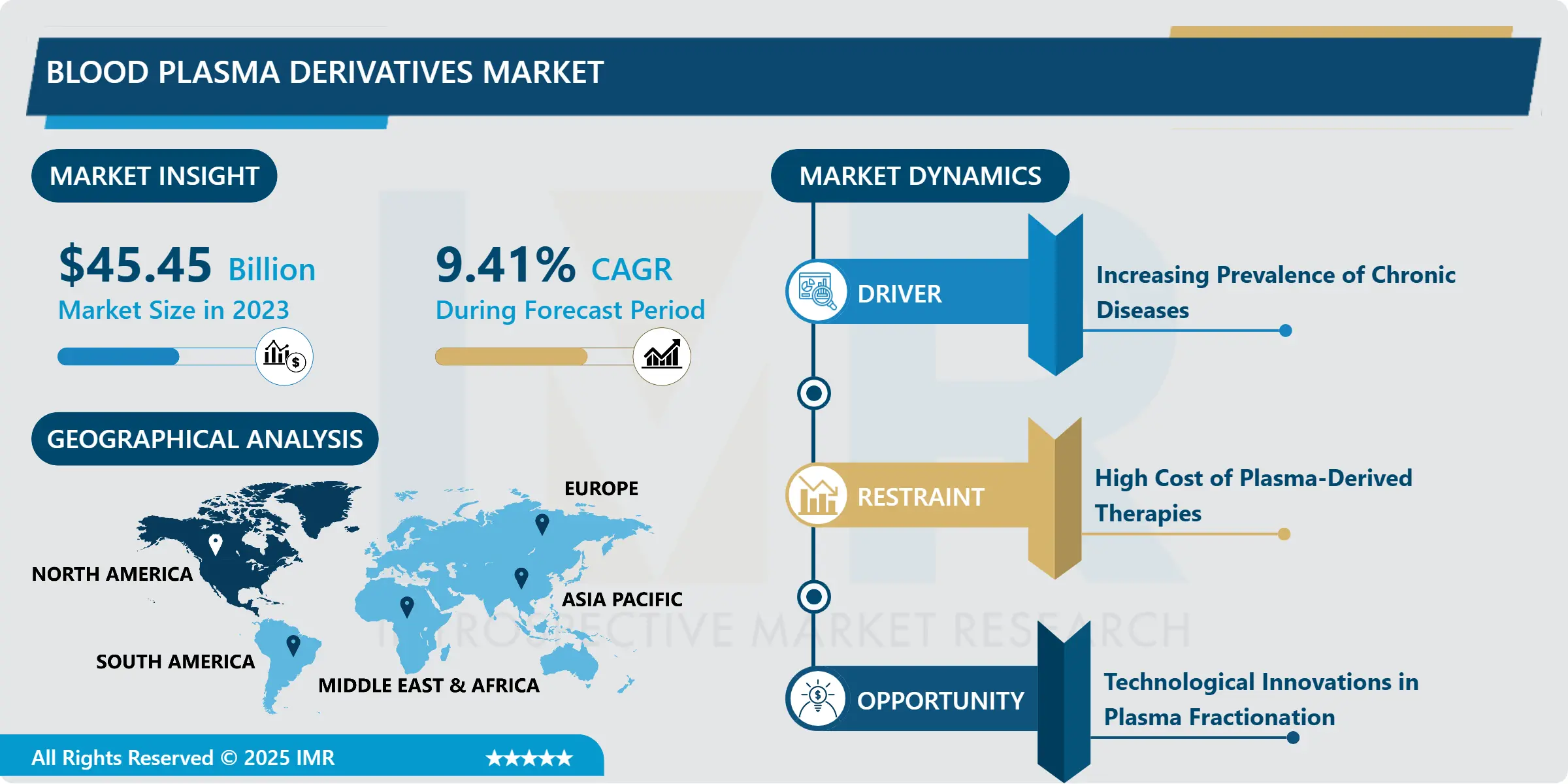
Blood Plasma Derivatives Market Size Was Valued at USD 45.45 Billion in 2023, and is Projected to Reach USD 102.12 Billion by 2032, Growing at a CAGR of 9.41% From 2024-2032.

IMR Group
Description
Blood Plasma Derivatives Market Synopsis:
Blood Plasma Derivatives Market Size Was Valued at USD 45.45 Billion in 2023, and is Projected to Reach USD 102.12 Billion by 2032, Growing at a CAGR of 9.41% From 2024-2032.
Blood plasma derivatives market refers to products that are produced from human plasma and used for the treatment of many ailments including immunodeficiencies disorders, haemophilia and other ailments & disorders. This is majorly in the form of immunoglobulins, clotting factors, albumin and fibrinogen, which though produced through fractionation processes have quit invaluable roles in the health sector internationally.
Increased demand for various treatments for long-term treatment illnesses, haemophilia as well as immune deficiency diseases. Increase in Genetic disorders, trauma, and surgical procedures are certain to push the demand pattern of plasma derivatives upwards at a steeper growth rate. These derivatives include IVIG, factor concentrates, and albumin, are some of the most common derivatives that have found use in multiple healthcare area due to their efficiency and availability. However, plasma technologies and quality assurance in the production of plasma fractionation has enhanced the production and availability of these valuable products.
Growth in plasma collection centre investments is the other reason that has paid a key role in the expansion of this particular market. Autonomous and untenanted reinforcement towards the development of plasma enucleation processes is elicited by government and private–sector protagonists to unite the burgeoning healthcare industry demands. The market also enjoys favourable regulatory enforcements and international relationships that guarantee safe and ethical plasma derivatives production. However, issues like costs of production and overwhelming need for proper cold chain controls still present major concern to players in this market.
Blood Plasma Derivatives Market Trend Analysis:
Personalized Plasma-Derived Therapies
A key emerging trend identified in the current marketplace concerning blood plasma derivatives is the shift toward individualized plasma products resulting from developments in molecular biotechnology and diagnostics. Practitioners have also begun to provide more personalized plasma-based therapies due to improved accuracy for dealing with diseases such as immunodeficiency, homophilic disorders, and acute inflammatory polyneuropathies, also known as Guillain-Barré syndrome. They make it possible to deliver therapies for a user based on what their genome is or what their medical condition is and this will enhance results while lessening on side effects. The establishment of such specific strategies is also in harmony with the general trends of present days, which imply patient-oriented approaches in medicine.
Pharmaceutical corporations are investing to advance plasma collection and match therapies because various technologies such as artificial intelligence (AI) and machine learning have been introduced in the process. AI tools help simplify the process of donor identification as well as enhance the process of fractionation to help understand treatments responses effectively. Thus, the combination of technology and healthcare development in the plasma derivatives market plays a driving role in the formation of the general tendency of such medicine.
Expansion into Emerging Markets
The market for blood plasma derivatives has favourable potential for expansion within growing economies, including developed Asia-Pacific and Latin America. These regions are is witnessing brisk emergence of health care infrastructure that is driving the growth of plasma collection centres and plasma fractionation units. India, china and Brazil are among the leading nations experiencing this change occasioned by frequency and better government and private sector funding. As the number of autoimmune diseases, bleeding disorders and trauma cases increases, there is a need for affordable and readily available plasma proteins therapies. This trend is further reinforced by increased knowledge of these reversal agents among the health care personnel and patients.
Lack of restrictive polices: International pharmaceutical companies’ partnership with local governments have become the key to driving growth for these new markets. Those strategies encompass long-term collaboration to create plasma collections and improve the fractionation to support the needs of each region’s healthcare systems. However, as stakeholders’ source for local manufacturers and distributors, the cost of plasma therapies is likely to come down making the therapies more accessible to the patients. These progressions make Asia-Pacific and Latin America hold a higher potential to be the leading growth of the blood plasma derivatives market in the future years.
Blood Plasma Derivatives Market Segment Analysis:
Blood Plasma Derivatives Market is Segmented on the basis of Product Type, Application, End User, and Region
By Product Type, immunoglobulins segment is expected to dominate the market during the forecast period
The market for blood plasma derivatives is divided by product type immunoglobulins share a large market or IVIG and SCIG owing to their usage in the treatment of immune deficiencies and autoimmune ailments. Immunoglobulins are used mainly for diseases such as primary immunodeficiency (PID) and chronic inflammatory demyelinating polyneuropathy (CIDP), which means that immunoglobulins occupy a very significant place in the market. In the same regard, albumin, which is employed in situations where there is low albumin level in the body and in cases where there is need to expand plasma volume is another important segment more especially in the emergency medicine /surgery. The situation is explained by progress in the development of fractionation technologies and the higher demand for these products in world markets.
Major other product categories are coagulation factors such as Factor VIII and Factor IX which are critical in haemophilia treatment and fibrinogen, useful in controlling bleeding during trauma and surgery. The “other” encompasses many plasma derived therapeutics for a number of more specific and rarer diseases; it demonstrates the breadth and expanding importance of the plasma derivative market and range of diseases that plasma can treat.
By Application, haemophilia segment expected to held the largest share
The market for blood plasma derivatives is divided by product type immunoglobulins share a large market or IVIG and SCIG owing to their usage in the treatment of immune deficiencies and autoimmune ailments. Immunoglobulins are used mainly for diseases such as primary immunodeficiency (PID) and chronic inflammatory demyelinating polyneuropathy (CIDP), which means that immunoglobulins occupy a very significant place in the market. In the same regard, albumin, which is employed in situations where there is low albumin level in the body and in cases where there is need to expand plasma volume is another important segment more especially in the emergency medicine /surgery. The situation is explained by progress in the development of fractionation technologies and the higher demand for these products in world markets.
Major other product categories are coagulation factors such as Factor VIII and Factor IX which are critical in haemophilia treatment and fibrinogen, useful in controlling bleeding during trauma and surgery. The “other” encompasses many plasma derived therapeutics for a number of more specific and rarer diseases; it demonstrates the breadth and expanding importance of the plasma derivative market and range of diseases that plasma can treat.
Blood Plasma Derivatives Market Regional Insights:
North America is Expected to Dominate the Market Over the Forecast period
North America is assumed to occupy the largest share in the global blood plasma. This dominance is due to supremacy of healthcare and higher public knowledge regarding plasmapheresis, coupled with novel and enhanced plasma fractionation technology across the region. The United States has a critical position, backed up by profitable plasma collection centers and substantial research programs aimed at enhancing plasma-dependent products. Moreover, highly regulated standards that the organization such as the FDA imposes are effective to provide quality and safe plasma products that clinicians and patients will trust.
It also has the advantage of a large investment in research and development (R&D) in plasma-based treatment. Separation methods, funding, and partnerships, both a collaborative effort between academia and industry, as well as a government working with business companies, have made significant advances in plasma separation and new therapeutic applications. In addition, excellent public private partnership has been established to enhance the supply chain towards supporting the flow of plasma required manufacturing. These factors have put North America at an appropriate place to form and progress the blood plasma derivatives market across the world.
Active Key Players in the Blood Plasma Derivatives Market
Baxter International Inc. (USA)
Biotest AG (Germany)
CSL Limited (Australia)
Grifols, S.A. (Spain)
Hualan Biological Engineering Inc. (China)
Kedrion S.p.A. (Italy)
LFB Group (France)
Octa pharma AG (Switzerland)
Pfizer Inc. (USA)
Sanquin (Netherlands)
Shire plc (now part of Takeda Pharmaceutical) (Japan)
SK Plasma Co., Ltd. (South Korea)
Takeda Pharmaceutical Company Limited (Japan)
Terumo BCT, Inc. (USA)
Virchow Biotech Pvt. Ltd. (India)
Other Active Players
Chapter 1: Introduction
1.1 Scope and Coverage
Chapter 2:Executive Summary
Chapter 3: Market Landscape
3.1 Market Dynamics
3.1.1 Drivers
3.1.2 Restraints
3.1.3 Opportunities
3.1.4 Challenges
3.2 Market Trend Analysis
3.3 PESTLE Analysis
3.4 Porter’s Five Forces Analysis
3.5 Industry Value Chain Analysis
3.6 Ecosystem
3.7 Regulatory Landscape
3.8 Price Trend Analysis
3.9 Patent Analysis
3.10 Technology Evolution
3.11 Investment Pockets
3.12 Import-Export Analysis
Chapter 4: Blood Plasma Derivatives Market by Product Type
4.1 Blood Plasma Derivatives Market Snapshot and Growth Engine
4.2 Blood Plasma Derivatives Market Overview
4.3 Immunoglobulins (IVIG
4.3.1 Introduction and Market Overview
4.3.2 Historic and Forecasted Market Size in Value USD and Volume Units (2017-2032F)
4.3.3 Key Market Trends, Growth Factors and Opportunities
4.3.4 Immunoglobulins (IVIG: Geographic Segmentation Analysis
4.4 SCIG
4.4.1 Introduction and Market Overview
4.4.2 Historic and Forecasted Market Size in Value USD and Volume Units (2017-2032F)
4.4.3 Key Market Trends, Growth Factors and Opportunities
4.4.4 SCIG: Geographic Segmentation Analysis
4.5 Albumin
4.5.1 Introduction and Market Overview
4.5.2 Historic and Forecasted Market Size in Value USD and Volume Units (2017-2032F)
4.5.3 Key Market Trends, Growth Factors and Opportunities
4.5.4 Albumin: Geographic Segmentation Analysis
4.6 Coagulation Factors (Factor VIII
4.6.1 Introduction and Market Overview
4.6.2 Historic and Forecasted Market Size in Value USD and Volume Units (2017-2032F)
4.6.3 Key Market Trends, Growth Factors and Opportunities
4.6.4 Coagulation Factors (Factor VIII: Geographic Segmentation Analysis
4.7 Factor IX
4.7.1 Introduction and Market Overview
4.7.2 Historic and Forecasted Market Size in Value USD and Volume Units (2017-2032F)
4.7.3 Key Market Trends, Growth Factors and Opportunities
4.7.4 Factor IX: Geographic Segmentation Analysis
4.8 Fibrinogen
4.8.1 Introduction and Market Overview
4.8.2 Historic and Forecasted Market Size in Value USD and Volume Units (2017-2032F)
4.8.3 Key Market Trends, Growth Factors and Opportunities
4.8.4 Fibrinogen: Geographic Segmentation Analysis
4.9 Protease Inhibitors
4.9.1 Introduction and Market Overview
4.9.2 Historic and Forecasted Market Size in Value USD and Volume Units (2017-2032F)
4.9.3 Key Market Trends, Growth Factors and Opportunities
4.9.4 Protease Inhibitors: Geographic Segmentation Analysis
4.10 Others)
4.10.1 Introduction and Market Overview
4.10.2 Historic and Forecasted Market Size in Value USD and Volume Units (2017-2032F)
4.10.3 Key Market Trends, Growth Factors and Opportunities
4.10.4 Others): Geographic Segmentation Analysis
Chapter 5: Blood Plasma Derivatives Market by Application
5.1 Blood Plasma Derivatives Market Snapshot and Growth Engine
5.2 Blood Plasma Derivatives Market Overview
5.3 (Haemophilia
5.3.1 Introduction and Market Overview
5.3.2 Historic and Forecasted Market Size in Value USD and Volume Units (2017-2032F)
5.3.3 Key Market Trends, Growth Factors and Opportunities
5.3.4 (Haemophilia: Geographic Segmentation Analysis
5.4 Immunodeficiency Disorders
5.4.1 Introduction and Market Overview
5.4.2 Historic and Forecasted Market Size in Value USD and Volume Units (2017-2032F)
5.4.3 Key Market Trends, Growth Factors and Opportunities
5.4.4 Immunodeficiency Disorders: Geographic Segmentation Analysis
5.5 Liver Diseases
5.5.1 Introduction and Market Overview
5.5.2 Historic and Forecasted Market Size in Value USD and Volume Units (2017-2032F)
5.5.3 Key Market Trends, Growth Factors and Opportunities
5.5.4 Liver Diseases: Geographic Segmentation Analysis
5.6 Trauma and Burns
5.6.1 Introduction and Market Overview
5.6.2 Historic and Forecasted Market Size in Value USD and Volume Units (2017-2032F)
5.6.3 Key Market Trends, Growth Factors and Opportunities
5.6.4 Trauma and Burns: Geographic Segmentation Analysis
5.7 Neurological Disorders
5.7.1 Introduction and Market Overview
5.7.2 Historic and Forecasted Market Size in Value USD and Volume Units (2017-2032F)
5.7.3 Key Market Trends, Growth Factors and Opportunities
5.7.4 Neurological Disorders: Geographic Segmentation Analysis
5.8 Others)
5.8.1 Introduction and Market Overview
5.8.2 Historic and Forecasted Market Size in Value USD and Volume Units (2017-2032F)
5.8.3 Key Market Trends, Growth Factors and Opportunities
5.8.4 Others): Geographic Segmentation Analysis
Chapter 6: Blood Plasma Derivatives Market by End User
6.1 Blood Plasma Derivatives Market Snapshot and Growth Engine
6.2 Blood Plasma Derivatives Market Overview
6.3 Hospitals and Clinics
6.3.1 Introduction and Market Overview
6.3.2 Historic and Forecasted Market Size in Value USD and Volume Units (2017-2032F)
6.3.3 Key Market Trends, Growth Factors and Opportunities
6.3.4 Hospitals and Clinics: Geographic Segmentation Analysis
6.4 Research Institutes
6.4.1 Introduction and Market Overview
6.4.2 Historic and Forecasted Market Size in Value USD and Volume Units (2017-2032F)
6.4.3 Key Market Trends, Growth Factors and Opportunities
6.4.4 Research Institutes: Geographic Segmentation Analysis
6.5 Diagnostic Laboratories
6.5.1 Introduction and Market Overview
6.5.2 Historic and Forecasted Market Size in Value USD and Volume Units (2017-2032F)
6.5.3 Key Market Trends, Growth Factors and Opportunities
6.5.4 Diagnostic Laboratories: Geographic Segmentation Analysis
Chapter 7: Company Profiles and Competitive Analysis
7.1 Competitive Landscape
7.1.1 Competitive Benchmarking
7.1.2 Blood Plasma Derivatives Market Share by Manufacturer (2023)
7.1.3 Industry BCG Matrix
7.1.4 Heat Map Analysis
7.1.5 Mergers and Acquisitions
7.2 BAXTER INTERNATIONAL INC.
7.2.1 Company Overview
7.2.2 Key Executives
7.2.3 Company Snapshot
7.2.4 Role of the Company in the Market
7.2.5 Sustainability and Social Responsibility
7.2.6 Operating Business Segments
7.2.7 Product Portfolio
7.2.8 Business Performance
7.2.9 Key Strategic Moves and Recent Developments
7.2.10 SWOT Analysis
7.3 CSL LIMITED
7.4 GRIFOLS
7.5 S.A.
7.6 KEDRION S.P.A.
7.7 OCTA PHARMA AG
7.8 OTHER ACTIVE PLAYERS
Chapter 8: Global Blood Plasma Derivatives Market By Region
8.1 Overview
8.2. North America Blood Plasma Derivatives Market
8.2.1 Key Market Trends, Growth Factors and Opportunities
8.2.2 Top Key Companies
8.2.3 Historic and Forecasted Market Size by Segments
8.2.4 Historic and Forecasted Market Size By Product Type
8.2.4.1 Immunoglobulins (IVIG
8.2.4.2 SCIG
8.2.4.3 Albumin
8.2.4.4 Coagulation Factors (Factor VIII
8.2.4.5 Factor IX
8.2.4.6 Fibrinogen
8.2.4.7 Protease Inhibitors
8.2.4.8 Others)
8.2.5 Historic and Forecasted Market Size By Application
8.2.5.1 (Haemophilia
8.2.5.2 Immunodeficiency Disorders
8.2.5.3 Liver Diseases
8.2.5.4 Trauma and Burns
8.2.5.5 Neurological Disorders
8.2.5.6 Others)
8.2.6 Historic and Forecasted Market Size By End User
8.2.6.1 Hospitals and Clinics
8.2.6.2 Research Institutes
8.2.6.3 Diagnostic Laboratories
8.2.7 Historic and Forecast Market Size by Country
8.2.7.1 US
8.2.7.2 Canada
8.2.7.3 Mexico
8.3. Eastern Europe Blood Plasma Derivatives Market
8.3.1 Key Market Trends, Growth Factors and Opportunities
8.3.2 Top Key Companies
8.3.3 Historic and Forecasted Market Size by Segments
8.3.4 Historic and Forecasted Market Size By Product Type
8.3.4.1 Immunoglobulins (IVIG
8.3.4.2 SCIG
8.3.4.3 Albumin
8.3.4.4 Coagulation Factors (Factor VIII
8.3.4.5 Factor IX
8.3.4.6 Fibrinogen
8.3.4.7 Protease Inhibitors
8.3.4.8 Others)
8.3.5 Historic and Forecasted Market Size By Application
8.3.5.1 (Haemophilia
8.3.5.2 Immunodeficiency Disorders
8.3.5.3 Liver Diseases
8.3.5.4 Trauma and Burns
8.3.5.5 Neurological Disorders
8.3.5.6 Others)
8.3.6 Historic and Forecasted Market Size By End User
8.3.6.1 Hospitals and Clinics
8.3.6.2 Research Institutes
8.3.6.3 Diagnostic Laboratories
8.3.7 Historic and Forecast Market Size by Country
8.3.7.1 Russia
8.3.7.2 Bulgaria
8.3.7.3 The Czech Republic
8.3.7.4 Hungary
8.3.7.5 Poland
8.3.7.6 Romania
8.3.7.7 Rest of Eastern Europe
8.4. Western Europe Blood Plasma Derivatives Market
8.4.1 Key Market Trends, Growth Factors and Opportunities
8.4.2 Top Key Companies
8.4.3 Historic and Forecasted Market Size by Segments
8.4.4 Historic and Forecasted Market Size By Product Type
8.4.4.1 Immunoglobulins (IVIG
8.4.4.2 SCIG
8.4.4.3 Albumin
8.4.4.4 Coagulation Factors (Factor VIII
8.4.4.5 Factor IX
8.4.4.6 Fibrinogen
8.4.4.7 Protease Inhibitors
8.4.4.8 Others)
8.4.5 Historic and Forecasted Market Size By Application
8.4.5.1 (Haemophilia
8.4.5.2 Immunodeficiency Disorders
8.4.5.3 Liver Diseases
8.4.5.4 Trauma and Burns
8.4.5.5 Neurological Disorders
8.4.5.6 Others)
8.4.6 Historic and Forecasted Market Size By End User
8.4.6.1 Hospitals and Clinics
8.4.6.2 Research Institutes
8.4.6.3 Diagnostic Laboratories
8.4.7 Historic and Forecast Market Size by Country
8.4.7.1 Germany
8.4.7.2 UK
8.4.7.3 France
8.4.7.4 The Netherlands
8.4.7.5 Italy
8.4.7.6 Spain
8.4.7.7 Rest of Western Europe
8.5. Asia Pacific Blood Plasma Derivatives Market
8.5.1 Key Market Trends, Growth Factors and Opportunities
8.5.2 Top Key Companies
8.5.3 Historic and Forecasted Market Size by Segments
8.5.4 Historic and Forecasted Market Size By Product Type
8.5.4.1 Immunoglobulins (IVIG
8.5.4.2 SCIG
8.5.4.3 Albumin
8.5.4.4 Coagulation Factors (Factor VIII
8.5.4.5 Factor IX
8.5.4.6 Fibrinogen
8.5.4.7 Protease Inhibitors
8.5.4.8 Others)
8.5.5 Historic and Forecasted Market Size By Application
8.5.5.1 (Haemophilia
8.5.5.2 Immunodeficiency Disorders
8.5.5.3 Liver Diseases
8.5.5.4 Trauma and Burns
8.5.5.5 Neurological Disorders
8.5.5.6 Others)
8.5.6 Historic and Forecasted Market Size By End User
8.5.6.1 Hospitals and Clinics
8.5.6.2 Research Institutes
8.5.6.3 Diagnostic Laboratories
8.5.7 Historic and Forecast Market Size by Country
8.5.7.1 China
8.5.7.2 India
8.5.7.3 Japan
8.5.7.4 South Korea
8.5.7.5 Malaysia
8.5.7.6 Thailand
8.5.7.7 Vietnam
8.5.7.8 The Philippines
8.5.7.9 Australia
8.5.7.10 New Zealand
8.5.7.11 Rest of APAC
8.6. Middle East & Africa Blood Plasma Derivatives Market
8.6.1 Key Market Trends, Growth Factors and Opportunities
8.6.2 Top Key Companies
8.6.3 Historic and Forecasted Market Size by Segments
8.6.4 Historic and Forecasted Market Size By Product Type
8.6.4.1 Immunoglobulins (IVIG
8.6.4.2 SCIG
8.6.4.3 Albumin
8.6.4.4 Coagulation Factors (Factor VIII
8.6.4.5 Factor IX
8.6.4.6 Fibrinogen
8.6.4.7 Protease Inhibitors
8.6.4.8 Others)
8.6.5 Historic and Forecasted Market Size By Application
8.6.5.1 (Haemophilia
8.6.5.2 Immunodeficiency Disorders
8.6.5.3 Liver Diseases
8.6.5.4 Trauma and Burns
8.6.5.5 Neurological Disorders
8.6.5.6 Others)
8.6.6 Historic and Forecasted Market Size By End User
8.6.6.1 Hospitals and Clinics
8.6.6.2 Research Institutes
8.6.6.3 Diagnostic Laboratories
8.6.7 Historic and Forecast Market Size by Country
8.6.7.1 Turkiye
8.6.7.2 Bahrain
8.6.7.3 Kuwait
8.6.7.4 Saudi Arabia
8.6.7.5 Qatar
8.6.7.6 UAE
8.6.7.7 Israel
8.6.7.8 South Africa
8.7. South America Blood Plasma Derivatives Market
8.7.1 Key Market Trends, Growth Factors and Opportunities
8.7.2 Top Key Companies
8.7.3 Historic and Forecasted Market Size by Segments
8.7.4 Historic and Forecasted Market Size By Product Type
8.7.4.1 Immunoglobulins (IVIG
8.7.4.2 SCIG
8.7.4.3 Albumin
8.7.4.4 Coagulation Factors (Factor VIII
8.7.4.5 Factor IX
8.7.4.6 Fibrinogen
8.7.4.7 Protease Inhibitors
8.7.4.8 Others)
8.7.5 Historic and Forecasted Market Size By Application
8.7.5.1 (Haemophilia
8.7.5.2 Immunodeficiency Disorders
8.7.5.3 Liver Diseases
8.7.5.4 Trauma and Burns
8.7.5.5 Neurological Disorders
8.7.5.6 Others)
8.7.6 Historic and Forecasted Market Size By End User
8.7.6.1 Hospitals and Clinics
8.7.6.2 Research Institutes
8.7.6.3 Diagnostic Laboratories
8.7.7 Historic and Forecast Market Size by Country
8.7.7.1 Brazil
8.7.7.2 Argentina
8.7.7.3 Rest of SA
Chapter 9 Analyst Viewpoint and Conclusion
9.1 Recommendations and Concluding Analysis
9.2 Potential Market Strategies
Chapter 10 Research Methodology
10.1 Research Process
10.2 Primary Research
10.3 Secondary Research
Q1: What would be the forecast period in the Blood Plasma Derivatives Market research report?
A1: The forecast period in the Blood Plasma Derivatives Market research report is 2024-2032.
Q2: Who are the key players in the Blood Plasma Derivatives Market?
A2: Baxter International Inc. (USA); Biotest AG (Germany);CSL Limited (Australia);Grifols, S.A. (Spain);Hualan Biological Engineering Inc. (China);Kedrion S.p.A. (Italy);LFB Group (France);Octa pharma AG (Switzerland);Pfizer Inc. (USA);Sanquin (Netherlands);Shire plc (now part of Takeda Pharmaceutical) (Japan);SK Plasma Co., Ltd. (South Korea);Takeda Pharmaceutical Company Limited (Japan);Terumo BCT, Inc. (USA);Virchow Biotech Pvt. Ltd. (India), and Other Active Players
Q3: What are the segments of the Blood Plasma Derivatives Market?
A3: The Blood Plasma Derivatives Market is segmented into Product Type, Application, End User and region. By Product Type, the market is categorized into Immunoglobulins (IVIG, SCIG), Albumin, Coagulation Factors (Factor VIII, Factor IX), Fibrinogen, Protease Inhibitors, Others. By Application, the market is categorized into Haemophilia, Immunodeficiency Disorders, Liver Diseases, Trauma and Burns, Neurological Disorders, Others. By End User, the market is categorized into Hospitals and Clinics, Research Institutes, Diagnostic Laboratories. By region, it is analyzed across North America (U.S., Canada, Mexico),Eastern Europe (Russia, Bulgaria, The Czech Republic, Hungary, Poland, Romania, Rest of Eastern Europe),Western Europe (Germany, UK, France, Netherlands, Italy, Spain, Rest of Western Europe),Asia Pacific (China, India, Japan, South Korea, Malaysia, Thailand, Vietnam, The Philippines, Australia, New-Zealand, Rest of APAC),Middle East & Africa (Turkiye, Bahrain, Kuwait, Saudi Arabia, Qatar, UAE, Israel, South Africa),South America (Brazil, Argentina, Rest of SA).
Q4: What is the Blood Plasma Derivatives Market?
A4: Blood plasma derivatives market refers to products that are produced from human plasma and used for the treatment of many ailments including immunodeficiencies disorders, hemophilia and other ailments & disorders. This is majorly in the form of immunoglobulins, clotting factors, albumin and fibrinogen, which though produced through fractionation processes have quit invaluable roles in the health sector internationally.
Q5: How big is the Blood Plasma Derivatives Market?
A5: Blood Plasma Derivatives Market Size Was Valued at USD 45.45 Billion in 2023, and is Projected to Reach USD 102.12 Billion by 2032, Growing at a CAGR of 9.41% From 2024-2032.
How to Buy a Report from eminsights.jp
On the product page, choose the license you want: Single-User License, Multi-User License or Enterprise License.
If you required report in your native language, then you can click on Translated Report button and fill out the form with report name and language you want, then our team will contact you as soon as possible.
Click the Buy Now button.
You will be redirected to the checkout page. Enter your company details and payment information.
Click Place Order to complete the purchase.
Confirmation: You’ll receive an order confirmation and our team will contact you shortly with your ordered report.
If you have any questions, fill out the contact form below or email us at [email protected].
Thank you for choosing eminsights.jp!