Stay Ahead in Fast-Growing Economies.
Browse Reports Now
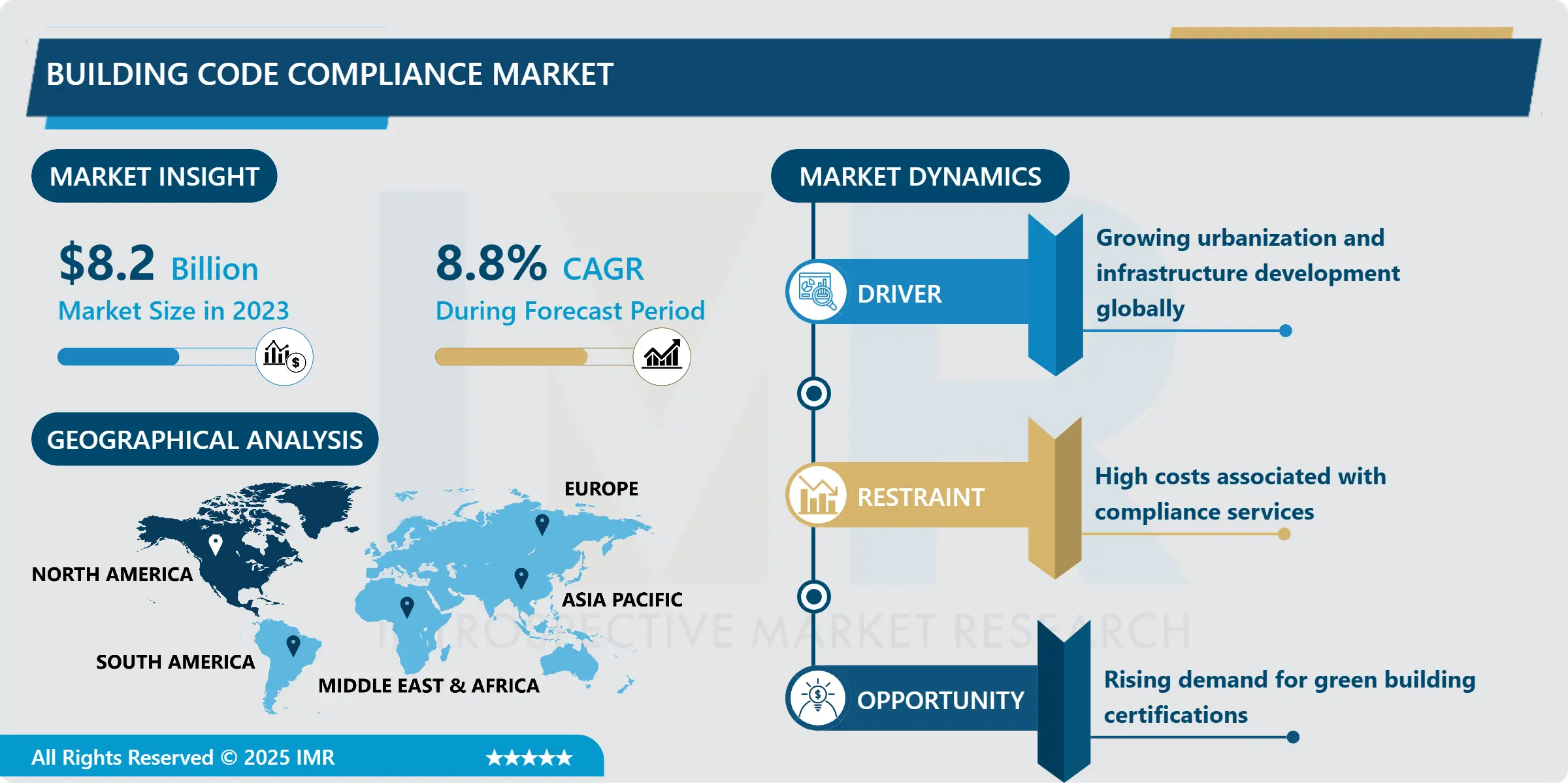
Building Code Compliance Market – Overview and Outlook by Potential Growth
Building Code Compliance Market Size Was Valued at USD 8.2 Billion in 2023, and is Projected to Reach USD 17.52 Billion by 2032, Growing at a CAGR of 8.8% From 2024-2032.

IMR Group
Description
Building Code Compliance Market Synopsis:
Building Code Compliance Market Size Was Valued at USD 8.2 Billion in 2023, and is Projected to Reach USD 17.52 Billion by 2032, Growing at a CAGR of 8.8% From 2024-2032.
The Building Code Compliance Market is defined as the part of the construction and regulation business that deals with regulation of construction projects and infrastructures to make them safe, sustainable as well as accessible to users. These codes include structural and fire protection, accessibility and automated and renewable energy efficiency, and environmental codes.
The Building Code Compliance Market is growing rapidly due to rising urbanization and other trends that favor constructive societal changes that will enhance safety and sustainability in building and structures. Due to governments global focus to set higher standards to reduce risks and enhance sustainability, corporations are spending considerably in compliance products to conform to rules. The market is driven by the fast construction activities especially in the emerging market of the world where infrastructure is considered as most important factor.
The growing emphasis on achieving green building certifications, as well as emphasizing the energy efficiency of the compliance service providers who have started providing their services to environmentally conscious customers. Technological advancement in the form of smart technologies such as IoT sensors and Digital twins are also also playing a role in redesigning the nature of the environment by offering real-time monitoring and tracking of compliance levels.
Building Code Compliance Market Trend Analysis:
Adoption of AI-Driven Compliance Solutions
The adoption of AI-driven compliance solutions is rapidly transforming the building code compliance market. Companies are increasingly leveraging artificial intelligence to streamline regulatory processes, improve accuracy, and reduce manual oversight. AI tools can interpret complex building codes, monitor real-time project data, and predict potential compliance issues before they arise, offering significant time and cost savings. This shift is particularly valuable in markets with evolving regulations, where staying current is critical to project success and risk management.
AI compliance platforms tailored to the construction and real estate sectors. These solutions enhance decision-making, optimize project planning, and support faster approvals, giving firms a competitive edge. As regulatory environments grow more complex worldwide, the demand for intelligent, automated compliance solutions is expected to surge, positioning AI-driven platforms as essential tools for ensuring operational efficiency, legal conformity, and sustainable development.
Green Building Initiatives Fueling Market Expansion
The green building initiatives are driving significant growth in the building code compliance market as sustainability becomes a key priority in construction. Governments, regulatory bodies, and private sectors are increasingly adopting green building standards and codes to reduce environmental impact, optimize energy efficiency, and promote resource conservation. These regulations create a growing demand for compliance solutions that ensure buildings meet the required standards, fostering innovation in materials, technology, and design.
As environmental concerns gain prominence, businesses are prioritizing sustainability in their operations, leading to greater investments in eco-friendly building practices. This shift is not only enhancing market opportunities for compliance tools and services but also encouraging the development of advanced technologies that streamline the compliance process. Companies that offer solutions enabling seamless adherence to green building codes are well-positioned to capitalize on this expanding market, further propelling growth in the sector.
Building Code Compliance Market Segment Analysis:
Building Code Compliance Market is Segmented on the basis of Service Type, Sourcing Service Type, End User, and Region
By Service Type, Testing & Inspection segment is expected to dominate the market during the forecast period
The building code compliance market’s Testing & Inspection segment is expected to lead the market, in terms of revenue, over the forecast period. This dominance is attributable to the fact that these services are instrumental in enforcing standards in building constructions. The examination and assessment services involve testing and inspection concerns with regards to construction material, structural efficiency and fire- safety amongst other aspects. Growth in construction development alongside more rigid compliance standards for development projects has fueled the need for these services. Advanced technology like non-destructive testing methods and real time data analytical tools help to increase the popularity of testing and inspection services resulting in strengthening its market.
Increased accessibility to independent third-party inspections is increasing the potential of this segment. Developers, insurers and many other regulatory am worried about flexibility of the data, they prefer unbiased assessments and this has been a common reason in the many choices. This trend puts into focus the segment’s criticality to safety and compliance and make it a pillar of the Building Code Compliance Market.
By Sourcing Service Type, In-house segment expected to held the largest share
The In-house segment is expected to dominate the Building Code Compliance Market because many major construction companies prefer to have their own in-house teams. These teams provide more local management of compliance activities, which allows organisations to adapt preventive measures to address different needs of projects. The in-house model also has a high degree of applicability for organizations that are participating in several projects simultaneously due to it being easily integrated with broader project management structures of the enterprise, incorporating compliance efforts as part of a wider range of activities of the company.
In addition, compliance teams can easily transform to fit these emerging regulation and company standards thereby facilitating the timely compliance to building regulations. The push for digital solutions is also improving in-house compliance departments by way of such technologies such as AI inspection technology and cloud compliance solutions. For this reason, that strategic advantage is expected to continue to support the superior position of in-house segment in the market.
Building Code Compliance Market Regional Insights:
North America is Expected to Dominate the Market Over the Forecast period
North America is anticipated to dominate in the Building Code Compliance market. These have contributed to a competitive advantage in this region which has codes for construction, high safety standards and a mature market. The US stands out because of developed regulatory systems and increased investment in updating the electricity infrastructure.
The embracement of technologically sophisticated compliance solutions and heightened concern towards green building recognition also entrenches the region. Growing concentration of population in urban areas and availability of incentives for Green Building Construction are expected to continue to drive North America to lead.
Active Key Players in the Building Code Compliance Market:
Applus+ (Spain)
Bureau Veritas (France)
DEKRA SE (Germany)
DNV GL (Norway)
Element Materials Technology (UK)
Eurofins Scientific (Luxembourg)
Intertek Group (UK)
Kinectrics (Canada)
Kiwa Group (Netherlands)
Lloyd’s Register (UK)
SGS SA (Switzerland)
TUV Nord Group (Germany)
TUV Rheinland (Germany)
TUV SUD (Germany)
UL Solutions (USA)
Other Active Players
Chapter 1: Introduction
1.1 Scope and Coverage
Chapter 2:Executive Summary
Chapter 3: Market Landscape
3.1 Market Dynamics
3.1.1 Drivers
3.1.2 Restraints
3.1.3 Opportunities
3.1.4 Challenges
3.2 Market Trend Analysis
3.3 PESTLE Analysis
3.4 Porter’s Five Forces Analysis
3.5 Industry Value Chain Analysis
3.6 Ecosystem
3.7 Regulatory Landscape
3.8 Price Trend Analysis
3.9 Patent Analysis
3.10 Technology Evolution
3.11 Investment Pockets
3.12 Import-Export Analysis
Chapter 4: Building Code Compliance Market by Service Type
4.1 Building Code Compliance Market Snapshot and Growth Engine
4.2 Building Code Compliance Market Overview
4.3 Testing & Inspection
4.3.1 Introduction and Market Overview
4.3.2 Historic and Forecasted Market Size in Value USD and Volume Units (2017-2032F)
4.3.3 Key Market Trends, Growth Factors and Opportunities
4.3.4 Testing & Inspection: Geographic Segmentation Analysis
4.4 Certification
4.4.1 Introduction and Market Overview
4.4.2 Historic and Forecasted Market Size in Value USD and Volume Units (2017-2032F)
4.4.3 Key Market Trends, Growth Factors and Opportunities
4.4.4 Certification: Geographic Segmentation Analysis
4.5 Project Management
4.5.1 Introduction and Market Overview
4.5.2 Historic and Forecasted Market Size in Value USD and Volume Units (2017-2032F)
4.5.3 Key Market Trends, Growth Factors and Opportunities
4.5.4 Project Management: Geographic Segmentation Analysis
4.6 Consulting
4.6.1 Introduction and Market Overview
4.6.2 Historic and Forecasted Market Size in Value USD and Volume Units (2017-2032F)
4.6.3 Key Market Trends, Growth Factors and Opportunities
4.6.4 Consulting: Geographic Segmentation Analysis
4.7 Others
4.7.1 Introduction and Market Overview
4.7.2 Historic and Forecasted Market Size in Value USD and Volume Units (2017-2032F)
4.7.3 Key Market Trends, Growth Factors and Opportunities
4.7.4 Others: Geographic Segmentation Analysis
Chapter 5: Building Code Compliance Market by Sourcing Service Type
5.1 Building Code Compliance Market Snapshot and Growth Engine
5.2 Building Code Compliance Market Overview
5.3 In-house
5.3.1 Introduction and Market Overview
5.3.2 Historic and Forecasted Market Size in Value USD and Volume Units (2017-2032F)
5.3.3 Key Market Trends, Growth Factors and Opportunities
5.3.4 In-house: Geographic Segmentation Analysis
5.4 Outsourced
5.4.1 Introduction and Market Overview
5.4.2 Historic and Forecasted Market Size in Value USD and Volume Units (2017-2032F)
5.4.3 Key Market Trends, Growth Factors and Opportunities
5.4.4 Outsourced: Geographic Segmentation Analysis
Chapter 6: Building Code Compliance Market by End User
6.1 Building Code Compliance Market Snapshot and Growth Engine
6.2 Building Code Compliance Market Overview
6.3 Residential
6.3.1 Introduction and Market Overview
6.3.2 Historic and Forecasted Market Size in Value USD and Volume Units (2017-2032F)
6.3.3 Key Market Trends, Growth Factors and Opportunities
6.3.4 Residential: Geographic Segmentation Analysis
6.4 Commercial
6.4.1 Introduction and Market Overview
6.4.2 Historic and Forecasted Market Size in Value USD and Volume Units (2017-2032F)
6.4.3 Key Market Trends, Growth Factors and Opportunities
6.4.4 Commercial: Geographic Segmentation Analysis
6.5 Industrial
6.5.1 Introduction and Market Overview
6.5.2 Historic and Forecasted Market Size in Value USD and Volume Units (2017-2032F)
6.5.3 Key Market Trends, Growth Factors and Opportunities
6.5.4 Industrial: Geographic Segmentation Analysis
Chapter 7: Company Profiles and Competitive Analysis
7.1 Competitive Landscape
7.1.1 Competitive Benchmarking
7.1.2 Building Code Compliance Market Share by Manufacturer (2023)
7.1.3 Industry BCG Matrix
7.1.4 Heat Map Analysis
7.1.5 Mergers and Acquisitions
7.2 APPLUS+ (SPAIN)
7.2.1 Company Overview
7.2.2 Key Executives
7.2.3 Company Snapshot
7.2.4 Role of the Company in the Market
7.2.5 Sustainability and Social Responsibility
7.2.6 Operating Business Segments
7.2.7 Product Portfolio
7.2.8 Business Performance
7.2.9 Key Strategic Moves and Recent Developments
7.2.10 SWOT Analysis
7.3 BUREAU VERITAS (FRANCE)
7.4 DEKRA SE (GERMANY)
7.5 DNV GL (NORWAY)
7.6 ELEMENT MATERIALS TECHNOLOGY (UK)
7.7 EUROFINS SCIENTIFIC (LUXEMBOURG)
7.8 INTERTEK GROUP (UK)
7.9 KINECTRICS (CANADA)
7.10 KIWA GROUP (NETHERLANDS)
7.11 LLOYD’S REGISTER (UK)
7.12 SGS SA (SWITZERLAND)
7.13 TUV NORD GROUP (GERMANY)
7.14 TUV RHEINLAND (GERMANY)
7.15 TUV SUD (GERMANY)
7.16 UL SOLUTIONS (USA)
7.17 OTHER ACTIVE PLAYERS
Chapter 8: Global Building Code Compliance Market By Region
8.1 Overview
8.2. North America Building Code Compliance Market
8.2.1 Key Market Trends, Growth Factors and Opportunities
8.2.2 Top Key Companies
8.2.3 Historic and Forecasted Market Size by Segments
8.2.4 Historic and Forecasted Market Size By Service Type
8.2.4.1 Testing & Inspection
8.2.4.2 Certification
8.2.4.3 Project Management
8.2.4.4 Consulting
8.2.4.5 Others
8.2.5 Historic and Forecasted Market Size By Sourcing Service Type
8.2.5.1 In-house
8.2.5.2 Outsourced
8.2.6 Historic and Forecasted Market Size By End User
8.2.6.1 Residential
8.2.6.2 Commercial
8.2.6.3 Industrial
8.2.7 Historic and Forecast Market Size by Country
8.2.7.1 US
8.2.7.2 Canada
8.2.7.3 Mexico
8.3. Eastern Europe Building Code Compliance Market
8.3.1 Key Market Trends, Growth Factors and Opportunities
8.3.2 Top Key Companies
8.3.3 Historic and Forecasted Market Size by Segments
8.3.4 Historic and Forecasted Market Size By Service Type
8.3.4.1 Testing & Inspection
8.3.4.2 Certification
8.3.4.3 Project Management
8.3.4.4 Consulting
8.3.4.5 Others
8.3.5 Historic and Forecasted Market Size By Sourcing Service Type
8.3.5.1 In-house
8.3.5.2 Outsourced
8.3.6 Historic and Forecasted Market Size By End User
8.3.6.1 Residential
8.3.6.2 Commercial
8.3.6.3 Industrial
8.3.7 Historic and Forecast Market Size by Country
8.3.7.1 Russia
8.3.7.2 Bulgaria
8.3.7.3 The Czech Republic
8.3.7.4 Hungary
8.3.7.5 Poland
8.3.7.6 Romania
8.3.7.7 Rest of Eastern Europe
8.4. Western Europe Building Code Compliance Market
8.4.1 Key Market Trends, Growth Factors and Opportunities
8.4.2 Top Key Companies
8.4.3 Historic and Forecasted Market Size by Segments
8.4.4 Historic and Forecasted Market Size By Service Type
8.4.4.1 Testing & Inspection
8.4.4.2 Certification
8.4.4.3 Project Management
8.4.4.4 Consulting
8.4.4.5 Others
8.4.5 Historic and Forecasted Market Size By Sourcing Service Type
8.4.5.1 In-house
8.4.5.2 Outsourced
8.4.6 Historic and Forecasted Market Size By End User
8.4.6.1 Residential
8.4.6.2 Commercial
8.4.6.3 Industrial
8.4.7 Historic and Forecast Market Size by Country
8.4.7.1 Germany
8.4.7.2 UK
8.4.7.3 France
8.4.7.4 The Netherlands
8.4.7.5 Italy
8.4.7.6 Spain
8.4.7.7 Rest of Western Europe
8.5. Asia Pacific Building Code Compliance Market
8.5.1 Key Market Trends, Growth Factors and Opportunities
8.5.2 Top Key Companies
8.5.3 Historic and Forecasted Market Size by Segments
8.5.4 Historic and Forecasted Market Size By Service Type
8.5.4.1 Testing & Inspection
8.5.4.2 Certification
8.5.4.3 Project Management
8.5.4.4 Consulting
8.5.4.5 Others
8.5.5 Historic and Forecasted Market Size By Sourcing Service Type
8.5.5.1 In-house
8.5.5.2 Outsourced
8.5.6 Historic and Forecasted Market Size By End User
8.5.6.1 Residential
8.5.6.2 Commercial
8.5.6.3 Industrial
8.5.7 Historic and Forecast Market Size by Country
8.5.7.1 China
8.5.7.2 India
8.5.7.3 Japan
8.5.7.4 South Korea
8.5.7.5 Malaysia
8.5.7.6 Thailand
8.5.7.7 Vietnam
8.5.7.8 The Philippines
8.5.7.9 Australia
8.5.7.10 New Zealand
8.5.7.11 Rest of APAC
8.6. Middle East & Africa Building Code Compliance Market
8.6.1 Key Market Trends, Growth Factors and Opportunities
8.6.2 Top Key Companies
8.6.3 Historic and Forecasted Market Size by Segments
8.6.4 Historic and Forecasted Market Size By Service Type
8.6.4.1 Testing & Inspection
8.6.4.2 Certification
8.6.4.3 Project Management
8.6.4.4 Consulting
8.6.4.5 Others
8.6.5 Historic and Forecasted Market Size By Sourcing Service Type
8.6.5.1 In-house
8.6.5.2 Outsourced
8.6.6 Historic and Forecasted Market Size By End User
8.6.6.1 Residential
8.6.6.2 Commercial
8.6.6.3 Industrial
8.6.7 Historic and Forecast Market Size by Country
8.6.7.1 Turkiye
8.6.7.2 Bahrain
8.6.7.3 Kuwait
8.6.7.4 Saudi Arabia
8.6.7.5 Qatar
8.6.7.6 UAE
8.6.7.7 Israel
8.6.7.8 South Africa
8.7. South America Building Code Compliance Market
8.7.1 Key Market Trends, Growth Factors and Opportunities
8.7.2 Top Key Companies
8.7.3 Historic and Forecasted Market Size by Segments
8.7.4 Historic and Forecasted Market Size By Service Type
8.7.4.1 Testing & Inspection
8.7.4.2 Certification
8.7.4.3 Project Management
8.7.4.4 Consulting
8.7.4.5 Others
8.7.5 Historic and Forecasted Market Size By Sourcing Service Type
8.7.5.1 In-house
8.7.5.2 Outsourced
8.7.6 Historic and Forecasted Market Size By End User
8.7.6.1 Residential
8.7.6.2 Commercial
8.7.6.3 Industrial
8.7.7 Historic and Forecast Market Size by Country
8.7.7.1 Brazil
8.7.7.2 Argentina
8.7.7.3 Rest of SA
Chapter 9 Analyst Viewpoint and Conclusion
9.1 Recommendations and Concluding Analysis
9.2 Potential Market Strategies
Chapter 10 Research Methodology
10.1 Research Process
10.2 Primary Research
10.3 Secondary Research
Q1: What would be the forecast period in the Building Code Compliance Market research report?
A1: The forecast period in the Building Code Compliance Market research report is 2024-2032.
Q2: Who are the key players in the Building Code Compliance Market?
A2: Applus+ (Spain),Bureau Veritas (France),DEKRA SE (Germany),DNV GL (Norway),Element Materials Technology (UK),Eurofins Scientific (Luxembourg),Intertek Group (UK),Kinectrics (Canada),Kiwa Group (Netherlands),Lloyd’s Register (UK),SGS SA (Switzerland),TUV Nord Group (Germany),TUV Rheinland (Germany),TUV SUD (Germany),UL Solutions (USA), and Other Active Players.
Q3: What are the segments of the Building Code Compliance Market?
A3: The Building Code Compliance Market is segmented into Service Type, Sourcing Service Type, End User and region. By Service Type, the market is categorized into Testing & Inspection, Certification, Project Management, Consulting, and Others. By Sourcing Service Type, the market is categorized into In-house, Outsourced. By End User, the market is categorized into Residential, Commercial, and Industrial. By region, it is analyzed across North America (U.S., Canada, Mexico),Eastern Europe (Russia, Bulgaria, The Czech Republic, Hungary, Poland, Romania, Rest of Eastern Europe),Western Europe (Germany, UK, France, Netherlands, Italy, Spain, Rest of Western Europe), Asia Pacific (China, India, Japan, South Korea, Malaysia, Thailand, Vietnam, The Philippines, Australia, New-Zealand, Rest of APAC), Middle East & Africa (Turkiye, Bahrain, Kuwait, Saudi Arabia, Qatar, UAE, Israel, South Africa), South America (Brazil, Argentina, Rest of SA).
Q4: What is the Building Code Compliance Market?
A4: The Building Code Compliance Market is defined as the part of the construction and regulation business that deals with regulation of construction projects and infrastructures to make them safe, sustainable as well as accessible to users. These codes include structural and fire protection, accessibility and automated and renewable energy efficiency, and environmental codes.
Q5: How big is the Building Code Compliance Market?
A5: Building Code Compliance Market Size Was Valued at USD 8.2 Billion in 2023, and is Projected to Reach USD 17.52 Billion by 2032, Growing at a CAGR of 8.8% From 2024-2032.
How to Buy a Report from eminsights.jp
On the product page, choose the license you want: Single-User License, Multi-User License or Enterprise License.
If you required report in your native language, then you can click on Translated Report button and fill out the form with report name and language you want, then our team will contact you as soon as possible.
Click the Buy Now button.
You will be redirected to the checkout page. Enter your company details and payment information.
Click Place Order to complete the purchase.
Confirmation: You’ll receive an order confirmation and our team will contact you shortly with your ordered report.
If you have any questions, fill out the contact form below or email us at [email protected].
Thank you for choosing eminsights.jp!