Stay Ahead in Fast-Growing Economies.
Browse Reports Now




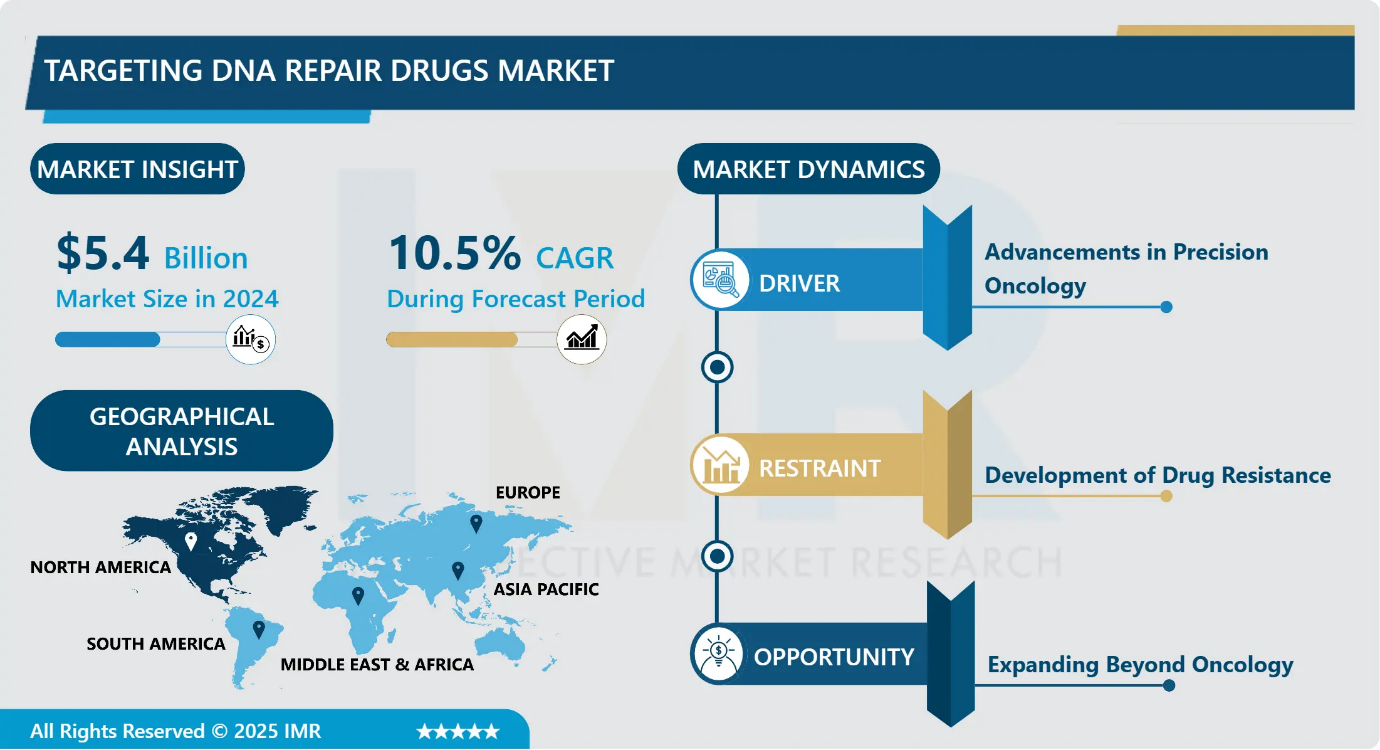
Targeting DNA Repair Drugs Market Size & Outlook 2025-2032
The targeting DNA repair drugs market encompasses a specialized segment of oncology and genetic disorder therapeutics focused on modulating DNA repair mechanisms. These drugs are designed to either inhibit or enhance the cell’s natural ability to repair DNA damage, depending on the therapeutic goal. Most commonly used in cancer treatment, they exploit the defective DNA repair pathways in cancer cells to increase their vulnerability to treatments like chemotherapy, radiation, and immunotherapy. By selectively targeting repair pathways such as homologous recombination (HR) or base excision repair (BER), these drugs offer a precision medicine approach to cancer therapy.

IMR Group
Description
Targeting DNA Repair Drugs Market Synopsis:
Targeting DNA Repair Drugs Market Size Was Valued at USD 5.4 Billion in 2024, and is Projected to Reach USD 12.0 Billion by 2032, Growing at a CAGR of 10.5% from 2025-2032.
The targeting DNA repair drugs market encompasses a specialized segment of oncology and genetic disorder therapeutics focused on modulating DNA repair mechanisms. These drugs are designed to either inhibit or enhance the cell’s natural ability to repair DNA damage, depending on the therapeutic goal. Most commonly used in cancer treatment, they exploit the defective DNA repair pathways in cancer cells to increase their vulnerability to treatments like chemotherapy, radiation, and immunotherapy. By selectively targeting repair pathways such as homologous recombination (HR) or base excision repair (BER), these drugs offer a precision medicine approach to cancer therapy.
The market has gained significant traction with the rise of PARP inhibitors and other targeted therapies that capitalize on synthetic lethality a strategy where the simultaneous disruption of two genes leads to cell death, while disruption of either alone does not. DNA repair inhibitors are especially beneficial in treating cancers with BRCA1/2 mutations and other homologous recombination deficiencies (HRDs). Ongoing research is expanding the pipeline to include drugs targeting additional repair pathways like mismatch repair (MMR) and nucleotide excision repair (NER), further broadening the market’s scope and therapeutic potential.
Globally, the market is driven by increasing cancer incidence, advancements in genomics, and growing interest in personalized medicine. Strategic collaborations between biotech firms and pharmaceutical giants are fostering innovation and accelerating clinical development. Despite promising opportunities, challenges remain, including resistance development and the complexity of DNA repair networks. Nonetheless, with continued research and supportive regulatory frameworks, the targeting DNA repair drugs market is poised for sustained growth in the coming years.
Targeting DNA Repair Drugs Market Growth and Trend Analysis:
Targeting DNA Repair Drugs Market Growth Driver- Advancements in Precision Oncology
One major driver for the targeting DNA repair drugs market is the rapid advancement in precision oncology. With growing insights into tumor genomics and molecular biology, researchers can identify specific DNA repair deficiencies, such as BRCA mutations, and tailor therapies accordingly. This precision approach enhances efficacy while minimizing toxicity, making DNA repair drugs more attractive for both clinicians and patients.
Academic and clinical studies have highlighted how exploiting synthetic lethality especially through PARP inhibitors has improved outcomes in ovarian, breast, and prostate cancers. As more biomarkers and genomic profiles are validated, the demand for DNA repair-targeting therapies is expected to increase, reinforcing their role in personalized cancer care and fueling market expansion.?
Targeting DNA Repair Drugs Market Limiting Factor- Development of Drug Resistance
A key restraint in the targeting DNA repair drugs market is the emergence of drug resistance, especially in long-term cancer treatments. For instance, cancer cells treated with PARP inhibitors can acquire secondary mutations that restore DNA repair function, reducing drug efficacy.
Studies have shown that tumors initially responsive to therapies like olaparib often relapse due to adaptive resistance mechanisms. This limits the durability of treatment responses and necessitates combination therapies or novel agents to overcome resistance. The dynamic nature of tumor evolution poses a challenge for maintaining treatment efficacy, making resistance a significant barrier to widespread, long-term use of DNA repair-targeted therapies.
Targeting DNA Repair Drugs Market Expansion Opportunity- Expanding Beyond Oncology
While primarily used in oncology, DNA repair drugs have promising potential in treating non-cancerous diseases associated with genomic instability, such as neurodegenerative disorders and rare genetic syndromes like Fanconi anemia or xeroderma pigmentosum. Emerging research in molecular biology indicates that enhancing DNA repair pathways could mitigate progression in diseases driven by DNA damage accumulation.
This creates a new therapeutic frontier, opening up untapped markets beyond cancer. As more preclinical evidence builds, the possibility of repurposing or designing DNA repair modulators for such conditions presents a significant opportunity for pharmaceutical companies to diversify their pipelines and address unmet medical needs.
Targeting DNA Repair Drugs Market Challenge Barrier- Complexity of DNA Repair Networks
A major challenge lies in the intricate and overlapping nature of DNA repair pathways within human cells. Multiple mechanisms including homologous recombination, base excision repair, and mismatch repair interact and compensate for each other, making it difficult to predict therapeutic outcomes when one pathway is targeted.
Additionally, selectively targeting cancer cells without harming normal cells remains a complex task due to shared repair mechanisms. This biological complexity complicates drug development, increases the risk of off-target effects, and demands highly specific biomarkers for patient stratification. As a result, designing effective, safe, and selective DNA repair drugs remains a scientific and clinical hurdle.
Targeting DNA Repair Drugs Market Segment Analysis:
Targeting DNA Repair Drugs Market is segmented based on Drug Type, Mechanism of Action, Disease Indications, Distribution Channel, End-Users, and Region
By Drug Type, Small Molecule Inhibitors Segment is Expected to Dominate the Market During the Forecast Period
Small Molecule Inhibitors segment is expected to dominate the global DNA repair drugs market. This is primarily due to the widespread use and proven efficacy of PARP inhibitors (e.g., olaparib, niraparib) in treating BRCA-mutated cancers such as ovarian, breast, and prostate cancer. These inhibitors are well-established, offer oral formulations for ease of use, and are more cost-effective compared to gene therapies or monoclonal antibodies.
Additionally, a strong development pipeline targeting other DNA repair enzymes (e.g., ATM, ATR, DNA-PK) supports ongoing growth. While gene therapy and RNA-based therapeutics show promising potential, their adoption remains limited due to high costs, regulatory complexities, and technological challenges. Therefore, small molecule inhibitors will likely maintain their lead in both clinical application and market share.
By End-User, Hospitals Segment Held the Largest Share in 2024
Hospitals serve as the primary centers for cancer diagnosis and treatment, where targeted therapies such as PARP inhibitors are most commonly prescribed and administered. They are equipped with advanced infrastructure, including oncology units, genetic testing facilities, and specialized staff, allowing for precise identification and management of patients with DNA repair deficiencies.
The high volume of cancer patients and the need for regular monitoring, supportive care, and treatment adjustments further drive the reliance on hospital settings. Additionally, hospitals often participate in clinical trials and have access to the latest approved therapies, strengthening their position as the dominant end user. This trend is expected to continue throughout the forecast period due to their comprehensive care capabilities.
Targeting DNA Repair Drugs Market Regional Insights:
North America is Expected to Dominate the Market Over the Forecast Period
Advanced healthcare infrastructure and strong focus on precision medicine. The region, particularly the United States, has a high adoption rate of targeted cancer therapies such as PARP inhibitors, supported by a well-established network of hospitals, research institutions, and diagnostic centers. The presence of major pharmaceutical and biotechnology companies contributes to robust R&D, clinical trials, and rapid commercialization of innovative DNA repair drugs.
Furthermore, a favorable regulatory framework, including expedited drug approvals by the FDA, and comprehensive insurance coverage enhance patient access to advanced treatments. Widespread use of genetic testing and strong government and private investment in oncology research further reinforce North America’s leading position in the market during the forecast period.
Targeting DNA Repair Drugs Market Active Players:
Abbott (USA)
Amgen Inc. (USA)
AstraZeneca (UK)
Bayer Ag (Germany)
Eli Lilly And Co. (USA)
F. Hoffmann-La Roche Ltd. (Switzerland)
FoRx Therapeutics (Switzerland)
Gilead Sciences Inc. (USA)
GlaxoSmithKline (UK)
Lonza (Switzerland)
Merck & Co. Inc. (USA)
Novartis Ag (Switzerland)
Pfizer (USA)
Sanofi (France)
Other Active Players
Key Industry Developments in the Targeting DNA Repair Drugs Market:
In October 2024, Sanofi and Orano Med partnered to accelerate the development of next-generation radioligand therapies targeting rare cancers, focusing on lead-212 alpha-emitting isotopes. Their collaboration aimed to advance precision alpha therapies that selectively destroy cancer cells while minimizing damage to healthy tissue.
In April 2023, Valerio Therapeutics presented preclinical data demonstrating that VIO-01, a pan-DDR DNA decoy, effectively inhibits multiple DNA repair pathways and shows strong anti-tumor activity regardless of homologous recombination status. The company completed IND-enabling studies and submitted an IND application to the FDA, which approved the start of the first-in-human clinical trial.
Chapter 1: Introduction
1.1 Scope and Coverage
Chapter 2:Executive Summary
Chapter 3: Market Landscape
3.1 Market Dynamics and Opportunity Analysis
3.1.1 Growth Drivers
3.1.2 Limiting Factors
3.1.3 Growth Opportunities
3.1.4 Challenges and Risks
3.2 Market Trend Analysis
3.3 Industry Ecosystem
3.4 Industry Value Chain Mapping
3.5 Strategic PESTLE Overview
3.6 Porter’s Five Forces Framework
3.7 Regulatory Framework
3.8 Pricing Trend Analysis
3.9 Intellectual Property Review
3.10 Technology Evolution
3.11 Import-Export Analysis
3.12 Consumer Behavior Analysis
3.13 Investment Pocket Analysis
3.14 Go-To Market Strategy
Chapter 4: Targeting DNA Repair Drugs Market by Drug Type (2018-2032)
4.1 Targeting DNA Repair Drugs Market Snapshot and Growth Engine
4.2 Market Overview
4.3 Small Molecule Inhibitors
4.3.1 Introduction and Market Overview
4.3.2 Historic and Forecasted Market Size in Value USD and Volume Units
4.3.3 Key Market Trends, Growth Factors, and Opportunities
4.3.4 Geographic Segmentation Analysis
4.4 Monoclonal Antibodies
4.5 Gene Therapy Products
4.6 RNA-based Therapeutics
4.7 Proteins and Enzymes
Chapter 5: Targeting DNA Repair Drugs Market by Mechanism of Action (2018-2032)
5.1 Targeting DNA Repair Drugs Market Snapshot and Growth Engine
5.2 Market Overview
5.3 Nucleotide Excision Repair (NER) Inhibitors
5.3.1 Introduction and Market Overview
5.3.2 Historic and Forecasted Market Size in Value USD and Volume Units
5.3.3 Key Market Trends, Growth Factors, and Opportunities
5.3.4 Geographic Segmentation Analysis
5.4 Base Excision Repair (BER) Modulators
5.5 Double-Strand Break Repair Agents
5.6 Alternative Pathway Activators
5.7 DNA Damage Response (DDR) Pathways
Chapter 6: Targeting DNA Repair Drugs Market by Disease Indications (2018-2032)
6.1 Targeting DNA Repair Drugs Market Snapshot and Growth Engine
6.2 Market Overview
6.3 Cancer
6.3.1 Introduction and Market Overview
6.3.2 Historic and Forecasted Market Size in Value USD and Volume Units
6.3.3 Key Market Trends, Growth Factors, and Opportunities
6.3.4 Geographic Segmentation Analysis
6.4 Neurodegenerative Disorders
6.5 Autoimmune Diseases
6.6 Cardiovascular Diseases
6.7 Age-related Disorders
Chapter 7: Targeting DNA Repair Drugs Market by Distribution Channel (2018-2032)
7.1 Targeting DNA Repair Drugs Market Snapshot and Growth Engine
7.2 Market Overview
7.3 Hospital Pharmacies
7.3.1 Introduction and Market Overview
7.3.2 Historic and Forecasted Market Size in Value USD and Volume Units
7.3.3 Key Market Trends, Growth Factors, and Opportunities
7.3.4 Geographic Segmentation Analysis
7.4 Retail Pharmacies
7.5 Online Pharmacies
7.6 Institutional Pharmacies
7.7 Specialized Drug Stores
Chapter 8: Targeting DNA Repair Drugs Market by End-User (2018-2032)
8.1 Targeting DNA Repair Drugs Market Snapshot and Growth Engine
8.2 Market Overview
8.3 Hospitals
8.3.1 Introduction and Market Overview
8.3.2 Historic and Forecasted Market Size in Value USD and Volume Units
8.3.3 Key Market Trends, Growth Factors, and Opportunities
8.3.4 Geographic Segmentation Analysis
8.4 Research Institutes
8.5 Pharmaceutical Companies
8.6 Diagnostic Laboratories
8.7 Academic Institutions
Chapter 9: Company Profiles and Competitive Analysis
9.1 Competitive Landscape
9.1.1 Competitive Benchmarking
9.1.2 Targeting DNA Repair Drugs Market Share by Manufacturer/Service Provider(2024)
9.1.3 Industry BCG Matrix
9.1.4 PArtnerships, Mergers & Acquisitions
9.2 ABBOTT (USA)
9.2.1 Company Overview
9.2.2 Key Executives
9.2.3 Company Snapshot
9.2.4 Role of the Company in the Market
9.2.5 Sustainability and Social Responsibility
9.2.6 Operating Business Segments
9.2.7 Product Portfolio
9.2.8 Business Performance
9.2.9 Recent News & Developments
9.2.10 SWOT Analysis
9.3 AMGEN INC. (USA)
9.4 ASTRAZENECA (UK)
9.5 BAYER AG (GERMANY)
9.6 ELI LILLY AND CO. (USA)
9.7 F. HOFFMANN-LA ROCHE LTD. (SWITZERLAND)
9.8 FORX THERAPEUTICS (SWITZERLAND)
9.9 GILEAD SCIENCES INC. (USA)
9.10 GLAXOSMITHKLINE (UK)
9.11 LONZA (SWITZERLAND)
9.12 MERCK & CO. INC. (USA)
9.13 NOVARTIS AG (SWITZERLAND)
9.14 PFIZER (USA)
9.15 SANOFI (FRANCE)
9.16 OTHER ACTIVE PLAYERS
Chapter 10: Global Targeting DNA Repair Drugs Market By Region
10.1 Overview
10.2. North America Targeting DNA Repair Drugs Market
10.2.1 Key Market Trends, Growth Factors and Opportunities
10.2.2 Top Key Companies
10.2.3 Historic and Forecasted Market Size by Segments
10.2.4 Historic and Forecast Market Size by Country
10.2.4.1 US
10.2.4.2 Canada
10.2.4.3 Mexico
10.3. Eastern Europe Targeting DNA Repair Drugs Market
10.3.1 Key Market Trends, Growth Factors and Opportunities
10.3.2 Top Key Companies
10.3.3 Historic and Forecasted Market Size by Segments
10.3.4 Historic and Forecast Market Size by Country
10.3.4.1 Russia
10.3.4.2 Bulgaria
10.3.4.3 The Czech Republic
10.3.4.4 Hungary
10.3.4.5 Poland
10.3.4.6 Romania
10.3.4.7 Rest of Eastern Europe
10.4. Western Europe Targeting DNA Repair Drugs Market
10.4.1 Key Market Trends, Growth Factors and Opportunities
10.4.2 Top Key Companies
10.4.3 Historic and Forecasted Market Size by Segments
10.4.4 Historic and Forecast Market Size by Country
10.4.4.1 Germany
10.4.4.2 UK
10.4.4.3 France
10.4.4.4 The Netherlands
10.4.4.5 Italy
10.4.4.6 Spain
10.4.4.7 Rest of Western Europe
10.5. Asia Pacific Targeting DNA Repair Drugs Market
10.5.1 Key Market Trends, Growth Factors and Opportunities
10.5.2 Top Key Companies
10.5.3 Historic and Forecasted Market Size by Segments
10.5.4 Historic and Forecast Market Size by Country
10.5.4.1 China
10.5.4.2 India
10.5.4.3 Japan
10.5.4.4 South Korea
10.5.4.5 Malaysia
10.5.4.6 Thailand
10.5.4.7 Vietnam
10.5.4.8 The Philippines
10.5.4.9 Australia
10.5.4.10 New Zealand
10.5.4.11 Rest of APAC
10.6. Middle East & Africa Targeting DNA Repair Drugs Market
10.6.1 Key Market Trends, Growth Factors and Opportunities
10.6.2 Top Key Companies
10.6.3 Historic and Forecasted Market Size by Segments
10.6.4 Historic and Forecast Market Size by Country
10.6.4.1 Turkiye
10.6.4.2 Bahrain
10.6.4.3 Kuwait
10.6.4.4 Saudi Arabia
10.6.4.5 Qatar
10.6.4.6 UAE
10.6.4.7 Israel
10.6.4.8 South Africa
10.7. South America Targeting DNA Repair Drugs Market
10.7.1 Key Market Trends, Growth Factors and Opportunities
10.7.2 Top Key Companies
10.7.3 Historic and Forecasted Market Size by Segments
10.7.4 Historic and Forecast Market Size by Country
10.7.4.1 Brazil
10.7.4.2 Argentina
10.7.4.3 Rest of SA
Chapter 11 Analyst Viewpoint and Conclusion
Chapter 12 Our Thematic Research Methodology
11.1 Research Process
11.2 Primary Research
11.3 Secondary Research
Chapter 13 Analyst Viewpoint and Conclusion
Chapter 14 Research Methodology
12.1 Research Process
12.2 Primary Research
12.3 Secondary Research
Chapter 15 Case Study
Chapter 16 Appendix
12.1 Sources
12.2 List of Tables and figures
12.3 Short Forms and Citations
12.4 Assumption and Conversion
12.5 Disclaimer
Q1: What is the Forecast Period Covered in the Targeting DNA Repair Drugs Market Research Report?
A1: The projected forecast period for the Targeting DNA Repair Drugs Market Research Report is 2025-2032.
Q2: Who are the Key Players in the Targeting DNA Repair Drugs Market?
A2: Abbott (USA), Amgen Inc. (USA), AstraZeneca (UK), Bayer Ag (Germany), Eli Lilly And Co. (USA), F. Hoffmann-La Roche Ltd. (Switzerland), FoRx Therapeutics (Switzerland), Gilead Sciences Inc. (USA), GlaxoSmithKline (UK), Lonza (Switzerland), Merck & Co. Inc. (USA), Novartis Ag (Switzerland), Pfizer (USA), Sanofi (France), and Other Active Players.
Q3: How is the Targeting DNA Repair Drugs Market segmented?
A3: The Targeting DNA Repair Drugs Market is segmented into Drug Type, Mechanism of Action, Disease Indications, Distribution Channel, End-Users, and Region. By Drug Type, the market is categorized into Small Molecule Inhibitors, Monoclonal Antibodies, Gene Therapy Products, RNA-based Therapeutics, Proteins and Enzymes. By Mechanism of Action, the market is categorized into Nucleotide Excision Repair (NER) Inhibitors, Base Excision Repair (BER) Modulators, Double-Strand Break Repair Agents, Alternative Pathway Activators, DNA Damage Response (DDR) Pathways. By Disease Indications, the market is categorized into Cancer, Neurodegenerative Disorders, Autoimmune Diseases, Cardiovascular Diseases, Age-related Disorders. By Distribution Channel, the market is categorized into Hospital Pharmacies, Retail Pharmacies, Online Pharmacies, Institutional Pharmacies, Specialized Drug Stores. By End-Users, the market is categorized into Hospitals, Research Institutes, Pharmaceutical Companies, Diagnostic Laboratories, Academic Institutions. By Region, it is analyzed across North America (U.S.; Canada; Mexico), Eastern Europe (Russia; Bulgaria; The Czech Republic; Hungary; Poland; Romania; Rest of Eastern Europe), Western Europe (Germany; UK; France; The Netherlands; Italy; ; Spain; Rest of Western Europe), Asia-Pacific (China, India, Japan, South Korea, Malaysia, Thailand, Vietnam, The Philippines, Australia, New Zealand, Rest of APAC), Middle East & Africa (Türkiye, Bahrain, Kuwait, Saudi Arabia, Qatar, UAE, Israel, South Africa), South America (Brazil; Argentina, Rest of SA.).
Q4: What defines the Targeting DNA Repair Drugs Market?
A4: The targeting DNA repair drugs market encompasses a specialized segment of oncology and genetic disorder therapeutics focused on modulating DNA repair mechanisms. These drugs are designed to either inhibit or enhance the cell's natural ability to repair DNA damage, depending on the therapeutic goal. Most commonly used in cancer treatment, they exploit the defective DNA repair pathways in cancer cells to increase their vulnerability to treatments like chemotherapy, radiation, and immunotherapy. By selectively targeting repair pathways such as homologous recombination (HR) or base excision repair (BER), these drugs offer a precision medicine approach to cancer therapy
Q5: What is the market size of the Targeting DNA Repair Drugs Market?
A5: Targeting DNA Repair Drugs Market Size Was Valued at USD 5.4 Billion in 2024, and is Projected to Reach USD 12.0 Billion by 2032, Growing at a CAGR of 10.5% from 2025-2032.
How to Buy a Report from eminsights.jp
On the product page, choose the license you want: Single-User License, Multi-User License or Enterprise License.
If you required report in your native language, then you can click on Translated Report button and fill out the form with report name and language you want, then our team will contact you as soon as possible.
Click the Buy Now button.
You will be redirected to the checkout page. Enter your company details and payment information.
Click Place Order to complete the purchase.
Confirmation: You’ll receive an order confirmation and our team will contact you shortly with your ordered report.
If you have any questions, fill out the contact form below or email us at [email protected].
Thank you for choosing eminsights.jp!