Stay Ahead in Fast-Growing Economies.
Browse Reports Now

Spot Vision Screener Market – Current Analysis by Market Share
The Spot Vision Screener market refers to products in the medical line that allow for screening of refractive errors plus vision complications such as myopia, hyperopia, astigmatism and many more. Such gadgets are often portable, extremely easy to operate, and give non- invasive and rather fast results that is why they are highly appreciated by doctors who practice in clinics, schools, etc., treating children and age-related disorders such as presbyopia.

IMR Group
Description
Spot Vision Screener Market Synopsis:
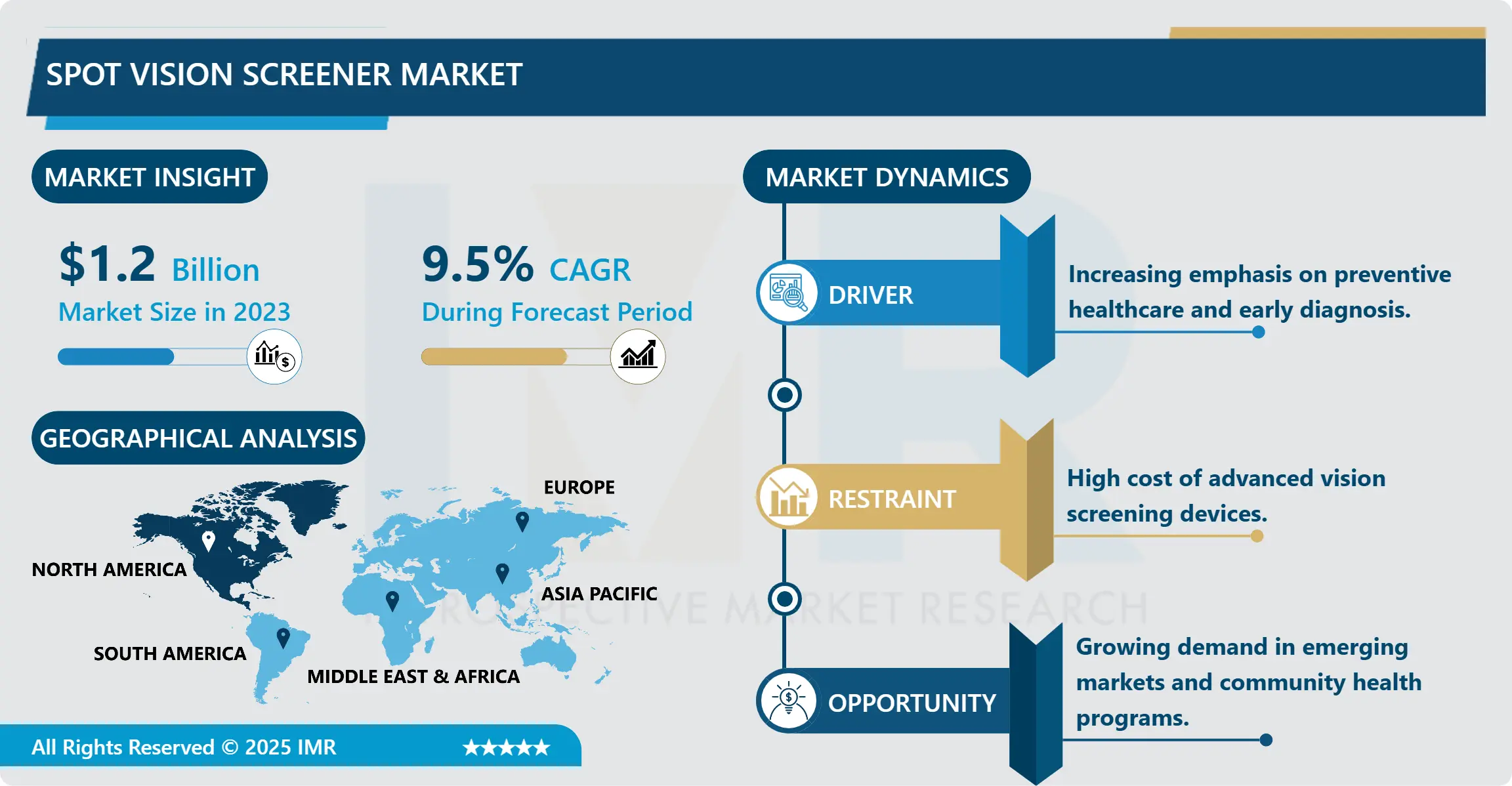
Spot Vision Screener Market Size Was Valued at USD 1.2 Billion in 2023, and is Projected to Reach USD 2.7 Billion by 2032, Growing at a CAGR of 9.5% From 2024-2032.
The Spot Vision Screener market refers to products in the medical line that allow for screening of refractive errors plus vision complications such as myopia, hyperopia, astigmatism and many more. Such gadgets are often portable, extremely easy to operate, and give non- invasive and rather fast results that is why they are highly appreciated by doctors who practice in clinics, schools, etc., treating children and age-related disorders such as presbyopia.
Spot Vision Screener market is progressing at a high pace because of growing need of vision screening devices globally. Since vision health is ensured a priority in today’s health systems, especially in the ageing population countries as well as the emphasis on health in early childhood, the market for such devices is shifting. Parents, governments and health care providers are getting to endorse spot vision screeners to fulfil the requirement of cost, convenient and efficacious vision screening systems. These gadgets are becoming more advanced and complex due to present day technology enabling them features like data storing, wireless capabilities and faster screening capacities that makes them valuable assets in large medical facilities as well as travelling health centres.
Moreover, more client awareness of early eye screening is essential because of undetected issues on the overall health of a clients’ eyes. Childhood vision became a prime area of interest because the disease detected at an early age and treated significantly affects learning and quality of life. Vision Screeners help screen many people thereby prompting early treatment which; in addition to enhancing quality of life of the patients, save a lot of costs in treating patients who could have required more comprehensive treatment had their conditions been discovered later.
Spot Vision Screener Market Trend Analysis:
Technological Innovations in Vision Screening
Another notable theme of the report is the growing utilization of modern technologies where the Spot Vision Screener market is concerned, including artificial intelligence and machine learning. These advancements have led to enhancement in the screening procedures for visions to become more accurate and much faster for devices to process the data collected and present better results. Modern computer vision systems allow spot vision screeners to identify symptoms that were not possible to detect before or required a lot of time to be noticed. Also, the trend of integrating cloud connectivity in such devices can help Health care providers share data easily after attending to a patient.
One more important tendency is the growth of the role of portable and pocket devices. As these approaches use small, portable, and easy-to-operate devices, vision screening is feasible from remote locations, schools, and community health programs, particularly where there is low health facility development. This move towards portability is entirely appropriate with the increased focus on proactive healthcare and more public health-oriented interventions, particularly within emerging markets. As a result of providing a more comprehensive range of vision screening in different areas pointing out the need for vision correction, mobile spot vision screeners are expected to revolutionize eye health across the world.
Expanding Reach in Emerging Markets
The market for the Spot Vision Screener is currently concentrated in the developing countries due to a lack of access to healthcare facilities. The Spot Vision Screener is especially large in the developing countries where adequate healthcare technologies are absent. Similarly, officials and authorities of Asian, Latin American, and African zones are focusing on developing the necessary health care technology to enhance the availability of the crucial health services, including vision health. Mobile application vision screeners are inexpensive devices and easy to implement, which enables them to be widely used in this area thus helping in identifying a high prevalence of vision impaired people due to limited access to health facilities.
Spot Vision Screener Market Segment Analysis:
Spot Vision Screener Market Segmented on the basis of type, application, end user and region.
By Type, Handheld Vision Screeners segment is expected to dominate the market during the forecast period
The Handheld Vision Screeners segment shall remain the market leader in generating revenues during the years ahead, because of their convenience, ease of use and multifunctional capabilities. Another utility is in possibility to make the screenings in different settings including schools, community health events and in areas where there is limited access to health facilities. They are portable due to their small size and the nature of few controls making them suitable tools for health care staff for quick and effective vision tests away from a clinical setting. Also, advances in technology have improved the efficiency and precision of the handheld equipment to twice that of larger sophisticated devices. These factors of convenience, affordable prices and the ability to apply the technology makes handheld vision screeners very attractive and are poised to be dominate both developed and emerging markets.
By Application, Hospitals segment expected to held the largest share
The application segment in which Hospitals are forecasted to hold the largest market is accurately justified because hospitals are primary healthcare centers are concerned with overall diagnosis and treatment. Hospitals are well equipped to invest in highly detailed vision screening devices to facilitate accurate and efficient total eye healthcare services to numerous outpatient clients. High demand for this segment also results from the need to conduct rapid vision assessment in hospitals where timely diagnosis of the vision’s problems is vital for patients’ conditions. Furthermore, children, adult, and geriatric patients are sure to pass thorough vision screenings within their visits to hospitals, as hospitals are diverse patient servicing centers. Consequently, hospitals are in an ideal place to integrate sophisticated aspects into vision screening technology, which has allowed them to continue to lead the Spot Vision Screener market.
Spot Vision Screener Market Regional Insights:
North America is Expected to Dominate the Market Over the Forecast period
North America will be evaluated to have a massive portion in the Spot Vision Screener market because of the high amount of money spent on healthcare, higher level of development in healthcare sector, and increased consciousness among people towards early detection of eye disorders. The use of these devices has recently been on the rise across many schools, pediatric clinics, and community health centers within the United States. It is expected that the North American market still has a monopoly of the global market as per new statistics. The region’s focus towards early diagnosing and prevention has been instrumental in the growth of the Spot Vision Screener market. Also, the government programs which are mainly providing support to vision health programs for children and the elder have also boosted the demand in this region.
Active Key Players in the Spot Vision Screener Market
Adaptica S.r.l. (Italy)
Essilor Group (France)
FIM Medical (France)
Good-Lite Co. (United States)
Grand Seiko Co., Ltd. (Japan)
Hill-Rom Holdings, Inc. (United States)
Honeywell International Inc. (United States)
Luneau Technology Group (France)
Medica Group (Italy)
NIDEK Co., Ltd. (Japan)
Optovue, Inc. (United States)
Plusoptix Inc. (Germany)
Stereo Optical Co., Inc. (United States)
Visionix Ltd. (Israel)
Welch Allyn (United States)
Other Active Players
Chapter 1: Introduction
1.1 Scope and Coverage
Chapter 2:Executive Summary
Chapter 3: Market Landscape
3.1 Market Dynamics
3.1.1 Drivers
3.1.2 Restraints
3.1.3 Opportunities
3.1.4 Challenges
3.2 Market Trend Analysis
3.3 PESTLE Analysis
3.4 Porter’s Five Forces Analysis
3.5 Industry Value Chain Analysis
3.6 Ecosystem
3.7 Regulatory Landscape
3.8 Price Trend Analysis
3.9 Patent Analysis
3.10 Technology Evolution
3.11 Investment Pockets
3.12 Import-Export Analysis
Chapter 4: Spot Vision Screener Market by Type
4.1 Spot Vision Screener Market Snapshot and Growth Engine
4.2 Spot Vision Screener Market Overview
4.3 Handheld Vision Screeners
4.3.1 Introduction and Market Overview
4.3.2 Historic and Forecasted Market Size in Value USD and Volume Units (2017-2032F)
4.3.3 Key Market Trends, Growth Factors and Opportunities
4.3.4 Handheld Vision Screeners: Geographic Segmentation Analysis
4.4 Tabletop Vision Screeners)
4.4.1 Introduction and Market Overview
4.4.2 Historic and Forecasted Market Size in Value USD and Volume Units (2017-2032F)
4.4.3 Key Market Trends, Growth Factors and Opportunities
4.4.4 Tabletop Vision Screeners): Geographic Segmentation Analysis
4.5
4.5.1 Introduction and Market Overview
4.5.2 Historic and Forecasted Market Size in Value USD and Volume Units (2017-2032F)
4.5.3 Key Market Trends, Growth Factors and Opportunities
4.5.4 : Geographic Segmentation Analysis
Chapter 5: Spot Vision Screener Market by Application
5.1 Spot Vision Screener Market Snapshot and Growth Engine
5.2 Spot Vision Screener Market Overview
5.3 Hospitals
5.3.1 Introduction and Market Overview
5.3.2 Historic and Forecasted Market Size in Value USD and Volume Units (2017-2032F)
5.3.3 Key Market Trends, Growth Factors and Opportunities
5.3.4 Hospitals: Geographic Segmentation Analysis
5.4 Clinics
5.4.1 Introduction and Market Overview
5.4.2 Historic and Forecasted Market Size in Value USD and Volume Units (2017-2032F)
5.4.3 Key Market Trends, Growth Factors and Opportunities
5.4.4 Clinics: Geographic Segmentation Analysis
5.5 Schools
5.5.1 Introduction and Market Overview
5.5.2 Historic and Forecasted Market Size in Value USD and Volume Units (2017-2032F)
5.5.3 Key Market Trends, Growth Factors and Opportunities
5.5.4 Schools: Geographic Segmentation Analysis
5.6 and Others)
5.6.1 Introduction and Market Overview
5.6.2 Historic and Forecasted Market Size in Value USD and Volume Units (2017-2032F)
5.6.3 Key Market Trends, Growth Factors and Opportunities
5.6.4 and Others): Geographic Segmentation Analysis
5.7
5.7.1 Introduction and Market Overview
5.7.2 Historic and Forecasted Market Size in Value USD and Volume Units (2017-2032F)
5.7.3 Key Market Trends, Growth Factors and Opportunities
5.7.4 : Geographic Segmentation Analysis
Chapter 6: Spot Vision Screener Market by End User
6.1 Spot Vision Screener Market Snapshot and Growth Engine
6.2 Spot Vision Screener Market Overview
6.3 Pediatric
6.3.1 Introduction and Market Overview
6.3.2 Historic and Forecasted Market Size in Value USD and Volume Units (2017-2032F)
6.3.3 Key Market Trends, Growth Factors and Opportunities
6.3.4 Pediatric: Geographic Segmentation Analysis
6.4 Adult
6.4.1 Introduction and Market Overview
6.4.2 Historic and Forecasted Market Size in Value USD and Volume Units (2017-2032F)
6.4.3 Key Market Trends, Growth Factors and Opportunities
6.4.4 Adult: Geographic Segmentation Analysis
6.5 Geriatric)
6.5.1 Introduction and Market Overview
6.5.2 Historic and Forecasted Market Size in Value USD and Volume Units (2017-2032F)
6.5.3 Key Market Trends, Growth Factors and Opportunities
6.5.4 Geriatric) : Geographic Segmentation Analysis
Chapter 7: Company Profiles and Competitive Analysis
7.1 Competitive Landscape
7.1.1 Competitive Benchmarking
7.1.2 Spot Vision Screener Market Share by Manufacturer (2023)
7.1.3 Industry BCG Matrix
7.1.4 Heat Map Analysis
7.1.5 Mergers and Acquisitions
7.2 HILL-ROM HOLDINGS (UNITED STATES)
7.2.1 Company Overview
7.2.2 Key Executives
7.2.3 Company Snapshot
7.2.4 Role of the Company in the Market
7.2.5 Sustainability and Social Responsibility
7.2.6 Operating Business Segments
7.2.7 Product Portfolio
7.2.8 Business Performance
7.2.9 Key Strategic Moves and Recent Developments
7.2.10 SWOT Analysis
7.3 WELCH ALLYN (UNITED STATES)
7.4 ADAPTICA S.R.L. (ITALY)
7.5 PLUSOPTIX INC. (GERMANY)
7.6 STEREO OPTICAL CO. (UNITED STATES)
7.7 OTHER ACTIVE PLAYERS
Chapter 8: Global Spot Vision Screener Market By Region
8.1 Overview
8.2. North America Spot Vision Screener Market
8.2.1 Key Market Trends, Growth Factors and Opportunities
8.2.2 Top Key Companies
8.2.3 Historic and Forecasted Market Size by Segments
8.2.4 Historic and Forecasted Market Size By Type
8.2.4.1 Handheld Vision Screeners
8.2.4.2 Tabletop Vision Screeners)
8.2.4.3
8.2.5 Historic and Forecasted Market Size By Application
8.2.5.1 Hospitals
8.2.5.2 Clinics
8.2.5.3 Schools
8.2.5.4 and Others)
8.2.5.5
8.2.6 Historic and Forecasted Market Size By End User
8.2.6.1 Pediatric
8.2.6.2 Adult
8.2.6.3 Geriatric)
8.2.7 Historic and Forecast Market Size by Country
8.2.7.1 US
8.2.7.2 Canada
8.2.7.3 Mexico
8.3. Eastern Europe Spot Vision Screener Market
8.3.1 Key Market Trends, Growth Factors and Opportunities
8.3.2 Top Key Companies
8.3.3 Historic and Forecasted Market Size by Segments
8.3.4 Historic and Forecasted Market Size By Type
8.3.4.1 Handheld Vision Screeners
8.3.4.2 Tabletop Vision Screeners)
8.3.4.3
8.3.5 Historic and Forecasted Market Size By Application
8.3.5.1 Hospitals
8.3.5.2 Clinics
8.3.5.3 Schools
8.3.5.4 and Others)
8.3.5.5
8.3.6 Historic and Forecasted Market Size By End User
8.3.6.1 Pediatric
8.3.6.2 Adult
8.3.6.3 Geriatric)
8.3.7 Historic and Forecast Market Size by Country
8.3.7.1 Russia
8.3.7.2 Bulgaria
8.3.7.3 The Czech Republic
8.3.7.4 Hungary
8.3.7.5 Poland
8.3.7.6 Romania
8.3.7.7 Rest of Eastern Europe
8.4. Western Europe Spot Vision Screener Market
8.4.1 Key Market Trends, Growth Factors and Opportunities
8.4.2 Top Key Companies
8.4.3 Historic and Forecasted Market Size by Segments
8.4.4 Historic and Forecasted Market Size By Type
8.4.4.1 Handheld Vision Screeners
8.4.4.2 Tabletop Vision Screeners)
8.4.4.3
8.4.5 Historic and Forecasted Market Size By Application
8.4.5.1 Hospitals
8.4.5.2 Clinics
8.4.5.3 Schools
8.4.5.4 and Others)
8.4.5.5
8.4.6 Historic and Forecasted Market Size By End User
8.4.6.1 Pediatric
8.4.6.2 Adult
8.4.6.3 Geriatric)
8.4.7 Historic and Forecast Market Size by Country
8.4.7.1 Germany
8.4.7.2 UK
8.4.7.3 France
8.4.7.4 The Netherlands
8.4.7.5 Italy
8.4.7.6 Spain
8.4.7.7 Rest of Western Europe
8.5. Asia Pacific Spot Vision Screener Market
8.5.1 Key Market Trends, Growth Factors and Opportunities
8.5.2 Top Key Companies
8.5.3 Historic and Forecasted Market Size by Segments
8.5.4 Historic and Forecasted Market Size By Type
8.5.4.1 Handheld Vision Screeners
8.5.4.2 Tabletop Vision Screeners)
8.5.4.3
8.5.5 Historic and Forecasted Market Size By Application
8.5.5.1 Hospitals
8.5.5.2 Clinics
8.5.5.3 Schools
8.5.5.4 and Others)
8.5.5.5
8.5.6 Historic and Forecasted Market Size By End User
8.5.6.1 Pediatric
8.5.6.2 Adult
8.5.6.3 Geriatric)
8.5.7 Historic and Forecast Market Size by Country
8.5.7.1 China
8.5.7.2 India
8.5.7.3 Japan
8.5.7.4 South Korea
8.5.7.5 Malaysia
8.5.7.6 Thailand
8.5.7.7 Vietnam
8.5.7.8 The Philippines
8.5.7.9 Australia
8.5.7.10 New Zealand
8.5.7.11 Rest of APAC
8.6. Middle East & Africa Spot Vision Screener Market
8.6.1 Key Market Trends, Growth Factors and Opportunities
8.6.2 Top Key Companies
8.6.3 Historic and Forecasted Market Size by Segments
8.6.4 Historic and Forecasted Market Size By Type
8.6.4.1 Handheld Vision Screeners
8.6.4.2 Tabletop Vision Screeners)
8.6.4.3
8.6.5 Historic and Forecasted Market Size By Application
8.6.5.1 Hospitals
8.6.5.2 Clinics
8.6.5.3 Schools
8.6.5.4 and Others)
8.6.5.5
8.6.6 Historic and Forecasted Market Size By End User
8.6.6.1 Pediatric
8.6.6.2 Adult
8.6.6.3 Geriatric)
8.6.7 Historic and Forecast Market Size by Country
8.6.7.1 Turkiye
8.6.7.2 Bahrain
8.6.7.3 Kuwait
8.6.7.4 Saudi Arabia
8.6.7.5 Qatar
8.6.7.6 UAE
8.6.7.7 Israel
8.6.7.8 South Africa
8.7. South America Spot Vision Screener Market
8.7.1 Key Market Trends, Growth Factors and Opportunities
8.7.2 Top Key Companies
8.7.3 Historic and Forecasted Market Size by Segments
8.7.4 Historic and Forecasted Market Size By Type
8.7.4.1 Handheld Vision Screeners
8.7.4.2 Tabletop Vision Screeners)
8.7.4.3
8.7.5 Historic and Forecasted Market Size By Application
8.7.5.1 Hospitals
8.7.5.2 Clinics
8.7.5.3 Schools
8.7.5.4 and Others)
8.7.5.5
8.7.6 Historic and Forecasted Market Size By End User
8.7.6.1 Pediatric
8.7.6.2 Adult
8.7.6.3 Geriatric)
8.7.7 Historic and Forecast Market Size by Country
8.7.7.1 Brazil
8.7.7.2 Argentina
8.7.7.3 Rest of SA
Chapter 9 Analyst Viewpoint and Conclusion
9.1 Recommendations and Concluding Analysis
9.2 Potential Market Strategies
Chapter 10 Research Methodology
10.1 Research Process
10.2 Primary Research
10.3 Secondary Research
Q1: What would be the forecast period in the Spot Vision Screener Market research report?
A1: The forecast period in the Spot Vision Screener Market research report is 2024-2032.
Q2: Who are the key players in the Spot Vision Screener Market?
A2: Adaptica S.r.l. (Italy), Essilor Group (France), FIM Medical (France), Good-Lite Co. (United States), Grand Seiko Co., Ltd. (Japan), Hill-Rom Holdings, Inc. (United States), Honeywell International Inc. (United States), Luneau Technology Group (France), Medica Group (Italy), NIDEK Co., Ltd. (Japan), Optovue, Inc. (United States), Plusoptix Inc. (Germany), Stereo Optical Co., Inc. (United States), Visionix Ltd. (Israel), Welch Allyn (United States), Other Active Players.
Q3: What are the segments of the Spot Vision Screener Market?
A3: The Spot Vision Screener Market is segmented into Type, Application, End User and region. By Type, the market is categorized into Handheld Vision Screeners, Tabletop Vision Screeners. By Application, the market is categorized into Hospitals, Clinics, Schools, and Others. By End User, the market is categorized into Pediatric, Adult, Geriatric. By region, it is analyzed across North America (U.S.; Canada; Mexico), Eastern Europe (Bulgaria; The Czech Republic; Hungary; Poland; Romania; Rest of Eastern Europe), Western Europe (Germany; UK; France; Netherlands; Italy; Russia; Spain; Rest of Western Europe), Asia-Pacific (China; India; Japan; Southeast Asia, etc.), South America (Brazil; Argentina, etc.), Middle East & Africa (Saudi Arabia; South Africa, etc.).
Q4: What is the Spot Vision Screener Market?
A4: The Spot Vision Screener market refers to products in the medical line that allow for screening of refractive errors plus vision complications such as myopia, hyperopia, astigmatism and many more.
Q5: How big is the Spot Vision Screener Market?
A5: Spot Vision Screener Market Size Was Valued at USD 1.2 Billion in 2023, and is Projected to Reach USD 2.7 Billion by 2032, Growing at a CAGR of 9.5% From 2024-2032.
How to Buy a Report from eminsights.jp
On the product page, choose the license you want: Single-User License, Multi-User License or Enterprise License.
If you required report in your native language, then you can click on Translated Report button and fill out the form with report name and language you want, then our team will contact you as soon as possible.
Click the Buy Now button.
You will be redirected to the checkout page. Enter your company details and payment information.
Click Place Order to complete the purchase.
Confirmation: You’ll receive an order confirmation and our team will contact you shortly with your ordered report.
If you have any questions, fill out the contact form below or email us at [email protected].
Thank you for choosing eminsights.jp!