Stay Ahead in Fast-Growing Economies.
Browse Reports Now
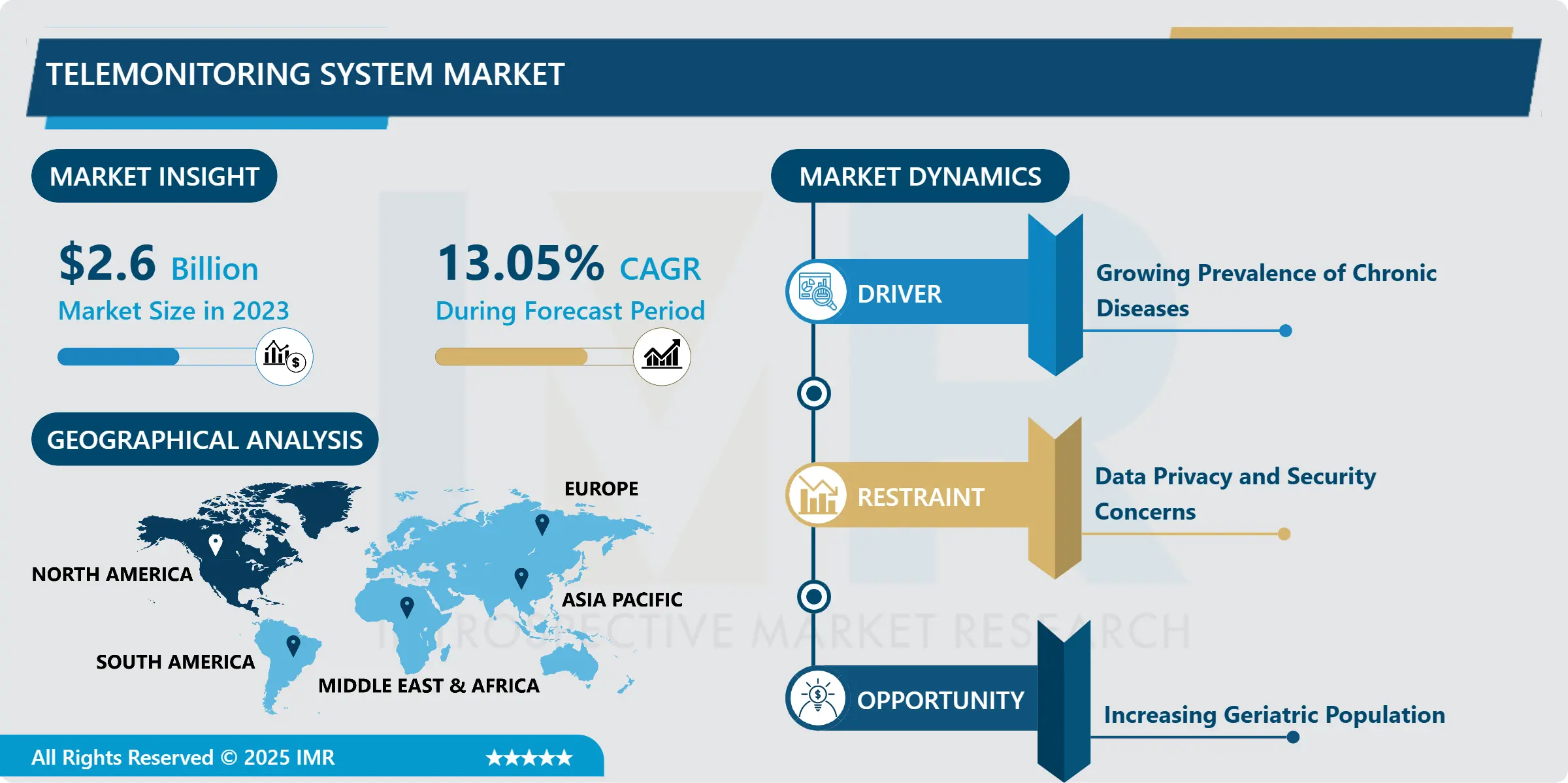
Telemonitoring System Market – Latest Advancement & Future Trends (2024-2032)
The Telemonitoring System Market can be described as the market of Remote Monitoring Systems that function with a help of telecommunications technologies, sending patient’s data to doctors.

IMR Group
Description
Telemonitoring System Market Synopsis:
Telemonitoring System Market Size Was Valued at USD 2.60 Billion in 2023, and is Projected to Reach USD 7.84 Billion by 2032, Growing at a CAGR of 13.05% From 2024-2032.
The Telemonitoring System Market can be described as the market of Remote Monitoring Systems that function with a help of telecommunications technologies, sending patient’s data to doctors. Such systems enable people to check the patient’s signs, condition, and respective medical values without having to attend physical visits that are time-consuming.
Telemonitoring systems have become very useful in the health care industry due to increase in cases of chronic diseases such as diabetes, cardiovascular diseases and respiratory diseases all over the world. These systems allow patients to monitor their health status from afar as collected information returns to the doctor for further review. The market has grown over the last few years and has received the benefits of electronic health resources and other healthcare facilities as well.
Emerging and innovative medical equipment as well as in communication systems have also supported the use of telemonitoring systems in the health sector. The application of AI and data analysis system improves the diagnosis accuracy in decision making processes, so that the healthcare providers can make right decisions at the right time. During the COVID-19 crisis, remote monitoring gained added steam, as healthcare systems struggled for ways to monitor hospital usage and adapt for lockdowns. As a result, both governments and private institutions have been putting a lot of capital into telemonitoring technologies, especially in North America and Europe because of the head start they possess in healthcare infrastructure.
Telemonitoring System Market Trend Analysis:
Integration of AI in Telemonitoring Systems
The biggest factor which can be observed in the telemonitoring system market is the incorporation of artificial intelligence in the monitoring applications. AI means that data analysis can be automated and provide doses other health care professional with predictive analysis and alerts of any abnormalities in health trends. The following AI-based technologies enhance the chances of successful telemonitoring with minimized risks of human errors in analysis of the patient status.
For example, AI can identify arrhythmia, low blood pressure or glucose levels, and many other issues that require an immediate call to the doctor. This trend is especially useful especially in conditions such as diabetes and other cardiac disorders since early direction of anomalies will improve the health status of patients. In the future, as advances in AI occur it is expected that the application of AI in telemonitoring systems will increase to support more individualized, anticipatory approaches to patient care.
Increasing Geriatric Population
The telemonitoring system market’s growth also holds potential because the global population is aging rapidly, and there is a quickly increasing number of individuals over the age of 65. As the world’s population ages, new cases of diseases like diabetes, cardiovascular diseases, and hypertension increase, and therefore, need close follow-up and control. Telemonitoring systems are especially important to be implemented for elderly patients who, for example, have restricted mobility and would have problems with frequent visits to clinics.
The current population aging is therefore increasing the demand for home care services such as telemonitoring that offers comfort, secure solutions and around the clock surveillance on patients’ well-being. Decision makers in governments and extenders are gradually starting to appreciate the roles these structures have to play in such determinants such as readmission rates to hospitals, cost control in the facilitate, and quality of life across maintained elderly people. Therefore, it can be concluded that telemonitoring technology investments flowing towards the section of the elderly will experience a tremendous increase in the ladder years.
Telemonitoring System Market Segment Analysis:
Telemonitoring System Market is Segmented on the basis of Component, Mode of Delivery, Application, End User, and Region.
By Component, Hardware segment is expected to dominate the market during the forecast period
Telemonitoring systems comprise two main components: hardware and software. Equipment is glucometers, blood pressure apparatus, cardiac accessories and any other equipment that is useful in collection of data from patients. As miniaturized portable and wearable devices are on the rise, the hardware used in telemonitoring is continually improving offering seamless non-invasive telemonitoring.
With regards to software, telemonitoring systems are used to store and analyze the data being harvested from the hardware components. With the help of software, patient and provider exchanges are also facilitated. Use of cloud-based solutions and application of artificial intelligence analytics to the telemonitoring software improves on its capability as a means by which healthcare providers can receive accurate information regarding the condition of patients and subsequently such information can be used to streamline diagnostic processes.
By Application, Cardiac segment expected to held the largest share
Telemonitoring is useful for a variety of purposes – COPD, glucose monitoring, cardiac monitoring, and blood pressure monitoring included. Tele supported COPD maintenance provides a way of monitoring respiratory status and identifying COPD flare ups in patients have chronic lung diseases. This is important to avoid hospitalizations and patient’s general well-being.
In the same way, glucose level telemonitoring systems are the necessities of diabetes treatment because patients need to be constantly telemonitoring their blood sugar level and share the results with physicians. Cardiac telemonitoring equipments to record the heart rate and identify the existence of an arrhythmia; blood pressure telemonitoring systems to detect hypertension and indicate possible signs of adverse health changes.
Telemonitoring System Market Regional Insights:
North America is Expected to Dominate the Market Over the Forecast period
North America can be considered as the largest market for telemonitoring systems due to well-developed healthcare system, high rate of acceptance towards key enabling technologies and reinforcement of telehealth services in the region. People suffering from chronic diseases and living in the region include patients with diabetes and cardiovascular diseases, which also explains high demand for technical telemonitoring systems.
Besides, policies such as reimbursement policies for telehealth as well as investment on health care technologies by the U.S government has fuelled the growth of the market. It is also expected that North America grows more competitive due to existing stake holders in the healthcare, technology, and legal systems that support remote patient monitoring in telemonitoring system market.
Active Key Players in the Telemonitoring System Market
Abbott Laboratories (United States)
Aerotel Medical Systems (Israel)
BioTelemetry, Inc. (United States)
Boston Scientific Corporation (United States)
GE Healthcare (United States)
Honeywell Life Care Solutions (United States)
Masimo Corporation (United States)
Medtronic (Ireland)
Nihon Kohden Corporation (Japan)
Omron Healthcare (Japan)
Philips Healthcare (Netherlands)
Resideo Technologies (United States)
Other Active Players.
Key Industry Developments in the Telemonitoring System Market:
In July 2023, Abbott Laboratories announced the acquisition of a small technology firm specializing in advanced algorithms for heart rate monitoring, enhancing their existing telemonitoring solutions. This strategic move aims to bolster Abbott’s cardiovascular telemonitoring capabilities by integrating superior predictive technologies into their platforms.
In August 2023, GE Healthcare launched a new telemonitoring system, designed to improve remote patient monitoring for chronic disease sufferers. This system features enhanced data analytics and compatibility with multiple medical devices, offering clinicians real-time insights into patient health.
In September 2023, Care Innovations LLC merged with a leading software development company to enhance their telemonitoring services. This merger is expected to expand their service offerings by integrating innovative software solutions that support more complex patient monitoring and data analysis needs.
In June 2023, Philips introduced a next-generation telemonitoring system, which includes AI-driven diagnostic tools and improved user interfaces. This launch reflects Philips’ ongoing commitment to transforming patient care through innovative telehealth technologies.
Chapter 1: Introduction
1.1 Scope and Coverage
Chapter 2:Executive Summary
Chapter 3: Market Landscape
3.1 Market Dynamics
3.1.1 Drivers
3.1.2 Restraints
3.1.3 Opportunities
3.1.4 Challenges
3.2 Market Trend Analysis
3.3 PESTLE Analysis
3.4 Porter’s Five Forces Analysis
3.5 Industry Value Chain Analysis
3.6 Ecosystem
3.7 Regulatory Landscape
3.8 Price Trend Analysis
3.9 Patent Analysis
3.10 Technology Evolution
3.11 Investment Pockets
3.12 Import-Export Analysis
Chapter 4: Telemonitoring System Market by Component
4.1 Telemonitoring System Market Snapshot and Growth Engine
4.2 Telemonitoring System Market Overview
4.3 Hardware
4.3.1 Introduction and Market Overview
4.3.2 Historic and Forecasted Market Size in Value USD and Volume Units (2017-2032F)
4.3.3 Key Market Trends, Growth Factors and Opportunities
4.3.4 Hardware: Geographic Segmentation Analysis
4.4 Software
4.4.1 Introduction and Market Overview
4.4.2 Historic and Forecasted Market Size in Value USD and Volume Units (2017-2032F)
4.4.3 Key Market Trends, Growth Factors and Opportunities
4.4.4 Software: Geographic Segmentation Analysis
Chapter 5: Telemonitoring System Market by Mode of Delivery
5.1 Telemonitoring System Market Snapshot and Growth Engine
5.2 Telemonitoring System Market Overview
5.3 Web-based
5.3.1 Introduction and Market Overview
5.3.2 Historic and Forecasted Market Size in Value USD and Volume Units (2017-2032F)
5.3.3 Key Market Trends, Growth Factors and Opportunities
5.3.4 Web-based: Geographic Segmentation Analysis
5.4 Cloud- based)
5.4.1 Introduction and Market Overview
5.4.2 Historic and Forecasted Market Size in Value USD and Volume Units (2017-2032F)
5.4.3 Key Market Trends, Growth Factors and Opportunities
5.4.4 Cloud- based): Geographic Segmentation Analysis
5.5
5.5.1 Introduction and Market Overview
5.5.2 Historic and Forecasted Market Size in Value USD and Volume Units (2017-2032F)
5.5.3 Key Market Trends, Growth Factors and Opportunities
5.5.4 : Geographic Segmentation Analysis
Chapter 6: Telemonitoring System Market by Application
6.1 Telemonitoring System Market Snapshot and Growth Engine
6.2 Telemonitoring System Market Overview
6.3 COPD Telemonitoring System
6.3.1 Introduction and Market Overview
6.3.2 Historic and Forecasted Market Size in Value USD and Volume Units (2017-2032F)
6.3.3 Key Market Trends, Growth Factors and Opportunities
6.3.4 COPD Telemonitoring System: Geographic Segmentation Analysis
6.4 Glucose Level Telemonitoring System
6.4.1 Introduction and Market Overview
6.4.2 Historic and Forecasted Market Size in Value USD and Volume Units (2017-2032F)
6.4.3 Key Market Trends, Growth Factors and Opportunities
6.4.4 Glucose Level Telemonitoring System: Geographic Segmentation Analysis
6.5 Cardiac Telemonitoring System
6.5.1 Introduction and Market Overview
6.5.2 Historic and Forecasted Market Size in Value USD and Volume Units (2017-2032F)
6.5.3 Key Market Trends, Growth Factors and Opportunities
6.5.4 Cardiac Telemonitoring System: Geographic Segmentation Analysis
6.6 Blood Pressure Telemonitoring System)
6.6.1 Introduction and Market Overview
6.6.2 Historic and Forecasted Market Size in Value USD and Volume Units (2017-2032F)
6.6.3 Key Market Trends, Growth Factors and Opportunities
6.6.4 Blood Pressure Telemonitoring System): Geographic Segmentation Analysis
6.7
6.7.1 Introduction and Market Overview
6.7.2 Historic and Forecasted Market Size in Value USD and Volume Units (2017-2032F)
6.7.3 Key Market Trends, Growth Factors and Opportunities
6.7.4 : Geographic Segmentation Analysis
Chapter 7: Telemonitoring System Market by End-User
7.1 Telemonitoring System Market Snapshot and Growth Engine
7.2 Telemonitoring System Market Overview
7.3 Home Care
7.3.1 Introduction and Market Overview
7.3.2 Historic and Forecasted Market Size in Value USD and Volume Units (2017-2032F)
7.3.3 Key Market Trends, Growth Factors and Opportunities
7.3.4 Home Care: Geographic Segmentation Analysis
7.4 Hospital Care
7.4.1 Introduction and Market Overview
7.4.2 Historic and Forecasted Market Size in Value USD and Volume Units (2017-2032F)
7.4.3 Key Market Trends, Growth Factors and Opportunities
7.4.4 Hospital Care: Geographic Segmentation Analysis
7.5 Long-Term Care Centers)
7.5.1 Introduction and Market Overview
7.5.2 Historic and Forecasted Market Size in Value USD and Volume Units (2017-2032F)
7.5.3 Key Market Trends, Growth Factors and Opportunities
7.5.4 Long-Term Care Centers) : Geographic Segmentation Analysis
Chapter 8: Company Profiles and Competitive Analysis
8.1 Competitive Landscape
8.1.1 Competitive Benchmarking
8.1.2 Telemonitoring System Market Share by Manufacturer (2023)
8.1.3 Industry BCG Matrix
8.1.4 Heat Map Analysis
8.1.5 Mergers and Acquisitions
8.2 PHILIPS HEALTHCARE (NETHERLANDS)
8.2.1 Company Overview
8.2.2 Key Executives
8.2.3 Company Snapshot
8.2.4 Role of the Company in the Market
8.2.5 Sustainability and Social Responsibility
8.2.6 Operating Business Segments
8.2.7 Product Portfolio
8.2.8 Business Performance
8.2.9 Key Strategic Moves and Recent Developments
8.2.10 SWOT Analysis
8.3 GE HEALTHCARE (UNITED STATES)
8.4 MEDTRONIC (IRELAND)
8.5 ABBOTT LABORATORIES (UNITED STATES)
8.6 NIHON KOHDEN CORPORATION (JAPAN)
8.7 BOSTON SCIENTIFIC CORPORATION (UNITED STATES)
8.8 HONEYWELL LIFE CARE SOLUTIONS (UNITED STATES)
8.9 MASIMO CORPORATION (UNITED STATES)
8.10 OMRON HEALTHCARE (JAPAN)
8.11 OTHER ACTIVE PLAYERS
Chapter 9: Global Telemonitoring System Market By Region
9.1 Overview
9.2. North America Telemonitoring System Market
9.2.1 Key Market Trends, Growth Factors and Opportunities
9.2.2 Top Key Companies
9.2.3 Historic and Forecasted Market Size by Segments
9.2.4 Historic and Forecasted Market Size By Component
9.2.4.1 Hardware
9.2.4.2 Software
9.2.5 Historic and Forecasted Market Size By Mode of Delivery
9.2.5.1 Web-based
9.2.5.2 Cloud- based)
9.2.5.3
9.2.6 Historic and Forecasted Market Size By Application
9.2.6.1 COPD Telemonitoring System
9.2.6.2 Glucose Level Telemonitoring System
9.2.6.3 Cardiac Telemonitoring System
9.2.6.4 Blood Pressure Telemonitoring System)
9.2.6.5
9.2.7 Historic and Forecasted Market Size By End-User
9.2.7.1 Home Care
9.2.7.2 Hospital Care
9.2.7.3 Long-Term Care Centers)
9.2.8 Historic and Forecast Market Size by Country
9.2.8.1 US
9.2.8.2 Canada
9.2.8.3 Mexico
9.3. Eastern Europe Telemonitoring System Market
9.3.1 Key Market Trends, Growth Factors and Opportunities
9.3.2 Top Key Companies
9.3.3 Historic and Forecasted Market Size by Segments
9.3.4 Historic and Forecasted Market Size By Component
9.3.4.1 Hardware
9.3.4.2 Software
9.3.5 Historic and Forecasted Market Size By Mode of Delivery
9.3.5.1 Web-based
9.3.5.2 Cloud- based)
9.3.5.3
9.3.6 Historic and Forecasted Market Size By Application
9.3.6.1 COPD Telemonitoring System
9.3.6.2 Glucose Level Telemonitoring System
9.3.6.3 Cardiac Telemonitoring System
9.3.6.4 Blood Pressure Telemonitoring System)
9.3.6.5
9.3.7 Historic and Forecasted Market Size By End-User
9.3.7.1 Home Care
9.3.7.2 Hospital Care
9.3.7.3 Long-Term Care Centers)
9.3.8 Historic and Forecast Market Size by Country
9.3.8.1 Russia
9.3.8.2 Bulgaria
9.3.8.3 The Czech Republic
9.3.8.4 Hungary
9.3.8.5 Poland
9.3.8.6 Romania
9.3.8.7 Rest of Eastern Europe
9.4. Western Europe Telemonitoring System Market
9.4.1 Key Market Trends, Growth Factors and Opportunities
9.4.2 Top Key Companies
9.4.3 Historic and Forecasted Market Size by Segments
9.4.4 Historic and Forecasted Market Size By Component
9.4.4.1 Hardware
9.4.4.2 Software
9.4.5 Historic and Forecasted Market Size By Mode of Delivery
9.4.5.1 Web-based
9.4.5.2 Cloud- based)
9.4.5.3
9.4.6 Historic and Forecasted Market Size By Application
9.4.6.1 COPD Telemonitoring System
9.4.6.2 Glucose Level Telemonitoring System
9.4.6.3 Cardiac Telemonitoring System
9.4.6.4 Blood Pressure Telemonitoring System)
9.4.6.5
9.4.7 Historic and Forecasted Market Size By End-User
9.4.7.1 Home Care
9.4.7.2 Hospital Care
9.4.7.3 Long-Term Care Centers)
9.4.8 Historic and Forecast Market Size by Country
9.4.8.1 Germany
9.4.8.2 UK
9.4.8.3 France
9.4.8.4 The Netherlands
9.4.8.5 Italy
9.4.8.6 Spain
9.4.8.7 Rest of Western Europe
9.5. Asia Pacific Telemonitoring System Market
9.5.1 Key Market Trends, Growth Factors and Opportunities
9.5.2 Top Key Companies
9.5.3 Historic and Forecasted Market Size by Segments
9.5.4 Historic and Forecasted Market Size By Component
9.5.4.1 Hardware
9.5.4.2 Software
9.5.5 Historic and Forecasted Market Size By Mode of Delivery
9.5.5.1 Web-based
9.5.5.2 Cloud- based)
9.5.5.3
9.5.6 Historic and Forecasted Market Size By Application
9.5.6.1 COPD Telemonitoring System
9.5.6.2 Glucose Level Telemonitoring System
9.5.6.3 Cardiac Telemonitoring System
9.5.6.4 Blood Pressure Telemonitoring System)
9.5.6.5
9.5.7 Historic and Forecasted Market Size By End-User
9.5.7.1 Home Care
9.5.7.2 Hospital Care
9.5.7.3 Long-Term Care Centers)
9.5.8 Historic and Forecast Market Size by Country
9.5.8.1 China
9.5.8.2 India
9.5.8.3 Japan
9.5.8.4 South Korea
9.5.8.5 Malaysia
9.5.8.6 Thailand
9.5.8.7 Vietnam
9.5.8.8 The Philippines
9.5.8.9 Australia
9.5.8.10 New Zealand
9.5.8.11 Rest of APAC
9.6. Middle East & Africa Telemonitoring System Market
9.6.1 Key Market Trends, Growth Factors and Opportunities
9.6.2 Top Key Companies
9.6.3 Historic and Forecasted Market Size by Segments
9.6.4 Historic and Forecasted Market Size By Component
9.6.4.1 Hardware
9.6.4.2 Software
9.6.5 Historic and Forecasted Market Size By Mode of Delivery
9.6.5.1 Web-based
9.6.5.2 Cloud- based)
9.6.5.3
9.6.6 Historic and Forecasted Market Size By Application
9.6.6.1 COPD Telemonitoring System
9.6.6.2 Glucose Level Telemonitoring System
9.6.6.3 Cardiac Telemonitoring System
9.6.6.4 Blood Pressure Telemonitoring System)
9.6.6.5
9.6.7 Historic and Forecasted Market Size By End-User
9.6.7.1 Home Care
9.6.7.2 Hospital Care
9.6.7.3 Long-Term Care Centers)
9.6.8 Historic and Forecast Market Size by Country
9.6.8.1 Turkiye
9.6.8.2 Bahrain
9.6.8.3 Kuwait
9.6.8.4 Saudi Arabia
9.6.8.5 Qatar
9.6.8.6 UAE
9.6.8.7 Israel
9.6.8.8 South Africa
9.7. South America Telemonitoring System Market
9.7.1 Key Market Trends, Growth Factors and Opportunities
9.7.2 Top Key Companies
9.7.3 Historic and Forecasted Market Size by Segments
9.7.4 Historic and Forecasted Market Size By Component
9.7.4.1 Hardware
9.7.4.2 Software
9.7.5 Historic and Forecasted Market Size By Mode of Delivery
9.7.5.1 Web-based
9.7.5.2 Cloud- based)
9.7.5.3
9.7.6 Historic and Forecasted Market Size By Application
9.7.6.1 COPD Telemonitoring System
9.7.6.2 Glucose Level Telemonitoring System
9.7.6.3 Cardiac Telemonitoring System
9.7.6.4 Blood Pressure Telemonitoring System)
9.7.6.5
9.7.7 Historic and Forecasted Market Size By End-User
9.7.7.1 Home Care
9.7.7.2 Hospital Care
9.7.7.3 Long-Term Care Centers)
9.7.8 Historic and Forecast Market Size by Country
9.7.8.1 Brazil
9.7.8.2 Argentina
9.7.8.3 Rest of SA
Chapter 10 Analyst Viewpoint and Conclusion
10.1 Recommendations and Concluding Analysis
10.2 Potential Market Strategies
Chapter 11 Research Methodology
11.1 Research Process
11.2 Primary Research
11.3 Secondary Research
Q1: What would be the forecast period in the Telemonitoring System Market research report?
A1: The forecast period in the Telemonitoring System Market research report is 2024-2032.
Q2: Who are the key players in the Telemonitoring System Market?
A2: Philips Healthcare (Netherlands), GE Healthcare (United States), Medtronic (Ireland), Abbott Laboratories (United States), Nihon Kohden Corporation (Japan), Boston Scientific Corporation (United States), Honeywell Life Care Solutions (United States), Masimo Corporation (United States), Omron Healthcare (Japan), and Other Active Players.
Q3: What are the segments of the Telemonitoring System Market?
A3: The Telemonitoring System Market is segmented into Component, Mode Of Delivery, Application, End User and region. By Component, the market is categorized into Hardware, Software. By Mode of Delivery, the market is categorized into Web-based, Cloud- based. By Application, the market is categorized into COPD Telemonitoring System, Glucose Level Telemonitoring System, Cardiac Telemonitoring System, Blood Pressure Telemonitoring System. By End-User, the market is categorized into Home Care, Hospital Care, Long-Term Care Centers. By region, it is analyzed across North America (U.S., Canada, Mexico), Eastern Europe (Russia, Bulgaria, The Czech Republic, Hungary, Poland, Romania, Rest of Eastern Europe), Western Europe (Germany, UK, France, The Netherlands, Italy, Russia, Spain, Rest of Western Europe), Asia Pacific (China, India, Japan, South Korea, Malaysia, Thailand, Vietnam, The Philippines, Australia, New-Zealand, Rest of APAC), Middle East & Africa (Turkiye, Bahrain, Kuwait, Saudi Arabia, Qatar, UAE, Israel, South Africa), South America (Brazil, Argentina, Rest of SA).
Q4: What is the Telemonitoring System Market?
A4: The Telemonitoring System Market can be described as the market of Remote Monitoring Systems that function with a help of telecommunications technologies, sending patient’s data to doctors. Such systems enable people to check the patient’s signs, condition, and respective medical values without having to attend physical visits that are time-consuming.
Q5: How big is the Telemonitoring System Market?
A5: Telemonitoring System Market Size Was Valued at USD 2.60 Billion in 2023, and is Projected to Reach USD 7.84 Billion by 2032, Growing at a CAGR of 13.05% From 2024-2032.
How to Buy a Report from eminsights.jp
On the product page, choose the license you want: Single-User License, Multi-User License or Enterprise License.
If you required report in your native language, then you can click on Translated Report button and fill out the form with report name and language you want, then our team will contact you as soon as possible.
Click the Buy Now button.
You will be redirected to the checkout page. Enter your company details and payment information.
Click Place Order to complete the purchase.
Confirmation: You’ll receive an order confirmation and our team will contact you shortly with your ordered report.
If you have any questions, fill out the contact form below or email us at [email protected].
Thank you for choosing eminsights.jp!