Stay Ahead in Fast-Growing Economies.
Browse Reports Now




Heavy Construction Vehicles Market Trends, Analysis & Future Outlook (2024-2032)
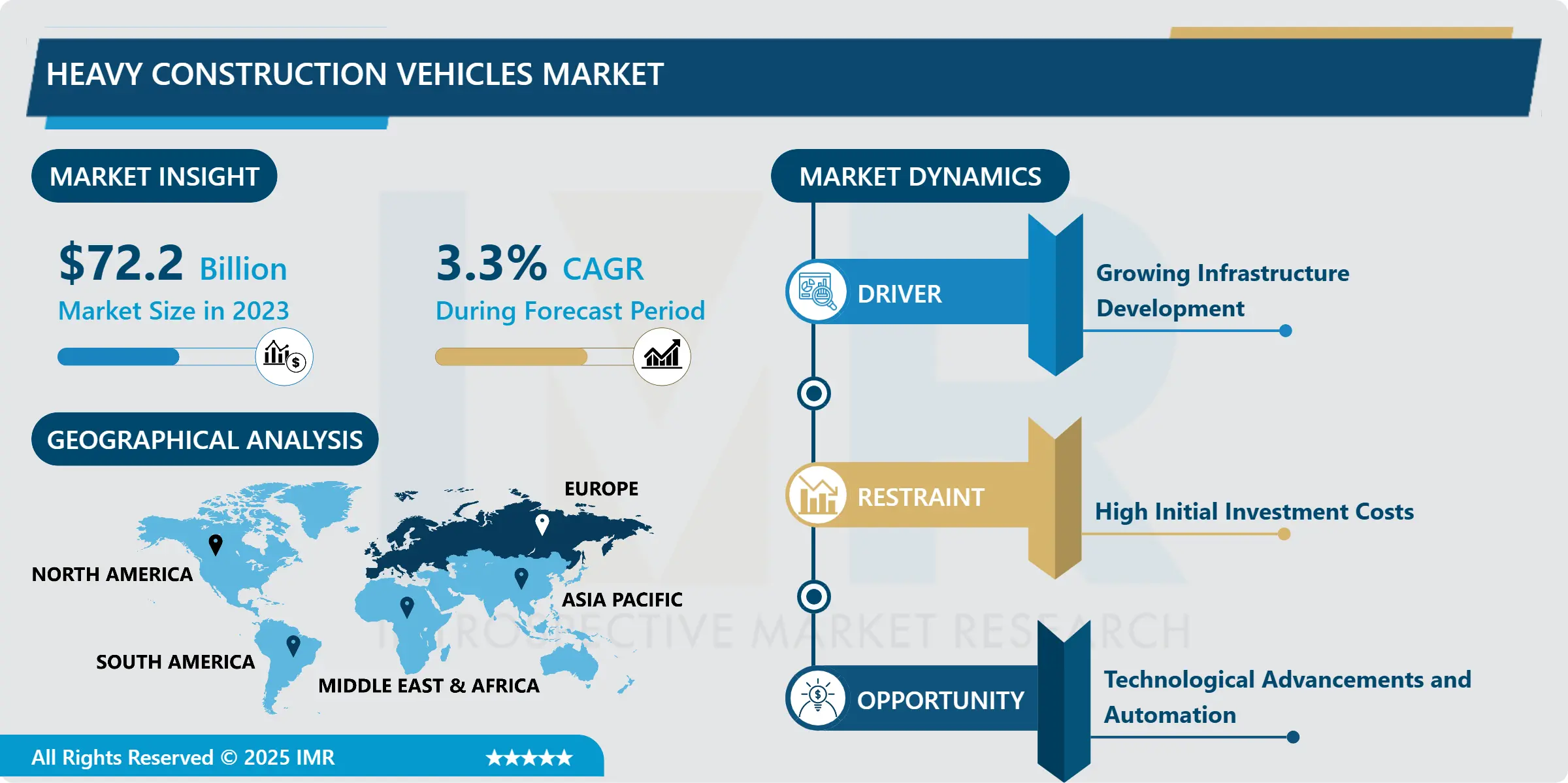
Heavy Construction Vehicles Market Size Was Valued at USD 72.2 Billion in 2023, and is Projected to Reach USD 96.7 Billion by 2032, Growing at a CAGR of 3.3% From 2024-2032.

IMR Group
Description
Key Market Highlights
Heavy Construction Vehicles Market Size Was Valued at USD 72.2 Billion in 2023, and is Projected to Reach USD 96.7 Billion by 2032, Growing at a CAGR of 3.3% From 2024-2032.
Market Size in 2023: USD 72.2 Billion
Projected Market Size by 2032: USD 96.7 Billion
CAGR (2024–2032): 3.3%
Fastest-Growing Market: Europe
By Type: The Dump Trucks segment is anticipated to lead the market by holding 27.39% of market share throughout the forecast period.
By Application: The Construction segment is expected to grab 32.69% market share to maintain dominance over the forecast period.
By Region: Europe is projected to hold 29.36% market share during the forecast period.
Active Players: Caterpillar Inc. (USA), CNH Industrial (UK), Doosan Infracore (South Korea), Volvo Construction Equipment (Sweden), and Other Active Players.
Heavy Construction Vehicles Market Synopsis:
The heavy construction vehicles market comprises the manufacturing and distribution of heavy construction vehicles and their sales to customers in different construction processes. These vehicles which are used to undertake certain activities like excavation, demolition, grading, handling materials and other transport operations are valuable tools in every large construction projects regardless of their type- be it residential, commercial, or infrastructural construction projects. The large construction machinery mostly includes dump trucks, excavator, backhoe loaders, bulldozer, mobile cranes, and wheel loader. These vehicles are critical in the accomplishment of strenuous tasks in construction, provide efficiency, and productivity in the course of construction projects, and are vital in guaranteeing the timely delivery of construction tasks. Thus, the demand for heavy construction vehicles crawler tractors and site dump trucks – has increased substantially due to thriving construction and extreme levels of urbanization globally, new technologies of construction equipment greater focus on automation and electrification of construction vehicle in the past few years.
Heavy Construction Vehicles Market Trend Analysis:
Rise of Electric and Autonomous Heavy Construction Vehicles
Electricity and autonomy controlling heavy construction vehicles is gradually becoming a trend in the market. Connecting the construction firms’ intention to use more efficient electric heavy vehicles have less operation cost, low impact on the environment, and the incentives to the use green technology. Other emerging equipments include the construction vehicles that are also being used increasingly in construction projects since they ease the working process, minimize human factor and increase safety in construction projects. These vehicles have Auto GPS systems, Telematics, Artificial Intelligence and are being worked upon to reach a higher level of effectiveness and minimized downtime and fuel consumption. These all innovations are assumed to popularize in the future and proliferate as the key growth factors in the market and will redefine heavy construction vehicle industry in the future years.
Focus on Urbanization and Smart Infrastructure Development
Actually, one of the major potential for the growth of the demand in the market for the heavy construction vehicles is the fact of the current global urbanization processes and the development of smart infrastructure. While population of urban area increases, there increases the demand for houses, roads, bridges, among other infrastructures. Business involved in constructions mostly need sophisticated and effective equipments to counter the increasing demand of urbanization. New generation smart cities, which means intelligent cities that use technology to optimize infrastructures, offer unique opportunities for manufacturers who can contribute creative ideas that will meet all of the requirements of such projects. Also, attention towards upgradation of infrastructure by governments also gives the companies an opportunity to provide them with specialized vehicles for large infrastructure projects leading to the growth in the heavy construction vehicle market.
Heavy Construction Vehicles Market Segment Analysis:
Heavy Construction Vehicles Market is Segmented on the basis of type, application, Fuel Type, and Region
By Type, Dump Trucks segment is expected to dominate the market during the forecast period
Out of all these segments, it is projected that the dump truck segment would lead the overall heavy construction vehicles market in particular during the forecasting period because of the key function of these vehicles in carrying materials such as soil, sand, gravel, and debris within construction projects. Dump trucks are fully enclosed, and they can convey a great deal of material, this characteristic being admired in most constructional projects. They are much applied in civil construction, mining, and construction of infrastructure roads since they offer the best solution for the transport of large quantities of loads in construction projects. Taking into consideration upturn in the number of construction and infrastructure projects where the necessity of performing the works fast as possible, the growth of demand for dump trucks is predicted, thus keeping this segment ahead in the given market.
By Application, Construction segment expected to held the largest share
The construction segment is anticipated to account for the largest market share of the heavy construction vehicles market due to the continuous advancements in infrastructure construction. Construction vehicles are a necessity in the construction industry as they are used for, earth moving, excavation, grading of land and movement of construction materials. Continues demand in number of residential and commercial and industrial constructions and other buildings important infrastructures like highways, bridges and airports are key to driving this segment. The increasing concentration on constructions, especially due to the growth in urbanization and government expenditure on infrastructural developments is expected to increase the demand for heavy-duty vehicles, which is the largest application segment in the market.
Heavy Construction Vehicles Market Regional Insights:
Europe is Expected to Dominate the Market Over the Forecast period
Continued urbanization and increased industrialization make Europe the largest market for heavy construction vehicles especially in China, India and Japan in 2023. This region is experiencing tremendous growth within the construction and mining industries that drive the need for strong metal equipment. The global market for heavy construction vehicles is also projected to experience similar trends where, for instance, china is among the largest market share.” Highways, bridges and high-speed rail networks that have been the hub of the government expenditure have stimulated the demand for construction vehicles. Second, the growth of real estate and construction industries in the region is likely to support the market in the future. According to a forecast for 2023, the Asia-Pacific region is expected to account for more than 40 % of the total world demand for heavy construction vehicles; thus, the leading region in the market.
Active Key Players in the Heavy Construction Vehicles Market:
Caterpillar Inc. (USA)
CNH Industrial (UK)
Doosan Infracore (South Korea)
Hitachi Construction Machinery Co. Ltd. (Japan)
Hyundai Construction Equipment (South Korea)
JCB (UK)
John Deere (USA)
Kobelco Construction Machinery Co. Ltd. (Japan)
Komatsu Ltd. (Japan)
Liebherr Group (Germany)
MAN SE (Germany)
SANY Group (China)
Terex Corporation (USA)
Volvo Construction Equipment (Sweden)
XCMG Group (China)
Other Active Players
Chapter 1: Introduction
1.1 Scope and Coverage
Chapter 2:Executive Summary
Chapter 3: Market Landscape
3.1 Market Dynamics
3.1.1 Drivers
3.1.2 Restraints
3.1.3 Opportunities
3.1.4 Challenges
3.2 Market Trend Analysis
3.3 PESTLE Analysis
3.4 Porter’s Five Forces Analysis
3.5 Industry Value Chain Analysis
3.6 Ecosystem
3.7 Regulatory Landscape
3.8 Price Trend Analysis
3.9 Patent Analysis
3.10 Technology Evolution
3.11 Investment Pockets
3.12 Import-Export Analysis
Chapter 4: Heavy Construction Vehicles Market by Type
4.1 Heavy Construction Vehicles Market Snapshot and Growth Engine
4.2 Heavy Construction Vehicles Market Overview
4.3 Dump Trucks
4.3.1 Introduction and Market Overview
4.3.2 Historic and Forecasted Market Size in Value USD and Volume Units (2017-2032F)
4.3.3 Key Market Trends, Growth Factors and Opportunities
4.3.4 Dump Trucks: Geographic Segmentation Analysis
4.4 Bulldozers
4.4.1 Introduction and Market Overview
4.4.2 Historic and Forecasted Market Size in Value USD and Volume Units (2017-2032F)
4.4.3 Key Market Trends, Growth Factors and Opportunities
4.4.4 Bulldozers: Geographic Segmentation Analysis
4.5 Loaders
4.5.1 Introduction and Market Overview
4.5.2 Historic and Forecasted Market Size in Value USD and Volume Units (2017-2032F)
4.5.3 Key Market Trends, Growth Factors and Opportunities
4.5.4 Loaders: Geographic Segmentation Analysis
4.6 Graders
4.6.1 Introduction and Market Overview
4.6.2 Historic and Forecasted Market Size in Value USD and Volume Units (2017-2032F)
4.6.3 Key Market Trends, Growth Factors and Opportunities
4.6.4 Graders: Geographic Segmentation Analysis
4.7 Dozers
4.7.1 Introduction and Market Overview
4.7.2 Historic and Forecasted Market Size in Value USD and Volume Units (2017-2032F)
4.7.3 Key Market Trends, Growth Factors and Opportunities
4.7.4 Dozers: Geographic Segmentation Analysis
4.8 Others
4.8.1 Introduction and Market Overview
4.8.2 Historic and Forecasted Market Size in Value USD and Volume Units (2017-2032F)
4.8.3 Key Market Trends, Growth Factors and Opportunities
4.8.4 Others: Geographic Segmentation Analysis
Chapter 5: Heavy Construction Vehicles Market by Application
5.1 Heavy Construction Vehicles Market Snapshot and Growth Engine
5.2 Heavy Construction Vehicles Market Overview
5.3 Construction
5.3.1 Introduction and Market Overview
5.3.2 Historic and Forecasted Market Size in Value USD and Volume Units (2017-2032F)
5.3.3 Key Market Trends, Growth Factors and Opportunities
5.3.4 Construction: Geographic Segmentation Analysis
5.4 Mining
5.4.1 Introduction and Market Overview
5.4.2 Historic and Forecasted Market Size in Value USD and Volume Units (2017-2032F)
5.4.3 Key Market Trends, Growth Factors and Opportunities
5.4.4 Mining: Geographic Segmentation Analysis
5.5 Material Handling
5.5.1 Introduction and Market Overview
5.5.2 Historic and Forecasted Market Size in Value USD and Volume Units (2017-2032F)
5.5.3 Key Market Trends, Growth Factors and Opportunities
5.5.4 Material Handling: Geographic Segmentation Analysis
5.6 Others
5.6.1 Introduction and Market Overview
5.6.2 Historic and Forecasted Market Size in Value USD and Volume Units (2017-2032F)
5.6.3 Key Market Trends, Growth Factors and Opportunities
5.6.4 Others: Geographic Segmentation Analysis
Chapter 6: Heavy Construction Vehicles Market by Fuel Type
6.1 Heavy Construction Vehicles Market Snapshot and Growth Engine
6.2 Heavy Construction Vehicles Market Overview
6.3 Diesel
6.3.1 Introduction and Market Overview
6.3.2 Historic and Forecasted Market Size in Value USD and Volume Units (2017-2032F)
6.3.3 Key Market Trends, Growth Factors and Opportunities
6.3.4 Diesel: Geographic Segmentation Analysis
6.4 Electric
6.4.1 Introduction and Market Overview
6.4.2 Historic and Forecasted Market Size in Value USD and Volume Units (2017-2032F)
6.4.3 Key Market Trends, Growth Factors and Opportunities
6.4.4 Electric: Geographic Segmentation Analysis
6.5 Others
6.5.1 Introduction and Market Overview
6.5.2 Historic and Forecasted Market Size in Value USD and Volume Units (2017-2032F)
6.5.3 Key Market Trends, Growth Factors and Opportunities
6.5.4 Others: Geographic Segmentation Analysis
Chapter 7: Company Profiles and Competitive Analysis
7.1 Competitive Landscape
7.1.1 Competitive Benchmarking
7.1.2 Heavy Construction Vehicles Market Share by Manufacturer (2023)
7.1.3 Industry BCG Matrix
7.1.4 Heat Map Analysis
7.1.5 Mergers and Acquisitions
7.2 CATERPILLAR INC. (USA)
7.2.1 Company Overview
7.2.2 Key Executives
7.2.3 Company Snapshot
7.2.4 Role of the Company in the Market
7.2.5 Sustainability and Social Responsibility
7.2.6 Operating Business Segments
7.2.7 Product Portfolio
7.2.8 Business Performance
7.2.9 Key Strategic Moves and Recent Developments
7.2.10 SWOT Analysis
7.3 CNH INDUSTRIAL (UK)
7.4 DOOSAN INFRACORE (SOUTH KOREA)
7.5 VOLVO CONSTRUCTION EQUIPMENT (SWEDEN)
7.6 HITACHI CONSTRUCTION MACHINERY CO. LTD. (JAPAN)
7.7 KOMATSU LTD. (JAPAN)
7.8 LIEBHERR GROUP (GERMANY)
7.9 JCB (UK)
7.10 TEREX CORPORATION (USA)
7.11 SANY GROUP (CHINA)
7.12 XCMG GROUP (CHINA)
7.13 JOHN DEERE (USA)
7.14 HYUNDAI CONSTRUCTION EQUIPMENT (SOUTH KOREA)
7.15 MAN SE (GERMANY)
7.16 KOBELCO CONSTRUCTION MACHINERY CO. LTD. (JAPAN)
7.17 OTHER ACTIVE PLAYERS
Chapter 8: Global Heavy Construction Vehicles Market By Region
8.1 Overview
8.2. North America Heavy Construction Vehicles Market
8.2.1 Key Market Trends, Growth Factors and Opportunities
8.2.2 Top Key Companies
8.2.3 Historic and Forecasted Market Size by Segments
8.2.4 Historic and Forecasted Market Size By Type
8.2.4.1 Dump Trucks
8.2.4.2 Bulldozers
8.2.4.3 Loaders
8.2.4.4 Graders
8.2.4.5 Dozers
8.2.4.6 Others
8.2.5 Historic and Forecasted Market Size By Application
8.2.5.1 Construction
8.2.5.2 Mining
8.2.5.3 Material Handling
8.2.5.4 Others
8.2.6 Historic and Forecasted Market Size By Fuel Type
8.2.6.1 Diesel
8.2.6.2 Electric
8.2.6.3 Others
8.2.7 Historic and Forecast Market Size by Country
8.2.7.1 US
8.2.7.2 Canada
8.2.7.3 Mexico
8.3. Eastern Europe Heavy Construction Vehicles Market
8.3.1 Key Market Trends, Growth Factors and Opportunities
8.3.2 Top Key Companies
8.3.3 Historic and Forecasted Market Size by Segments
8.3.4 Historic and Forecasted Market Size By Type
8.3.4.1 Dump Trucks
8.3.4.2 Bulldozers
8.3.4.3 Loaders
8.3.4.4 Graders
8.3.4.5 Dozers
8.3.4.6 Others
8.3.5 Historic and Forecasted Market Size By Application
8.3.5.1 Construction
8.3.5.2 Mining
8.3.5.3 Material Handling
8.3.5.4 Others
8.3.6 Historic and Forecasted Market Size By Fuel Type
8.3.6.1 Diesel
8.3.6.2 Electric
8.3.6.3 Others
8.3.7 Historic and Forecast Market Size by Country
8.3.7.1 Russia
8.3.7.2 Bulgaria
8.3.7.3 The Czech Republic
8.3.7.4 Hungary
8.3.7.5 Poland
8.3.7.6 Romania
8.3.7.7 Rest of Eastern Europe
8.4. Western Europe Heavy Construction Vehicles Market
8.4.1 Key Market Trends, Growth Factors and Opportunities
8.4.2 Top Key Companies
8.4.3 Historic and Forecasted Market Size by Segments
8.4.4 Historic and Forecasted Market Size By Type
8.4.4.1 Dump Trucks
8.4.4.2 Bulldozers
8.4.4.3 Loaders
8.4.4.4 Graders
8.4.4.5 Dozers
8.4.4.6 Others
8.4.5 Historic and Forecasted Market Size By Application
8.4.5.1 Construction
8.4.5.2 Mining
8.4.5.3 Material Handling
8.4.5.4 Others
8.4.6 Historic and Forecasted Market Size By Fuel Type
8.4.6.1 Diesel
8.4.6.2 Electric
8.4.6.3 Others
8.4.7 Historic and Forecast Market Size by Country
8.4.7.1 Germany
8.4.7.2 UK
8.4.7.3 France
8.4.7.4 The Netherlands
8.4.7.5 Italy
8.4.7.6 Spain
8.4.7.7 Rest of Western Europe
8.5. Asia Pacific Heavy Construction Vehicles Market
8.5.1 Key Market Trends, Growth Factors and Opportunities
8.5.2 Top Key Companies
8.5.3 Historic and Forecasted Market Size by Segments
8.5.4 Historic and Forecasted Market Size By Type
8.5.4.1 Dump Trucks
8.5.4.2 Bulldozers
8.5.4.3 Loaders
8.5.4.4 Graders
8.5.4.5 Dozers
8.5.4.6 Others
8.5.5 Historic and Forecasted Market Size By Application
8.5.5.1 Construction
8.5.5.2 Mining
8.5.5.3 Material Handling
8.5.5.4 Others
8.5.6 Historic and Forecasted Market Size By Fuel Type
8.5.6.1 Diesel
8.5.6.2 Electric
8.5.6.3 Others
8.5.7 Historic and Forecast Market Size by Country
8.5.7.1 China
8.5.7.2 India
8.5.7.3 Japan
8.5.7.4 South Korea
8.5.7.5 Malaysia
8.5.7.6 Thailand
8.5.7.7 Vietnam
8.5.7.8 The Philippines
8.5.7.9 Australia
8.5.7.10 New Zealand
8.5.7.11 Rest of APAC
8.6. Middle East & Africa Heavy Construction Vehicles Market
8.6.1 Key Market Trends, Growth Factors and Opportunities
8.6.2 Top Key Companies
8.6.3 Historic and Forecasted Market Size by Segments
8.6.4 Historic and Forecasted Market Size By Type
8.6.4.1 Dump Trucks
8.6.4.2 Bulldozers
8.6.4.3 Loaders
8.6.4.4 Graders
8.6.4.5 Dozers
8.6.4.6 Others
8.6.5 Historic and Forecasted Market Size By Application
8.6.5.1 Construction
8.6.5.2 Mining
8.6.5.3 Material Handling
8.6.5.4 Others
8.6.6 Historic and Forecasted Market Size By Fuel Type
8.6.6.1 Diesel
8.6.6.2 Electric
8.6.6.3 Others
8.6.7 Historic and Forecast Market Size by Country
8.6.7.1 Turkiye
8.6.7.2 Bahrain
8.6.7.3 Kuwait
8.6.7.4 Saudi Arabia
8.6.7.5 Qatar
8.6.7.6 UAE
8.6.7.7 Israel
8.6.7.8 South Africa
8.7. South America Heavy Construction Vehicles Market
8.7.1 Key Market Trends, Growth Factors and Opportunities
8.7.2 Top Key Companies
8.7.3 Historic and Forecasted Market Size by Segments
8.7.4 Historic and Forecasted Market Size By Type
8.7.4.1 Dump Trucks
8.7.4.2 Bulldozers
8.7.4.3 Loaders
8.7.4.4 Graders
8.7.4.5 Dozers
8.7.4.6 Others
8.7.5 Historic and Forecasted Market Size By Application
8.7.5.1 Construction
8.7.5.2 Mining
8.7.5.3 Material Handling
8.7.5.4 Others
8.7.6 Historic and Forecasted Market Size By Fuel Type
8.7.6.1 Diesel
8.7.6.2 Electric
8.7.6.3 Others
8.7.7 Historic and Forecast Market Size by Country
8.7.7.1 Brazil
8.7.7.2 Argentina
8.7.7.3 Rest of SA
Chapter 9 Analyst Viewpoint and Conclusion
9.1 Recommendations and Concluding Analysis
9.2 Potential Market Strategies
Chapter 10 Research Methodology
10.1 Research Process
10.2 Primary Research
10.3 Secondary Research
Q1: What would be the forecast period in the Heavy Construction Vehicles Market research report?
A1: The forecast period in the Heavy Construction Vehicles Market research report is 2024-2032.
Q2: Who are the key players in the Heavy Construction Vehicles Market?
A2: Caterpillar Inc. (USA), CNH Industrial (UK), Doosan Infracore (South Korea), Hitachi Construction Machinery Co. Ltd. (Japan), Hyundai Construction Equipment (South Korea), JCB (UK), John Deere (USA), Kobelco Construction Machinery Co. Ltd. (Japan), Komatsu Ltd. (Japan), Liebherr Group (Germany), MAN SE (Germany), SANY Group (China), Terex Corporation (USA), Volvo Construction Equipment (Sweden), XCMG Group (China), and Other Active Player.
Q3: What are the segments of the Heavy Construction Vehicles Market?
A3: The Heavy Construction Vehicles Market is segmented into Type, Application, Fuel Type and region. By Type, the market is categorized into Dump Trucks, Bulldozers, Loaders, Graders, Dozers, Others. By Application, the market is categorized into Construction, Mining, Material Handling, Others. By Fuel Type, the market is categorized into Diesel, Electric, Others. By region, it is analyzed across North America (U.S., Canada, Mexico), Eastern Europe (Russia, Bulgaria, The Czech Republic, Hungary, Poland, Romania, Rest of Eastern Europe), Western Europe (Germany, UK, France, The Netherlands, Italy, Russia, Spain, Rest of Western Europe), Asia Pacific (China, India, Japan, South Korea, Malaysia, Thailand, Vietnam, The Philippines, Australia, New-Zealand, Rest of APAC), Middle East & Africa (Turkiye, Bahrain, Kuwait, Saudi Arabia, Qatar, UAE, Israel, South Africa), South America (Brazil, Argentina, Rest of SA).
Q4: What is the Heavy Construction Vehicles Market?
A4: The heavy construction vehicles market comprises the manufacturing and distribution of heavy construction vehicles and their sales to customers in different construction processes. These vehicles which are used to undertake certain activities like excavation, demolition, grading, handling materials and other transport operations are valuable tools in every large construction projects regardless of their type- be it residential, commercial, or infrastructural construction projects. The large construction machinery mostly includes dump trucks, excavator, backhoe loaders, bulldozer, mobile cranes, and wheel loader. These vehicles are critical in the accomplishment of strenuous tasks in construction, provide efficiency, and productivity in the course of construction projects, and are vital in guaranteeing the timely delivery of construction tasks. Thus, the demand for heavy construction vehicles – crawler tractors and site dump trucks – has increased substantially due to thriving construction and extreme levels of urbanization globally, new technologies of construction equipment – greater focus on automation and electrification of construction vehicle in the past few years.
Q5: How big is the Heavy Construction Vehicles Market?
A5: Heavy Construction Vehicles Market Size Was Valued at USD 72.2 Billion in 2023, and is Projected to Reach USD 96.7 Billion by 2032, Growing at a CAGR of 3.3% From 2024-2032.
How to Buy a Report from eminsights.jp
On the product page, choose the license you want: Single-User License, Multi-User License or Enterprise License.
If you required report in your native language, then you can click on Translated Report button and fill out the form with report name and language you want, then our team will contact you as soon as possible.
Click the Buy Now button.
You will be redirected to the checkout page. Enter your company details and payment information.
Click Place Order to complete the purchase.
Confirmation: You’ll receive an order confirmation and our team will contact you shortly with your ordered report.
If you have any questions, fill out the contact form below or email us at [email protected].
Thank you for choosing eminsights.jp!