Stay Ahead in Fast-Growing Economies.
Browse Reports Now
Myopia Control Lenses Market Industry Overview, Key Insights & Forecast to 2032
Myopia Control Lenses Market To Reach USD 4.13 Billion by 2032

IMR Group
Description
Myopia Control Lenses Market Synopsis:
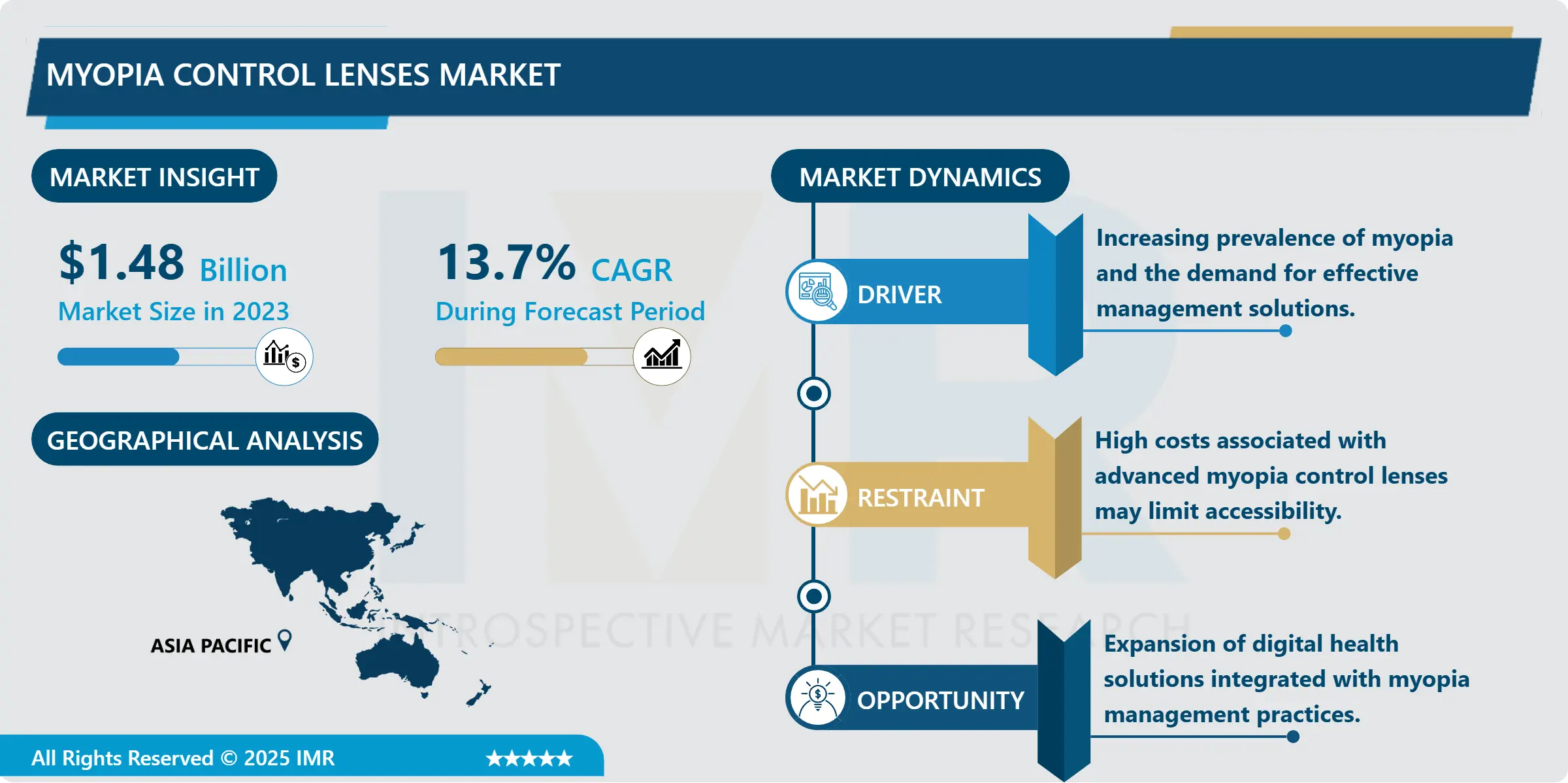
Myopia Control Lenses Market Size Was Valued at USD 1.48 Billion in 2023, and is Projected to Reach USD 4.13 Billion by 2032, Growing at a CAGR of 13.7% From 2024-2032.
Myopia control lenses as the name implies are optical corrections designed to slow down myopia, near sightedness, in the youths and young adults. They are special including multifocal glasses and Orthokeratology lenses and some special contact lenses that work as tearing down the process of focusing the light on the retina and preventing eyeball elongation which is one of the main-factor of worsening myopia. Due to the increasing trend of myopic population in the world these lenses are finding demand not only for correction of vision problem but also for prevention of probable future vision complications.
The global market for myopia control lenses has been growing rapidly because of the rising trend in the incidence of myopia among young people. Myopia is acknowledged to be a global public health problem by the World Health Organization, and based on the current trends, assessment it is expected that within the next two-three decades, about 50 percent of the global population may develop this sight-threatening disease. The high incidence owes to factors including, time spent on devices, rising population density and least time spent in the natural setting, especially from population dwelling in towns. With increasing consciousness of these conditions, parents and health care givers are looking for ways to slow down and prevent the progression of myopia.
As a result of this realization, the market has been introduced to a variety of innovative products that are aimed at myopia control. Such lenses include soft contact lenses with bifocal/multifocal design and functionality, orthokeratology lens for overnight corneal molding, as well as multifocally prescribed eyeglasses with a distant vision promoting influence. The lenses are getting better and companies are putting much focus on research and development to make them better for the kids while being easy to wear. Moreover, the application of informatics technology, including apps for myopia examination, will stand out as the essential development in the future myopia control.
Myopia Control Lenses Market Trend Analysis:
Increasing Adoption of Orthokeratology
One phenomenon that is clearly recognizable in the context of myopia control lenses is the increasing use of orthokeratology (Ortho-K) lenses. These specially designed RGP contact lenses are used at night, to gently reshape the cornea to correct vision during the day to not require the use of glasses/contacts. The effectiveness of Ortho-K lenses in controlling the rate of myopia has therefore made them popular with parents as well as eye care practitioners. Multiple researches have shown Ortho-K is effective in slowing down myopia almost by half and, therefore, is quite useful in controlling myopia.
This is complemented by rising concern and savvy concerning the progressive potential impact spheres of myopia, including cataracts, glaucoma, and retinal detachment. Many eye care practitioners have recommended these lenses as a prophylactic measure of sorts. Additionally, children and parents like the fact that the lenses are worn at night and this has helped in the increase acceptance of Ortho-K lenses. The penetration of these lenses will continue to grow as more practitioners are trained to fit them and with ongoing advancement in technology orthokeratology will continue to grow.
Growing Market for Digital Eye Care Solutions
There is a big opportunity in myopia management combined with a digital health offering in the myopia control lenses space. With the growth in the use of telemedicine, eye care providers are finding the new ways of consulting with and following up patients on their conditions through the use of devices and the internet. This also improves the way in which patient involvement is done while making it easy for parents to find help when dealing with their children’s myopia. They found that the integration of eye care solutions with digital tools can culminate in increased compliance to follow-Up Care Plans and outcomes.
Myopia Control Lenses Market Segment Analysis:
Myopia Control Lenses Market is Segmented on the basis of Product Type, Lenses Type, Age Group, End Users, and Region
By Type, Contact Lens segment is expected to dominate the market during the forecast period
On the basis of product type, the contact lens segment is expected to have a higher market share in the myopia control lenses growth during the forecast period owing to increasing use of advanced, non-Speiser wear solutions among parents and young people. Multifocal lenses and orthokeratology lenses for myopia control ensure that intervention while wearing lenses as convenient while also being effective interfere with myopia progression. These lenses are convenient for youths who do not wish to wear conventional spectacles, children and teenagers especially those who engage in physical activities like contact lenses. While more specialised contact lenses for myopia management get recommended by a growing number of eye care professionals and improving understanding of the long-term vision consequences, this segment will continue to grow, gaining a large share of the overall market as families look for ways to help their children cope with myopia.
By Lenses Type, Multifocal Lenses segment expected to held the largest share
The multifocal lenses segment should continue to dominate the market for myopia control lenses because of their effectiveness in preventing myopia from progressing in children. These lenses come with different prescriptions allowing one to have a clear vision at different ranges that solves the existing problems of refractive errors also encourages good vision habits. Given the growing understanding of the problems associated with untreated myopia in the future, parents are starting to switch to multifocal lenses. In addition, there are significant enhancements to the dispensing of lenses which enhance their wearing comfort faves and convenience making these lenses choice for both, eye care practitioners and families. Such an increase in acceptance is expected to fuel strong market development of the multifocal lenses segment in the future.
Myopia Control Lenses Market Regional Insights:
Asia-Pacific is Expected to Dominate the Market Over the Forecast period
The Asia-Pacific is expected to emerge as the largest market in the myopia control lenses market by 2023 occupying about 45% of the market. This large population is due to the rising trend of myopia in China, South Korea, and Singapore where living…urban lifestyles and prolonged hours on computers further aggravate the already deteriorating eye sight of children. Besides, growing consciousness of the future consequences of myopia has prompted preventive actions among parents and health care practitioners in these areas and coined a healthy market for myopia prevention contact lenses.
Lastly, the tough educational campaigns and government effort in minimizing myopia prevalence also help considerably in the region’s predominance. In the nations like China, awareness campaigns promoting outdoor trips and eye check-ups have increased popularity because of which people are demanding better means of myopia control. Since the Asia-Pacific is keen at investing in myopia control lenses and other advanced technologies for treatments and controlling eye defects, it will retain its dominance in the world market for the approaching years.
Active Key Players in the Myopia Control Lenses Market:
CooperVision (USA)
Johnson & Johnson Vision Care (USA)
EssilorLuxottica (France)
Bausch + Lomb (Canada)
Hoya Corporation (Japan)
Menicon Co., Ltd. (Japan)
Visioneering Technologies, Inc. (USA)
2EyesVision (Australia)
MiSight (USA)
Rodenstock (Germany)
Alcon (Switzerland)
KeraVision (USA)
Ortho-K (Australia)
Vision Source (USA)
Other Active Players
Chapter 1: Introduction
1.1 Scope and Coverage
Chapter 2:Executive Summary
Chapter 3: Market Landscape
3.1 Market Dynamics
3.1.1 Drivers
3.1.2 Restraints
3.1.3 Opportunities
3.1.4 Challenges
3.2 Market Trend Analysis
3.3 PESTLE Analysis
3.4 Porter’s Five Forces Analysis
3.5 Industry Value Chain Analysis
3.6 Ecosystem
3.7 Regulatory Landscape
3.8 Price Trend Analysis
3.9 Patent Analysis
3.10 Technology Evolution
3.11 Investment Pockets
3.12 Import-Export Analysis
Chapter 4: Myopia Control Lenses Market by Product Type
4.1 Myopia Control Lenses Market Snapshot and Growth Engine
4.2 Myopia Control Lenses Market Overview
4.3 Contact Lens and Spectacle Lens
4.3.1 Introduction and Market Overview
4.3.2 Historic and Forecasted Market Size in Value USD and Volume Units (2017-2032F)
4.3.3 Key Market Trends, Growth Factors and Opportunities
4.3.4 Contact Lens and Spectacle Lens: Geographic Segmentation Analysis
Chapter 5: Myopia Control Lenses Market by Lenses Type
5.1 Myopia Control Lenses Market Snapshot and Growth Engine
5.2 Myopia Control Lenses Market Overview
5.3 Multifocal Lenses
5.3.1 Introduction and Market Overview
5.3.2 Historic and Forecasted Market Size in Value USD and Volume Units (2017-2032F)
5.3.3 Key Market Trends, Growth Factors and Opportunities
5.3.4 Multifocal Lenses: Geographic Segmentation Analysis
5.4 Dual-focus Lenses
5.4.1 Introduction and Market Overview
5.4.2 Historic and Forecasted Market Size in Value USD and Volume Units (2017-2032F)
5.4.3 Key Market Trends, Growth Factors and Opportunities
5.4.4 Dual-focus Lenses: Geographic Segmentation Analysis
5.5 Peripheral Defocus Lenses
5.5.1 Introduction and Market Overview
5.5.2 Historic and Forecasted Market Size in Value USD and Volume Units (2017-2032F)
5.5.3 Key Market Trends, Growth Factors and Opportunities
5.5.4 Peripheral Defocus Lenses: Geographic Segmentation Analysis
Chapter 6: Myopia Control Lenses Market by Age Group
6.1 Myopia Control Lenses Market Snapshot and Growth Engine
6.2 Myopia Control Lenses Market Overview
6.3 Children and Adults
6.3.1 Introduction and Market Overview
6.3.2 Historic and Forecasted Market Size in Value USD and Volume Units (2017-2032F)
6.3.3 Key Market Trends, Growth Factors and Opportunities
6.3.4 Children and Adults: Geographic Segmentation Analysis
Chapter 7: Myopia Control Lenses Market by End User
7.1 Myopia Control Lenses Market Snapshot and Growth Engine
7.2 Myopia Control Lenses Market Overview
7.3 Optometry Clinics
7.3.1 Introduction and Market Overview
7.3.2 Historic and Forecasted Market Size in Value USD and Volume Units (2017-2032F)
7.3.3 Key Market Trends, Growth Factors and Opportunities
7.3.4 Optometry Clinics: Geographic Segmentation Analysis
7.4 Optical Retail Stores
7.4.1 Introduction and Market Overview
7.4.2 Historic and Forecasted Market Size in Value USD and Volume Units (2017-2032F)
7.4.3 Key Market Trends, Growth Factors and Opportunities
7.4.4 Optical Retail Stores: Geographic Segmentation Analysis
7.5 and Online Retail
7.5.1 Introduction and Market Overview
7.5.2 Historic and Forecasted Market Size in Value USD and Volume Units (2017-2032F)
7.5.3 Key Market Trends, Growth Factors and Opportunities
7.5.4 and Online Retail: Geographic Segmentation Analysis
Chapter 8: Company Profiles and Competitive Analysis
8.1 Competitive Landscape
8.1.1 Competitive Benchmarking
8.1.2 Myopia Control Lenses Market Share by Manufacturer (2023)
8.1.3 Industry BCG Matrix
8.1.4 Heat Map Analysis
8.1.5 Mergers and Acquisitions
8.2 COOPERVISION (USA)
8.2.1 Company Overview
8.2.2 Key Executives
8.2.3 Company Snapshot
8.2.4 Role of the Company in the Market
8.2.5 Sustainability and Social Responsibility
8.2.6 Operating Business Segments
8.2.7 Product Portfolio
8.2.8 Business Performance
8.2.9 Key Strategic Moves and Recent Developments
8.2.10 SWOT Analysis
8.3 JOHNSON & JOHNSON VISION CARE (USA)
8.4 ESSILORLUXOTTICA (FRANCE)
8.5 BAUSCH + LOMB (CANADA)
8.6 HOYA CORPORATION (JAPAN)
8.7 MENICON CO. LTD. (JAPAN)
8.8 VISIONEERING TECHNOLOGIES INC. (USA)
8.9 2EYESVISION (AUSTRALIA)
8.10 MISIGHT (USA)
8.11 RODENSTOCK (GERMANY)
8.12 ALCON (SWITZERLAND)
8.13 KERAVISION (USA)
8.14 ORTHO-K (AUSTRALIA)
8.15 VISION SOURCE (USA)
8.16 OTHER ACTIVE PLAYERS
Chapter 9: Global Myopia Control Lenses Market By Region
9.1 Overview
9.2. North America Myopia Control Lenses Market
9.2.1 Key Market Trends, Growth Factors and Opportunities
9.2.2 Top Key Companies
9.2.3 Historic and Forecasted Market Size by Segments
9.2.4 Historic and Forecasted Market Size By Product Type
9.2.4.1 Contact Lens and Spectacle Lens
9.2.5 Historic and Forecasted Market Size By Lenses Type
9.2.5.1 Multifocal Lenses
9.2.5.2 Dual-focus Lenses
9.2.5.3 Peripheral Defocus Lenses
9.2.6 Historic and Forecasted Market Size By Age Group
9.2.6.1 Children and Adults
9.2.7 Historic and Forecasted Market Size By End User
9.2.7.1 Optometry Clinics
9.2.7.2 Optical Retail Stores
9.2.7.3 and Online Retail
9.2.8 Historic and Forecast Market Size by Country
9.2.8.1 US
9.2.8.2 Canada
9.2.8.3 Mexico
9.3. Eastern Europe Myopia Control Lenses Market
9.3.1 Key Market Trends, Growth Factors and Opportunities
9.3.2 Top Key Companies
9.3.3 Historic and Forecasted Market Size by Segments
9.3.4 Historic and Forecasted Market Size By Product Type
9.3.4.1 Contact Lens and Spectacle Lens
9.3.5 Historic and Forecasted Market Size By Lenses Type
9.3.5.1 Multifocal Lenses
9.3.5.2 Dual-focus Lenses
9.3.5.3 Peripheral Defocus Lenses
9.3.6 Historic and Forecasted Market Size By Age Group
9.3.6.1 Children and Adults
9.3.7 Historic and Forecasted Market Size By End User
9.3.7.1 Optometry Clinics
9.3.7.2 Optical Retail Stores
9.3.7.3 and Online Retail
9.3.8 Historic and Forecast Market Size by Country
9.3.8.1 Russia
9.3.8.2 Bulgaria
9.3.8.3 The Czech Republic
9.3.8.4 Hungary
9.3.8.5 Poland
9.3.8.6 Romania
9.3.8.7 Rest of Eastern Europe
9.4. Western Europe Myopia Control Lenses Market
9.4.1 Key Market Trends, Growth Factors and Opportunities
9.4.2 Top Key Companies
9.4.3 Historic and Forecasted Market Size by Segments
9.4.4 Historic and Forecasted Market Size By Product Type
9.4.4.1 Contact Lens and Spectacle Lens
9.4.5 Historic and Forecasted Market Size By Lenses Type
9.4.5.1 Multifocal Lenses
9.4.5.2 Dual-focus Lenses
9.4.5.3 Peripheral Defocus Lenses
9.4.6 Historic and Forecasted Market Size By Age Group
9.4.6.1 Children and Adults
9.4.7 Historic and Forecasted Market Size By End User
9.4.7.1 Optometry Clinics
9.4.7.2 Optical Retail Stores
9.4.7.3 and Online Retail
9.4.8 Historic and Forecast Market Size by Country
9.4.8.1 Germany
9.4.8.2 UK
9.4.8.3 France
9.4.8.4 The Netherlands
9.4.8.5 Italy
9.4.8.6 Spain
9.4.8.7 Rest of Western Europe
9.5. Asia Pacific Myopia Control Lenses Market
9.5.1 Key Market Trends, Growth Factors and Opportunities
9.5.2 Top Key Companies
9.5.3 Historic and Forecasted Market Size by Segments
9.5.4 Historic and Forecasted Market Size By Product Type
9.5.4.1 Contact Lens and Spectacle Lens
9.5.5 Historic and Forecasted Market Size By Lenses Type
9.5.5.1 Multifocal Lenses
9.5.5.2 Dual-focus Lenses
9.5.5.3 Peripheral Defocus Lenses
9.5.6 Historic and Forecasted Market Size By Age Group
9.5.6.1 Children and Adults
9.5.7 Historic and Forecasted Market Size By End User
9.5.7.1 Optometry Clinics
9.5.7.2 Optical Retail Stores
9.5.7.3 and Online Retail
9.5.8 Historic and Forecast Market Size by Country
9.5.8.1 China
9.5.8.2 India
9.5.8.3 Japan
9.5.8.4 South Korea
9.5.8.5 Malaysia
9.5.8.6 Thailand
9.5.8.7 Vietnam
9.5.8.8 The Philippines
9.5.8.9 Australia
9.5.8.10 New Zealand
9.5.8.11 Rest of APAC
9.6. Middle East & Africa Myopia Control Lenses Market
9.6.1 Key Market Trends, Growth Factors and Opportunities
9.6.2 Top Key Companies
9.6.3 Historic and Forecasted Market Size by Segments
9.6.4 Historic and Forecasted Market Size By Product Type
9.6.4.1 Contact Lens and Spectacle Lens
9.6.5 Historic and Forecasted Market Size By Lenses Type
9.6.5.1 Multifocal Lenses
9.6.5.2 Dual-focus Lenses
9.6.5.3 Peripheral Defocus Lenses
9.6.6 Historic and Forecasted Market Size By Age Group
9.6.6.1 Children and Adults
9.6.7 Historic and Forecasted Market Size By End User
9.6.7.1 Optometry Clinics
9.6.7.2 Optical Retail Stores
9.6.7.3 and Online Retail
9.6.8 Historic and Forecast Market Size by Country
9.6.8.1 Turkiye
9.6.8.2 Bahrain
9.6.8.3 Kuwait
9.6.8.4 Saudi Arabia
9.6.8.5 Qatar
9.6.8.6 UAE
9.6.8.7 Israel
9.6.8.8 South Africa
9.7. South America Myopia Control Lenses Market
9.7.1 Key Market Trends, Growth Factors and Opportunities
9.7.2 Top Key Companies
9.7.3 Historic and Forecasted Market Size by Segments
9.7.4 Historic and Forecasted Market Size By Product Type
9.7.4.1 Contact Lens and Spectacle Lens
9.7.5 Historic and Forecasted Market Size By Lenses Type
9.7.5.1 Multifocal Lenses
9.7.5.2 Dual-focus Lenses
9.7.5.3 Peripheral Defocus Lenses
9.7.6 Historic and Forecasted Market Size By Age Group
9.7.6.1 Children and Adults
9.7.7 Historic and Forecasted Market Size By End User
9.7.7.1 Optometry Clinics
9.7.7.2 Optical Retail Stores
9.7.7.3 and Online Retail
9.7.8 Historic and Forecast Market Size by Country
9.7.8.1 Brazil
9.7.8.2 Argentina
9.7.8.3 Rest of SA
Chapter 10 Analyst Viewpoint and Conclusion
10.1 Recommendations and Concluding Analysis
10.2 Potential Market Strategies
Chapter 11 Research Methodology
11.1 Research Process
11.2 Primary Research
11.3 Secondary Research
Q1: What would be the forecast period in the Myopia Control Lenses Market research report?
A1: The forecast period in the Myopia Control Lenses Market research report is 2024-2032.
Q2: Who are the key players in the Myopia Control Lenses Market?
A2: CooperVision (USA), Johnson & Johnson Vision Care (USA), EssilorLuxottica (France), Bausch + Lomb (Canada), Hoya Corporation (Japan), Menicon Co., Ltd. (Japan), Visioneering Technologies, Inc. (USA), 2EyesVision (Australia), MiSight (USA), Rodenstock (Germany), Alcon (Switzerland), KeraVision (USA), Ortho-K (Australia), Vision Source (USA), and Other Active Players.
Q3: What are the segments of the Myopia Control Lenses Market?
A3: The Myopia Control Lenses Market is segmented into Product Type, Lense Type, By Age Group, End User and region. By Product Type, the market is categorized into Contact Lens and Spectacle Lens. By Lense Type, the market is categorized into Multifocal Lenses, Dual-focus Lenses, Peripheral Defocus Lenses. By Age Group, the market is categorized into Children and Adults. By End User, the market is categorized into Optometry Clinics, Optical Retail Stores, and Online Retail. By region, it is analyzed across North America (U.S., Canada, Mexico), Eastern Europe (Russia, Bulgaria, The Czech Republic, Hungary, Poland, Romania, Rest of Eastern Europe), Western Europe (Germany, UK, France, The Netherlands, Italy, Russia, Spain, Rest of Western Europe), Asia Pacific (China, India, Japan, South Korea, Malaysia, Thailand, Vietnam, The Philippines, Australia, New-Zealand, Rest of APAC), Middle East & Africa (Turkiye, Bahrain, Kuwait, Saudi Arabia, Qatar, UAE, Israel, South Africa), South America (Brazil, Argentina, Rest of SA).
Q4: What is the Myopia Control Lenses Market?
A4: Myopia control lenses as the name implies are optical corrections designed to slow down myopia, near sightedness, in the youths and young adults. They are special including multifocal glasses and Orthokeratology lenses and some special contact lenses that work as tearing down the process of focusing the light on the retina and preventing eyeball elongation which is one of the main-factor of worsening myopia. Due to the increasing trend of myopic population in the world these lenses are finding demand not only for correction of vision problem but also for prevention of probable future vision complications.
Q5: How big is the Myopia Control Lenses Market?
A5: Myopia Control Lenses Market Size Was Valued at USD 1.48 Billion in 2023, and is Projected to Reach USD 4.13 Billion by 2032, Growing at a CAGR of 13.7% From 2024-2032.
How to Buy a Report from eminsights.jp
On the product page, choose the license you want: Single-User License, Multi-User License or Enterprise License.
If you required report in your native language, then you can click on Translated Report button and fill out the form with report name and language you want, then our team will contact you as soon as possible.
Click the Buy Now button.
You will be redirected to the checkout page. Enter your company details and payment information.
Click Place Order to complete the purchase.
Confirmation: You’ll receive an order confirmation and our team will contact you shortly with your ordered report.
If you have any questions, fill out the contact form below or email us at [email protected].
Thank you for choosing eminsights.jp!