Stay Ahead in Fast-Growing Economies.
Browse Reports Now




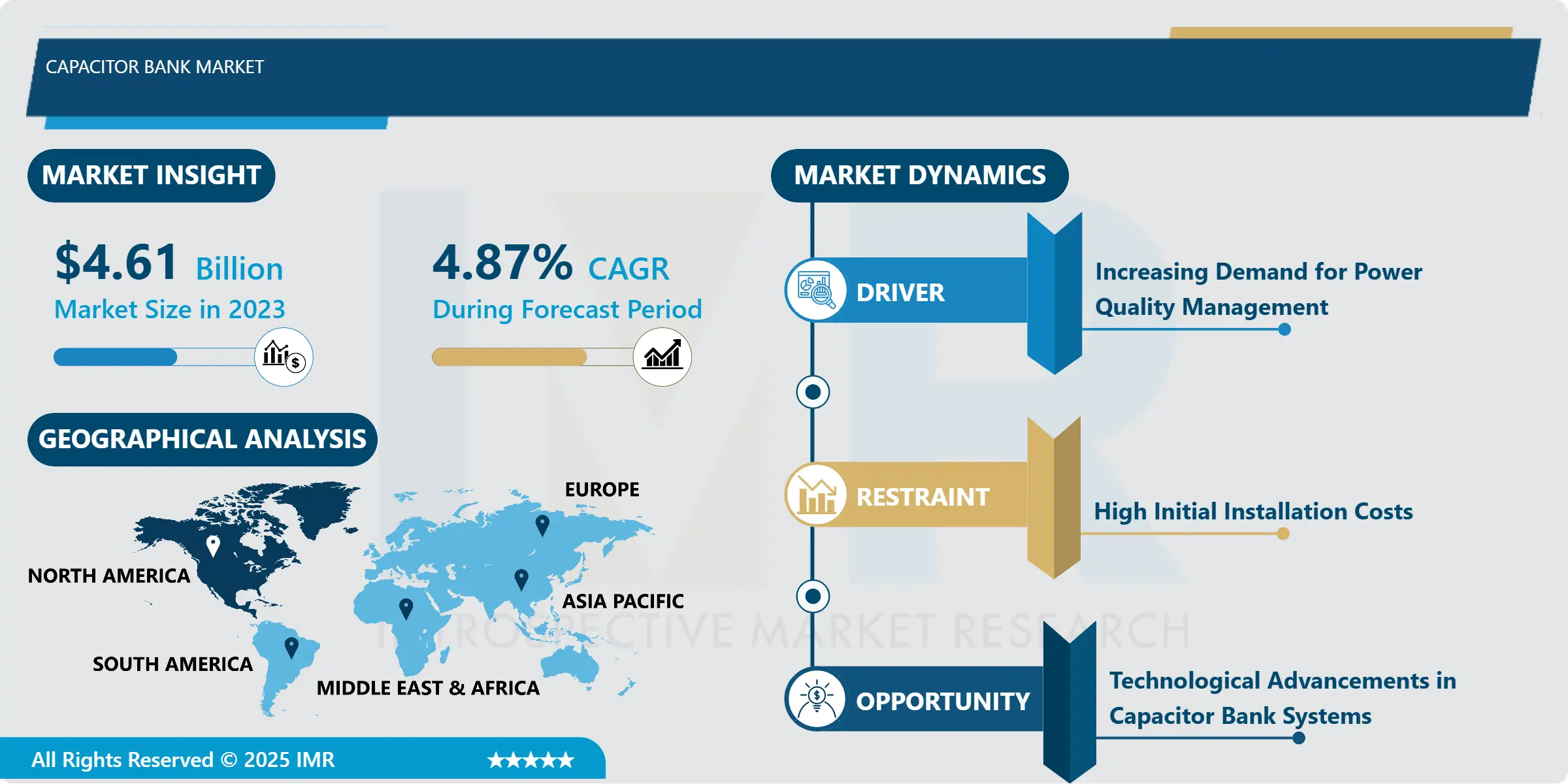
Capacitor Bank Market Growth Analysis & Forecast (2024-2032)
The capacitor bank market can be defined as the market that deals with the manufacturing, selling as well as providing the services associated with capacitor banks which are mostly utilized to regulate the amount of power that is utilized to perform loads, smooth out voltage and also to optimize the functionality of electricity.

IMR Group
Description
Capacitor Bank Market Synopsis:
Capacitor Bank Market Size Was Valued at USD 4.61Billion in 2023, and is Projected to Reach USD 7.07 Billion by 2032, Growing at a CAGR of 4.87% From 2024-2032.
The capacitor bank market can be defined as the market that deals with the manufacturing, selling as well as providing the services associated with capacitor banks which are mostly utilized to regulate the amount of power that is utilized to perform loads, smooth out voltage and also to optimize the functionality of electricity. These devices find their use in various fields of industry, commerce and utilities for the control of reactive power, minimization of losses and improvement in the electrical power networks. Fixed and automatic capacitor banks control the voltage, and play a significant role in controlling the stability of the grid, as well as keeping the supply and demand in balance and avoiding overloads whenever possible. Increased demand for energy efficient devices and electrical equipment and additional infrastructure development in developing countries is the main driver for capacitor banks market.
The overall capacitor bank market is growing at an upward trend globally with many market stimulants that include energy conservation and power quality improvement in their businesses. Capacitor banks are well adopted in utilities networks to correct power factor, reduce energy losses, and control voltage variations. The increase in the use of industries, in urban area, and other production units have made a boost the use of more electrical systems in the manufacturing units, utility services, and commercial complexes. It is also driven by the rising deployment of renewable energy in the generation of electricity using wind and solar power that need power supplies to be steady and not interruptible.
New technologies and ideas such as smart grid systems are also likely to advance the market, due to the increased ability that they offer in terms of supervising power distribution. Also, the energy conservation laws and policies along with incentives put forward by several governments around the world to support energy efficiency technologies are also driving the capacitor bank market. Yet, the market also poses dangers such as high initial costs involved in installation of the product and annual or frequent replacements of its parts. Nevertheless, the captive capacitor bank market is projected to maintain its growth path due to the ever-enduring focus on energy saving, stabilization of the-grid and emergence of renewably generated energy forms.
Capacitor Bank Market Trend Analysis:
Driving the Growth of the Capacitor Bank Market
Demand for energy efficient solutions coupled with the growing rate of industrialization and urbanization is putting pressure on capacitor banks in commercial, residential as well as industrial applications. The application of capacitor banks is very important since it holds the voltage stability of powers systems, improve the power factor and also reduce energy losses which are some of the keys to efficient energy use. This is especially the case in the industries of manufacturing, utilities and renewable power where optimisation of the use of power management is critical for effectiveness and resource economy. This has been the case as energy management takes central stage in modern infrastructural developments and capacitor banks offer a cost effective power quality improvement and electricity wastage minimization technique.
The current movement towards smart grids and incorporation of renewable energy sources to the power distribution system increases the need for capacitor banks. These systems are important in integrating the fluctuating power supply from renewable sources such as the solar and wind. Most times, these fluctuations are managed by capacitor banks in order for the electrical power supply to be more steady and more reliable. With countries and industries striving to adopt more sustainable methods of energy consumption and improvement in the power grid, capacitor banks will also continue to present a large market scope in terms of growth in the future, especially in regions such as Asia-Pacific, Middle East and Africa.
Enhancing Energy Efficiency and Supporting Renewable Integration
With industries and utilities focusing their efforts on power quality, energy savings, leaching sophistication to minimize energy losses the market is slowly expanding for capacitor banks. These devices are extremely useful for matters to do with regulating voltage levels and generally raising the power factor of such circuits. It is seen that use of capacitor banks contribute in reducing the wastage of energy and effectiveness of power distribution in electrical systems will be more effective and have less operational costs. The increasing focus on power quality in manufacturing industries, data centers and electricity utilities is therefore developing the demand for these devices because of the ability of the devices to ensure efficient and longer lifespan of electrical equipment.
The use of wind and solar energy has created new problems in relation to stability in the electricity grid since these forms of energy are characterized by instability. These challenges make capacitor banks an of significant merit to help rectify the challenges for voltage imbalances and provide reactive power to stabilize the electrical grid. However, understanding the significant of capacitor banks stabilising power fluctuation increases especially as the integration of renewable energy sources advance. This poses considerable opportunities for the capacitor bank market particularly with the adoption of intelligent grid technologies as utilities and industries integrate more renewable power products into the power grid and as a means of maintaining high quality power.
Capacitor Bank Market Segment Analysis:
Capacitor Bank Market is Segmented on the basis of Voltage, Application, and Region.
By Voltage, High [>69 kV] segment is expected to dominate the market during the forecast period
EHV transmission network extended with voltages normally over 69 kV are heavily necessary as it helps in transmitting power over long distances from generating stations to substations or over large areas such as sub- regional or regional distribution centers. These systems are meant to reduce energy losses in the transmission process so that electricity delivers to where it is required with least loss. Substation networks are important to manage large-scale fluctuations on the power grid and therefore high-voltage power networks are very vital. High Voltages in the Power factor correction helps to solve reactive power requirements to enhance the capability of the grid and minimize energy loss due to inefficient utilization of power. Consequently, high-voltage systems are a versatile solution that significantly contributes to the functionality and efficiency of national and regional power networks by avoiding extra capacity demand.
Aside of the increasing grid efficiency, high voltage installation integrated with harmonic filters to minimizing the waveform distortion that can affect the operating performance of sensitives equipments or create inefficiency when applied in industrial processes. Voltage regulation in high voltage network is vested in the ability to guarantee the stability of the supply since demand constantly fluctuates in order to avoid disruption of power quality. They are also crucial in incorporating renewable generation into the network most especially the utility-scale photovoltaic and wind power applications. Such renewable sources must be connected in parallel manner often posing challenges of fluctuating power; however, this fluctuation can be alleviated by use of high voltage systems which facilitates consistent power provision to the grid. High voltage systems are thus essential not only for the conventional power transmission but also for prosumer grid.
By Application, Power Factor Correction segment expected to held the largest share
Corrective technique play a vital role in power factor control for residential electrical system as well in industrial electrical system in order to increase the efficiency of electrical systems by balancing the voltage and current. In circuits where inductive loads such as motors, transformers and thick machinery are used, then mutual power factor compensation equipments such as capacitors and inductors are used to ease the power factor demand. VAR does not do any work of use in the system, but it is the major cause of poor power factor and thus consumes more energy, incurring more tariff and reducing the power system capacity. But through correction of power factor it minimize the losses, enhances the characteristics of electrical networks and ensures stability of the power system.
Power factor correction can therefore be done at low voltage in homes and low rise commercial buildings as well as medium or high voltage systems in industrial facilities. Identically, PFC is very important for industrial applications, where power consumption is much higher and additional capacity may be barely sufficient. Losses that are associated with power factor include; Improved power factor is essential in industries as it reduces operating costs, reduces equipment wear and increases system reliability. Book 2, Chapter M1 Point to Point Control PFC can be tailored to certain requirements depending on the nature and the size of the system; every voltage level will produce the best performances and efficiency.
Capacitor Bank Market Regional Insights:
North America is Expected to Dominate the Market Over the Forecast period
North America has experienced a progressive development of the capacitor bank market urged by the progress of the infrastructure, particularly in the USA and Canada. As both countries keep on carrying out process of further development and modernization of the electrical power system, there has been a significant need for remedies that enhance PQ and system security. This is particularly important for the improvement of voltage fluctuations as well as power factor which are important in the proper distribution of electricity in the power grid. Furthermore, there is a growing demand across different industrial segments to implement energy efficient measures that ensure efficient use of energy and the existing capacity and requirement of a capacitor bank make them central to achieving these goals.
Another source of market growth in the North American region includes regulatory requirements, with an appropriate legislative environment being an important prerequisite for the development of a capacitor bank. The government of both the U.S. and Canada has set high standards to enhance the energy saving efficiency of electrical systems. These regulations combined with increasing concern of grid stability have propelled use of capacitor banks in industrial, commercial, utility segments. The importance of capacitor banks in energy efficient utilization and correction of power quality becomes even more important with increased reliance on reduced energy losses together with absorption of renewable energy into the MG. Regulatory backing, the technological breakthrough, and the emerging emphasis on sustainability are anticipated to solidify its impact on the market in North American region to grow in the future.
Active Key Players in the Capacitor Bank Market:
Eaton
Comar Condensatori S.p.A
ABB Ltd.
Siemens
Schneider Electric SE
General Electric Company
Toshiba Corporation
Hitachi Ltd.
Larsen & Toubro
Bharat Heavy Electricals Limited, and Other Active Players
Chapter 1: Introduction
1.1 Scope and Coverage
Chapter 2:Executive Summary
Chapter 3: Market Landscape
3.1 Market Dynamics
3.1.1 Drivers
3.1.2 Restraints
3.1.3 Opportunities
3.1.4 Challenges
3.2 Market Trend Analysis
3.3 PESTLE Analysis
3.4 Porter’s Five Forces Analysis
3.5 Industry Value Chain Analysis
3.6 Ecosystem
3.7 Regulatory Landscape
3.8 Price Trend Analysis
3.9 Patent Analysis
3.10 Technology Evolution
3.11 Investment Pockets
3.12 Import-Export Analysis
Chapter 4: Capacitor Bank Market by Voltage
4.1 Capacitor Bank Market Snapshot and Growth Engine
4.2 Capacitor Bank Market Overview
4.3 Low [ 4.3.1 Introduction and Market Overview
4.3.2 Historic and Forecasted Market Size in Value USD and Volume Units (2017-2032F)
4.3.3 Key Market Trends, Growth Factors and Opportunities
4.3.4 Low [ 4.4 Medium [10 kV – 69 kV] and High [>69 kV]
4.4.1 Introduction and Market Overview
4.4.2 Historic and Forecasted Market Size in Value USD and Volume Units (2017-2032F)
4.4.3 Key Market Trends, Growth Factors and Opportunities
4.4.4 Medium [10 kV – 69 kV] and High [>69 kV]: Geographic Segmentation Analysis
Chapter 5: Capacitor Bank Market by Application
5.1 Capacitor Bank Market Snapshot and Growth Engine
5.2 Capacitor Bank Market Overview
5.3 Power Factor Correction
5.3.1 Introduction and Market Overview
5.3.2 Historic and Forecasted Market Size in Value USD and Volume Units (2017-2032F)
5.3.3 Key Market Trends, Growth Factors and Opportunities
5.3.4 Power Factor Correction: Geographic Segmentation Analysis
5.4 Harmonic Filter
5.4.1 Introduction and Market Overview
5.4.2 Historic and Forecasted Market Size in Value USD and Volume Units (2017-2032F)
5.4.3 Key Market Trends, Growth Factors and Opportunities
5.4.4 Harmonic Filter: Geographic Segmentation Analysis
5.5 Voltage Regulation
5.5.1 Introduction and Market Overview
5.5.2 Historic and Forecasted Market Size in Value USD and Volume Units (2017-2032F)
5.5.3 Key Market Trends, Growth Factors and Opportunities
5.5.4 Voltage Regulation: Geographic Segmentation Analysis
5.6 Renewable Integration
5.6.1 Introduction and Market Overview
5.6.2 Historic and Forecasted Market Size in Value USD and Volume Units (2017-2032F)
5.6.3 Key Market Trends, Growth Factors and Opportunities
5.6.4 Renewable Integration: Geographic Segmentation Analysis
5.7 Industrial Application
5.7.1 Introduction and Market Overview
5.7.2 Historic and Forecasted Market Size in Value USD and Volume Units (2017-2032F)
5.7.3 Key Market Trends, Growth Factors and Opportunities
5.7.4 Industrial Application: Geographic Segmentation Analysis
5.8 Data Centers and Others
5.8.1 Introduction and Market Overview
5.8.2 Historic and Forecasted Market Size in Value USD and Volume Units (2017-2032F)
5.8.3 Key Market Trends, Growth Factors and Opportunities
5.8.4 Data Centers and Others: Geographic Segmentation Analysis
Chapter 6: Company Profiles and Competitive Analysis
6.1 Competitive Landscape
6.1.1 Competitive Benchmarking
6.1.2 Capacitor Bank Market Share by Manufacturer (2023)
6.1.3 Industry BCG Matrix
6.1.4 Heat Map Analysis
6.1.5 Mergers and Acquisitions
6.2 EATON
6.2.1 Company Overview
6.2.2 Key Executives
6.2.3 Company Snapshot
6.2.4 Role of the Company in the Market
6.2.5 Sustainability and Social Responsibility
6.2.6 Operating Business Segments
6.2.7 Product Portfolio
6.2.8 Business Performance
6.2.9 Key Strategic Moves and Recent Developments
6.2.10 SWOT Analysis
6.3 COMAR CONDENSATORI S.P.A
6.4 ABB LTD.
6.5 SIEMENS
6.6 SCHNEIDER ELECTRIC SE
6.7 GENERAL ELECTRIC COMPANY
6.8 TOSHIBA CORPORATION
6.9 HITACHI LTD.
6.10 LARSEN & TOUBRO
6.11 BHARAT HEAVY ELECTRICALS LIMITED
6.12 OTHER ACTIVE PLAYERS
Chapter 7: Global Capacitor Bank Market By Region
7.1 Overview
7.2. North America Capacitor Bank Market
7.2.1 Key Market Trends, Growth Factors and Opportunities
7.2.2 Top Key Companies
7.2.3 Historic and Forecasted Market Size by Segments
7.2.4 Historic and Forecasted Market Size By Voltage
7.2.4.1 Low [ 7.2.4.2 Medium [10 kV – 69 kV] and High [>69 kV]
7.2.5 Historic and Forecasted Market Size By Application
7.2.5.1 Power Factor Correction
7.2.5.2 Harmonic Filter
7.2.5.3 Voltage Regulation
7.2.5.4 Renewable Integration
7.2.5.5 Industrial Application
7.2.5.6 Data Centers and Others
7.2.6 Historic and Forecast Market Size by Country
7.2.6.1 US
7.2.6.2 Canada
7.2.6.3 Mexico
7.3. Eastern Europe Capacitor Bank Market
7.3.1 Key Market Trends, Growth Factors and Opportunities
7.3.2 Top Key Companies
7.3.3 Historic and Forecasted Market Size by Segments
7.3.4 Historic and Forecasted Market Size By Voltage
7.3.4.1 Low [ 7.3.4.2 Medium [10 kV – 69 kV] and High [>69 kV]
7.3.5 Historic and Forecasted Market Size By Application
7.3.5.1 Power Factor Correction
7.3.5.2 Harmonic Filter
7.3.5.3 Voltage Regulation
7.3.5.4 Renewable Integration
7.3.5.5 Industrial Application
7.3.5.6 Data Centers and Others
7.3.6 Historic and Forecast Market Size by Country
7.3.6.1 Russia
7.3.6.2 Bulgaria
7.3.6.3 The Czech Republic
7.3.6.4 Hungary
7.3.6.5 Poland
7.3.6.6 Romania
7.3.6.7 Rest of Eastern Europe
7.4. Western Europe Capacitor Bank Market
7.4.1 Key Market Trends, Growth Factors and Opportunities
7.4.2 Top Key Companies
7.4.3 Historic and Forecasted Market Size by Segments
7.4.4 Historic and Forecasted Market Size By Voltage
7.4.4.1 Low [ 7.4.4.2 Medium [10 kV – 69 kV] and High [>69 kV]
7.4.5 Historic and Forecasted Market Size By Application
7.4.5.1 Power Factor Correction
7.4.5.2 Harmonic Filter
7.4.5.3 Voltage Regulation
7.4.5.4 Renewable Integration
7.4.5.5 Industrial Application
7.4.5.6 Data Centers and Others
7.4.6 Historic and Forecast Market Size by Country
7.4.6.1 Germany
7.4.6.2 UK
7.4.6.3 France
7.4.6.4 The Netherlands
7.4.6.5 Italy
7.4.6.6 Spain
7.4.6.7 Rest of Western Europe
7.5. Asia Pacific Capacitor Bank Market
7.5.1 Key Market Trends, Growth Factors and Opportunities
7.5.2 Top Key Companies
7.5.3 Historic and Forecasted Market Size by Segments
7.5.4 Historic and Forecasted Market Size By Voltage
7.5.4.1 Low [ 7.5.4.2 Medium [10 kV – 69 kV] and High [>69 kV]
7.5.5 Historic and Forecasted Market Size By Application
7.5.5.1 Power Factor Correction
7.5.5.2 Harmonic Filter
7.5.5.3 Voltage Regulation
7.5.5.4 Renewable Integration
7.5.5.5 Industrial Application
7.5.5.6 Data Centers and Others
7.5.6 Historic and Forecast Market Size by Country
7.5.6.1 China
7.5.6.2 India
7.5.6.3 Japan
7.5.6.4 South Korea
7.5.6.5 Malaysia
7.5.6.6 Thailand
7.5.6.7 Vietnam
7.5.6.8 The Philippines
7.5.6.9 Australia
7.5.6.10 New Zealand
7.5.6.11 Rest of APAC
7.6. Middle East & Africa Capacitor Bank Market
7.6.1 Key Market Trends, Growth Factors and Opportunities
7.6.2 Top Key Companies
7.6.3 Historic and Forecasted Market Size by Segments
7.6.4 Historic and Forecasted Market Size By Voltage
7.6.4.1 Low [ 7.6.4.2 Medium [10 kV – 69 kV] and High [>69 kV]
7.6.5 Historic and Forecasted Market Size By Application
7.6.5.1 Power Factor Correction
7.6.5.2 Harmonic Filter
7.6.5.3 Voltage Regulation
7.6.5.4 Renewable Integration
7.6.5.5 Industrial Application
7.6.5.6 Data Centers and Others
7.6.6 Historic and Forecast Market Size by Country
7.6.6.1 Turkiye
7.6.6.2 Bahrain
7.6.6.3 Kuwait
7.6.6.4 Saudi Arabia
7.6.6.5 Qatar
7.6.6.6 UAE
7.6.6.7 Israel
7.6.6.8 South Africa
7.7. South America Capacitor Bank Market
7.7.1 Key Market Trends, Growth Factors and Opportunities
7.7.2 Top Key Companies
7.7.3 Historic and Forecasted Market Size by Segments
7.7.4 Historic and Forecasted Market Size By Voltage
7.7.4.1 Low [ 7.7.4.2 Medium [10 kV – 69 kV] and High [>69 kV]
7.7.5 Historic and Forecasted Market Size By Application
7.7.5.1 Power Factor Correction
7.7.5.2 Harmonic Filter
7.7.5.3 Voltage Regulation
7.7.5.4 Renewable Integration
7.7.5.5 Industrial Application
7.7.5.6 Data Centers and Others
7.7.6 Historic and Forecast Market Size by Country
7.7.6.1 Brazil
7.7.6.2 Argentina
7.7.6.3 Rest of SA
Chapter 8 Analyst Viewpoint and Conclusion
8.1 Recommendations and Concluding Analysis
8.2 Potential Market Strategies
Chapter 9 Research Methodology
9.1 Research Process
9.2 Primary Research
9.3 Secondary Research
Q1: What would be the forecast period in the Capacitor Bank Market research report?
A1: The forecast period in the Capacitor Bank Market research report is 2024-2032.
Q2: Who are the key players in the Capacitor Bank Market?
A2: Eaton, Comar Condensatori S.p.A, ABB Ltd., Siemens, Schneider Electric SE, General Electric Company, Toshiba Corporation, Hitachi Ltd., Larsen & Toubro, Bharat Heavy Electricals Limited, and Other Active Players.
Q3: What are the segments of the Capacitor Bank Market?
A3: The Capacitor Bank Market is segmented into Voltage, Application, and Region. By Voltage, the market is categorized into Low [69 kV]. By Application, the market is categorized into Power Factor Correction, Harmonic Filter, Voltage Regulation, Renewable Integration, Industrial Application, Data Centers, and Others. By region, it is analyzed across North America (U.S., Canada, Mexico), Eastern Europe (Russia, Bulgaria, The Czech Republic, Hungary, Poland, Romania, Rest of Eastern Europe), Western Europe (Germany, UK, France, Netherlands, Italy, Spain, Rest of Western Europe), Asia Pacific (China, India, Japan, South Korea, Malaysia, Thailand, Vietnam, The Philippines, Australia, New Zealand, Rest of APAC), Middle East & Africa (Turkiye, Bahrain, Kuwait, Saudi Arabia, Qatar, UAE, Israel, South Africa), South America (Brazil, Argentina, Rest of SA).
Q4: What is the Capacitor Bank Market?
A4: The capacitor bank market refers to the industry involved in the production, installation, and maintenance of capacitor banks, which are used to improve power factor, stabilize voltage levels, and enhance the efficiency of electrical systems. These devices are commonly employed in industrial, commercial, and utility applications to manage reactive power, reduce energy losses, and optimize the performance of electrical networks. Capacitor banks can be fixed or automatic and are critical for maintaining grid stability, ensuring consistent power supply, and minimizing the risk of overloads. The market for capacitor banks is driven by growing demand for energy-efficient solutions and the expansion of infrastructure in emerging economies.
Q5: How big is the Capacitor Bank Market?
A5: Capacitor Bank Market Size Was Valued at USD 4.61 Billion in 2023, and is Projected to Reach USD 7.07 Billion by 2032, Growing at a CAGR of 4.87% From 2024-2032.
How to Buy a Report from eminsights.jp
On the product page, choose the license you want: Single-User License, Multi-User License or Enterprise License.
If you required report in your native language, then you can click on Translated Report button and fill out the form with report name and language you want, then our team will contact you as soon as possible.
Click the Buy Now button.
You will be redirected to the checkout page. Enter your company details and payment information.
Click Place Order to complete the purchase.
Confirmation: You’ll receive an order confirmation and our team will contact you shortly with your ordered report.
If you have any questions, fill out the contact form below or email us at [email protected].
Thank you for choosing eminsights.jp!