Stay Ahead in Fast-Growing Economies.
Browse Reports Now




Nanomedicines Market Outlook & Forecast to 2032
Market To Reach USD 734.88 Billion by 2032

IMR Group
Description
Nanomedicines Market Synopsis:
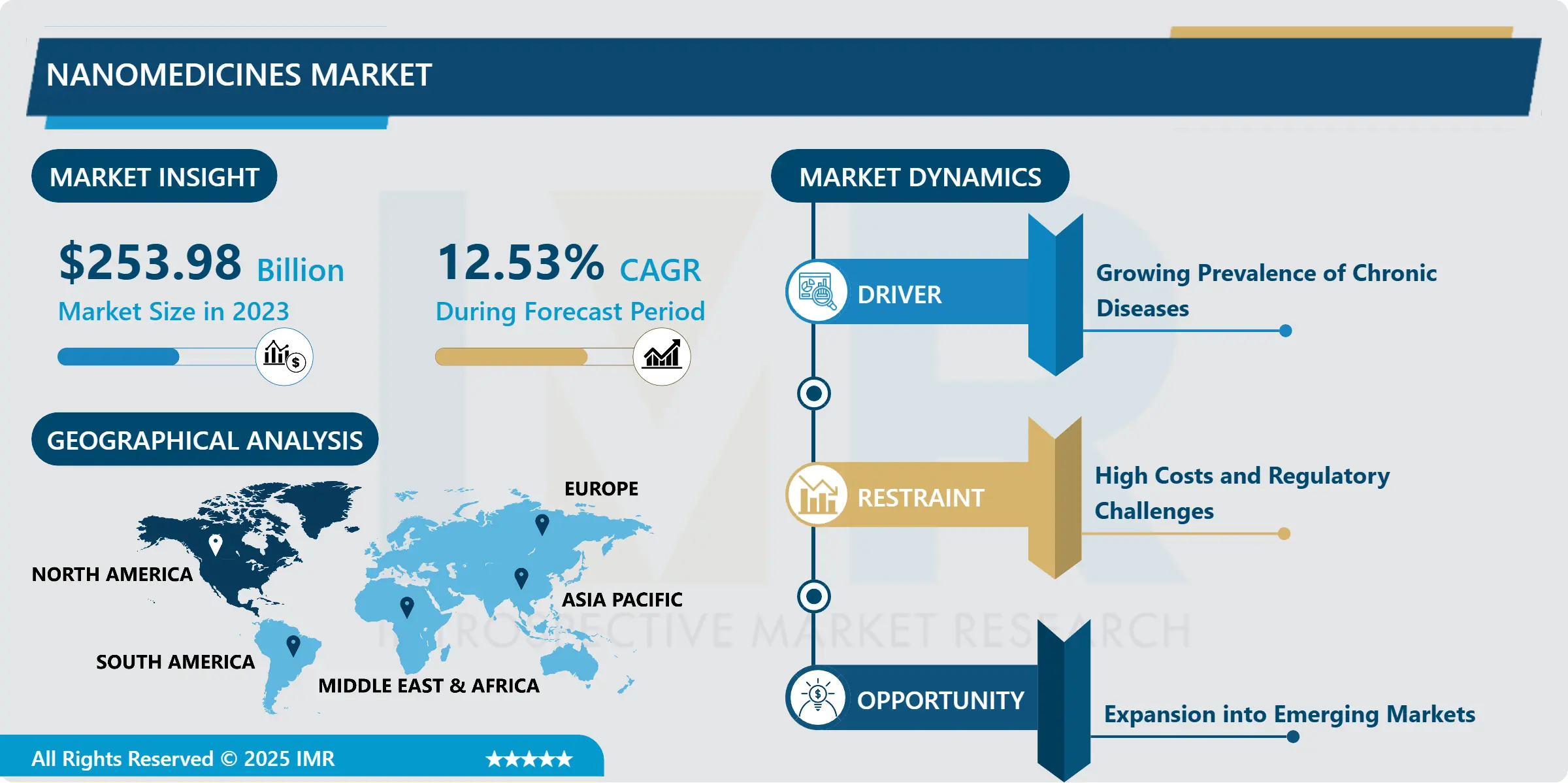
Nanomedicines Market Size Was Valued at USD 253.98 Billion in 2023, and is Projected to Reach USD 734.88 Billion by 2032, Growing at a CAGR of 12.53% From 2024-2032.
Nanomedicines are basically using nanotechnology in developing novel therapeutic as well as diagnostic interventions. These medicines incorporate nanotechnology in them for example liposomes, nanoparticles, and polymers used to deliver drugs and improve the drugs’ bioavailability, to get to specific cells/tissues in the body, and allowing for a type of health care that is more effective and specific.
Nanomedicines are the latest phenomenon in the field of health care and are poised for significant growth because of new developments in nanotechnology and increasing incidences of chronic and complex diseases. The first benefit of nanomedicines is that, these nanocarriers can enhance solubility and stability, allow the controlled release of new generation drugs and minimize side in comparative with conventional drugs effects to improve the therapeutic efficiency. n den Oncology, Cardiovascular diseases and Infectious Diseases, nanomedicines meet and challenge many of the unmet needs in modern healthcare.
The market has attracted a lot of investment from both public and private sectors of the economy since it holds high potential for changing the market environment. International governments and research organisations are investigating in the effectiveness of nanotechnology to solve priority health issues, with special focus on developed health systems of North America and Europe. The Asian Pacific markets are also growing progressively higher on account of high research activities and improved healthcare spendings.
Since the advancement and possibilities shown by nanomedicines, their development and commercialization has a number of challenges; higher costs of production, regulatory issues, and necessary manufacturing techniques. But presently, due to the highly demanding field of precision medicine and other innovations, the future of the market looks promising.
Nanomedicines Market Trend Analysis:
Rising Use of Nanoparticles in Oncology
The use of nanoparticle in cancer therapy is tide about in the nanomedicines market. Nanocarriers, for example liposomes and dendrimers, are now being used in oncology for targeted drug delivery. These nanoparticles can of course accommodate chemotherapeutic drugs and transport them to the affected cancer cells without affecting the normal cells surrounding them hence diluting side effects. This makes the treatments of cancer more effective and patients’ welfare to improve.
Nanoparticles enable the conflation of treatment and detection, designing theranostic products. It is emerging as a trend because it enables monitoring of treatment outcomes as they occur. Due to the increasing incidence of cancer across the world, entry of nanoparticles into the realm of oncology has the potential to change the landscape of cancer treatment and management.
Expansion into Emerging Markets
The Asia-Pacific, Latin America and Middle East regions are particularly promising markets for nanomedicines due to their ongoing expansion. These regions have higher healthcare cost, growing awareness of advanced medical technologies and higher incidence of chronic diseases. Governments in these regions are also specifically focusing on the development of the health sector hence providing suitable grounds for acceptation of nanomedicines.
The large patient populations coupled with relatively low manufacturing costs begin to make nations like India and China highly attractive destinations for nanomedicine R&D. C-level strategic alliances between leading nanomedicine players worldwide and their counterparts in the targeted countries are also deepening penetration. Now developing these regions have a higher index of health care and therefore, with the advanced treatment in a modern world such nanomedicines, an exponential appeal is certain to arise.
Nanomedicines Market Segment Analysis:
Nanomedicines Market is Segmented on the basis of Type, Application, End User, and Region.
By Type, Liposomes segment is expected to dominate the market during the forecast period
The Liposomes segment is anticipated to dominate the Nanomedicines Market during the forecast period due to their versatile applications in drug delivery systems. Liposomes, which are spherical vesicles composed of lipid bilayers, offer significant advantages in improving the bioavailability and targeting efficiency of drugs. These properties are especially crucial in the treatment of cancer, infectious diseases, and chronic conditions where targeted therapy can enhance efficacy and reduce side effects.
Liposomes can encapsulate both hydrophobic and hydrophilic drugs, making them suitable for a wide range of therapeutic agents. Their ability to deliver drugs directly to specific cells or tissues increases their appeal in precision medicine. Advancements in liposomal formulation technologies and growing investment in research and development are expected to fuel market growth, reinforcing the segment’s dominant position in the nanomedicines landscape over the coming years.
By Application, Oncology segment expected to held the largest share
The oncology segment is projected to hold the largest share in the nanomedicines market due to the growing prevalence of cancer and the increasing demand for effective treatments. Nanomedicines, which utilize nanoparticles to deliver drugs more efficiently, offer several advantages in oncology, including improved drug targeting, reduced side effects, and enhanced bioavailability. These advancements allow for more precise treatment of cancer cells while minimizing damage to healthy tissues. The development of nanocarriers, such as liposomes, dendrimers, and polymeric nanoparticles, is revolutionizing cancer therapy by enabling better drug penetration and sustained release.
Ongoing clinical trials and research continue to show promising results in the application of nanomedicines for various cancer types, further driving their adoption in oncology. With continuous innovation and rising cancer cases globally, the oncology segment is expected to maintain its dominant position in the nanomedicines market in the coming years.
Nanomedicines Market Regional Insights:
North America is Expected to Dominate the Market Over the Forecast period
North America holds the largest share in the nanomedicines market because of the well-developed heath care sector, sustained funds on Research and Development and favorable regulatory environment. The region’s focus on precision medicine and access to health care professionals also dictate the use of nanomedicines. Thus, the largest contribution comes from the United States with research efforts supported by universities and biotechnology companies.
Since North America has a very large population suffering from chronic illnesses there is high demand for better treatments. Government sponsorship and subsidies enable nanotechnology to continue being developed in the region and also contribute to the continued leadership in the nanomedicines market.
Active Key Players in the Nanomedicines Market:
Pfizer Inc. (United States)
Johnson & Johnson (United States)
AstraZeneca (United Kingdom)
Sanofi (France)
Merck & Co., Inc. (United States)
Novartis AG (Switzerland)
F. Hoffmann-La Roche AG (Switzerland)
Amgen Inc. (United States)
Gilead Sciences, Inc. (United States)
Celgene Corporation (United States)
Teva Pharmaceutical Industries Ltd. (Israel)
Bayer AG (Germany), and Other Active Players
Chapter 1: Introduction
1.1 Scope and Coverage
Chapter 2:Executive Summary
Chapter 3: Market Landscape
3.1 Market Dynamics
3.1.1 Drivers
3.1.2 Restraints
3.1.3 Opportunities
3.1.4 Challenges
3.2 Market Trend Analysis
3.3 PESTLE Analysis
3.4 Porter’s Five Forces Analysis
3.5 Industry Value Chain Analysis
3.6 Ecosystem
3.7 Regulatory Landscape
3.8 Price Trend Analysis
3.9 Patent Analysis
3.10 Technology Evolution
3.11 Investment Pockets
3.12 Import-Export Analysis
Chapter 4: Nanomedicines Market by Type
4.1 Nanomedicines Market Snapshot and Growth Engine
4.2 Nanomedicines Market Overview
4.3 Liposomes
4.3.1 Introduction and Market Overview
4.3.2 Historic and Forecasted Market Size in Value USD and Volume Units (2017-2032F)
4.3.3 Key Market Trends, Growth Factors and Opportunities
4.3.4 Liposomes: Geographic Segmentation Analysis
4.4 Nanocrystals
4.4.1 Introduction and Market Overview
4.4.2 Historic and Forecasted Market Size in Value USD and Volume Units (2017-2032F)
4.4.3 Key Market Trends, Growth Factors and Opportunities
4.4.4 Nanocrystals: Geographic Segmentation Analysis
4.5 Nanotubes
4.5.1 Introduction and Market Overview
4.5.2 Historic and Forecasted Market Size in Value USD and Volume Units (2017-2032F)
4.5.3 Key Market Trends, Growth Factors and Opportunities
4.5.4 Nanotubes: Geographic Segmentation Analysis
4.6 Polymers
4.6.1 Introduction and Market Overview
4.6.2 Historic and Forecasted Market Size in Value USD and Volume Units (2017-2032F)
4.6.3 Key Market Trends, Growth Factors and Opportunities
4.6.4 Polymers: Geographic Segmentation Analysis
4.7 Metal Nanoparticles
4.7.1 Introduction and Market Overview
4.7.2 Historic and Forecasted Market Size in Value USD and Volume Units (2017-2032F)
4.7.3 Key Market Trends, Growth Factors and Opportunities
4.7.4 Metal Nanoparticles: Geographic Segmentation Analysis
4.8 Dendrimers
4.8.1 Introduction and Market Overview
4.8.2 Historic and Forecasted Market Size in Value USD and Volume Units (2017-2032F)
4.8.3 Key Market Trends, Growth Factors and Opportunities
4.8.4 Dendrimers: Geographic Segmentation Analysis
Chapter 5: Nanomedicines Market by Application
5.1 Nanomedicines Market Snapshot and Growth Engine
5.2 Nanomedicines Market Overview
5.3 Oncology
5.3.1 Introduction and Market Overview
5.3.2 Historic and Forecasted Market Size in Value USD and Volume Units (2017-2032F)
5.3.3 Key Market Trends, Growth Factors and Opportunities
5.3.4 Oncology: Geographic Segmentation Analysis
5.4 Cardiovascular Diseases
5.4.1 Introduction and Market Overview
5.4.2 Historic and Forecasted Market Size in Value USD and Volume Units (2017-2032F)
5.4.3 Key Market Trends, Growth Factors and Opportunities
5.4.4 Cardiovascular Diseases: Geographic Segmentation Analysis
5.5 Neurological Disorders
5.5.1 Introduction and Market Overview
5.5.2 Historic and Forecasted Market Size in Value USD and Volume Units (2017-2032F)
5.5.3 Key Market Trends, Growth Factors and Opportunities
5.5.4 Neurological Disorders: Geographic Segmentation Analysis
5.6 Anti-inflammatory/Immunology
5.6.1 Introduction and Market Overview
5.6.2 Historic and Forecasted Market Size in Value USD and Volume Units (2017-2032F)
5.6.3 Key Market Trends, Growth Factors and Opportunities
5.6.4 Anti-inflammatory/Immunology: Geographic Segmentation Analysis
5.7 Infectious Diseases
5.7.1 Introduction and Market Overview
5.7.2 Historic and Forecasted Market Size in Value USD and Volume Units (2017-2032F)
5.7.3 Key Market Trends, Growth Factors and Opportunities
5.7.4 Infectious Diseases: Geographic Segmentation Analysis
5.8 Others
5.8.1 Introduction and Market Overview
5.8.2 Historic and Forecasted Market Size in Value USD and Volume Units (2017-2032F)
5.8.3 Key Market Trends, Growth Factors and Opportunities
5.8.4 Others: Geographic Segmentation Analysis
Chapter 6: Nanomedicines Market by End User
6.1 Nanomedicines Market Snapshot and Growth Engine
6.2 Nanomedicines Market Overview
6.3 Hospitals
6.3.1 Introduction and Market Overview
6.3.2 Historic and Forecasted Market Size in Value USD and Volume Units (2017-2032F)
6.3.3 Key Market Trends, Growth Factors and Opportunities
6.3.4 Hospitals: Geographic Segmentation Analysis
6.4 Specialty Clinics
6.4.1 Introduction and Market Overview
6.4.2 Historic and Forecasted Market Size in Value USD and Volume Units (2017-2032F)
6.4.3 Key Market Trends, Growth Factors and Opportunities
6.4.4 Specialty Clinics: Geographic Segmentation Analysis
6.5 Research Organizations
6.5.1 Introduction and Market Overview
6.5.2 Historic and Forecasted Market Size in Value USD and Volume Units (2017-2032F)
6.5.3 Key Market Trends, Growth Factors and Opportunities
6.5.4 Research Organizations: Geographic Segmentation Analysis
6.6 Others
6.6.1 Introduction and Market Overview
6.6.2 Historic and Forecasted Market Size in Value USD and Volume Units (2017-2032F)
6.6.3 Key Market Trends, Growth Factors and Opportunities
6.6.4 Others: Geographic Segmentation Analysis
Chapter 7: Company Profiles and Competitive Analysis
7.1 Competitive Landscape
7.1.1 Competitive Benchmarking
7.1.2 Nanomedicines Market Share by Manufacturer (2023)
7.1.3 Industry BCG Matrix
7.1.4 Heat Map Analysis
7.1.5 Mergers and Acquisitions
7.2 PFIZER INC. (UNITED STATES)
7.2.1 Company Overview
7.2.2 Key Executives
7.2.3 Company Snapshot
7.2.4 Role of the Company in the Market
7.2.5 Sustainability and Social Responsibility
7.2.6 Operating Business Segments
7.2.7 Product Portfolio
7.2.8 Business Performance
7.2.9 Key Strategic Moves and Recent Developments
7.2.10 SWOT Analysis
7.3 JOHNSON & JOHNSON (UNITED STATES)
7.4 ASTRAZENECA (UNITED KINGDOM)
7.5 SANOFI (FRANCE)
7.6 MERCK & CO. INC. (UNITED STATES)
7.7 NOVARTIS AG (SWITZERLAND)
7.8 F. HOFFMANN-LA ROCHE AG (SWITZERLAND)
7.9 AMGEN INC. (UNITED STATES)
7.10 GILEAD SCIENCES INC. (UNITED STATES)
7.11 CELGENE CORPORATION (UNITED STATES)
7.12 TEVA PHARMACEUTICAL INDUSTRIES LTD. (ISRAEL)
7.13 BAYER AG (GERMANY)
7.14 OTHER ACTIVE PLAYERS
Chapter 8: Global Nanomedicines Market By Region
8.1 Overview
8.2. North America Nanomedicines Market
8.2.1 Key Market Trends, Growth Factors and Opportunities
8.2.2 Top Key Companies
8.2.3 Historic and Forecasted Market Size by Segments
8.2.4 Historic and Forecasted Market Size By Type
8.2.4.1 Liposomes
8.2.4.2 Nanocrystals
8.2.4.3 Nanotubes
8.2.4.4 Polymers
8.2.4.5 Metal Nanoparticles
8.2.4.6 Dendrimers
8.2.5 Historic and Forecasted Market Size By Application
8.2.5.1 Oncology
8.2.5.2 Cardiovascular Diseases
8.2.5.3 Neurological Disorders
8.2.5.4 Anti-inflammatory/Immunology
8.2.5.5 Infectious Diseases
8.2.5.6 Others
8.2.6 Historic and Forecasted Market Size By End User
8.2.6.1 Hospitals
8.2.6.2 Specialty Clinics
8.2.6.3 Research Organizations
8.2.6.4 Others
8.2.7 Historic and Forecast Market Size by Country
8.2.7.1 US
8.2.7.2 Canada
8.2.7.3 Mexico
8.3. Eastern Europe Nanomedicines Market
8.3.1 Key Market Trends, Growth Factors and Opportunities
8.3.2 Top Key Companies
8.3.3 Historic and Forecasted Market Size by Segments
8.3.4 Historic and Forecasted Market Size By Type
8.3.4.1 Liposomes
8.3.4.2 Nanocrystals
8.3.4.3 Nanotubes
8.3.4.4 Polymers
8.3.4.5 Metal Nanoparticles
8.3.4.6 Dendrimers
8.3.5 Historic and Forecasted Market Size By Application
8.3.5.1 Oncology
8.3.5.2 Cardiovascular Diseases
8.3.5.3 Neurological Disorders
8.3.5.4 Anti-inflammatory/Immunology
8.3.5.5 Infectious Diseases
8.3.5.6 Others
8.3.6 Historic and Forecasted Market Size By End User
8.3.6.1 Hospitals
8.3.6.2 Specialty Clinics
8.3.6.3 Research Organizations
8.3.6.4 Others
8.3.7 Historic and Forecast Market Size by Country
8.3.7.1 Russia
8.3.7.2 Bulgaria
8.3.7.3 The Czech Republic
8.3.7.4 Hungary
8.3.7.5 Poland
8.3.7.6 Romania
8.3.7.7 Rest of Eastern Europe
8.4. Western Europe Nanomedicines Market
8.4.1 Key Market Trends, Growth Factors and Opportunities
8.4.2 Top Key Companies
8.4.3 Historic and Forecasted Market Size by Segments
8.4.4 Historic and Forecasted Market Size By Type
8.4.4.1 Liposomes
8.4.4.2 Nanocrystals
8.4.4.3 Nanotubes
8.4.4.4 Polymers
8.4.4.5 Metal Nanoparticles
8.4.4.6 Dendrimers
8.4.5 Historic and Forecasted Market Size By Application
8.4.5.1 Oncology
8.4.5.2 Cardiovascular Diseases
8.4.5.3 Neurological Disorders
8.4.5.4 Anti-inflammatory/Immunology
8.4.5.5 Infectious Diseases
8.4.5.6 Others
8.4.6 Historic and Forecasted Market Size By End User
8.4.6.1 Hospitals
8.4.6.2 Specialty Clinics
8.4.6.3 Research Organizations
8.4.6.4 Others
8.4.7 Historic and Forecast Market Size by Country
8.4.7.1 Germany
8.4.7.2 UK
8.4.7.3 France
8.4.7.4 The Netherlands
8.4.7.5 Italy
8.4.7.6 Spain
8.4.7.7 Rest of Western Europe
8.5. Asia Pacific Nanomedicines Market
8.5.1 Key Market Trends, Growth Factors and Opportunities
8.5.2 Top Key Companies
8.5.3 Historic and Forecasted Market Size by Segments
8.5.4 Historic and Forecasted Market Size By Type
8.5.4.1 Liposomes
8.5.4.2 Nanocrystals
8.5.4.3 Nanotubes
8.5.4.4 Polymers
8.5.4.5 Metal Nanoparticles
8.5.4.6 Dendrimers
8.5.5 Historic and Forecasted Market Size By Application
8.5.5.1 Oncology
8.5.5.2 Cardiovascular Diseases
8.5.5.3 Neurological Disorders
8.5.5.4 Anti-inflammatory/Immunology
8.5.5.5 Infectious Diseases
8.5.5.6 Others
8.5.6 Historic and Forecasted Market Size By End User
8.5.6.1 Hospitals
8.5.6.2 Specialty Clinics
8.5.6.3 Research Organizations
8.5.6.4 Others
8.5.7 Historic and Forecast Market Size by Country
8.5.7.1 China
8.5.7.2 India
8.5.7.3 Japan
8.5.7.4 South Korea
8.5.7.5 Malaysia
8.5.7.6 Thailand
8.5.7.7 Vietnam
8.5.7.8 The Philippines
8.5.7.9 Australia
8.5.7.10 New Zealand
8.5.7.11 Rest of APAC
8.6. Middle East & Africa Nanomedicines Market
8.6.1 Key Market Trends, Growth Factors and Opportunities
8.6.2 Top Key Companies
8.6.3 Historic and Forecasted Market Size by Segments
8.6.4 Historic and Forecasted Market Size By Type
8.6.4.1 Liposomes
8.6.4.2 Nanocrystals
8.6.4.3 Nanotubes
8.6.4.4 Polymers
8.6.4.5 Metal Nanoparticles
8.6.4.6 Dendrimers
8.6.5 Historic and Forecasted Market Size By Application
8.6.5.1 Oncology
8.6.5.2 Cardiovascular Diseases
8.6.5.3 Neurological Disorders
8.6.5.4 Anti-inflammatory/Immunology
8.6.5.5 Infectious Diseases
8.6.5.6 Others
8.6.6 Historic and Forecasted Market Size By End User
8.6.6.1 Hospitals
8.6.6.2 Specialty Clinics
8.6.6.3 Research Organizations
8.6.6.4 Others
8.6.7 Historic and Forecast Market Size by Country
8.6.7.1 Turkiye
8.6.7.2 Bahrain
8.6.7.3 Kuwait
8.6.7.4 Saudi Arabia
8.6.7.5 Qatar
8.6.7.6 UAE
8.6.7.7 Israel
8.6.7.8 South Africa
8.7. South America Nanomedicines Market
8.7.1 Key Market Trends, Growth Factors and Opportunities
8.7.2 Top Key Companies
8.7.3 Historic and Forecasted Market Size by Segments
8.7.4 Historic and Forecasted Market Size By Type
8.7.4.1 Liposomes
8.7.4.2 Nanocrystals
8.7.4.3 Nanotubes
8.7.4.4 Polymers
8.7.4.5 Metal Nanoparticles
8.7.4.6 Dendrimers
8.7.5 Historic and Forecasted Market Size By Application
8.7.5.1 Oncology
8.7.5.2 Cardiovascular Diseases
8.7.5.3 Neurological Disorders
8.7.5.4 Anti-inflammatory/Immunology
8.7.5.5 Infectious Diseases
8.7.5.6 Others
8.7.6 Historic and Forecasted Market Size By End User
8.7.6.1 Hospitals
8.7.6.2 Specialty Clinics
8.7.6.3 Research Organizations
8.7.6.4 Others
8.7.7 Historic and Forecast Market Size by Country
8.7.7.1 Brazil
8.7.7.2 Argentina
8.7.7.3 Rest of SA
Chapter 9 Analyst Viewpoint and Conclusion
9.1 Recommendations and Concluding Analysis
9.2 Potential Market Strategies
Chapter 10 Research Methodology
10.1 Research Process
10.2 Primary Research
10.3 Secondary Research
Q1: What would be the forecast period in the Nanomedicines Market research report?
A1: The forecast period in the Nanomedicines Market research report is 2024-2032.
Q2: Who are the key players in the Nanomedicines Market?
A2: Pfizer Inc. (United States), Johnson & Johnson (United States), AstraZeneca (United Kingdom), Sanofi (France), Merck & Co., Inc. (United States), Novartis AG (Switzerland), F. Hoffmann-La Roche AG (Switzerland), Amgen Inc. (United States), Gilead Sciences, Inc. (United States), Celgene Corporation (United States), Teva Pharmaceutical Industries Ltd. (Israel), Bayer AG (Germany), and Other Active Players.
Q3: What are the segments of the Nanomedicines Market?
A3: The Nanomedicines Market is segmented into Type, Application, End User and region. By Type, the market is categorized into Liposomes, Nanocrystals, Nanotubes, Polymers, Metal Nanoparticles, Dendrimers. By Application, the market is categorized into Oncology, Cardiovascular Diseases, Neurological Disorders, Anti-inflammatory/Immunology, Infectious Diseases, Others. By End User, the market is categorized into Hospitals, Specialty Clinics, Research Organizations, Others. By region, it is analyzed across North America (U.S., Canada, Mexico), Eastern Europe (Russia, Bulgaria, The Czech Republic, Hungary, Poland, Romania, Rest of Eastern Europe), Western Europe (Germany, UK, France, Netherlands, Italy, Spain, Rest of Western Europe), Asia Pacific (China, India, Japan, South Korea, Malaysia, Thailand, Vietnam, The Philippines, Australia, New Zealand, Rest of APAC), Middle East & Africa (Turkiye, Bahrain, Kuwait, Saudi Arabia, Qatar, UAE, Israel, South Africa), South America (Brazil, Argentina, Rest of SA).
Q4: What is the Nanomedicines Market?
A4: Nanomedicines are basically using nanotechnology in developing novel therapeutic as well as diagnostic interventions. These medicines incorporate nanotechnology in them for example liposomes, nanoparticles, and polymers used to deliver drugs and improve the drugs’ bioavailability, to get to specific cells/tissues in the body, and allowing for a type of health care that is more effective and specific.
Q5: How big is the Nanomedicines Market?
A5: Nanomedicines Market Size Was Valued at USD 253.98 Billion in 2023, and is Projected to Reach USD 734.88 Billion by 2032, Growing at a CAGR of 12.53% From 2024-2032.
How to Buy a Report from eminsights.jp
On the product page, choose the license you want: Single-User License, Multi-User License or Enterprise License.
If you required report in your native language, then you can click on Translated Report button and fill out the form with report name and language you want, then our team will contact you as soon as possible.
Click the Buy Now button.
You will be redirected to the checkout page. Enter your company details and payment information.
Click Place Order to complete the purchase.
Confirmation: You’ll receive an order confirmation and our team will contact you shortly with your ordered report.
If you have any questions, fill out the contact form below or email us at [email protected].
Thank you for choosing eminsights.jp!