Stay Ahead in Fast-Growing Economies.
Browse Reports Now




Sanitation Vehicles Market Size, Share, Growth Opportunities & Forecast Report (2024-2032)
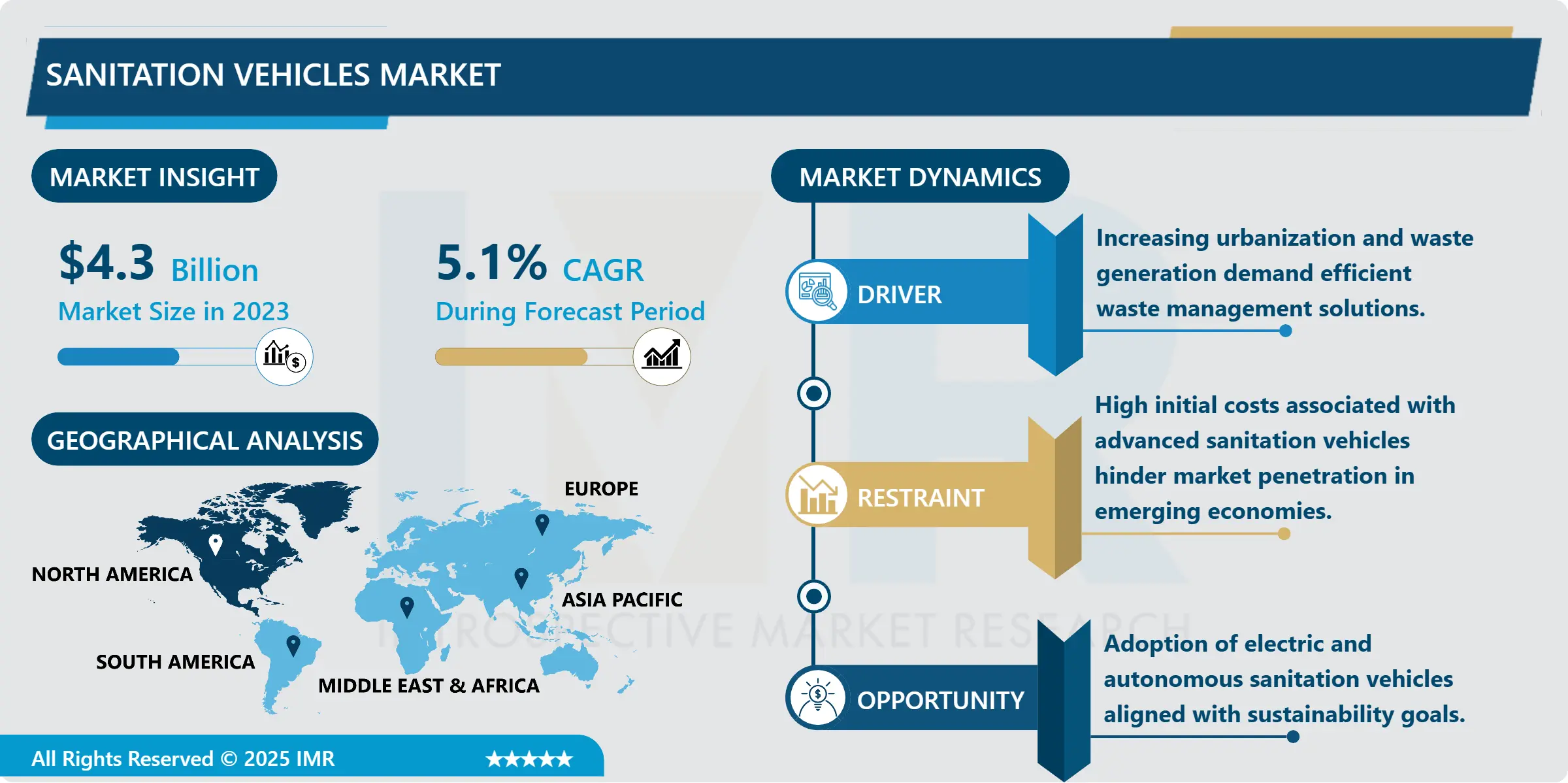
Sanitation Vehicles Market Size Was Valued at USD 4.30 Billion in 2023, and is Projected to Reach USD 6.73 Billion by 2032, Growing at a CAGR of 5.10 % From 2024-2032. Sanitation vehicles market includes those vehicles which are used for sanitation purposes ranging from waste management to street cleaning vehicles and vehicles required for other sanitation functions.

IMR Group
Description
Sanitation Vehicles Market Synopsis:
Sanitation Vehicles Market Size Was Valued at USD 4.30 Billion in 2023, and is Projected to Reach USD 6.73 Billion by 2032, Growing at a CAGR of 5.10 % From 2024-2032.
Sanitation vehicles market includes those vehicles which are used for sanitation purposes ranging from waste management to street cleaning vehicles and vehicles required for other sanitation functions. These are rear loaders, front loaders compactors and sweepers and are instrumental in the attainment of environmentally safe standards and manage waste within cities. Its coverage is extensive because the market aims at the provision of services in managing municipal and commercial solid waste, health-care hazardous waste, as well as recyclables.
The market of sanitation vehicles has become burgeoning mainly due to growing awareness of people worldwide regarding cleanliness of cities and effectiveness of waste removal. Both central as well as local authorities are gradually developing advanced acquiescence Sanitation Vehicle fleets to meet the increasing urban populace as well as to meet continuously rising standards of waste disposal and recycling standards. There is tremendous demand for modern sanitation vehicles as it addresses the emerging economies’ urban infrastructure challenges and answer to the ecological efficiency ambitions.
These factors have put the sanitation vehicle market in the developed regions up for innovation with the inclusion of GPS tracking as well as automated systems, and fuel-efficient sanitation vehicles. Also, increased emphasis is on environmentally friendly vehicles, which include electric and hybrid sanitation trucks as governments seek to cut down on carbon footprint and adopt new environmentally friendly causes. These factors are hence advancing the overall and competitive market prospects for sanitation vehicles in various countries.
Sanitation Vehicles Market Trend Analysis:
Integration of Smart Technologies in Sanitation Vehicles
The adaptive use of smart technologies in disinfection vehicles is changing the face of the market. The current sanitation vehicles integrated the IOT sensors, GPS, and AI-driven route optimization to improve operation and fuel usage. These advances make it possible for the municipalities to optimise the pick-ups of wastes, to remotely control and to supervise the performance of the vehicles and ultimately to operate at a lower cost. In addition, automatic loading and unloading are decreasing the use of manpower, improving efficiency, and limiting the chances of employees’ accidents. The growth of populated areas and the need to dispose of anthropogenic wastes more efficiently are the growth of smart technology in sanitation vehicles used in major cities.
Growing Demand for Electric Sanitation Vehicles
The growing focus on sustainability around the world is likely to open up great prospects for the creation and use of electric sanitation vehicles. Electric fleets are being adopted globally as governments across nations are offering incentives and subsidies such as incentives that reduce the use of fossil fuels and decrease emissions of carbon. Apart from being key factors towards environmental conservation, electric sanitation vehicles also have the added advantage of saving cost in terms of fuel consumption and service. Furthermore, battery technology is improving the range and capacity of power of such vehicles—thereby making them suitable for broader application. Hence, environmental concerns in the urban areas will lead to increased focus on electric sanitation vehicles and appropriate demand in the market opens a gate for bright future for the manufacturers and the stakeholders.
Sanitation Vehicles Market Segment Analysis:
The sanitation Vehicles market is segmented on the basis of Product Type, Application, Technology, and Region.
By Product, Rear Loaders segment is expected to dominate the market during the forecast period
Sanitation vehicles analyzed by the load type are expected to show a predominance of rear loaders during the forecast period owing to operational efficiency as well as extensive usage across urban and residential settings. These mast vehicles are fitted with rear loading systems that allow easy collection of waste from standard size bin thus being fit for domestic and industrial uses. Small and portable, they are best suited for the congested roads common in urban places hence amplify the rate of their sales in such regions. Also, advanced loading systems which are automated or semi-automated are being included in rear loaders making the machine to be more efficient in the manufacturer’s operation hence cutting onion costs such as labor expenses.
By Application, the Urban garbage segment is expected to hold the largest share
The urban garbage segment is estimated to occupy the largest share of the sanitation vehicles market. The current trends in the expansion of urban areas and the quantity of APM generated from such areas provide this impetus. Collection of waste in urban areas demands efficient bicycles for collecting different waste such as recyclable items, bio-degradable materials as well as other inaminate objects. Sanitation vehicles used on urban waste collection and disposal normally come equipped with enhanced compaction systems to enhance on transport and final disposal. Governments and municipalities are also keen on increasing efficiency in collection and disposal of waste in the developing urban cities and as a result, more efficient vehicles are being developed.
Sanitation Vehicles Market Regional Insights:
North America is Expected to Dominate the Market Over the Forecast period
North America is expected to continue its domination in the sanitation vehicles market throughout the forecast period due to the developed waste management systems, and high spending on municipal facilities. In the United States and Canada, primarily, experimentation with new sanitation vehicle technologies, like electric and automated sanitation vehicles is actively being promoted to improve sanitation collection efficacy as well as to reduce the negative impact on the environment. Also, many countries’ governments have developed a series of strict policies to regulate waste disposal and recycling more strictly, therefore many municipal councils have come to the challenge to modernize their sanitation fleet with vehicles that are enviro-friendly and incorporate the latest technology.
Availability of major manufacturers of sanitation vehicles in North America is the factor that again strengthens the position of the region. These firms are putting much emphasis on advancing their research and development, to bring to the market changes such as hybrid and electric sanitation trucks. In addition, the rising trend and importance placed on sustainability and cleanliness of the North American cities hence continuously matching with the global trends thus guaranteeing market continuity. The region has a strong industrial base along with developing trends in the waste management industry thus making it a force to beat in the sanitation vehicles market.
Active Key Players in the Sanitation Vehicles Market
Aebi Schmidt Holding AG (Switzerland)
Bucher Industries AG (Switzerland)
CNH Industrial NV (United Kingdom)
Dover Corporation (United States)
Dulevo International (Italy)
Farid Industrie SpA (Italy)
FAUN Umwelttechnik GmbH & Co. KG (Germany)
Heil Environmental Industries (United States)
Hino Motors Ltd. (Japan)
Isuzu Motors Ltd. (Japan)
Iveco S.p.A. (Italy)
Labrie Environmental Group (Canada)
McNeilus Companies, Inc. (United States)
Nilfisk Group (Denmark)
Other Active Players.
Chapter 1: Introduction
1.1 Scope and Coverage
Chapter 2:Executive Summary
Chapter 3: Market Landscape
3.1 Market Dynamics
3.1.1 Drivers
3.1.2 Restraints
3.1.3 Opportunities
3.1.4 Challenges
3.2 Market Trend Analysis
3.3 PESTLE Analysis
3.4 Porter’s Five Forces Analysis
3.5 Industry Value Chain Analysis
3.6 Ecosystem
3.7 Regulatory Landscape
3.8 Price Trend Analysis
3.9 Patent Analysis
3.10 Technology Evolution
3.11 Investment Pockets
3.12 Import-Export Analysis
Chapter 4: Sanitation Vehicles Market by Equipment
4.1 Sanitation Vehicles Market Snapshot and Growth Engine
4.2 Sanitation Vehicles Market Overview
4.3 Consumer Equipment Satellite Navigation Equipment Dish Antenna Satellite Radio Broadband Equipment Mobile Satellite Terminals Network Equipment Network Operation Centre (NOCs) Equipment VSAT Equipment Antennas Power Units Gateways Test and Monitoring Equipment
4.3.1 Introduction and Market Overview
4.3.2 Historic and Forecasted Market Size in Value USD and Volume Units (2017-2032F)
4.3.3 Key Market Trends, Growth Factors and Opportunities
4.3.4 Consumer Equipment Satellite Navigation Equipment Dish Antenna Satellite Radio Broadband Equipment Mobile Satellite Terminals Network Equipment Network Operation Centre (NOCs) Equipment VSAT Equipment Antennas Power Units Gateways Test and Monitoring Equipment: Geographic Segmentation Analysis
Chapter 5: Sanitation Vehicles Market by Application
5.1 Sanitation Vehicles Market Snapshot and Growth Engine
5.2 Sanitation Vehicles Market Overview
5.3 Communication Earth Observation Navigation
5.3.1 Introduction and Market Overview
5.3.2 Historic and Forecasted Market Size in Value USD and Volume Units (2017-2032F)
5.3.3 Key Market Trends, Growth Factors and Opportunities
5.3.4 Communication Earth Observation Navigation: Geographic Segmentation Analysis
Chapter 6: Sanitation Vehicles Market by End User
6.1 Sanitation Vehicles Market Snapshot and Growth Engine
6.2 Sanitation Vehicles Market Overview
6.3 Consumer
6.3.1 Introduction and Market Overview
6.3.2 Historic and Forecasted Market Size in Value USD and Volume Units (2017-2032F)
6.3.3 Key Market Trends, Growth Factors and Opportunities
6.3.4 Consumer: Geographic Segmentation Analysis
6.4 Government and Military Commercial
6.4.1 Introduction and Market Overview
6.4.2 Historic and Forecasted Market Size in Value USD and Volume Units (2017-2032F)
6.4.3 Key Market Trends, Growth Factors and Opportunities
6.4.4 Government and Military Commercial: Geographic Segmentation Analysis
6.5 Enterprise
6.5.1 Introduction and Market Overview
6.5.2 Historic and Forecasted Market Size in Value USD and Volume Units (2017-2032F)
6.5.3 Key Market Trends, Growth Factors and Opportunities
6.5.4 Enterprise: Geographic Segmentation Analysis
Chapter 7: Company Profiles and Competitive Analysis
7.1 Competitive Landscape
7.1.1 Competitive Benchmarking
7.1.2 Sanitation Vehicles Market Share by Manufacturer (2023)
7.1.3 Industry BCG Matrix
7.1.4 Heat Map Analysis
7.1.5 Mergers and Acquisitions
7.2 AEBI SCHMIDT HOLDING AG (SWITZERLAND)
7.2.1 Company Overview
7.2.2 Key Executives
7.2.3 Company Snapshot
7.2.4 Role of the Company in the Market
7.2.5 Sustainability and Social Responsibility
7.2.6 Operating Business Segments
7.2.7 Product Portfolio
7.2.8 Business Performance
7.2.9 Key Strategic Moves and Recent Developments
7.2.10 SWOT Analysis
7.3 BUCHER INDUSTRIES AG (SWITZERLAND)
7.4 CNH INDUSTRIAL NV (UNITED KINGDOM)
7.5 DOVER CORPORATION (UNITED STATES)
7.6 DULEVO INTERNATIONAL (ITALY)
7.7 FARID INDUSTRIE SPA (ITALY)
7.8 FAUN UMWELTTECHNIK GMBH & CO. KG (GERMANY)
7.9 HEIL ENVIRONMENTAL INDUSTRIES (UNITED STATES)
7.10 HINO MOTORS LTD. (JAPAN)
7.11 ISUZU MOTORS LTD. (JAPAN)
7.12 IVECO S.P.A. (ITALY)
7.13 LABRIE ENVIRONMENTAL GROUP (CANADA)
7.14 MCNEILUS COMPANIES INC. (UNITED STATES) NILFISK GROUP (DENMARK)
7.15 OTHER ACTIVE PLAYERS
Chapter 8: Global Sanitation Vehicles Market By Region
8.1 Overview
8.2. North America Sanitation Vehicles Market
8.2.1 Key Market Trends, Growth Factors and Opportunities
8.2.2 Top Key Companies
8.2.3 Historic and Forecasted Market Size by Segments
8.2.4 Historic and Forecasted Market Size By Equipment
8.2.4.1 Consumer Equipment Satellite Navigation Equipment Dish Antenna Satellite Radio Broadband Equipment Mobile Satellite Terminals Network Equipment Network Operation Centre (NOCs) Equipment VSAT Equipment Antennas Power Units Gateways Test and Monitoring Equipment
8.2.5 Historic and Forecasted Market Size By Application
8.2.5.1 Communication Earth Observation Navigation
8.2.6 Historic and Forecasted Market Size By End User
8.2.6.1 Consumer
8.2.6.2 Government and Military Commercial
8.2.6.3 Enterprise
8.2.7 Historic and Forecast Market Size by Country
8.2.7.1 US
8.2.7.2 Canada
8.2.7.3 Mexico
8.3. Eastern Europe Sanitation Vehicles Market
8.3.1 Key Market Trends, Growth Factors and Opportunities
8.3.2 Top Key Companies
8.3.3 Historic and Forecasted Market Size by Segments
8.3.4 Historic and Forecasted Market Size By Equipment
8.3.4.1 Consumer Equipment Satellite Navigation Equipment Dish Antenna Satellite Radio Broadband Equipment Mobile Satellite Terminals Network Equipment Network Operation Centre (NOCs) Equipment VSAT Equipment Antennas Power Units Gateways Test and Monitoring Equipment
8.3.5 Historic and Forecasted Market Size By Application
8.3.5.1 Communication Earth Observation Navigation
8.3.6 Historic and Forecasted Market Size By End User
8.3.6.1 Consumer
8.3.6.2 Government and Military Commercial
8.3.6.3 Enterprise
8.3.7 Historic and Forecast Market Size by Country
8.3.7.1 Russia
8.3.7.2 Bulgaria
8.3.7.3 The Czech Republic
8.3.7.4 Hungary
8.3.7.5 Poland
8.3.7.6 Romania
8.3.7.7 Rest of Eastern Europe
8.4. Western Europe Sanitation Vehicles Market
8.4.1 Key Market Trends, Growth Factors and Opportunities
8.4.2 Top Key Companies
8.4.3 Historic and Forecasted Market Size by Segments
8.4.4 Historic and Forecasted Market Size By Equipment
8.4.4.1 Consumer Equipment Satellite Navigation Equipment Dish Antenna Satellite Radio Broadband Equipment Mobile Satellite Terminals Network Equipment Network Operation Centre (NOCs) Equipment VSAT Equipment Antennas Power Units Gateways Test and Monitoring Equipment
8.4.5 Historic and Forecasted Market Size By Application
8.4.5.1 Communication Earth Observation Navigation
8.4.6 Historic and Forecasted Market Size By End User
8.4.6.1 Consumer
8.4.6.2 Government and Military Commercial
8.4.6.3 Enterprise
8.4.7 Historic and Forecast Market Size by Country
8.4.7.1 Germany
8.4.7.2 UK
8.4.7.3 France
8.4.7.4 The Netherlands
8.4.7.5 Italy
8.4.7.6 Spain
8.4.7.7 Rest of Western Europe
8.5. Asia Pacific Sanitation Vehicles Market
8.5.1 Key Market Trends, Growth Factors and Opportunities
8.5.2 Top Key Companies
8.5.3 Historic and Forecasted Market Size by Segments
8.5.4 Historic and Forecasted Market Size By Equipment
8.5.4.1 Consumer Equipment Satellite Navigation Equipment Dish Antenna Satellite Radio Broadband Equipment Mobile Satellite Terminals Network Equipment Network Operation Centre (NOCs) Equipment VSAT Equipment Antennas Power Units Gateways Test and Monitoring Equipment
8.5.5 Historic and Forecasted Market Size By Application
8.5.5.1 Communication Earth Observation Navigation
8.5.6 Historic and Forecasted Market Size By End User
8.5.6.1 Consumer
8.5.6.2 Government and Military Commercial
8.5.6.3 Enterprise
8.5.7 Historic and Forecast Market Size by Country
8.5.7.1 China
8.5.7.2 India
8.5.7.3 Japan
8.5.7.4 South Korea
8.5.7.5 Malaysia
8.5.7.6 Thailand
8.5.7.7 Vietnam
8.5.7.8 The Philippines
8.5.7.9 Australia
8.5.7.10 New Zealand
8.5.7.11 Rest of APAC
8.6. Middle East & Africa Sanitation Vehicles Market
8.6.1 Key Market Trends, Growth Factors and Opportunities
8.6.2 Top Key Companies
8.6.3 Historic and Forecasted Market Size by Segments
8.6.4 Historic and Forecasted Market Size By Equipment
8.6.4.1 Consumer Equipment Satellite Navigation Equipment Dish Antenna Satellite Radio Broadband Equipment Mobile Satellite Terminals Network Equipment Network Operation Centre (NOCs) Equipment VSAT Equipment Antennas Power Units Gateways Test and Monitoring Equipment
8.6.5 Historic and Forecasted Market Size By Application
8.6.5.1 Communication Earth Observation Navigation
8.6.6 Historic and Forecasted Market Size By End User
8.6.6.1 Consumer
8.6.6.2 Government and Military Commercial
8.6.6.3 Enterprise
8.6.7 Historic and Forecast Market Size by Country
8.6.7.1 Turkiye
8.6.7.2 Bahrain
8.6.7.3 Kuwait
8.6.7.4 Saudi Arabia
8.6.7.5 Qatar
8.6.7.6 UAE
8.6.7.7 Israel
8.6.7.8 South Africa
8.7. South America Sanitation Vehicles Market
8.7.1 Key Market Trends, Growth Factors and Opportunities
8.7.2 Top Key Companies
8.7.3 Historic and Forecasted Market Size by Segments
8.7.4 Historic and Forecasted Market Size By Equipment
8.7.4.1 Consumer Equipment Satellite Navigation Equipment Dish Antenna Satellite Radio Broadband Equipment Mobile Satellite Terminals Network Equipment Network Operation Centre (NOCs) Equipment VSAT Equipment Antennas Power Units Gateways Test and Monitoring Equipment
8.7.5 Historic and Forecasted Market Size By Application
8.7.5.1 Communication Earth Observation Navigation
8.7.6 Historic and Forecasted Market Size By End User
8.7.6.1 Consumer
8.7.6.2 Government and Military Commercial
8.7.6.3 Enterprise
8.7.7 Historic and Forecast Market Size by Country
8.7.7.1 Brazil
8.7.7.2 Argentina
8.7.7.3 Rest of SA
Chapter 9 Analyst Viewpoint and Conclusion
9.1 Recommendations and Concluding Analysis
9.2 Potential Market Strategies
Chapter 10 Research Methodology
10.1 Research Process
10.2 Primary Research
10.3 Secondary Research
Q1: What would be the forecast period in the Sanitation Vehicles market research report?
A1: The forecast period in the Sanitation Vehicles Market research report is 2024-2032.
Q2: Who are the key players in the Sanitation Vehicles Market?
A2: Aebi Schmidt Holding AG (Switzerland), Bucher Industries AG (Switzerland), CNH Industrial NV (United Kingdom), Dover Corporation (United States), Dulevo International (Italy), Farid Industrie SpA (Italy), FAUN Umwelttechnik GmbH & Co. KG (Germany), Heil Environmental Industries (United States), Hino Motors Ltd. (Japan), Isuzu Motors Ltd. (Japan), Iveco S.p.A. (Italy), Labrie Environmental Group (Canada), McNeilus Companies, Inc. (United States), Nilfisk Group (Denmark), Other Active Players
Q3: What are the segments of the Sanitation Vehicles Market?
A3: The Sanitation Vehicles market is segmented into Product Type, Application, Technology, and region. By Product Type, the market is categorized into Front Loaders, Rear Loaders, and Side Loaders. By Application, the market is categorized into Urban Garbage Treatment, Building & Mining Industry, and Others. By Technology, the market is categorized into Manual and Semi-/Fully Automatic. By region, it is analyzed across North America (U.S., Canada, Mexico), Eastern Europe (Russia, Bulgaria, The Czech Republic, Hungary, Poland, Romania, Rest of Eastern Europe), Western Europe (Germany, UK, France, The Netherlands, Italy, Russia, Spain, Rest of Western Europe), Asia Pacific (China, India, Japan, South Korea, Malaysia, Thailand, Vietnam, The Philippines, Australia, New-Zealand, Rest of APAC), Middle East & Africa (Turkiye, Bahrain, Kuwait, Saudi Arabia, Qatar, UAE, Israel, South Africa), South America (Brazil, Argentina, Rest of SA).
Q4: What is the Sanitation Vehicles Market?
A4: Sanitation vehicles market includes those vehicles which are used for sanitation purposes ranging from waste management to street cleaning vehicles and vehicles required for other sanitation functions. These are rear loaders, front loaders compactors and sweepers and are instrumental in the attainment of environmentally safe standards and manage waste within cities. Its coverage is extensive because the market aims at the provision of services in managing municipal and commercial solid waste, health-care hazardous waste, as well as recyclables.
Q5: How big is the Sanitation Vehicles Market?
A5: Sanitation Vehicles Market Size Was Valued at USD 4.30 Billion in 2023, and is Projected to Reach USD 6.73 Billion by 2032, Growing at a CAGR of 5.10 % From 2024-2032.
How to Buy a Report from eminsights.jp
On the product page, choose the license you want: Single-User License, Multi-User License or Enterprise License.
If you required report in your native language, then you can click on Translated Report button and fill out the form with report name and language you want, then our team will contact you as soon as possible.
Click the Buy Now button.
You will be redirected to the checkout page. Enter your company details and payment information.
Click Place Order to complete the purchase.
Confirmation: You’ll receive an order confirmation and our team will contact you shortly with your ordered report.
If you have any questions, fill out the contact form below or email us at [email protected].
Thank you for choosing eminsights.jp!