Stay Ahead in Fast-Growing Economies.
Browse Reports Now
Refrigerant Market Key Developments, Demand & Forecast Report (2024-2032)
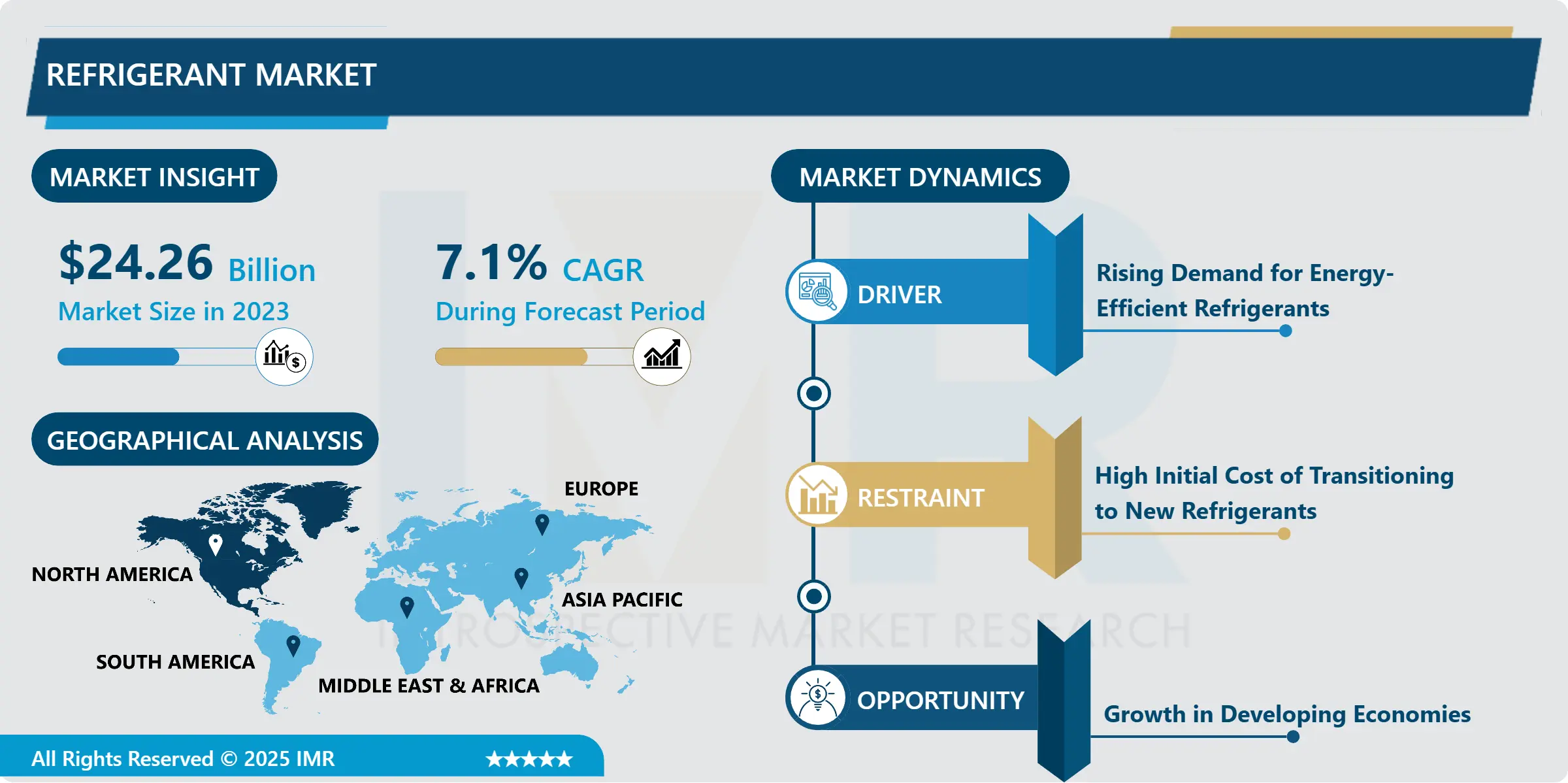
Refrigerant Market Size Was Valued at USD 24.26 Billion in 2023, and is Projected to Reach USD 44.98 Billion by 2032, Growing at a CAGR of 7.10% From 2024-2032. Refrigerant market concerns the circulating fluid selling market that deals with substances that serve the purpose of cooling systems such as air conditioners, refrigerators and industrial refrigeration systems.

IMR Group
Description
Refrigerant Market Synopsis:
Refrigerant Market Size Was Valued at USD 24.26 Billion in 2023, and is Projected to Reach USD 44.98 Billion by 2032, Growing at a CAGR of 7.10% From 2024-2032.
Refrigerant market concerns the circulating fluid selling market that deals with substances that serve the purpose of cooling systems such as air conditioners, refrigerators and industrial refrigeration systems. These substances now referred to as refrigerants cause heat to be conveyed away from the refrigeration system and subsequently released to cool down the system. The market is changing because of the environmental legislation and people’s gaze that affects the market of building materials and products, in the growth of new requirements for energy-efficient, environmentally friendly products.
The market of refrigerant is central to the HVAC&R industry horizontally present worldwide. Refrigerants are required in numerous applications, for example HVAC in residential and commercial buildings, refrigeration and industrial cooling systems. As temperatures are rising and the population moves into the cities the demand for cooling systems is growing, which put the pressure on the refrigerant market. In addition, international laws including the recently signed Kigali Amendment to the Montreal Protocol that seeks to ban substances with high-global-warming-potential (GWP) refrigerants including HFCs (Hydrofluorocarbons) has created a shift towards friendly environment refrigerants.
This change is promoting growth of new refrigerants such as Hydrofluoroolefins (HFOs), low carbon natural refrigerants (ammonia and CO2), and hydrocarbons. These alternatives are expected to have least or even negligible environmental footprint According to this table, many of them exhibit low to zero GWP. Furthermore, efforts to promote energy efficient refrigeration systems are focusing manufacturers onto using refrigerants with enhanced thermodynamic parameters that enhance system efficiency during operation and at the same time use less energy. It culminates that the market is not restricted to technological changes, as well as the intention of the authorities to regulate the emission of greenhouse gases but also to the economic factors, such as the increase in the prices for traditional refrigerants and shift of focus to energy-efficient solutions.
Refrigerant Market Trend Analysis:
Shift Towards Environmentally-Friendly Refrigerants
A clear future that has emerged in the market for refrigerants is the replacement of the consummate FGS by favourable environment ones. With global warming and climate change now causing more worry, global conventions like the Kigali Amendment are gradually eliminating HFCs that have very high GWP. The aforementioned regulations are compelling manufacturers to use refrigerants with minimal effects on the environment. For example, while Hydrofluoroolefins (HFOs) and natural refrigerants ammonia, CO2 and hydrocarbons are being used in new building residences and commercial and industrial uses because they have a lower GWP.
This is enjoyed at a time when different industries are all over the world exploring ways of cutting on their polluting capabilities. Business are willing to perform the necessary research on the development of refrigerant chemicals that will meet the new regulations in environmental production and at the same time be of improved efficiency compared to the current refrigeration systems. Its mentioned that as these newest types of refrigerants start to appear in the market they are likely to become the standard refrigerants for cooling systems dramatically decreasing the industry’s impact on global warming.
Growth in Developing Economies
Therefore, a significant opportunity in the refrigerant market is the continuously rising growth of the developing countries. With India, China and some African countries’ populations still modernizing and experiencing the advanced standards of living, they need more refrigeration and air conditioning systems. The development in this industry can be seen as a key opportunity for refrigerant manufacturing companies, particularly varieties which are environmentally friendly with improved energy efficiency. These regions are also likely to witness an increase in the adoption of commercial refrigeration attributed to advancements in retail, food and drug sectors.
Moreover, given that the government of these regions has embarked on the development of sustainable energy and has complied with the international environment regulation, it may help to promote the use of environment friendly refrigerant. There is therefore a great opportunity for manufacturers to offer low GWP refrigerants and solutions that will address diverse markets. Future prospects of the refrigerant market in these emerging regions will depend on enhanced usage of green technologies as motorists for long term growth.
Refrigerant Market Segment Analysis:
Refrigerant Market is Segmented on the basis of Type, Application, End User, and Region.
By Type, Hydrochlorofluorocarbons (HCFCs segment is expected to dominate the market during the forecast period
HFCs have, in the past, been the most popular because of their application in conditioning and refrigeration. However, with a high GWP potential, HFCs are being replaced gradually by more environment friendly substances and hence a dramatic increase in the use of HFOs and natural refrigerants.
Ammonia, carbon dioxide and hydrocarbons have been reported as some of the natural refrigerants because they have GWP that mostly ranges from zero to less than 20 considered to be eco-friendlier. Therefore, HFOs are becoming a next best option, which offer comparable performance as HFCs but at much lower GWP levels. Since the current legislation to environmental issues becomes more stringent and the public’s focus on or own environment becomes even stronger then there exists the great potential for the future sales of these unconventional refrigerants. The process of moving toward the low-GWP refrigerants remains a gradual process that changes the structure of the refrigerator market and invests in their development intensively.
By Application, Residential Refrigeration segment expected to held the largest share
Residential and commercial refrigeration take the biggest market share due to increased demand for refrigeration solutions in residential areas, supermarkets, and food storage industries. Further, industrial refrigeration particularly for food and beverage industry is still a good reason due to the large refrigeration demands provided in storing and handling facilities.
Another important application is air conditioning which has demand growth rate observed in both residential and commercial end uses, particularly in warm climates. The change to more efficient and eco-friendly refrigerants in such uses appears to be emerging as the key consideration for manufacturers. They remain a key feature of deliberate growth agenda especially in developing economies due to the continuously changing nature of societies’ lifestyles through urbanization and pro-technology improved lifestyles.
Refrigerant Market Regional Insights:
North America is Expected to Dominate the Market Over the Forecast period
North America is presently the largest regional consumer of refrigerants since its countries, especially the United States and Canada, have a high demand for air conditioning and refrigerated systems. The region has very rigid requirements based on the Kigali Amendment, which has played a major role in transitioning to natural refrigerants. There is always the issue of energy conservation and need to have green products in the market due to world’s increasing awareness on environmental conservation.
North America is strategically positioned for research and development investment in the refrigerant market due to the existence of industry leading refrigerant manufacturers. In addition, the United States and Canada are leading applications for new residential, commercial, and industrial refrigeration that will continue to drive the demand for refrigerants. North America is favored with a highly developed infrastructre, sound legislation, and emphasis on environmental concerns that will keep North America as the leading consumer of refrigerants across the world.
Active Key Players in the Refrigerant Market
Air Products and Chemicals, Inc. (USA)
Arkema S.A. (France)
BASF SE (Germany)
China National Petroleum Corporation (China)
Daikin Industries Ltd. (Japan)
Exxon Mobil Corporation (USA)
GFL Environmental Inc. (Canada)
Honeywell International Inc. (USA)
Linde Group (Germany)
Mitsubishi Chemical Corporation (Japan)
SRF Limited (India)
The Chemours Company (USA)
Other Active Players.
Chapter 1: Introduction
1.1 Scope and Coverage
Chapter 2:Executive Summary
Chapter 3: Market Landscape
3.1 Market Dynamics
3.1.1 Drivers
3.1.2 Restraints
3.1.3 Opportunities
3.1.4 Challenges
3.2 Market Trend Analysis
3.3 PESTLE Analysis
3.4 Porter’s Five Forces Analysis
3.5 Industry Value Chain Analysis
3.6 Ecosystem
3.7 Regulatory Landscape
3.8 Price Trend Analysis
3.9 Patent Analysis
3.10 Technology Evolution
3.11 Investment Pockets
3.12 Import-Export Analysis
Chapter 4: Refrigerant Market by Type
4.1 Refrigerant Market Snapshot and Growth Engine
4.2 Refrigerant Market Overview
4.3 Rear Loaders
4.3.1 Introduction and Market Overview
4.3.2 Historic and Forecasted Market Size in Value USD and Volume Units (2017-2032F)
4.3.3 Key Market Trends, Growth Factors and Opportunities
4.3.4 Rear Loaders: Geographic Segmentation Analysis
4.4 Front Loaders
4.4.1 Introduction and Market Overview
4.4.2 Historic and Forecasted Market Size in Value USD and Volume Units (2017-2032F)
4.4.3 Key Market Trends, Growth Factors and Opportunities
4.4.4 Front Loaders: Geographic Segmentation Analysis
4.5 Side Loaders
4.5.1 Introduction and Market Overview
4.5.2 Historic and Forecasted Market Size in Value USD and Volume Units (2017-2032F)
4.5.3 Key Market Trends, Growth Factors and Opportunities
4.5.4 Side Loaders: Geographic Segmentation Analysis
4.6 Other
4.6.1 Introduction and Market Overview
4.6.2 Historic and Forecasted Market Size in Value USD and Volume Units (2017-2032F)
4.6.3 Key Market Trends, Growth Factors and Opportunities
4.6.4 Other: Geographic Segmentation Analysis
Chapter 5: Refrigerant Market by Application
5.1 Refrigerant Market Snapshot and Growth Engine
5.2 Refrigerant Market Overview
5.3 Residential
5.3.1 Introduction and Market Overview
5.3.2 Historic and Forecasted Market Size in Value USD and Volume Units (2017-2032F)
5.3.3 Key Market Trends, Growth Factors and Opportunities
5.3.4 Residential : Geographic Segmentation Analysis
5.4 Commercial
5.4.1 Introduction and Market Overview
5.4.2 Historic and Forecasted Market Size in Value USD and Volume Units (2017-2032F)
5.4.3 Key Market Trends, Growth Factors and Opportunities
5.4.4 Commercial: Geographic Segmentation Analysis
5.5 Industrial
5.5.1 Introduction and Market Overview
5.5.2 Historic and Forecasted Market Size in Value USD and Volume Units (2017-2032F)
5.5.3 Key Market Trends, Growth Factors and Opportunities
5.5.4 Industrial: Geographic Segmentation Analysis
5.6 Municipal
5.6.1 Introduction and Market Overview
5.6.2 Historic and Forecasted Market Size in Value USD and Volume Units (2017-2032F)
5.6.3 Key Market Trends, Growth Factors and Opportunities
5.6.4 Municipal: Geographic Segmentation Analysis
Chapter 6: Refrigerant Market by Capacity
6.1 Refrigerant Market Snapshot and Growth Engine
6.2 Refrigerant Market Overview
6.3 Below 10 Cubic Yards
6.3.1 Introduction and Market Overview
6.3.2 Historic and Forecasted Market Size in Value USD and Volume Units (2017-2032F)
6.3.3 Key Market Trends, Growth Factors and Opportunities
6.3.4 Below 10 Cubic Yards: Geographic Segmentation Analysis
6.4 10-20 Cubic Yards
6.4.1 Introduction and Market Overview
6.4.2 Historic and Forecasted Market Size in Value USD and Volume Units (2017-2032F)
6.4.3 Key Market Trends, Growth Factors and Opportunities
6.4.4 10-20 Cubic Yards: Geographic Segmentation Analysis
6.5 Above 20 Cubic Yards
6.5.1 Introduction and Market Overview
6.5.2 Historic and Forecasted Market Size in Value USD and Volume Units (2017-2032F)
6.5.3 Key Market Trends, Growth Factors and Opportunities
6.5.4 Above 20 Cubic Yards: Geographic Segmentation Analysis
Chapter 7: Refrigerant Market by Technology
7.1 Refrigerant Market Snapshot and Growth Engine
7.2 Refrigerant Market Overview
7.3 Manual
7.3.1 Introduction and Market Overview
7.3.2 Historic and Forecasted Market Size in Value USD and Volume Units (2017-2032F)
7.3.3 Key Market Trends, Growth Factors and Opportunities
7.3.4 Manual: Geographic Segmentation Analysis
7.4 Semi-Automatic
7.4.1 Introduction and Market Overview
7.4.2 Historic and Forecasted Market Size in Value USD and Volume Units (2017-2032F)
7.4.3 Key Market Trends, Growth Factors and Opportunities
7.4.4 Semi-Automatic: Geographic Segmentation Analysis
7.5 Automatic)
7.5.1 Introduction and Market Overview
7.5.2 Historic and Forecasted Market Size in Value USD and Volume Units (2017-2032F)
7.5.3 Key Market Trends, Growth Factors and Opportunities
7.5.4 Automatic): Geographic Segmentation Analysis
Chapter 8: Refrigerant Market by End-User
8.1 Refrigerant Market Snapshot and Growth Engine
8.2 Refrigerant Market Overview
8.3 Municipalities
8.3.1 Introduction and Market Overview
8.3.2 Historic and Forecasted Market Size in Value USD and Volume Units (2017-2032F)
8.3.3 Key Market Trends, Growth Factors and Opportunities
8.3.4 Municipalities: Geographic Segmentation Analysis
8.4 Commercial Businesses
8.4.1 Introduction and Market Overview
8.4.2 Historic and Forecasted Market Size in Value USD and Volume Units (2017-2032F)
8.4.3 Key Market Trends, Growth Factors and Opportunities
8.4.4 Commercial Businesses: Geographic Segmentation Analysis
8.5 Waste Management Companies
8.5.1 Introduction and Market Overview
8.5.2 Historic and Forecasted Market Size in Value USD and Volume Units (2017-2032F)
8.5.3 Key Market Trends, Growth Factors and Opportunities
8.5.4 Waste Management Companies: Geographic Segmentation Analysis
Chapter 9: Company Profiles and Competitive Analysis
9.1 Competitive Landscape
9.1.1 Competitive Benchmarking
9.1.2 Refrigerant Market Share by Manufacturer (2023)
9.1.3 Industry BCG Matrix
9.1.4 Heat Map Analysis
9.1.5 Mergers and Acquisitions
9.2 HONEYWELL INTERNATIONAL INC. (USA)
9.2.1 Company Overview
9.2.2 Key Executives
9.2.3 Company Snapshot
9.2.4 Role of the Company in the Market
9.2.5 Sustainability and Social Responsibility
9.2.6 Operating Business Segments
9.2.7 Product Portfolio
9.2.8 Business Performance
9.2.9 Key Strategic Moves and Recent Developments
9.2.10 SWOT Analysis
9.3 THE CHEMOURS COMPANY (USA)
9.4 DAIKIN INDUSTRIES LTD. (JAPAN)
9.5 LINDE GROUP (GERMANY)
9.6 ARKEMA S.A. (FRANCE)
9.7 BASF SE (GERMANY)
9.8 MITSUBISHI CHEMICAL CORPORATION (JAPAN)
9.9 AIR PRODUCTS AND CHEMICALS INC. (USA)
9.10 EXXON MOBIL CORPORATION (USA)
9.11 SRF LIMITED (INDIA)
9.12 CHINA NATIONAL PETROLEUM CORPORATION (CHINA)
9.13 GFL ENVIRONMENTAL INC. (CANADA)
9.14 OTHER ACTIVE PLAYERS
Chapter 10: Global Refrigerant Market By Region
10.1 Overview
10.2. North America Refrigerant Market
10.2.1 Key Market Trends, Growth Factors and Opportunities
10.2.2 Top Key Companies
10.2.3 Historic and Forecasted Market Size by Segments
10.2.4 Historic and Forecasted Market Size By Type
10.2.4.1 Rear Loaders
10.2.4.2 Front Loaders
10.2.4.3 Side Loaders
10.2.4.4 Other
10.2.5 Historic and Forecasted Market Size By Application
10.2.5.1 Residential
10.2.5.2 Commercial
10.2.5.3 Industrial
10.2.5.4 Municipal
10.2.6 Historic and Forecasted Market Size By Capacity
10.2.6.1 Below 10 Cubic Yards
10.2.6.2 10-20 Cubic Yards
10.2.6.3 Above 20 Cubic Yards
10.2.7 Historic and Forecasted Market Size By Technology
10.2.7.1 Manual
10.2.7.2 Semi-Automatic
10.2.7.3 Automatic)
10.2.8 Historic and Forecasted Market Size By End-User
10.2.8.1 Municipalities
10.2.8.2 Commercial Businesses
10.2.8.3 Waste Management Companies
10.2.9 Historic and Forecast Market Size by Country
10.2.9.1 US
10.2.9.2 Canada
10.2.9.3 Mexico
10.3. Eastern Europe Refrigerant Market
10.3.1 Key Market Trends, Growth Factors and Opportunities
10.3.2 Top Key Companies
10.3.3 Historic and Forecasted Market Size by Segments
10.3.4 Historic and Forecasted Market Size By Type
10.3.4.1 Rear Loaders
10.3.4.2 Front Loaders
10.3.4.3 Side Loaders
10.3.4.4 Other
10.3.5 Historic and Forecasted Market Size By Application
10.3.5.1 Residential
10.3.5.2 Commercial
10.3.5.3 Industrial
10.3.5.4 Municipal
10.3.6 Historic and Forecasted Market Size By Capacity
10.3.6.1 Below 10 Cubic Yards
10.3.6.2 10-20 Cubic Yards
10.3.6.3 Above 20 Cubic Yards
10.3.7 Historic and Forecasted Market Size By Technology
10.3.7.1 Manual
10.3.7.2 Semi-Automatic
10.3.7.3 Automatic)
10.3.8 Historic and Forecasted Market Size By End-User
10.3.8.1 Municipalities
10.3.8.2 Commercial Businesses
10.3.8.3 Waste Management Companies
10.3.9 Historic and Forecast Market Size by Country
10.3.9.1 Russia
10.3.9.2 Bulgaria
10.3.9.3 The Czech Republic
10.3.9.4 Hungary
10.3.9.5 Poland
10.3.9.6 Romania
10.3.9.7 Rest of Eastern Europe
10.4. Western Europe Refrigerant Market
10.4.1 Key Market Trends, Growth Factors and Opportunities
10.4.2 Top Key Companies
10.4.3 Historic and Forecasted Market Size by Segments
10.4.4 Historic and Forecasted Market Size By Type
10.4.4.1 Rear Loaders
10.4.4.2 Front Loaders
10.4.4.3 Side Loaders
10.4.4.4 Other
10.4.5 Historic and Forecasted Market Size By Application
10.4.5.1 Residential
10.4.5.2 Commercial
10.4.5.3 Industrial
10.4.5.4 Municipal
10.4.6 Historic and Forecasted Market Size By Capacity
10.4.6.1 Below 10 Cubic Yards
10.4.6.2 10-20 Cubic Yards
10.4.6.3 Above 20 Cubic Yards
10.4.7 Historic and Forecasted Market Size By Technology
10.4.7.1 Manual
10.4.7.2 Semi-Automatic
10.4.7.3 Automatic)
10.4.8 Historic and Forecasted Market Size By End-User
10.4.8.1 Municipalities
10.4.8.2 Commercial Businesses
10.4.8.3 Waste Management Companies
10.4.9 Historic and Forecast Market Size by Country
10.4.9.1 Germany
10.4.9.2 UK
10.4.9.3 France
10.4.9.4 The Netherlands
10.4.9.5 Italy
10.4.9.6 Spain
10.4.9.7 Rest of Western Europe
10.5. Asia Pacific Refrigerant Market
10.5.1 Key Market Trends, Growth Factors and Opportunities
10.5.2 Top Key Companies
10.5.3 Historic and Forecasted Market Size by Segments
10.5.4 Historic and Forecasted Market Size By Type
10.5.4.1 Rear Loaders
10.5.4.2 Front Loaders
10.5.4.3 Side Loaders
10.5.4.4 Other
10.5.5 Historic and Forecasted Market Size By Application
10.5.5.1 Residential
10.5.5.2 Commercial
10.5.5.3 Industrial
10.5.5.4 Municipal
10.5.6 Historic and Forecasted Market Size By Capacity
10.5.6.1 Below 10 Cubic Yards
10.5.6.2 10-20 Cubic Yards
10.5.6.3 Above 20 Cubic Yards
10.5.7 Historic and Forecasted Market Size By Technology
10.5.7.1 Manual
10.5.7.2 Semi-Automatic
10.5.7.3 Automatic)
10.5.8 Historic and Forecasted Market Size By End-User
10.5.8.1 Municipalities
10.5.8.2 Commercial Businesses
10.5.8.3 Waste Management Companies
10.5.9 Historic and Forecast Market Size by Country
10.5.9.1 China
10.5.9.2 India
10.5.9.3 Japan
10.5.9.4 South Korea
10.5.9.5 Malaysia
10.5.9.6 Thailand
10.5.9.7 Vietnam
10.5.9.8 The Philippines
10.5.9.9 Australia
10.5.9.10 New Zealand
10.5.9.11 Rest of APAC
10.6. Middle East & Africa Refrigerant Market
10.6.1 Key Market Trends, Growth Factors and Opportunities
10.6.2 Top Key Companies
10.6.3 Historic and Forecasted Market Size by Segments
10.6.4 Historic and Forecasted Market Size By Type
10.6.4.1 Rear Loaders
10.6.4.2 Front Loaders
10.6.4.3 Side Loaders
10.6.4.4 Other
10.6.5 Historic and Forecasted Market Size By Application
10.6.5.1 Residential
10.6.5.2 Commercial
10.6.5.3 Industrial
10.6.5.4 Municipal
10.6.6 Historic and Forecasted Market Size By Capacity
10.6.6.1 Below 10 Cubic Yards
10.6.6.2 10-20 Cubic Yards
10.6.6.3 Above 20 Cubic Yards
10.6.7 Historic and Forecasted Market Size By Technology
10.6.7.1 Manual
10.6.7.2 Semi-Automatic
10.6.7.3 Automatic)
10.6.8 Historic and Forecasted Market Size By End-User
10.6.8.1 Municipalities
10.6.8.2 Commercial Businesses
10.6.8.3 Waste Management Companies
10.6.9 Historic and Forecast Market Size by Country
10.6.9.1 Turkiye
10.6.9.2 Bahrain
10.6.9.3 Kuwait
10.6.9.4 Saudi Arabia
10.6.9.5 Qatar
10.6.9.6 UAE
10.6.9.7 Israel
10.6.9.8 South Africa
10.7. South America Refrigerant Market
10.7.1 Key Market Trends, Growth Factors and Opportunities
10.7.2 Top Key Companies
10.7.3 Historic and Forecasted Market Size by Segments
10.7.4 Historic and Forecasted Market Size By Type
10.7.4.1 Rear Loaders
10.7.4.2 Front Loaders
10.7.4.3 Side Loaders
10.7.4.4 Other
10.7.5 Historic and Forecasted Market Size By Application
10.7.5.1 Residential
10.7.5.2 Commercial
10.7.5.3 Industrial
10.7.5.4 Municipal
10.7.6 Historic and Forecasted Market Size By Capacity
10.7.6.1 Below 10 Cubic Yards
10.7.6.2 10-20 Cubic Yards
10.7.6.3 Above 20 Cubic Yards
10.7.7 Historic and Forecasted Market Size By Technology
10.7.7.1 Manual
10.7.7.2 Semi-Automatic
10.7.7.3 Automatic)
10.7.8 Historic and Forecasted Market Size By End-User
10.7.8.1 Municipalities
10.7.8.2 Commercial Businesses
10.7.8.3 Waste Management Companies
10.7.9 Historic and Forecast Market Size by Country
10.7.9.1 Brazil
10.7.9.2 Argentina
10.7.9.3 Rest of SA
Chapter 11 Analyst Viewpoint and Conclusion
11.1 Recommendations and Concluding Analysis
11.2 Potential Market Strategies
Chapter 12 Research Methodology
12.1 Research Process
12.2 Primary Research
12.3 Secondary Research
Q1: What would be the forecast period in the Refrigerant Market research report?
A1: The forecast period in the Refrigerant Market research report is 2024-2032.
Q2: Who are the key players in the Refrigerant Market?
A2: Honeywell International Inc. (USA), The Chemours Company (USA), Daikin Industries Ltd. (Japan), Linde Group (Germany), Arkema S.A. (France), BASF SE (Germany), Mitsubishi Chemical Corporation (Japan), and Other Active Players.
Q3: What are the segments of the Refrigerant Market?
A3: The Refrigerant Market is segmented into Type, Application, End User and region. By Type, the market is categorized into Hydrochlorofluorocarbons (HCFCs), Hydrofluorocarbons (HFCs), Hydrofluoroolefins (HFOs), Natural Refrigerants, Others By Application, the market is categorized into Residential Refrigeration, Commercial Refrigeration, Industrial Refrigeration, Air Conditioning, Others. By End-User, the market is categorized into Automotive, Building & Construction, Healthcare, Food & Beverage, Others. By region, it is analyzed across North America (U.S., Canada, Mexico), Eastern Europe (Russia, Bulgaria, The Czech Republic, Hungary, Poland, Romania, Rest of Eastern Europe), Western Europe (Germany, UK, France, The Netherlands, Italy, Russia, Spain, Rest of Western Europe), Asia Pacific (China, India, Japan, South Korea, Malaysia, Thailand, Vietnam, The Philippines, Australia, New-Zealand, Rest of APAC), Middle East & Africa (Turkiye, Bahrain, Kuwait, Saudi Arabia, Qatar, UAE, Israel, South Africa), South America (Brazil, Argentina, Rest of SA).
Q4: What is the Refrigerant Market?
A4: Refrigerant market concerns the circulating fluid selling market that deals with substances that serve the purpose of cooling systems such as air conditioners, refrigerators and industrial refrigeration systems. These substances now referred to as refrigerants cause heat to be conveyed away from the refrigeration system and subsequently released to cooll down the system. The market is changing because of the environmental legislation and people’s gaze that affects the market of building materials and products, in the growth of new requirements for energy-efficient, environmentally friendly products.
Q5: How big is the Refrigerant Market?
A5: Refrigerant Market Size Was Valued at USD 24.26 Billion in 2023, and is Projected to Reach USD 44.98 Billion by 2032, Growing at a CAGR of 7.10% From 2024-2032.
How to Buy a Report from eminsights.jp
On the product page, choose the license you want: Single-User License, Multi-User License or Enterprise License.
If you required report in your native language, then you can click on Translated Report button and fill out the form with report name and language you want, then our team will contact you as soon as possible.
Click the Buy Now button.
You will be redirected to the checkout page. Enter your company details and payment information.
Click Place Order to complete the purchase.
Confirmation: You’ll receive an order confirmation and our team will contact you shortly with your ordered report.
If you have any questions, fill out the contact form below or email us at [email protected].
Thank you for choosing eminsights.jp!