Stay Ahead in Fast-Growing Economies.
Browse Reports Now




Patient Engagement Solution Market Growth Insights & Forecast Report to 2032
The Patient Engagement Solution Market consists of various technological tools and services that help in interacting with the patient on one hand and the healthcare givers on the other hand. It seeks to redefine patient experience, optimise health, contribute towards patient engagement via digital platforms, mHealth tools & more.

IMR Group
Description
Patient Engagement Solution Market Synopsis:
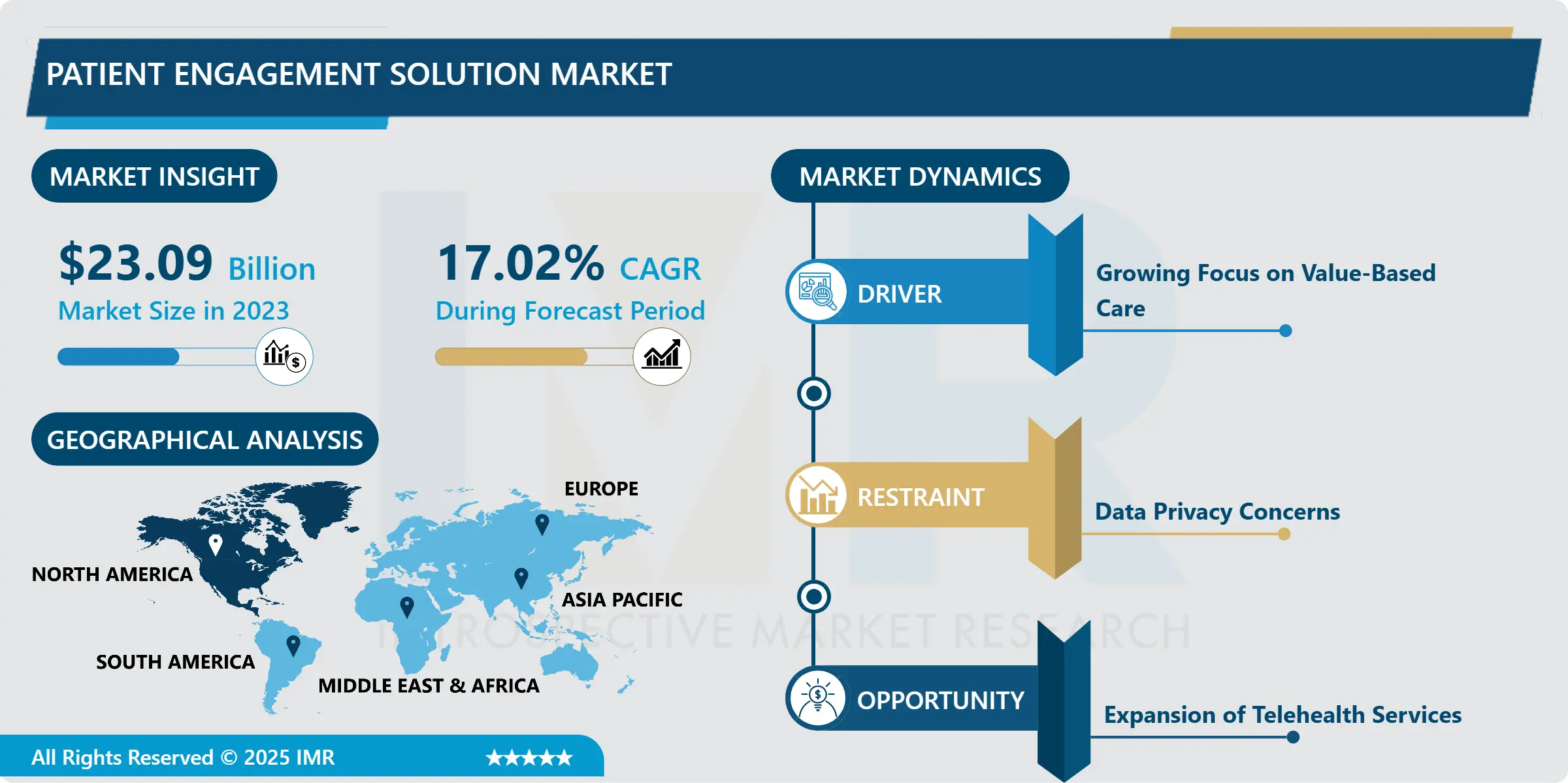
Patient Engagement Solution Market Size Was Valued at USD 23.09 Billion in 2023, and is Projected to Reach USD 95.01 Billion by 2032, Growing at a CAGR of 17.02% From 2024-2032.
The Patient Engagement Solution Market consists of various technological tools and services that help in interacting with the patient on one hand and the healthcare givers on the other hand. It seeks to redefine patient experience, optimise health, contribute towards patient engagement via digital platforms, mHealth tools & more.
The Patient Engagement Solution Market is relatively new but has developed a growing imperative over the past few years as healthcare providers seek to better engage with their patients. With changing healthcare environment focusing on value based care, patient engagement is the key to improve the health. Engagement, therefore, not only helps for patients to embrace full responsibilities over their healthcare but also helps with compliance to care and medications. Therefore, patient engagement solutions have become more popular among healthcare organizations to improve efficient communication, patient satisfaction and use of resources.
A number of factors explain the growth of patient engagement solution market as mentioned below. Increasing incidences of chronic diseases, continuously aging population and access to health care technologies are forcing health care managers to look for new methods of patient involvement. In addition, COVID-19 increased the use of tele- and digital health services, which also implies the importance of meaningful patient communication. As such, specifically, there has been a growing expenditure on mobile applications and patient portals that allow providers to communicate with patients. They repost this trend because health care organizations are increasingly focusing on the needs of patients.
Patient Engagement Solution Market Trend Analysis:
Digital Health Integration
The Patient Engagement Solution Market has identified the digital health integration as one of the trends that is defining the market. It indicates that several technology solutions are being advanced in the healthcare programs, and thus, patient engagement is commonly seen as the amalgamation of diverse digital health tools. It contributes to the efficiency of the Health care givers but also ensures that the patients within the health system receive an integrated journey throughout the various systems. Patients are given a single point to access their information, appointments, and to communicate with healthcare providers in ways that help them to engage better with their physicians.
Through the use of technologies in the management of health, data gathered can easily be shared and can be highly useful for more effective and efficient one-on-one communication. For example, wearable should help monitor the clients’ health status and send data to their healthcare providers so as to enhance provision of care. For this reason, healthcare organizations are currently being used in a selection of the primary interoperability solutions to allow the communication of different digital health systems. It is therefore expected that this trend will persist as patient involvement shifts to technology centric approaches which integrates patient and healthcare provider interactions.
Expansion of Telehealth Services
With the advancement in technology, particularly in telehealth services, a significant opportunity lies in expansion of the Patient Engagement Solution Market. As patients are going for remote health options, service options to avail remote health options, remote consultation, and regular touchpoints with the health care provider are much in demand. On the same note, Telehealth avails basic health care to patients who otherwise could not access the services, and also responds to the culture that is fast emerging in the society where people want care to fit in their schedules. As a result, interest in patient engagement solutions that would complement telehealth capabilities in healthcare organizations is apparent.
The development of telecare services give healthcare provider possibility to interact with patients more actively out of formal environment. Using programs into telehealth platforms, the providers are capable of promoting and sustaining the involvement of the patients in their care paths. By appointment reminding, follow-up messages, and informational materials, electronic communication can be used in appointment scheduling. Given that the use of telehealth is steadily growing, the patient engagement solution market can expect to benefit greatly from the need for technologies that enable integrated delivery of virtual care.
Patient Engagement Solution Market Segment Analysis:
Patient Engagement Solution Market is Segmented on the basis of Component, Delivery Mode, Application, End user, and Region.
By Component, Services segment is expected to dominate the market during the forecast period
Patient engagement tools refer to software applications and platforms that can help support communication, workflows, and more importantly, patient’s information. These solutions may have integrated functionalities including patient virtual access, scheduling & reminders mechanisms, and messaging applications that enhance real time interaction between the patient and care giver. The need for software applications that help accommodate individualized approach towards patients and can help enhance patient satisfaction is on the rise. Although in many case, hardware element in the patient engagement solution market does not as significant as software, real devices, including tablet, kiosk and mHealth devices are of strategic importance to patient engagement. These tools are utilized within ‘health-care’ settings to afford patient’s simple approaches to information and services. The merging of the hardware to the software solutions brings the overall patient relations experience to a whole new level making engagement strategies even more interactive.
Participation services can be described broadly as consisting of consulting, implementation, training, and support. These services are essential for healthcare organisations that seek to leapfrog or enhance patient engagement solutions. Third, providers may need advice on their implementation solutions because they may lack ideas on what is best to do, how it is to be implemented or where to seek implementation support. There is a constant increase in the demand for patient engagement because increasing numbers of healthcare organizations realize their significance, and this creates a need for services to implement them.
By Application, Health Management segment expected to held the largest share
Another emerging mHealth application is in health management whereQMHCassy aims to improve patient’s ability to manage their diseases through providing tools for monitoring their health status, taking medications, and improving their quality of life. These applications allow patients to develop personal health targets, receive clinician-supplied medication advice and appointment notifications, gain instructional health information. Through self-management, the health management solutions therefore carry the responsibility of advancing patient’s status and preventing re-admission into hospitals. Psychosocial management applications are applications designed for the management of social and behavioural requirements of patients. These solutions help foster interaction between care givers and patients, hence creating solution for mental illness, health behavioral modifications and social indicators. The above applications help bring in the patients in managing their care, acknowledge the fact that the social and behavioral aspects play a crucial role in enhancing patients’ health status.
Home healthcare management applications are mainly targeted at patients who receive their treatment at home. These solutions may be telemonitoring or telehealth functions as well as care coordination that enable messaging between patients, caregivers, and physicians. As home care continues to evolve as the go-to solution in the healthcare sector these apps are very important in supporting patients to continue enjoying their independence and quality life. Mobile financial health management applications are designed to help patients in terms of reimbursement and healthcare finances. These solutions offer support to be had for controlling clinical expenditures; clarification of insurance coverage; and details on monetary support entitlements. Through removing the finances obstacles to care, these applications increase patients’ involvement and guarantee that patients know what they are paying for and thus come up with wise decisions.
Patient Engagement Solution Market Regional Insights:
North America is Expected to Dominate the Market Over the Forecast period
North America is ruling the Patient Engagement Solution Market due to better health care infrastructure, suitable technology use, and focus on the patient. The funding for technologies that improve engagement with the patient has seen a dramatic increase in the region’s healthcare systems. In addition, advances in telehealth and mobile health have instigated the need for Patient Engagement Solutions, thus putting North America at the forefront in the market.
Also, North America’s regulatory scenario favours patient engagement solutions cognisance with efforts targeted toward enhancing healthcare quality and patient outcome. This in addition to government support on digital health agendas and shift to value-based care models assertions thus explain why the region leads. With the focus on patient engagement still being an essential aspect within healthcare organizations, North America should continue to dominate the market and inspire development of relevant patient engagement solutions.
Active Key Players in the Patient Engagement Solution Market:
Epic Systems Corporation (USA)
Cerner Corporation (USA)
Allscripts Healthcare Solutions (USA)
McKesson Corporation (USA)
Athenahealth, Inc. (USA)
Philips Healthcare (Netherlands)
IBM Watson Health (USA)
Siemens Healthineers (Germany)
Medtronic (Ireland)Oracle Corporation (USA)
Salesforce.com, Inc. (USA)
Medidata Solutions, Inc. (USA), and Other Active Players
Key Industry Developments in the Patient Engagement Solution Market:
In April 2024, Greenway Health partnered with Ambient AI Assistant Nabla, integrating latter’s leading AI technology into Greenway’s EHR solutions to enable clinicians to save up to two hours per day through AI-powered clinical documentation, alleviating administrative burdens and enhancing patient engagement by allowing providers to focus on delivering quality care.
In April 2024, Matrix Medical Network partnered with Linkwell Health, to leverage Linkwell’s omnichannel engagement platform and expertise in patient activation to drive utilization of Matrix’s services, enhance patient experience, and empower individuals to achieve better health outcomes by meeting them where they live.
In February 2024, Riverside Doctors’ Hospital published study in the success with the use of Upfront Healthcare’s patient engagement platform for orthopedic total joint care cases including hip and knee replacement.
In September 2023, Zocdoc launched Zocdoc Practice Solutions, a suite of free tools for patient engagement for use by the healthcare providers.
Chapter 1: Introduction
1.1 Scope and Coverage
Chapter 2:Executive Summary
Chapter 3: Market Landscape
3.1 Market Dynamics
3.1.1 Drivers
3.1.2 Restraints
3.1.3 Opportunities
3.1.4 Challenges
3.2 Market Trend Analysis
3.3 PESTLE Analysis
3.4 Porter’s Five Forces Analysis
3.5 Industry Value Chain Analysis
3.6 Ecosystem
3.7 Regulatory Landscape
3.8 Price Trend Analysis
3.9 Patent Analysis
3.10 Technology Evolution
3.11 Investment Pockets
3.12 Import-Export Analysis
Chapter 4: Patient Engagement Solution Market by Component
4.1 Patient Engagement Solution Market Snapshot and Growth Engine
4.2 Patient Engagement Solution Market Overview
4.3 Software
4.3.1 Introduction and Market Overview
4.3.2 Historic and Forecasted Market Size in Value USD and Volume Units (2017-2032F)
4.3.3 Key Market Trends, Growth Factors and Opportunities
4.3.4 Software: Geographic Segmentation Analysis
4.4 Hardware
4.4.1 Introduction and Market Overview
4.4.2 Historic and Forecasted Market Size in Value USD and Volume Units (2017-2032F)
4.4.3 Key Market Trends, Growth Factors and Opportunities
4.4.4 Hardware: Geographic Segmentation Analysis
4.5 Services
4.5.1 Introduction and Market Overview
4.5.2 Historic and Forecasted Market Size in Value USD and Volume Units (2017-2032F)
4.5.3 Key Market Trends, Growth Factors and Opportunities
4.5.4 Services: Geographic Segmentation Analysis
Chapter 5: Patient Engagement Solution Market by Delivery Mode
5.1 Patient Engagement Solution Market Snapshot and Growth Engine
5.2 Patient Engagement Solution Market Overview
5.3 On-Premise
5.3.1 Introduction and Market Overview
5.3.2 Historic and Forecasted Market Size in Value USD and Volume Units (2017-2032F)
5.3.3 Key Market Trends, Growth Factors and Opportunities
5.3.4 On-Premise: Geographic Segmentation Analysis
5.4 Cloud-Based
5.4.1 Introduction and Market Overview
5.4.2 Historic and Forecasted Market Size in Value USD and Volume Units (2017-2032F)
5.4.3 Key Market Trends, Growth Factors and Opportunities
5.4.4 Cloud-Based: Geographic Segmentation Analysis
Chapter 6: Patient Engagement Solution Market by Application
6.1 Patient Engagement Solution Market Snapshot and Growth Engine
6.2 Patient Engagement Solution Market Overview
6.3 Health Management
6.3.1 Introduction and Market Overview
6.3.2 Historic and Forecasted Market Size in Value USD and Volume Units (2017-2032F)
6.3.3 Key Market Trends, Growth Factors and Opportunities
6.3.4 Health Management: Geographic Segmentation Analysis
6.4 Social and Behavioral Management
6.4.1 Introduction and Market Overview
6.4.2 Historic and Forecasted Market Size in Value USD and Volume Units (2017-2032F)
6.4.3 Key Market Trends, Growth Factors and Opportunities
6.4.4 Social and Behavioral Management: Geographic Segmentation Analysis
6.5 Home Healthcare Management
6.5.1 Introduction and Market Overview
6.5.2 Historic and Forecasted Market Size in Value USD and Volume Units (2017-2032F)
6.5.3 Key Market Trends, Growth Factors and Opportunities
6.5.4 Home Healthcare Management: Geographic Segmentation Analysis
6.6 Financial Health Management
6.6.1 Introduction and Market Overview
6.6.2 Historic and Forecasted Market Size in Value USD and Volume Units (2017-2032F)
6.6.3 Key Market Trends, Growth Factors and Opportunities
6.6.4 Financial Health Management: Geographic Segmentation Analysis
Chapter 7: Patient Engagement Solution Market by End User
7.1 Patient Engagement Solution Market Snapshot and Growth Engine
7.2 Patient Engagement Solution Market Overview
7.3 Healthcare Providers
7.3.1 Introduction and Market Overview
7.3.2 Historic and Forecasted Market Size in Value USD and Volume Units (2017-2032F)
7.3.3 Key Market Trends, Growth Factors and Opportunities
7.3.4 Healthcare Providers: Geographic Segmentation Analysis
7.4 Patients
7.4.1 Introduction and Market Overview
7.4.2 Historic and Forecasted Market Size in Value USD and Volume Units (2017-2032F)
7.4.3 Key Market Trends, Growth Factors and Opportunities
7.4.4 Patients: Geographic Segmentation Analysis
7.5 Payers
7.5.1 Introduction and Market Overview
7.5.2 Historic and Forecasted Market Size in Value USD and Volume Units (2017-2032F)
7.5.3 Key Market Trends, Growth Factors and Opportunities
7.5.4 Payers: Geographic Segmentation Analysis
7.6 Others
7.6.1 Introduction and Market Overview
7.6.2 Historic and Forecasted Market Size in Value USD and Volume Units (2017-2032F)
7.6.3 Key Market Trends, Growth Factors and Opportunities
7.6.4 Others: Geographic Segmentation Analysis
Chapter 8: Patient Engagement Solution Market by Therapeutic Area
8.1 Patient Engagement Solution Market Snapshot and Growth Engine
8.2 Patient Engagement Solution Market Overview
8.3 Chronic Diseases
8.3.1 Introduction and Market Overview
8.3.2 Historic and Forecasted Market Size in Value USD and Volume Units (2017-2032F)
8.3.3 Key Market Trends, Growth Factors and Opportunities
8.3.4 Chronic Diseases: Geographic Segmentation Analysis
8.4 Fitness
8.4.1 Introduction and Market Overview
8.4.2 Historic and Forecasted Market Size in Value USD and Volume Units (2017-2032F)
8.4.3 Key Market Trends, Growth Factors and Opportunities
8.4.4 Fitness: Geographic Segmentation Analysis
8.5 Women’s Health
8.5.1 Introduction and Market Overview
8.5.2 Historic and Forecasted Market Size in Value USD and Volume Units (2017-2032F)
8.5.3 Key Market Trends, Growth Factors and Opportunities
8.5.4 Women’s Health: Geographic Segmentation Analysis
8.6 Mental Health
8.6.1 Introduction and Market Overview
8.6.2 Historic and Forecasted Market Size in Value USD and Volume Units (2017-2032F)
8.6.3 Key Market Trends, Growth Factors and Opportunities
8.6.4 Mental Health: Geographic Segmentation Analysis
8.7 Others
8.7.1 Introduction and Market Overview
8.7.2 Historic and Forecasted Market Size in Value USD and Volume Units (2017-2032F)
8.7.3 Key Market Trends, Growth Factors and Opportunities
8.7.4 Others: Geographic Segmentation Analysis
Chapter 9: Company Profiles and Competitive Analysis
9.1 Competitive Landscape
9.1.1 Competitive Benchmarking
9.1.2 Patient Engagement Solution Market Share by Manufacturer (2023)
9.1.3 Industry BCG Matrix
9.1.4 Heat Map Analysis
9.1.5 Mergers and Acquisitions
9.2 EPIC SYSTEMS CORPORATION (USA)
9.2.1 Company Overview
9.2.2 Key Executives
9.2.3 Company Snapshot
9.2.4 Role of the Company in the Market
9.2.5 Sustainability and Social Responsibility
9.2.6 Operating Business Segments
9.2.7 Product Portfolio
9.2.8 Business Performance
9.2.9 Key Strategic Moves and Recent Developments
9.2.10 SWOT Analysis
9.3 CERNER CORPORATION (USA)
9.4 ALLSCRIPTS HEALTHCARE SOLUTIONS (USA)
9.5 MCKESSON CORPORATION (USA)
9.6 ATHENAHEALTH INC. (USA)
9.7 PHILIPS HEALTHCARE (NETHERLANDS)
9.8 IBM WATSON HEALTH (USA)
9.9 SIEMENS HEALTHINEERS (GERMANY)
9.10 MEDTRONIC (IRELAND)
9.11 ORACLE CORPORATION (USA)
9.12 SALESFORCE.COM INC. (USA)
9.13 MEDIDATA SOLUTIONS INC. (USA)
9.14 OTHER ACTIVE PLAYERS
Chapter 10: Global Patient Engagement Solution Market By Region
10.1 Overview
10.2. North America Patient Engagement Solution Market
10.2.1 Key Market Trends, Growth Factors and Opportunities
10.2.2 Top Key Companies
10.2.3 Historic and Forecasted Market Size by Segments
10.2.4 Historic and Forecasted Market Size By Component
10.2.4.1 Software
10.2.4.2 Hardware
10.2.4.3 Services
10.2.5 Historic and Forecasted Market Size By Delivery Mode
10.2.5.1 On-Premise
10.2.5.2 Cloud-Based
10.2.6 Historic and Forecasted Market Size By Application
10.2.6.1 Health Management
10.2.6.2 Social and Behavioral Management
10.2.6.3 Home Healthcare Management
10.2.6.4 Financial Health Management
10.2.7 Historic and Forecasted Market Size By End User
10.2.7.1 Healthcare Providers
10.2.7.2 Patients
10.2.7.3 Payers
10.2.7.4 Others
10.2.8 Historic and Forecasted Market Size By Therapeutic Area
10.2.8.1 Chronic Diseases
10.2.8.2 Fitness
10.2.8.3 Women’s Health
10.2.8.4 Mental Health
10.2.8.5 Others
10.2.9 Historic and Forecast Market Size by Country
10.2.9.1 US
10.2.9.2 Canada
10.2.9.3 Mexico
10.3. Eastern Europe Patient Engagement Solution Market
10.3.1 Key Market Trends, Growth Factors and Opportunities
10.3.2 Top Key Companies
10.3.3 Historic and Forecasted Market Size by Segments
10.3.4 Historic and Forecasted Market Size By Component
10.3.4.1 Software
10.3.4.2 Hardware
10.3.4.3 Services
10.3.5 Historic and Forecasted Market Size By Delivery Mode
10.3.5.1 On-Premise
10.3.5.2 Cloud-Based
10.3.6 Historic and Forecasted Market Size By Application
10.3.6.1 Health Management
10.3.6.2 Social and Behavioral Management
10.3.6.3 Home Healthcare Management
10.3.6.4 Financial Health Management
10.3.7 Historic and Forecasted Market Size By End User
10.3.7.1 Healthcare Providers
10.3.7.2 Patients
10.3.7.3 Payers
10.3.7.4 Others
10.3.8 Historic and Forecasted Market Size By Therapeutic Area
10.3.8.1 Chronic Diseases
10.3.8.2 Fitness
10.3.8.3 Women’s Health
10.3.8.4 Mental Health
10.3.8.5 Others
10.3.9 Historic and Forecast Market Size by Country
10.3.9.1 Russia
10.3.9.2 Bulgaria
10.3.9.3 The Czech Republic
10.3.9.4 Hungary
10.3.9.5 Poland
10.3.9.6 Romania
10.3.9.7 Rest of Eastern Europe
10.4. Western Europe Patient Engagement Solution Market
10.4.1 Key Market Trends, Growth Factors and Opportunities
10.4.2 Top Key Companies
10.4.3 Historic and Forecasted Market Size by Segments
10.4.4 Historic and Forecasted Market Size By Component
10.4.4.1 Software
10.4.4.2 Hardware
10.4.4.3 Services
10.4.5 Historic and Forecasted Market Size By Delivery Mode
10.4.5.1 On-Premise
10.4.5.2 Cloud-Based
10.4.6 Historic and Forecasted Market Size By Application
10.4.6.1 Health Management
10.4.6.2 Social and Behavioral Management
10.4.6.3 Home Healthcare Management
10.4.6.4 Financial Health Management
10.4.7 Historic and Forecasted Market Size By End User
10.4.7.1 Healthcare Providers
10.4.7.2 Patients
10.4.7.3 Payers
10.4.7.4 Others
10.4.8 Historic and Forecasted Market Size By Therapeutic Area
10.4.8.1 Chronic Diseases
10.4.8.2 Fitness
10.4.8.3 Women’s Health
10.4.8.4 Mental Health
10.4.8.5 Others
10.4.9 Historic and Forecast Market Size by Country
10.4.9.1 Germany
10.4.9.2 UK
10.4.9.3 France
10.4.9.4 The Netherlands
10.4.9.5 Italy
10.4.9.6 Spain
10.4.9.7 Rest of Western Europe
10.5. Asia Pacific Patient Engagement Solution Market
10.5.1 Key Market Trends, Growth Factors and Opportunities
10.5.2 Top Key Companies
10.5.3 Historic and Forecasted Market Size by Segments
10.5.4 Historic and Forecasted Market Size By Component
10.5.4.1 Software
10.5.4.2 Hardware
10.5.4.3 Services
10.5.5 Historic and Forecasted Market Size By Delivery Mode
10.5.5.1 On-Premise
10.5.5.2 Cloud-Based
10.5.6 Historic and Forecasted Market Size By Application
10.5.6.1 Health Management
10.5.6.2 Social and Behavioral Management
10.5.6.3 Home Healthcare Management
10.5.6.4 Financial Health Management
10.5.7 Historic and Forecasted Market Size By End User
10.5.7.1 Healthcare Providers
10.5.7.2 Patients
10.5.7.3 Payers
10.5.7.4 Others
10.5.8 Historic and Forecasted Market Size By Therapeutic Area
10.5.8.1 Chronic Diseases
10.5.8.2 Fitness
10.5.8.3 Women’s Health
10.5.8.4 Mental Health
10.5.8.5 Others
10.5.9 Historic and Forecast Market Size by Country
10.5.9.1 China
10.5.9.2 India
10.5.9.3 Japan
10.5.9.4 South Korea
10.5.9.5 Malaysia
10.5.9.6 Thailand
10.5.9.7 Vietnam
10.5.9.8 The Philippines
10.5.9.9 Australia
10.5.9.10 New Zealand
10.5.9.11 Rest of APAC
10.6. Middle East & Africa Patient Engagement Solution Market
10.6.1 Key Market Trends, Growth Factors and Opportunities
10.6.2 Top Key Companies
10.6.3 Historic and Forecasted Market Size by Segments
10.6.4 Historic and Forecasted Market Size By Component
10.6.4.1 Software
10.6.4.2 Hardware
10.6.4.3 Services
10.6.5 Historic and Forecasted Market Size By Delivery Mode
10.6.5.1 On-Premise
10.6.5.2 Cloud-Based
10.6.6 Historic and Forecasted Market Size By Application
10.6.6.1 Health Management
10.6.6.2 Social and Behavioral Management
10.6.6.3 Home Healthcare Management
10.6.6.4 Financial Health Management
10.6.7 Historic and Forecasted Market Size By End User
10.6.7.1 Healthcare Providers
10.6.7.2 Patients
10.6.7.3 Payers
10.6.7.4 Others
10.6.8 Historic and Forecasted Market Size By Therapeutic Area
10.6.8.1 Chronic Diseases
10.6.8.2 Fitness
10.6.8.3 Women’s Health
10.6.8.4 Mental Health
10.6.8.5 Others
10.6.9 Historic and Forecast Market Size by Country
10.6.9.1 Turkiye
10.6.9.2 Bahrain
10.6.9.3 Kuwait
10.6.9.4 Saudi Arabia
10.6.9.5 Qatar
10.6.9.6 UAE
10.6.9.7 Israel
10.6.9.8 South Africa
10.7. South America Patient Engagement Solution Market
10.7.1 Key Market Trends, Growth Factors and Opportunities
10.7.2 Top Key Companies
10.7.3 Historic and Forecasted Market Size by Segments
10.7.4 Historic and Forecasted Market Size By Component
10.7.4.1 Software
10.7.4.2 Hardware
10.7.4.3 Services
10.7.5 Historic and Forecasted Market Size By Delivery Mode
10.7.5.1 On-Premise
10.7.5.2 Cloud-Based
10.7.6 Historic and Forecasted Market Size By Application
10.7.6.1 Health Management
10.7.6.2 Social and Behavioral Management
10.7.6.3 Home Healthcare Management
10.7.6.4 Financial Health Management
10.7.7 Historic and Forecasted Market Size By End User
10.7.7.1 Healthcare Providers
10.7.7.2 Patients
10.7.7.3 Payers
10.7.7.4 Others
10.7.8 Historic and Forecasted Market Size By Therapeutic Area
10.7.8.1 Chronic Diseases
10.7.8.2 Fitness
10.7.8.3 Women’s Health
10.7.8.4 Mental Health
10.7.8.5 Others
10.7.9 Historic and Forecast Market Size by Country
10.7.9.1 Brazil
10.7.9.2 Argentina
10.7.9.3 Rest of SA
Chapter 11 Analyst Viewpoint and Conclusion
11.1 Recommendations and Concluding Analysis
11.2 Potential Market Strategies
Chapter 12 Research Methodology
12.1 Research Process
12.2 Primary Research
12.3 Secondary Research
Q1: What would be the forecast period in the Patient Engagement Solution Market research report?
A1: The forecast period in the Patient Engagement Solution Market research report is 2024-2032.
Q2: Who are the key players in the Patient Engagement Solution Market?
A2: Epic Systems Corporation (USA), Cerner Corporation (USA), Allscripts Healthcare Solutions (USA), McKesson Corporation (USA), Athenahealth, Inc. (USA), Philips Healthcare (Netherlands), IBM Watson Health (USA), Siemens Healthineers (Germany), Medtronic (Ireland), Oracle Corporation (USA), Salesforce.com, Inc. (USA), Medidata Solutions, Inc. (USA) and Other Active Players.
Q3: What are the segments of the Patient Engagement Solution Market?
A3: The Patient Engagement Solution Market is segmented into Component, Delivery Mode, End User, Application, Therapeutic Area, and Region. By Component, the market is categorized into Software, Hardware, Services. By Delivery Mode, the market is categorized into On-Premise, Cloud-Based. By Application, the market is categorized into Health Management, Social and Behavioral Management, Home Healthcare Management, and Financial Health Management. By End User, the market is categorized into Healthcare Providers, Patients, Payers, and Others. By therapeutic Area, the market is categorized into Chronic Diseases, Fitness, Women's Health, Mental Health, and Others. By region, it is analyzed across North America (U.S., Canada, Mexico), Eastern Europe (Russia, Bulgaria, The Czech Republic, Hungary, Poland, Romania, Rest of Eastern Europe), Western Europe (Germany, UK, France, Netherlands, Italy, Spain, Rest of Western Europe), Asia Pacific (China, India, Japan, South Korea, Malaysia, Thailand, Vietnam, The Philippines, Australia, New Zealand, Rest of APAC), Middle East & Africa (Turkiye, Bahrain, Kuwait, Saudi Arabia, Qatar, UAE, Israel, South Africa), South America (Brazil, Argentina, Rest of SA).
Q4: What is the Patient Engagement Solution Market?
A4: The Patient Engagement Solution Market consists of various technological tools and services that help in interacting with the patient on one hand and the healthcare givers on the other hand. It seeks to redefine patient experience, optimise health, contribute towards patient engagement via digital platforms, mHealth tools & more.
Q5: How big is the Patient Engagement Solution Market?
A5: Patient Engagement Solution Market Size Was Valued at USD 23.09 Billion in 2023, and is Projected to Reach USD 95.01 Billion by 2032, Growing at a CAGR of 17.02% From 2024-2032.
How to Buy a Report from eminsights.jp
On the product page, choose the license you want: Single-User License, Multi-User License or Enterprise License.
If you required report in your native language, then you can click on Translated Report button and fill out the form with report name and language you want, then our team will contact you as soon as possible.
Click the Buy Now button.
You will be redirected to the checkout page. Enter your company details and payment information.
Click Place Order to complete the purchase.
Confirmation: You’ll receive an order confirmation and our team will contact you shortly with your ordered report.
If you have any questions, fill out the contact form below or email us at [email protected].
Thank you for choosing eminsights.jp!