Stay Ahead in Fast-Growing Economies.
Browse Reports Now




Patient Temperature Management Systems Market Size, Share & Forecast (2024-2032)
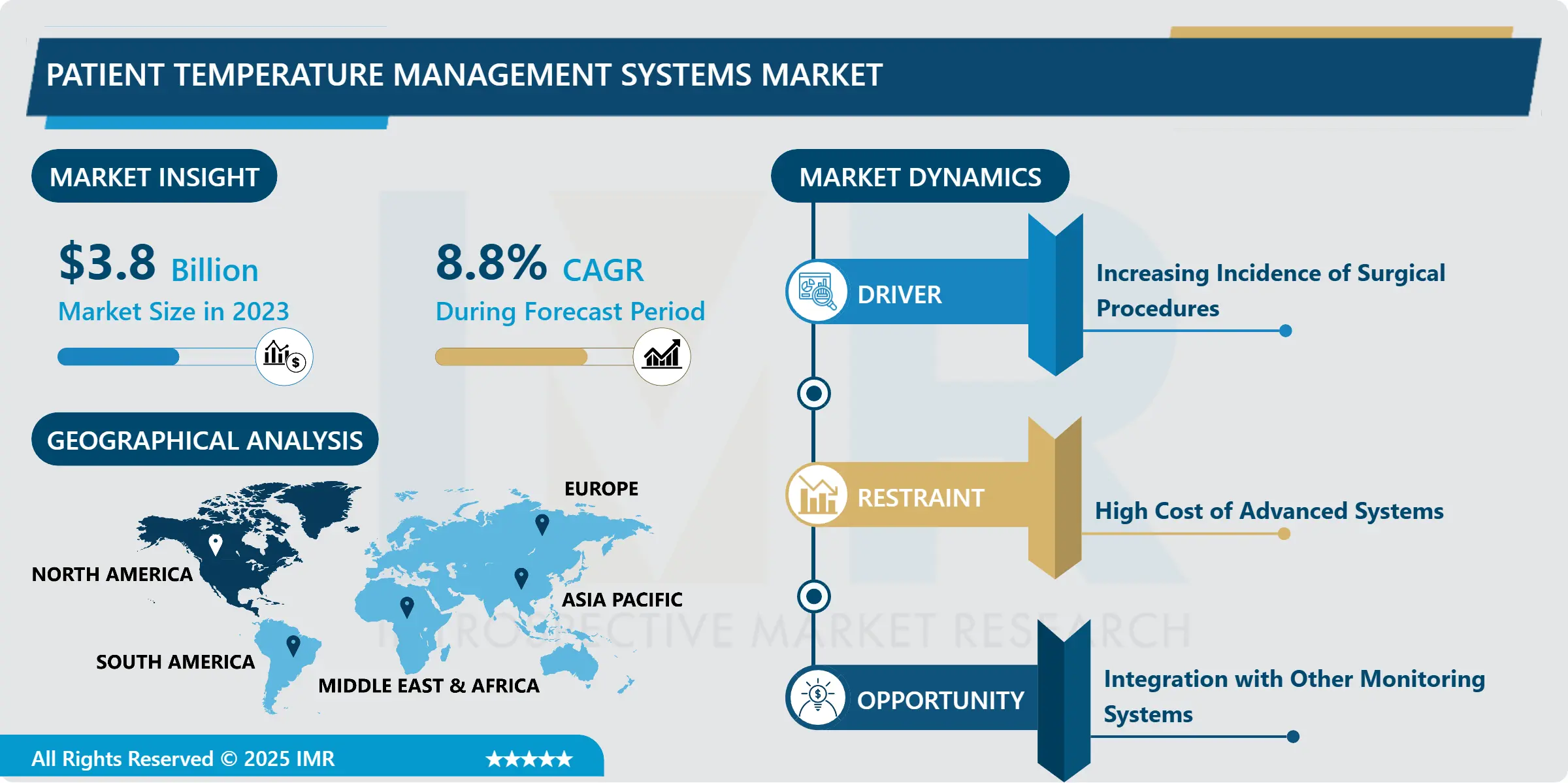
Patient Temperature Management Systems Market Size Was Valued at USD 3.80 Billion in 2023, and is Projected to Reach USD 8.12 Billion by 2032, Growing at a CAGR of 8.80% From 2024-2032.

IMR Group
Description
Patient Temperature Management Systems Market Synopsis:
Patient Temperature Management Systems Market Size Was Valued at USD 3.80 Billion in 2023, and is Projected to Reach USD 8.12 Billion by 2032, Growing at a CAGR of 8.80% From 2024-2032.
Patient Temperature Management Systems (PTMS) are medical technologies utilized for the purpose of monitoring and controlling patient’s body temperature during surgery, within an intensive care unit or during rehabilitation. These systems are necessary if patients are not to suffer from hypothermia or hyperthermia and outcome must be improved. Different techniques like the use of warming blankets axillary temperature regulation devices and thermostatic control is used by PTMS to control the temperature. Due to heat and cold management these systems make medical procedures safer, effective and precise and minimizes effects of thermal stress.
Patient temperature management systems PTMS has grown rapidly in the last few years due to the growing concern of the patient on comfort during treatments.. Being aware of the significance of temperature control in surgery, the critical care and in the postoperative period, demand for efficient temperature control product has escalated. PTMS comprise a range of pieces of equipment and technologies, serving to control and, in particular, to measure patient temperature to decrease the likelihood of hypothermia or hyperthermia throughout certain medical procedures. These systems have an essential position in improving patient lives, especially in the vulnerable population, making it current recognizing in most hospitals, surgical centers, and emergency departments.• There is great variability of products with the market offering products such as warming and cooling blankets, surface warming system and intravascular temperature management devices.healthcare settings. As medical professionals recognize the critical role of temperature regulation in surgical procedures, critical care, and postoperative recovery, the demand for effective temperature management solutions has surged. PTMS encompass a variety of devices and technologies designed to maintain and monitor patient body temperature, thereby reducing the risk of hypothermia and hyperthermia during medical treatments. These systems play a pivotal role in enhancing patient outcomes, particularly in high-risk populations, which has led to widespread adoption across hospitals, surgical centers, and emergency departments.
The market is characterized by a diverse range of products, including warming and cooling blankets, surface warming systems, and intravascular temperature management devices. Subsequent developments in technology have also continue to push market growth forward, including wireless monitoring systems and system that can control the patient’s temperature and feeds real time information to healthcare practitioners. Thanks to the ever increasing elderly population and the rising trend in operations especially the less invasive ones, there is a strong market for PTMS. Secondly, the regulatory authorities are setting high standards related to temperature control in care delivery, which promotes market growth as care providers focus on meeting these standards.Suprisingly, at the regional level, North America remains the largest PTMS market primarily due to, a well-developed healthcare system, high-per capita health care spending, and increasing patient safety trends. But the Asia-Pacific region is anticipated to increase at the highest growth rate during the forecast period. These growth factors include advancement in healthcare technology, higher disposal income per capital, and growth in the patient base. Health care investment is also on the rise in emerging economies that are consequently fueling the trend in the use of scientific medical technology such as PTMS. Dosimetric rivalry within the market remains concentrated within significant players who are targeting various strategies such as partnership, acquisition, and merger to strengthen their position within the marketplace.As a final note, the Patient Temperature Management Systems market remains in good stead as more key stakeholders within the healthcare industry look to improve the wellbeing, safety and comfort of patients. The last three points mention also indicate that such tendencies as the integration of advanced technologies and the emphasis on the regulation of certain activities will also continue to drive the market. The PTMS market will only grow with the development of healthcare delivery systems that require its solutions, it will only improve services and systems to serve both the patient and healthcare provider needs in line with the changing environment of clinical care.
Patient Temperature Management Systems Market Trend Analysis:
Emerging Trends in the Patient Temperature Management Systems Market
A gradual transition of PTMS from fixed to portable and user-friendly has already given a new orientation to the market. Since numerous operations are performed on an outpatient basis, and home care services are being provided, there is a growing need for temperature management solutions that can be implemented outside of clinical hospitals. This trend has forced manufacturers to seek better design type and high performance while coming up with small and light PTMS. Apart from increasing the portability of temperature management, these innovations also increase patients’ comfort and safety during rehabilitation and contribute to the healthcare improvement.• Furthermore, the concept of the development of patient preferences is pushing for the specific temperature management for each patient.eries and home healthcare services gain traction, there is an increasing demand for temperature management solutions that are easily deployable outside traditional hospital settings. This trend has prompted manufacturers to innovate in the design and functionality of PTMS, resulting in compact and lightweight devices that maintain high performance. These portable solutions not only enhance the convenience of temperature regulation but also improve patient comfort and safety during recovery, ultimately contributing to better healthcare outcomes.
Moreover, the emphasis on personalized medicine is driving the development of customized temperature management protocols tailored to individual patient needs. As the knowledge that patients may have different responses to the fluctuations in temperature rises manufacturers are actively working on developmental research on making systems that can be tailored to meet clinical situations. This focus on those approaches increases the effectiveness of PTMS in o configuring it to the specifications relevant to patients. Therefore, the market is gradually shifting to greater competitiveness as players seek to introduce new products that would not only meet the legal requirements but also provide value for the patients in various care facilities.
Advancements in the Patient Temperature Management Systems Market
Currently the Adoption of advanced technologies like artificial intelligence (AI), and the Internet of Things (IoT) into patient temperature management systems (PTMS) is dramatically changing the ways that patient temperature are monitored.. Such technologies enable the monitoring of patients’ temperature; caregivers or physicians are alerted the moment a patient’s temperature is outside the normal limit. This capability not only increases the efficiency with which monitoring can be achieved but also enables early interventions to be done which greatly benefit the patients. Big data can be processed by the help of the AI and provide patterns and possible future complicated situation, which will help the healthcare professionals in making proper clinical decisions. Consequently, healthcare care end users are now understanding the benefits of these complex systems; thereby resulting in higher expenditure towards complex temperature management solutions.• Further, PTMS is expected to have a lot of market potential, especially in the developed countries who have well developed healthcare systems.t Systems (PTMS) is revolutionizing how patient temperatures are monitored and managed. These technologies facilitate real-time tracking of patients’ temperatures, allowing healthcare providers to receive immediate alerts when a patient’s temperature deviates from the norm. This capability not only enhances monitoring efficiency but also supports timely interventions, which can significantly improve patient outcomes. AI algorithms can analyze vast amounts of data to identify patterns and predict potential complications, enabling healthcare professionals to make more informed clinical decisions. As a result, healthcare facilities are increasingly recognizing the value of these advanced systems, leading to heightened investments in sophisticated temperature management solutions.
The market for PTMS is poised for substantial growth, especially in developed regions where healthcare infrastructure is well-established. Current advancements in your hospital and healthcare systems are focused on patient safety and effectively delivering quality healthcare, and this has led to promotion of the best temperature management systems. The need for such systems is also expected to increase with a rising number of surgeries, for which temperature regulation after the surgery is crucial to avoid scenarios like hypothermia. Also, growth in home healthcare services is providing chances for portable and easy to use PTMS applicable in other settings but not necessarily clinical. Because of the growing technological systems and the consistent enhancement of patient care, the need for PTMS market is expected to gain momentum with opportunities for development as the market advances.
Patient Temperature Management Systems Market Segment Analysis:
Patient Temperature Management Systems Market is Segmented on the basis of Product, Application, End-use, and Region.
By Product, Conventional Warning Systems segment is expected to dominate the market during the forecast period.
Current traditional alerting systems can be considered as foundational instruments helping to monitor the patient condition, using fundamental, nonautomated methods to assess values and identify changes.. Such systems are based on relatively simple alarm options and signals that highlight certain concerns to healthcare employees and provide for necessary actions. While these systems have proven useful in many different medical environments over the years, they are largely passive in nature, requiring human intervention for observation as well as for reaction. Thus, there is always the possible of human factors for example the alarms issued might be looked and not noticed or the wrong signals may be interpreted such as in stressed conditions.• Although historical approaches to patient safety are important, many of the warning systems provided in modern technologies may not be as sophisticated.se systems are characterized by their use of straightforward alarm functions and visual indicators that alert healthcare staff to potential issues, allowing for prompt intervention. Despite their historical effectiveness in various clinical settings, these systems primarily rely on the vigilance of medical personnel for monitoring and response. Consequently, the potential for human error remains a concern, as alarms may be overlooked or misinterpreted during high-stress situations.
While conventional warning systems have played a critical role in patient safety, they often lack the advanced capabilities found in more modern monitoring technologies. Real-time data analysis key attributes like trends and patterns of patient’s vital signs are usually not supported. In addition, EHR compatibility issues can prevent more precise patient history and reaction to treatments monitoring. This limitation limits the overall flexibility of the system to responding to any changes in the patient, in order to come up with timely and efficiency interventions. With the ongoing advancement in health care the advanced and complex health care systems are required for successful patient monitoring and increase utilization of patients’ data.
By End-use, Operating rooms segment expected to held the largest share
It is shocking of find that warning and cooling systems are essential to operating rooms since accidents carry very high risks and every patient ‘s safety counts.. Evaluation of the physiological parameters including; pulse rate, blood pressure and oxygen levels is particularly crucial during surgery. These systems offer an all-time monitoring of data that means that the surgical teams can note any irregularity at any one time. When values representing patient status show discomfort, appropriate alerts provided may trigger early actions which could reduce adverse effects and facilitate unhampered efforts during the surgery operation. This makes the reporting of data real-time, effectively making patient care to be preventative in nature with surgical teams being able to promptly address changes in the patient’s status.• Besides vital signs, another crucial component is in controlling hypothermia of the patient in surgery.mount. During surgical procedures, real-time monitoring of vital signs such as heart rate, blood pressure, and oxygen saturation is essential for maintaining optimal patient conditions. These systems provide continuous data tracking, enabling surgical teams to detect any abnormalities instantaneously. In cases where patient vitals indicate distress, immediate alerts can prompt quick interventions, potentially preventing complications and ensuring the surgical procedure proceeds smoothly. This immediacy in data reporting fosters a proactive approach to patient care, where surgical teams can respond rapidly to changes in patient conditions.
In addition to monitoring vital signs, cooling systems also play a vital role in managing the patient’s body temperature during surgery. Temperature control is important because fluctuations in temperature have numerous negative effects which include increased bleeding, poor wound healing and complications arising from anesthesia. Through application of up to date cooling systems within the operating room arrangement, there is the capacity to control and regulate the thermal status of the patient at surgery. This dual use of warning and cooling system not only makes patients safer but also helps to generally improve the performance of surgery. The collaboration between these systems fosters an environment where surgical teams can focus on their primary goal: of realizing favorable patient outcomes.
Patient Temperature Management Systems Market Regional Insights:
North America is Expected to Dominate the Market Over the Forecast period
In North America, especially in the United States, the Patient Temperature Management Systems market is well developed due to a high incidence of chronic diseases, as well as the developed healthcare sector. With the ever increasing cases of diseases like cardiovascular diseases, diabetes and respiratory ailments, more healthcare organizations seek to deliver enhanced client outcomes. Technological development of the medical devices has provided hospitals with complex temperature regulation systems that are critically important to obtain and maintain normothermia during surgery and other critical care interventions. Besides, this commitment helps in cutting down the rates of complications and at the same time quickening healing periods that makes management of temperature as one of the functional aspects of the current medical practice. Besides, the existence of the industry’s principal actors and constant innovations is central for market development in this area.by the high prevalence of chronic diseases and a well-established healthcare infrastructure. As chronic conditions such as cardiovascular diseases, diabetes, and respiratory illnesses become more common, healthcare providers are increasingly focused on optimizing patient care. The integration of advanced technological solutions in medical devices has enabled hospitals to adopt sophisticated temperature management systems, which play a crucial role in maintaining normothermia during surgical procedures and critical care. This commitment to improved patient outcomes not only helps in reducing complications but also significantly enhances recovery times, making temperature management an essential component of modern healthcare practices.
Active Key Players in the Patient Temperature Management Systems Market:
Stryker Corporation
Zoll Medical Corporation
Medtronic
BD
Cincinnati Sub-Zero Products,
Gentherm
3M Company
TSC Life
Atom Medical Corporation
ICU Medical
BrainCool AB, Other Active Players
Chapter 1: Introduction
1.1 Scope and Coverage
Chapter 2:Executive Summary
Chapter 3: Market Landscape
3.1 Market Dynamics
3.1.1 Drivers
3.1.2 Restraints
3.1.3 Opportunities
3.1.4 Challenges
3.2 Market Trend Analysis
3.3 PESTLE Analysis
3.4 Porter’s Five Forces Analysis
3.5 Industry Value Chain Analysis
3.6 Ecosystem
3.7 Regulatory Landscape
3.8 Price Trend Analysis
3.9 Patent Analysis
3.10 Technology Evolution
3.11 Investment Pockets
3.12 Import-Export Analysis
Chapter 4: Patient Temperature Management Systems Market by Product
4.1 Patient Temperature Management Systems Market Snapshot and Growth Engine
4.2 Patient Temperature Management Systems Market Overview
4.3 Patient Warning Systems and Patient Cooling Systems
4.3.1 Introduction and Market Overview
4.3.2 Historic and Forecasted Market Size in Value USD and Volume Units (2017-2032F)
4.3.3 Key Market Trends, Growth Factors and Opportunities
4.3.4 Patient Warning Systems and Patient Cooling Systems: Geographic Segmentation Analysis
Chapter 5: Patient Temperature Management Systems Market by Application
5.1 Patient Temperature Management Systems Market Snapshot and Growth Engine
5.2 Patient Temperature Management Systems Market Overview
5.3 General Surgery
5.3.1 Introduction and Market Overview
5.3.2 Historic and Forecasted Market Size in Value USD and Volume Units (2017-2032F)
5.3.3 Key Market Trends, Growth Factors and Opportunities
5.3.4 General Surgery: Geographic Segmentation Analysis
5.4 Cardiology
5.4.1 Introduction and Market Overview
5.4.2 Historic and Forecasted Market Size in Value USD and Volume Units (2017-2032F)
5.4.3 Key Market Trends, Growth Factors and Opportunities
5.4.4 Cardiology: Geographic Segmentation Analysis
5.5 Pediatrics
5.5.1 Introduction and Market Overview
5.5.2 Historic and Forecasted Market Size in Value USD and Volume Units (2017-2032F)
5.5.3 Key Market Trends, Growth Factors and Opportunities
5.5.4 Pediatrics: Geographic Segmentation Analysis
5.6 Neurology
5.6.1 Introduction and Market Overview
5.6.2 Historic and Forecasted Market Size in Value USD and Volume Units (2017-2032F)
5.6.3 Key Market Trends, Growth Factors and Opportunities
5.6.4 Neurology: Geographic Segmentation Analysis
5.7 Orthopaedic Surgery
5.7.1 Introduction and Market Overview
5.7.2 Historic and Forecasted Market Size in Value USD and Volume Units (2017-2032F)
5.7.3 Key Market Trends, Growth Factors and Opportunities
5.7.4 Orthopaedic Surgery: Geographic Segmentation Analysis
5.8 Thoracic Surgery and Others
5.8.1 Introduction and Market Overview
5.8.2 Historic and Forecasted Market Size in Value USD and Volume Units (2017-2032F)
5.8.3 Key Market Trends, Growth Factors and Opportunities
5.8.4 Thoracic Surgery and Others: Geographic Segmentation Analysis
Chapter 6: Patient Temperature Management Systems Market by End-use
6.1 Patient Temperature Management Systems Market Snapshot and Growth Engine
6.2 Patient Temperature Management Systems Market Overview
6.3 Operating rooms
6.3.1 Introduction and Market Overview
6.3.2 Historic and Forecasted Market Size in Value USD and Volume Units (2017-2032F)
6.3.3 Key Market Trends, Growth Factors and Opportunities
6.3.4 Operating rooms: Geographic Segmentation Analysis
6.4 Neonatal Care
6.4.1 Introduction and Market Overview
6.4.2 Historic and Forecasted Market Size in Value USD and Volume Units (2017-2032F)
6.4.3 Key Market Trends, Growth Factors and Opportunities
6.4.4 Neonatal Care: Geographic Segmentation Analysis
6.5 ICUs
6.5.1 Introduction and Market Overview
6.5.2 Historic and Forecasted Market Size in Value USD and Volume Units (2017-2032F)
6.5.3 Key Market Trends, Growth Factors and Opportunities
6.5.4 ICUs: Geographic Segmentation Analysis
6.6 Emergency room
6.6.1 Introduction and Market Overview
6.6.2 Historic and Forecasted Market Size in Value USD and Volume Units (2017-2032F)
6.6.3 Key Market Trends, Growth Factors and Opportunities
6.6.4 Emergency room: Geographic Segmentation Analysis
6.7 Preoperative Care Units
6.7.1 Introduction and Market Overview
6.7.2 Historic and Forecasted Market Size in Value USD and Volume Units (2017-2032F)
6.7.3 Key Market Trends, Growth Factors and Opportunities
6.7.4 Preoperative Care Units: Geographic Segmentation Analysis
6.8 Postoperative Care Units
6.8.1 Introduction and Market Overview
6.8.2 Historic and Forecasted Market Size in Value USD and Volume Units (2017-2032F)
6.8.3 Key Market Trends, Growth Factors and Opportunities
6.8.4 Postoperative Care Units: Geographic Segmentation Analysis
6.9 Acute Care
6.9.1 Introduction and Market Overview
6.9.2 Historic and Forecasted Market Size in Value USD and Volume Units (2017-2032F)
6.9.3 Key Market Trends, Growth Factors and Opportunities
6.9.4 Acute Care: Geographic Segmentation Analysis
6.10 Burn Centers
6.10.1 Introduction and Market Overview
6.10.2 Historic and Forecasted Market Size in Value USD and Volume Units (2017-2032F)
6.10.3 Key Market Trends, Growth Factors and Opportunities
6.10.4 Burn Centers: Geographic Segmentation Analysis
6.11 Cath Labs
6.11.1 Introduction and Market Overview
6.11.2 Historic and Forecasted Market Size in Value USD and Volume Units (2017-2032F)
6.11.3 Key Market Trends, Growth Factors and Opportunities
6.11.4 Cath Labs: Geographic Segmentation Analysis
6.12 Neurological Care Units
6.12.1 Introduction and Market Overview
6.12.2 Historic and Forecasted Market Size in Value USD and Volume Units (2017-2032F)
6.12.3 Key Market Trends, Growth Factors and Opportunities
6.12.4 Neurological Care Units: Geographic Segmentation Analysis
6.13 Others
6.13.1 Introduction and Market Overview
6.13.2 Historic and Forecasted Market Size in Value USD and Volume Units (2017-2032F)
6.13.3 Key Market Trends, Growth Factors and Opportunities
6.13.4 Others: Geographic Segmentation Analysis
Chapter 7: Company Profiles and Competitive Analysis
7.1 Competitive Landscape
7.1.1 Competitive Benchmarking
7.1.2 Patient Temperature Management Systems Market Share by Manufacturer (2023)
7.1.3 Industry BCG Matrix
7.1.4 Heat Map Analysis
7.1.5 Mergers and Acquisitions
7.2 STRYKER CORPORATION
7.2.1 Company Overview
7.2.2 Key Executives
7.2.3 Company Snapshot
7.2.4 Role of the Company in the Market
7.2.5 Sustainability and Social Responsibility
7.2.6 Operating Business Segments
7.2.7 Product Portfolio
7.2.8 Business Performance
7.2.9 Key Strategic Moves and Recent Developments
7.2.10 SWOT Analysis
7.3 ZOLL MEDICAL CORPORATION
7.4 MEDTRONIC
7.5 BD
7.6 CINCINNATI SUB-ZERO PRODUCTS LLC/GENTHERM
7.7 3M COMPANY
7.8 TSC LIFE
7.9 ATOM MEDICAL CORPORATION
7.10 ICU MEDICAL
7.11 BRAINCOOL AB
7.12 OTHER ACTIVE PLAYERS
Chapter 8: Global Patient Temperature Management Systems Market By Region
8.1 Overview
8.2. North America Patient Temperature Management Systems Market
8.2.1 Key Market Trends, Growth Factors and Opportunities
8.2.2 Top Key Companies
8.2.3 Historic and Forecasted Market Size by Segments
8.2.4 Historic and Forecasted Market Size By Product
8.2.4.1 Patient Warning Systems and Patient Cooling Systems
8.2.5 Historic and Forecasted Market Size By Application
8.2.5.1 General Surgery
8.2.5.2 Cardiology
8.2.5.3 Pediatrics
8.2.5.4 Neurology
8.2.5.5 Orthopaedic Surgery
8.2.5.6 Thoracic Surgery and Others
8.2.6 Historic and Forecasted Market Size By End-use
8.2.6.1 Operating rooms
8.2.6.2 Neonatal Care
8.2.6.3 ICUs
8.2.6.4 Emergency room
8.2.6.5 Preoperative Care Units
8.2.6.6 Postoperative Care Units
8.2.6.7 Acute Care
8.2.6.8 Burn Centers
8.2.6.9 Cath Labs
8.2.6.10 Neurological Care Units
8.2.6.11 Others
8.2.7 Historic and Forecast Market Size by Country
8.2.7.1 US
8.2.7.2 Canada
8.2.7.3 Mexico
8.3. Eastern Europe Patient Temperature Management Systems Market
8.3.1 Key Market Trends, Growth Factors and Opportunities
8.3.2 Top Key Companies
8.3.3 Historic and Forecasted Market Size by Segments
8.3.4 Historic and Forecasted Market Size By Product
8.3.4.1 Patient Warning Systems and Patient Cooling Systems
8.3.5 Historic and Forecasted Market Size By Application
8.3.5.1 General Surgery
8.3.5.2 Cardiology
8.3.5.3 Pediatrics
8.3.5.4 Neurology
8.3.5.5 Orthopaedic Surgery
8.3.5.6 Thoracic Surgery and Others
8.3.6 Historic and Forecasted Market Size By End-use
8.3.6.1 Operating rooms
8.3.6.2 Neonatal Care
8.3.6.3 ICUs
8.3.6.4 Emergency room
8.3.6.5 Preoperative Care Units
8.3.6.6 Postoperative Care Units
8.3.6.7 Acute Care
8.3.6.8 Burn Centers
8.3.6.9 Cath Labs
8.3.6.10 Neurological Care Units
8.3.6.11 Others
8.3.7 Historic and Forecast Market Size by Country
8.3.7.1 Russia
8.3.7.2 Bulgaria
8.3.7.3 The Czech Republic
8.3.7.4 Hungary
8.3.7.5 Poland
8.3.7.6 Romania
8.3.7.7 Rest of Eastern Europe
8.4. Western Europe Patient Temperature Management Systems Market
8.4.1 Key Market Trends, Growth Factors and Opportunities
8.4.2 Top Key Companies
8.4.3 Historic and Forecasted Market Size by Segments
8.4.4 Historic and Forecasted Market Size By Product
8.4.4.1 Patient Warning Systems and Patient Cooling Systems
8.4.5 Historic and Forecasted Market Size By Application
8.4.5.1 General Surgery
8.4.5.2 Cardiology
8.4.5.3 Pediatrics
8.4.5.4 Neurology
8.4.5.5 Orthopaedic Surgery
8.4.5.6 Thoracic Surgery and Others
8.4.6 Historic and Forecasted Market Size By End-use
8.4.6.1 Operating rooms
8.4.6.2 Neonatal Care
8.4.6.3 ICUs
8.4.6.4 Emergency room
8.4.6.5 Preoperative Care Units
8.4.6.6 Postoperative Care Units
8.4.6.7 Acute Care
8.4.6.8 Burn Centers
8.4.6.9 Cath Labs
8.4.6.10 Neurological Care Units
8.4.6.11 Others
8.4.7 Historic and Forecast Market Size by Country
8.4.7.1 Germany
8.4.7.2 UK
8.4.7.3 France
8.4.7.4 The Netherlands
8.4.7.5 Italy
8.4.7.6 Spain
8.4.7.7 Rest of Western Europe
8.5. Asia Pacific Patient Temperature Management Systems Market
8.5.1 Key Market Trends, Growth Factors and Opportunities
8.5.2 Top Key Companies
8.5.3 Historic and Forecasted Market Size by Segments
8.5.4 Historic and Forecasted Market Size By Product
8.5.4.1 Patient Warning Systems and Patient Cooling Systems
8.5.5 Historic and Forecasted Market Size By Application
8.5.5.1 General Surgery
8.5.5.2 Cardiology
8.5.5.3 Pediatrics
8.5.5.4 Neurology
8.5.5.5 Orthopaedic Surgery
8.5.5.6 Thoracic Surgery and Others
8.5.6 Historic and Forecasted Market Size By End-use
8.5.6.1 Operating rooms
8.5.6.2 Neonatal Care
8.5.6.3 ICUs
8.5.6.4 Emergency room
8.5.6.5 Preoperative Care Units
8.5.6.6 Postoperative Care Units
8.5.6.7 Acute Care
8.5.6.8 Burn Centers
8.5.6.9 Cath Labs
8.5.6.10 Neurological Care Units
8.5.6.11 Others
8.5.7 Historic and Forecast Market Size by Country
8.5.7.1 China
8.5.7.2 India
8.5.7.3 Japan
8.5.7.4 South Korea
8.5.7.5 Malaysia
8.5.7.6 Thailand
8.5.7.7 Vietnam
8.5.7.8 The Philippines
8.5.7.9 Australia
8.5.7.10 New Zealand
8.5.7.11 Rest of APAC
8.6. Middle East & Africa Patient Temperature Management Systems Market
8.6.1 Key Market Trends, Growth Factors and Opportunities
8.6.2 Top Key Companies
8.6.3 Historic and Forecasted Market Size by Segments
8.6.4 Historic and Forecasted Market Size By Product
8.6.4.1 Patient Warning Systems and Patient Cooling Systems
8.6.5 Historic and Forecasted Market Size By Application
8.6.5.1 General Surgery
8.6.5.2 Cardiology
8.6.5.3 Pediatrics
8.6.5.4 Neurology
8.6.5.5 Orthopaedic Surgery
8.6.5.6 Thoracic Surgery and Others
8.6.6 Historic and Forecasted Market Size By End-use
8.6.6.1 Operating rooms
8.6.6.2 Neonatal Care
8.6.6.3 ICUs
8.6.6.4 Emergency room
8.6.6.5 Preoperative Care Units
8.6.6.6 Postoperative Care Units
8.6.6.7 Acute Care
8.6.6.8 Burn Centers
8.6.6.9 Cath Labs
8.6.6.10 Neurological Care Units
8.6.6.11 Others
8.6.7 Historic and Forecast Market Size by Country
8.6.7.1 Turkiye
8.6.7.2 Bahrain
8.6.7.3 Kuwait
8.6.7.4 Saudi Arabia
8.6.7.5 Qatar
8.6.7.6 UAE
8.6.7.7 Israel
8.6.7.8 South Africa
8.7. South America Patient Temperature Management Systems Market
8.7.1 Key Market Trends, Growth Factors and Opportunities
8.7.2 Top Key Companies
8.7.3 Historic and Forecasted Market Size by Segments
8.7.4 Historic and Forecasted Market Size By Product
8.7.4.1 Patient Warning Systems and Patient Cooling Systems
8.7.5 Historic and Forecasted Market Size By Application
8.7.5.1 General Surgery
8.7.5.2 Cardiology
8.7.5.3 Pediatrics
8.7.5.4 Neurology
8.7.5.5 Orthopaedic Surgery
8.7.5.6 Thoracic Surgery and Others
8.7.6 Historic and Forecasted Market Size By End-use
8.7.6.1 Operating rooms
8.7.6.2 Neonatal Care
8.7.6.3 ICUs
8.7.6.4 Emergency room
8.7.6.5 Preoperative Care Units
8.7.6.6 Postoperative Care Units
8.7.6.7 Acute Care
8.7.6.8 Burn Centers
8.7.6.9 Cath Labs
8.7.6.10 Neurological Care Units
8.7.6.11 Others
8.7.7 Historic and Forecast Market Size by Country
8.7.7.1 Brazil
8.7.7.2 Argentina
8.7.7.3 Rest of SA
Chapter 9 Analyst Viewpoint and Conclusion
9.1 Recommendations and Concluding Analysis
9.2 Potential Market Strategies
Chapter 10 Research Methodology
10.1 Research Process
10.2 Primary Research
10.3 Secondary Research
Q1: What would be the forecast period in the Patient Temperature Management Systems Market research report?
A1: The forecast period in the Patient Temperature Management Systems Market research report is 2024-2032.
Q2: Who are the key players in the Patient Temperature Management Systems Market?
A2: Stryker Corporation, Medtronic, ZOLL Medical Corporation, BD, Cincinnati Sub-Zero Products, Gentherm, 3M Company, TSC Life, ICU Medical, Atom Medical Corporation, BrainCool AB and Other Active Players.
Q3: What are the segments of the Patient Temperature Management Systems Market?
A3: The Patient Temperature Management Systems Market is segmented into By Product, By Application, By End-use, and region. By Product, the market is categorized into Patient Warning Systems and Patient Cooling Systems. By Application, the market is categorized into General Surgery, Cardiology, Pediatrics, Neurology, Orthopaedic Surgery, Thoracic Surgery, and Others. By End-use, the market is categorized into Operating rooms, Neonatal Care, ICUs, Emergency room, Preoperative Care Units, Postoperative Care Units, Acute Care, Burn Centers, Cath Labs, Neurological Care Units, and Others. By region, it is analyzed across North America (U.S., Canada, Mexico), Eastern Europe (Russia, Bulgaria, The Czech Republic, Hungary, Poland, Romania, Rest of Eastern Europe), Western Europe (Germany, UK, France, Netherlands, Italy, Spain, Rest of Western Europe), Asia Pacific (China, India, Japan, South Korea, Malaysia, Thailand, Vietnam, The Philippines, Australia, New Zealand, Rest of APAC), Middle East & Africa (Turkiye, Bahrain, Kuwait, Saudi Arabia, Qatar, UAE, Israel, South Africa), South America (Brazil, Argentina, Rest of SA).
Q4: What is the Patient Temperature Management Systems Market?
A4: Patient Temperature Management Systems (PTMS) are medical technologies utilized for the purpose of monitoring and controlling patient’s body temperature during surgery, within an intensive care unit or during rehabilitation. These systems are necessary if patients are not to suffer from hypothermia or hyperthermia and outcome must be improved. Different techniques like the use of warming blankets axillary temperature regulation devices and thermostatic control is used by PTMS to control the temperature. Due to heat and cold management these systems make medical procedures safer, effective and precise and minimizes effects of thermal stress.
Q5: How big is the Patient Temperature Management Systems Market?
A5: Patient Temperature Management Systems Market Size Was Valued at USD 3.80 Billion in 2023, and is Projected to Reach USD 8.12 Billion by 2032, Growing at a CAGR of 8.80% From 2024-2032.
How to Buy a Report from eminsights.jp
On the product page, choose the license you want: Single-User License, Multi-User License or Enterprise License.
If you required report in your native language, then you can click on Translated Report button and fill out the form with report name and language you want, then our team will contact you as soon as possible.
Click the Buy Now button.
You will be redirected to the checkout page. Enter your company details and payment information.
Click Place Order to complete the purchase.
Confirmation: You’ll receive an order confirmation and our team will contact you shortly with your ordered report.
If you have any questions, fill out the contact form below or email us at [email protected].
Thank you for choosing eminsights.jp!