Stay Ahead in Fast-Growing Economies.
Browse Reports Now




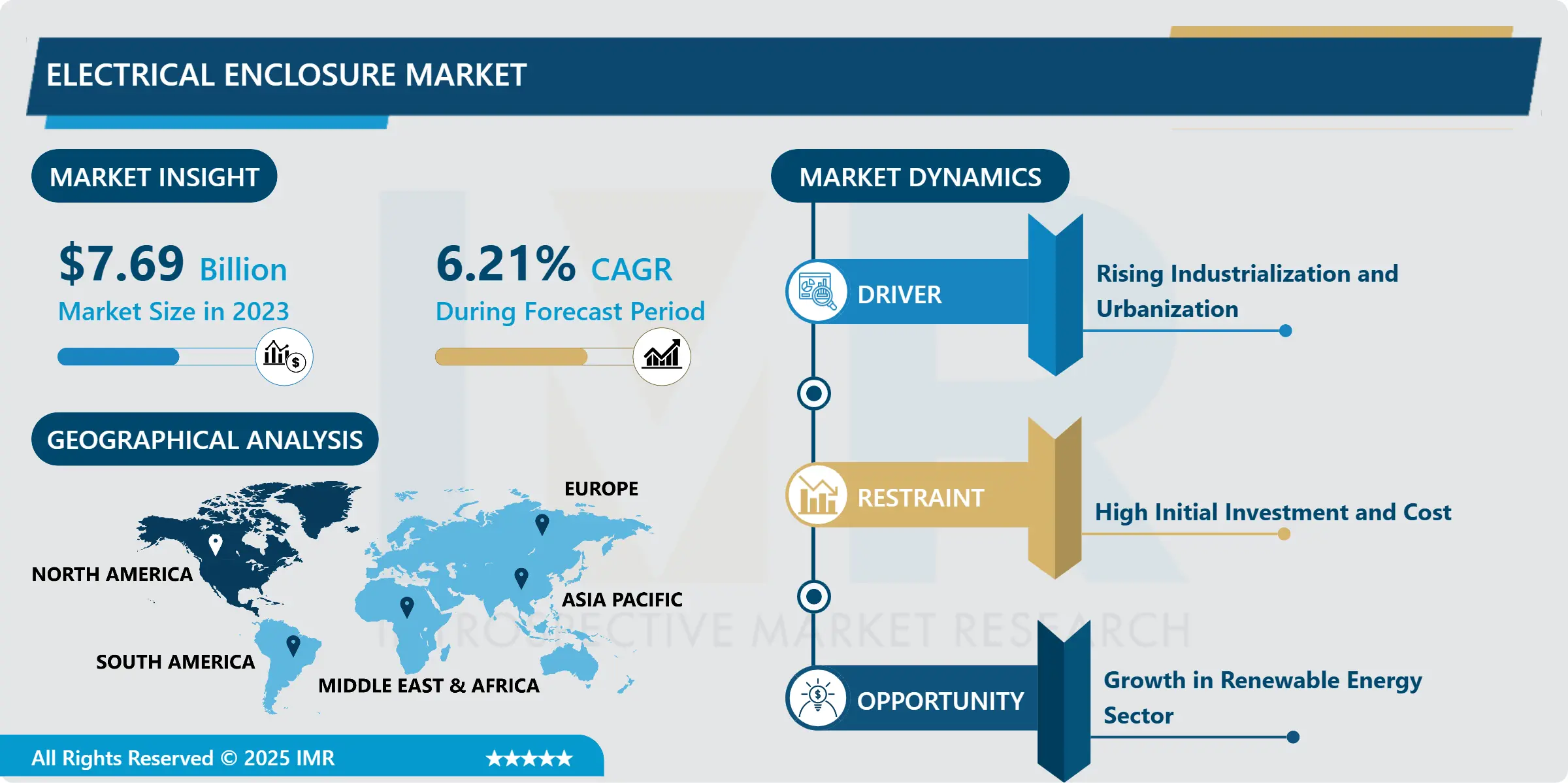
Electrical Enclosure Market Size, Share, Growth & Forecast (2024-2032)
Electrical Enclosure Market Size Was Valued at USD 7.69 Billion in 2023, and is Projected to Reach USD 13.23 Billion by 2032, Growing at a CAGR of 6.21% From 2024-2032.

IMR Group
Description
Electrical Enclosure Market Synopsis:
Electrical Enclosure Market Size Was Valued at USD 7.69 Billion in 2023, and is Projected to Reach USD 13.23 Billion by 2032, Growing at a CAGR of 6.21% From 2024-2032.
The Electrical Enclosure market or industry is the business of producing and selling protective structures meant for protecting electrical as well as electronic apparatus. As indicated, these are intended to shield the circuits from environmental factors like dust, moisture and physical impacts while at the same time safeguarding electrical parts.
The electrical enclosure market has been expanding progressively across the world because of the growing utilization of electrical and electronics devices internationally. Electrical enclosures are important for safeguarding electrical management and equipment from external attacks from physical factors like dust, water, among others. These enclosures come with variations for use in power distribution, telecommunications, industrial automation, and oil & gas industries.
Automation of industries together with renewable materials in production of energy has enhanced the significance of electrical enclosures in several ways. electrical enclosure market is not only driven by several industrial segments but also needed for the constantly developing telecommunication network, in which enclosures play a significant safety role. The automotive and manufacturing also hold a large potential for the electrical enclosures as electrical parts in automobiles and machinery are becoming increasingly incorporated. In addition, elements such as growing corrective and preventive electrical installations standards’ concerns have led to the need by industries to use quality enclosures that can effectively withstand various environmental conditions. As the market grows producers are concentrating on product development especially smart enclosures that have sensing and remote-control features. This trend seeks to improve the functionality of the electrical systems, safety and power factor and also extending the life of the systems hence decreasing recurring costs of maintenance.
Electrical Enclosure Market Trend Analysis:
Integration of Smart Technology in Electrical Enclosures
The component used in electrical enclosures are being installed with sensors, remote monitoring and connectivity features that enable monitoring of the conditions within and around the enclosure. This innovation allows operators monitor potentially faulty systems including temperature, moisture or even intruders before they cause more severe problems. Sources of smart enclosures show that when operators are given real time information, they will be useful in scheduling maintenance, safety measures and minimum time off.
Adoption of smart technologies within electrical enclosures is enabling industries to lean towards predictive maintenance. The status of electrical systems can easily be checked from a remote location and maintenance teams will be notified of the developing failures so that they can attend to them before total failure. This transition of the focus from crisis-based maintenance to be preventive or condition-based maintenance is also assumed to create interest towards smart electrical enclosures particularly in energy-, telecom- and manufacturing industries where any interruption might result in substantial operational and associated costs.
Growth in Renewable Energy Sector
Nuclear and solar energy presented a tremendous opportunity for power plants and the overall enclosure market. With the world embracing cleaner renewable energy sources like solar energy, wind energy among others, the need for electrical enclosures for protection of the renewable energy equipment including solar panels, wind turbines and batteries is expected to increase. They are equally important because they extend the life span of renewal energy systems, particularly through shielding of delicate parts from elements such as moisture, dust and high temperatures.
The trend of installation of solar power plants, wind farms and energy storage systems in both developed and developing world generates robust peculiarities like durability and ability to withstand adverse weather conditions to enclosures. The global focus on renewable energy will remain high in the foreseeable future due to which electrical components used in the protection of such equipment will similarly grow, leading to the electrical enclosure market growth. This has already applied in the manufacturers’ product where some designed enclosures to suite the application of the renewable energy high durability of the product for withstanding outdoors and tough climates.
Electrical Enclosure Market Segment Analysis:
Electrical Enclosure Market is Segmented on the basis of Type, Material Type, Protection Type, Sales Channel End User, and Region
By Type, Wall-mounted segment is expected to dominate the market during the forecast period
Wall electrical enclosures are applied where layout conditions do not allow for free standing, or where the system is designed to be set on the wall, for convenient access. These enclosures are widely used and are preferably in residential, commercial, and industrial services because of flexibility in its installation. They are usually applied in the construction of circuit breakers, switches as well as other small electrical apparatus. Self-contained flush-mounted enclosures are used in applications where space on the floor is valuable or unavailable, protecting industries, offices, and telecommunications area.
These enclosures are normally made from robust materials and could be steel or plastic in general and this because; they are enclosed with harsh environmental conditions. It also protects from dust, water and mechanical injuries that are very important to maintain the electrical equipment contained inside. Their popular use is as a result of their versatility in the different sectors, especially the energy, telecommunication and manufacturing segments where they contain critical electrical equipment packed in limited spaces.
By End-use Industry, Energy & Power segment expected to held the largest share
The energy and power sector is perhaps one of the most significant consumers of enclosures for electrical devices, parts, and equipment since electrical systems employed in generation, transmission and distribution require formidable protection. Enclosures play a vital role for protection of electrical equipment in some extreme environmental conditions in electric power plants, substation or electrical networks. As the global energy consumption rate rises and the interest in renewable energy resources increases, the need for efficient, sturdy electrical enclosures shall also increase. These enclosures guard the delicate instruments against dust, moisture and physical impacts for corrected and unhampered power supply.
The traditional energy sector is moving toward renewable energy like the solar and wind power, the needs for electrical enclosures which are durable to stand the outdoor climates are highly demanded. Primary resistance provided by electrical enclosures in protection of the equipment also in remote areas and during severe weather additionally increases the demand arising from the renewable energy segment and boosts the electrical enclosures market’s growth.
Electrical Enclosure Market Regional Insights:
North America is Expected to Dominate the Market Over the Forecast period
The North American region is the largest electrical enclosure market due to a well-establish manufacturing and industrial sector coupled with the technological superiorities. The United States and Canada also have made significant investments in energy, telecommunications, manufacturing sectors, etc., and all these sectors require electrical enclosures to protect electrical systems. The rising need for renewable power, computerized power structures, and industrial digitalization in the area also boosts the electrical enclosure market.
The North America enjoys stringent regulatory standards and safe guard measures which in return demand high quality electrical enclosure. Stringent requirements for sustainability and energy efficiency also create the need for improved types of enclosures in the region, especially in renewable energy and electrical power distribution segments. As a result of well-developed industries and increased emphasis on research and development, North America will continue to hold the largest market share of electrical enclosures on the global market.
Active Key Players in the Electrical Enclosure Market:
Schneider Electric (France)
Eaton Corporation (Ireland)
ABB Ltd. (Switzerland)
Rittal GmbH & Co. KG (Germany)
Hammond Manufacturing (Canada)
Pentair plc (Ireland)
Emerson Electric Co. (USA)
General Electric Company (USA)
Siemens AG (Germany)
Legrand S.A. (France)
NEMA Enclosures, Inc. (USA)
Adalet (USA)
Other Active Players
Chapter 1: Introduction
1.1 Scope and Coverage
Chapter 2:Executive Summary
Chapter 3: Market Landscape
3.1 Market Dynamics
3.1.1 Drivers
3.1.2 Restraints
3.1.3 Opportunities
3.1.4 Challenges
3.2 Market Trend Analysis
3.3 PESTLE Analysis
3.4 Porter’s Five Forces Analysis
3.5 Industry Value Chain Analysis
3.6 Ecosystem
3.7 Regulatory Landscape
3.8 Price Trend Analysis
3.9 Patent Analysis
3.10 Technology Evolution
3.11 Investment Pockets
3.12 Import-Export Analysis
Chapter 4: Electrical Enclosure Market by Material Type
4.1 Electrical Enclosure Market Snapshot and Growth Engine
4.2 Electrical Enclosure Market Overview
4.3 Metal
4.3.1 Introduction and Market Overview
4.3.2 Historic and Forecasted Market Size in Value USD and Volume Units (2017-2032F)
4.3.3 Key Market Trends, Growth Factors and Opportunities
4.3.4 Metal: Geographic Segmentation Analysis
4.4 Plastic
4.4.1 Introduction and Market Overview
4.4.2 Historic and Forecasted Market Size in Value USD and Volume Units (2017-2032F)
4.4.3 Key Market Trends, Growth Factors and Opportunities
4.4.4 Plastic: Geographic Segmentation Analysis
4.5 Composites
4.5.1 Introduction and Market Overview
4.5.2 Historic and Forecasted Market Size in Value USD and Volume Units (2017-2032F)
4.5.3 Key Market Trends, Growth Factors and Opportunities
4.5.4 Composites: Geographic Segmentation Analysis
Chapter 5: Electrical Enclosure Market by Type
5.1 Electrical Enclosure Market Snapshot and Growth Engine
5.2 Electrical Enclosure Market Overview
5.3 Wall-mounted
5.3.1 Introduction and Market Overview
5.3.2 Historic and Forecasted Market Size in Value USD and Volume Units (2017-2032F)
5.3.3 Key Market Trends, Growth Factors and Opportunities
5.3.4 Wall-mounted: Geographic Segmentation Analysis
5.4 Floor-standing
5.4.1 Introduction and Market Overview
5.4.2 Historic and Forecasted Market Size in Value USD and Volume Units (2017-2032F)
5.4.3 Key Market Trends, Growth Factors and Opportunities
5.4.4 Floor-standing: Geographic Segmentation Analysis
5.5 Freestanding
5.5.1 Introduction and Market Overview
5.5.2 Historic and Forecasted Market Size in Value USD and Volume Units (2017-2032F)
5.5.3 Key Market Trends, Growth Factors and Opportunities
5.5.4 Freestanding: Geographic Segmentation Analysis
Chapter 6: Electrical Enclosure Market by End-use Industry
6.1 Electrical Enclosure Market Snapshot and Growth Engine
6.2 Electrical Enclosure Market Overview
6.3 Energy & Power
6.3.1 Introduction and Market Overview
6.3.2 Historic and Forecasted Market Size in Value USD and Volume Units (2017-2032F)
6.3.3 Key Market Trends, Growth Factors and Opportunities
6.3.4 Energy & Power: Geographic Segmentation Analysis
6.4 Manufacturing
6.4.1 Introduction and Market Overview
6.4.2 Historic and Forecasted Market Size in Value USD and Volume Units (2017-2032F)
6.4.3 Key Market Trends, Growth Factors and Opportunities
6.4.4 Manufacturing: Geographic Segmentation Analysis
6.5 Telecommunications
6.5.1 Introduction and Market Overview
6.5.2 Historic and Forecasted Market Size in Value USD and Volume Units (2017-2032F)
6.5.3 Key Market Trends, Growth Factors and Opportunities
6.5.4 Telecommunications: Geographic Segmentation Analysis
6.6 Oil & Gas
6.6.1 Introduction and Market Overview
6.6.2 Historic and Forecasted Market Size in Value USD and Volume Units (2017-2032F)
6.6.3 Key Market Trends, Growth Factors and Opportunities
6.6.4 Oil & Gas: Geographic Segmentation Analysis
6.7 Automotive
6.7.1 Introduction and Market Overview
6.7.2 Historic and Forecasted Market Size in Value USD and Volume Units (2017-2032F)
6.7.3 Key Market Trends, Growth Factors and Opportunities
6.7.4 Automotive: Geographic Segmentation Analysis
6.8 Others
6.8.1 Introduction and Market Overview
6.8.2 Historic and Forecasted Market Size in Value USD and Volume Units (2017-2032F)
6.8.3 Key Market Trends, Growth Factors and Opportunities
6.8.4 Others: Geographic Segmentation Analysis
Chapter 7: Electrical Enclosure Market by Protection Type
7.1 Electrical Enclosure Market Snapshot and Growth Engine
7.2 Electrical Enclosure Market Overview
7.3 Weatherproof
7.3.1 Introduction and Market Overview
7.3.2 Historic and Forecasted Market Size in Value USD and Volume Units (2017-2032F)
7.3.3 Key Market Trends, Growth Factors and Opportunities
7.3.4 Weatherproof: Geographic Segmentation Analysis
7.4 Corrosion-resistant
7.4.1 Introduction and Market Overview
7.4.2 Historic and Forecasted Market Size in Value USD and Volume Units (2017-2032F)
7.4.3 Key Market Trends, Growth Factors and Opportunities
7.4.4 Corrosion-resistant: Geographic Segmentation Analysis
7.5 Explosion-proof
7.5.1 Introduction and Market Overview
7.5.2 Historic and Forecasted Market Size in Value USD and Volume Units (2017-2032F)
7.5.3 Key Market Trends, Growth Factors and Opportunities
7.5.4 Explosion-proof: Geographic Segmentation Analysis
7.6 NEMA-rated
7.6.1 Introduction and Market Overview
7.6.2 Historic and Forecasted Market Size in Value USD and Volume Units (2017-2032F)
7.6.3 Key Market Trends, Growth Factors and Opportunities
7.6.4 NEMA-rated: Geographic Segmentation Analysis
7.7 Others
7.7.1 Introduction and Market Overview
7.7.2 Historic and Forecasted Market Size in Value USD and Volume Units (2017-2032F)
7.7.3 Key Market Trends, Growth Factors and Opportunities
7.7.4 Others: Geographic Segmentation Analysis
Chapter 8: Electrical Enclosure Market by Sales Channel
8.1 Electrical Enclosure Market Snapshot and Growth Engine
8.2 Electrical Enclosure Market Overview
8.3 Direct
8.3.1 Introduction and Market Overview
8.3.2 Historic and Forecasted Market Size in Value USD and Volume Units (2017-2032F)
8.3.3 Key Market Trends, Growth Factors and Opportunities
8.3.4 Direct: Geographic Segmentation Analysis
8.4 Distributors and Retailers
8.4.1 Introduction and Market Overview
8.4.2 Historic and Forecasted Market Size in Value USD and Volume Units (2017-2032F)
8.4.3 Key Market Trends, Growth Factors and Opportunities
8.4.4 Distributors and Retailers: Geographic Segmentation Analysis
Chapter 9: Company Profiles and Competitive Analysis
9.1 Competitive Landscape
9.1.1 Competitive Benchmarking
9.1.2 Electrical Enclosure Market Share by Manufacturer (2023)
9.1.3 Industry BCG Matrix
9.1.4 Heat Map Analysis
9.1.5 Mergers and Acquisitions
9.2 SCHNEIDER ELECTRIC – (FRANCE)
9.2.1 Company Overview
9.2.2 Key Executives
9.2.3 Company Snapshot
9.2.4 Role of the Company in the Market
9.2.5 Sustainability and Social Responsibility
9.2.6 Operating Business Segments
9.2.7 Product Portfolio
9.2.8 Business Performance
9.2.9 Key Strategic Moves and Recent Developments
9.2.10 SWOT Analysis
9.3 EATON CORPORATION – (IRELAND)
9.4 ABB LTD. – (SWITZERLAND)
9.5 RITTAL GMBH & CO. KG – (GERMANY)
9.6 HAMMOND MANUFACTURING – (CANADA)
9.7 PENTAIR PLC – (IRELAND)
9.8 EMERSON ELECTRIC CO. – (USA)
9.9 GENERAL ELECTRIC COMPANY – (USA)
9.10 SIEMENS AG – (GERMANY)
9.11 LEGRAND S.A. – (FRANCE)
9.12 NEMA ENCLOSURES INC. – (USA)
9.13 ADALET – (USA)
9.14 OTHER ACTIVE PLAYERS
Chapter 10: Global Electrical Enclosure Market By Region
10.1 Overview
10.2. North America Electrical Enclosure Market
10.2.1 Key Market Trends, Growth Factors and Opportunities
10.2.2 Top Key Companies
10.2.3 Historic and Forecasted Market Size by Segments
10.2.4 Historic and Forecasted Market Size By Material Type
10.2.4.1 Metal
10.2.4.2 Plastic
10.2.4.3 Composites
10.2.5 Historic and Forecasted Market Size By Type
10.2.5.1 Wall-mounted
10.2.5.2 Floor-standing
10.2.5.3 Freestanding
10.2.6 Historic and Forecasted Market Size By End-use Industry
10.2.6.1 Energy & Power
10.2.6.2 Manufacturing
10.2.6.3 Telecommunications
10.2.6.4 Oil & Gas
10.2.6.5 Automotive
10.2.6.6 Others
10.2.7 Historic and Forecasted Market Size By Protection Type
10.2.7.1 Weatherproof
10.2.7.2 Corrosion-resistant
10.2.7.3 Explosion-proof
10.2.7.4 NEMA-rated
10.2.7.5 Others
10.2.8 Historic and Forecasted Market Size By Sales Channel
10.2.8.1 Direct
10.2.8.2 Distributors and Retailers
10.2.9 Historic and Forecast Market Size by Country
10.2.9.1 US
10.2.9.2 Canada
10.2.9.3 Mexico
10.3. Eastern Europe Electrical Enclosure Market
10.3.1 Key Market Trends, Growth Factors and Opportunities
10.3.2 Top Key Companies
10.3.3 Historic and Forecasted Market Size by Segments
10.3.4 Historic and Forecasted Market Size By Material Type
10.3.4.1 Metal
10.3.4.2 Plastic
10.3.4.3 Composites
10.3.5 Historic and Forecasted Market Size By Type
10.3.5.1 Wall-mounted
10.3.5.2 Floor-standing
10.3.5.3 Freestanding
10.3.6 Historic and Forecasted Market Size By End-use Industry
10.3.6.1 Energy & Power
10.3.6.2 Manufacturing
10.3.6.3 Telecommunications
10.3.6.4 Oil & Gas
10.3.6.5 Automotive
10.3.6.6 Others
10.3.7 Historic and Forecasted Market Size By Protection Type
10.3.7.1 Weatherproof
10.3.7.2 Corrosion-resistant
10.3.7.3 Explosion-proof
10.3.7.4 NEMA-rated
10.3.7.5 Others
10.3.8 Historic and Forecasted Market Size By Sales Channel
10.3.8.1 Direct
10.3.8.2 Distributors and Retailers
10.3.9 Historic and Forecast Market Size by Country
10.3.9.1 Russia
10.3.9.2 Bulgaria
10.3.9.3 The Czech Republic
10.3.9.4 Hungary
10.3.9.5 Poland
10.3.9.6 Romania
10.3.9.7 Rest of Eastern Europe
10.4. Western Europe Electrical Enclosure Market
10.4.1 Key Market Trends, Growth Factors and Opportunities
10.4.2 Top Key Companies
10.4.3 Historic and Forecasted Market Size by Segments
10.4.4 Historic and Forecasted Market Size By Material Type
10.4.4.1 Metal
10.4.4.2 Plastic
10.4.4.3 Composites
10.4.5 Historic and Forecasted Market Size By Type
10.4.5.1 Wall-mounted
10.4.5.2 Floor-standing
10.4.5.3 Freestanding
10.4.6 Historic and Forecasted Market Size By End-use Industry
10.4.6.1 Energy & Power
10.4.6.2 Manufacturing
10.4.6.3 Telecommunications
10.4.6.4 Oil & Gas
10.4.6.5 Automotive
10.4.6.6 Others
10.4.7 Historic and Forecasted Market Size By Protection Type
10.4.7.1 Weatherproof
10.4.7.2 Corrosion-resistant
10.4.7.3 Explosion-proof
10.4.7.4 NEMA-rated
10.4.7.5 Others
10.4.8 Historic and Forecasted Market Size By Sales Channel
10.4.8.1 Direct
10.4.8.2 Distributors and Retailers
10.4.9 Historic and Forecast Market Size by Country
10.4.9.1 Germany
10.4.9.2 UK
10.4.9.3 France
10.4.9.4 The Netherlands
10.4.9.5 Italy
10.4.9.6 Spain
10.4.9.7 Rest of Western Europe
10.5. Asia Pacific Electrical Enclosure Market
10.5.1 Key Market Trends, Growth Factors and Opportunities
10.5.2 Top Key Companies
10.5.3 Historic and Forecasted Market Size by Segments
10.5.4 Historic and Forecasted Market Size By Material Type
10.5.4.1 Metal
10.5.4.2 Plastic
10.5.4.3 Composites
10.5.5 Historic and Forecasted Market Size By Type
10.5.5.1 Wall-mounted
10.5.5.2 Floor-standing
10.5.5.3 Freestanding
10.5.6 Historic and Forecasted Market Size By End-use Industry
10.5.6.1 Energy & Power
10.5.6.2 Manufacturing
10.5.6.3 Telecommunications
10.5.6.4 Oil & Gas
10.5.6.5 Automotive
10.5.6.6 Others
10.5.7 Historic and Forecasted Market Size By Protection Type
10.5.7.1 Weatherproof
10.5.7.2 Corrosion-resistant
10.5.7.3 Explosion-proof
10.5.7.4 NEMA-rated
10.5.7.5 Others
10.5.8 Historic and Forecasted Market Size By Sales Channel
10.5.8.1 Direct
10.5.8.2 Distributors and Retailers
10.5.9 Historic and Forecast Market Size by Country
10.5.9.1 China
10.5.9.2 India
10.5.9.3 Japan
10.5.9.4 South Korea
10.5.9.5 Malaysia
10.5.9.6 Thailand
10.5.9.7 Vietnam
10.5.9.8 The Philippines
10.5.9.9 Australia
10.5.9.10 New Zealand
10.5.9.11 Rest of APAC
10.6. Middle East & Africa Electrical Enclosure Market
10.6.1 Key Market Trends, Growth Factors and Opportunities
10.6.2 Top Key Companies
10.6.3 Historic and Forecasted Market Size by Segments
10.6.4 Historic and Forecasted Market Size By Material Type
10.6.4.1 Metal
10.6.4.2 Plastic
10.6.4.3 Composites
10.6.5 Historic and Forecasted Market Size By Type
10.6.5.1 Wall-mounted
10.6.5.2 Floor-standing
10.6.5.3 Freestanding
10.6.6 Historic and Forecasted Market Size By End-use Industry
10.6.6.1 Energy & Power
10.6.6.2 Manufacturing
10.6.6.3 Telecommunications
10.6.6.4 Oil & Gas
10.6.6.5 Automotive
10.6.6.6 Others
10.6.7 Historic and Forecasted Market Size By Protection Type
10.6.7.1 Weatherproof
10.6.7.2 Corrosion-resistant
10.6.7.3 Explosion-proof
10.6.7.4 NEMA-rated
10.6.7.5 Others
10.6.8 Historic and Forecasted Market Size By Sales Channel
10.6.8.1 Direct
10.6.8.2 Distributors and Retailers
10.6.9 Historic and Forecast Market Size by Country
10.6.9.1 Turkiye
10.6.9.2 Bahrain
10.6.9.3 Kuwait
10.6.9.4 Saudi Arabia
10.6.9.5 Qatar
10.6.9.6 UAE
10.6.9.7 Israel
10.6.9.8 South Africa
10.7. South America Electrical Enclosure Market
10.7.1 Key Market Trends, Growth Factors and Opportunities
10.7.2 Top Key Companies
10.7.3 Historic and Forecasted Market Size by Segments
10.7.4 Historic and Forecasted Market Size By Material Type
10.7.4.1 Metal
10.7.4.2 Plastic
10.7.4.3 Composites
10.7.5 Historic and Forecasted Market Size By Type
10.7.5.1 Wall-mounted
10.7.5.2 Floor-standing
10.7.5.3 Freestanding
10.7.6 Historic and Forecasted Market Size By End-use Industry
10.7.6.1 Energy & Power
10.7.6.2 Manufacturing
10.7.6.3 Telecommunications
10.7.6.4 Oil & Gas
10.7.6.5 Automotive
10.7.6.6 Others
10.7.7 Historic and Forecasted Market Size By Protection Type
10.7.7.1 Weatherproof
10.7.7.2 Corrosion-resistant
10.7.7.3 Explosion-proof
10.7.7.4 NEMA-rated
10.7.7.5 Others
10.7.8 Historic and Forecasted Market Size By Sales Channel
10.7.8.1 Direct
10.7.8.2 Distributors and Retailers
10.7.9 Historic and Forecast Market Size by Country
10.7.9.1 Brazil
10.7.9.2 Argentina
10.7.9.3 Rest of SA
Chapter 11 Analyst Viewpoint and Conclusion
11.1 Recommendations and Concluding Analysis
11.2 Potential Market Strategies
Chapter 12 Research Methodology
12.1 Research Process
12.2 Primary Research
12.3 Secondary Research
Q1: What would be the forecast period in the Electrical Enclosure Market research report?
A1: The forecast period in the Electrical Enclosure Market research report is 2024-2032.
Q2: Who are the key players in the Electrical Enclosure Market?
A2: Schneider Electric (France), Eaton Corporation (Ireland), ABB Ltd. (Switzerland), Rittal GmbH & Co. KG (Germany), Hammond Manufacturing (Canada), Pentair plc (Ireland), Emerson Electric Co. (USA), General Electric Company (USA), Siemens AG (Germany), Legrand S.A. (France), NEMA Enclosures, Inc. (USA), Adalet (USA), and Other Active Players.
Q3: What are the segments of the Electrical Enclosure Market?
A3: The Electrical Enclosure Market is segmented into Type, Material Type, Protection Type, Sales Channel, End User and region. By Material Type, the market is categorized into Metal, Plastic, and Composites. By Type, the market is categorized into Wall-mounted, Floor-standing, and Freestanding. By End-use Industry, the market is categorized into Energy & Power, Manufacturing, Telecommunications, Oil & Gas, Automotive, and Others. By Protection Type, the market is categorized into Weatherproof, Corrosion-resistant, Explosion-proof, NEMA-rated, and Others. By Sales Channel, the market is categorized into Direct and Distributors and Retailers. By Region, it is analyzed across North America (U.S., Canada, Mexico), Eastern Europe (Russia, Bulgaria, The Czech Republic, Hungary, Poland, Romania, Rest of Eastern Europe), Western Europe (Germany, UK, France, Netherlands, Italy, Spain, Rest of Western Europe), Asia Pacific (China, India, Japan, South Korea, Malaysia, Thailand, Vietnam, The Philippines, Australia, New-Zealand, Rest of APAC), Middle East & Africa (Turkiye, Bahrain, Kuwait, Saudi Arabia, Qatar, UAE, Israel, South Africa), South America (Brazil, Argentina, Rest of SA)
Q4: What is the Electrical Enclosure Market?
A4: The Electrical Enclosure market or industry is the business of producing and selling protective structures meant for protecting electrical as well as electronic apparatus. As indicated, these are intended to shield the circuits from environmental factors like dust, moisture and physical impacts while at the same time safeguarding electrical parts.
Q5: How big is the Electrical Enclosure Market?
A5: Electrical Enclosure Market Size Was Valued at USD 7.69 Billion in 2023, and is Projected to Reach USD 13.23 Billion by 2032, Growing at a CAGR of 6.21% From 2024-2032.
How to Buy a Report from eminsights.jp
On the product page, choose the license you want: Single-User License, Multi-User License or Enterprise License.
If you required report in your native language, then you can click on Translated Report button and fill out the form with report name and language you want, then our team will contact you as soon as possible.
Click the Buy Now button.
You will be redirected to the checkout page. Enter your company details and payment information.
Click Place Order to complete the purchase.
Confirmation: You’ll receive an order confirmation and our team will contact you shortly with your ordered report.
If you have any questions, fill out the contact form below or email us at [email protected].
Thank you for choosing eminsights.jp!