Stay Ahead in Fast-Growing Economies.
Browse Reports Now




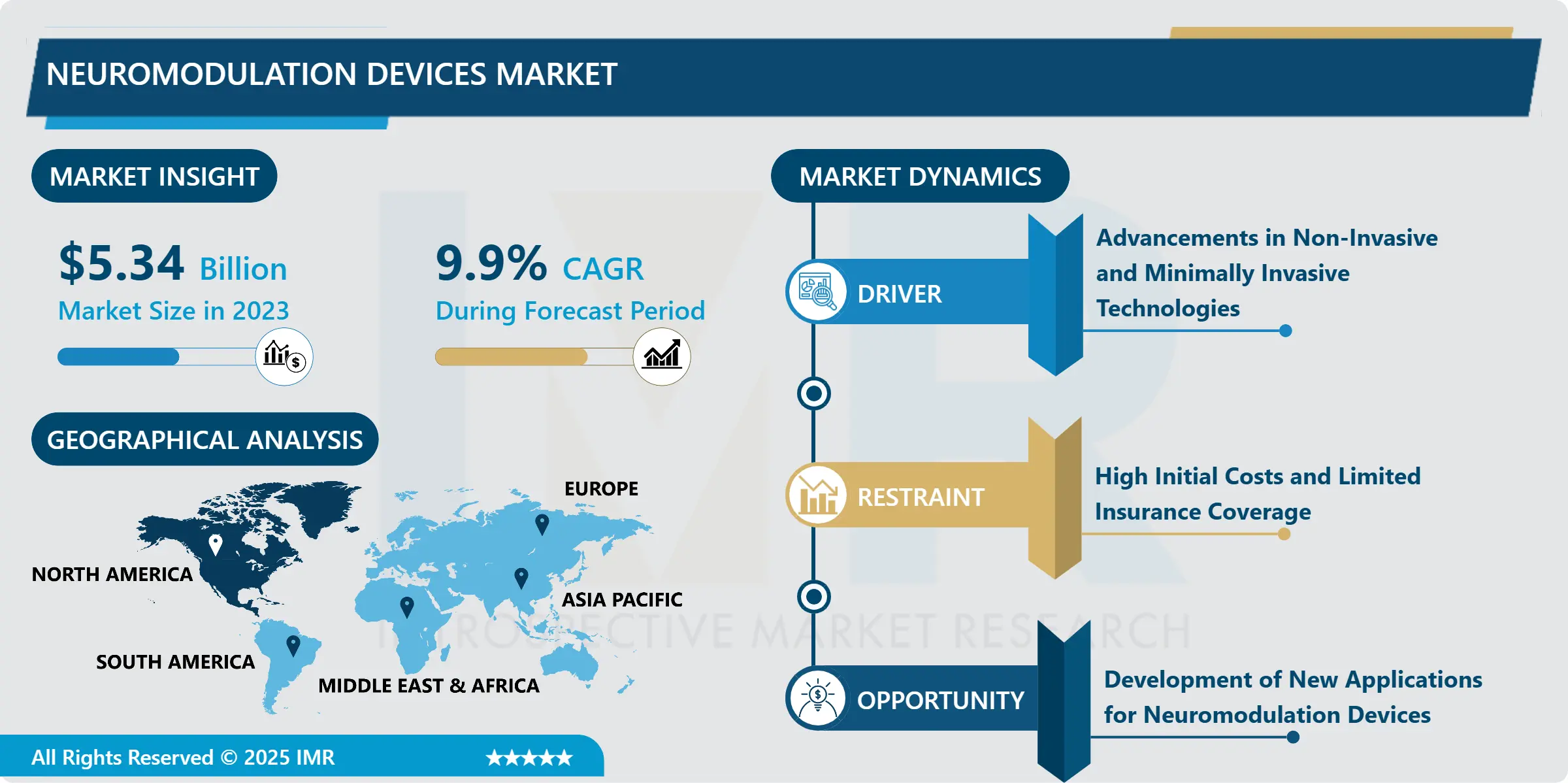
Neuromodulation Devices Market Size, Share, Growth & Forecast (2024-2032)
Neuromodulation Devices Market Size Was Valued at USD 5.34 Billion in 2023, and is Projected to Reach USD 12.48 Billion by 2032, Growing at a CAGR of 9.90% From 2024-2032.

IMR Group
Description
Neuromodulation Devices Market Synopsis:
Neuromodulation Devices Market Size Was Valued at USD 5.34 Billion in 2023, and is Projected to Reach USD 12.48 Billion by 2032, Growing at a CAGR of 9.90% From 2024-2032.
Neuromodulation devices market is defined as the field that deals with the manufacturing and marketing of medical devices that is used to affect the activity of the nerves either mechanically by electrical signals or by using certain chemicals. These devices are employed for management of a number of neurological disorders ranging from chronic pain, Parkinson’s disease, epilepsy, depression and incontinence to provide patients with minimized invasive therapeutic solutions. The market is driven by such factors as continuous developments in technology, and the design of the device used in neuromodulation therapies, and heightened awareness of the neuromodulation therapy as compared to other standard therapies.
One of the big drivers that helped the neuromodulation devices market evolve were neurological and chronic pain disorders market. They include; Management of diseases like Parkinson, epilepsy, and chronic pain that are increasing globally needs a smart way to handle. As traditional approaches wherein medications and operations may not be very efficient or as they sometimes are associated with adverse effects, neuromodulation devices are gradually emerging as possible solutions of choice due to a relatively low risk of complications and longer overall therapeutic outcomes.
Another micro factor that can be said to have a direct effect on the operation market is the technological factor. Newer parameter aspects in MRI guided, broadband based therapy methods such as TMS and fine adjustments of invasive tools as DBS are sharpening up the treatment. About the same way, they are trying to style neuromodulation therapies as appealing and easily accessible, and therefore are enhancing the market potential.
Neuromodulation Devices Market Trend Analysis:
Growing shift towards non-invasive and minimally invasive therapies
One of the ongoing trends in the market of the neuromodulation devices is the rising focus on non-invasive and minimal invasive treatments. Noninvasive procedures such as TMS and tDCS have shown increased use as they do not predispose the patient to serious side effects seen with invasive procedures. The reason why patients and healthcare providers prefer such techniques is that they provide enormous therapeutic advantages with little down time.
The other trend is the incorporation of the neuromodulation devices with other technologies like artificial intelligence AI, and wearables. It has been used for conforming to the bespoke care pathways, likely patient reactions and even calibrating the functioning of devices. This technological complementarity is improving the accuracy and efficiency of the primary neuromodulation therapies thereby increasing the utilization of the therapy.
Healthcare infrastructure improvements and rising healthcare expenditures
Market growth in the neuromodulation devices industry provides one of the market’s major opportunities in emerging markets with Asia-Pacific and Latin America. These are becoming essential as a number of advanced medical devices are on demand due to progressing healthcare infrastructure and rising expenditures on health care in these regions. Such opportunities may be captured by companies through localisation of their products, and entering into liaison with regional health care institutions.
At the same time, opening up the possibilities for the use of neuromodulation therapy in the treatment of other diseases is a new networking opportunity for market participants. Although neuromodulation devices at the moment are applied for chronic pain, Parkinson’s disease, epilepsy among others there is research on how the devices can be used in conditions such as depression, Alzheimer’s disease, and anxiety. The further expansion of the indications spectrum will expand the market’s reach to a great extent.
Neuromodulation Devices Market Segment Analysis:
Neuromodulation Devices Market is Segmented on the basis of Product, Technology, Application, End User, and Region
By Product, Spinal Cord Stimulation (SCS) Devices segment is expected to dominate the market during the forecast period
Neuromodulation device markets segmentation by product type is currently designed with several advanced therapeutic products that can treat various neurological disorders. The Spinal Cord Stimulation (SCS) is implantable devices for pain control, which sends electrical signals to the spinal nerves. DBS devices are put in a specific part of the brain to acknowledged medical conditions such as Parkinson’s disease or epilepsy. It is a kind of implants that are used to control urinary incontinence by electrical impulse stimulation of nerve.” Vagus Nerve Stimulators also known as VNS are implanted medical devices for neurologically prescribed epilepsy and/or depression by producing electrical signals to the vagus nerve. TMS equipment is used in prescribing treatment for disorders like depression by means of subjecting the nervous tissues of the head to the application of magnetic field. These other neuromodulation devices incorporate a number of new technologies and approaches aimed at expanding the range of neurmodulation options.
By Application, Chronic Pain segment expected to held the largest share
The market is also classified on the basis of application which provides a solution for neurological as well as, chronic diseases. One can illustrate this by taking cancer cases where neurostimulation equipment including SCS spinal stimulators are normally used to control such pain as; back/neck pain, Neuropathic pain among others. The deep brain stimulators are employed in the management of Parkinson’s disease through managing the motor signs through the stimulation of some parts of the brain. Another one is epilepsy; where devices including; Lev Vagus Nerve Stimulation (VNS) and deep Brain Simulators have been effectively used to control the seizures. Today, a severe medical disorder like depression is resolved through a simple procedure that employs the Transcranial Magnetic Stimulation (TMS) gadgets. Neuromodulation devices also assist with Alzheimer’s disease and cognitive disorders, and further investigations have to be carried out to determine the effectiveness of outcomes as well. The Urinary incontinence is managed through Sacral Nerve Stimulation (SNS) these are the nerves responsible for the control of bladders. There are some other functions in other neurological disorders, psychotic and other disorders and some other new functions which includes anxiety and migraine.
Neuromodulation Devices Market Regional Insights:
North America is Expected to Dominate the Market Over the Forecast period
North America region holds the largest avenue of the neuromodulation devices market led by the positive adoption trend of the improved medical technologies in the U.S. and Canada. Some of these are the pressure from key players in the region, particularly due to the reimbursement policies and a sound health care structure that has placed this region at the forefront. In addition, an increasing incidence in neurological disorders and enhanced knowledge of minimally invasive treatment approaches give a boost to North America as well.
The U.S. healthcare is especially concerned with innovation, and thus, a numerous amount of works has been done in the field of neuromodulation technologies. This has made the market grow fast because there have been many clinical trials and success product launch in the recent past. Thus, North America remains in the leading positions and is expected to dominate the market in the coming years.
Active Key Players in the Neuromodulation Devices Market:
Abbott Laboratories (U.S.)
Boston Scientific Corporation (U.S.)
Cyberonics, Inc. (U.S.)
ElectroCore, Inc. (U.S.)
LivaNova PLC (U.K.)
Medtronic (Ireland)
Nevro Corporation (U.S.)
Nuvectra Corporation (U.S.)
St. Jude Medical (U.S.)
Synapse Biomedical Inc. (U.S.)
Other Active Players
Chapter 1: Introduction
1.1 Scope and Coverage
Chapter 2:Executive Summary
Chapter 3: Market Landscape
3.1 Market Dynamics
3.1.1 Drivers
3.1.2 Restraints
3.1.3 Opportunities
3.1.4 Challenges
3.2 Market Trend Analysis
3.3 PESTLE Analysis
3.4 Porter’s Five Forces Analysis
3.5 Industry Value Chain Analysis
3.6 Ecosystem
3.7 Regulatory Landscape
3.8 Price Trend Analysis
3.9 Patent Analysis
3.10 Technology Evolution
3.11 Investment Pockets
3.12 Import-Export Analysis
Chapter 4: Neuromodulation Devices Market by Product
4.1 Neuromodulation Devices Market Snapshot and Growth Engine
4.2 Neuromodulation Devices Market Overview
4.3 Spinal Cord Stimulation (SCS) Devices
4.3.1 Introduction and Market Overview
4.3.2 Historic and Forecasted Market Size in Value USD and Volume Units (2017-2032F)
4.3.3 Key Market Trends, Growth Factors and Opportunities
4.3.4 Spinal Cord Stimulation (SCS) Devices: Geographic Segmentation Analysis
4.4 Deep Brain Stimulation (DBS) Devices
4.4.1 Introduction and Market Overview
4.4.2 Historic and Forecasted Market Size in Value USD and Volume Units (2017-2032F)
4.4.3 Key Market Trends, Growth Factors and Opportunities
4.4.4 Deep Brain Stimulation (DBS) Devices: Geographic Segmentation Analysis
4.5 Sacral Nerve Stimulation (SNS) Devices
4.5.1 Introduction and Market Overview
4.5.2 Historic and Forecasted Market Size in Value USD and Volume Units (2017-2032F)
4.5.3 Key Market Trends, Growth Factors and Opportunities
4.5.4 Sacral Nerve Stimulation (SNS) Devices: Geographic Segmentation Analysis
4.6 Vagus Nerve Stimulation (VNS) Devices
4.6.1 Introduction and Market Overview
4.6.2 Historic and Forecasted Market Size in Value USD and Volume Units (2017-2032F)
4.6.3 Key Market Trends, Growth Factors and Opportunities
4.6.4 Vagus Nerve Stimulation (VNS) Devices: Geographic Segmentation Analysis
4.7 Transcranial Magnetic Stimulation (TMS) Devices
4.7.1 Introduction and Market Overview
4.7.2 Historic and Forecasted Market Size in Value USD and Volume Units (2017-2032F)
4.7.3 Key Market Trends, Growth Factors and Opportunities
4.7.4 Transcranial Magnetic Stimulation (TMS) Devices: Geographic Segmentation Analysis
4.8 Other Neuromodulation Devices
4.8.1 Introduction and Market Overview
4.8.2 Historic and Forecasted Market Size in Value USD and Volume Units (2017-2032F)
4.8.3 Key Market Trends, Growth Factors and Opportunities
4.8.4 Other Neuromodulation Devices: Geographic Segmentation Analysis
Chapter 5: Neuromodulation Devices Market by Technology
5.1 Neuromodulation Devices Market Snapshot and Growth Engine
5.2 Neuromodulation Devices Market Overview
5.3 Invasive Neuromodulation Devices
5.3.1 Introduction and Market Overview
5.3.2 Historic and Forecasted Market Size in Value USD and Volume Units (2017-2032F)
5.3.3 Key Market Trends, Growth Factors and Opportunities
5.3.4 Invasive Neuromodulation Devices: Geographic Segmentation Analysis
5.4 Non-Invasive Neuromodulation Devices
5.4.1 Introduction and Market Overview
5.4.2 Historic and Forecasted Market Size in Value USD and Volume Units (2017-2032F)
5.4.3 Key Market Trends, Growth Factors and Opportunities
5.4.4 Non-Invasive Neuromodulation Devices: Geographic Segmentation Analysis
Chapter 6: Neuromodulation Devices Market by Application
6.1 Neuromodulation Devices Market Snapshot and Growth Engine
6.2 Neuromodulation Devices Market Overview
6.3 Chronic Pain
6.3.1 Introduction and Market Overview
6.3.2 Historic and Forecasted Market Size in Value USD and Volume Units (2017-2032F)
6.3.3 Key Market Trends, Growth Factors and Opportunities
6.3.4 Chronic Pain: Geographic Segmentation Analysis
6.4 Parkinson’s Disease
6.4.1 Introduction and Market Overview
6.4.2 Historic and Forecasted Market Size in Value USD and Volume Units (2017-2032F)
6.4.3 Key Market Trends, Growth Factors and Opportunities
6.4.4 Parkinson’s Disease: Geographic Segmentation Analysis
6.5 Epilepsy
6.5.1 Introduction and Market Overview
6.5.2 Historic and Forecasted Market Size in Value USD and Volume Units (2017-2032F)
6.5.3 Key Market Trends, Growth Factors and Opportunities
6.5.4 Epilepsy: Geographic Segmentation Analysis
6.6 Depression
6.6.1 Introduction and Market Overview
6.6.2 Historic and Forecasted Market Size in Value USD and Volume Units (2017-2032F)
6.6.3 Key Market Trends, Growth Factors and Opportunities
6.6.4 Depression: Geographic Segmentation Analysis
6.7 Alzheimer’s Disease
6.7.1 Introduction and Market Overview
6.7.2 Historic and Forecasted Market Size in Value USD and Volume Units (2017-2032F)
6.7.3 Key Market Trends, Growth Factors and Opportunities
6.7.4 Alzheimer’s Disease: Geographic Segmentation Analysis
6.8 Urinary Incontinence
6.8.1 Introduction and Market Overview
6.8.2 Historic and Forecasted Market Size in Value USD and Volume Units (2017-2032F)
6.8.3 Key Market Trends, Growth Factors and Opportunities
6.8.4 Urinary Incontinence: Geographic Segmentation Analysis
6.9 Others
6.9.1 Introduction and Market Overview
6.9.2 Historic and Forecasted Market Size in Value USD and Volume Units (2017-2032F)
6.9.3 Key Market Trends, Growth Factors and Opportunities
6.9.4 Others: Geographic Segmentation Analysis
Chapter 7: Neuromodulation Devices Market by End User
7.1 Neuromodulation Devices Market Snapshot and Growth Engine
7.2 Neuromodulation Devices Market Overview
7.3 Hospitals
7.3.1 Introduction and Market Overview
7.3.2 Historic and Forecasted Market Size in Value USD and Volume Units (2017-2032F)
7.3.3 Key Market Trends, Growth Factors and Opportunities
7.3.4 Hospitals: Geographic Segmentation Analysis
7.4 Ambulatory Surgical Centers
7.4.1 Introduction and Market Overview
7.4.2 Historic and Forecasted Market Size in Value USD and Volume Units (2017-2032F)
7.4.3 Key Market Trends, Growth Factors and Opportunities
7.4.4 Ambulatory Surgical Centers: Geographic Segmentation Analysis
7.5 Home Care Settings
7.5.1 Introduction and Market Overview
7.5.2 Historic and Forecasted Market Size in Value USD and Volume Units (2017-2032F)
7.5.3 Key Market Trends, Growth Factors and Opportunities
7.5.4 Home Care Settings: Geographic Segmentation Analysis
7.6 Clinics
7.6.1 Introduction and Market Overview
7.6.2 Historic and Forecasted Market Size in Value USD and Volume Units (2017-2032F)
7.6.3 Key Market Trends, Growth Factors and Opportunities
7.6.4 Clinics: Geographic Segmentation Analysis
Chapter 8: Company Profiles and Competitive Analysis
8.1 Competitive Landscape
8.1.1 Competitive Benchmarking
8.1.2 Neuromodulation Devices Market Share by Manufacturer (2023)
8.1.3 Industry BCG Matrix
8.1.4 Heat Map Analysis
8.1.5 Mergers and Acquisitions
8.2 ABBOTT LABORATORIES (U.S.)
8.2.1 Company Overview
8.2.2 Key Executives
8.2.3 Company Snapshot
8.2.4 Role of the Company in the Market
8.2.5 Sustainability and Social Responsibility
8.2.6 Operating Business Segments
8.2.7 Product Portfolio
8.2.8 Business Performance
8.2.9 Key Strategic Moves and Recent Developments
8.2.10 SWOT Analysis
8.3 BOSTON SCIENTIFIC CORPORATION (U.S.)
8.4 CYBERONICS INC. (U.S.)
8.5 ELECTROCORE INC. (U.S.)
8.6 LIVANOVA PLC (U.K.)
8.7 MEDTRONIC (IRELAND)
8.8 NEVRO CORPORATION (U.S.)
8.9 NUVECTRA CORPORATION (U.S.)
8.10 ST. JUDE MEDICAL (U.S.)
8.11 SYNAPSE BIOMEDICAL INC. (U.S.)
8.12 OTHER ACTIVE PLAYERS
Chapter 9: Global Neuromodulation Devices Market By Region
9.1 Overview
9.2. North America Neuromodulation Devices Market
9.2.1 Key Market Trends, Growth Factors and Opportunities
9.2.2 Top Key Companies
9.2.3 Historic and Forecasted Market Size by Segments
9.2.4 Historic and Forecasted Market Size By Product
9.2.4.1 Spinal Cord Stimulation (SCS) Devices
9.2.4.2 Deep Brain Stimulation (DBS) Devices
9.2.4.3 Sacral Nerve Stimulation (SNS) Devices
9.2.4.4 Vagus Nerve Stimulation (VNS) Devices
9.2.4.5 Transcranial Magnetic Stimulation (TMS) Devices
9.2.4.6 Other Neuromodulation Devices
9.2.5 Historic and Forecasted Market Size By Technology
9.2.5.1 Invasive Neuromodulation Devices
9.2.5.2 Non-Invasive Neuromodulation Devices
9.2.6 Historic and Forecasted Market Size By Application
9.2.6.1 Chronic Pain
9.2.6.2 Parkinson’s Disease
9.2.6.3 Epilepsy
9.2.6.4 Depression
9.2.6.5 Alzheimer’s Disease
9.2.6.6 Urinary Incontinence
9.2.6.7 Others
9.2.7 Historic and Forecasted Market Size By End User
9.2.7.1 Hospitals
9.2.7.2 Ambulatory Surgical Centers
9.2.7.3 Home Care Settings
9.2.7.4 Clinics
9.2.8 Historic and Forecast Market Size by Country
9.2.8.1 US
9.2.8.2 Canada
9.2.8.3 Mexico
9.3. Eastern Europe Neuromodulation Devices Market
9.3.1 Key Market Trends, Growth Factors and Opportunities
9.3.2 Top Key Companies
9.3.3 Historic and Forecasted Market Size by Segments
9.3.4 Historic and Forecasted Market Size By Product
9.3.4.1 Spinal Cord Stimulation (SCS) Devices
9.3.4.2 Deep Brain Stimulation (DBS) Devices
9.3.4.3 Sacral Nerve Stimulation (SNS) Devices
9.3.4.4 Vagus Nerve Stimulation (VNS) Devices
9.3.4.5 Transcranial Magnetic Stimulation (TMS) Devices
9.3.4.6 Other Neuromodulation Devices
9.3.5 Historic and Forecasted Market Size By Technology
9.3.5.1 Invasive Neuromodulation Devices
9.3.5.2 Non-Invasive Neuromodulation Devices
9.3.6 Historic and Forecasted Market Size By Application
9.3.6.1 Chronic Pain
9.3.6.2 Parkinson’s Disease
9.3.6.3 Epilepsy
9.3.6.4 Depression
9.3.6.5 Alzheimer’s Disease
9.3.6.6 Urinary Incontinence
9.3.6.7 Others
9.3.7 Historic and Forecasted Market Size By End User
9.3.7.1 Hospitals
9.3.7.2 Ambulatory Surgical Centers
9.3.7.3 Home Care Settings
9.3.7.4 Clinics
9.3.8 Historic and Forecast Market Size by Country
9.3.8.1 Russia
9.3.8.2 Bulgaria
9.3.8.3 The Czech Republic
9.3.8.4 Hungary
9.3.8.5 Poland
9.3.8.6 Romania
9.3.8.7 Rest of Eastern Europe
9.4. Western Europe Neuromodulation Devices Market
9.4.1 Key Market Trends, Growth Factors and Opportunities
9.4.2 Top Key Companies
9.4.3 Historic and Forecasted Market Size by Segments
9.4.4 Historic and Forecasted Market Size By Product
9.4.4.1 Spinal Cord Stimulation (SCS) Devices
9.4.4.2 Deep Brain Stimulation (DBS) Devices
9.4.4.3 Sacral Nerve Stimulation (SNS) Devices
9.4.4.4 Vagus Nerve Stimulation (VNS) Devices
9.4.4.5 Transcranial Magnetic Stimulation (TMS) Devices
9.4.4.6 Other Neuromodulation Devices
9.4.5 Historic and Forecasted Market Size By Technology
9.4.5.1 Invasive Neuromodulation Devices
9.4.5.2 Non-Invasive Neuromodulation Devices
9.4.6 Historic and Forecasted Market Size By Application
9.4.6.1 Chronic Pain
9.4.6.2 Parkinson’s Disease
9.4.6.3 Epilepsy
9.4.6.4 Depression
9.4.6.5 Alzheimer’s Disease
9.4.6.6 Urinary Incontinence
9.4.6.7 Others
9.4.7 Historic and Forecasted Market Size By End User
9.4.7.1 Hospitals
9.4.7.2 Ambulatory Surgical Centers
9.4.7.3 Home Care Settings
9.4.7.4 Clinics
9.4.8 Historic and Forecast Market Size by Country
9.4.8.1 Germany
9.4.8.2 UK
9.4.8.3 France
9.4.8.4 The Netherlands
9.4.8.5 Italy
9.4.8.6 Spain
9.4.8.7 Rest of Western Europe
9.5. Asia Pacific Neuromodulation Devices Market
9.5.1 Key Market Trends, Growth Factors and Opportunities
9.5.2 Top Key Companies
9.5.3 Historic and Forecasted Market Size by Segments
9.5.4 Historic and Forecasted Market Size By Product
9.5.4.1 Spinal Cord Stimulation (SCS) Devices
9.5.4.2 Deep Brain Stimulation (DBS) Devices
9.5.4.3 Sacral Nerve Stimulation (SNS) Devices
9.5.4.4 Vagus Nerve Stimulation (VNS) Devices
9.5.4.5 Transcranial Magnetic Stimulation (TMS) Devices
9.5.4.6 Other Neuromodulation Devices
9.5.5 Historic and Forecasted Market Size By Technology
9.5.5.1 Invasive Neuromodulation Devices
9.5.5.2 Non-Invasive Neuromodulation Devices
9.5.6 Historic and Forecasted Market Size By Application
9.5.6.1 Chronic Pain
9.5.6.2 Parkinson’s Disease
9.5.6.3 Epilepsy
9.5.6.4 Depression
9.5.6.5 Alzheimer’s Disease
9.5.6.6 Urinary Incontinence
9.5.6.7 Others
9.5.7 Historic and Forecasted Market Size By End User
9.5.7.1 Hospitals
9.5.7.2 Ambulatory Surgical Centers
9.5.7.3 Home Care Settings
9.5.7.4 Clinics
9.5.8 Historic and Forecast Market Size by Country
9.5.8.1 China
9.5.8.2 India
9.5.8.3 Japan
9.5.8.4 South Korea
9.5.8.5 Malaysia
9.5.8.6 Thailand
9.5.8.7 Vietnam
9.5.8.8 The Philippines
9.5.8.9 Australia
9.5.8.10 New Zealand
9.5.8.11 Rest of APAC
9.6. Middle East & Africa Neuromodulation Devices Market
9.6.1 Key Market Trends, Growth Factors and Opportunities
9.6.2 Top Key Companies
9.6.3 Historic and Forecasted Market Size by Segments
9.6.4 Historic and Forecasted Market Size By Product
9.6.4.1 Spinal Cord Stimulation (SCS) Devices
9.6.4.2 Deep Brain Stimulation (DBS) Devices
9.6.4.3 Sacral Nerve Stimulation (SNS) Devices
9.6.4.4 Vagus Nerve Stimulation (VNS) Devices
9.6.4.5 Transcranial Magnetic Stimulation (TMS) Devices
9.6.4.6 Other Neuromodulation Devices
9.6.5 Historic and Forecasted Market Size By Technology
9.6.5.1 Invasive Neuromodulation Devices
9.6.5.2 Non-Invasive Neuromodulation Devices
9.6.6 Historic and Forecasted Market Size By Application
9.6.6.1 Chronic Pain
9.6.6.2 Parkinson’s Disease
9.6.6.3 Epilepsy
9.6.6.4 Depression
9.6.6.5 Alzheimer’s Disease
9.6.6.6 Urinary Incontinence
9.6.6.7 Others
9.6.7 Historic and Forecasted Market Size By End User
9.6.7.1 Hospitals
9.6.7.2 Ambulatory Surgical Centers
9.6.7.3 Home Care Settings
9.6.7.4 Clinics
9.6.8 Historic and Forecast Market Size by Country
9.6.8.1 Turkiye
9.6.8.2 Bahrain
9.6.8.3 Kuwait
9.6.8.4 Saudi Arabia
9.6.8.5 Qatar
9.6.8.6 UAE
9.6.8.7 Israel
9.6.8.8 South Africa
9.7. South America Neuromodulation Devices Market
9.7.1 Key Market Trends, Growth Factors and Opportunities
9.7.2 Top Key Companies
9.7.3 Historic and Forecasted Market Size by Segments
9.7.4 Historic and Forecasted Market Size By Product
9.7.4.1 Spinal Cord Stimulation (SCS) Devices
9.7.4.2 Deep Brain Stimulation (DBS) Devices
9.7.4.3 Sacral Nerve Stimulation (SNS) Devices
9.7.4.4 Vagus Nerve Stimulation (VNS) Devices
9.7.4.5 Transcranial Magnetic Stimulation (TMS) Devices
9.7.4.6 Other Neuromodulation Devices
9.7.5 Historic and Forecasted Market Size By Technology
9.7.5.1 Invasive Neuromodulation Devices
9.7.5.2 Non-Invasive Neuromodulation Devices
9.7.6 Historic and Forecasted Market Size By Application
9.7.6.1 Chronic Pain
9.7.6.2 Parkinson’s Disease
9.7.6.3 Epilepsy
9.7.6.4 Depression
9.7.6.5 Alzheimer’s Disease
9.7.6.6 Urinary Incontinence
9.7.6.7 Others
9.7.7 Historic and Forecasted Market Size By End User
9.7.7.1 Hospitals
9.7.7.2 Ambulatory Surgical Centers
9.7.7.3 Home Care Settings
9.7.7.4 Clinics
9.7.8 Historic and Forecast Market Size by Country
9.7.8.1 Brazil
9.7.8.2 Argentina
9.7.8.3 Rest of SA
Chapter 10 Analyst Viewpoint and Conclusion
10.1 Recommendations and Concluding Analysis
10.2 Potential Market Strategies
Chapter 11 Research Methodology
11.1 Research Process
11.2 Primary Research
11.3 Secondary Research
Q1: What would be the forecast period in the Neuromodulation Devices Market research report?
A1: The forecast period in the Neuromodulation Devices Market research report is 2024-2032.
Q2: Who are the key players in the Neuromodulation Devices Market?
A2: Medtronic (Ireland), Boston Scientific Corporation (U.S.), Abbott Laboratories (U.S.), Nevro Corporation (U.S.), Nuvectra Corporation (U.S.), Cyberonics, Inc. (U.S.), LivaNova PLC (U.K.), St. Jude Medical (U.S.), ElectroCore, Inc. (U.S.), Synapse Biomedical Inc. (U.S.) and Other Active Players.
Q3: What are the segments of the Neuromodulation Devices Market?
A3: The Neuromodulation Devices Market is segmented into by Product (Spinal Cord Stimulation (SCS) Devices, Deep Brain Stimulation (DBS) Devices, Sacral Nerve Stimulation (SNS) Devices, Vagus Nerve Stimulation (VNS) Devices, Transcranial Magnetic Stimulation (TMS) Devices, Other Neuromodulation Devices), Technology (Invasive Neuromodulation Devices, Non-Invasive Neuromodulation Devices), Application (Chronic Pain, Parkinson's Disease, Epilepsy, Depression, Alzheimer’s Disease, Urinary Incontinence, Others), End User (Hospitals, Ambulatory Surgical Centers, Home Care Settings, Clinics). By region, it is analyzed across North America (U.S., Canada, Mexico), Eastern Europe (Russia, Bulgaria, The Czech Republic, Hungary, Poland, Romania, Rest of Eastern Europe), Western Europe (Germany, UK, France, The Netherlands, Italy, Russia, Spain, Rest of Western Europe), Asia Pacific (China, India, Japan, South Korea, Malaysia, Thailand, Vietnam, The Philippines, Australia, New-Zealand, Rest of APAC), Middle East & Africa (Turkiye, Bahrain, Kuwait, Saudi Arabia, Qatar, UAE, Israel, South Africa), South America (Brazil, Argentina, Rest of SA).
Q4: What is the Neuromodulation Devices Market?
A4: The neuromodulation devices market refers to the industry focused on the development and commercialization of medical devices that modulate nerve activity through electrical stimulation or chemical agents. These devices are used to treat a variety of neurological conditions, including chronic pain, Parkinson’s disease, epilepsy, depression, and incontinence, offering patients non-invasive or minimally invasive therapeutic options. The market is driven by technological advancements in device design and increasing awareness of neuromodulation therapies as an alternative to traditional treatment methods.
Q5: How big is the Neuromodulation Devices Market?
A5: Neuromodulation Devices Market Size Was Valued at USD 5.34 Billion in 2023, and is Projected to Reach USD 12.48 Billion by 2032, Growing at a CAGR of 9.90% From 2024-2032.
How to Buy a Report from eminsights.jp
On the product page, choose the license you want: Single-User License, Multi-User License or Enterprise License.
If you required report in your native language, then you can click on Translated Report button and fill out the form with report name and language you want, then our team will contact you as soon as possible.
Click the Buy Now button.
You will be redirected to the checkout page. Enter your company details and payment information.
Click Place Order to complete the purchase.
Confirmation: You’ll receive an order confirmation and our team will contact you shortly with your ordered report.
If you have any questions, fill out the contact form below or email us at [email protected].
Thank you for choosing eminsights.jp!