Stay Ahead in Fast-Growing Economies.
Browse Reports Now




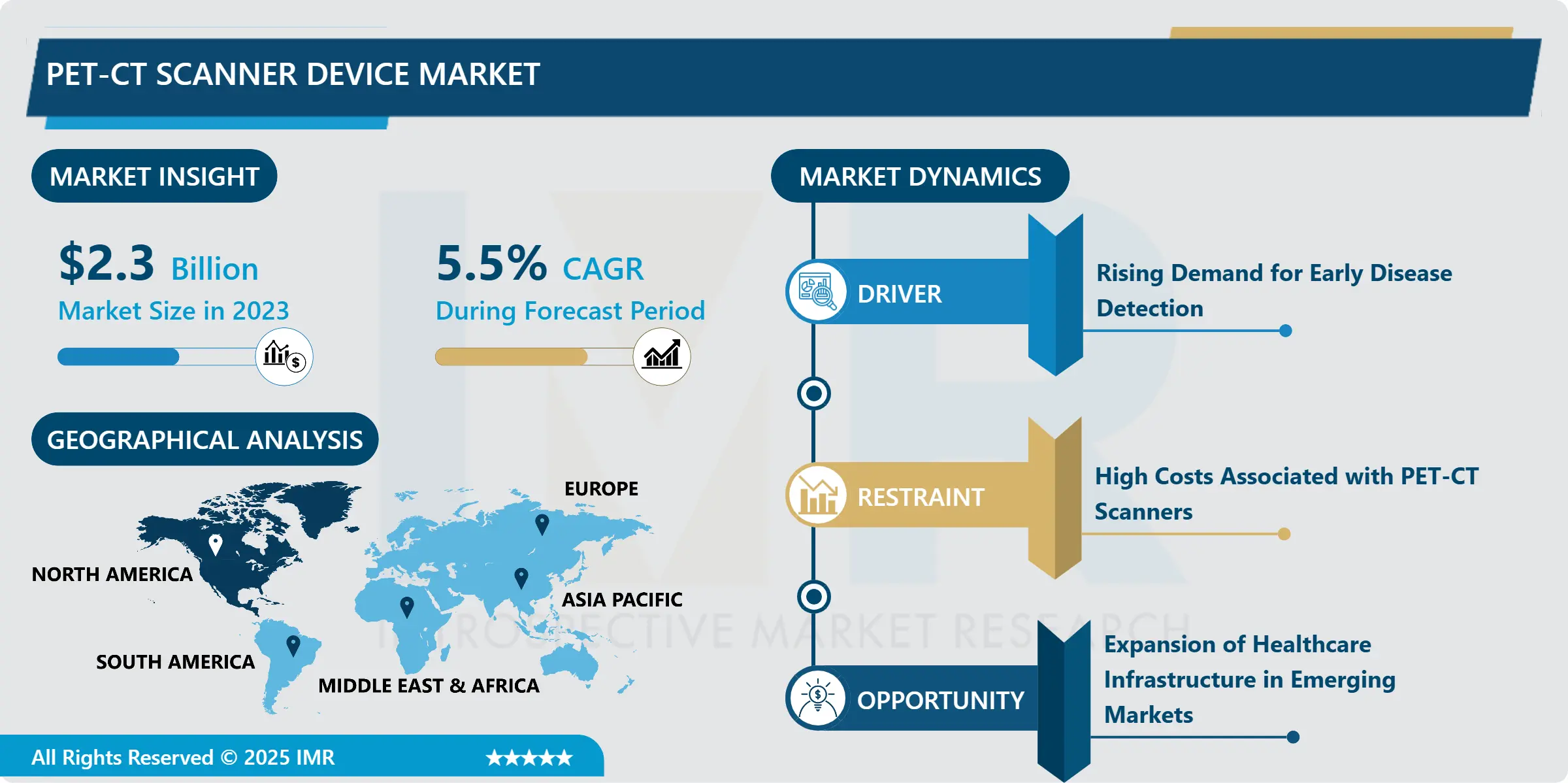
PET-CT Scanner Device Market Growth Analysis & Forecast (2024-2032)
The PET-CT scanner device market includes imaging equipment applied for both diagnostic and locating cancer, stroke, cardiovascular diseases, and other illnesses.

IMR Group
Description
PET-CT Scanner Device Market Synopsis:
PET-CT Scanner Device Market Size Was Valued at USD 2.3 Billion in 2023, and is Projected to Reach USD 3.8 Billion by 2032, Growing at a CAGR of 5.5% From 2024-2032.
The PET-CT scanner device market includes imaging equipment applied for both diagnostic and locating cancer, stroke, cardiovascular diseases, and other illnesses. As a combination of PET and CT, these devices provide point to point upfront images of metabolic and anatomical formations, which enhance diagnostic efficiency. This dual-imaging approach helpful to clinicians when identifying diseases at their early stages because it allows them to treat patients effectively and with minimal invasiveness.
The global PET-CT scanner device market has expanded at an incredibly fast pace due to high incidences of chronic illnesses particularly cancer which requires efficient diagnostic imaging equipment. Half of the PET-CT scanners are used in oncology to obtain functional and structural images of a patient with a tumor and metastases. The shift in employer and employee healthcare expenditure, particularly in the developed nations, PET-CT scanners have been boosted through enhanced health care facilities and increased use of diagnostic imaging methods. Furthermore, TOF and artificial intelligence PET-CT systems are rapidly advancing and growing the market based on improvements in image quality, and effective and accurate nuclear medicine diagnosis. These development are in tune with the global shift towards less invasive diagnostics procedures.
Communication for Asia-Pacific region is that emerging markets are often crank up market growth due to elevating healthcare facility and government support for superior diagnostic techniques. However, in the areas where the networks of the medical organizations are still being constructed, the question of availability and cost are significant. But, growth is expected to be supported by the public private partnership business models combined with increasing demand for early detection. That, besides, is genetically connected with the steady growth of demand for PET-CT imaging as the devices help to provide essential data on individual treatment for patients suffering from oncological diseases.
PET-CT Scanner Device Market Trend Analysis
Rise of AI-Integrated PET-CT Scanners
One of the key farsighted trends observed in PET-CT scanner devices is the integration of anti-intelligence or artificial intelligence in the diagnostic imaging marketplace. Various applications of AI include improving the image reconstruction of PET-CT scanners, decreasing noises to render high quality images with high precision. It also means that image analysis is performed faster, meaning that clinical decision-making at the bed-side is enhanced, and overall operations in a busy health care facility are enhanced. Also, AI ensures that patients receive appropriate radiation dosage in scans as this makes them safer. The ever-growing advancements will continue to be implemented in Medical imaging applications, thus PET-CT Scanner market is expected to be transformed through connectivity by the AI Devices because they have better capabilities for the diagnosis of ailments to deliver improved patient care.
Growing Demand in Emerging Markets
New economy countries offer substantial opportunities in the PET-CT scanner device market. Many of these countries as those emerging from Asia-Pacific, Latin America as well as some of those in the Middle East are embracing the challenge by putting considerable investment on growing health care systems for developing treatments and diagnostics for chronic diseases. There is growing demand in such areas on latest diagnostic imaging equipment such as PET-CT scanners and this is attributed to; In addition, there has been an increase in government inclination towards social networking sites, increasing disposable income and increasing urban populations all of which are driving this market. It is clear that PET-CT radiation technology has a promising demand in these markets, and thus companies investing in these markets can have relatively lower operating costs.
PET-CT Scanner Device Market Segment Analysis:
PET-CT Scanner Device Market is Segmented on the basis of Type, Slice Count, Application, and Region.
By Type, Stationary Scanners segment is expected to dominate the market during the forecast period
The factors highlighting segmentation are based on scanner type; it consists of Fixed or Stationary and Mobile PET-CT Scanners; among this stationary scanner are expected to capture the large share in the market during the forecast period. Integrated PET-CT fixed structures are appropriate for therapeutic and diagnostic centers, which perform a large number of diagnostic examinations. Their design ensures that imaging is possible, resulting in high quality diagnosis hence suitable for use in oncology, cardiology and neurology scans at normal usage frequencies. The usefulness of having stationary scanners is that they provide much needed accuracy for areas that require high through put and accuracy of diagnosis.
Fixed scanners are preferred as their functionality is more advanced in comparison with portable ones, such as higher sensitivity and resolution. Which are most frequently fitted with technology like time-of-flight (TOF) imaging that can boost the diagnostic capabilities. While there had been improvements in portable or mobile PET-CT scanners and now widely used especially for the remote or rural settings, fixed or just fixed type PET-CT scanners are still more popularly chosen in large-scale health care institutions requiring more structural support. This is an indication of the fact that the market requires high performance equipment in meeting various diagnostic challenges.
By Slice Count, Low Slice Scanner (
Chapter 1: Introduction
1.1 Scope and Coverage
Chapter 2:Executive Summary
Chapter 3: Market Landscape
3.1 Market Dynamics
3.1.1 Drivers
3.1.2 Restraints
3.1.3 Opportunities
3.1.4 Challenges
3.2 Market Trend Analysis
3.3 PESTLE Analysis
3.4 Porter’s Five Forces Analysis
3.5 Industry Value Chain Analysis
3.6 Ecosystem
3.7 Regulatory Landscape
3.8 Price Trend Analysis
3.9 Patent Analysis
3.10 Technology Evolution
3.11 Investment Pockets
3.12 Import-Export Analysis
Chapter 4: PET-CT Scanner Device Market by Type
4.1 PET-CT Scanner Device Market Snapshot and Growth Engine
4.2 PET-CT Scanner Device Market Overview
4.3 Stationary Scanners
4.3.1 Introduction and Market Overview
4.3.2 Historic and Forecasted Market Size in Value USD and Volume Units (2017-2032F)
4.3.3 Key Market Trends, Growth Factors and Opportunities
4.3.4 Stationary Scanners: Geographic Segmentation Analysis
4.4 Portable Scanners/Mobile Scanners
4.4.1 Introduction and Market Overview
4.4.2 Historic and Forecasted Market Size in Value USD and Volume Units (2017-2032F)
4.4.3 Key Market Trends, Growth Factors and Opportunities
4.4.4 Portable Scanners/Mobile Scanners: Geographic Segmentation Analysis
Chapter 5: PET-CT Scanner Device Market by Slice Count
5.1 PET-CT Scanner Device Market Snapshot and Growth Engine
5.2 PET-CT Scanner Device Market Overview
5.3 Low Slice Scanner (64 Slices): Geographic Segmentation Analysis
Chapter 6: PET-CT Scanner Device Market by Application
6.1 PET-CT Scanner Device Market Snapshot and Growth Engine
6.2 PET-CT Scanner Device Market Overview
6.3 Oncology
6.3.1 Introduction and Market Overview
6.3.2 Historic and Forecasted Market Size in Value USD and Volume Units (2017-2032F)
6.3.3 Key Market Trends, Growth Factors and Opportunities
6.3.4 Oncology: Geographic Segmentation Analysis
6.4 Neurology
6.4.1 Introduction and Market Overview
6.4.2 Historic and Forecasted Market Size in Value USD and Volume Units (2017-2032F)
6.4.3 Key Market Trends, Growth Factors and Opportunities
6.4.4 Neurology: Geographic Segmentation Analysis
6.5 Cardiology
6.5.1 Introduction and Market Overview
6.5.2 Historic and Forecasted Market Size in Value USD and Volume Units (2017-2032F)
6.5.3 Key Market Trends, Growth Factors and Opportunities
6.5.4 Cardiology: Geographic Segmentation Analysis
6.6 Others
6.6.1 Introduction and Market Overview
6.6.2 Historic and Forecasted Market Size in Value USD and Volume Units (2017-2032F)
6.6.3 Key Market Trends, Growth Factors and Opportunities
6.6.4 Others: Geographic Segmentation Analysis
Chapter 7: Company Profiles and Competitive Analysis
7.1 Competitive Landscape
7.1.1 Competitive Benchmarking
7.1.2 PET-CT Scanner Device Market Share by Manufacturer (2023)
7.1.3 Industry BCG Matrix
7.1.4 Heat Map Analysis
7.1.5 Mergers and Acquisitions
7.2 CANON MEDICAL SYSTEMS CORPORATION (JAPAN)
7.2.1 Company Overview
7.2.2 Key Executives
7.2.3 Company Snapshot
7.2.4 Role of the Company in the Market
7.2.5 Sustainability and Social Responsibility
7.2.6 Operating Business Segments
7.2.7 Product Portfolio
7.2.8 Business Performance
7.2.9 Key Strategic Moves and Recent Developments
7.2.10 SWOT Analysis
7.3 CMR NAVISCAN CORPORATION (USA)
7.4 CURIUM PHARMA (FRANCE)
7.5 GE HEALTHCARE (USA)
7.6 HITACHI
7.7 LTD. (JAPAN)
7.8 KONINKLIJKE PHILIPS N.V. (NETHERLANDS)
7.9 MEDISO LTD. (HUNGARY)
7.10 MINFOUND MEDICAL SYSTEMS CO. LTD. (CHINA)
7.11 NEUSOFT MEDICAL SYSTEMS (CHINA)
7.12 ONCOVISION (SPAIN)
7.13 POSITRON CORPORATION (USA)
7.14 SIEMENS HEALTHINEERS (GERMANY)
7.15 SOFIE BIOSCIENCES (USA)
7.16 SPECTRUM DYNAMICS MEDICAL (SWITZERLAND)
7.17 UNITED IMAGING HEALTHCARE (CHINA)
7.18 OTHER ACTIVE PLAYERS
Chapter 8: Global PET-CT Scanner Device Market By Region
8.1 Overview
8.2. North America PET-CT Scanner Device Market
8.2.1 Key Market Trends, Growth Factors and Opportunities
8.2.2 Top Key Companies
8.2.3 Historic and Forecasted Market Size by Segments
8.2.4 Historic and Forecasted Market Size By Type
8.2.4.1 Stationary Scanners
8.2.4.2 Portable Scanners/Mobile Scanners
8.2.5 Historic and Forecasted Market Size By Slice Count
8.2.5.1 Low Slice Scanner (64 Slices)
8.2.6 Historic and Forecasted Market Size By Application
8.2.6.1 Oncology
8.2.6.2 Neurology
8.2.6.3 Cardiology
8.2.6.4 Others
8.2.7 Historic and Forecast Market Size by Country
8.2.7.1 US
8.2.7.2 Canada
8.2.7.3 Mexico
8.3. Eastern Europe PET-CT Scanner Device Market
8.3.1 Key Market Trends, Growth Factors and Opportunities
8.3.2 Top Key Companies
8.3.3 Historic and Forecasted Market Size by Segments
8.3.4 Historic and Forecasted Market Size By Type
8.3.4.1 Stationary Scanners
8.3.4.2 Portable Scanners/Mobile Scanners
8.3.5 Historic and Forecasted Market Size By Slice Count
8.3.5.1 Low Slice Scanner (64 Slices)
8.3.6 Historic and Forecasted Market Size By Application
8.3.6.1 Oncology
8.3.6.2 Neurology
8.3.6.3 Cardiology
8.3.6.4 Others
8.3.7 Historic and Forecast Market Size by Country
8.3.7.1 Russia
8.3.7.2 Bulgaria
8.3.7.3 The Czech Republic
8.3.7.4 Hungary
8.3.7.5 Poland
8.3.7.6 Romania
8.3.7.7 Rest of Eastern Europe
8.4. Western Europe PET-CT Scanner Device Market
8.4.1 Key Market Trends, Growth Factors and Opportunities
8.4.2 Top Key Companies
8.4.3 Historic and Forecasted Market Size by Segments
8.4.4 Historic and Forecasted Market Size By Type
8.4.4.1 Stationary Scanners
8.4.4.2 Portable Scanners/Mobile Scanners
8.4.5 Historic and Forecasted Market Size By Slice Count
8.4.5.1 Low Slice Scanner (64 Slices)
8.4.6 Historic and Forecasted Market Size By Application
8.4.6.1 Oncology
8.4.6.2 Neurology
8.4.6.3 Cardiology
8.4.6.4 Others
8.4.7 Historic and Forecast Market Size by Country
8.4.7.1 Germany
8.4.7.2 UK
8.4.7.3 France
8.4.7.4 The Netherlands
8.4.7.5 Italy
8.4.7.6 Spain
8.4.7.7 Rest of Western Europe
8.5. Asia Pacific PET-CT Scanner Device Market
8.5.1 Key Market Trends, Growth Factors and Opportunities
8.5.2 Top Key Companies
8.5.3 Historic and Forecasted Market Size by Segments
8.5.4 Historic and Forecasted Market Size By Type
8.5.4.1 Stationary Scanners
8.5.4.2 Portable Scanners/Mobile Scanners
8.5.5 Historic and Forecasted Market Size By Slice Count
8.5.5.1 Low Slice Scanner (64 Slices)
8.5.6 Historic and Forecasted Market Size By Application
8.5.6.1 Oncology
8.5.6.2 Neurology
8.5.6.3 Cardiology
8.5.6.4 Others
8.5.7 Historic and Forecast Market Size by Country
8.5.7.1 China
8.5.7.2 India
8.5.7.3 Japan
8.5.7.4 South Korea
8.5.7.5 Malaysia
8.5.7.6 Thailand
8.5.7.7 Vietnam
8.5.7.8 The Philippines
8.5.7.9 Australia
8.5.7.10 New Zealand
8.5.7.11 Rest of APAC
8.6. Middle East & Africa PET-CT Scanner Device Market
8.6.1 Key Market Trends, Growth Factors and Opportunities
8.6.2 Top Key Companies
8.6.3 Historic and Forecasted Market Size by Segments
8.6.4 Historic and Forecasted Market Size By Type
8.6.4.1 Stationary Scanners
8.6.4.2 Portable Scanners/Mobile Scanners
8.6.5 Historic and Forecasted Market Size By Slice Count
8.6.5.1 Low Slice Scanner (64 Slices)
8.6.6 Historic and Forecasted Market Size By Application
8.6.6.1 Oncology
8.6.6.2 Neurology
8.6.6.3 Cardiology
8.6.6.4 Others
8.6.7 Historic and Forecast Market Size by Country
8.6.7.1 Turkiye
8.6.7.2 Bahrain
8.6.7.3 Kuwait
8.6.7.4 Saudi Arabia
8.6.7.5 Qatar
8.6.7.6 UAE
8.6.7.7 Israel
8.6.7.8 South Africa
8.7. South America PET-CT Scanner Device Market
8.7.1 Key Market Trends, Growth Factors and Opportunities
8.7.2 Top Key Companies
8.7.3 Historic and Forecasted Market Size by Segments
8.7.4 Historic and Forecasted Market Size By Type
8.7.4.1 Stationary Scanners
8.7.4.2 Portable Scanners/Mobile Scanners
8.7.5 Historic and Forecasted Market Size By Slice Count
8.7.5.1 Low Slice Scanner (64 Slices)
8.7.6 Historic and Forecasted Market Size By Application
8.7.6.1 Oncology
8.7.6.2 Neurology
8.7.6.3 Cardiology
8.7.6.4 Others
8.7.7 Historic and Forecast Market Size by Country
8.7.7.1 Brazil
8.7.7.2 Argentina
8.7.7.3 Rest of SA
Chapter 9 Analyst Viewpoint and Conclusion
9.1 Recommendations and Concluding Analysis
9.2 Potential Market Strategies
Chapter 10 Research Methodology
10.1 Research Process
10.2 Primary Research
10.3 Secondary Research
Q1: What would be the forecast period in the PET-CT Scanner Device Market research report?
A1: The forecast period in the PET-CT Scanner Device Market research report is 2024-2032.
Q2: Who are the key players in the PET-CT Scanner Device Market?
A2: Medical Systems Corporation, CMR Naviscan Corporation, GE Healthcare, Hitachi, Ltd., and Siemens Healthineers and Other Major Players.
Q3: What are the segments of the PET-CT Scanner Device Market?
A3: The PET-CT Scanner Device Market is segmented into Type, Slice Count, Application and region. By Type, the market is categorized into Stationary Scanners, Portable Scanners/Mobile Scanners. By Slice Count, the market is categorized into Low Slice Scanner (64 Slices). By Application, the market is categorized into Oncology, Neurology, Cardiology, Others. By region, it is analyzed across North America (U.S., Canada, Mexico), Eastern Europe (Russia, Bulgaria, The Czech Republic, Hungary, Poland, Romania, Rest of Eastern Europe), Western Europe (Germany, UK, France, Netherlands, Italy, Spain, Rest of Western Europe), Asia Pacific (China, India, Japan, South Korea, Malaysia, Thailand, Vietnam, The Philippines, Australia, New Zealand, Rest of APAC), Middle East & Africa (Turkiye, Bahrain, Kuwait, Saudi Arabia, Qatar, UAE, Israel, South Africa), South America (Brazil, Argentina, Rest of SA).
Q4: What is the PET-CT Scanner Device Market?
A4: The PET-CT scanner device market includes imaging equipment applied for both diagnostic and locating cancer, stroke, cardiovascular diseases, and other illnesses. As a combination of PET and CT, these devices provide point to point upfront images of metabolic and anatomical formations, which enhance diagnostic efficiency. This dual-imaging approach helpful to clinicians when identifying diseases at their early stages because it allows them to treat patients effectively and with minimal invasiveness.
Q5: How big is the PET-CT Scanner Device Market?
A5: PET-CT Scanner Device Market Size Was Valued at USD 2.3 Billion in 2023, and is Projected to Reach USD 3.8 Billion by 2032, Growing at a CAGR of 5.5% From 2024-2032.
How to Buy a Report from eminsights.jp
On the product page, choose the license you want: Single-User License, Multi-User License or Enterprise License.
If you required report in your native language, then you can click on Translated Report button and fill out the form with report name and language you want, then our team will contact you as soon as possible.
Click the Buy Now button.
You will be redirected to the checkout page. Enter your company details and payment information.
Click Place Order to complete the purchase.
Confirmation: You’ll receive an order confirmation and our team will contact you shortly with your ordered report.
If you have any questions, fill out the contact form below or email us at [email protected].
Thank you for choosing eminsights.jp!