Stay Ahead in Fast-Growing Economies.
Browse Reports Now




Epileptic Seizures Treatment Market Size, Share, Growth & Forecast (2024-2032)
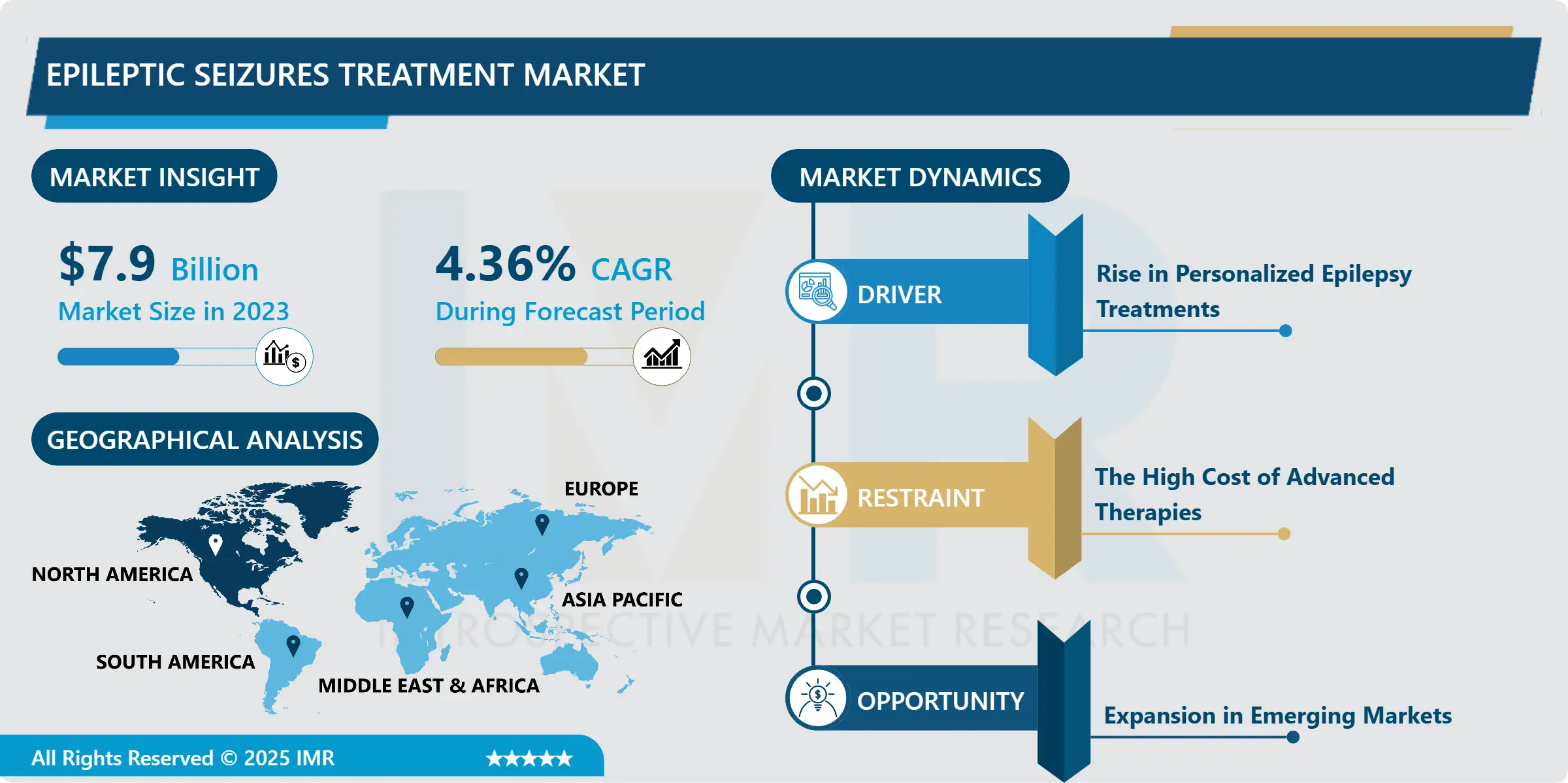
Epileptic Seizures Treatment Market Size Was Valued at USD 7.9 Billion in 2023, and is Projected to Reach USD 11.8 Billion by 2032, Growing at a CAGR of 4.36% From 2024-2032.

IMR Group
Description
Epileptic Seizures Treatment Market Synopsis:
Epileptic Seizures Treatment Market Size Was Valued at USD 7.9 Billion in 2023, and is Projected to Reach USD 11.8 Billion by 2032, Growing at a CAGR of 4.36% From 2024-2032.
The Epileptic Seizures Treatment Market refers to the global industry focused on the development, production, and distribution of pharmaceutical and medical devices aimed at managing and treating epilepsy and seizures. This includes anti-epileptic drugs (AEDs), devices like vague nerve stimulators (VNS), and other interventions that help control or reduce the frequency and severity of seizures.
The market for Epileptic Seizures Treatment has so greatly expanded over last decade due to the increasing awareness about epilepsy, the new progresses of medical scientist and the demand on better therapy. It is estimated that about 50 million people globally are living with epilepsy a major neurological disorder. As seen by the large number of drugs and devices in the market, there are large opportunities to grow further as new treatments, better and tailored to patients, are created.
The growth of the market is contributed to some factors including rising incidence of epilepsy, growth of healthcare industry in emerging nations, and technological progress in medical solutions. Current R&D include using newer molecules and compounds which are much effective and cause fewer side effects than conventional anti-epileptic drugs, drugs on the basis of certain pathways or Genetic factors about epilepsy. Also, the usage of Neurostimulation therapies for treating disorders including VNS and deep brain stimulation therapy is in the rise in usage. The increase in patients that require proper seizure control has also put pressure on the market and boosted demand for both pharmacological and biomedical products.
Epileptic Seizures Treatment Market Trend Analysis:
Rise in Personalized Epilepsy Treatments
One of the strongly evident trends in the epileptic seizure treatment market is the trend towards individualization of treatment. This include developing strategies targeting therapies, where the treatment plans depend on features such as genetic predisposition, abstract kind of seizure, and other characteristics of the person. Progress in the field of genomics and biomarkers was made to develop personalized therapy targeting these side effects while optimising seizure management. It is becoming more valuable where the patient does not respond to first-and second-line treatment, a condition known as drug-resistant epilepsy.
Organizations are directing their efforts towards the creation of new genetic tests and molecules that can enhance the seizure activity, as well as more specialized medication. This trend is expected to continue growing, and will further drive the market as adoption of targeted therapies increases.
Expansion in Emerging Markets
One of the biggest opportunities that exist within the Epileptic Seizures Treatment Market is the increasing improvements in the availability of healthcare in developing countries. Considering the fact that many players remain untapped especially in Asian-Pacific, Latin America and some African region, there is promising market in these areas. With the steady growth of healthcare systems in those regions, the requirement for corresponding improvement in diagnostics, pharmaceuticals, and seizure control is on the rise.
Furthermore, increased consciousness of epilepsy and neurological problems, along with advancements in the health care sector by governments globally should help the use of AEDs and treatment instruments. The availability of treatment and increased health insurance will also work the magic to ensure treatments for epilepsy in such regions are realized.
Epileptic Seizures Treatment Market Segment Analysis:
Epileptic Seizures Treatment Market is Segmented on the basis of Treatment Type, Seizure Type, End User, and Region
By Treatment Type, Medications segment is expected to dominate the market during the forecast period
The medications segment is expected to maintain a leading position in the epileptic seizures treatment market throughout the forecast period, supported by the extensive use of anti-epileptic drugs (AEDs) as the primary method of seizure control. These therapies offer reliable and effective seizure management for a broad patient population, improving quality of life and long-term outcomes. Advances in drug delivery systems and treatment protocols have also enhanced patient adherence and optimized therapeutic impact, reinforcing the strength of this segment.
The increasing prevalence of epilepsy and growing access to healthcare services across both developed and emerging markets are accelerating the demand for pharmaceutical interventions. A well-established pipeline of innovative AEDs, along with ongoing clinical developments and regulatory support, is contributing to sustained market growth. Pharmaceutical companies continue to prioritize research and development efforts aimed at introducing safer and more targeted medications, further solidifying the dominance of the medications segment in the treatment landscape.
By Seizure Type, Focal seizures segment expected to held the largest share
Focal seizures, which are localized to specific areas of the brain, are expected to hold the largest market share in the epileptic seizures treatment segment due to their higher prevalence compared to other seizure types. Focal seizures affect a significant proportion of the epilepsy patient population, driving the demand for specialized treatment options. The growing recognition of focal seizures and the advancement of targeted therapies have resulted in a marked increase in the treatment options available, contributing to the expansion of this market segment.
The focus on effective management of focal seizures has prompted the development of innovative medications, neuromodulation therapies, and surgical interventions, further strengthening the market’s position. The increasing incidence of epilepsy, coupled with the rising awareness and early diagnosis of focal seizures, ensures that this segment remains a key driver for growth in the epilepsy treatment landscape. As the treatment landscape continues to evolve, pharmaceutical companies and healthcare providers are expected to increase investments to meet the unmet needs of focal seizure patients.
Epileptic Seizures Treatment Market Regional Insights:
North America is Expected to Dominate the Market Over the Forecast period
North America dominated the Epileptic Seizures Treatment Market in 2023 with the largest country level market in the United States. The region captured a good market share in the global market and it was believed to range from 40-45 %. This has been driven by a high rate of epilepsy incidences in North America together with advanced health systems and enhanced government sponsorship to epilepsy treatment and research.
Further, there are a large market for AEDs and neurostimulation devices in the U.S., along with high HC spending and a beneficial regulatory system. Also, North America has global pharmaceutical and medical device players who are engaged in the production of modern treatments which makes it to continue being the market leader.
Active Key Players in the Epileptic Seizures Treatment Market
Abbott Laboratories (United States)
Astellas Pharma (Japan)
Bayer AG (Germany)
BioMarin Pharmaceutical (United States)
Cerebral Therapeutics (United States)
Eisai Co. Ltd. (Japan)
Epilepsy Foundation (United States)
GlaxoSmithKline (United Kingdom)
Janssen Pharmaceuticals (United States)
Medtronic (Ireland)
Novartis AG (Switzerland)
Pfizer Inc. (United States)
Sanofi (France)
UCB S.A. (Belgium)
Valeant Pharmaceuticals (Canada)
Other Active Players
Chapter 1: Introduction
1.1 Scope and Coverage
Chapter 2:Executive Summary
Chapter 3: Market Landscape
3.1 Market Dynamics
3.1.1 Drivers
3.1.2 Restraints
3.1.3 Opportunities
3.1.4 Challenges
3.2 Market Trend Analysis
3.3 PESTLE Analysis
3.4 Porter’s Five Forces Analysis
3.5 Industry Value Chain Analysis
3.6 Ecosystem
3.7 Regulatory Landscape
3.8 Price Trend Analysis
3.9 Patent Analysis
3.10 Technology Evolution
3.11 Investment Pockets
3.12 Import-Export Analysis
Chapter 4: Epileptic Seizures Treatment Market by Treatment Type
4.1 Epileptic Seizures Treatment Market Snapshot and Growth Engine
4.2 Epileptic Seizures Treatment Market Overview
4.3 Medications: First-generation anti-epileptic drugs
4.3.1 Introduction and Market Overview
4.3.2 Historic and Forecasted Market Size in Value USD and Volume Units (2017-2032F)
4.3.3 Key Market Trends, Growth Factors and Opportunities
4.3.4 Medications: First-generation anti-epileptic drugs: Geographic Segmentation Analysis
4.4 Second-generation anti-epileptic drugs
4.4.1 Introduction and Market Overview
4.4.2 Historic and Forecasted Market Size in Value USD and Volume Units (2017-2032F)
4.4.3 Key Market Trends, Growth Factors and Opportunities
4.4.4 Second-generation anti-epileptic drugs: Geographic Segmentation Analysis
4.5 Third-generation anti-epileptic drugs
4.5.1 Introduction and Market Overview
4.5.2 Historic and Forecasted Market Size in Value USD and Volume Units (2017-2032F)
4.5.3 Key Market Trends, Growth Factors and Opportunities
4.5.4 Third-generation anti-epileptic drugs: Geographic Segmentation Analysis
4.6 Devices: Vagus nerve stimulation (VNS) devices
4.6.1 Introduction and Market Overview
4.6.2 Historic and Forecasted Market Size in Value USD and Volume Units (2017-2032F)
4.6.3 Key Market Trends, Growth Factors and Opportunities
4.6.4 Devices: Vagus nerve stimulation (VNS) devices: Geographic Segmentation Analysis
4.7 Responsive neurostimulation devices
4.7.1 Introduction and Market Overview
4.7.2 Historic and Forecasted Market Size in Value USD and Volume Units (2017-2032F)
4.7.3 Key Market Trends, Growth Factors and Opportunities
4.7.4 Responsive neurostimulation devices: Geographic Segmentation Analysis
4.8 Deep brain stimulation devices
4.8.1 Introduction and Market Overview
4.8.2 Historic and Forecasted Market Size in Value USD and Volume Units (2017-2032F)
4.8.3 Key Market Trends, Growth Factors and Opportunities
4.8.4 Deep brain stimulation devices: Geographic Segmentation Analysis
Chapter 5: Epileptic Seizures Treatment Market by Application
5.1 Epileptic Seizures Treatment Market Snapshot and Growth Engine
5.2 Epileptic Seizures Treatment Market Overview
5.3 Focal seizures
5.3.1 Introduction and Market Overview
5.3.2 Historic and Forecasted Market Size in Value USD and Volume Units (2017-2032F)
5.3.3 Key Market Trends, Growth Factors and Opportunities
5.3.4 Focal seizures: Geographic Segmentation Analysis
5.4 Generalized seizures
5.4.1 Introduction and Market Overview
5.4.2 Historic and Forecasted Market Size in Value USD and Volume Units (2017-2032F)
5.4.3 Key Market Trends, Growth Factors and Opportunities
5.4.4 Generalized seizures: Geographic Segmentation Analysis
5.5 Unknown onset seizures
5.5.1 Introduction and Market Overview
5.5.2 Historic and Forecasted Market Size in Value USD and Volume Units (2017-2032F)
5.5.3 Key Market Trends, Growth Factors and Opportunities
5.5.4 Unknown onset seizures: Geographic Segmentation Analysis
Chapter 6: Epileptic Seizures Treatment Market by Seizure Type
6.1 Epileptic Seizures Treatment Market Snapshot and Growth Engine
6.2 Epileptic Seizures Treatment Market Overview
6.3 Hospitals
6.3.1 Introduction and Market Overview
6.3.2 Historic and Forecasted Market Size in Value USD and Volume Units (2017-2032F)
6.3.3 Key Market Trends, Growth Factors and Opportunities
6.3.4 Hospitals: Geographic Segmentation Analysis
6.4 Ambulatory surgical centers
6.4.1 Introduction and Market Overview
6.4.2 Historic and Forecasted Market Size in Value USD and Volume Units (2017-2032F)
6.4.3 Key Market Trends, Growth Factors and Opportunities
6.4.4 Ambulatory surgical centers: Geographic Segmentation Analysis
6.5 Homecare
6.5.1 Introduction and Market Overview
6.5.2 Historic and Forecasted Market Size in Value USD and Volume Units (2017-2032F)
6.5.3 Key Market Trends, Growth Factors and Opportunities
6.5.4 Homecare: Geographic Segmentation Analysis
Chapter 7: Company Profiles and Competitive Analysis
7.1 Competitive Landscape
7.1.1 Competitive Benchmarking
7.1.2 Epileptic Seizures Treatment Market Share by Manufacturer (2023)
7.1.3 Industry BCG Matrix
7.1.4 Heat Map Analysis
7.1.5 Mergers and Acquisitions
7.2 ABBOTT LABORATORIES (UNITED STATES)
7.2.1 Company Overview
7.2.2 Key Executives
7.2.3 Company Snapshot
7.2.4 Role of the Company in the Market
7.2.5 Sustainability and Social Responsibility
7.2.6 Operating Business Segments
7.2.7 Product Portfolio
7.2.8 Business Performance
7.2.9 Key Strategic Moves and Recent Developments
7.2.10 SWOT Analysis
7.3 ASTELLAS PHARMA (JAPAN)
7.4 BAYER AG (GERMANY)
7.5 BIOMARIN PHARMACEUTICAL (UNITED STATES)
7.6 CEREBRAL THERAPEUTICS (UNITED STATES)
7.7 EISAI CO. LTD. (JAPAN)
7.8 EPILEPSY FOUNDATION (UNITED STATES)
7.9 GLAXOSMITHKLINE (UNITED KINGDOM)
7.10 JANSSEN PHARMACEUTICALS (UNITED STATES)
7.11 MEDTRONIC (IRELAND)
7.12 NOVARTIS AG (SWITZERLAND)
7.13 PFIZER INC. (UNITED STATES)
7.14 SANOFI (FRANCE)
7.15 UCB S.A. (BELGIUM)
7.16 VALEANT PHARMACEUTICALS (CANADA)
7.17 OTHER ACTIVE PLAYERS
Chapter 8: Global Epileptic Seizures Treatment Market By Region
8.1 Overview
8.2. North America Epileptic Seizures Treatment Market
8.2.1 Key Market Trends, Growth Factors and Opportunities
8.2.2 Top Key Companies
8.2.3 Historic and Forecasted Market Size by Segments
8.2.4 Historic and Forecasted Market Size By Treatment Type
8.2.4.1 Medications: First-generation anti-epileptic drugs
8.2.4.2 Second-generation anti-epileptic drugs
8.2.4.3 Third-generation anti-epileptic drugs
8.2.4.4 Devices: Vagus nerve stimulation (VNS) devices
8.2.4.5 Responsive neurostimulation devices
8.2.4.6 Deep brain stimulation devices
8.2.5 Historic and Forecasted Market Size By Application
8.2.5.1 Focal seizures
8.2.5.2 Generalized seizures
8.2.5.3 Unknown onset seizures
8.2.6 Historic and Forecasted Market Size By Seizure Type
8.2.6.1 Hospitals
8.2.6.2 Ambulatory surgical centers
8.2.6.3 Homecare
8.2.7 Historic and Forecast Market Size by Country
8.2.7.1 US
8.2.7.2 Canada
8.2.7.3 Mexico
8.3. Eastern Europe Epileptic Seizures Treatment Market
8.3.1 Key Market Trends, Growth Factors and Opportunities
8.3.2 Top Key Companies
8.3.3 Historic and Forecasted Market Size by Segments
8.3.4 Historic and Forecasted Market Size By Treatment Type
8.3.4.1 Medications: First-generation anti-epileptic drugs
8.3.4.2 Second-generation anti-epileptic drugs
8.3.4.3 Third-generation anti-epileptic drugs
8.3.4.4 Devices: Vagus nerve stimulation (VNS) devices
8.3.4.5 Responsive neurostimulation devices
8.3.4.6 Deep brain stimulation devices
8.3.5 Historic and Forecasted Market Size By Application
8.3.5.1 Focal seizures
8.3.5.2 Generalized seizures
8.3.5.3 Unknown onset seizures
8.3.6 Historic and Forecasted Market Size By Seizure Type
8.3.6.1 Hospitals
8.3.6.2 Ambulatory surgical centers
8.3.6.3 Homecare
8.3.7 Historic and Forecast Market Size by Country
8.3.7.1 Russia
8.3.7.2 Bulgaria
8.3.7.3 The Czech Republic
8.3.7.4 Hungary
8.3.7.5 Poland
8.3.7.6 Romania
8.3.7.7 Rest of Eastern Europe
8.4. Western Europe Epileptic Seizures Treatment Market
8.4.1 Key Market Trends, Growth Factors and Opportunities
8.4.2 Top Key Companies
8.4.3 Historic and Forecasted Market Size by Segments
8.4.4 Historic and Forecasted Market Size By Treatment Type
8.4.4.1 Medications: First-generation anti-epileptic drugs
8.4.4.2 Second-generation anti-epileptic drugs
8.4.4.3 Third-generation anti-epileptic drugs
8.4.4.4 Devices: Vagus nerve stimulation (VNS) devices
8.4.4.5 Responsive neurostimulation devices
8.4.4.6 Deep brain stimulation devices
8.4.5 Historic and Forecasted Market Size By Application
8.4.5.1 Focal seizures
8.4.5.2 Generalized seizures
8.4.5.3 Unknown onset seizures
8.4.6 Historic and Forecasted Market Size By Seizure Type
8.4.6.1 Hospitals
8.4.6.2 Ambulatory surgical centers
8.4.6.3 Homecare
8.4.7 Historic and Forecast Market Size by Country
8.4.7.1 Germany
8.4.7.2 UK
8.4.7.3 France
8.4.7.4 The Netherlands
8.4.7.5 Italy
8.4.7.6 Spain
8.4.7.7 Rest of Western Europe
8.5. Asia Pacific Epileptic Seizures Treatment Market
8.5.1 Key Market Trends, Growth Factors and Opportunities
8.5.2 Top Key Companies
8.5.3 Historic and Forecasted Market Size by Segments
8.5.4 Historic and Forecasted Market Size By Treatment Type
8.5.4.1 Medications: First-generation anti-epileptic drugs
8.5.4.2 Second-generation anti-epileptic drugs
8.5.4.3 Third-generation anti-epileptic drugs
8.5.4.4 Devices: Vagus nerve stimulation (VNS) devices
8.5.4.5 Responsive neurostimulation devices
8.5.4.6 Deep brain stimulation devices
8.5.5 Historic and Forecasted Market Size By Application
8.5.5.1 Focal seizures
8.5.5.2 Generalized seizures
8.5.5.3 Unknown onset seizures
8.5.6 Historic and Forecasted Market Size By Seizure Type
8.5.6.1 Hospitals
8.5.6.2 Ambulatory surgical centers
8.5.6.3 Homecare
8.5.7 Historic and Forecast Market Size by Country
8.5.7.1 China
8.5.7.2 India
8.5.7.3 Japan
8.5.7.4 South Korea
8.5.7.5 Malaysia
8.5.7.6 Thailand
8.5.7.7 Vietnam
8.5.7.8 The Philippines
8.5.7.9 Australia
8.5.7.10 New Zealand
8.5.7.11 Rest of APAC
8.6. Middle East & Africa Epileptic Seizures Treatment Market
8.6.1 Key Market Trends, Growth Factors and Opportunities
8.6.2 Top Key Companies
8.6.3 Historic and Forecasted Market Size by Segments
8.6.4 Historic and Forecasted Market Size By Treatment Type
8.6.4.1 Medications: First-generation anti-epileptic drugs
8.6.4.2 Second-generation anti-epileptic drugs
8.6.4.3 Third-generation anti-epileptic drugs
8.6.4.4 Devices: Vagus nerve stimulation (VNS) devices
8.6.4.5 Responsive neurostimulation devices
8.6.4.6 Deep brain stimulation devices
8.6.5 Historic and Forecasted Market Size By Application
8.6.5.1 Focal seizures
8.6.5.2 Generalized seizures
8.6.5.3 Unknown onset seizures
8.6.6 Historic and Forecasted Market Size By Seizure Type
8.6.6.1 Hospitals
8.6.6.2 Ambulatory surgical centers
8.6.6.3 Homecare
8.6.7 Historic and Forecast Market Size by Country
8.6.7.1 Turkiye
8.6.7.2 Bahrain
8.6.7.3 Kuwait
8.6.7.4 Saudi Arabia
8.6.7.5 Qatar
8.6.7.6 UAE
8.6.7.7 Israel
8.6.7.8 South Africa
8.7. South America Epileptic Seizures Treatment Market
8.7.1 Key Market Trends, Growth Factors and Opportunities
8.7.2 Top Key Companies
8.7.3 Historic and Forecasted Market Size by Segments
8.7.4 Historic and Forecasted Market Size By Treatment Type
8.7.4.1 Medications: First-generation anti-epileptic drugs
8.7.4.2 Second-generation anti-epileptic drugs
8.7.4.3 Third-generation anti-epileptic drugs
8.7.4.4 Devices: Vagus nerve stimulation (VNS) devices
8.7.4.5 Responsive neurostimulation devices
8.7.4.6 Deep brain stimulation devices
8.7.5 Historic and Forecasted Market Size By Application
8.7.5.1 Focal seizures
8.7.5.2 Generalized seizures
8.7.5.3 Unknown onset seizures
8.7.6 Historic and Forecasted Market Size By Seizure Type
8.7.6.1 Hospitals
8.7.6.2 Ambulatory surgical centers
8.7.6.3 Homecare
8.7.7 Historic and Forecast Market Size by Country
8.7.7.1 Brazil
8.7.7.2 Argentina
8.7.7.3 Rest of SA
Chapter 9 Analyst Viewpoint and Conclusion
9.1 Recommendations and Concluding Analysis
9.2 Potential Market Strategies
Chapter 10 Research Methodology
10.1 Research Process
10.2 Primary Research
10.3 Secondary Research
Q1: What would be the forecast period in the Epileptic Seizures Treatment Market research report?
A1: The forecast period in the Epileptic Seizures Treatment Market research report is 2024-2032.
Q2: Who are the key players in the Epileptic Seizures Treatment Market?
A2: Abbott Laboratories (United States), Astellas Pharma (Japan), Bayer AG (Germany), BioMarin Pharmaceutical (United States), Cerebral Therapeutics (United States), Eisai Co. Ltd. (Japan), Epilepsy Foundation (United States), GlaxoSmithKline (United Kingdom), Janssen Pharmaceuticals (United States), Medtronic (Ireland), Novartis AG (Switzerland), Pfizer Inc. (United States), Sanofi (France), UCB S.A. (Belgium), Valeant Pharmaceuticals (Canada) and Other Active Players.
Q3: What are the segments of the Epileptic Seizures Treatment Market?
A3: The Epileptic Seizures Treatment Market is segmented into Type, Application, End User and region. by Treatment Type, the market is categorized into (Medications: First-generation anti-epileptic drugs, Second-generation anti-epileptic drugs, Third-generation anti-epileptic drugs, Devices: Vagus nerve stimulation (VNS) devices, Responsive neurostimulation devices, Deep brain stimulation devices), Application, , the market is categorized into (Focal seizures, Generalized seizures, Unknown onset seizures), By Seizure Type, , the market is categorized into (Hospitals, Ambulatory surgical centers, Homecare). By Region, it is analyzed across North America (U.S., Canada, Mexico), Eastern Europe (Russia, Bulgaria, The Czech Republic, Hungary, Poland, Romania, Rest of Eastern Europe), Western Europe (Germany, UK, France, Netherlands, Italy, Spain, Rest of Western Europe), Asia Pacific (China, India, Japan, South Korea, Malaysia, Thailand, Vietnam, The Philippines, Australia, New-Zealand, Rest of APAC), Middle East & Africa (Turkiye, Bahrain, Kuwait, Saudi Arabia, Qatar, UAE, Israel, South Africa), South America (Brazil, Argentina, Rest of SA).
Q4: What is the Epileptic Seizures Treatment Market?
A4: The Epileptic Seizures Treatment Market refers to the global industry focused on the development, production, and distribution of pharmaceutical and medical devices aimed at managing and treating epilepsy and seizures. This includes anti-epileptic drugs (AEDs), devices like vague nerve stimulators (VNS), and other interventions that help control or reduce the frequency and severity of seizures.
Q5: How big is the Epileptic Seizures Treatment Market?
A5: Epileptic Seizures Treatment Market Size Was Valued at USD 7.9 Billion in 2023, and is Projected to Reach USD 11.8 Billion by 2032, Growing at a CAGR of 4.36% From 2024-2032.
How to Buy a Report from eminsights.jp
On the product page, choose the license you want: Single-User License, Multi-User License or Enterprise License.
If you required report in your native language, then you can click on Translated Report button and fill out the form with report name and language you want, then our team will contact you as soon as possible.
Click the Buy Now button.
You will be redirected to the checkout page. Enter your company details and payment information.
Click Place Order to complete the purchase.
Confirmation: You’ll receive an order confirmation and our team will contact you shortly with your ordered report.
If you have any questions, fill out the contact form below or email us at [email protected].
Thank you for choosing eminsights.jp!