Stay Ahead in Fast-Growing Economies.
Browse Reports Now




Pharmaceutical Water Market Growth Analysis & Forecast (2024-2032)
The pharmaceutical water market is a subgroup in the pharmaceuticals Industry; it manufactures and supplies water strictly compounded, processed and treated for its purpose in preparation of pharmaceutical products.

IMR Group
Description
Pharmaceutical Water Market Synopsis:
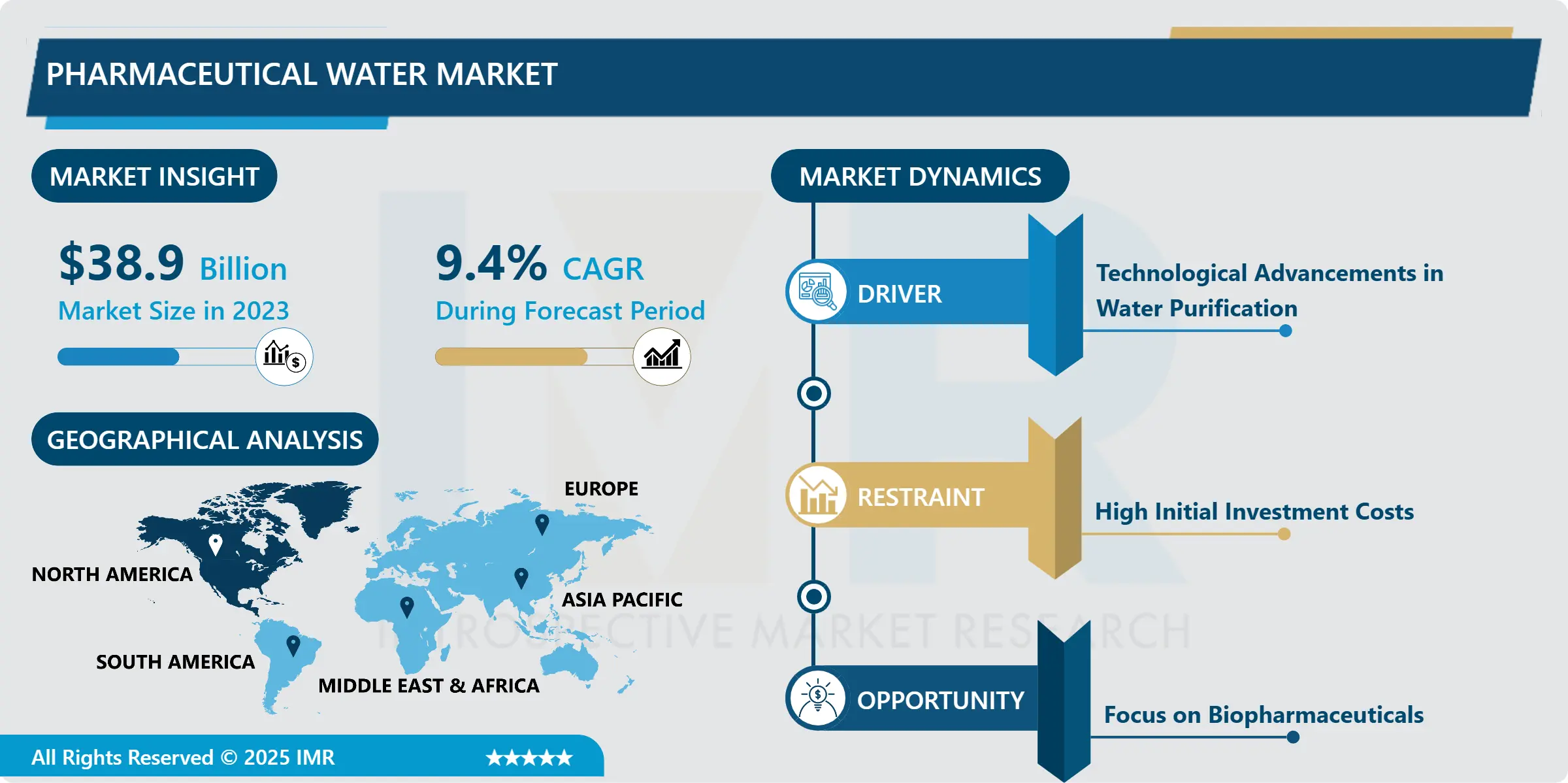
Pharmaceutical Water Market Size Was Valued at USD 38.90 Billion in 2023, and is Projected to Reach USD 87.32 Billion by 2032, Growing at a CAGR of 9.4 % From 2024-2032.
The pharmaceutical water market is a subgroup in the pharmaceuticals Industry; it manufactures and supplies water strictly compounded, processed and treated for its purpose in preparation of pharmaceutical products. This water must also meet very tight regulatory standards and quality as it is a vital component in both the preparation of the medications and in the cleaning of equipment and as an active in injectable solutions. Depending on the role that is played they are named as Purified water (PW), Water for injection (WFI), Sterile water for injection (SWFI) and more. Pharmaceutical water manufacturing involves number of treatment processes such as reverse osmosis, distillation and ultra filtration to purify the water and to eliminate microbial growth. Due to the stringent regulatory measures that governing bodies such as FDA and EMA set on the level of sending out pharmaceutical products, a high-quality pharmaceutical will be necessary in the production of biologics, injectable and other other advance therapeutic products.
The market of pharmaceutical water is growing steadily due to the rising need of water with high quality in different processes of production of pharmaceutical products. The growth of the pharmaceutical industry is in line with the production of biologics, injectables and sterile products, the need for water fit for its these uses has never been this important. Depending in its degree of purity and application, WFI is distinguished from PW and other types of pharmaceutical water. High purity pharmaceuticals, especially biopharmaceuticals, have become more popular because they need closely sterilized water for purification purposes, and this has created the need for better quality pharmaceutical water, therefore driving the market. Also, the increased manufacturing of generics and continuous drift to extended, harder and much more challenging formulations have created more dependence on the purified water sources within pharmaceutical manufacturing plants.
The technological progress achieved within the water purification systems are also participating in the development of the pharmaceutical water market. New technologies, purification technologies and methods such as modern purification methods, membranes and automation of process are making water purification a successful process. These developments improve not only the quality of the end pharmaceutical water but also balances the cost of producing pharmaceutical water hence encourage more pharmaceuticals industries to employ high quality of water treatment systems. However, quality of pharmaceutical water must satisfy the requirements provided by such international quandies concepts as FDA from the United States and EMA from the Europe and other similar organizations; that is why quality control measures are added to the criterion to make it really suitable for use. As long as these tendencies remain, it is stimulating that the market of pharmaceutical water will show constant growth and needs quality, innovative technologies, and pharmacy space in the world.
Pharmaceutical Water Market Trend Analysis:
Increasing Adoption of Sustainable Water Purification Technologies
The only new emerging trend evident in the pharmaceutical water is the rising concern over green water treatment. As such, the increasing awareness, and government policies on the use of environmentally friendly products, and water use has created the need to enhance the green methods in the drug manufactures’ operational processes. This transition has required using higher emissions efficiency purification technologies that as a bonus have eliminated losses and energy use and given higher water quality. Such technologies include membrane filtration, UV disinfection and advance oxidation processes because they are some of the slow growing technologies since they yield higher quality of pharmaceutical water than the traditional and conventional technologies though they pose less harm on the environment. However, when calling on real-time monitoring systems and automation in water treatment processes, the extent of the utilization ratio of water treatment can be raised and it can guarantee that it will follow the rules and regulations. While pharma firms are looking for ways on how to better manage water more effectively in a sustainable manner, they are looking for opportunities for how to better systematize water in order to address other needs such as CSR and brand image in the market.
Expansion of Emerging Markets Presents Growth Opportunities
The growth in developing markets offers the largest potential for the pharmaceutical water market due to increasing demand for healthcare products and services, and increasing attention toward the pharmaceutical industry. They include Asia-Pacific, Latin America, Middle Eastern countries which are urbanizing at high rates, experiencing population increase and high prevalence of chronic diseases, factors that call for high use of pharmaceutical products. With the steady growth of these markets, the local manufacturers of pharmaceutical products are trying to upgrade their production capacities and conform to the global standards which require availability of high-quality pharmaceutical water. In addition, strengthening imports constraints through local production of drugs the government’s drive is boosting the manufacturing infrastructure and technologies for water purification systems. While this trend opens the way for internationalized pharmaceutical companies to invest in these developing regions it also opens up possibilities for companies in the water purification and technology industry as well.
Pharmaceutical Water Market Segment Analysis:
Pharmaceutical Water Market is Segmented on the basis of Product Type, Application, End User, and Region.
By Type, Water for Injection segment is expected to dominate the market during the forecast period
WFI is required where high degree of purity is required more especially in the production of the parenteral products which are usually injected into the body. The utilisation of product is higher than the usage in formulation because as the demand for the injectable products like vaccines/biologic products, then the demand for WFI also increases tremendously. The FDA and the EMA set very high quality standards for WFI which has led to manufacturers ask for better purification techniques and equipment. In addition, with the recent emphasis placed on aseptic processing in the manufacture of pharmaceutical goods particularly the injectable goods, WFI remains very vital in achieving the sterility of the manufactured goods. Added to this continuously growing demand for new and more complex applications for which WFI is used, the Water for Injection segment is positioned to retain its domination of the pharmaceutical water market throughout the forecast period.
By Application, Drug Formulation segment expected to held the largest share
This segment is focused on the function of water in formulation of several products such as the solid dosage forms including tablets and capsule, liquid products and injections. Consequently, there can be no overemphasis on the need for quality water in the formulation of drugs, since it affects the stability, safety and response of the products being psychopharmaceuticals. As the population looks to attain better therapeutic products and more intricate solutions like biologics and biosimilars, the requirement for consistently immaculate quality water increases when evaluated against regulatory guidelines and requirements set by organizations like the FDA and the EMA. Also, as the pharmaceutical industry moves towards special formulations and medicinal products, the use of WFI and PW will likely increase immensely as the industry advances to using better formulations.
Pharmaceutical Water Market Regional Insights:
North America is Expected to Dominate the Market Over the Forecast period
The pharmaceutical water market share in North America is anticipated to have the greatest growth during the forecast period due to the concentrated pharmaceuticals market and high regulatory concerns regarding product cleanness. Some of the biggest pharmaceutical companies inhabit this region and they are investing a lot of capital on research and development in a bid to diversify their portfolio. This investment is accompanied by an increasing need for Biologic Products, injectables, and highly Pure Water for other advanced therapeutic products. Furthermore, quality regulation bodies such as the U.S Food and Drug Administration and other agencies in the America region put firm compliance to strict regulatory standards for pharmaceutical water.
Besides, the growing concern for CSR and “green” around the pharma industry has opened North America as a key growth region to this market. This is due to the fact that drug manufacturers are seeking to develop less expansive and much more efficient methods for handling the environmental impact of the products and since water treatments have proven to be effective in this area this demand is gradually growing. It is also persistently encouraging the development and adoption of higher efficiency filtration technologies that build on water utilization and reduce wastage. In addition, the advancement of Biopharmaceutical establishments requiring high purity of pharmaceutical water in production of new improved biologic products especially in the area of operation.
Active Key Players in the Pharmaceutical Water Market
Aqua Solutions, Inc. (USA)
Evoqua Water Technologies (USA)
GE Water & Process Technologies (USA)
Merck KGaA (Germany)
Pall Corporation (USA)
Parker Hannifin Corporation (USA)
Pentair plc (USA)
Sartorius AG (Germany)
Seitz Filter GmbH (Germany)
Siemens Water Technologies (USA)
SUEZ Water Technologies & Solutions (France)
Thermo Fisher Scientific Inc. (USA)
Veolia Water Technologies (France)
Watts Water Technologies, Inc. (USA)
WFI Solutions (USA), and Other Active Players
Key Industry Developments in the Pharmaceutical Water Market:
In July 2023, the pharmaceutical business Nexus Pharmaceuticals declared in July 2023 that its Sterile Water for Injection, USP in 10mL and 20mL Single-Dose Vials had been approved by the U.S.
Chapter 1: Introduction
1.1 Scope and Coverage
Chapter 2:Executive Summary
Chapter 3: Market Landscape
3.1 Market Dynamics
3.1.1 Drivers
3.1.2 Restraints
3.1.3 Opportunities
3.1.4 Challenges
3.2 Market Trend Analysis
3.3 PESTLE Analysis
3.4 Porter’s Five Forces Analysis
3.5 Industry Value Chain Analysis
3.6 Ecosystem
3.7 Regulatory Landscape
3.8 Price Trend Analysis
3.9 Patent Analysis
3.10 Technology Evolution
3.11 Investment Pockets
3.12 Import-Export Analysis
Chapter 4: Pharmaceutical Water Market by Product Type
4.1 Pharmaceutical Water Market Snapshot and Growth Engine
4.2 Pharmaceutical Water Market Overview
4.3 Highly Purified Water
4.3.1 Introduction and Market Overview
4.3.2 Historic and Forecasted Market Size in Value USD and Volume Units (2017-2032F)
4.3.3 Key Market Trends, Growth Factors and Opportunities
4.3.4 Highly Purified Water: Geographic Segmentation Analysis
4.4 Water for Injection
4.4.1 Introduction and Market Overview
4.4.2 Historic and Forecasted Market Size in Value USD and Volume Units (2017-2032F)
4.4.3 Key Market Trends, Growth Factors and Opportunities
4.4.4 Water for Injection: Geographic Segmentation Analysis
4.5 Water for Inhalation
4.5.1 Introduction and Market Overview
4.5.2 Historic and Forecasted Market Size in Value USD and Volume Units (2017-2032F)
4.5.3 Key Market Trends, Growth Factors and Opportunities
4.5.4 Water for Inhalation: Geographic Segmentation Analysis
4.6 Deionized water
4.6.1 Introduction and Market Overview
4.6.2 Historic and Forecasted Market Size in Value USD and Volume Units (2017-2032F)
4.6.3 Key Market Trends, Growth Factors and Opportunities
4.6.4 Deionized water: Geographic Segmentation Analysis
4.7 Distilled Water
4.7.1 Introduction and Market Overview
4.7.2 Historic and Forecasted Market Size in Value USD and Volume Units (2017-2032F)
4.7.3 Key Market Trends, Growth Factors and Opportunities
4.7.4 Distilled Water: Geographic Segmentation Analysis
4.8 and Others
4.8.1 Introduction and Market Overview
4.8.2 Historic and Forecasted Market Size in Value USD and Volume Units (2017-2032F)
4.8.3 Key Market Trends, Growth Factors and Opportunities
4.8.4 and Others: Geographic Segmentation Analysis
Chapter 5: Pharmaceutical Water Market by Application
5.1 Pharmaceutical Water Market Snapshot and Growth Engine
5.2 Pharmaceutical Water Market Overview
5.3 Drug Formulation
5.3.1 Introduction and Market Overview
5.3.2 Historic and Forecasted Market Size in Value USD and Volume Units (2017-2032F)
5.3.3 Key Market Trends, Growth Factors and Opportunities
5.3.4 Drug Formulation: Geographic Segmentation Analysis
5.4 Cleaning and Purification
5.4.1 Introduction and Market Overview
5.4.2 Historic and Forecasted Market Size in Value USD and Volume Units (2017-2032F)
5.4.3 Key Market Trends, Growth Factors and Opportunities
5.4.4 Cleaning and Purification: Geographic Segmentation Analysis
5.5 Buffers and Solutions Others
5.5.1 Introduction and Market Overview
5.5.2 Historic and Forecasted Market Size in Value USD and Volume Units (2017-2032F)
5.5.3 Key Market Trends, Growth Factors and Opportunities
5.5.4 Buffers and Solutions Others: Geographic Segmentation Analysis
Chapter 6: Pharmaceutical Water Market by End User
6.1 Pharmaceutical Water Market Snapshot and Growth Engine
6.2 Pharmaceutical Water Market Overview
6.3 Pharmaceutical & Biotechnology
6.3.1 Introduction and Market Overview
6.3.2 Historic and Forecasted Market Size in Value USD and Volume Units (2017-2032F)
6.3.3 Key Market Trends, Growth Factors and Opportunities
6.3.4 Pharmaceutical & Biotechnology: Geographic Segmentation Analysis
6.4 Companies Contract Research & Manufacturing Organizations
6.4.1 Introduction and Market Overview
6.4.2 Historic and Forecasted Market Size in Value USD and Volume Units (2017-2032F)
6.4.3 Key Market Trends, Growth Factors and Opportunities
6.4.4 Companies Contract Research & Manufacturing Organizations: Geographic Segmentation Analysis
6.5 Academics & Research Laboratories
6.5.1 Introduction and Market Overview
6.5.2 Historic and Forecasted Market Size in Value USD and Volume Units (2017-2032F)
6.5.3 Key Market Trends, Growth Factors and Opportunities
6.5.4 Academics & Research Laboratories: Geographic Segmentation Analysis
6.6 Hospitals & Healthcare Facilities
6.6.1 Introduction and Market Overview
6.6.2 Historic and Forecasted Market Size in Value USD and Volume Units (2017-2032F)
6.6.3 Key Market Trends, Growth Factors and Opportunities
6.6.4 Hospitals & Healthcare Facilities: Geographic Segmentation Analysis
Chapter 7: Company Profiles and Competitive Analysis
7.1 Competitive Landscape
7.1.1 Competitive Benchmarking
7.1.2 Pharmaceutical Water Market Share by Manufacturer (2023)
7.1.3 Industry BCG Matrix
7.1.4 Heat Map Analysis
7.1.5 Mergers and Acquisitions
7.2 AQUA SOLUTIONS INC. (USA)
7.2.1 Company Overview
7.2.2 Key Executives
7.2.3 Company Snapshot
7.2.4 Role of the Company in the Market
7.2.5 Sustainability and Social Responsibility
7.2.6 Operating Business Segments
7.2.7 Product Portfolio
7.2.8 Business Performance
7.2.9 Key Strategic Moves and Recent Developments
7.2.10 SWOT Analysis
7.3 EVOQUA WATER TECHNOLOGIES (USA)
7.4 GE WATER & PROCESS TECHNOLOGIES (USA)
7.5 MERCK KGAA (GERMANY)
7.6 PALL CORPORATION (USA)
7.7 PARKER HANNIFIN CORPORATION (USA)
7.8 PENTAIR PLC (USA)
7.9 SARTORIUS AG (GERMANY)
7.10 SEITZ FILTER GMBH (GERMANY)
7.11 SIEMENS WATER TECHNOLOGIES (USA)
7.12 SUEZ WATER TECHNOLOGIES & SOLUTIONS (FRANCE)
7.13 THERMO FISHER SCIENTIFIC INC. (USA)
7.14 VEOLIA WATER TECHNOLOGIES (FRANCE)
7.15 WATTS WATER TECHNOLOGIES INC. (USA)
7.16 WFI SOLUTIONS (USA)
7.17 OTHER ACTIVE PLAYERS
Chapter 8: Global Pharmaceutical Water Market By Region
8.1 Overview
8.2. North America Pharmaceutical Water Market
8.2.1 Key Market Trends, Growth Factors and Opportunities
8.2.2 Top Key Companies
8.2.3 Historic and Forecasted Market Size by Segments
8.2.4 Historic and Forecasted Market Size By Product Type
8.2.4.1 Highly Purified Water
8.2.4.2 Water for Injection
8.2.4.3 Water for Inhalation
8.2.4.4 Deionized water
8.2.4.5 Distilled Water
8.2.4.6 and Others
8.2.5 Historic and Forecasted Market Size By Application
8.2.5.1 Drug Formulation
8.2.5.2 Cleaning and Purification
8.2.5.3 Buffers and Solutions Others
8.2.6 Historic and Forecasted Market Size By End User
8.2.6.1 Pharmaceutical & Biotechnology
8.2.6.2 Companies Contract Research & Manufacturing Organizations
8.2.6.3 Academics & Research Laboratories
8.2.6.4 Hospitals & Healthcare Facilities
8.2.7 Historic and Forecast Market Size by Country
8.2.7.1 US
8.2.7.2 Canada
8.2.7.3 Mexico
8.3. Eastern Europe Pharmaceutical Water Market
8.3.1 Key Market Trends, Growth Factors and Opportunities
8.3.2 Top Key Companies
8.3.3 Historic and Forecasted Market Size by Segments
8.3.4 Historic and Forecasted Market Size By Product Type
8.3.4.1 Highly Purified Water
8.3.4.2 Water for Injection
8.3.4.3 Water for Inhalation
8.3.4.4 Deionized water
8.3.4.5 Distilled Water
8.3.4.6 and Others
8.3.5 Historic and Forecasted Market Size By Application
8.3.5.1 Drug Formulation
8.3.5.2 Cleaning and Purification
8.3.5.3 Buffers and Solutions Others
8.3.6 Historic and Forecasted Market Size By End User
8.3.6.1 Pharmaceutical & Biotechnology
8.3.6.2 Companies Contract Research & Manufacturing Organizations
8.3.6.3 Academics & Research Laboratories
8.3.6.4 Hospitals & Healthcare Facilities
8.3.7 Historic and Forecast Market Size by Country
8.3.7.1 Russia
8.3.7.2 Bulgaria
8.3.7.3 The Czech Republic
8.3.7.4 Hungary
8.3.7.5 Poland
8.3.7.6 Romania
8.3.7.7 Rest of Eastern Europe
8.4. Western Europe Pharmaceutical Water Market
8.4.1 Key Market Trends, Growth Factors and Opportunities
8.4.2 Top Key Companies
8.4.3 Historic and Forecasted Market Size by Segments
8.4.4 Historic and Forecasted Market Size By Product Type
8.4.4.1 Highly Purified Water
8.4.4.2 Water for Injection
8.4.4.3 Water for Inhalation
8.4.4.4 Deionized water
8.4.4.5 Distilled Water
8.4.4.6 and Others
8.4.5 Historic and Forecasted Market Size By Application
8.4.5.1 Drug Formulation
8.4.5.2 Cleaning and Purification
8.4.5.3 Buffers and Solutions Others
8.4.6 Historic and Forecasted Market Size By End User
8.4.6.1 Pharmaceutical & Biotechnology
8.4.6.2 Companies Contract Research & Manufacturing Organizations
8.4.6.3 Academics & Research Laboratories
8.4.6.4 Hospitals & Healthcare Facilities
8.4.7 Historic and Forecast Market Size by Country
8.4.7.1 Germany
8.4.7.2 UK
8.4.7.3 France
8.4.7.4 The Netherlands
8.4.7.5 Italy
8.4.7.6 Spain
8.4.7.7 Rest of Western Europe
8.5. Asia Pacific Pharmaceutical Water Market
8.5.1 Key Market Trends, Growth Factors and Opportunities
8.5.2 Top Key Companies
8.5.3 Historic and Forecasted Market Size by Segments
8.5.4 Historic and Forecasted Market Size By Product Type
8.5.4.1 Highly Purified Water
8.5.4.2 Water for Injection
8.5.4.3 Water for Inhalation
8.5.4.4 Deionized water
8.5.4.5 Distilled Water
8.5.4.6 and Others
8.5.5 Historic and Forecasted Market Size By Application
8.5.5.1 Drug Formulation
8.5.5.2 Cleaning and Purification
8.5.5.3 Buffers and Solutions Others
8.5.6 Historic and Forecasted Market Size By End User
8.5.6.1 Pharmaceutical & Biotechnology
8.5.6.2 Companies Contract Research & Manufacturing Organizations
8.5.6.3 Academics & Research Laboratories
8.5.6.4 Hospitals & Healthcare Facilities
8.5.7 Historic and Forecast Market Size by Country
8.5.7.1 China
8.5.7.2 India
8.5.7.3 Japan
8.5.7.4 South Korea
8.5.7.5 Malaysia
8.5.7.6 Thailand
8.5.7.7 Vietnam
8.5.7.8 The Philippines
8.5.7.9 Australia
8.5.7.10 New Zealand
8.5.7.11 Rest of APAC
8.6. Middle East & Africa Pharmaceutical Water Market
8.6.1 Key Market Trends, Growth Factors and Opportunities
8.6.2 Top Key Companies
8.6.3 Historic and Forecasted Market Size by Segments
8.6.4 Historic and Forecasted Market Size By Product Type
8.6.4.1 Highly Purified Water
8.6.4.2 Water for Injection
8.6.4.3 Water for Inhalation
8.6.4.4 Deionized water
8.6.4.5 Distilled Water
8.6.4.6 and Others
8.6.5 Historic and Forecasted Market Size By Application
8.6.5.1 Drug Formulation
8.6.5.2 Cleaning and Purification
8.6.5.3 Buffers and Solutions Others
8.6.6 Historic and Forecasted Market Size By End User
8.6.6.1 Pharmaceutical & Biotechnology
8.6.6.2 Companies Contract Research & Manufacturing Organizations
8.6.6.3 Academics & Research Laboratories
8.6.6.4 Hospitals & Healthcare Facilities
8.6.7 Historic and Forecast Market Size by Country
8.6.7.1 Turkiye
8.6.7.2 Bahrain
8.6.7.3 Kuwait
8.6.7.4 Saudi Arabia
8.6.7.5 Qatar
8.6.7.6 UAE
8.6.7.7 Israel
8.6.7.8 South Africa
8.7. South America Pharmaceutical Water Market
8.7.1 Key Market Trends, Growth Factors and Opportunities
8.7.2 Top Key Companies
8.7.3 Historic and Forecasted Market Size by Segments
8.7.4 Historic and Forecasted Market Size By Product Type
8.7.4.1 Highly Purified Water
8.7.4.2 Water for Injection
8.7.4.3 Water for Inhalation
8.7.4.4 Deionized water
8.7.4.5 Distilled Water
8.7.4.6 and Others
8.7.5 Historic and Forecasted Market Size By Application
8.7.5.1 Drug Formulation
8.7.5.2 Cleaning and Purification
8.7.5.3 Buffers and Solutions Others
8.7.6 Historic and Forecasted Market Size By End User
8.7.6.1 Pharmaceutical & Biotechnology
8.7.6.2 Companies Contract Research & Manufacturing Organizations
8.7.6.3 Academics & Research Laboratories
8.7.6.4 Hospitals & Healthcare Facilities
8.7.7 Historic and Forecast Market Size by Country
8.7.7.1 Brazil
8.7.7.2 Argentina
8.7.7.3 Rest of SA
Chapter 9 Analyst Viewpoint and Conclusion
9.1 Recommendations and Concluding Analysis
9.2 Potential Market Strategies
Chapter 10 Research Methodology
10.1 Research Process
10.2 Primary Research
10.3 Secondary Research
Q1: What would be the forecast period in the Pharmaceutical Water Market research report?
A1: The forecast period in the Pharmaceutical Water Market research report is 2024-2032.
Q2: Who are the key players in the Pharmaceutical Water Market?
A2: Aqua Solutions, Inc. (USA), Evoqua Water Technologies (USA), GE Water & Process Technologies (USA), Merck KGaA (Germany), Pall Corporation (USA), Parker Hannifin Corporation (USA), Pentair plc (USA), Sartorius AG (Germany), Seitz Filter GmbH (Germany), Siemens Water Technologies (USA), SUEZ Water Technologies & Solutions (France), Thermo Fisher Scientific Inc. (USA), Veolia Water Technologies (France), Watts Water Technologies, Inc. (USA), WFI Solutions (USA), and Other Active Players
Q3: What are the segments of the Pharmaceutical Water Market?
A3: The Pharmaceutical Water Market is segmented into Type, Application, End User, and region. By Type, the market is categorized into Highly Purified Water, Water for Injection, Water for Inhalation, Deionized water, Distilled Water, and Others. By Application, the market is categorized into Drug Formulation, Cleaning and Purification, Buffers and Solutions, and Others. By End User, the market is categorized into Pharmaceutical & Biotechnology, Companies Contract Research & Manufacturing Organizations, Academics & Research Laboratories, Hospitals & Healthcare Facilities. By region, it is analyzed across North America (U.S., Canada, Mexico), Eastern Europe (Russia, Bulgaria, The Czech Republic, Hungary, Poland, Romania, Rest of Eastern Europe), Western Europe (Germany, UK, France, Netherlands, Italy, Spain, Rest of Western Europe), Asia Pacific (China, India, Japan, South Korea, Malaysia, Thailand, Vietnam, The Philippines, Australia, New Zealand, Rest of APAC), Middle East & Africa (Turkiye, Bahrain, Kuwait, Saudi Arabia, Qatar, UAE, Israel, South Africa), South America (Brazil, Argentina, Rest of SA).
Q4: What is the Pharmaceutical Water Market?
A4: The pharmaceutical water market is a subgroup in the pharmaceuticals Industry; it manufactures and supplies water strictly compounded, processed and treated for its purpose in preparation of pharmaceutical products. This water must also meet very tight regulatory standards and quality as it is a vital component in both the preparation of the medications and in the cleaning of equipment and as an active in injectable solutions. Depending on the role that is played they are named as Purified water (PW), Water for injection (WFI), Sterile water for injection (SWFI) and more. Pharmaceutical water manufacturing involves number of treatment processes such as reverse osmosis, distillation and ultra filtration to purify the water and to eliminate microbial growth. Due to the stringent regulatory measures that governing bodies such as FDA and EMA set on the level of sending out pharmaceutical products, a high-quality pharmaceutical will be necessary in the production of biologics, injectable and other other advance therapeutic products.
Q5: How big is the Pharmaceutical Water Market?
A5: Pharmaceutical Water Market Size Was Valued at USD 38.90 Billion in 2023, and is Projected to Reach USD 87.32 Billion by 2032, Growing at a CAGR of 9.4 % From 2024-2032.
How to Buy a Report from eminsights.jp
On the product page, choose the license you want: Single-User License, Multi-User License or Enterprise License.
If you required report in your native language, then you can click on Translated Report button and fill out the form with report name and language you want, then our team will contact you as soon as possible.
Click the Buy Now button.
You will be redirected to the checkout page. Enter your company details and payment information.
Click Place Order to complete the purchase.
Confirmation: You’ll receive an order confirmation and our team will contact you shortly with your ordered report.
If you have any questions, fill out the contact form below or email us at [email protected].
Thank you for choosing eminsights.jp!