Stay Ahead in Fast-Growing Economies.
Browse Reports Now
Energy Harvesting System Market Size, Share, Growth & Forecast (2024-2032)
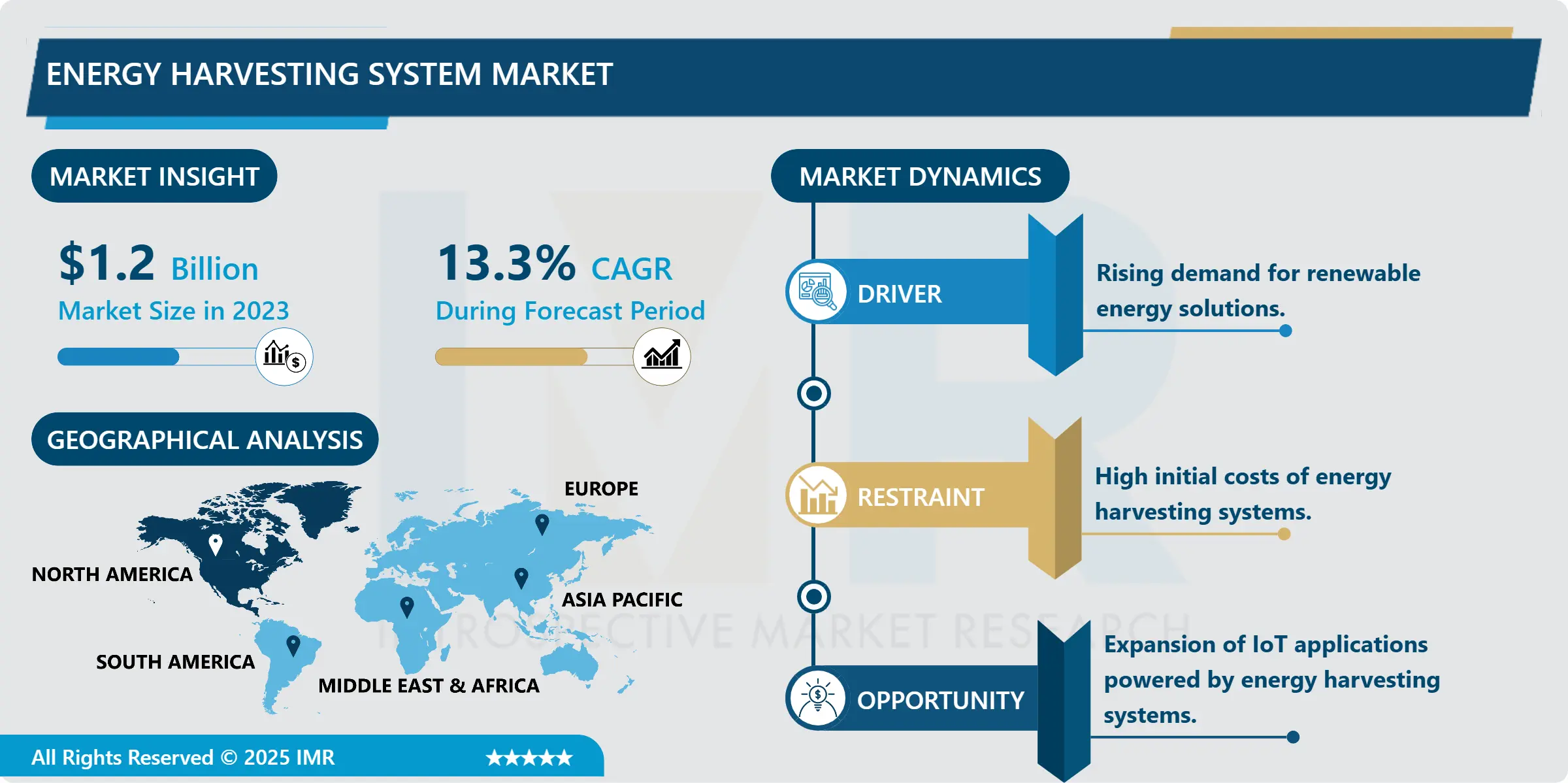
Energy Harvesting System Market Size Was Valued at USD 1.2 Billion in 2023, and is Projected to Reach USD 3.69 Billion by 2032, Growing at a CAGR of 13.3 % From 2024-2032.

IMR Group
Description
Energy Harvesting System Market Synopsis:
Energy Harvesting System Market Size Was Valued at USD 1.2 Billion in 2023, and is Projected to Reach USD 3.69 Billion by 2032, Growing at a CAGR of 13.3 % From 2024-2032.
Energy Harvesting System Market is defined here as the process by which energy can be collected from natural or man-made sources including light heat vibration or electromagnetic field and its conversion to electrical energy which can then be used in powering devices. They are becoming increasingly used for sustainable energy systems using renewable energy to reduce reliance on typical battery power and grids.
Energy harvesting is a rapidly growing market because of the growing awareness for the need for sustainability and the shift towards green energy. There is an increased emphasis on decreasing an organisation’s carbon footprint, and EH solutions offer a tangible option for power supply. Besides the energy efficiency, these systems play a crucial role in supporting IoT devices, sensors, wearables and other applications requiring continuous use and never-ending batteries or reliance on the power grid. This trend is important especially in Industrial and consumer electronics applications because efficacy in energy consumption is paramount.
Smart cities, more incorporation of the IoT also add to the development of energy harvesting systems. Adoption of renewable sources of energy and government policies that have contracted environmental pollution have continued to bolster the adoption. The market is aided by newly developed material and technology for energy conversion systems that making these systems relatively cheaper and available to more users.
Energy Harvesting System Market Trend Analysis:
Increasing Integration with IoT Solutions
The increasing integration of energy harvesting systems with Internet of Things (IoT) solutions is a key driver of market growth. As IoT applications expand across industrial automation, smart homes, healthcare, and transportation, the demand for self-powered, maintenance-free devices is rising. Energy harvesting systems enable IoT sensors and devices to operate independently of external power sources by converting ambient energy, such as light, heat, or vibration, into usable electrical energy. This not only reduces the need for battery replacements but also supports the sustainable and scalable deployment of IoT networks.
As businesses prioritize energy efficiency and operational reliability, energy harvesting presents a compelling value proposition. The convergence of IoT with energy harvesting technologies is therefore accelerating innovation and adoption across sectors, creating new opportunities for stakeholders in the global energy harvesting system market.
Advancements in Light Energy Harvesting Technologies
The Energy Harvesting System market is rapidly evolving, driven by significant advancements in light energy harvesting technologies. Innovations in photovoltaic materials, such as perovskite and organic solar cells, have enhanced efficiency and flexibility, enabling energy capture from diverse light sources, including indoor and low-intensity environments.
These improvements reduce dependency on traditional power supplies, making devices more sustainable and self-sufficient. Additionally, integration of light harvesting components into wearable electronics, IoT devices, and smart sensors is expanding their practical applications across industries. Enhanced durability, miniaturization, and cost-effectiveness of these technologies further accelerate market adoption. As businesses seek greener and more autonomous power solutions, advancements in light energy harvesting position the market for substantial growth, unlocking new opportunities in consumer electronics, healthcare, and industrial automation sectors worldwide.
Energy Harvesting System Market Segment Analysis:
Energy Harvesting System Market Segmented on the basis of Technology, Application, and Region
By Technology, the Light energy harvesting segment is expected to dominate the market during the forecast period
The Energy Harvesting System market is a rapidly evolving segment within the broader renewable energy and smart device ecosystem. Among the various energy sources, the light energy harvesting segment is anticipated to dominate the market during the forecast period. This growth is driven by increasing demand for sustainable power solutions in wireless sensor networks, IoT devices, and consumer electronics. Light energy harvesting, particularly through photovoltaic cells, enables low-maintenance and long-term power generation from ambient light sources, both indoors and outdoors.
Technological advancements in miniaturized solar panels and energy-efficient circuits further enhance adoption across sectors such as building automation, automotive, and industrial monitoring. The shift toward energy-autonomous systems, coupled with regulatory emphasis on green energy, positions light energy harvesting as a key contributor to the expansion of the global energy harvesting system market.
By Application, the Consumer electronics segment expected to held the largest share
The Energy Harvesting System market is a rapidly growing segment driven by the increasing demand for sustainable and self-powered technologies. Among its various applications, the consumer electronics segment is anticipated to hold the largest market share. This growth is primarily attributed to the rising adoption of wearable devices, smart home technologies, and IoT-enabled gadgets that require low-power, maintenance-free energy sources.
Energy harvesting enables these devices to function efficiently without relying on traditional batteries, thereby extending their operational life and reducing environmental impact. Advancements in miniaturized energy harvesting components, coupled with growing consumer preference for wireless and portable electronics, further fuel market expansion. As manufacturers prioritize energy-efficient and eco-friendly solutions, the integration of energy harvesting systems into consumer electronics is expected to remain a key driver of market growth in the coming years.
Energy Harvesting System Market Regional Insights:
North America is Expected to Dominate the Market Over the Forecast period
North America is expected to remain dominant in the Energy Harvesting System Market and contribute to the majority of worldwide sales. It has been superimposed that the region has adopted several hi-tech technologies within a short span and contains a pool of core market members. Smart homes or application-based energy harvesting systems are most widely implemented in the United States with energy fields like industrial automation an IoT technology. Also, incentives from the government as well as the funding in support of more sustainable energy projects have established a proper market ground.
Environmental media adopted by the region, inclusive of the early embrace of renewable energy systems, are putting pressure on energy harvesting systems. Advancements in material science and energy conversion technologies are also serving to support the market. Higher sensitivity towards energy consumption and pollution issues should further enhance North American dominance in energy harvesting technology deployment.
Active Key Players in the Energy Harvesting System Market
ABB Ltd. (Switzerland)
Analog Devices, Inc. (USA)
Cymbet Corporation (USA)
EnOcean GmbH (Germany)
Fujitsu Limited (Japan)
Honeywell International Inc. (USA)
Maxim Integrated Products, Inc. (USA)
Microchip Technology Inc. (USA)
Powercast Corporation (USA)
Qorvo, Inc. (USA)
Schneider Electric SE (France)
STMicroelectronics (Switzerland)
Texas Instruments Incorporated (USA)
Toshiba Corporation (Japan)
Voltree Power Inc. (USA)
Other Active Players
Chapter 1: Introduction
1.1 Scope and Coverage
Chapter 2:Executive Summary
Chapter 3: Market Landscape
3.1 Market Dynamics
3.1.1 Drivers
3.1.2 Restraints
3.1.3 Opportunities
3.1.4 Challenges
3.2 Market Trend Analysis
3.3 PESTLE Analysis
3.4 Porter’s Five Forces Analysis
3.5 Industry Value Chain Analysis
3.6 Ecosystem
3.7 Regulatory Landscape
3.8 Price Trend Analysis
3.9 Patent Analysis
3.10 Technology Evolution
3.11 Investment Pockets
3.12 Import-Export Analysis
Chapter 4: Energy Harvesting System Market by Technology
4.1 Energy Harvesting System Market Snapshot and Growth Engine
4.2 Energy Harvesting System Market Overview
4.3 Light Energy Harvesting Vibration Energy Harvesting Thermal Energy Harvesting RF Energy Harvesting
4.3.1 Introduction and Market Overview
4.3.2 Historic and Forecasted Market Size in Value USD and Volume Units (2017-2032F)
4.3.3 Key Market Trends, Growth Factors and Opportunities
4.3.4 Light Energy Harvesting Vibration Energy Harvesting Thermal Energy Harvesting RF Energy Harvesting: Geographic Segmentation Analysis
Chapter 5: Energy Harvesting System Market by Application
5.1 Energy Harvesting System Market Snapshot and Growth Engine
5.2 Energy Harvesting System Market Overview
5.3 Consumer Electronics Building and Home Automation Industrial
5.3.1 Introduction and Market Overview
5.3.2 Historic and Forecasted Market Size in Value USD and Volume Units (2017-2032F)
5.3.3 Key Market Trends, Growth Factors and Opportunities
5.3.4 Consumer Electronics Building and Home Automation Industrial: Geographic Segmentation Analysis
5.4 Transportation Other
5.4.1 Introduction and Market Overview
5.4.2 Historic and Forecasted Market Size in Value USD and Volume Units (2017-2032F)
5.4.3 Key Market Trends, Growth Factors and Opportunities
5.4.4 Transportation Other: Geographic Segmentation Analysis
Chapter 6: Company Profiles and Competitive Analysis
6.1 Competitive Landscape
6.1.1 Competitive Benchmarking
6.1.2 Energy Harvesting System Market Share by Manufacturer (2023)
6.1.3 Industry BCG Matrix
6.1.4 Heat Map Analysis
6.1.5 Mergers and Acquisitions
6.2 ABB LTD. (SWITZERLAND)
6.2.1 Company Overview
6.2.2 Key Executives
6.2.3 Company Snapshot
6.2.4 Role of the Company in the Market
6.2.5 Sustainability and Social Responsibility
6.2.6 Operating Business Segments
6.2.7 Product Portfolio
6.2.8 Business Performance
6.2.9 Key Strategic Moves and Recent Developments
6.2.10 SWOT Analysis
6.3 ANALOG DEVICES INC. (USA)
6.4 CYMBET CORPORATION (USA)
6.5 ENOCEAN GMBH (GERMANY)
6.6 FUJITSU LIMITED (JAPAN)
6.7 HONEYWELL INTERNATIONAL INC. (USA)
6.8 MAXIM INTEGRATED PRODUCTS INC. (USA)
6.9 MICROCHIP TECHNOLOGY INC. (USA)
6.10 POWERCAST CORPORATION (USA)
6.11 QORVO INC. (USA)
6.12 SCHNEIDER ELECTRIC SE (FRANCE)
6.13 STMICROELECTRONICS (SWITZERLAND)
6.14 TEXAS INSTRUMENTS INCORPORATED (USA)
6.15 TOSHIBA CORPORATION (JAPAN)
6.16 VOLTREE POWER INC. (USA)
6.17 OTHER ACTIVE PLAYERS
Chapter 7: Global Energy Harvesting System Market By Region
7.1 Overview
7.2. North America Energy Harvesting System Market
7.2.1 Key Market Trends, Growth Factors and Opportunities
7.2.2 Top Key Companies
7.2.3 Historic and Forecasted Market Size by Segments
7.2.4 Historic and Forecasted Market Size By Technology
7.2.4.1 Light Energy Harvesting Vibration Energy Harvesting Thermal Energy Harvesting RF Energy Harvesting
7.2.5 Historic and Forecasted Market Size By Application
7.2.5.1 Consumer Electronics Building and Home Automation Industrial
7.2.5.2 Transportation Other
7.2.6 Historic and Forecast Market Size by Country
7.2.6.1 US
7.2.6.2 Canada
7.2.6.3 Mexico
7.3. Eastern Europe Energy Harvesting System Market
7.3.1 Key Market Trends, Growth Factors and Opportunities
7.3.2 Top Key Companies
7.3.3 Historic and Forecasted Market Size by Segments
7.3.4 Historic and Forecasted Market Size By Technology
7.3.4.1 Light Energy Harvesting Vibration Energy Harvesting Thermal Energy Harvesting RF Energy Harvesting
7.3.5 Historic and Forecasted Market Size By Application
7.3.5.1 Consumer Electronics Building and Home Automation Industrial
7.3.5.2 Transportation Other
7.3.6 Historic and Forecast Market Size by Country
7.3.6.1 Russia
7.3.6.2 Bulgaria
7.3.6.3 The Czech Republic
7.3.6.4 Hungary
7.3.6.5 Poland
7.3.6.6 Romania
7.3.6.7 Rest of Eastern Europe
7.4. Western Europe Energy Harvesting System Market
7.4.1 Key Market Trends, Growth Factors and Opportunities
7.4.2 Top Key Companies
7.4.3 Historic and Forecasted Market Size by Segments
7.4.4 Historic and Forecasted Market Size By Technology
7.4.4.1 Light Energy Harvesting Vibration Energy Harvesting Thermal Energy Harvesting RF Energy Harvesting
7.4.5 Historic and Forecasted Market Size By Application
7.4.5.1 Consumer Electronics Building and Home Automation Industrial
7.4.5.2 Transportation Other
7.4.6 Historic and Forecast Market Size by Country
7.4.6.1 Germany
7.4.6.2 UK
7.4.6.3 France
7.4.6.4 The Netherlands
7.4.6.5 Italy
7.4.6.6 Spain
7.4.6.7 Rest of Western Europe
7.5. Asia Pacific Energy Harvesting System Market
7.5.1 Key Market Trends, Growth Factors and Opportunities
7.5.2 Top Key Companies
7.5.3 Historic and Forecasted Market Size by Segments
7.5.4 Historic and Forecasted Market Size By Technology
7.5.4.1 Light Energy Harvesting Vibration Energy Harvesting Thermal Energy Harvesting RF Energy Harvesting
7.5.5 Historic and Forecasted Market Size By Application
7.5.5.1 Consumer Electronics Building and Home Automation Industrial
7.5.5.2 Transportation Other
7.5.6 Historic and Forecast Market Size by Country
7.5.6.1 China
7.5.6.2 India
7.5.6.3 Japan
7.5.6.4 South Korea
7.5.6.5 Malaysia
7.5.6.6 Thailand
7.5.6.7 Vietnam
7.5.6.8 The Philippines
7.5.6.9 Australia
7.5.6.10 New Zealand
7.5.6.11 Rest of APAC
7.6. Middle East & Africa Energy Harvesting System Market
7.6.1 Key Market Trends, Growth Factors and Opportunities
7.6.2 Top Key Companies
7.6.3 Historic and Forecasted Market Size by Segments
7.6.4 Historic and Forecasted Market Size By Technology
7.6.4.1 Light Energy Harvesting Vibration Energy Harvesting Thermal Energy Harvesting RF Energy Harvesting
7.6.5 Historic and Forecasted Market Size By Application
7.6.5.1 Consumer Electronics Building and Home Automation Industrial
7.6.5.2 Transportation Other
7.6.6 Historic and Forecast Market Size by Country
7.6.6.1 Turkiye
7.6.6.2 Bahrain
7.6.6.3 Kuwait
7.6.6.4 Saudi Arabia
7.6.6.5 Qatar
7.6.6.6 UAE
7.6.6.7 Israel
7.6.6.8 South Africa
7.7. South America Energy Harvesting System Market
7.7.1 Key Market Trends, Growth Factors and Opportunities
7.7.2 Top Key Companies
7.7.3 Historic and Forecasted Market Size by Segments
7.7.4 Historic and Forecasted Market Size By Technology
7.7.4.1 Light Energy Harvesting Vibration Energy Harvesting Thermal Energy Harvesting RF Energy Harvesting
7.7.5 Historic and Forecasted Market Size By Application
7.7.5.1 Consumer Electronics Building and Home Automation Industrial
7.7.5.2 Transportation Other
7.7.6 Historic and Forecast Market Size by Country
7.7.6.1 Brazil
7.7.6.2 Argentina
7.7.6.3 Rest of SA
Chapter 8 Analyst Viewpoint and Conclusion
8.1 Recommendations and Concluding Analysis
8.2 Potential Market Strategies
Chapter 9 Research Methodology
9.1 Research Process
9.2 Primary Research
9.3 Secondary Research
Q1: What would be the forecast period in the Energy Harvesting System Market Research report?
A1: The forecast period in the Energy Harvesting System Market Research Report is 2024-2032.
Q2: Who are the key players in the Energy Harvesting System Market?
A2: ABB Ltd. (Switzerland), Analog Devices, Inc. (USA), Cymbet Corporation (USA), EnOcean GmbH (Germany), Fujitsu Limited (Japan), Honeywell International Inc. (USA), Maxim Integrated Products, Inc. (USA), Microchip Technology Inc. (USA), Powercast Corporation (USA), Qorvo, Inc. (USA), Schneider Electric SE (France), STMicroelectronics (Switzerland), Texas Instruments Incorporated (USA), Toshiba Corporation (Japan), Voltree Power Inc. (USA), and Other Active Players.
Q3: What are the segments of the Energy Harvesting System Market?
A3: The Energy Harvesting System Market is segmented into Technology, Application, and region. By Technology, the market is categorized into Light Energy Harvesting Vibration Energy Harvesting Thermal Energy Harvesting RF Energy Harvesting. By Application, the market is categorized into Consumer Electronics Building and Home Automation Industrial, Transportation Other Applications. By region, it is analyzed across North America (U.S., Canada, Mexico),Eastern Europe (Russia, Bulgaria, The Czech Republic, Hungary, Poland, Romania, Rest of Eastern Europe),Western Europe (Germany, UK, France, Netherlands, Italy, Spain, Rest of Western Europe), Asia Pacific (China, India, Japan, South Korea, Malaysia, Thailand, Vietnam, The Philippines, Australia, New-Zealand, Rest of APAC), Middle East & Africa (Turkiye, Bahrain, Kuwait, Saudi Arabia, Qatar, UAE, Israel, South Africa), South America (Brazil, Argentina, Rest of SA).
Q4: What is the Energy Harvesting System Market?
A4: Energy Harvesting System Market is defined here as the process by which energy can be collected from natural or man-made sources including light heat vibration or electromagnetic field and its conversion to electrical energy which can then be used in powering devices. They are becoming increasingly used for sustainable energy systems using renewable energy to reduce reliance on typical battery power and grids.
Q5: How big is the Energy Harvesting System Market?
A5: Energy Harvesting System Market Size Was Valued at USD 1.2 Billion in 2023, and is Projected to Reach USD 3.69 Billion by 2032, Growing at a CAGR of 13.3% From 2024-2032.
How to Buy a Report from eminsights.jp
On the product page, choose the license you want: Single-User License, Multi-User License or Enterprise License.
If you required report in your native language, then you can click on Translated Report button and fill out the form with report name and language you want, then our team will contact you as soon as possible.
Click the Buy Now button.
You will be redirected to the checkout page. Enter your company details and payment information.
Click Place Order to complete the purchase.
Confirmation: You’ll receive an order confirmation and our team will contact you shortly with your ordered report.
If you have any questions, fill out the contact form below or email us at [email protected].
Thank you for choosing eminsights.jp!