Stay Ahead in Fast-Growing Economies.
Browse Reports Now
Veterinary Antibiotics Market Key Developments, Demand & Forecast Report (2024-2032)
The market for veterinary antibiotics is growing at a healthy rate at the global level due to rising consciousness regarding animal’s health and disease control in animals of production and pets. As the world population grows there is need for higher quality animal products including meat, milk, and eggs. This demand increases the necessity for the mass prescription of feed antibiotics as a means of keeping the stock healthy and disease-free.

IMR Group
Description
Veterinary Antibiotics Market Synopsis
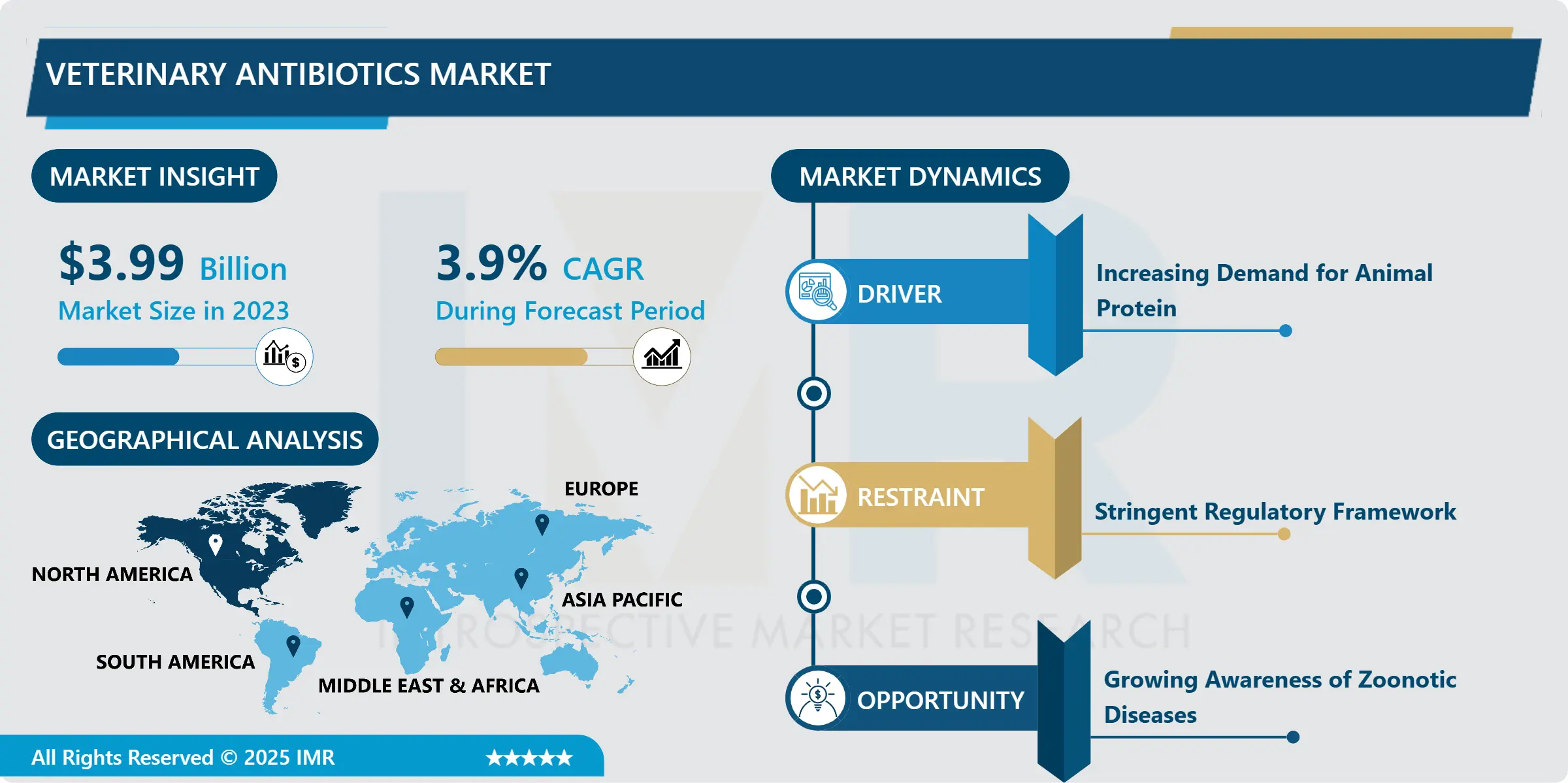
Veterinary Antibiotics Market Size Was Valued at USD 3.99 Billion in 2023, and is Projected to Reach USD 5.63 Billion by 2032, Growing at a CAGR of 3.9 % From 2024-2032.
The veterinary antibiotics market can be defined as that part of the healthcare industry that is involved in the manufacturing and selling of antibiotics that is used to prevent, treat, or control bacterial infections in animals. These antibiotics are useful in maintaining the health of the animals, enhancing the production of livestock, and thus food security to avert disease episodes on farms.
The market for veterinary antibiotics is growing at a healthy rate at the global level due to rising consciousness regarding animal’s health and disease control in animals of production and pets. As the world population grows there is need for higher quality animal products including meat, milk, and eggs. This demand increases the necessity for the mass prescription of feed antibiotics as a means of keeping the stock healthy and disease-free. Moreover, the increase of the number of pets and the development of individual approach to their veterinary needs have also contributed to the increased demand for specific antibiotics for companion animals.
Bureaus and Non-Governmental organizations around the world are also putting measures in place intended for the misuse of antibiotics and in advancing the prudent use of the drugs. This has given birth to better and more effective antibiotics without side effects comparison to the initial one that was discovered. Further, understanding that antibiotic resistance is a global problem, investments made by pharma companies in research and development to fight it are leveraging market expansion. The growth in the services of veterinary, availability of animal health care products in the developing countries also fuel the growth of the market.
Veterinary Antibiotics Market Trend Analysis:
The Shift Toward Injectable and Long-Acting Antibiotics
Another interesting characteristic observed in the current market of veterinary antibiotics is the tendency for growth in the consumption of injectable and long-acting products. These products have the advantage of longer duration of action with in a fewer number of doses which is particularly desirable when used in large animals where repeated treatment is not feasible. Long-acting formulation enhances the adherence to dosage and minimizes the costs of formatting for farmers while providing the comparable therapeutic efficacy. This shift is functional to new drug delivery techniques and a taste towards products that add value to convenience and cost-cutting in animal care services.
Expansion in Emerging Economies
Growth in the veterinary antibiotics market is expected to come from the emerging economies. Urbanization, growing middle class income and the growing relevancy of animal health in these areas is driving demand for veterinary antibiotics. This has resulted to expansion of animal farming practices as well as awareness of zoonotic disease in region like Asia Pacific, Latin America and Africa thus resulting to higher uptake of antibiotics. These markets are being addressed through distribution channels, cheap production and partnerships with local veterinary services by the companies. These functions not only increase the company’s customer portfolio but also increase the density in the growth zones.
Veterinary Antibiotics Market Segment Analysis:
Veterinary Antibiotics Market Segmented on the basis of drug type, dosage form, animal type, and Region.
By Drug Type, Aminoglycosides segment is expected to dominate the market during the forecast period
The market for veterinary antibiotics will find the aminoglycosides segment leading in the coming years of the forecast period. Aminoglycosides which are used extensively in veterinary practice because of their good activity against gram negative organisms and since they possess a broad-spectrum antibacterial activity. They are more suitable in the management of respiratory, gastrointestinal and systemic diseases in both production and companion animals. This has been partly due to the relatively low cost and ready stock of the aminoglycosides from manufacture hence the compliance to the markets both the growth market which is the developing countries and the mature market which is the developed countries. As resistance is still a matter of concern with other antibiotics, aminoglycosides are considered the best one because of its strong site of action.
By Dosage Form, the Powder segment is expected to hold the largest share
The powdered form is expected to dominate the veterinary antibiotics market considering that it was the largest market segment in 2014. Powdered form is distinctly advantageous because it is easily administrable and has multiple uses adopted by most of the veterinarians and farmers. They can either be top dressed in the feeds or added to the water, to ease the administration of feeds to the livestock. This form of delivery is more suitable in large farm tracts which makes individual administration more complicated. On a similar note, powders are cheaper and have a longer shelf life than other formulations, making them suitable for use especially in resource constrained environment.
Veterinary Antibiotics Market Regional Insights:
North America is Expected to Dominate the Market Over the Forecast period
North America has been anticipated to continue its leadership in the veterinary antibiotics market during the course of the forecast period. The region has well-developed animal healthcare services, and consumers have considerable knowledge about animal health services. The largest market is occupied by the United States because of massive production in animal farms and increased popularity of owning pets. Likewise, extremely regulatory measures that have for long addressed the promotion and use of antibiotic in animals as feed additives have promoted research into innovative and precise interventions that are both efficient and safe.
The fact that many prominent international and regional pharmaceutical organizations have their headquarters in North America and that these organizations carry on constant research and development also play a massive role in the market’s expansion there. Some of the measures today aimed at addressing the issue of antibiotic resistance have also given way to latest practices and solutions that foster market developments. The use of high-tech diagnostic methods in the conjunction with antibiotics increases the effectiveness of these treatments and solidifies North America’s leadership in the market.
Active Key Players in the Veterinary Antibiotics Market
Boehringer Ingelheim (Germany)
Ceva Santé Animale (France)
Dechra Pharmaceuticals (United Kingdom)
Elanco Animal Health (United States)
Heska Corporation (United States)
Huvepharma (Bulgaria)
Merck Animal Health (United States)
Norbrook Laboratories (United Kingdom)
Phibro Animal Health Corporation (United States)
Vetoquinol (France)
Virbac (France)
Zoetis (United States)
Bio-Vet (United States)
Neogen Corporation (United States)
Orion Pharma (Finland)
Other Active Players
Chapter 1: Introduction
1.1 Scope and Coverage
Chapter 2:Executive Summary
Chapter 3: Market Landscape
3.1 Market Dynamics
3.1.1 Drivers
3.1.2 Restraints
3.1.3 Opportunities
3.1.4 Challenges
3.2 Market Trend Analysis
3.3 PESTLE Analysis
3.4 Porter’s Five Forces Analysis
3.5 Industry Value Chain Analysis
3.6 Ecosystem
3.7 Regulatory Landscape
3.8 Price Trend Analysis
3.9 Patent Analysis
3.10 Technology Evolution
3.11 Investment Pockets
3.12 Import-Export Analysis
Chapter 4: Veterinary Antibiotics Market by Drug Type
4.1 Veterinary Antibiotics Market Snapshot and Growth Engine
4.2 Veterinary Antibiotics Market Overview
4.3 Antibiotics Antifungal drugs Anti-inflammatory drugs Immunotherapy drugs Parasiticides Others
4.3.1 Introduction and Market Overview
4.3.2 Historic and Forecasted Market Size in Value USD and Volume Units (2017-2032F)
4.3.3 Key Market Trends, Growth Factors and Opportunities
4.3.4 Antibiotics Antifungal drugs Anti-inflammatory drugs Immunotherapy drugs Parasiticides Others: Geographic Segmentation Analysis
Chapter 5: Veterinary Antibiotics Market by Animal Type
5.1 Veterinary Antibiotics Market Snapshot and Growth Engine
5.2 Veterinary Antibiotics Market Overview
5.3 Dogs Cats Horses Others
5.3.1 Introduction and Market Overview
5.3.2 Historic and Forecasted Market Size in Value USD and Volume Units (2017-2032F)
5.3.3 Key Market Trends, Growth Factors and Opportunities
5.3.4 Dogs Cats Horses Others: Geographic Segmentation Analysis
Chapter 6: Veterinary Antibiotics Market by Distribution Channel
6.1 Veterinary Antibiotics Market Snapshot and Growth Engine
6.2 Veterinary Antibiotics Market Overview
6.3 Hospital Pharmacies Retail E-commerce
6.3.1 Introduction and Market Overview
6.3.2 Historic and Forecasted Market Size in Value USD and Volume Units (2017-2032F)
6.3.3 Key Market Trends, Growth Factors and Opportunities
6.3.4 Hospital Pharmacies Retail E-commerce: Geographic Segmentation Analysis
Chapter 7: Company Profiles and Competitive Analysis
7.1 Competitive Landscape
7.1.1 Competitive Benchmarking
7.1.2 Veterinary Antibiotics Market Share by Manufacturer (2023)
7.1.3 Industry BCG Matrix
7.1.4 Heat Map Analysis
7.1.5 Mergers and Acquisitions
7.2 BOEHRINGER INGELHEIM (GERMANY)
7.2.1 Company Overview
7.2.2 Key Executives
7.2.3 Company Snapshot
7.2.4 Role of the Company in the Market
7.2.5 Sustainability and Social Responsibility
7.2.6 Operating Business Segments
7.2.7 Product Portfolio
7.2.8 Business Performance
7.2.9 Key Strategic Moves and Recent Developments
7.2.10 SWOT Analysis
7.3 CEVA SANTÉ ANIMALE (FRANCE)
7.4 DECHRA PHARMACEUTICALS (UNITED KINGDOM)
7.5 ELANCO ANIMAL HEALTH (UNITED STATES)
7.6 HESKA CORPORATION (UNITED STATES)
7.7 HUVEPHARMA (BULGARIA)
7.8 MERCK ANIMAL HEALTH (UNITED STATES)
7.9 NORBROOK LABORATORIES (UNITED KINGDOM)
7.10 PHIBRO ANIMAL HEALTH CORPORATION (UNITED STATES)
7.11 VETOQUINOL (FRANCE)
7.12 VIRBAC (FRANCE)
7.13 ZOETIS (UNITED STATES)
7.14 BIO-VET (UNITED STATES)
7.15 NEOGEN CORPORATION (UNITED STATES)
7.16 ORION PHARMA (FINLAND)
7.17 OTHER ACTIVE PLAYERS
Chapter 8: Global Veterinary Antibiotics Market By Region
8.1 Overview
8.2. North America Veterinary Antibiotics Market
8.2.1 Key Market Trends, Growth Factors and Opportunities
8.2.2 Top Key Companies
8.2.3 Historic and Forecasted Market Size by Segments
8.2.4 Historic and Forecasted Market Size By Drug Type
8.2.4.1 Antibiotics Antifungal drugs Anti-inflammatory drugs Immunotherapy drugs Parasiticides Others
8.2.5 Historic and Forecasted Market Size By Animal Type
8.2.5.1 Dogs Cats Horses Others
8.2.6 Historic and Forecasted Market Size By Distribution Channel
8.2.6.1 Hospital Pharmacies Retail E-commerce
8.2.7 Historic and Forecast Market Size by Country
8.2.7.1 US
8.2.7.2 Canada
8.2.7.3 Mexico
8.3. Eastern Europe Veterinary Antibiotics Market
8.3.1 Key Market Trends, Growth Factors and Opportunities
8.3.2 Top Key Companies
8.3.3 Historic and Forecasted Market Size by Segments
8.3.4 Historic and Forecasted Market Size By Drug Type
8.3.4.1 Antibiotics Antifungal drugs Anti-inflammatory drugs Immunotherapy drugs Parasiticides Others
8.3.5 Historic and Forecasted Market Size By Animal Type
8.3.5.1 Dogs Cats Horses Others
8.3.6 Historic and Forecasted Market Size By Distribution Channel
8.3.6.1 Hospital Pharmacies Retail E-commerce
8.3.7 Historic and Forecast Market Size by Country
8.3.7.1 Russia
8.3.7.2 Bulgaria
8.3.7.3 The Czech Republic
8.3.7.4 Hungary
8.3.7.5 Poland
8.3.7.6 Romania
8.3.7.7 Rest of Eastern Europe
8.4. Western Europe Veterinary Antibiotics Market
8.4.1 Key Market Trends, Growth Factors and Opportunities
8.4.2 Top Key Companies
8.4.3 Historic and Forecasted Market Size by Segments
8.4.4 Historic and Forecasted Market Size By Drug Type
8.4.4.1 Antibiotics Antifungal drugs Anti-inflammatory drugs Immunotherapy drugs Parasiticides Others
8.4.5 Historic and Forecasted Market Size By Animal Type
8.4.5.1 Dogs Cats Horses Others
8.4.6 Historic and Forecasted Market Size By Distribution Channel
8.4.6.1 Hospital Pharmacies Retail E-commerce
8.4.7 Historic and Forecast Market Size by Country
8.4.7.1 Germany
8.4.7.2 UK
8.4.7.3 France
8.4.7.4 The Netherlands
8.4.7.5 Italy
8.4.7.6 Spain
8.4.7.7 Rest of Western Europe
8.5. Asia Pacific Veterinary Antibiotics Market
8.5.1 Key Market Trends, Growth Factors and Opportunities
8.5.2 Top Key Companies
8.5.3 Historic and Forecasted Market Size by Segments
8.5.4 Historic and Forecasted Market Size By Drug Type
8.5.4.1 Antibiotics Antifungal drugs Anti-inflammatory drugs Immunotherapy drugs Parasiticides Others
8.5.5 Historic and Forecasted Market Size By Animal Type
8.5.5.1 Dogs Cats Horses Others
8.5.6 Historic and Forecasted Market Size By Distribution Channel
8.5.6.1 Hospital Pharmacies Retail E-commerce
8.5.7 Historic and Forecast Market Size by Country
8.5.7.1 China
8.5.7.2 India
8.5.7.3 Japan
8.5.7.4 South Korea
8.5.7.5 Malaysia
8.5.7.6 Thailand
8.5.7.7 Vietnam
8.5.7.8 The Philippines
8.5.7.9 Australia
8.5.7.10 New Zealand
8.5.7.11 Rest of APAC
8.6. Middle East & Africa Veterinary Antibiotics Market
8.6.1 Key Market Trends, Growth Factors and Opportunities
8.6.2 Top Key Companies
8.6.3 Historic and Forecasted Market Size by Segments
8.6.4 Historic and Forecasted Market Size By Drug Type
8.6.4.1 Antibiotics Antifungal drugs Anti-inflammatory drugs Immunotherapy drugs Parasiticides Others
8.6.5 Historic and Forecasted Market Size By Animal Type
8.6.5.1 Dogs Cats Horses Others
8.6.6 Historic and Forecasted Market Size By Distribution Channel
8.6.6.1 Hospital Pharmacies Retail E-commerce
8.6.7 Historic and Forecast Market Size by Country
8.6.7.1 Turkiye
8.6.7.2 Bahrain
8.6.7.3 Kuwait
8.6.7.4 Saudi Arabia
8.6.7.5 Qatar
8.6.7.6 UAE
8.6.7.7 Israel
8.6.7.8 South Africa
8.7. South America Veterinary Antibiotics Market
8.7.1 Key Market Trends, Growth Factors and Opportunities
8.7.2 Top Key Companies
8.7.3 Historic and Forecasted Market Size by Segments
8.7.4 Historic and Forecasted Market Size By Drug Type
8.7.4.1 Antibiotics Antifungal drugs Anti-inflammatory drugs Immunotherapy drugs Parasiticides Others
8.7.5 Historic and Forecasted Market Size By Animal Type
8.7.5.1 Dogs Cats Horses Others
8.7.6 Historic and Forecasted Market Size By Distribution Channel
8.7.6.1 Hospital Pharmacies Retail E-commerce
8.7.7 Historic and Forecast Market Size by Country
8.7.7.1 Brazil
8.7.7.2 Argentina
8.7.7.3 Rest of SA
Chapter 9 Analyst Viewpoint and Conclusion
9.1 Recommendations and Concluding Analysis
9.2 Potential Market Strategies
Chapter 10 Research Methodology
10.1 Research Process
10.2 Primary Research
10.3 Secondary Research
Q1: What would be the forecast period in the Veterinary Antibiotics Market research report?
A1: The forecast period in the Veterinary Antibiotics Market research report is 2024-2032.
Q2: Who are the key players in the Veterinary Antibiotics Market?
A2: Boehringer Ingelheim, Ceva Santé Animale, Dechra Pharmaceuticals, Elanco Animal Health, and Virbac., and Other Active Players.
Q3: What are the segments of the Veterinary Antibiotics Market?
A3: The Veterinary Antibiotics Market is segmented into Drug Type, Dosage Form, Animal Type, and Region. By Drug Type, the market is categorized into Aminoglycosides ß-Lactam Antibiotics Chloramphenicol Fluoroquinolones Glycopeptides Lincosamides Macrolides Polymyxins. By Dosage Form, the market is categorized into Powder Solutions Injections Others. By Animal Type, the market is categorized into Companion Canine Feline Livestock Ovine Porcine Others. By region, it is analyzed across North America (U.S., Canada, Mexico), Eastern Europe (Russia, Bulgaria, The Czech Republic, Hungary, Poland, Romania, Rest of Eastern Europe), Western Europe (Germany, UK, France, The Netherlands, Italy, Spain, Rest of Western Europe), Asia Pacific (China, India, Japan, South Korea, Malaysia, Thailand, Vietnam, The Philippines, Australia, New-Zealand, Rest of APAC), Middle East & Africa (Turkiye, Bahrain, Kuwait, Saudi Arabia, Qatar, UAE, Israel, South Africa), South America (Brazil, Argentina, Rest of SA).
Q4: What is the Veterinary Antibiotics Market?
A4: Veterinary antibiotics market can be defined as that part of the healthcare industry that is involved in the manufacturing and selling of antibiotics that is used to prevent, treat, or control bacterial infections in animals. These antibiotics are useful in maintaining health of the animals, enhancing production of livestock, and thus food security to avert disease episodes on farms.
Q5: How big is the Veterinary Antibiotics Market?
A5: Veterinary Antibiotics Market Size Was Valued at USD 3.99 Billion in 2023, and is Projected to Reach USD 5.63 Billion by 2032, Growing at a CAGR of 3.9 % From 2024-2032.
How to Buy a Report from eminsights.jp
On the product page, choose the license you want: Single-User License, Multi-User License or Enterprise License.
If you required report in your native language, then you can click on Translated Report button and fill out the form with report name and language you want, then our team will contact you as soon as possible.
Click the Buy Now button.
You will be redirected to the checkout page. Enter your company details and payment information.
Click Place Order to complete the purchase.
Confirmation: You’ll receive an order confirmation and our team will contact you shortly with your ordered report.
If you have any questions, fill out the contact form below or email us at [email protected].
Thank you for choosing eminsights.jp!